

Shit Hearing People Say To Me - K-ARTIST

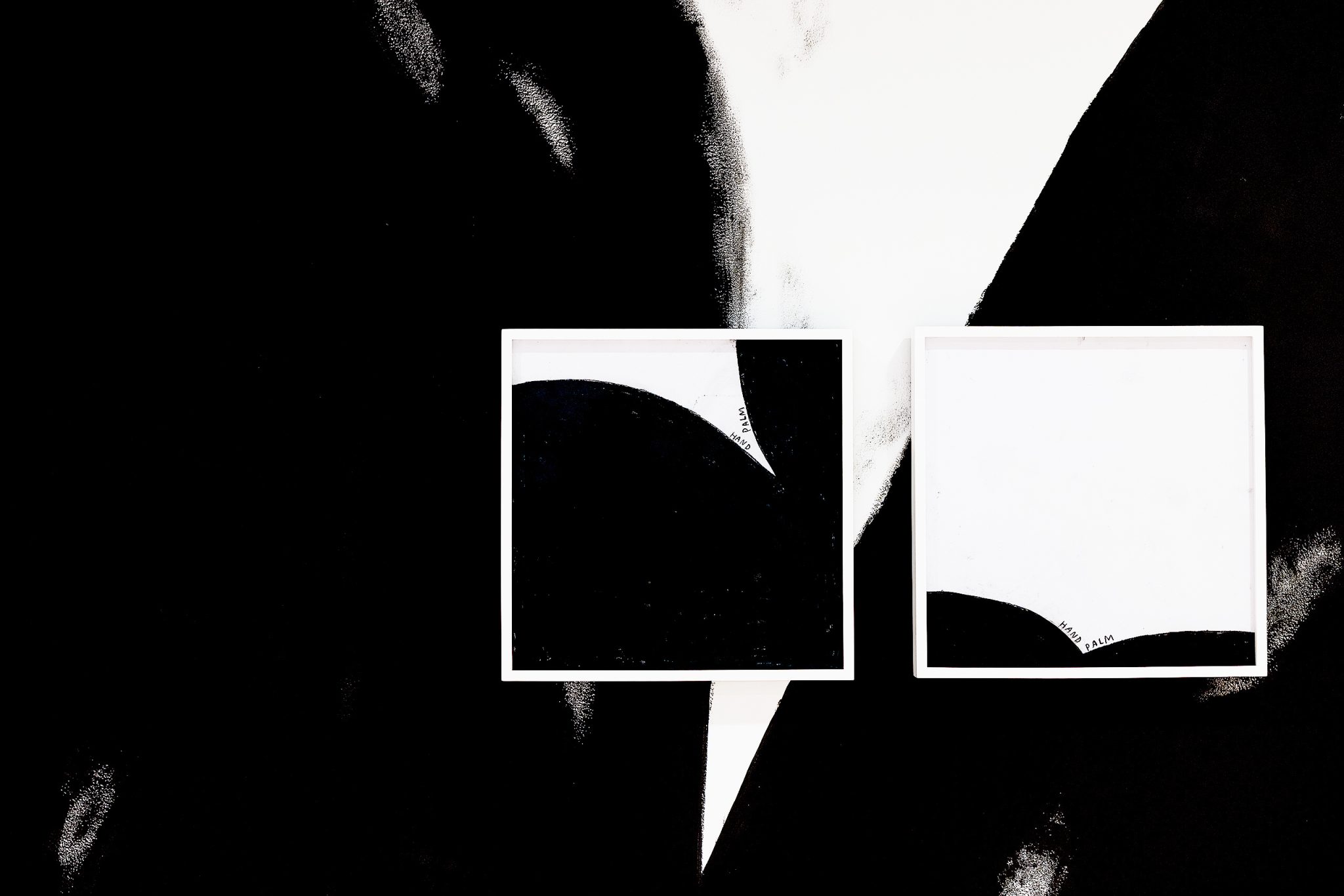
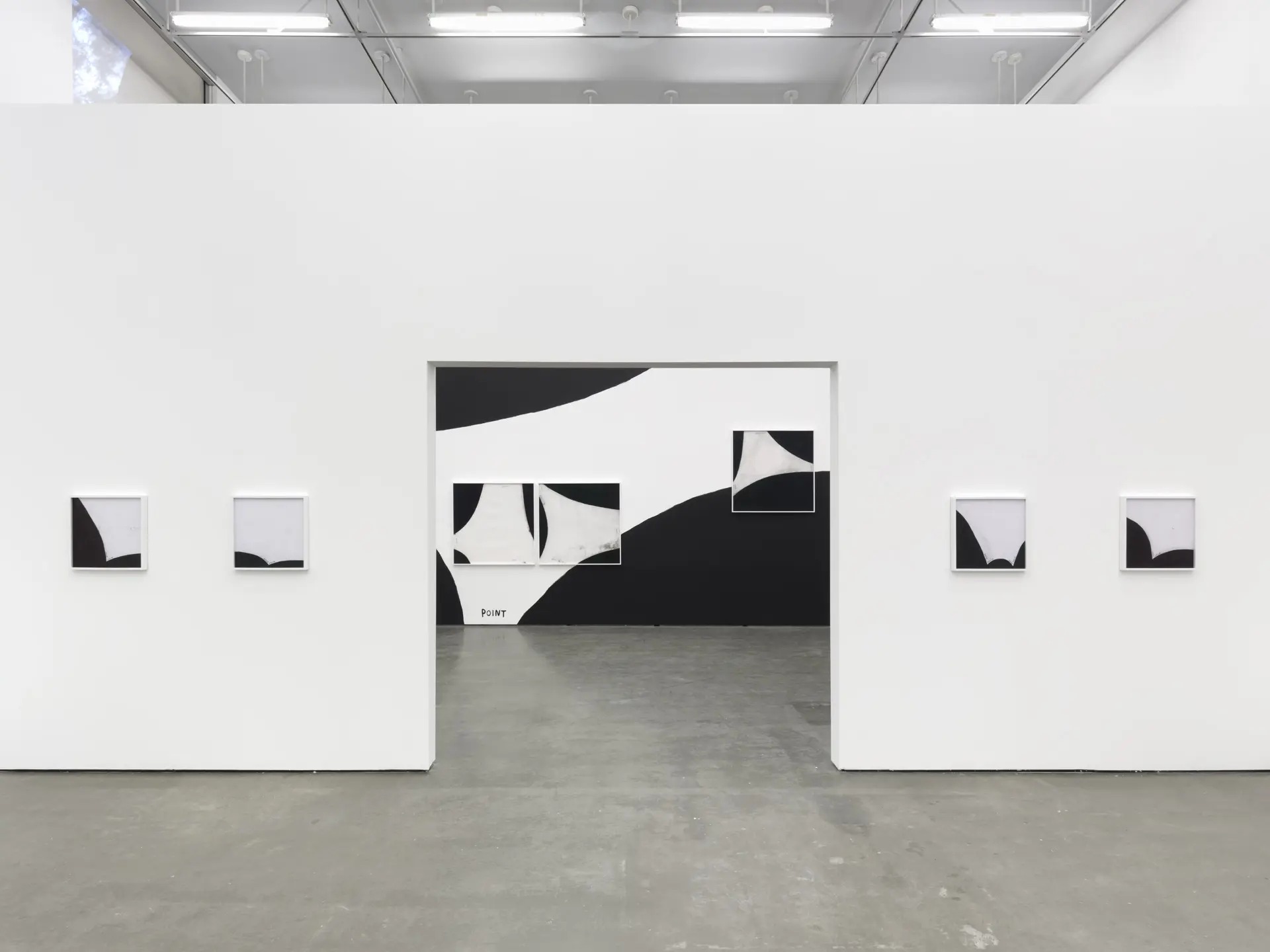
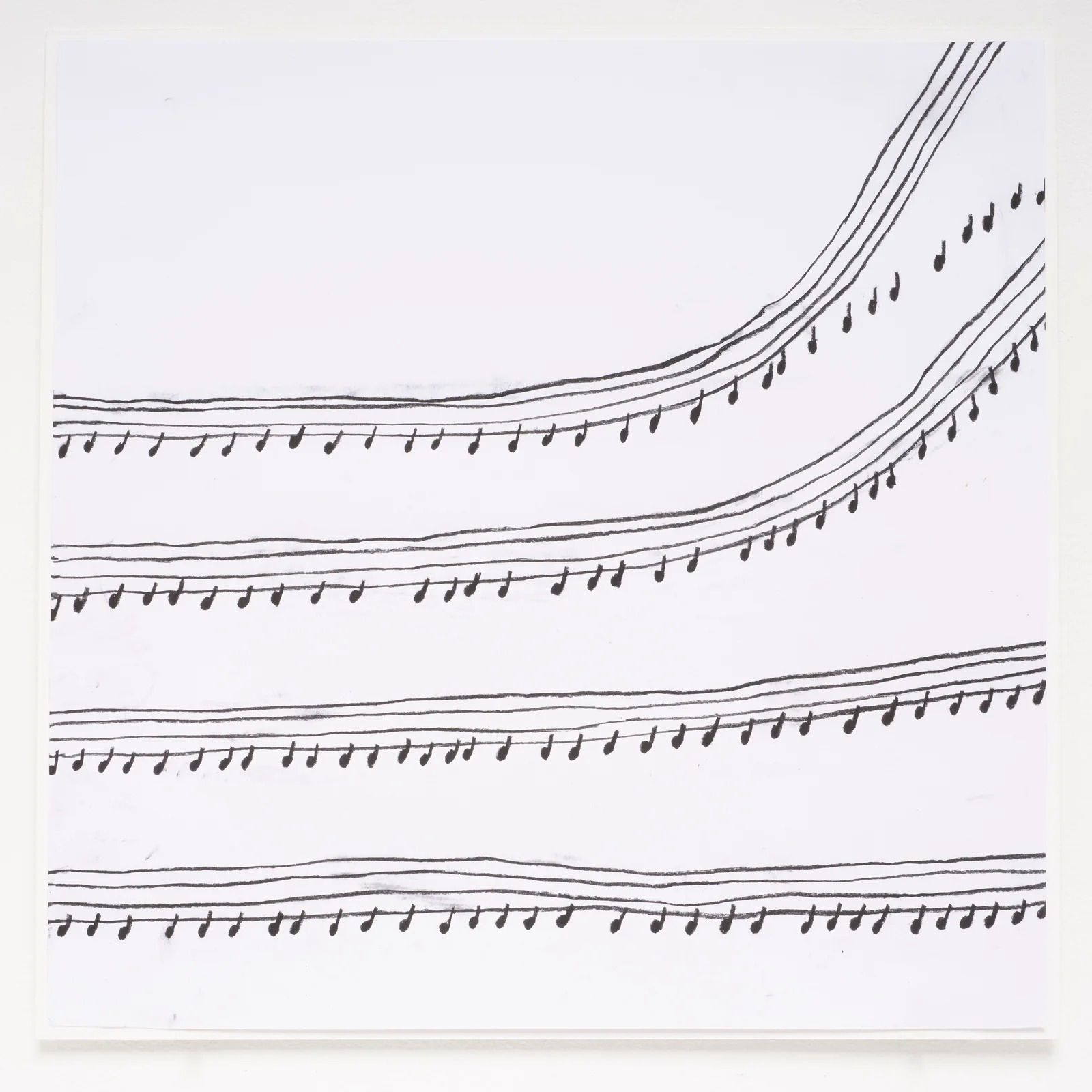
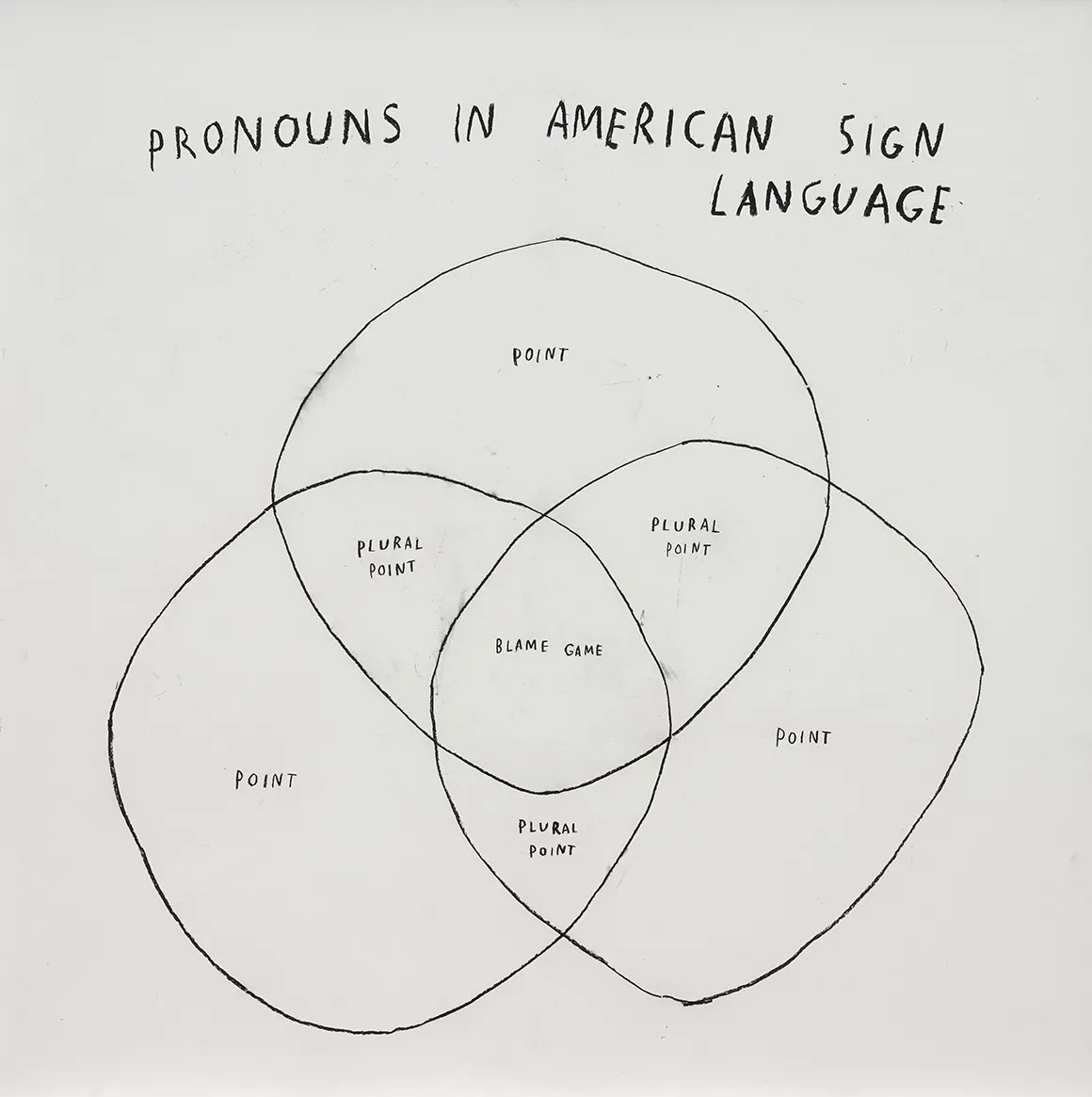
Shit Hearing People Say To Me

2019
Charcoal and oil pastel on paper
125 x 125 cm
About The Work

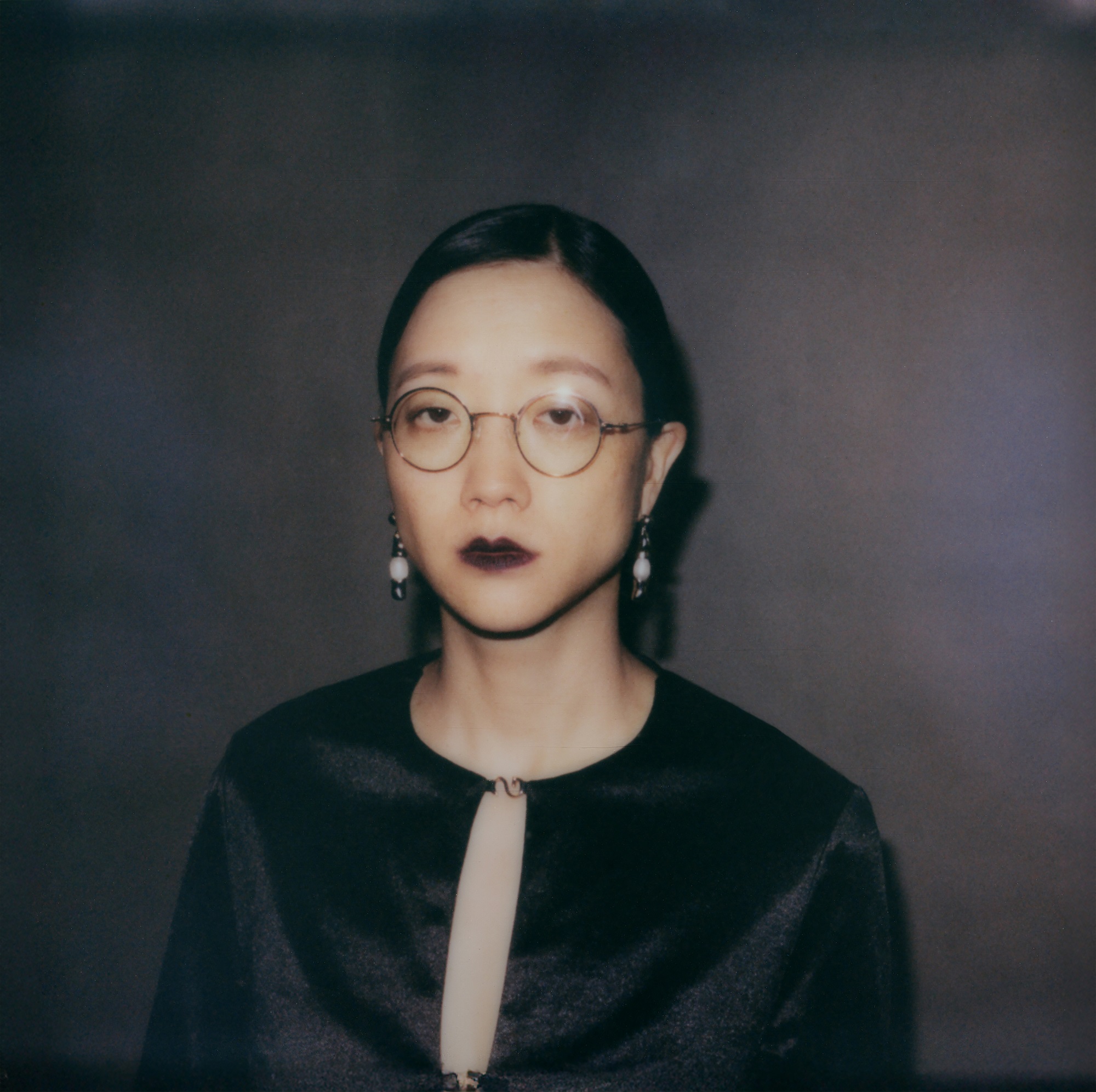
Christine Sun Kim has explored structures of communication and social relations across a range of media, including sound and language, drawing, performance, and video. Her practice considers sound not simply as a physical phenomenon, but as part of a broader social system closely intertwined with power, institutions, and norms.

For Kim, who was born Deaf, sound is not confined to the sensory act of hearing. It is also a system that shapes people’s behavior, determines the scope of access to information, and grants greater social value to particular languages and voices.

Through drawing, graphic notation—a system for translating sound into a visual language—and other media, Kim makes visible the invisible rules of communication and the ways in which language operates, inviting us to reconsider how we relate to the world.

While rooted in the experiences of the Deaf community, her practice expands into broader questions of accessibility and communication. In particular, she presents differences in sensory experience not as deficiencies or limitations, but as conditions that open up new possibilities for perception and relationships.

Ultimately, the questions that run through Kim’s practice extend beyond simply asking what sound is. Her work asks who creates the rules by which the world is organized, whose languages and experiences are recognized as worthy of being heard and seen, and under what conditions people with different sensory experiences and languages can form relationships with one another.

Solo Exhibitions (Brief)

Christine Sun Kim has presented solo exhibitions and projects at Tate Modern, London, in 2016; De Appel, Amsterdam, in 2017; the MIT List Visual Arts Center, Cambridge, in 2020; the Queens Museum, New York, in 2022; the Art Institute of Chicago and Secession, Vienna, in 2023; the Whitney Museum of American Art, New York, and Mori Art Museum, Tokyo, in 2025; and the Walker Art Center, Minneapolis, and the National Museum of Modern and Contemporary Art, Korea, Seoul, in 2026, with further solo exhibitions scheduled at Gallery Hyundai, Seoul, and Mudam Luxembourg – Musée d’Art Moderne Grand-Duc Jean later that year.

Group Exhibitions (Brief)

Christine Sun Kim has participated in group exhibitions and biennials at The Museum of Modern Art, New York, in 2013; MoMA PS1, New York, in 2015; Seoul Museum of Art in 2016; the San Francisco Museum of Modern Art in 2017; the Whitney Museum of American Art, New York, in 2019; MUSEUM MMK FÜR MODERNE KUNST, Frankfurt, in 2021; the Gwangju Biennale in 2023; and Tate Liverpool in 2025, and is scheduled to participate in the NGV Triennial at the National Gallery of Victoria, Melbourne, in 2026.

Awards (Selected)

Christine Sun Kim received the Newhouse Award from the Wynn Newhouse Foundation in 2012, the SeMA-Hana Media Art Award in 2016, and the Prix International d’Art Contemporain of the Fondation Prince Pierre de Monaco in 2022.

Residencies (Selected)

Christine Sun Kim has participated in residencies at the Whitney Museum of American Art’s Youth Insights Program in 2009; the Mellon Tri-College Creative Residency at Haverford College in 2012; Recess, New York, in 2013; Arnolfini, Bristol, and the Visual Arts Center at The University of Texas at Austin in 2015; the Crisp-Ellert Art Museum at Flagler College in 2018; Somerset House, London, in 2022; and the American Academy in Rome in 2025.

Collections (Selected)

Christine Sun Kim’s work is held in the collections of The Museum of Modern Art, New York; the Whitney Museum of American Art; Tate Modern; the National Museum of Modern and Contemporary Art, Korea; the Art Institute of Chicago; the Los Angeles County Museum of Art; The Museum of Contemporary Art, Los Angeles; the Smithsonian American Art Museum; Stedelijk Museum Amsterdam; MUSEUM MMK FÜR MODERNE KUNST; the Walker Art Center; and the Buffalo AKG Art Museum, among others.
Works of Art

New Perceptions and Relations Through Sensory Difference

Originality & Identity

Christine Sun Kim’s practice begins with questioning the social conventions and power relations surrounding “sound.” For Kim, who was born Deaf, sound is not confined to the sensory act of hearing. It is also a system that shapes people’s behavior, determines the scope of access to information, and grants greater social value to particular languages and voices.

Having explored silence, volume, and vibration in her early works, she gradually expanded her inquiry to ask who is authorized to speak, whose language is considered standard, and who determines the rules of communication. This perspective develops into a critical awareness of how spoken language functions as a form of “social currency,” framing sound as something socially and politically constructed.

American Sign Language (ASL), Kim’s first language, serves as a central system of thought through which these concerns unfold. Kim presents it as an autonomous language that produces meaning through distance, direction, bodily movement, facial expression, and space. Discrepancies that arise through interpretation, differences between English and “Deaf English,” and the shifting of one’s voice through the intervention of interpreters recur throughout her work.

Translation here does not culminate in a seamless connection between different languages. Delays, mistranslations, omissions, and frictions that emerge between them are instead revealed as conditions that constitute communication itself. Through these gaps, Kim reconsiders the very ideal of “accurate transmission” and emphasizes that each language organizes the world in distinct ways.

These investigations are closely connected to questions of accessibility. For Kim, accessibility is not simply a matter of adding accommodations to an already established institution after the fact, but a political question concerning whose needs were taken as the standard when information, spaces, and institutions were first designed. In the 'Degrees of Deaf Rage' series, she translates institutional frictions encountered in museums, education, travel, and interpretation into degrees and angles of rage.

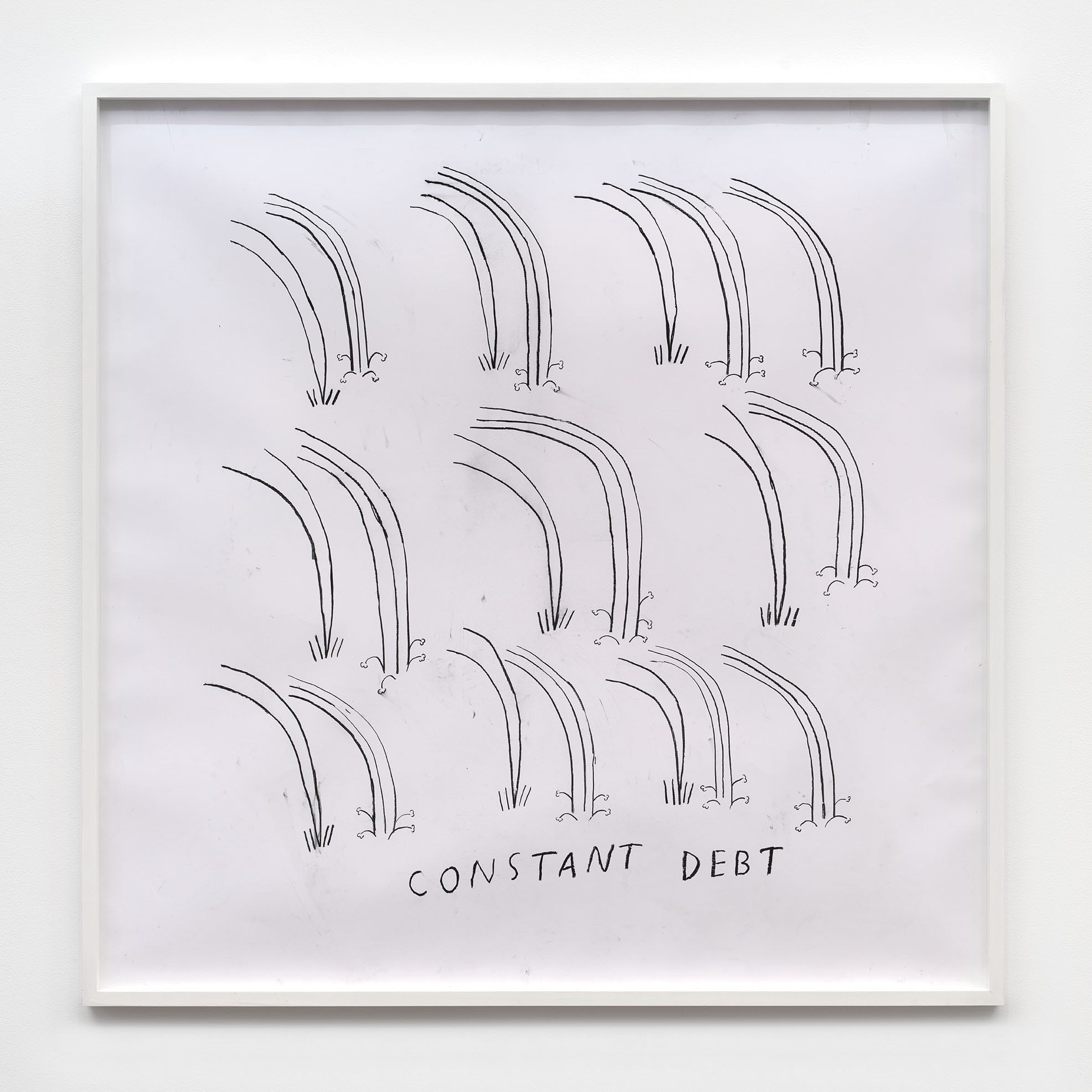
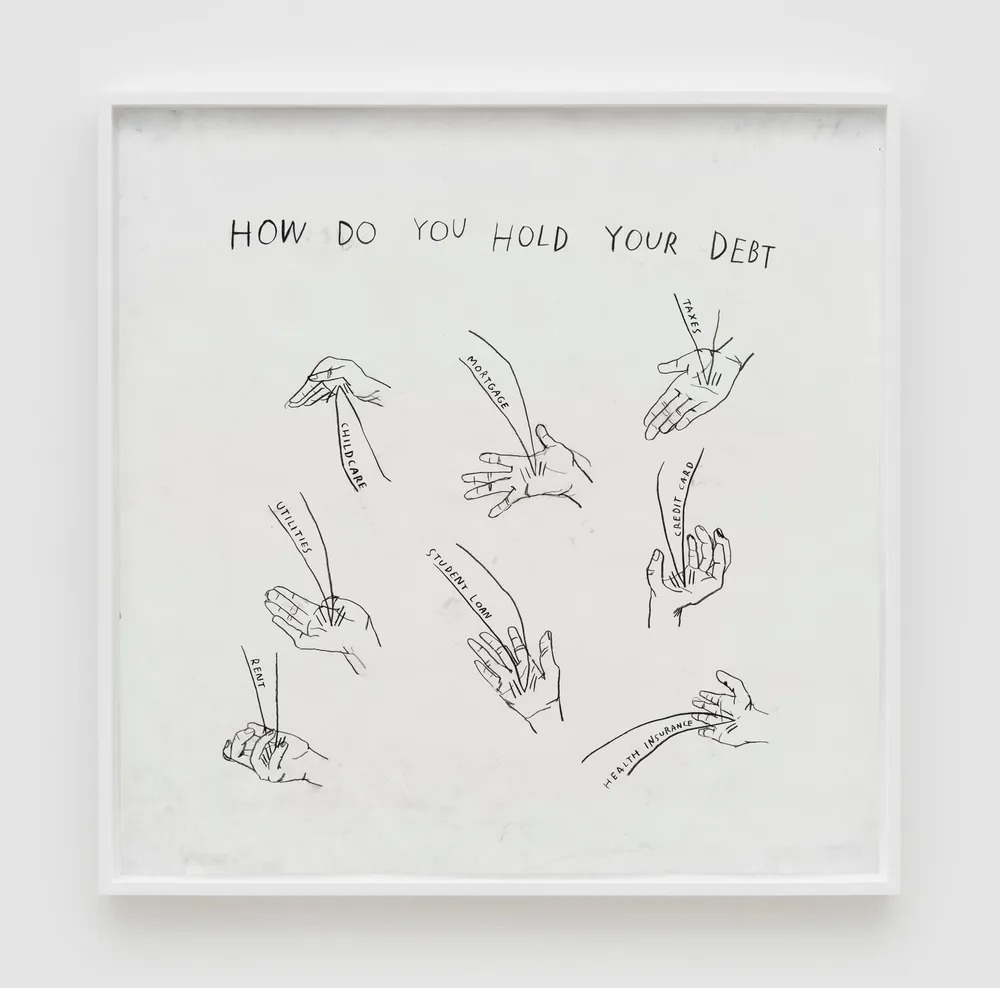
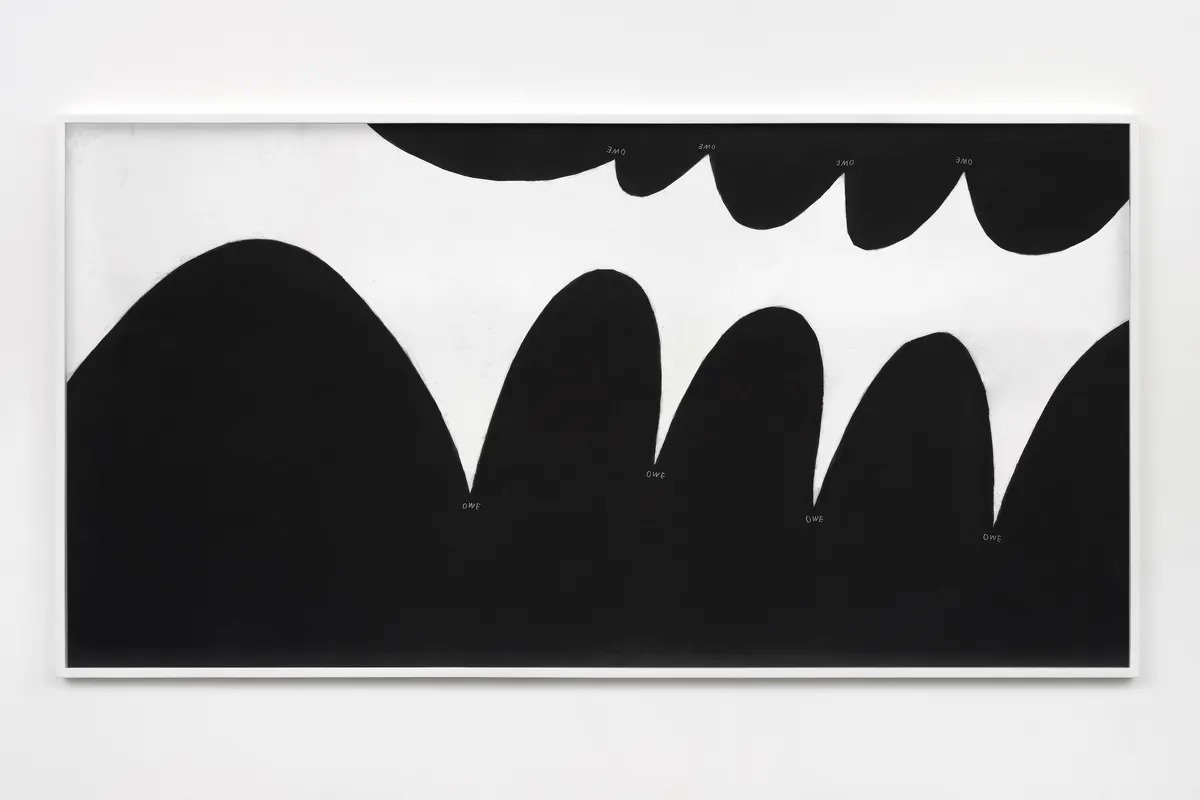
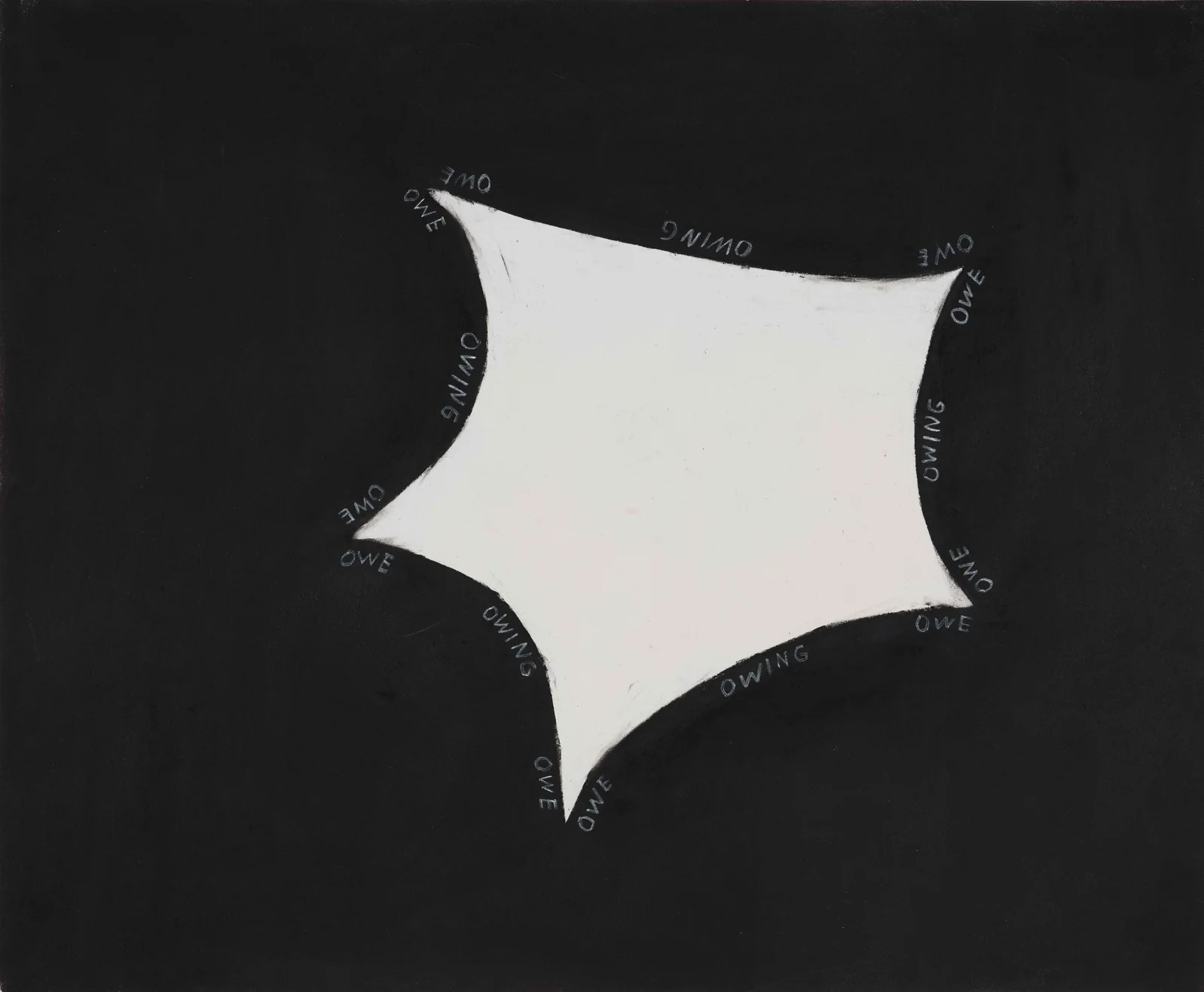
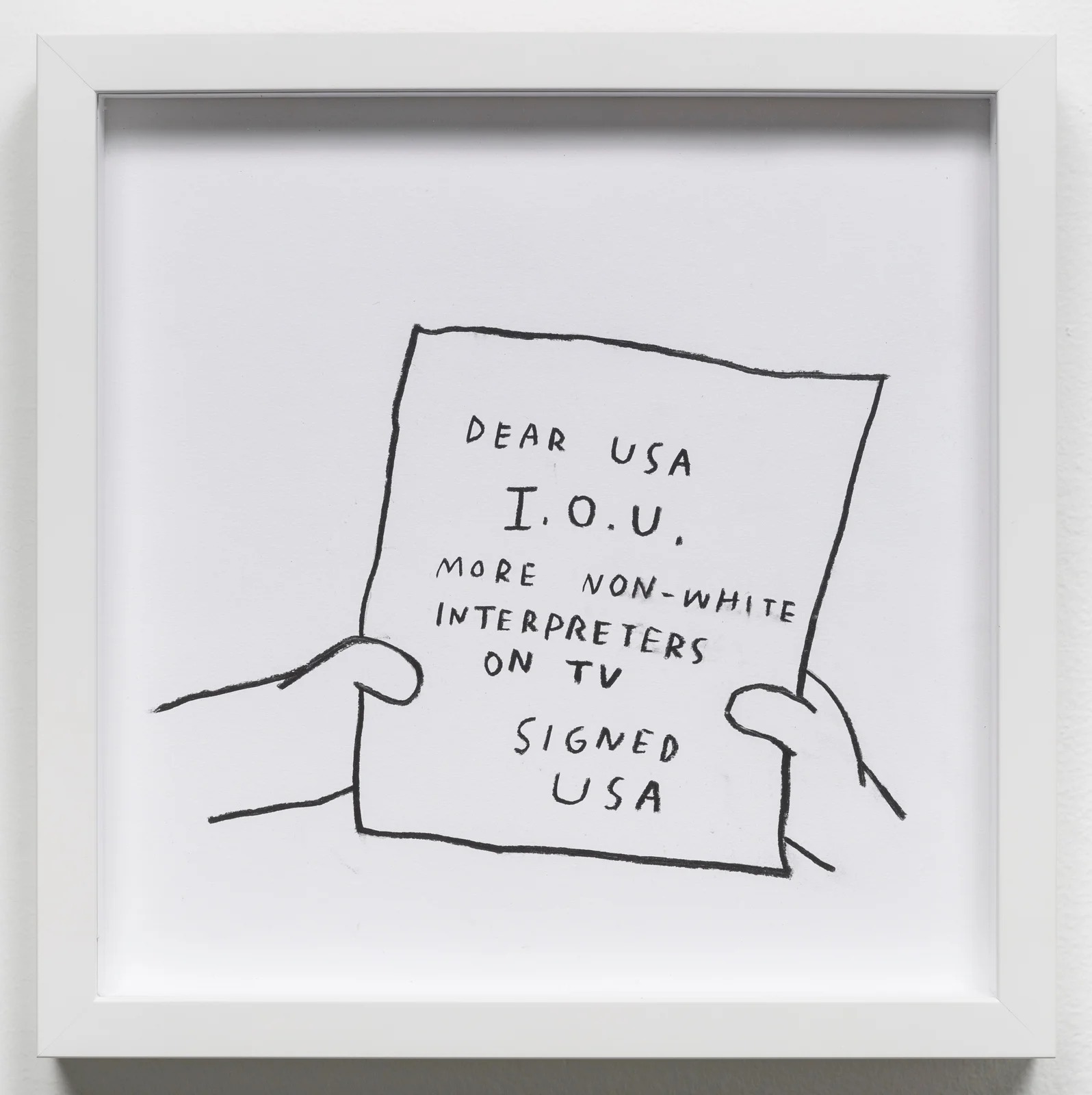
In works concerning debt, including How Do You Hold Your Debt, she extends the issue from the financial burdens carried by individuals to the historical debts that American society owes to Deaf labor and technological contributions. The dry, incisive humor that runs throughout her practice prevents such critiques from becoming straightforward denunciations.

By twisting familiar language and social conventions, Kim prompts viewers to reconsider systems of communication they have long taken for granted. This is also why her engagement with disability, accessibility, and institutional power does not resolve into a single didactic message.

In recent years, these concerns have expanded further to encompass the future, family, motherhood, climate and political anxiety, community, and social debt. In Too Much Future, the future emerges as a site onto which anxiety and optimism are simultaneously projected, while works concerning family and children ask whether care belongs to the individual or can be practiced relationally and collectively.

In this sense, Kim’s experience as a Deaf person forms both a point of departure for her practice and a situated position from which she interprets the world. At the same time, it continues to evolve through her accumulated experiences as a Korean American, a woman, a parent, and an artist.

Ultimately, the questions running through Kim’s work extend beyond what sound is to ask who establishes the rules of the world, whose languages and experiences are made audible and visible, and under what conditions people with different sensory and linguistic experiences can enter into relationships with one another.

Style & Contents

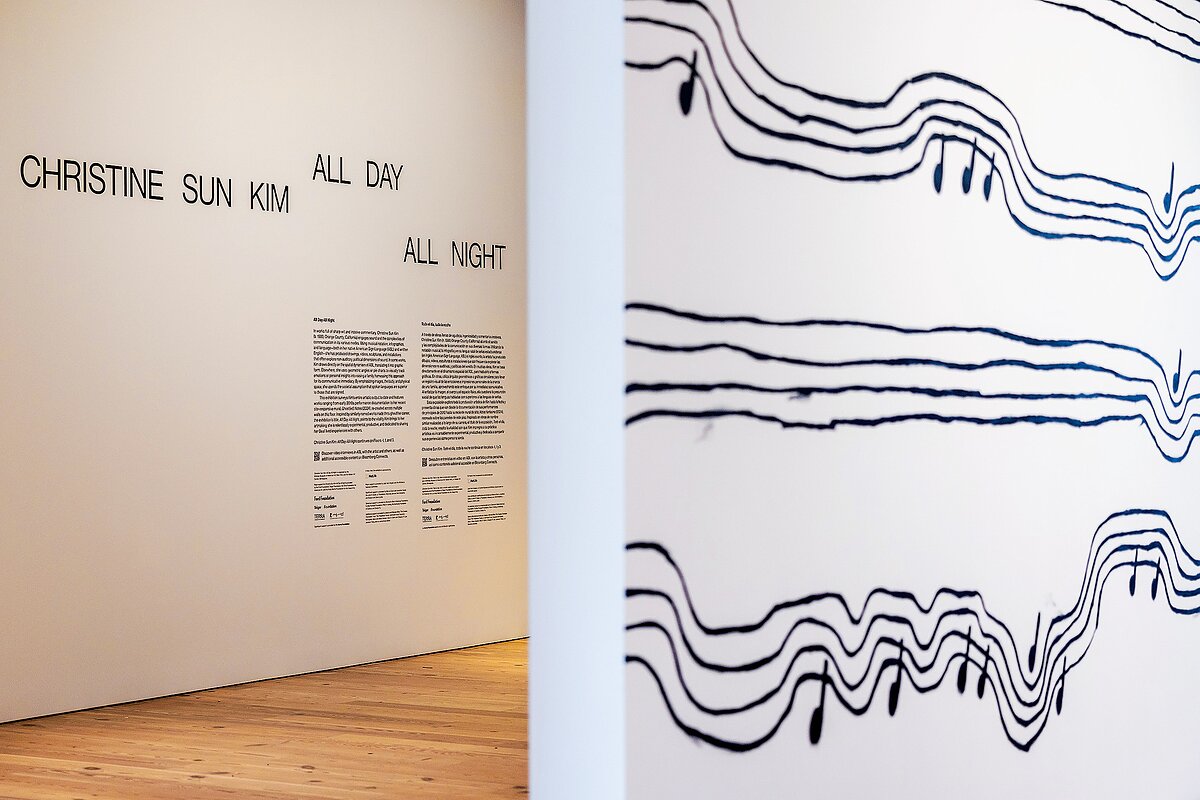
Christine Sun Kim’s practice spans drawing, video, sound, performance, sculpture, murals, and public art, with drawing serving as a persistent foundation. Central to her work is the use of lines, text, and symbols to record movement, time, intensity, and relationships. In her early “speaker drawings,” Kim placed paper or wood with ink on vibrating speakers, registering sound as physical movement.

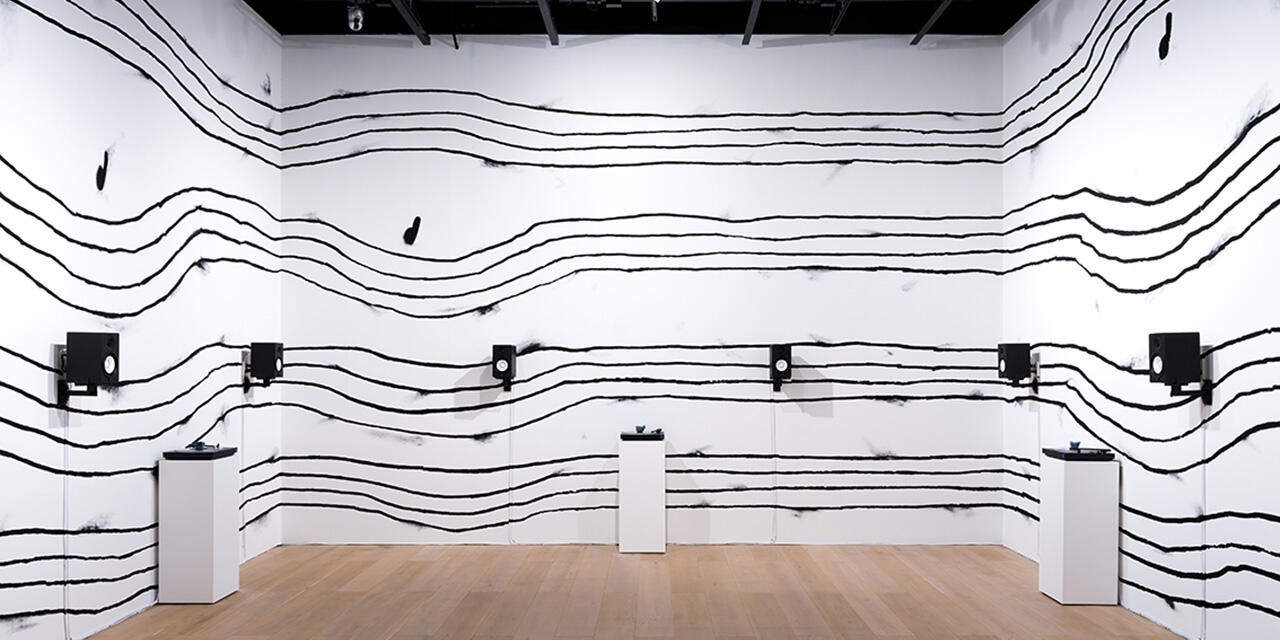
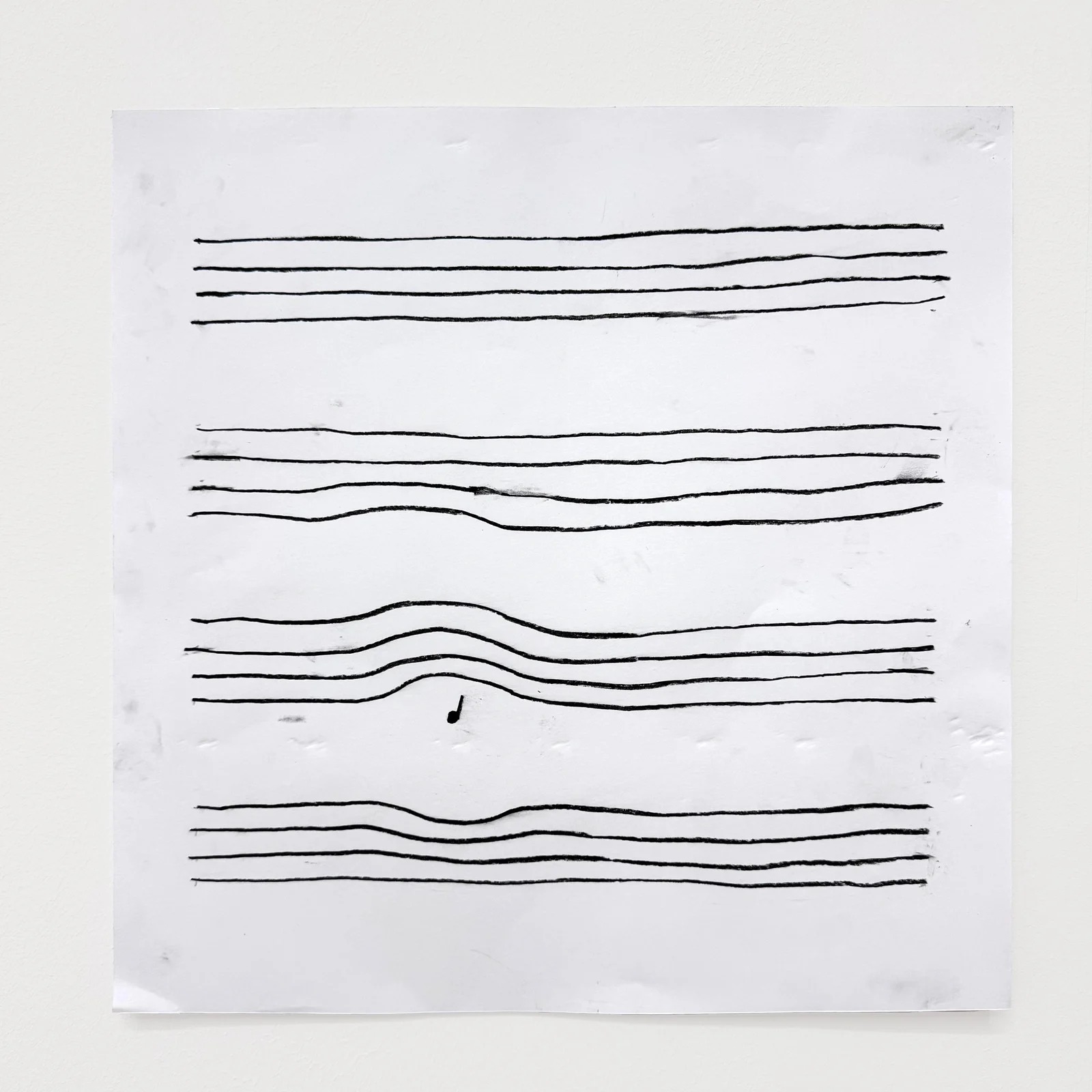
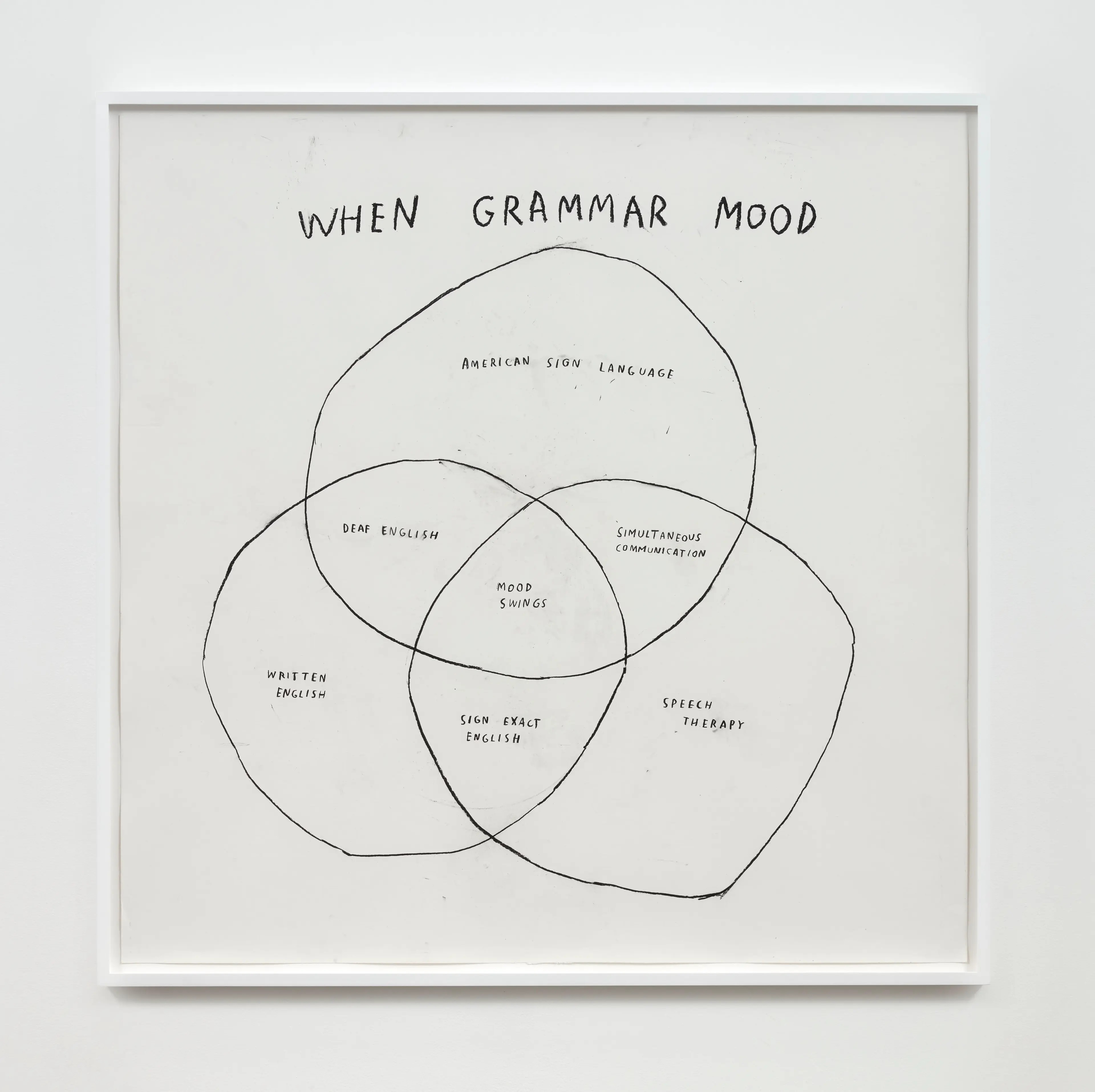
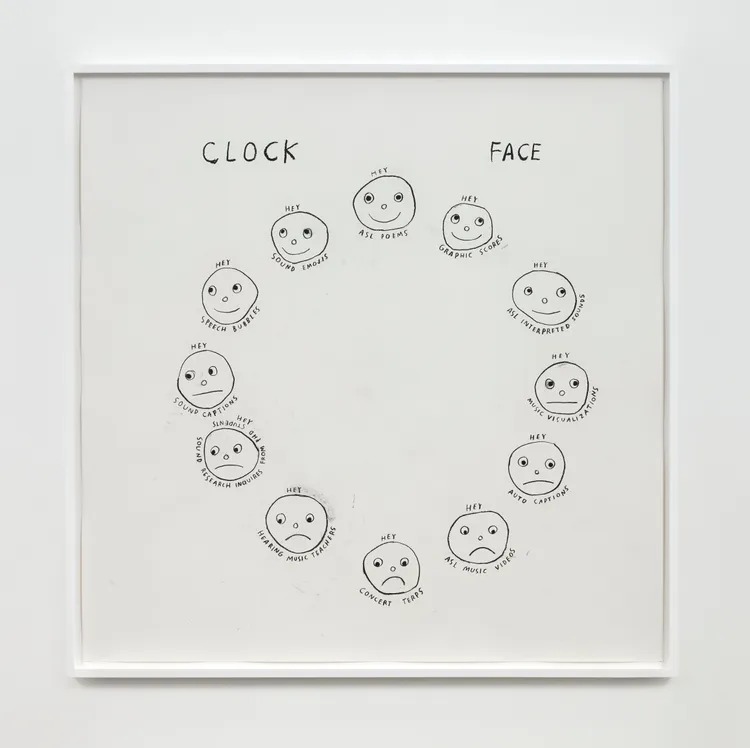
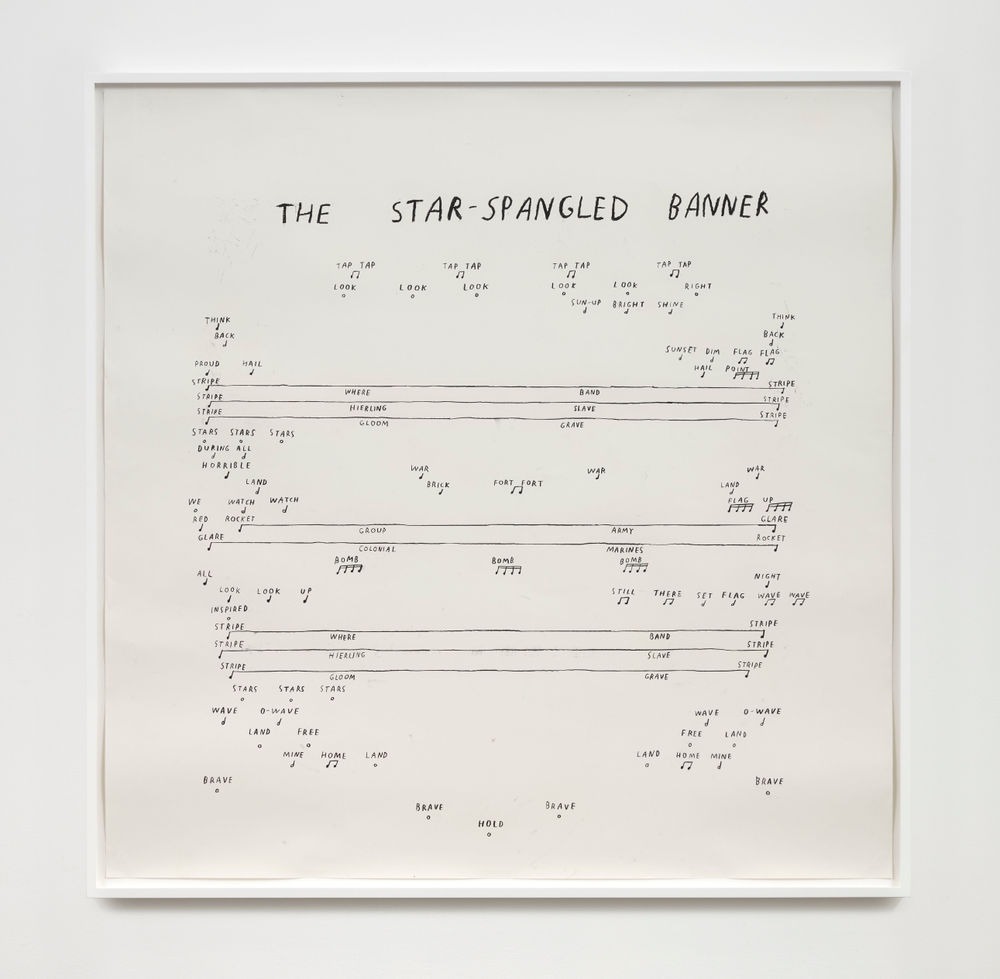
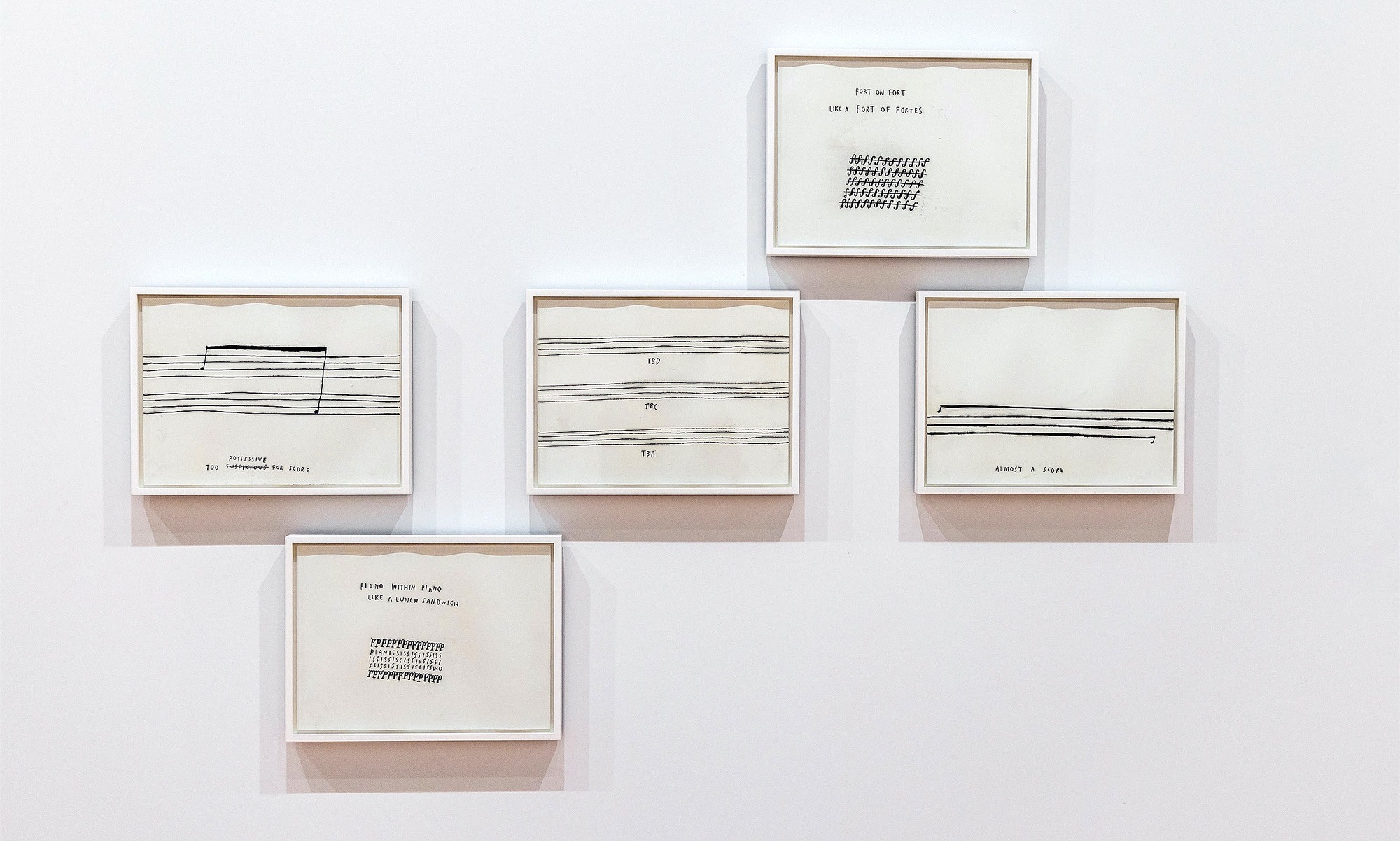
She later began actively appropriating graphic systems conventionally used to transmit information, including musical staff lines and dynamic markings, decibel scales, pie charts, and Venn diagrams. Rather than retaining their original functions, these symbols are transformed as they come to carry the artist’s own experiences and language.

By inserting subjective and complex subjects such as emotion, rage, debt, and social relationships into diagrams that appear to communicate objective information with clarity, Kim creates tension between informational form and personal experience.

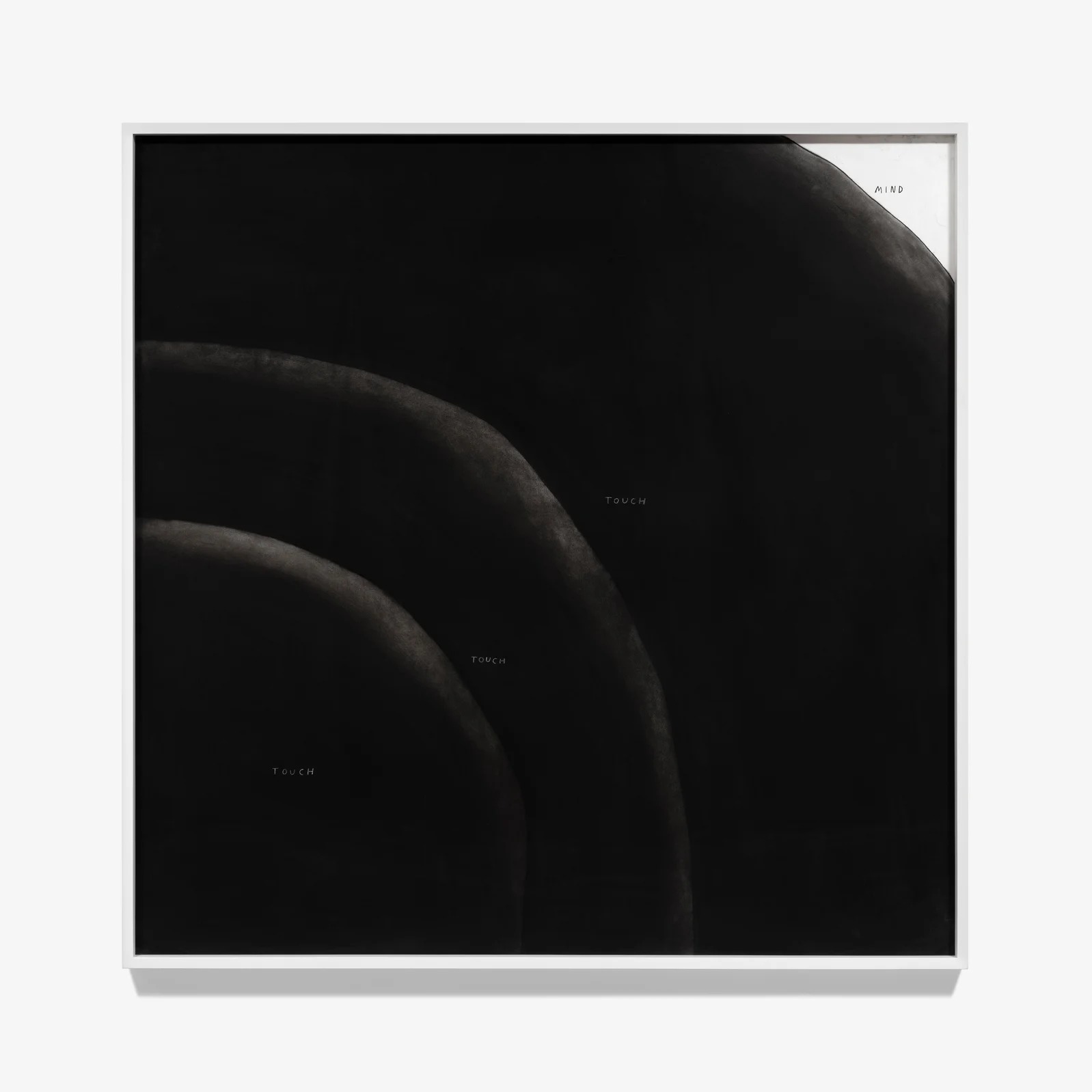
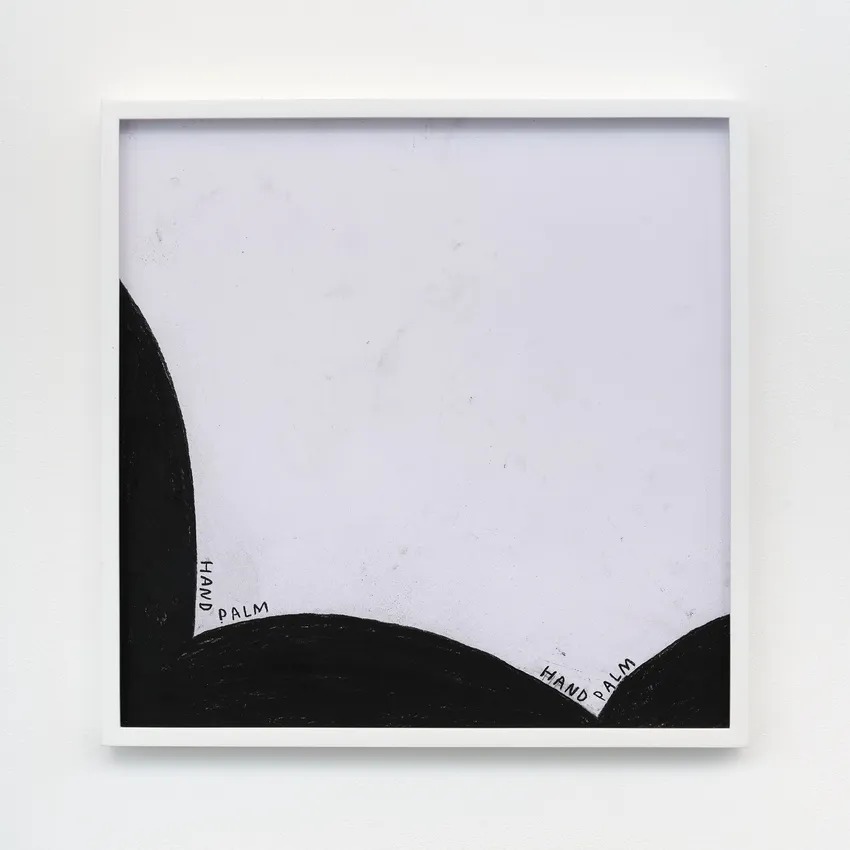
The spatiality and bodily movement of American Sign Language (ASL) form another important foundation of this graphic vocabulary. Kim translates the trajectories of hands and arms into arcs and lines, reconstructing on a flat surface the space occupied by particular signs or their repeated movements.

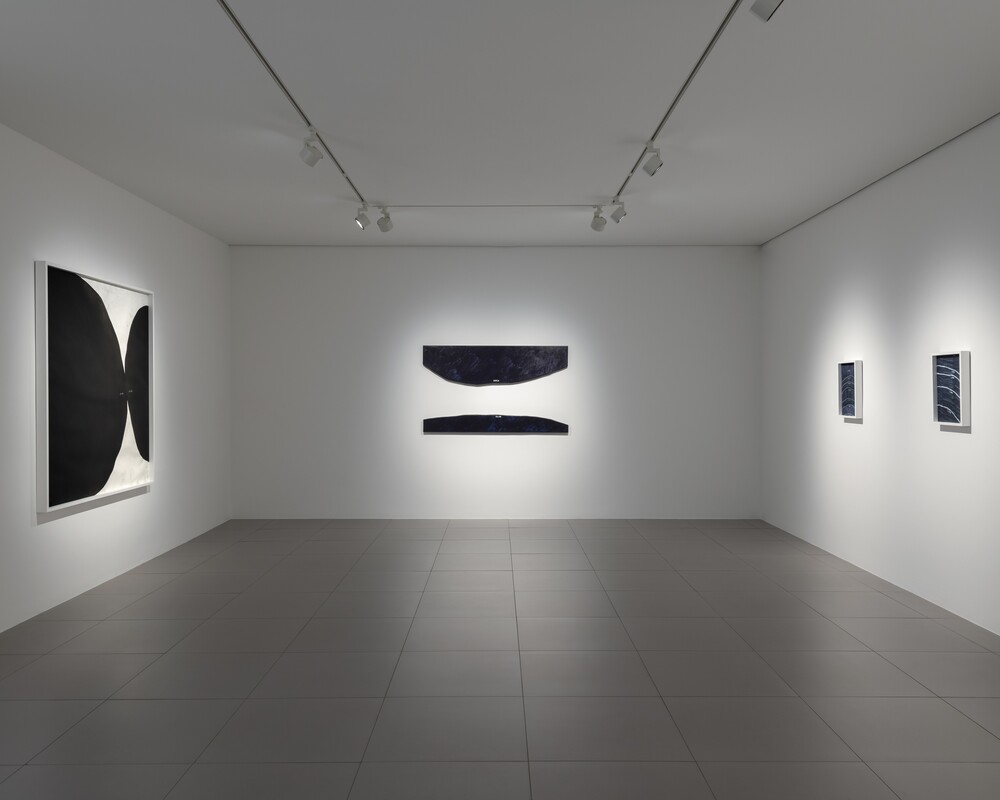
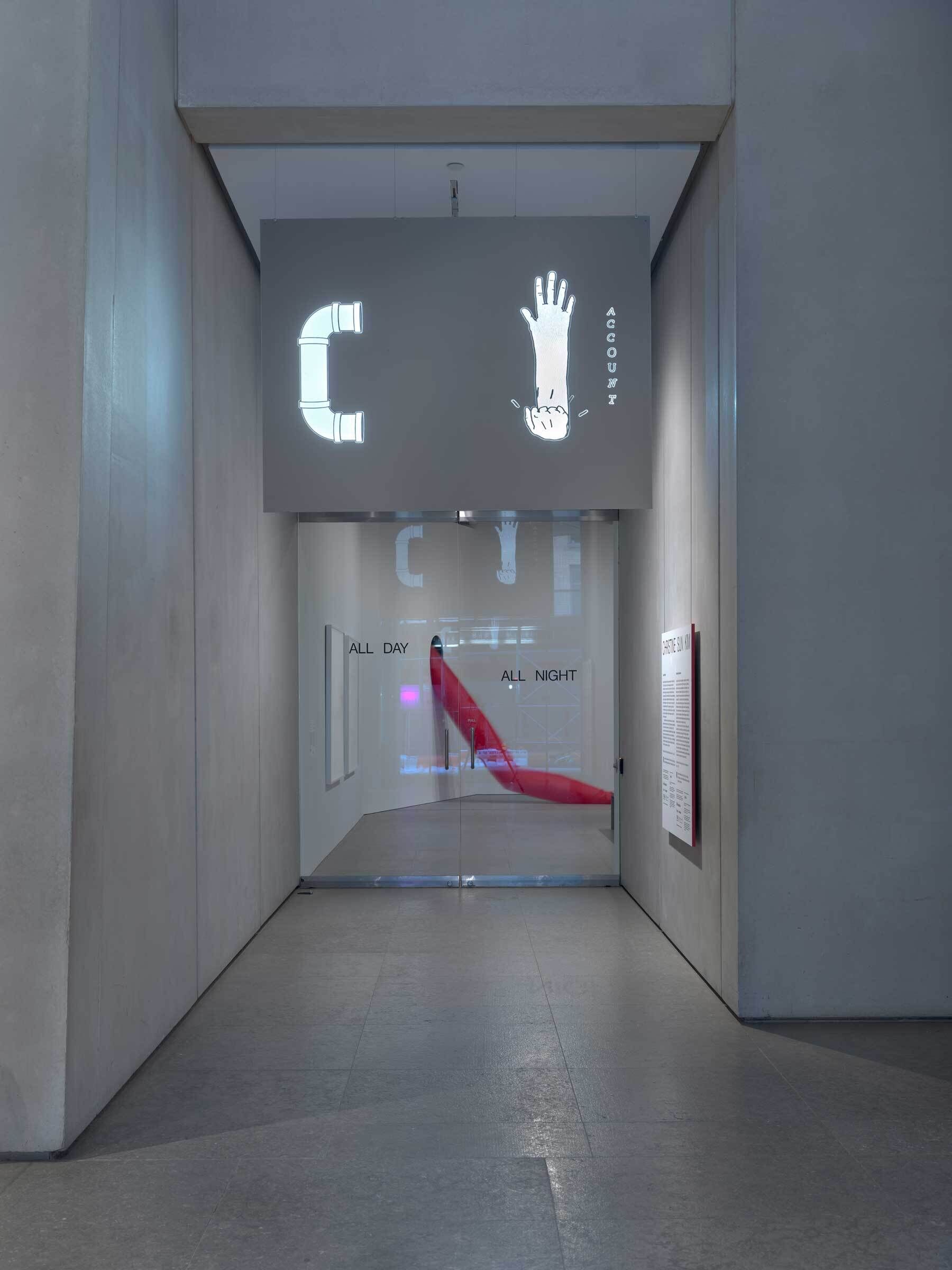
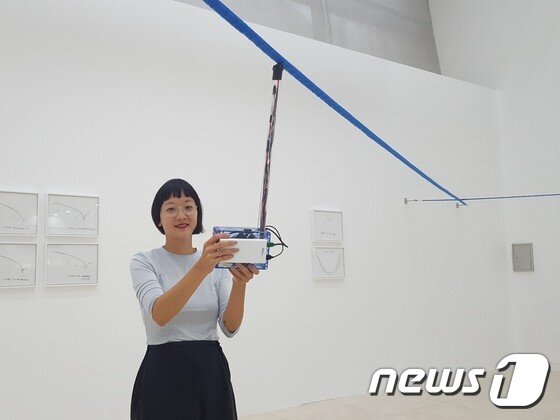
The method of recording signed movements through charcoal curves in All. Day. and All. Night. has been repeatedly developed and expanded in subsequent works. More recently, these lines have come to determine the contours of the canvas itself or expand across architectural spaces, moving between drawing, sculpture, and installation.

Visual languages that suggest speed and direction, such as motion lines from comics, have also entered her vocabulary. As a result, line in Kim’s work does not merely delineate an object but operates as a sign that simultaneously conveys bodily movement, the direction in which language unfolds, and the forces at work between relationships.

Text is likewise a central formal element in Kim’s compositions. She actively uses not only standard English but also “Deaf English,” which renders the grammar of ASL through written English, as well as expressions arising through interpretation, short phrases, and wordplay. In series such as 'English vs Deaf English', 'Terp Voices', and 'Degrees of Deaf Rage', the very content that articulates linguistic differences determines the form of the work.

Short phrases in capital letters, handwriting, strikethroughs, and repeated words combine with diagrams to create compositions that are concise and immediate. At the same time, Kim generates dry humor through double meanings—for instance, “degree” referring to both an angle and an extent, or “right” meaning both a right angle and something justified or correct. Such linguistic devices prevent the institutional tensions and rage addressed in her work from becoming fixed under a single weighty interpretation, allowing meaning to move in multiple directions.

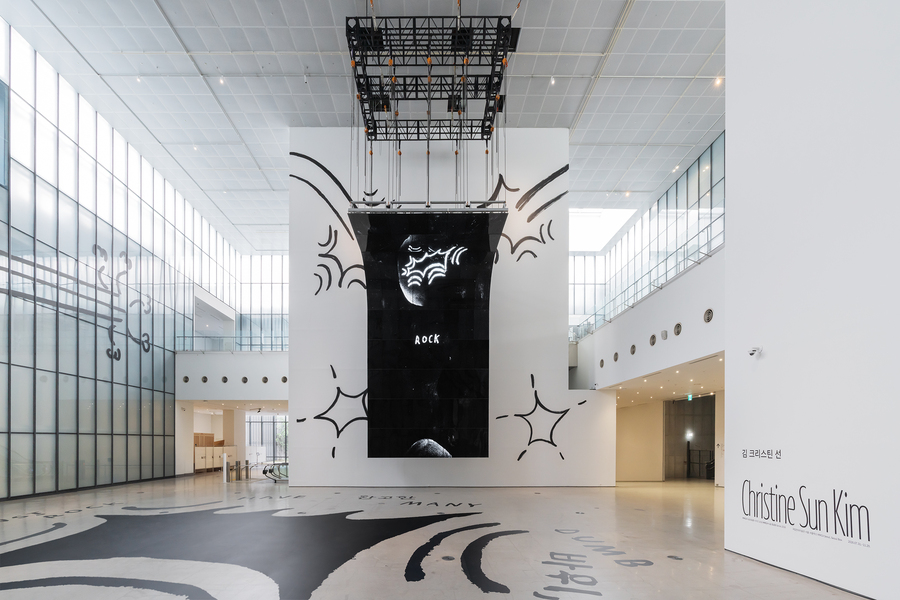
The scale of Kim’s work has also expanded significantly over the course of her career. The graphic language that began in drawings on paper has moved into billboards, architectural-scale murals, museum façades, subway stations, and urban spaces, entering into direct relationships with their surrounding environments.

In works such as Too Much Future and Ghost(ed) Notes, enlarged lines and text resist being grasped at a single glance, prompting viewers to adjust their distance or move their bodies in order to read. Phrases and images dispersed throughout the city similarly bring Deaf culture and the visuality of sign language into the field of everyday vision.

In this way, Kim has repeatedly applied a restrained formal vocabulary developed through drawing across different scales and media, continually transforming it according to the structure of each space and the ways in which viewers encounter the work.

Topography & Continuity

Christine Sun Kim began gaining broader recognition in the early 2010s at the intersection of sound art and disability arts. Two exhibitions in 2012—《What Can a Body Do?》 at Haverford College and 《Gesture Sign Art: Deaf Culture/Hearing Culture》 at Kunstraum Kreuzberg/Bethanien in Berlin—were particularly significant in situating her early practice within distinct contexts.

The former positioned her work within the discourse of disability justice and disability arts, while the latter introduced her engagement with sign language and sound through the relationship between Deaf culture and sound art. The following year, her participation in 《Soundings: A Contemporary Score》 at The Museum of Modern Art, New York, brought her work further attention within contemporary sound art.

Since then, Kim has developed a distinctive position across sound art, conceptual art, language-based practice, and disability arts, extending Deaf sensory and linguistic experience beyond the representation of a particular identity.

A sustained concern throughout Kim’s practice, from her earliest works to the present, is the very act of “inscribing” sound and language. Her speaker drawings, which translated vibration into physical traces; early drawings that employed musical symbols to gauge silence and loudness; and works that converted the movements of American Sign Language into lines all provided the foundation for her later development of infographics, large-scale murals, and public art.

Over time, her concerns have expanded from the physical properties of sound to language, translation, institutions, accessibility, and social debt, while her methodology of transforming invisible relationships and movements into visual systems has remained consistent. Arcs, staff lines, hand icons, and musical symbols from earlier works are repeatedly revisited in new contexts.

Rather than abandoning established forms in favor of successive new phases, Kim has developed her practice by recombining an existing vocabulary and shifting its scale and context, allowing its meanings to continually proliferate.

This continuity is also evident in the expansion of her practice from museum interiors into the public sphere of the city. With the Whitney Museum of American Art billboard Too Much Future, the lines and text of her drawings acquired an architectural scale and subsequently entered everyday visual environments including Times Square, urban billboards, building façades, and transit spaces.

Here, increasing scale entails more than formal enlargement. By allowing languages derived from Deaf culture and American Sign Language to occupy public space, Kim turns the question of whose language gains visibility in the city into a concrete spatial concern. At the same time, her large-scale murals and installations retain the restrained vocabulary of line and text developed through works on paper, sustaining a clear continuity across shifts in medium and site.

Kim’s practice has also come to occupy an important position within international discussions surrounding disability arts and accessibility. Her trajectory through the 2019 Whitney Biennial, 《Crip Time》 at MUSEUM MMK FÜR MODERNE KUNST in Frankfurt in 2021, and the Gwangju Biennale in 2023, followed by major survey exhibitions at the Whitney Museum of American Art in 2025 and the Walker Art Center in 2026, demonstrates how her work has continued to expand within broader discourses of contemporary art rather than remaining confined to a single field.

More recently, she has connected her established visual language with changing conditions in her own life, extending her concerns to motherhood and family, her Korean American identity, political polarization, and anxieties surrounding the future.

Works of Art

New Perceptions and Relations Through Sensory Difference

Articles

Exhibitions

Activities