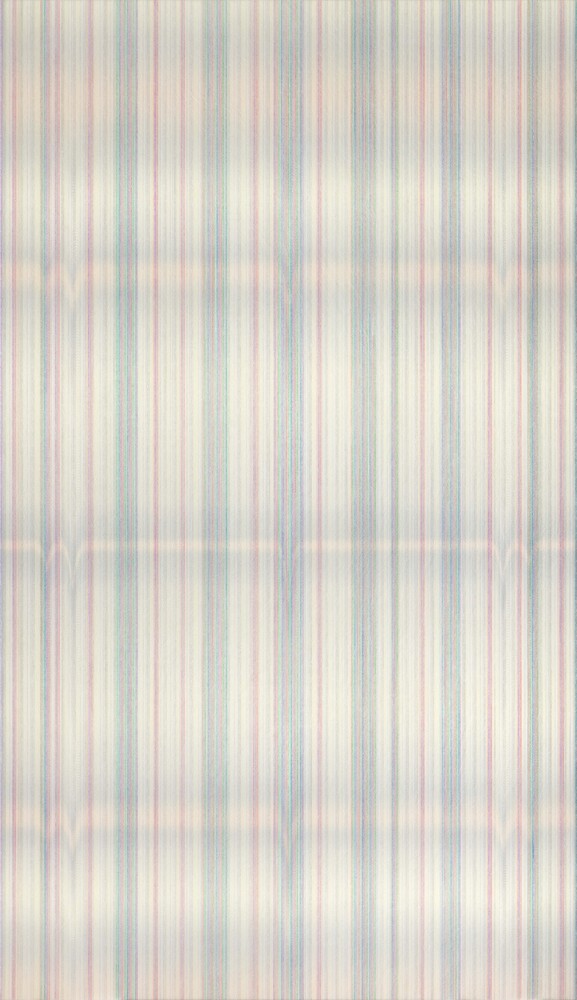
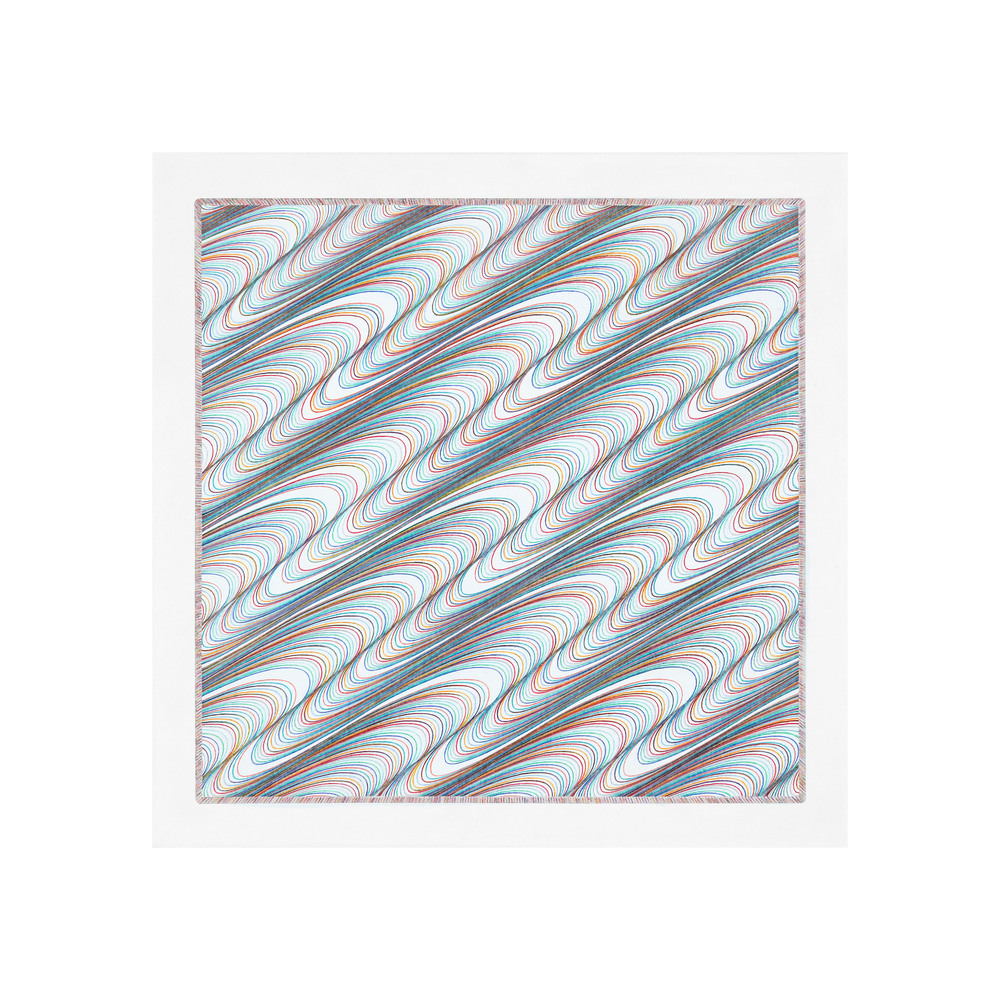
Space Engine - Quarter 009 - K-ARTIST

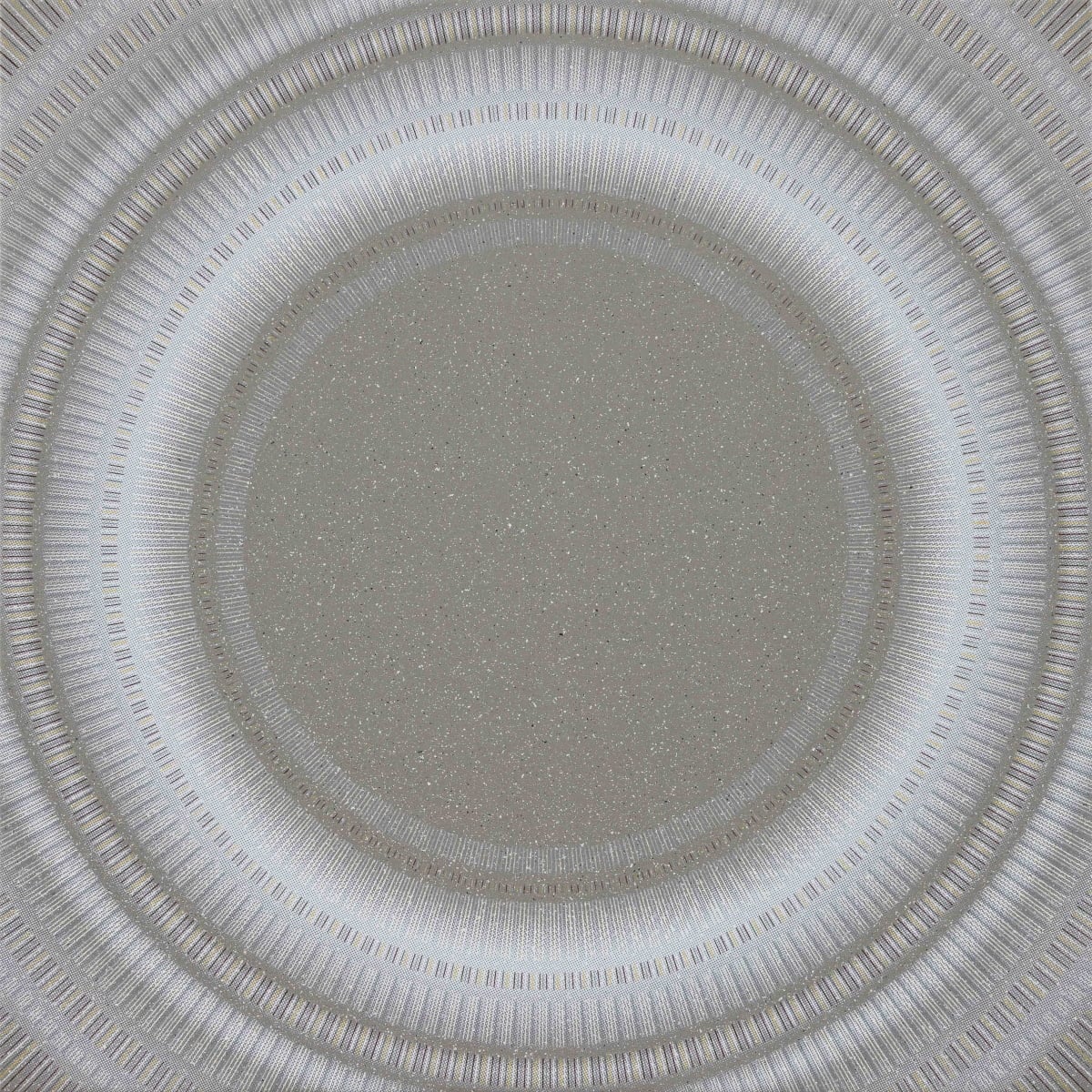
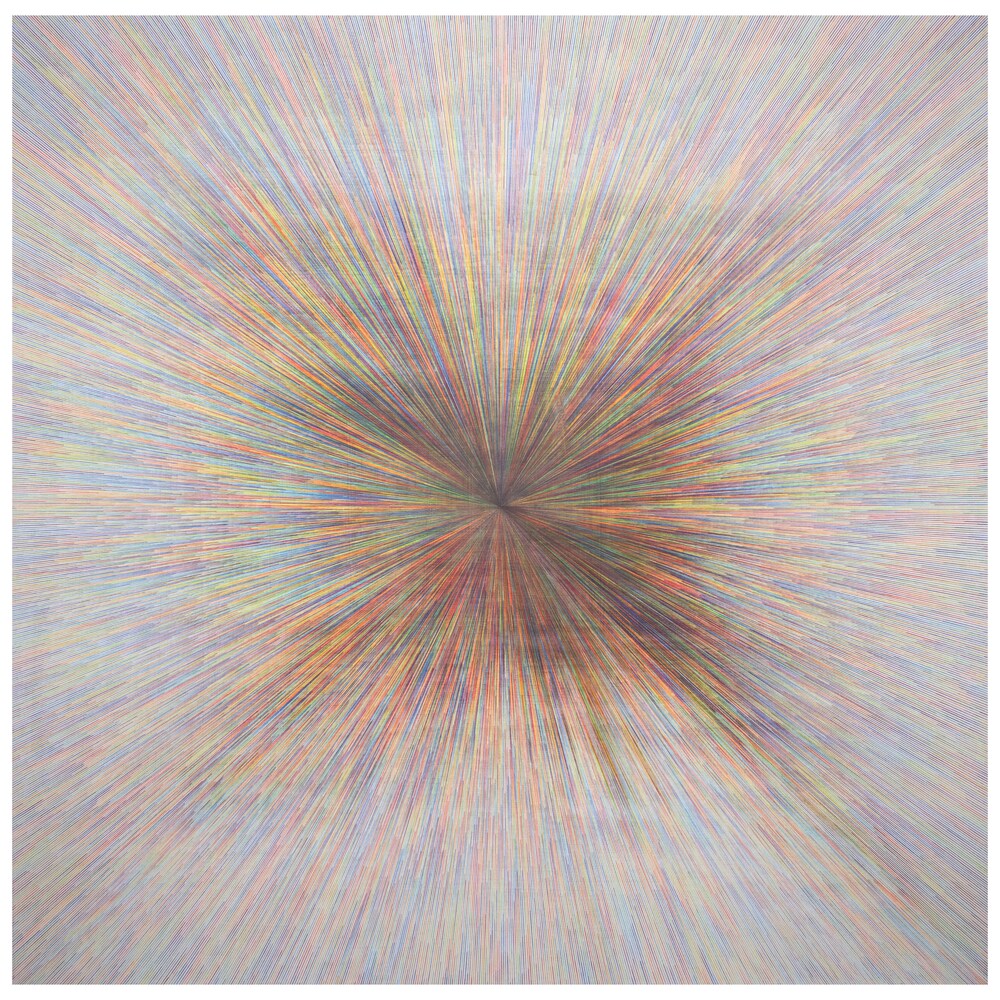
Space Engine - Quarter 009

2025 
Colored pencil, acrylic and UV print on canvas
110 x 110 cm
About The Work

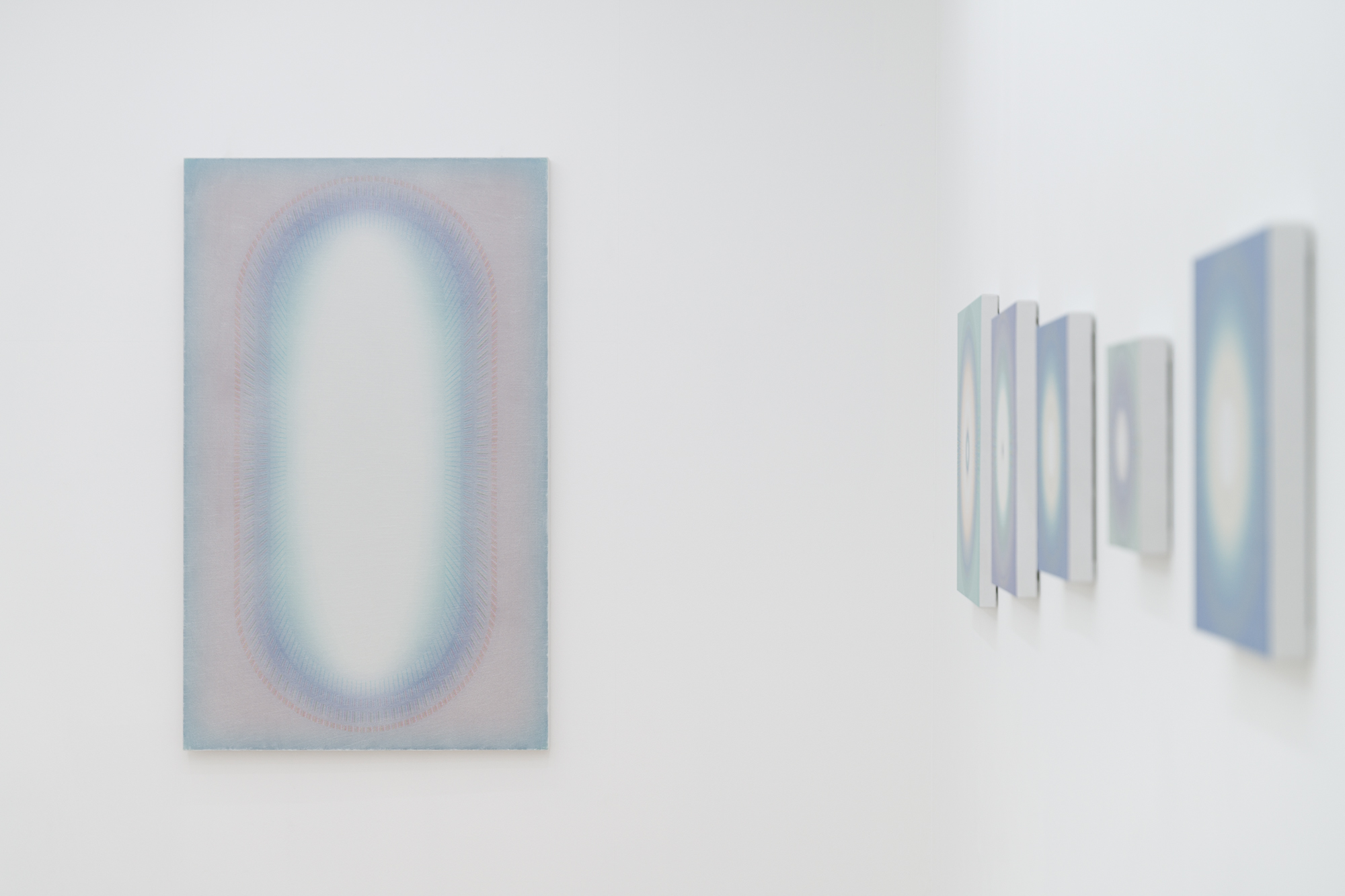
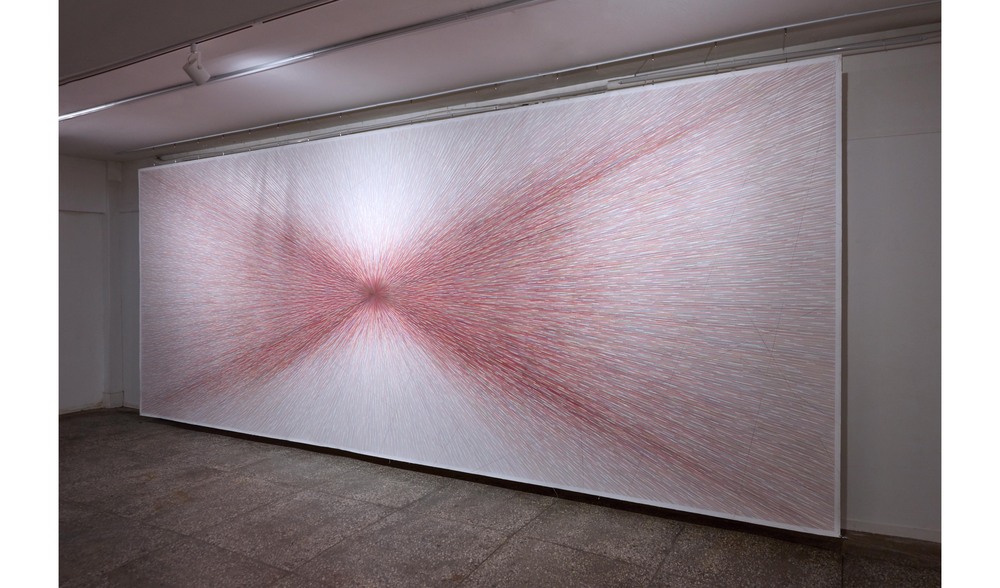
Keun Wook Ji has developed a practice grounded in an interest in the microscopic order of the universe, such as atoms and molecules, translating it into nonlinear sensory experiences through the repetitive act of drawing lines across the canvas. Formed through meticulously calculated rules and persistent mark-making, his geometric patterns generate a distinctive density and texture on the picture surface, producing subtle visual vibrations.

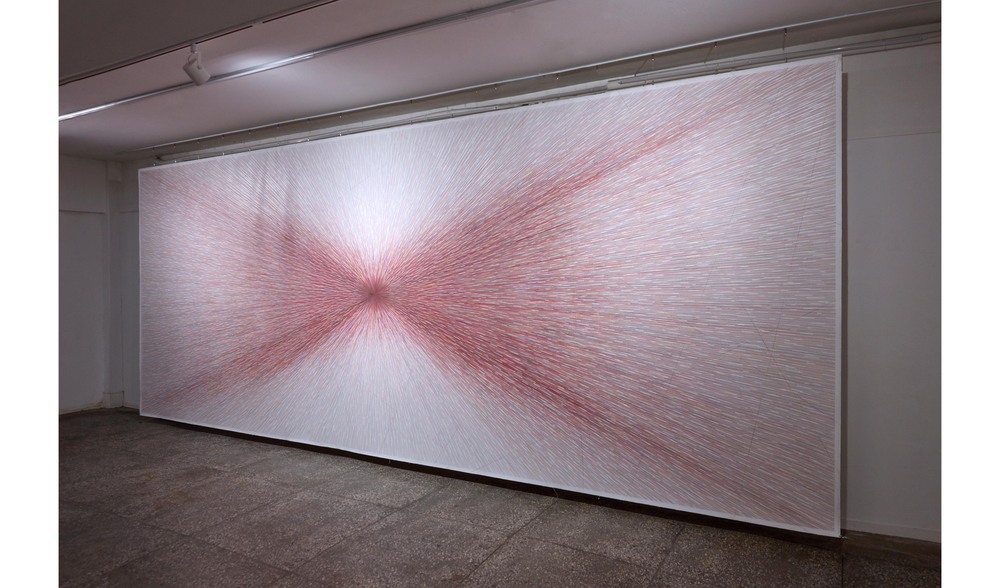
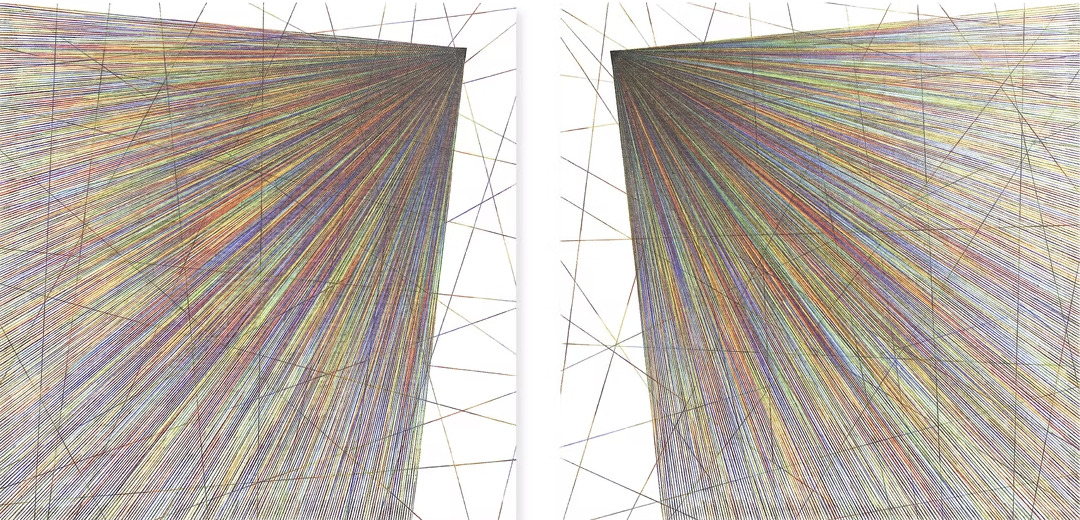
Ji’s practice begins with the question of whether invisible forces and systems of order can be sensed through painting. Using colored pencils and rulers, he densely fills the surface with lines drawn at regular intervals and in consistent directions. Accumulated through this repetitive process, the lines form landscapes that resemble countless subatomic particles brought together by an invisible cosmic order to constitute a larger form. 

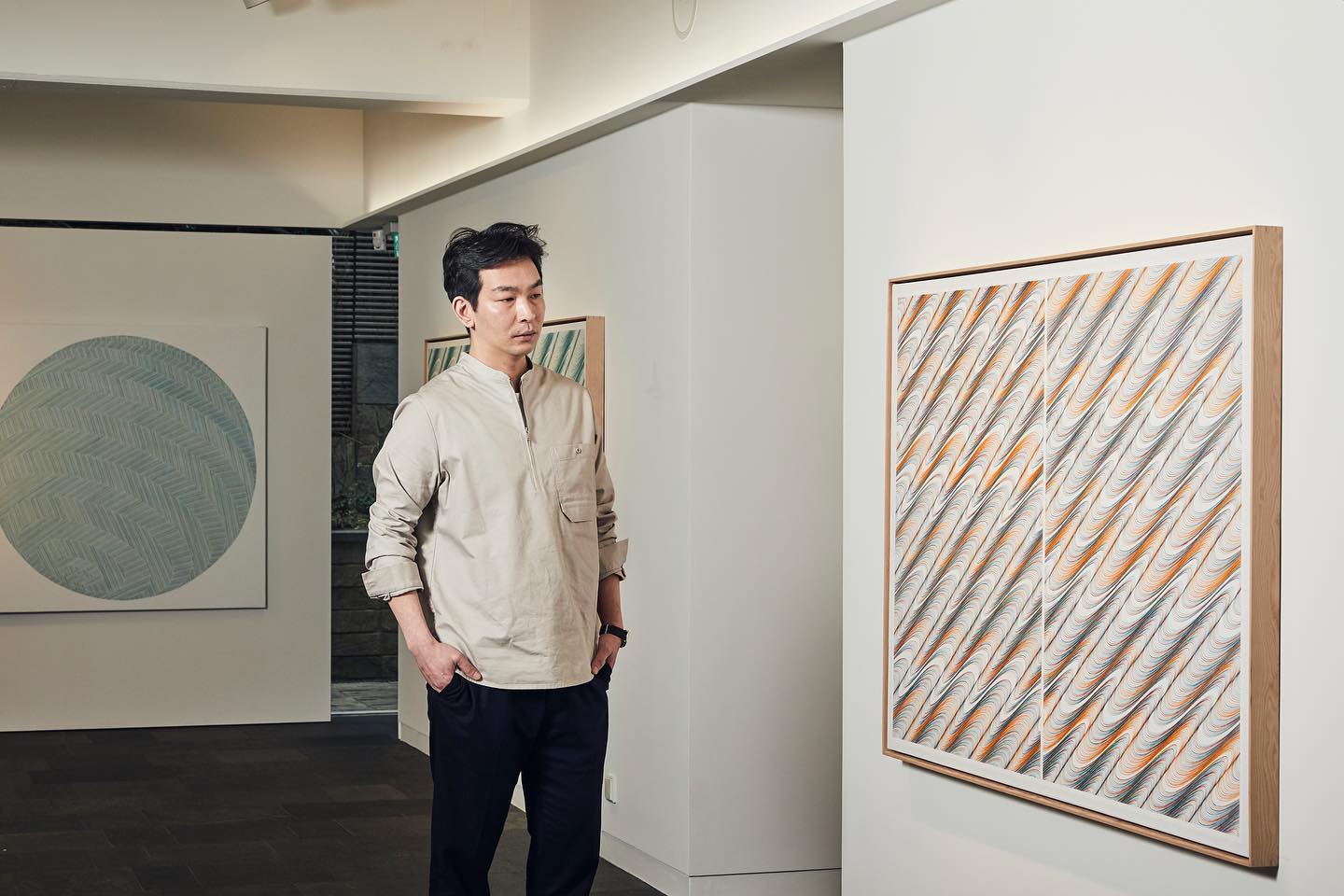
The subtle waves generated by these lines prevent the viewer’s gaze from settling on any single point. Instead, viewers move through the spaces between the lines as if swimming across the picture surface, experiencing the traces and movements accumulated within the work rather than simply reading it as an image.

The artist further explores the potential forms and movements of the gaze, approaching observation itself as an act capable of affecting the energy and flow of a given space.

His process of extending the work beyond the picture plane to construct spatial relationships within the exhibition space and incorporate the viewer’s physical position into the work is an investigation into the material phenomena that emerge from the distance between image and gaze. In this way, his practice seeks to capture the invisible movements that pass between painting and the viewer’s body, as well as the interactions they generate.

In Ji’s paintings, action, matter, and time without a fixed form intersect on a single surface. Repetitive mark-making thus becomes more than an act of reproducing order; it remains as a trace of temporality accumulated in nonlinear layers. By extending painting into the realms of space, the body, and sensory experience, Ji’s practice transforms visual stimulation into a broader, embodied form of sensation and affect, drawing viewers into the sensory world generated by his work.

Solo Exhibitions (Brief)

Ji has held solo exhibitions including 《Metallic Wings》 (Hakgojae Gallery, Seoul, 2026), 《Eyes on the Arc》 (Schema Art Museum, Cheongju, 2025), 《GLASS》 (WWNN, Seoul, 2024), and 《Qua-o-ar》 (Sungkok Art Museum, Seoul, 2024).

Group Exhibitions (Brief)

Ji has also participated in numerous group exhibitions, including 《From the Earth》 (Hakgojae Gallery, Seoul, 2025), 《Flyby》 (Prompt Project, Seoul, 2024), 《Another Materiality》 (MOMA, Seoul, 2023), 《Skins》 (Hakgojae Gallery, Seoul, 2022), 《Lagrangian Point》 (DrawingRoom, Seoul, 2022), 《What If!》 (A-Lounge Contemporary, Seoul, 2021), and 《Sharpness》 (Ilwoo Space, Seoul, 2020).

Awards (Selected)

Ji was selected for the Sungkok Art Museum Open Call (2024) and the Seoul Foundation for Arts and Culture’s Emerging Artist Track and Promising Artist Track programs (2026, 2021).

Works of Art

Painting Cosmic Order through Innumerable Lines

Originality & Identity

Keun Wook Ji’s practice begins with the question of whether invisible forces and systems can be made perceptible through painting. While studying Art & Science in London, he became interested in physics and adopted the repetitive act of drawing lines as a way of expressing gravity through abstraction.

In Actual Dynamics - Symmetry 10021(2015) and Actual Dynamics - 2444(2018), countless colored-pencil lines converge toward the center or extend in multiple directions, transforming energies that cannot be directly observed—such as the movements of atoms, molecules, and microscopic particles—into visual structures. The central concern of these early paintings is not to represent the appearance of the universe, but to generate a sensation of continuous movement within a static plane.
 
His early works are based on calculated rules and deliberately restricted autonomy. By meticulously organizing relationships among points, lines, and planes, Cohesive Sphere Wave Ver.(2018) creates a sense of spatial depth and fragmented movement through divided surfaces and multiple viewpoints. The accumulation of lines with different colors and densities makes the image appear both geometrically fixed and subtly expanding or vibrating.

This contradiction resembles the condition of the universe, in which innumerable particles remain in constant motion while forming a larger order. For Ji, science does not function as a subject through which precise phenomena are explained. Rather, it provides a point of departure for imagining worlds that cannot easily be confirmed through the senses and for organizing the structure of painting.
 
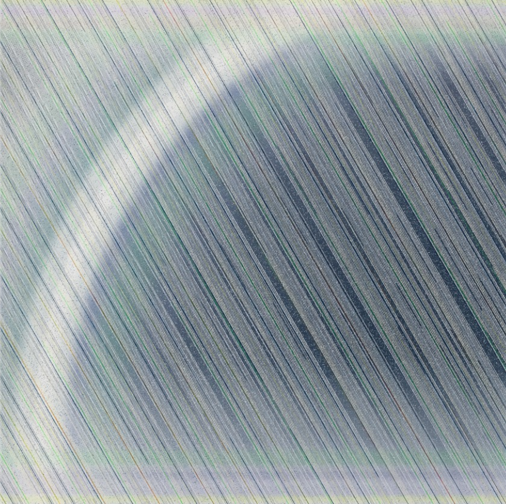
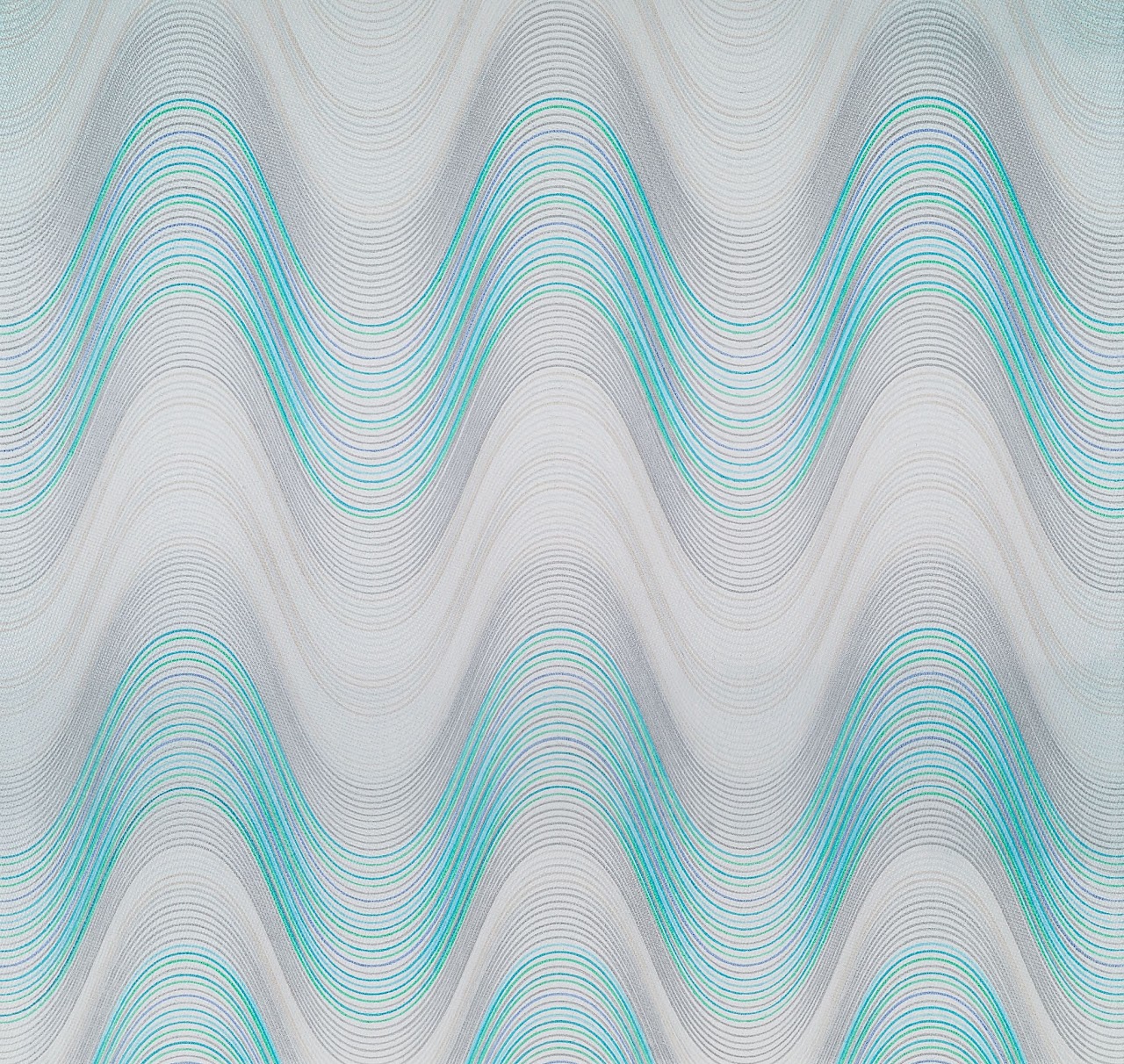
The ‘Curving Paths’(2019) series marks a departure from the centralized structures of his early works, allowing concentration and dispersion to occur simultaneously across the surface. The curves in Curving Paths - 021(2019) continue without a clearly defined destination or vanishing point, generating a sense of uninterrupted waves and continuous flow.

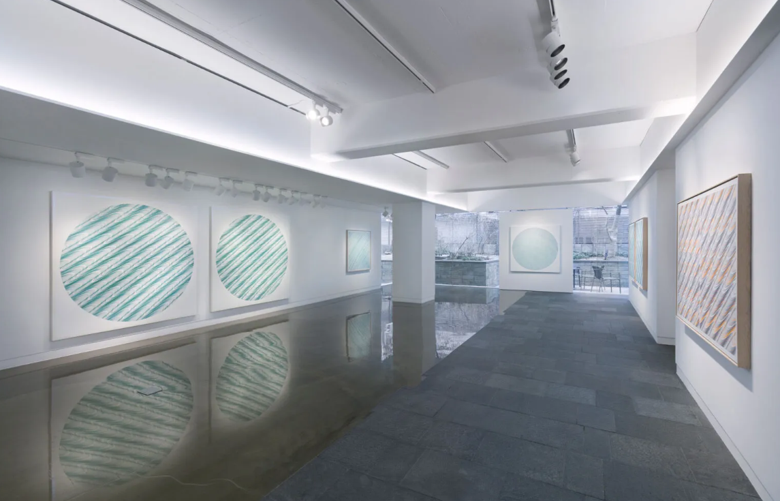
In 《Hardboiled Breeze》(Hakgojae Gallery, Seoul, 2023), Ji subsequently redirected the gaze concentrated within the image toward the external world and began to address more actively the relationship between the work and its surrounding space. In the ‘Inter-rim’, ‘Inter-wave’, and ‘Inter-shape’ series, the line no longer remains merely a unit for constructing form. It reveals tensions and interferences between colors, between separate pictorial surfaces, and between painting and the viewer’s body.
 
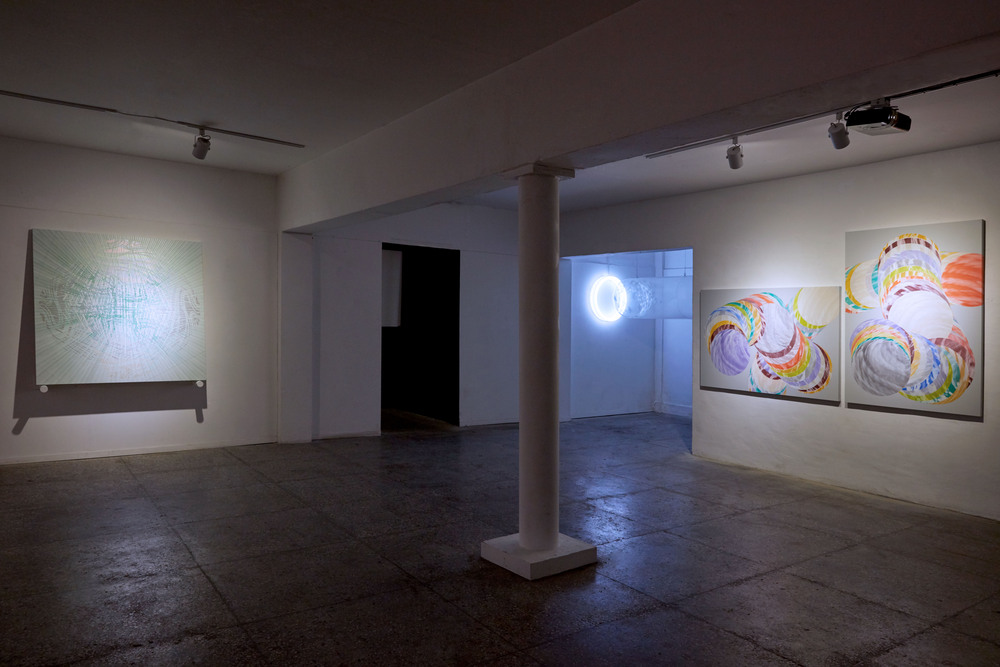
《Qua-o-ar》(Sungkok Art Museum, Seoul, 2024) and 《GLASS》(WWNN, Seoul, 2024) extended these scientific interests toward more specific questions drawn from astronomy and quantum mechanics. 《Qua-o-ar》 began with the rings of the dwarf planet Quaoar, whose position cannot be fully explained by conventional theories, and used intersections of lines and color fields to explore nonlinear dimensions of space and time.

In 《GLASS》, Ji referred to the double-slit experiment and focused on the way an act of observation can intervene in a physical phenomenon. His attention thus shifted from invisible particles and waves themselves toward the question of how the gaze transforms the world it observes. Painting developed from an image suggesting cosmic order into an event in which image and viewer affect one another.

Style & Contents

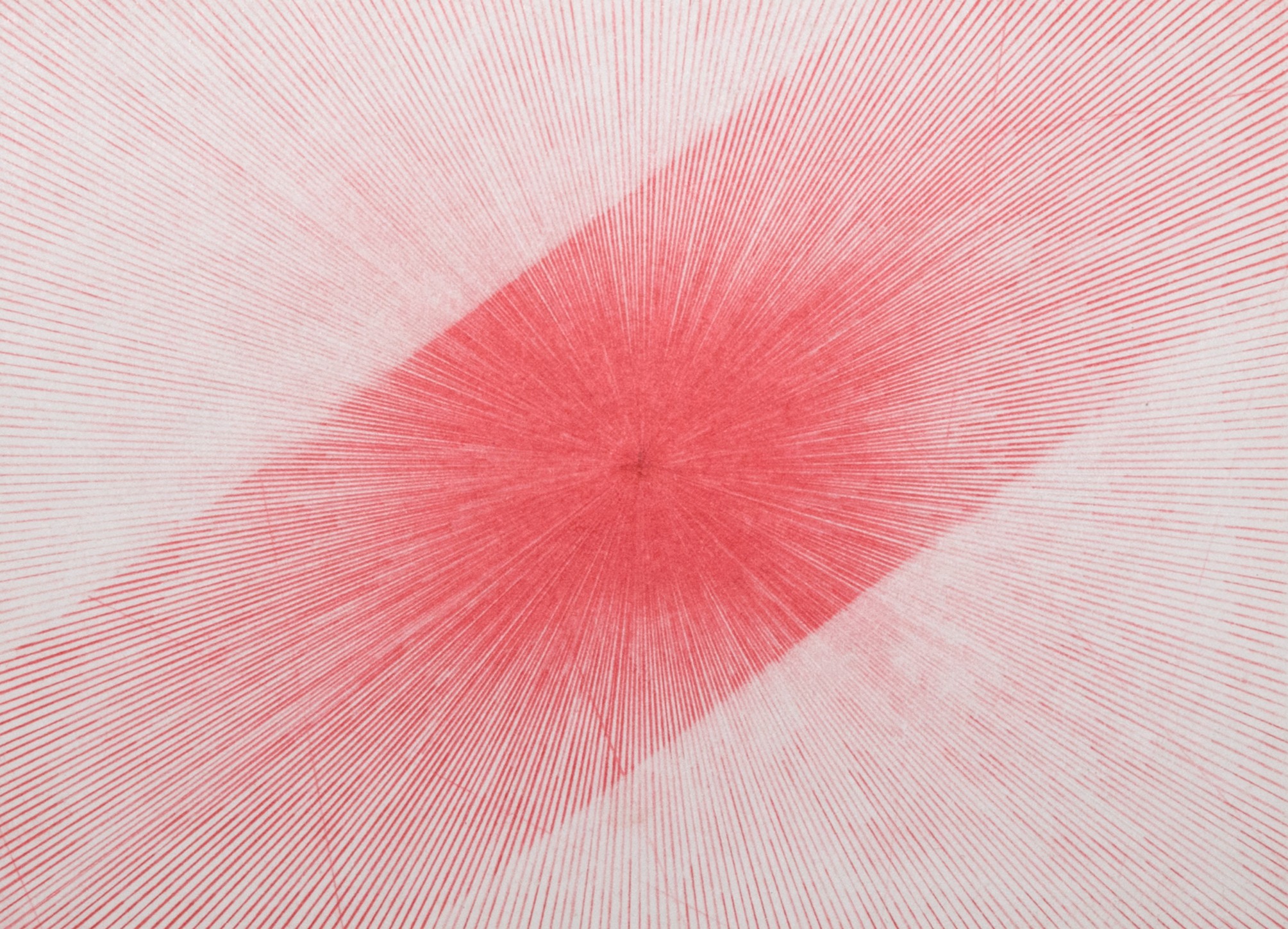
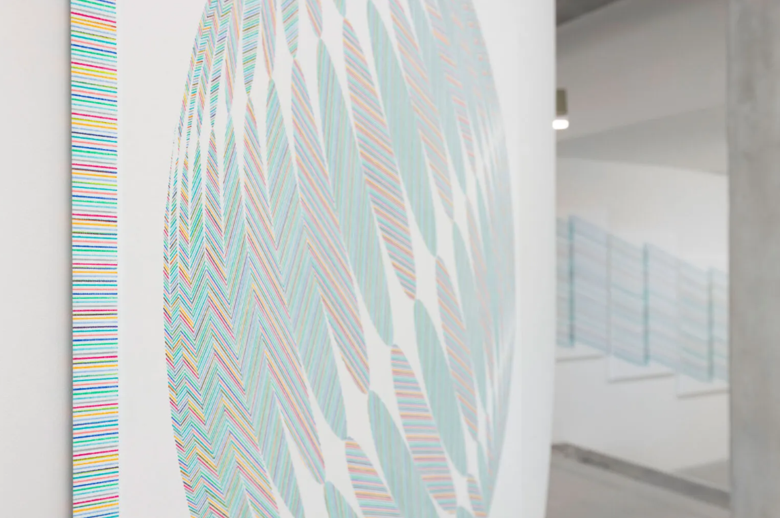
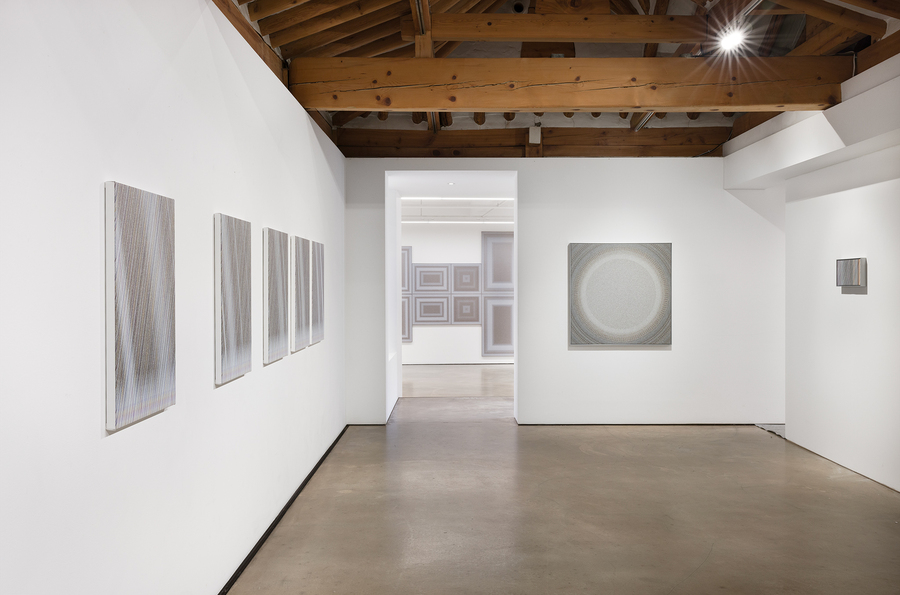
Ji’s surfaces are produced by repeatedly drawing lines with colored pencils and rulers according to predetermined directions and intervals. Compared with conventional painting media, the colored pencil is a light and familiar tool, but when applied thousands of times, its pigment particles and fine ridges accumulate to form a distinctive density and surface.

From a distance, the lines merge into planes or geometric structures, while at close range, individual strokes, particles, variations in pressure, and minute errors become visible. The artist plans the working process from its first stage to its final stage, and when an error occurs, he may begin again from the start. This method retains the sequential and irreversible working structure he acquired through his undergraduate training in printmaking.
 
Up to 《Linear Ground》(Hakgojae Gallery, Seoul, 2019), the central elements of the work were the perspective, vibration, and optical effects created by straight and curved lines. In later works, however, Ji began layering acrylic paint and opaque media beneath the lines and combining them with UV printing, placing greater emphasis on the collision between colored-pencil marks and other materials.

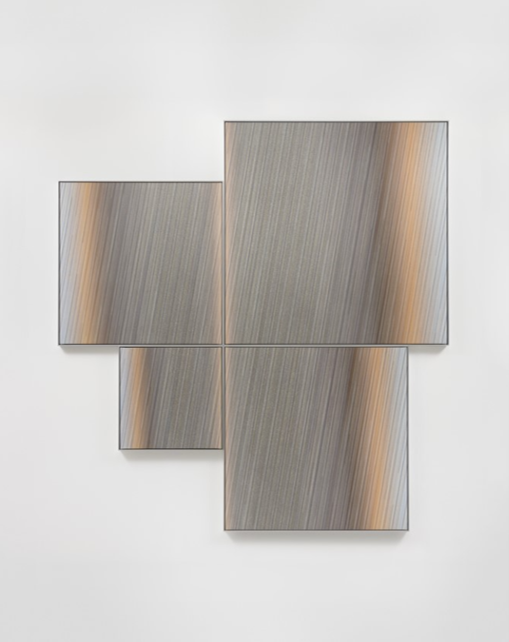
Inter-shape Collider
(2023) creates different levels of depth by overlapping pale chromatic strata with darker surface layers. At points where straight lines and curves intersect, the work produces a rhythm that appears simultaneously firm and gentle. In the artist’s terms, “hardboiled” corresponds to the rigor of planning and structure, while “breeze” describes the soft movement generated through line and color.
 
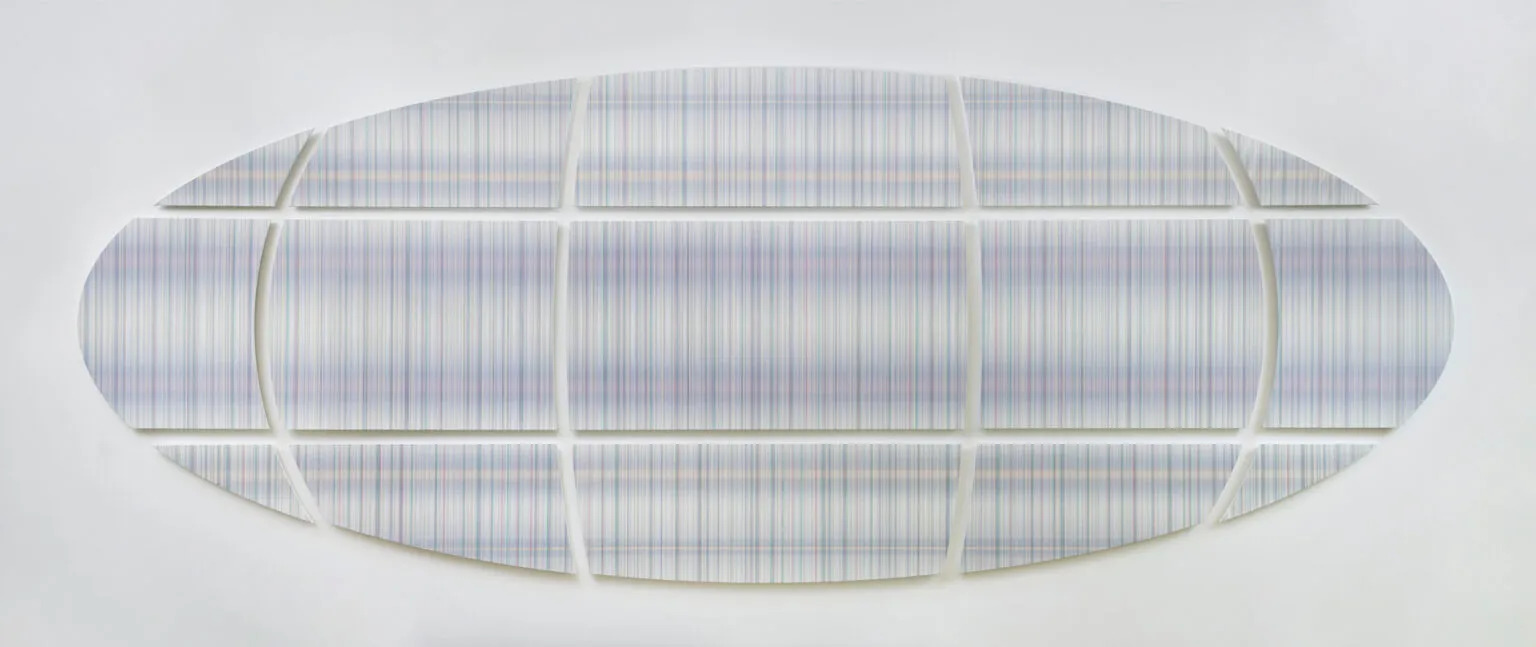
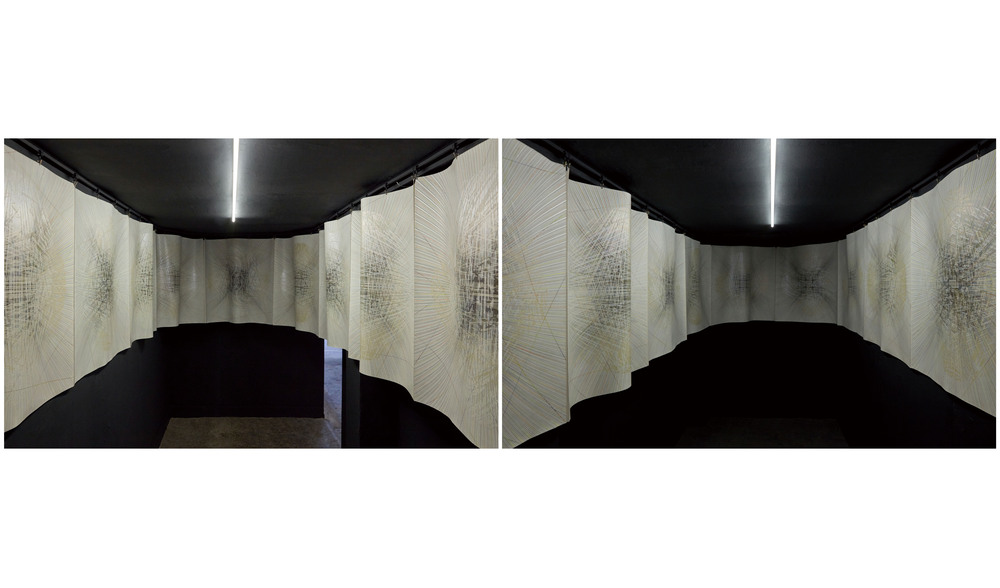
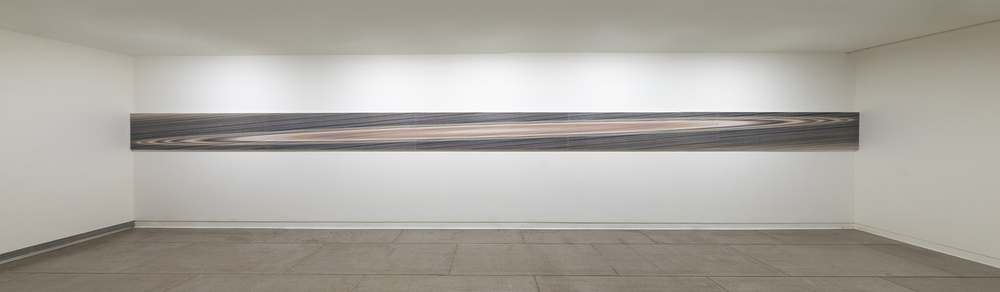
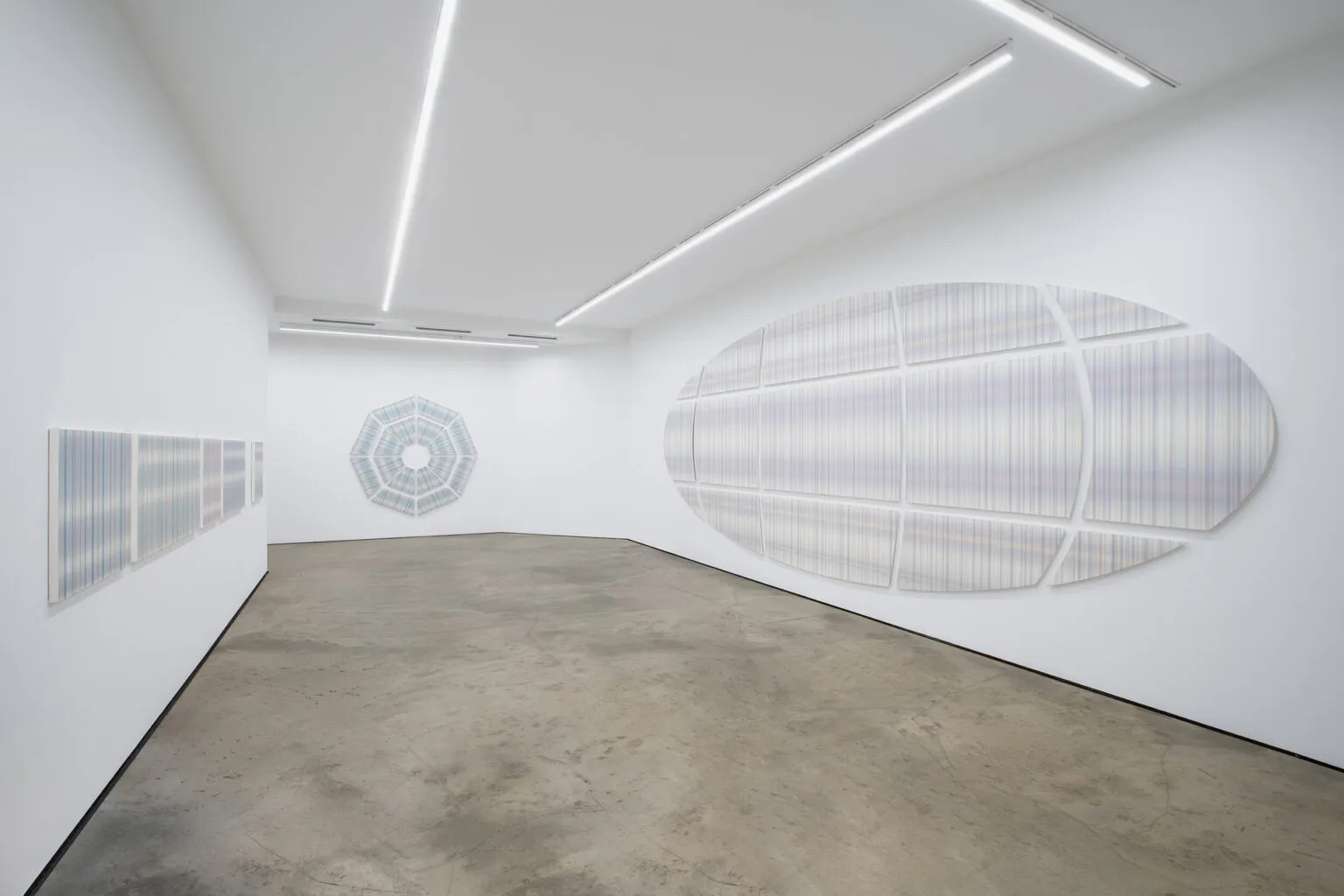
Inter-shape Radiation(2023) combines fifteen canvases into an elliptical structure measuring approximately eight meters in width. The curved edges of the individual canvases and the straight lines crossing their surfaces connect the internal movement of the image with the flow of the physical exhibition space.

The intervals between the canvases and the white wall behind them function as passages through which the pictorial waves continue. Rather than observing the entire work from a single position, viewers move alongside it and repeatedly adjust the direction of their gaze. The irregular contour and monumental scale transform painting from an image mounted on a wall into a spatial structure surrounding the viewer’s body.
 
More recently, imagery collected through the virtual universe simulator Space Engine and metallic materials have introduced additional layers to the work. In 《Qua-o-ar》, Space Engine - Disc 002(2024) and Space Engine - Paths 001~010(2024) incorporate visual references gathered while navigating a non-experiential universe, transferring them through UV printing and overlaying them with colored pencil and acrylic.

In 《Metallic Wings》(Hakgojae Gallery, Seoul, 2026), Ji used stainless-steel-based pigments and reflective surfaces to produce paintings that shift according to light and the viewer’s position. Metal is treated not only as a solid material but also as a substance containing time, formed through long periods of pressure and transformation. The “wings” suggest a movement through which matter escapes its weight and given conditions, extending beyond the picture plane.

Topography & Continuity

Ji’s paintings share certain elements with geometric abstraction, Op Art, and process-based painting, but they are not directed solely toward refined optical illusion or formal completion. In his work, the line is not an outline describing form but a material trace that directly records time, pressure, and breath.

Although each painting is constructed according to strict rules, the trembling of the hand and the uneven accumulation of colored-pencil particles remain visible, allowing mechanical order and bodily error to coexist. Compared with artists who interpret repeated line-making primarily as meditation or spiritual discipline, Ji connects repetitive action to cosmic movement, material structures, and the conditions of observation.
 
A distinctive aspect of his practice lies in connecting microscopic and macroscopic worlds through the same formal principles. At close range, the surface disperses into colored-pencil particles and thin lines, while from a distance it gathers into larger structures resembling planetary rings, waves, or fields. This visual transition recalls the way minute particles collectively form a cosmic body.

While the early ‘Actual Dynamics’ series organized gravity and microscopic motion through ordered lines, the ‘Curving Paths’ series emphasized flow and continuity, the ‘Inter-shape’ series explored interactions between painting and space, and the recent ‘Space Engine’ series brought an otherwise inaccessible universe into painting through observation and simulation.
 
The role of scientific concepts has also changed throughout this development. In the early works, physics provided a theoretical basis for designing the rules and structures of the image. In 《Qua-o-ar》, gaps and exceptions within established theories became openings for imagination.

In 《GLASS》, the conditions under which the observer’s gaze intervenes in a phenomenon became central, while 《Metallic Wings》 shifted attention toward the coexistence of different temporalities within action and matter. Science therefore functions not as a diagram explaining the content of the work, but as a flexible method for investigating invisible worlds and states that remain unexplained.
 
Ji was selected for the Sungkok Art Museum Open Call and has received support through both the Emerging Artist and Promising Artist tracks of the Seoul Foundation for Arts and Culture’s Arts Support Program. His recent exhibitions—from 《Hardboiled Breeze》 and 《Qua-o-ar》 to 《GLASS》 and 《Metallic Wings》—demonstrate how he has maintained his foundation in colored-pencil abstraction while expanding into shaped canvases, UV printing, metallic pigments, and site-responsive installation.

His academic background in printmaking and painting at Hongik University and in Art & Science at Central Saint Martins also underpins his ability to combine sensory surfaces with systematic thinking. Rather than settling into a single scientific image or established form, his practice is likely to develop through the continued translation of new materials, technologies, and modes of observation into embodied experiences of painting.

Works of Art

Painting Cosmic Order through Innumerable Lines

Articles

Exhibitions

Activities