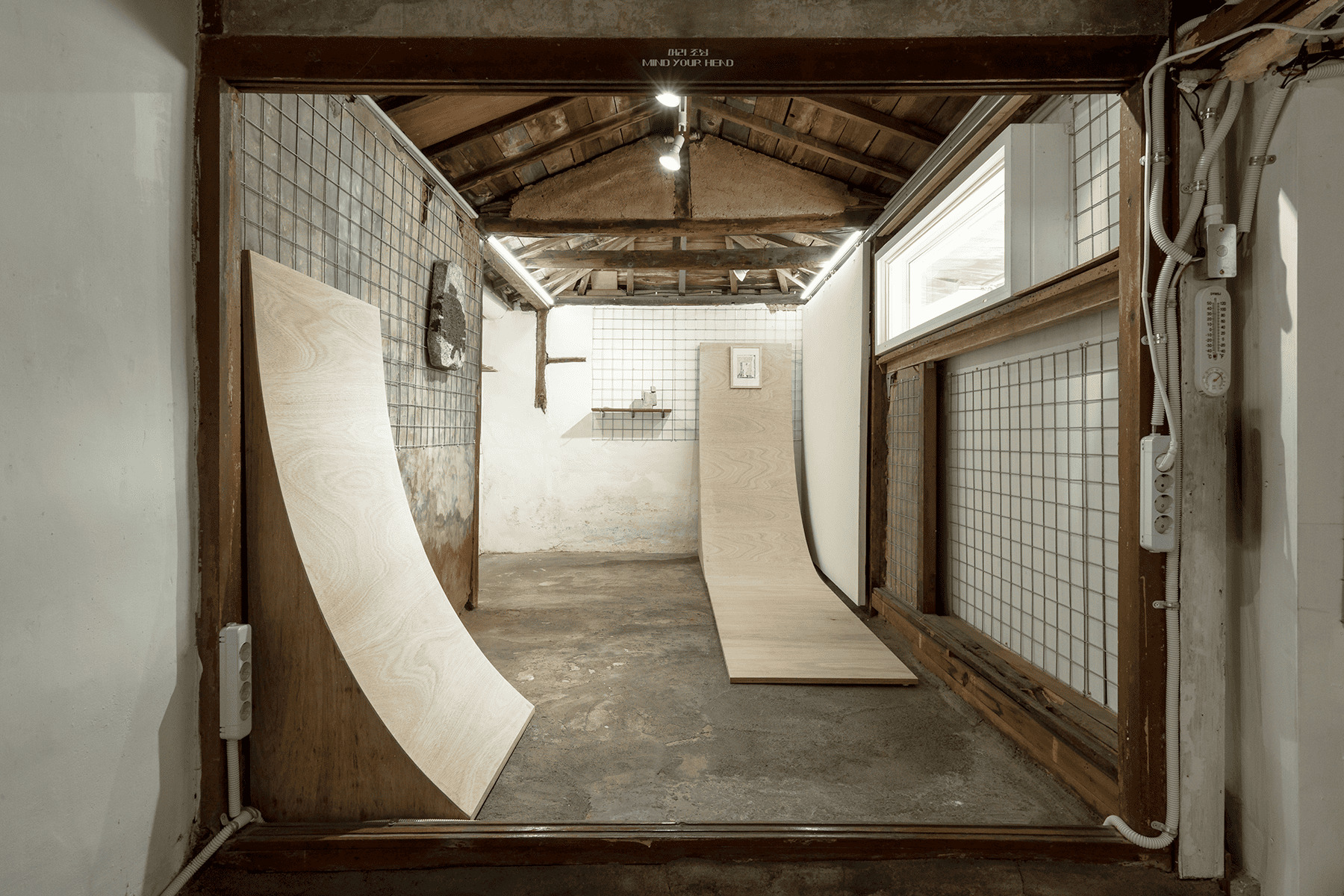
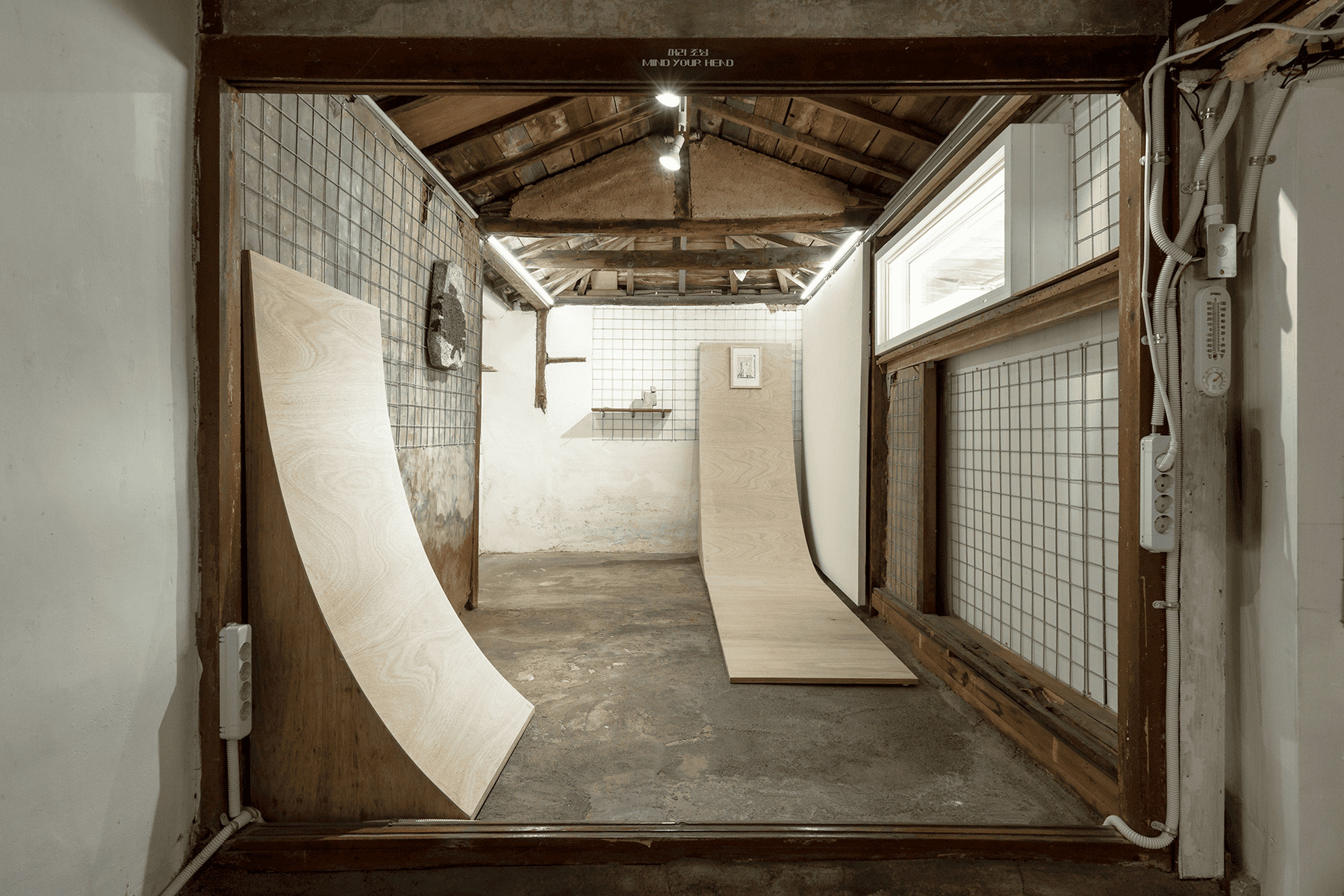
Sliding Edge(Chamber ver.) - K-ARTIST

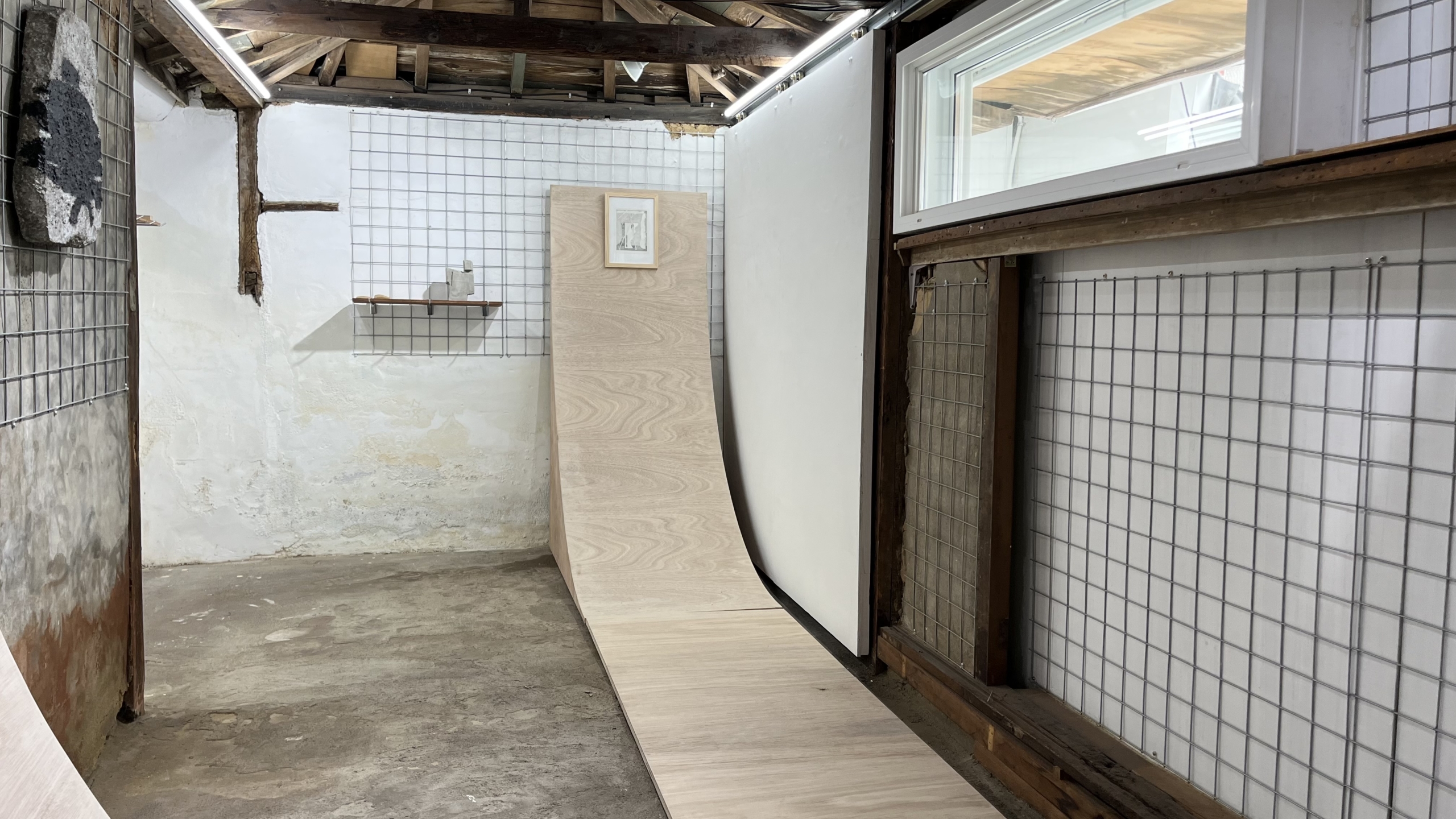
Sliding Edge(Chamber ver.)

2023
Plywood
Dimensions variable
About The Work

Jinseon Ahn explores the subtle anxieties and vibrations sensed within urban environments and architectural spaces, focusing on how these sensations shape our spatial perception. In particular, she observes how physical elements—such as floors, walls, and ceilings—alter our awareness and bodily experience.
 
Through her exploration of anxiety, the city and its spaces are reconfigured into new forms, becoming key visual components in her work. These transformed elements manifest as installation pieces that invite viewers to re-experience a sense of unease through their interaction with the space.
 
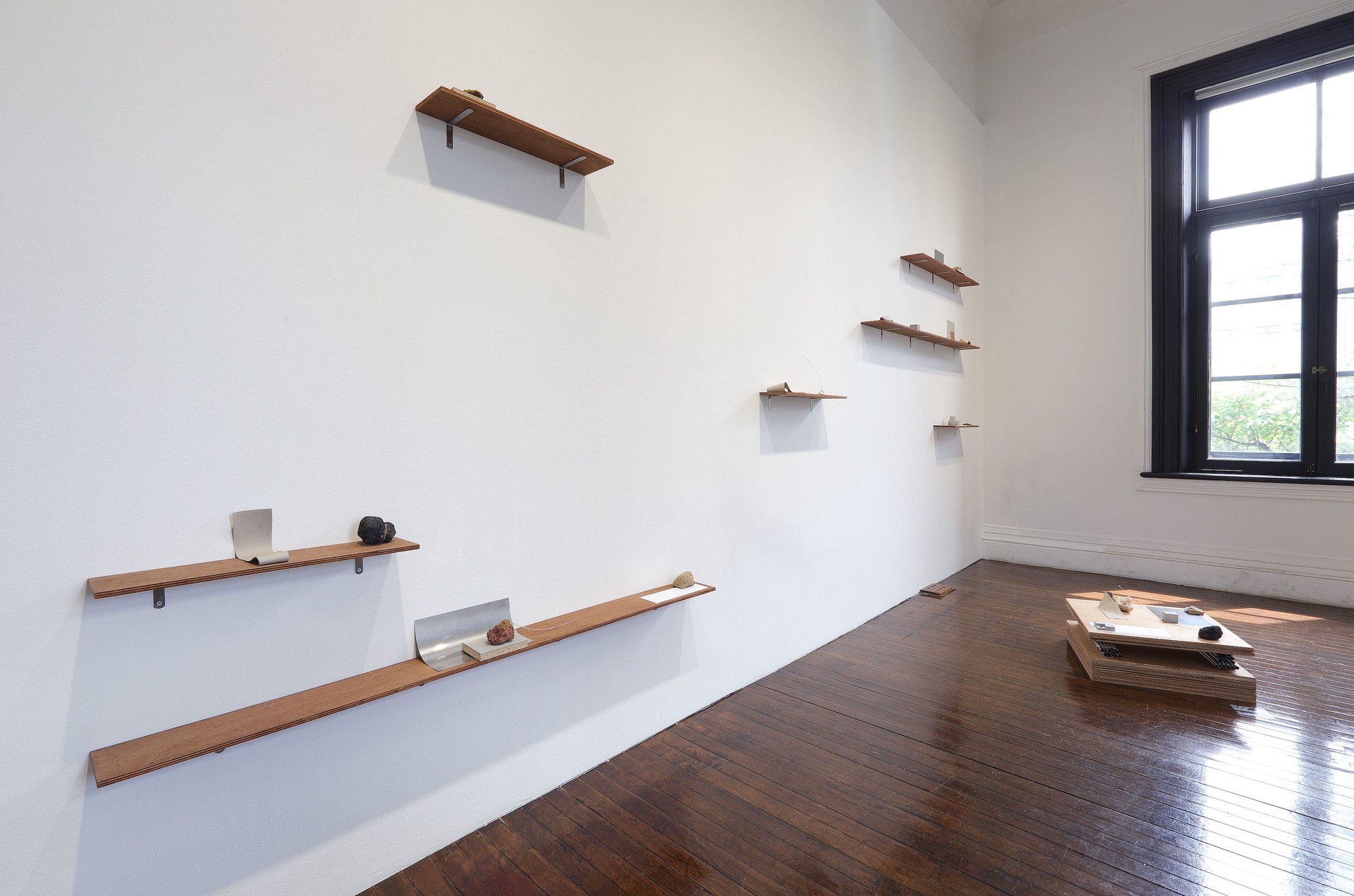
Jinseon Ahn reconstructs the subtle unease and vibrations she senses while slowly navigating the city into a synesthetic installation experience. By experimentally utilizing a variety of construction materials found in urban spaces—and juxtaposing heavy, fixed elements with lighter ones—she amplifies the tension within the space.
 
Through these interventions, her work encourages viewers to perceive the space in new ways and generates fresh narratives about the city and its environments. In the process, sensory perception and experience are expanded.

Solo Exhibitions (Brief)

Jinseon Ahn held her first solo exhibition, 《Throbbing, Moving, Stopped》, at Mueumsanbang, Seoul in 2023.

Group Exhibitions (Brief)

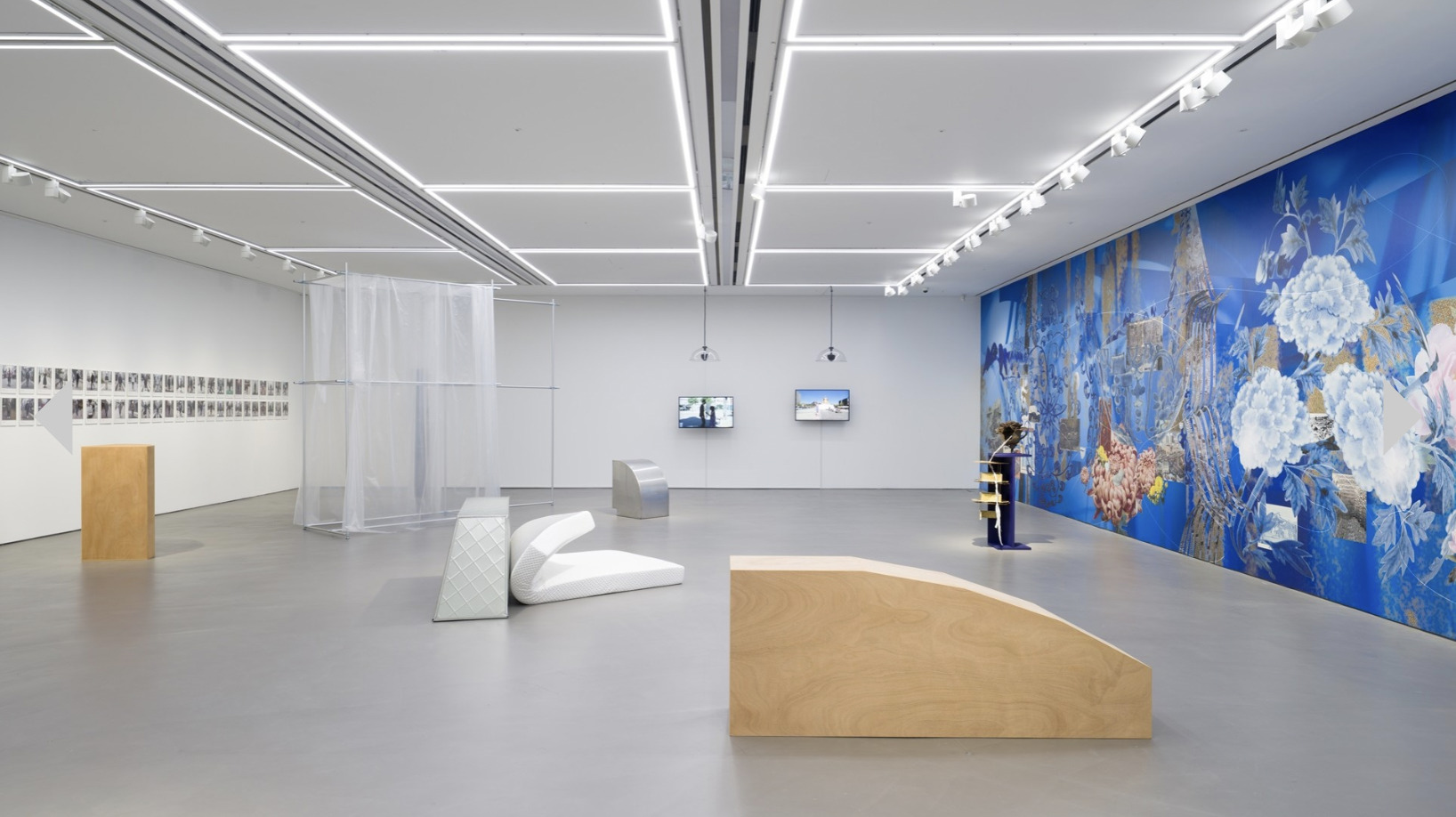
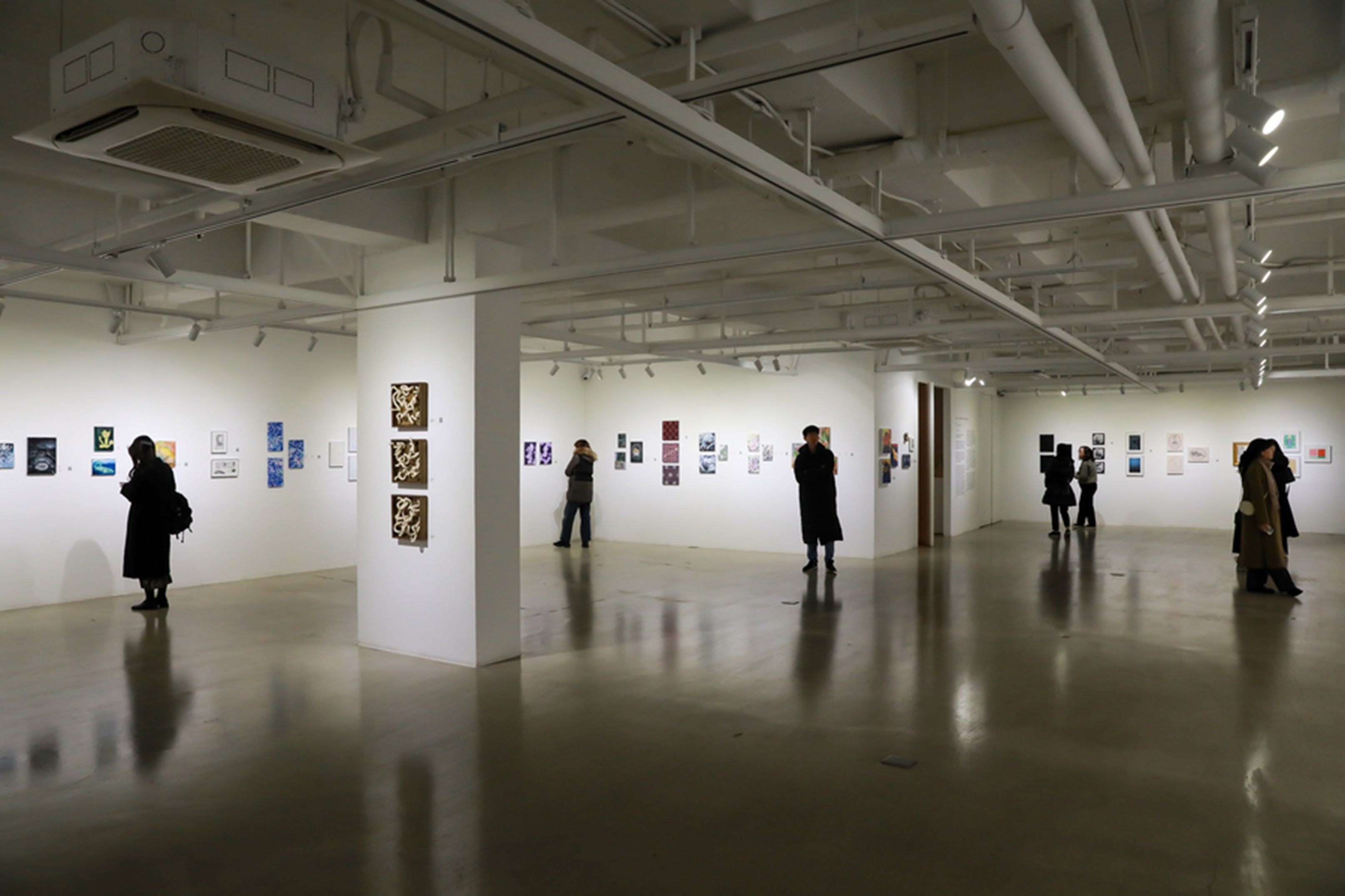
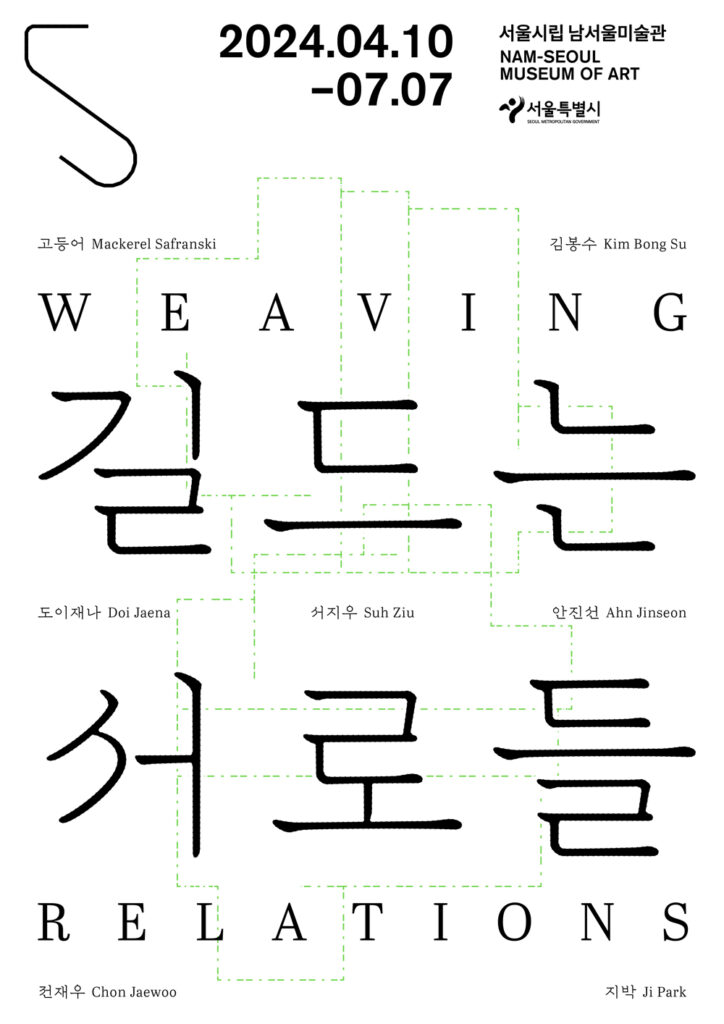
Ahn has also participated in numerous group exhibitions, including 《(non)Blind-Spot》 (PS CENTER, Seoul, 2025), 《Ringing Saga》 (DOOSAN Gallery, Seoul, 2025), 《Piece of Us》 (Dohing Art, Seoul, 2024), 《Weaving Relations》 (Nam-Seoul Museum of Art, Seoul, 2024), 《Solid, Weak, Temple》 (Chamber, Seoul, 2023), 《Fluid Floor》 (Boloc, Seoul, 2022), and 《Plasticized Construction》 (SeMA Storage, Seoul, 2021).

Works of Art

The Exploration Process of Anxiety

Originality & Identity

Jinseon Ahn explores moments of anxiety and vibration sensorially experienced within urban environments. Beginning with Maps (2017), her method of collecting scenes from the city from an observer’s perspective captures the point where bodily sensations and the physical structure of the city intersect. The artist does not define subtle bodily sensations produced by the city—its sound, vibration, and tilting—as mere discomfort, but sees them as a starting point for perception and as a point of transition that provokes curiosity.

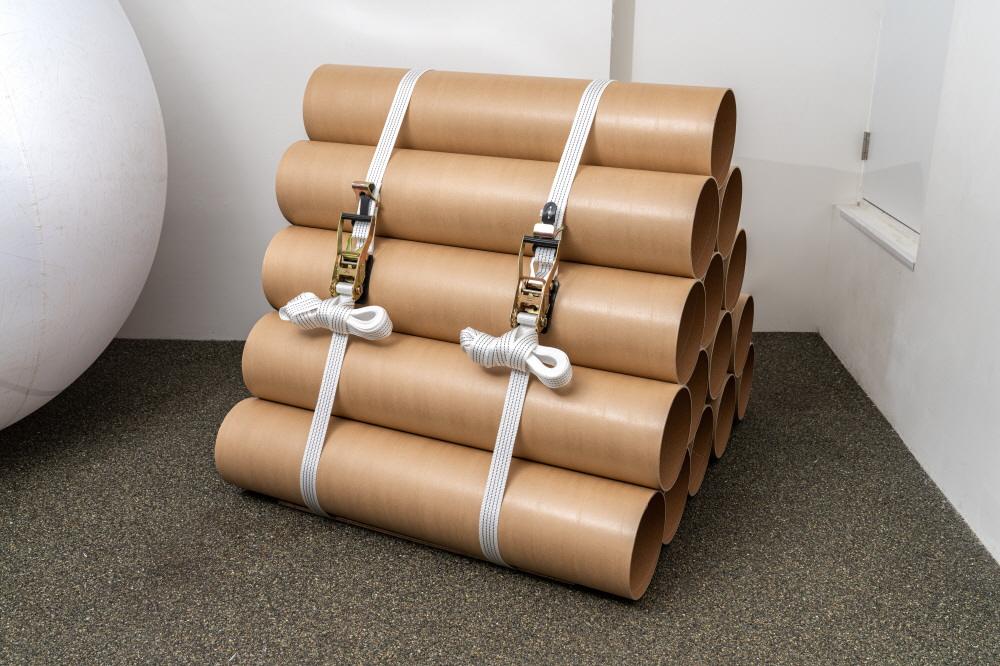
In her solo exhibition 《Throbbing, Moving, Stopped》 (Mueumsanbang, 2023), this concern expands into a spatial sense of anxiety through the use of materials that directly evoke urban experience—paper pipes, metal sheets, cement, and fabric. Works such as White Ball (2017), Throbbing Ground (2023), and Viaduct (2023) transform structural forms that resemble urban infrastructure into sensations of trembling and drop, guiding the viewer back to an embodied experience of the city.

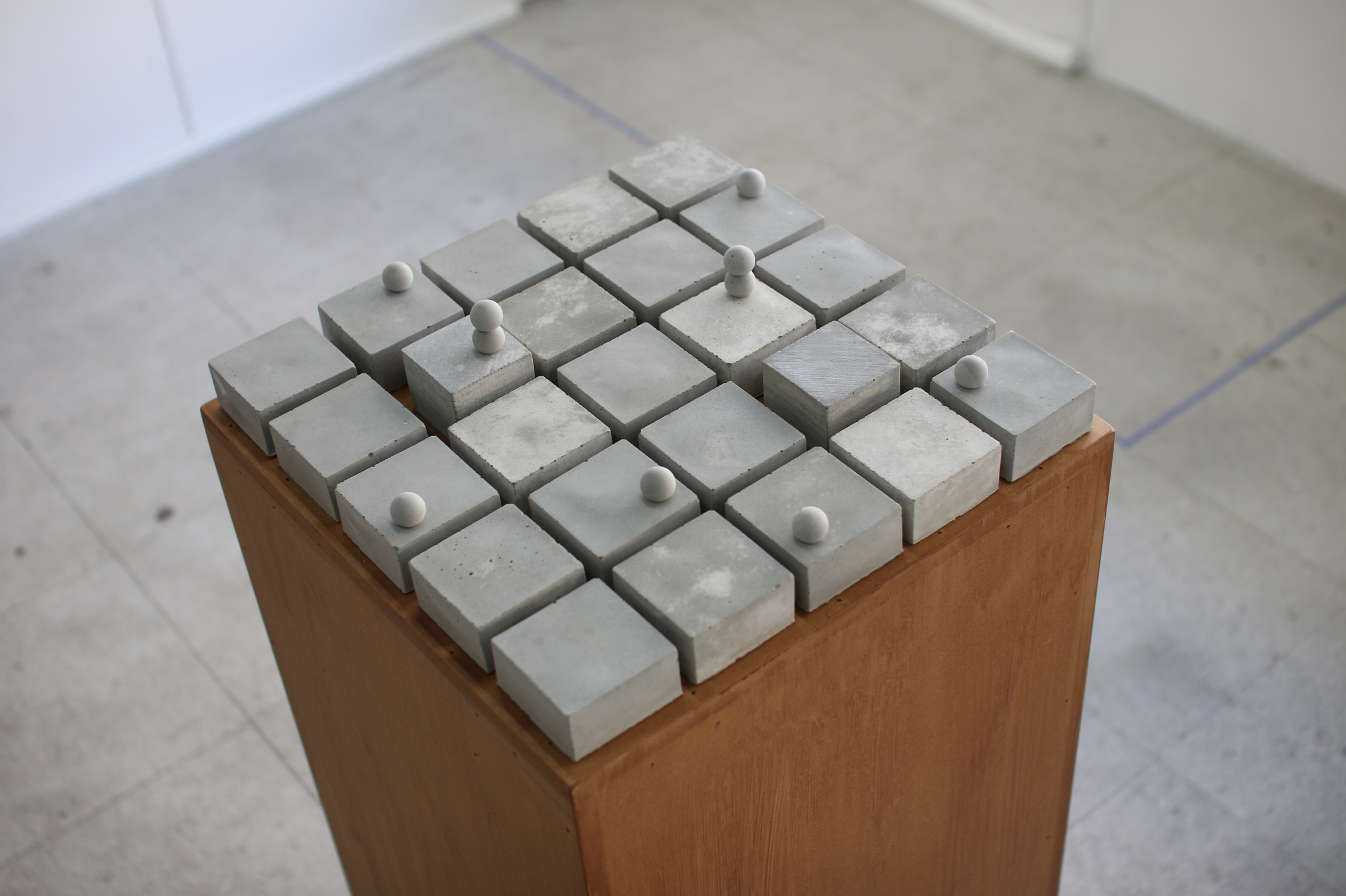
In the recent group exhibitions 《Weaving Relations》 (Nam-Seoul Museum of Art, 2024) and 《Solid, Weak, Temple》 (Chamber, 2023), the artist’s focus shifts from bodily sensibility within urban space to the landscape of reconstruction and rearrangement. For instance, Urban Model Study (2024) and the ‘Sliding Edge’ (2023) series reorganize structural and invisible elements of the city into a new relational system. Furthermore, in 《Ringing Saga》 (DOOSAN Gallery Seoul, 2025), this concern expands into observations on the repetitive collapse and architectural cycles of the city. Works such as Bookshelf (2025), Drawer Cabinet (2025), and Mattress (2025), named after objects collected from the streets, emerge as metaphorical representations of the city’s life cycle.

Thus, Ahn’s practice starts from personal sensations and then rearranges the structures, materiality, and landscape of the city, transforming the sensory experience of anxiety and vibration into visual experience. The perspective that reads the city as an ecological and social system forms a consistent thread throughout her work.

Style & Contents

Formally, Ahn composes unstable structures by assembling everyday urban materials—cement, iron, fabric, paper pipes, paint, and wood—and presents them as installation works. In earlier works such as Maps and White Ball, she focuses on oscillation and buoyancy, visualizing a state of unstable equilibrium.

In the solo exhibition 《Throbbing, Moving, Stopped》, the objects are not simply placed in space but configure the entire space into an unstable state. Throbbing Ground and Viaduct reveal both stability and instability through contrasting materials and conditions—weight and lightness, fixed and mobile. This approach manifests as a sculptural language that imitates or overturns combinations of structures commonly found in urban space.

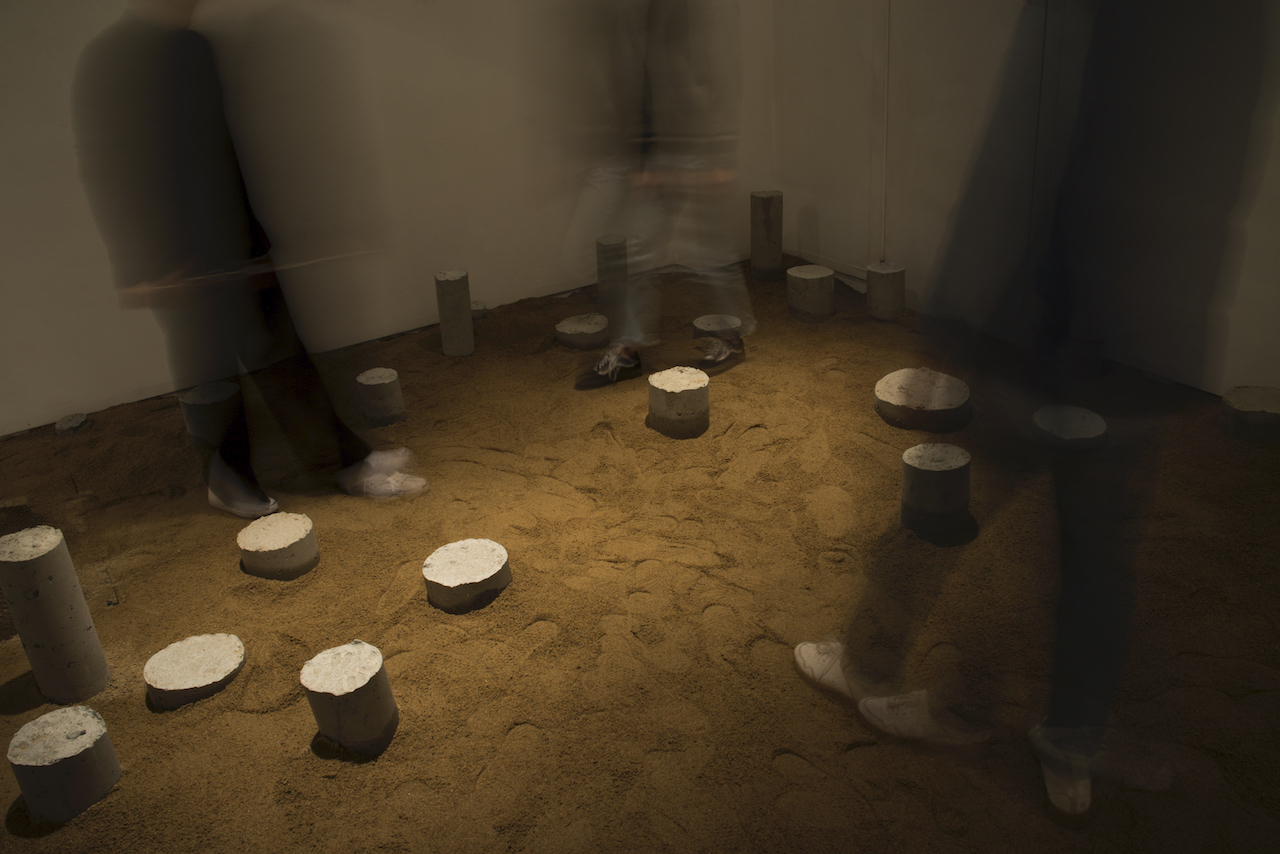
The ‘Sliding Edge’ series presented in the group exhibition 《Solid, Weak, Temple》 transforms architectural structures into provisional forms and expands into installations that react to the movements and vibrations of the audience. Later, Urban Model Study shown in 《Weaving Relations》 disassembles and reconstructs the city into an assemblable model, with objects entangled to form new structural relationships.

The new works from 《Ringing Saga》 visualize traces of structural replacement and urban remnants by reconstructing discarded and displaced objects from the cityscape. In this way, Ahn’s formal approach has expanded from the repetitive combination of objects to designing the structure of space itself, developing into installations in which the physical presence and movement of the viewer become part of the work.

Topography & Continuity

Ahn’s work does not treat the city as a solid architectural system, but rather as a network of unstable sensations and provisional structures. In this sense, her practice occupies a distinct position within the field of sculpture and installation. In particular, the way she combines urban materials and connects them to bodily experience through spatial engagement aligns with a formal sensibility that directly links public environments to physical perception.

While her early works began by comparing personal sensations with the physical conditions of urban space, later works expand into structural layers, architectural residues, and cycles of reproduction and abandonment. As seen in exhibitions such as 《Weaving Relations》 and 《Ringing Saga》, the artist translates the invisible structures beneath the surface of the city into visual language, establishing her own sculptural vocabulary for rearranging the urban landscape.

For Ahn, space is not a rigid and stable structure but a constantly vibrating and transforming scene. Her work, which focuses on unstable balance and provisional architecture, suggests further possibilities in multi-sensory spatial configurations that embrace the viewer’s physical experience. Her practice will likely continue to develop beyond the study of cities and spaces into a direction that considers urban ecology in relation to social and environmental change.

Works of Art

The Exploration Process of Anxiety

Articles

Exhibitions

Activities