The Second Night - K-ARTIST

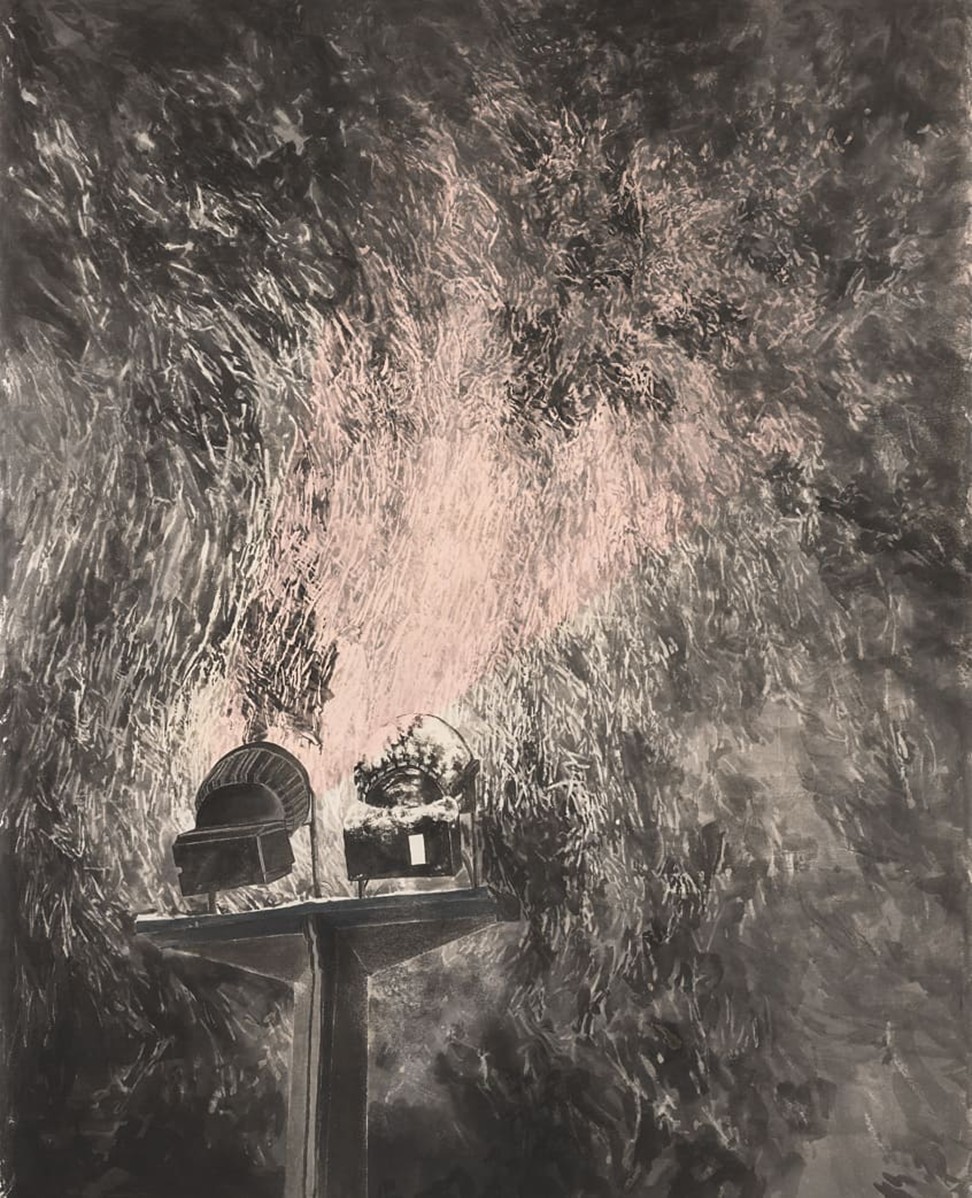
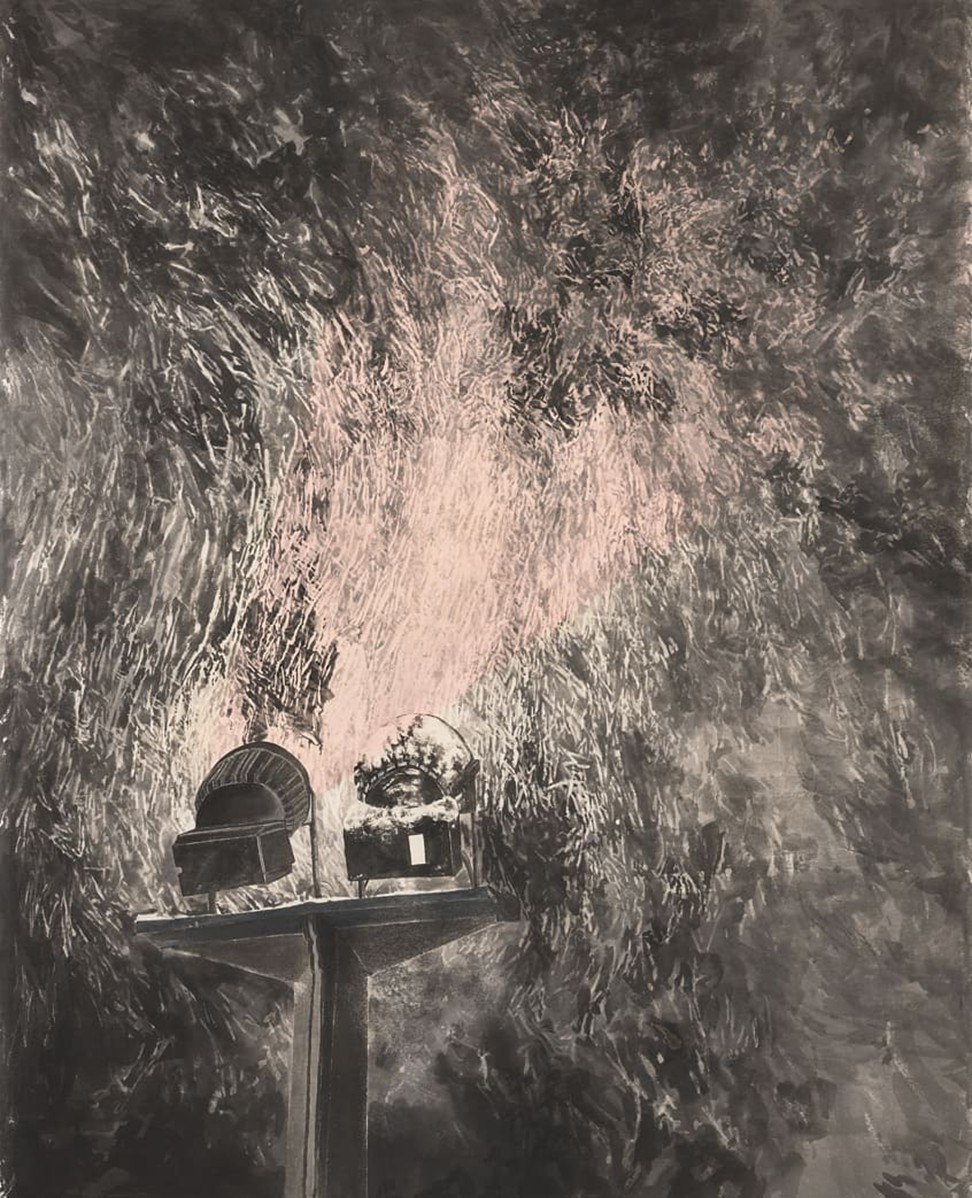
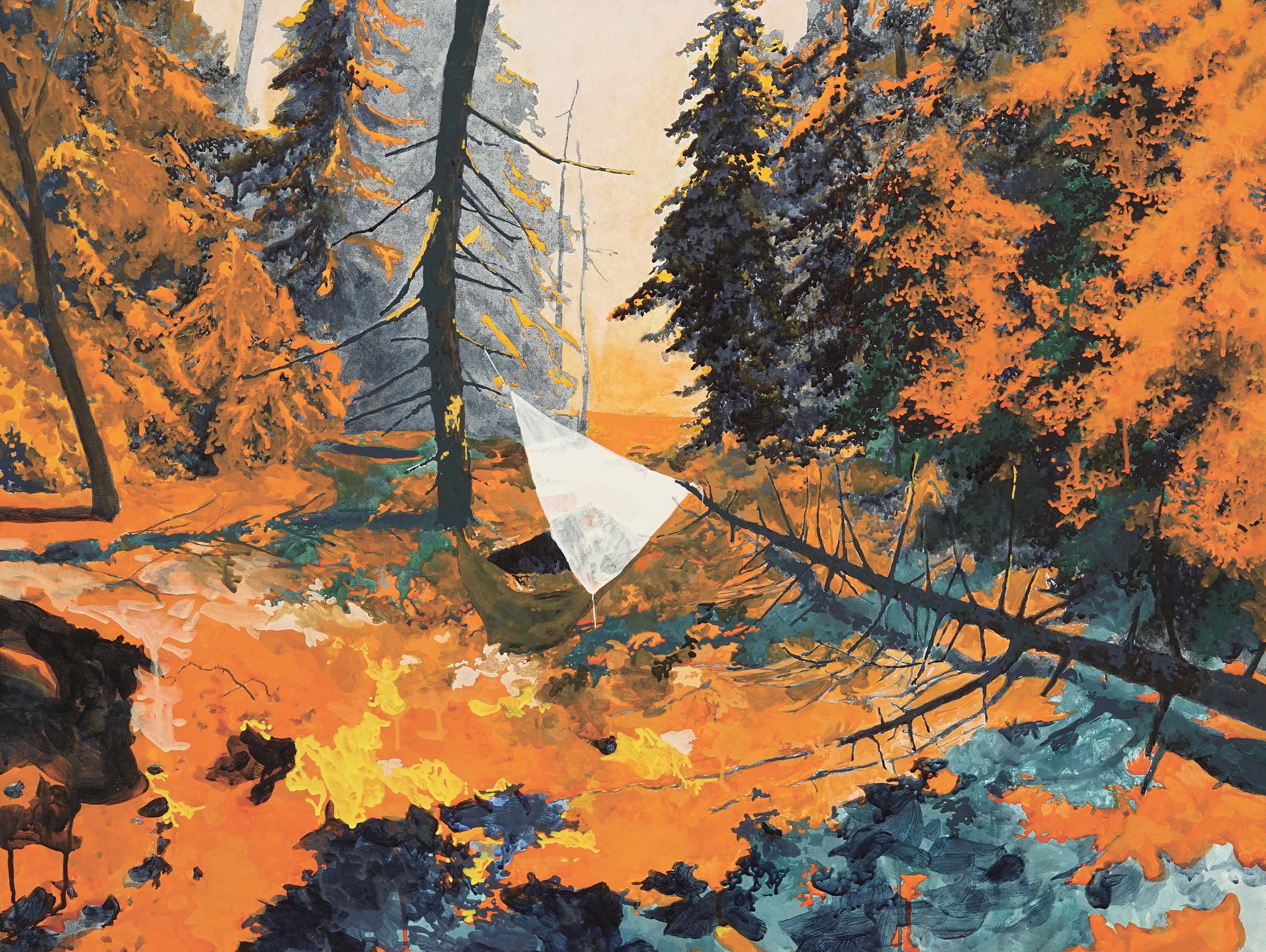
The Second Night

2021
Ink on handmade paper
160 × 132 cm
About The Work

Joo Hyeongjoon has developed a body of work that unfolds the world of the unconscious as it appears in dreams, grounded in the traditional materials of paper, brush, and ink. Reinterpreting Eastern philosophy and traditional media through a contemporary lens, the artist continuously experiments with ways of recording “emptiness” (yeobaek) and imagined narratives as perceived from the perspective of modern life.
 
Joo Hyeongjoon’s work begins with recording the anxieties of reality reflected in his own unconscious through text, which he then reconstructs into the visual language of painting. He primarily employs traditional painting as his medium, his work ultimately speaks to the lives of countless ordinary people today.
 
By filling the gap between the subject of representation and the painting—between reality and imagination—with his own visual language, his practice mirrors the experience of confronting the distance between one’s ideals and the realities of contemporary life. Through the careful negotiation between past and present, reality and aspiration, Joo’s completed paintings offer ordinary viewers a sense of healing and comfort.

Solo Exhibitions (Brief)

Joo’s major solo exhibitions include 《In My Darkest Moments, Even My Own Shadow Abandons Me》 (Kumho Museum of Art, Seoul, 2025), 《Where the White Hawk Stayed》 (Sahng-up Gallery, Seoul, 2023), 《Complete Association》 (SHIFT, Seoul, 2020), and 《SAFEGUARD》 (Shinhan Gallery, Seoul, 2019).

Group Exhibitions (Brief)

Joo has also participated in numerous group exhibitions, including 《A Very Long Worrying Future》 (Kyobo Art Space, Seoul, 2025), the 25th Danwon Art Festival Selected Artists Exhibition 《Here, Encounter》 (Kimhongdo Art Museum, Ansan, 2024), Our Volume (Sangchonjae, Seoul, 2023), and Festival GIHOEK 2020 (Oil Tank Culture Park, Seoul, 2020).

Awards (Selected)

Joo was selected as the 22nd Kumho Young Artist.

Residencies (Selected)

Joo has participated as a resident artist at the Gachang Art Studio in Daegu (2020) and at Gong Art Space in Beijing, China (2013).

Works of Art

The Unconscious World that Appears in Dreams

Originality & Identity

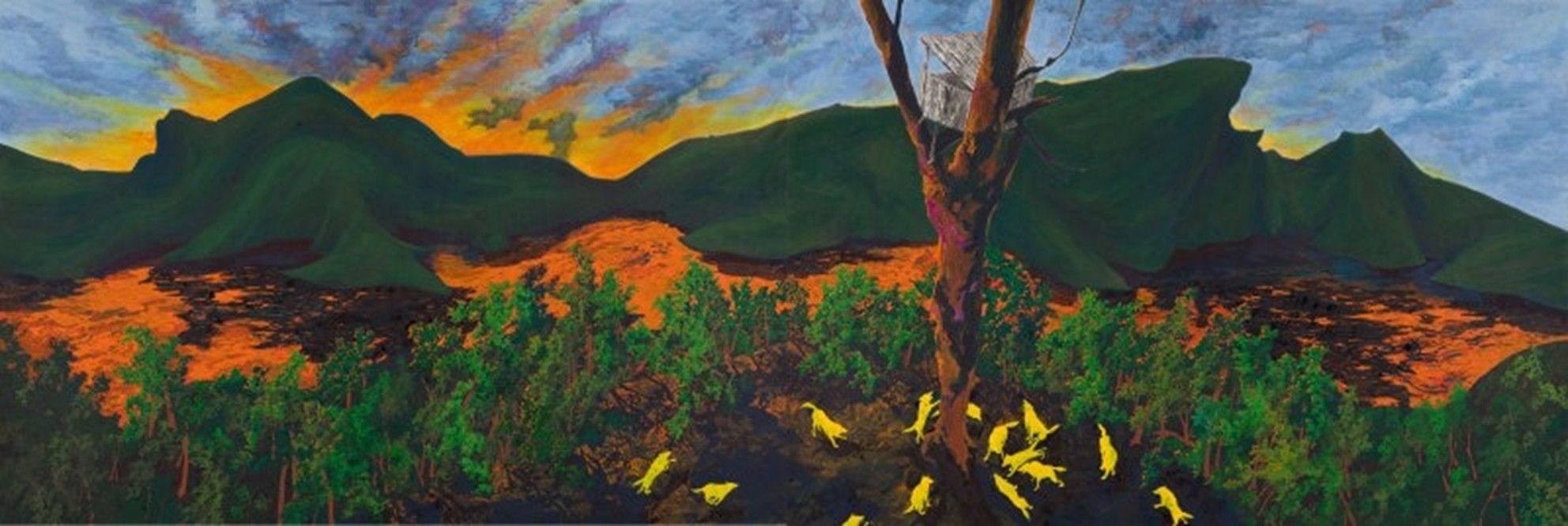
Joo Hyeongjoon’s practice begins from a sense of anxiety and the defense mechanisms of the inner self. His early ‘Shelter’ (2017) series visualized the psyche’s desire to escape from real-world anxiety by transforming it into pictorial space. Such anxieties are transposed into symbolic elements—wolves, light, walls, and houses—each reflecting the artist’s own lived experience. In his solo exhibition 《SAFEGUARD》(Shinhan Gallery, 2019), Joo visualized the process through which the self perceives and responds to anxiety, staging a confrontation between light and its defensive counterpart. He regarded anxiety not as a feeling to be avoided, but as a fundamental energy that sustains the self.

In his 2020 solo exhibition 《Complete Association》(SHIFT), psychological anxiety expands into a structure of perception. Drawing on the concept of “perceptual completion,” Joo translated the human tendency to infer and complete a whole from fragmented images into a pictorial device. The absence and gaps found in reality were transformed into “emptiness” within the picture plane—spaces that reflect the human unconscious striving to compensate for an imperfect world through imagination.

Later, in 《Where the White Hawk Stayed》(Sahng-up Gallery, 2023), he addressed the issue of desire, expanding from personal anxiety to social narrative. The artist reimagined the wishes of ordinary people as mythic narratives, depicting universal human aspirations. This marked a shift from exploring individual psychology in his early work toward engaging with collective desires embedded in the contemporary condition.

In his most recent solo exhibition 《In My Darkest Moments, Even My Own Shadow Abandons Me》(Kumho Museum of Art, 2025), presented after being selected as the 22nd Kumho Young Artist, the fictional figure “Q” embodies this transformation. Q is a being who seeks light within despair, symbolizing both the artist himself and the shared inner life of all individuals. Joo Hyeongjoon’s paintings thus evolve as psychological narratives that take inner anxiety as a point of departure, exploring the balance between reality and ideal, individual and collective, darkness and light.

Style & Contents

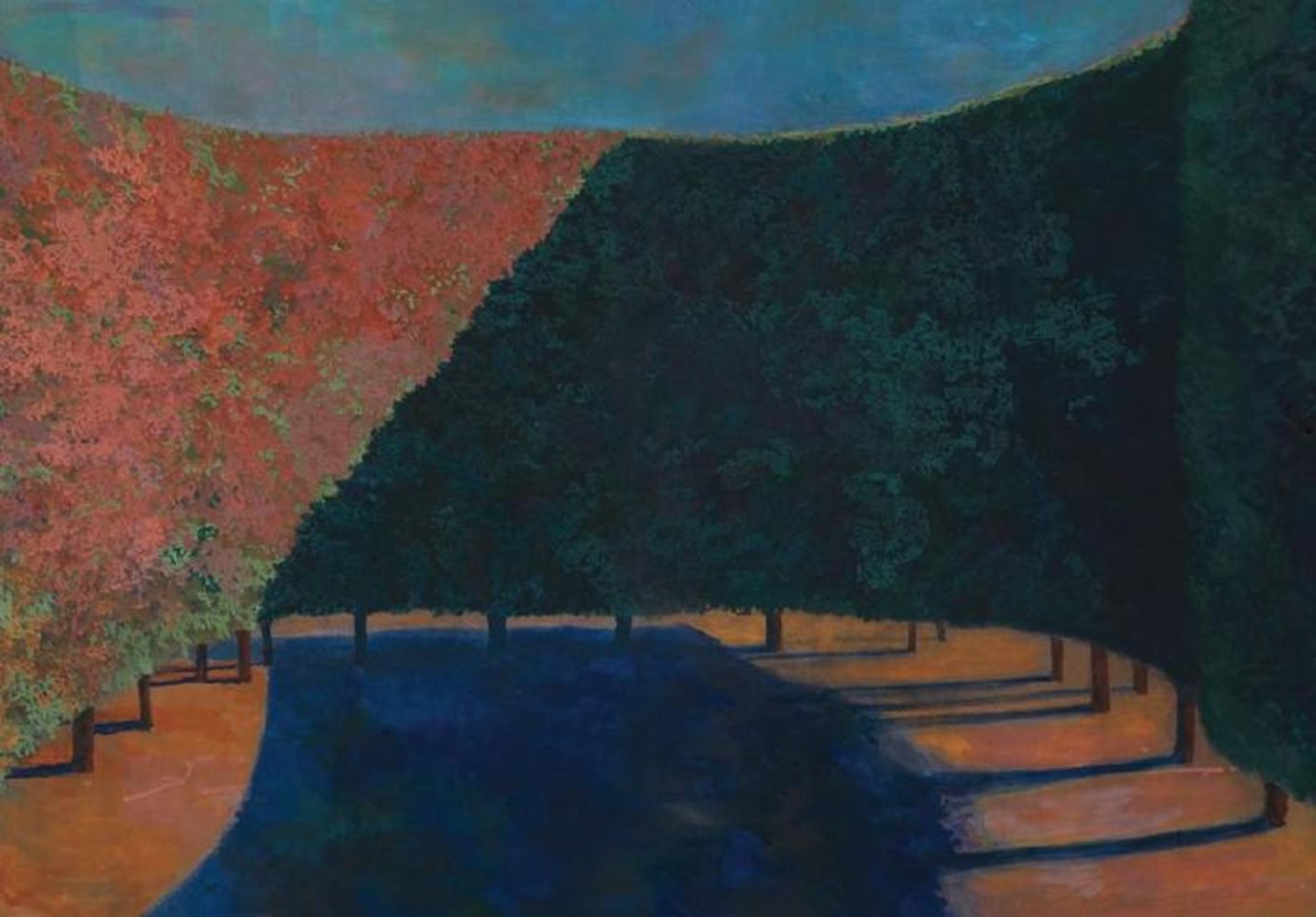
Joo Hyeongjoon works primarily with traditional East Asian materials—paper, brush, and ink—yet continuously reinterprets them through a contemporary lens. In his early ‘Safeguard’ (2019) series, he employed both ink and color to construct symbolic oppositions, expanding emotional tension through the spatial interplay of light and geometric forms. The geometric shapes in Safeguard act as the self’s defensive mechanisms against anxiety, existing at the intersection between natural imagery and artificial structure.

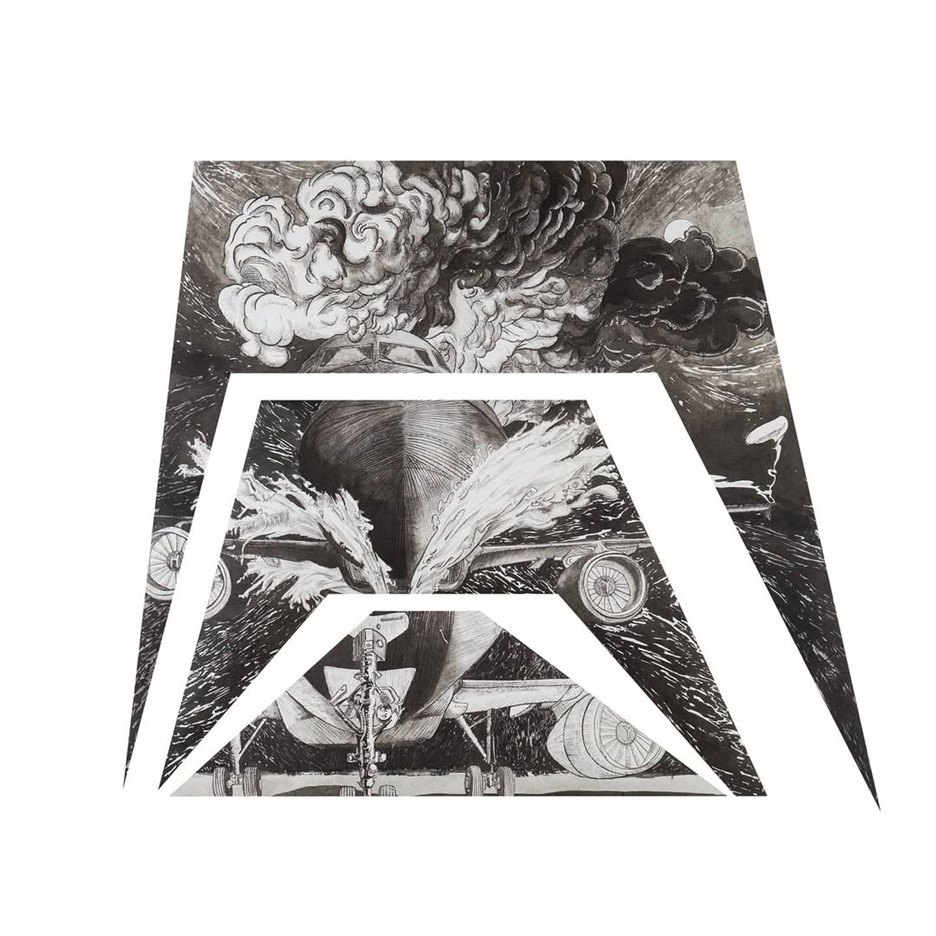
In 《Complete Association》, he cut and reassembled his previous paintings to guide an active mode of viewing through the relationship between parts and whole. This approach can be seen as a reinterpretation of the traditional East Asian notion of yeobaek (emptiness) as a psychological and perceptual framework. Utilizing both the jungchae (重彩) method of layering pigments and the junbeop (皴法) brush technique, he expressed internal anxiety through the tonal and textural qualities of ink. The interplay of black and white and the intentional voids within the surface function as visual devices that reveal the “in-between” spaces of the image.

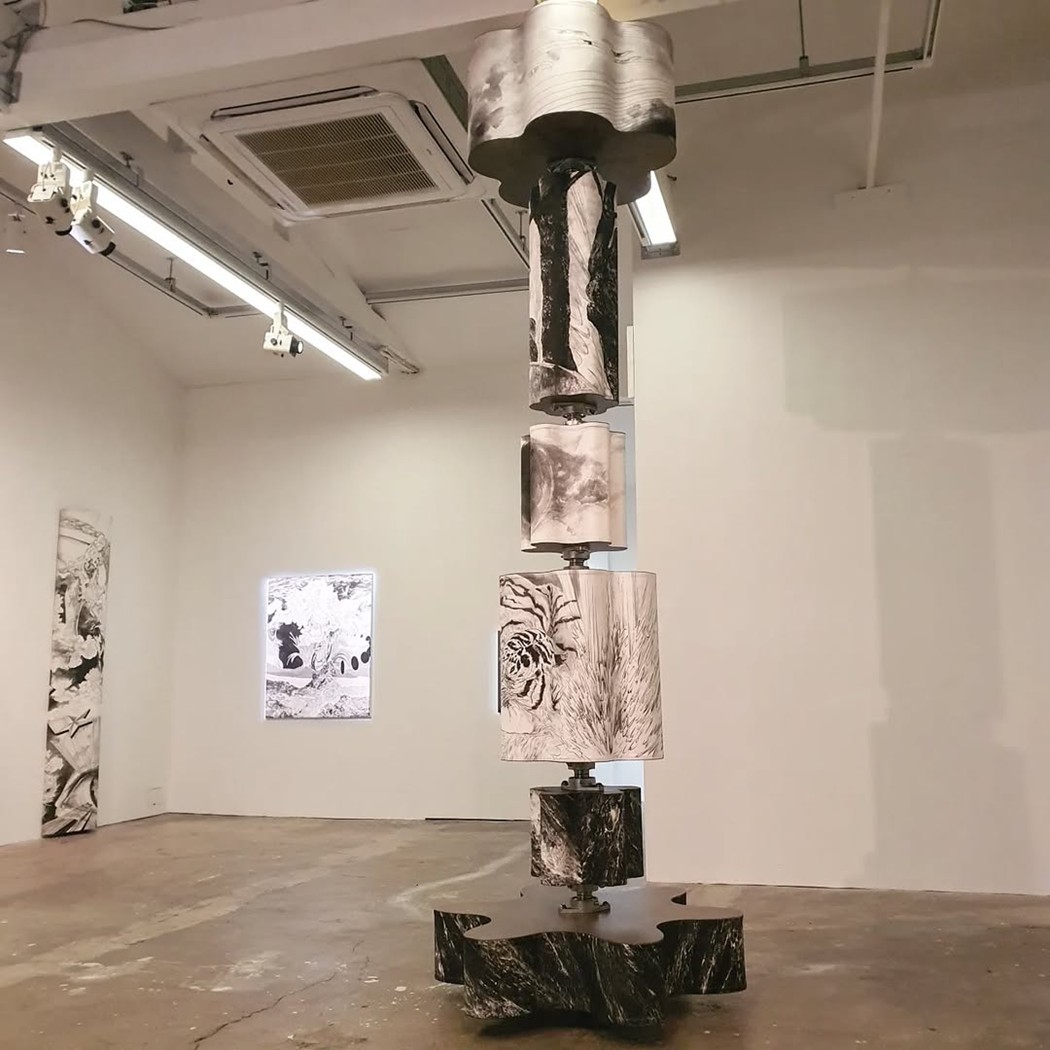
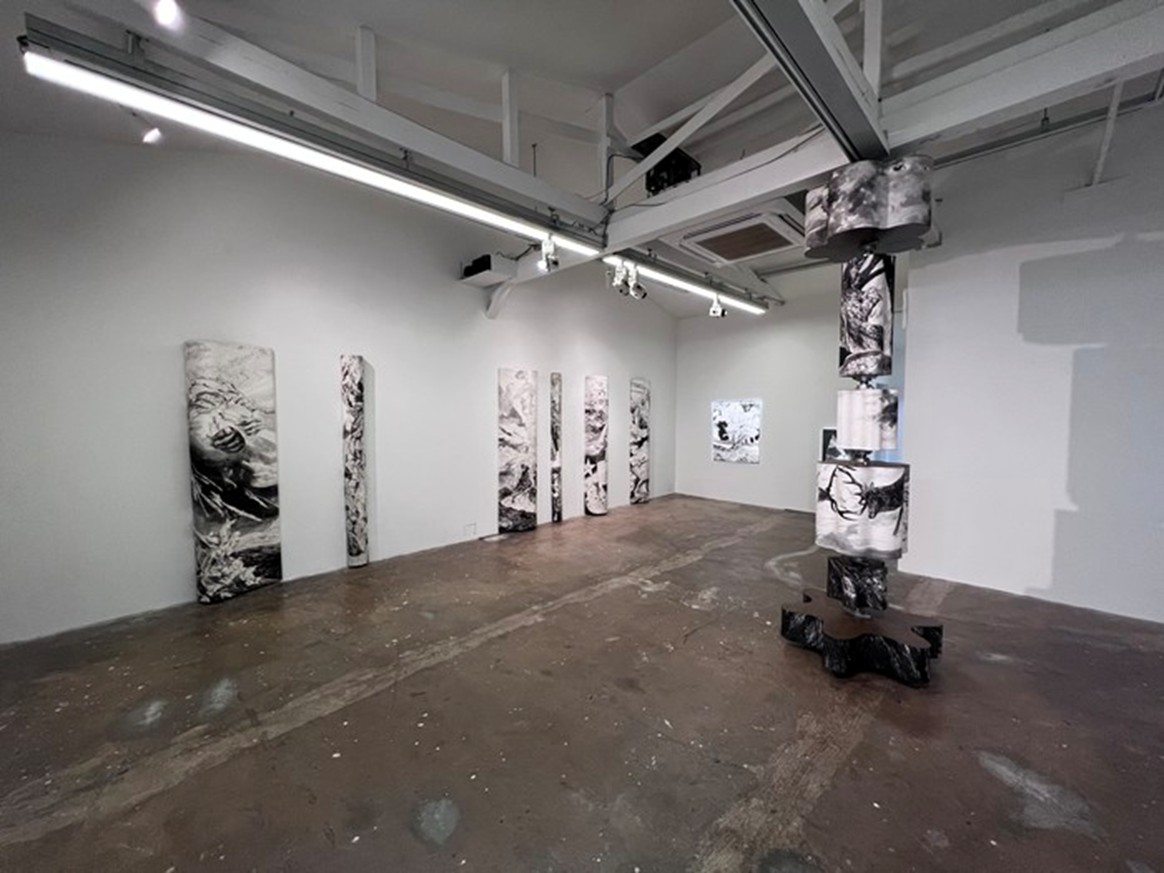
In 《Where the White Hawk Stayed》, the pictorial plane expands into a three-dimensional structure. His tower-shaped sculptural paintings symbolically stack personal wishes, leading the viewer to move around the work in a circular path. This embodies the artist’s central theme of “desire” in physical form—transforming painting into a spatial and narrative experience.

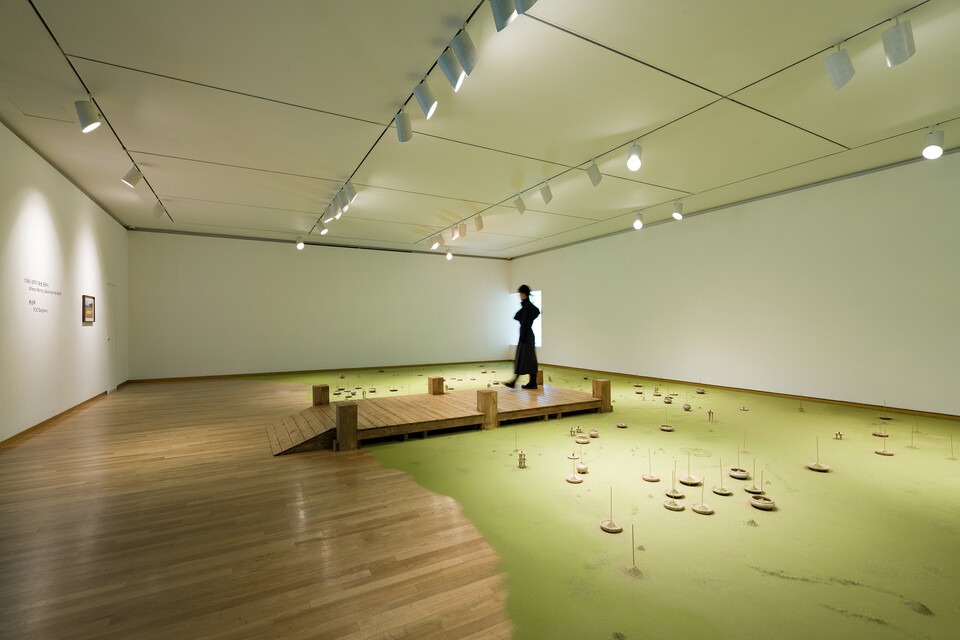
In 《In My Darkest Moments, Even My Own Shadow Abandons Me》, painting once again extends into the spatial dimension of installation. Fragmented canvases and paintings placed upon protruding structures form a continuous narrative, while the flow of linear brushwork follows the emotional trajectory of the character Q. Moving beyond representation, Joo constructs a sensory narrative that traverses the boundaries between light and darkness, structure and emptiness, surface and space.

Topography & Continuity

Joo Hyeongjoon works primarily with traditional East Asian materials—paper, brush, and ink—yet continuously reinterprets them through a contemporary lens. In his early ‘Safeguard’ (2019) series, he employed both ink and color to construct symbolic oppositions, expanding emotional tension through the spatial interplay of light and geometric forms. The geometric shapes in Safeguard act as the self’s defensive mechanisms against anxiety, existing at the intersection between natural imagery and artificial structure.

In 《Complete Association》, he cut and reassembled his previous paintings to guide an active mode of viewing through the relationship between parts and whole. This approach can be seen as a reinterpretation of the traditional East Asian notion of yeobaek (emptiness) as a psychological and perceptual framework. Utilizing both the jungchae (重彩) method of layering pigments and the junbeop (皴法) brush technique, he expressed internal anxiety through the tonal and textural qualities of ink. The interplay of black and white and the intentional voids within the surface function as visual devices that reveal the “in-between” spaces of the image.

In 《Where the White Hawk Stayed》, the pictorial plane expands into a three-dimensional structure. His tower-shaped sculptural paintings symbolically stack personal wishes, leading the viewer to move around the work in a circular path. This embodies the artist’s central theme of “desire” in physical form—transforming painting into a spatial and narrative experience.

In 《In My Darkest Moments, Even My Own Shadow Abandons Me》, painting once again extends into the spatial dimension of installation. Fragmented canvases and paintings placed upon protruding structures form a continuous narrative, while the flow of linear brushwork follows the emotional trajectory of the character Q. Moving beyond representation, Joo constructs a sensory narrative that traverses the boundaries between light and darkness, structure and emptiness, surface and space.

Works of Art

The Unconscious World that Appears in Dreams

Articles

Exhibitions

Activities