

Same Thing - K-ARTIST

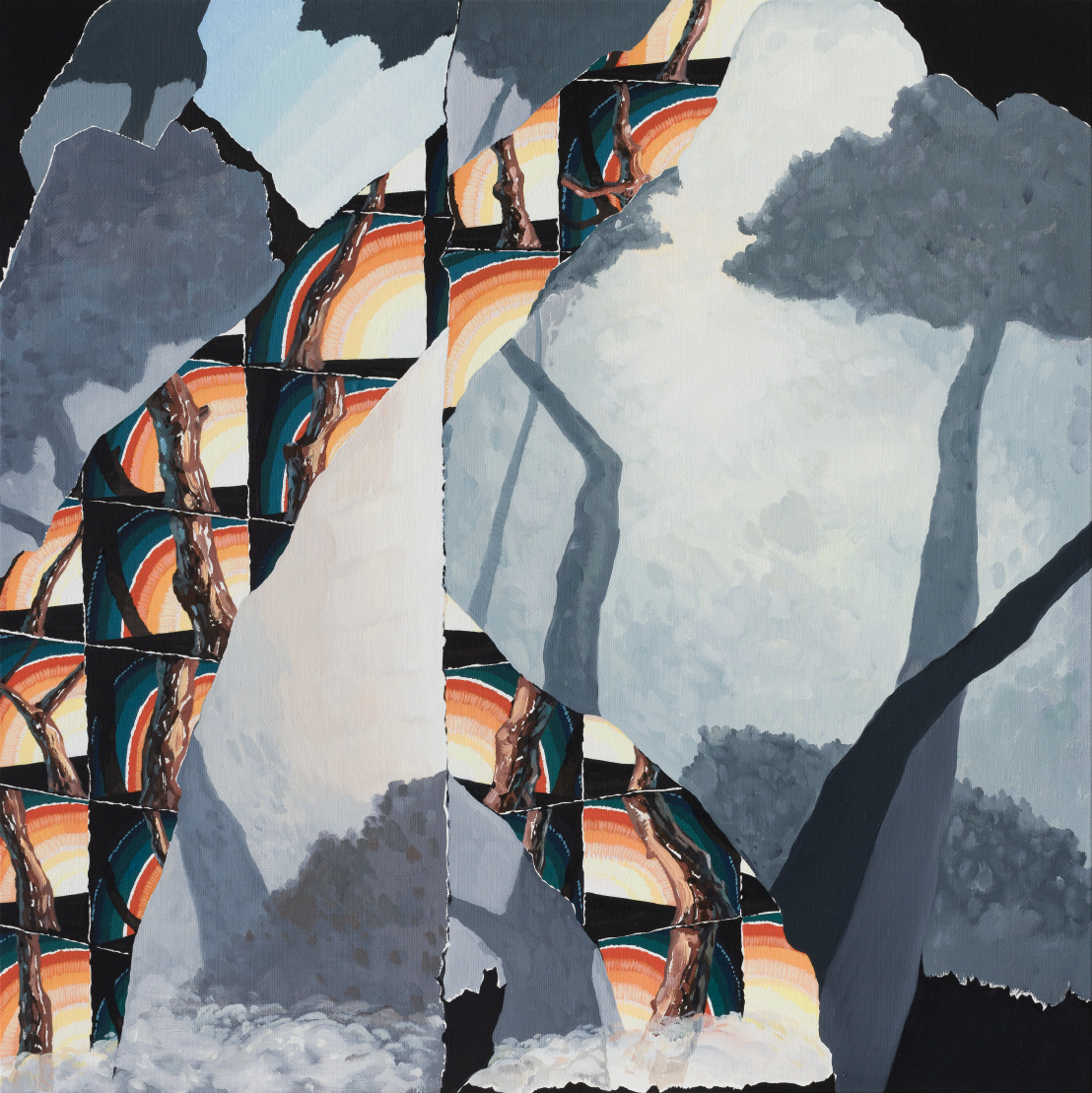
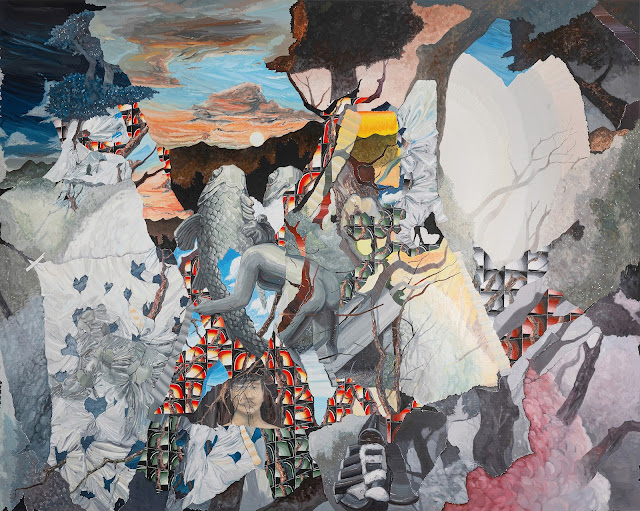
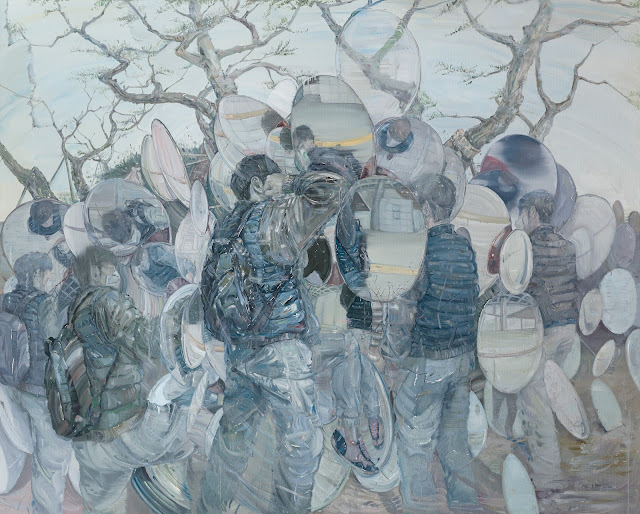
Same Thing

2018
Oil on canvas
130.3 x 97.0 cm
About The Work

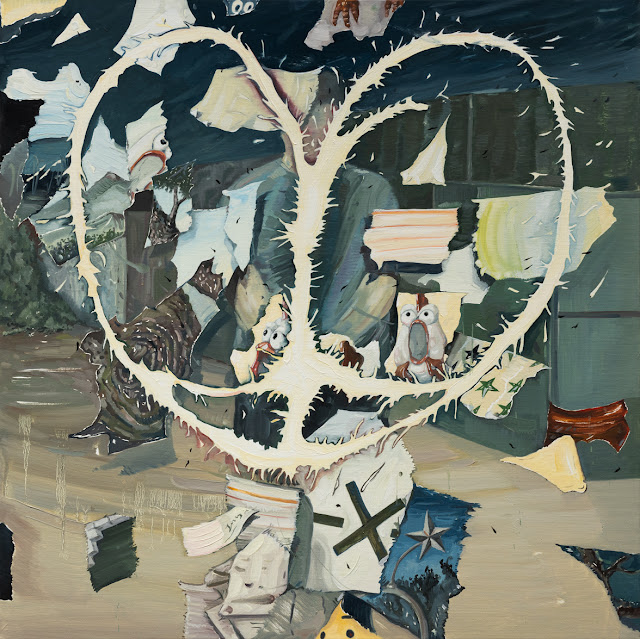
Jungin Kim has been creating what he calls “open paintings,” in which seemingly unrelated fragments of memory are placed together on a single canvas, prompting viewers to lose their way within the work and imagine their own stories. These fragments of memory, akin to pixels, are regarded as individuals; through the process of grafting them onto the canvas, an image of “solidarity” emerges. 
 
Jungin Kim’s paintings can be read as a form of resistance against the invisible pressures—or power—that disrupt and homogenize society, the very forces underlying social change. The “image solidarity” that he constructs on canvas by gathering marginalized fragments from the peripheries of his life and memory conceals each piece’s specific time, space, content, and meaning, twisting them into forms that lack relational coherence and retain an inherent ambiguity. 
 
The ambiguity created through this entanglement functions as a strategy of resistance against power in his work. By leading viewers to lose themselves, wander, and seek meaning within the uncertainty, he experiments with possibilities for imagination, critical perspective, subjectivity, and the restoration of judgment through painting.

Solo Exhibitions (Brief)

Kim’s solo exhibitions include 《Pixel Memory》 (Laheen Gallery, Seoul, 2023), 《Image Union》 (SeMA Storage, Seoul, 2022), 《Record of Fragments》 (Sungkok Art Museum, Seoul, 2022), and 《Image not able to be melted by harsh waves of change》 (Leeungno Museum, Daejeon, 2021).

Group Exhibitions (Brief)

Kim has also participated in numerous group exhibitions, including 《Layers of Now》 (Space458, Seoul, 2025), 《Perigee Winter Show 2024》 (Perigee Gallery, Seoul, 2024), 《Mussolini Podcast》 (Amado Art Space, Seoul, 2024), 《Mono Mansion》 (Outhouse, Seoul, 2023), 《NANJI ACCESS with PACK : Mbps》 (Seoul Museum of Art, Seoul, 2022), and 《Edited Landscape》 (Gana Art Busan, Busan, 2022).

Awards (Selected)

Kim was selected for the SeMA Emerging Artists (2022) and Sungkok Art Museum (SAM) Open Call (2022), and he was a semi-finalist in the ‘2025 Kiaf HIGHLIGHTS’.

Residencies (Selected)

Kim was selected for Art village Chuncheon residency.

Collections (Selected)

Kim’s works are held in collections including the MMCA Art Bank, the Museum Department of Seoul City Hall, and more.
Works of Art

The Strategy of Resistance Against Power

Originality & Identity

Jungin Kim’s paintings originate from an imaginative act of reconstructing the world through fragmented memories. He divides and reassembles ambiguous images lingering in the mind like “pixels,” visually articulating the incomplete structure of memory through painting. Early works such as On-Site Atmosphere 1(2017), Dull People(2017), and Negative Gaze(2017) reflect the anxiety, alienation, and skepticism an individual feels amid rapid urban redevelopment and environmental change. Yet the artist’s interest does not remain at a socially critical narrative. Within the same conditions of change, he seeks a sense of relationship freed from anthropocentric vision through beings that have adapted to their environments—such as trees or animals—rather than through humans themselves.

Since 2018, Kim has gradually dismantled the boundaries between human and nature, subject and non-human. In works like Discoloring Space(2018), Objects that depend on each other(2019), and Hiding Man(2020), the forms of trees and humans overlap and blur, erasing any hierarchy of existence. This marks a point at which the artist expands his focus toward “relationships” themselves, creating a field where fragments of different times and memories collide and coexist. In his solo exhibition 《Image not able to be melted by harsh waves of change》(Leeungno Museum, 2021), he reassembled discarded objects, debris, and forgotten scenes to visualize a painterly “solidarity of images” that resists the current of society (Image Union(2021)).

In his 2023 solo exhibition 《Pixel Memory》(Laheen Gallery, 2023), these fragments of memory become systematically structured through the unit of the “pixel.” By layering and overlapping traces of the past, the artist proposes a slow painting that resists the accelerating pace of forgetting. Trees, fabrics, figures, and sketches no longer serve as subjects of representation but as units of memory, and their combination expands into a field of multi-layered associations rather than a single narrative. Ultimately, Kim’s paintings lead us to contemplate an open pictorial world where “not one truth but multiple memories coexist.”

Style & Contents

Kim’s formal experimentations can be summarized as a fluidity that exists at the boundaries between division and connection, plane and volume, representation and non-representation. In his early works, he rendered human figures and urban ruins in near-monochrome tones or blurred forms, dismantling anthropocentric narratives. His compositions depart from traditional arrangements, forming psychological spaces through unstable shifts in perspective and subtle gradations of gray.

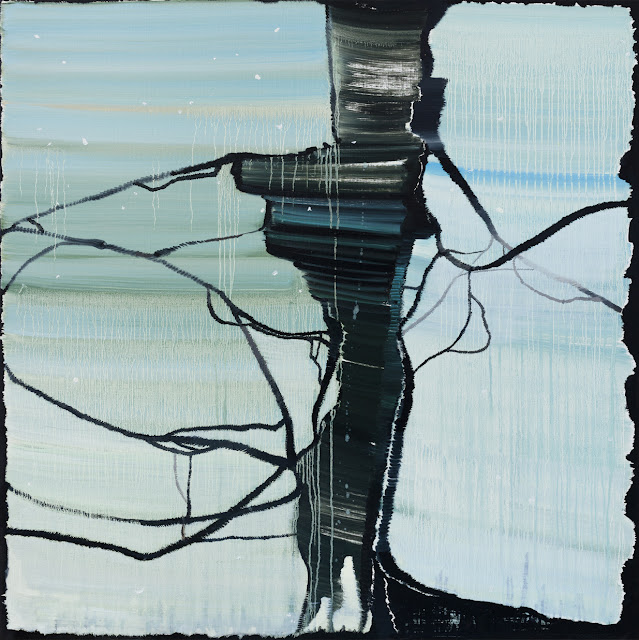
The artist also focuses on mirrors as devices of spatial division within the canvas. Confusion by the Mirror(2020) and Path to a Tree(2020) overlap reflections and distortions, superimposing multiple layers of reality and posing a pictorial question about “the difference between seeing and experiencing.” This fragmented visual structure later develops into the collage-like compositions that define his recent works.

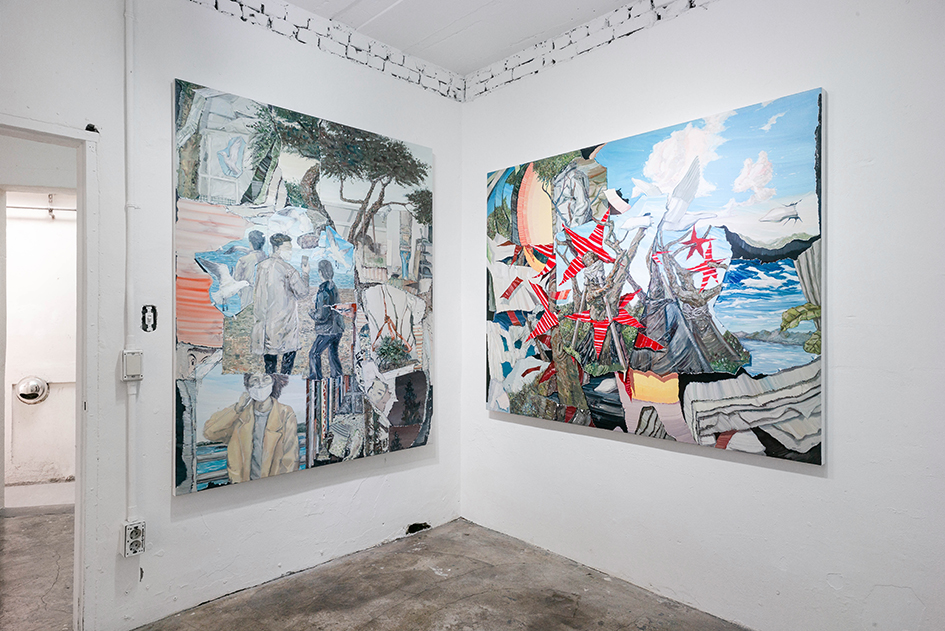
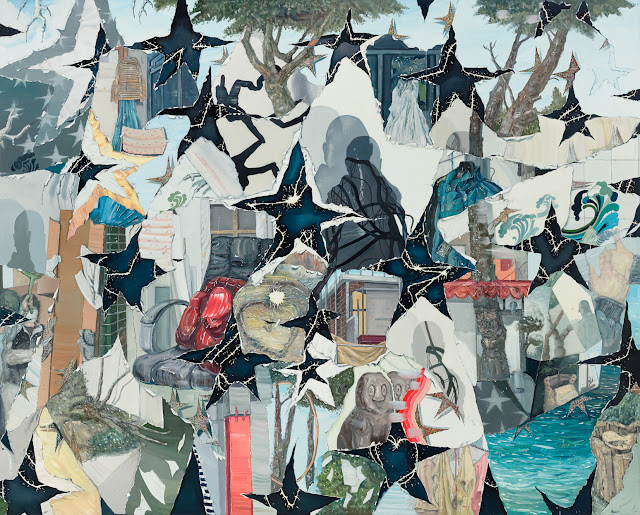
Kim’s images appear as if cut from different layers of memory and taped together. Works such as The inextinguishable flame(2021), A Star Made of Debris(2021), and How I look at the scenery 1(2022) create gaps of meaning as heterogeneous fragments interact with one another. For the artist, what matters is not representational completeness, but the relationships formed between fragments—and the empty intervals that connect them.

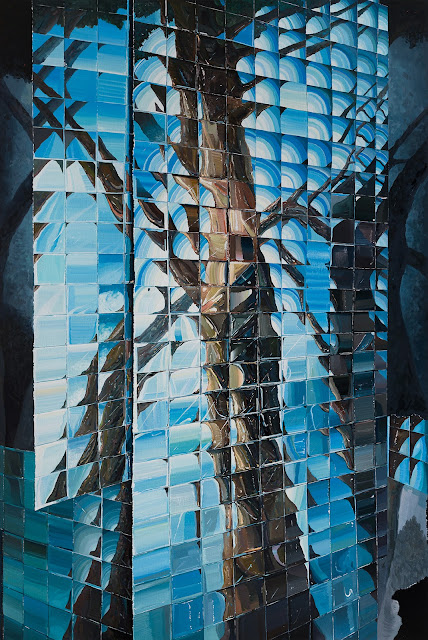
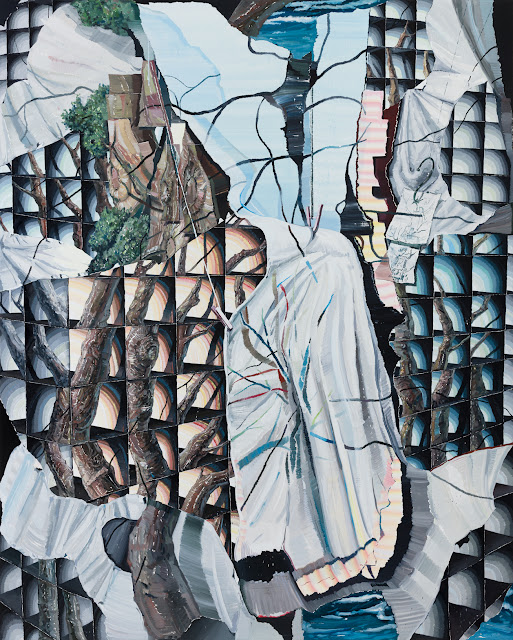
In his recent works from 《Pixel Memory》, including Memories becoming clearer(2023), Sum of memory slices(2023), and Rewind(2025), the canvas is divided into a grid-like pattern of pixel units. The repetition of cubic forms generates a rhythmic sense of three-dimensionality, yet the image never converges into a single, fixed form. Instead, it continuously connects and dissolves, visualizing the incompleteness and nonlinearity of memory. Through this structure, Kim realizes a pictorial space in which the axis of time is dismantled—manifesting “the present tense of memory.”

Topography & Continuity

Within the current of contemporary Korean painting, Jungin Kim establishes a new terrain of relational painting mediated by the fragmentation of memory. His practice has evolved from a critical awareness of urban reality toward a reconstruction of personal memory and coexistence with non-human beings. This trajectory explores the potential for solidarity among marginalized existences and demonstrates how painting can serve as a site of sensory and intellectual resistance.

He abandons traditional representational language, instead appropriating visual vocabularies from contemporary image culture—pixels, mirrors, fragments, and patterns—into his painterly language. These forms operate as a slow resistance against the velocity and forgetfulness of the digital age, reaffirming painting’s materiality and contemplative depth.

The ambiguity within Kim’s paintings is not a byproduct of abstraction but a strategic space that defers meaning and disperses interpretive authority. Viewers lose their way within it and project their own “fragments of memory.” This open structure forms the essence of Kim’s work and the foundation of what he calls “images in solidarity.”

Looking ahead, Kim is expected to further expand the themes of memory, fragmentation, pixels, and solidarity through an increasingly diverse visual language. Having advanced toward three-dimensional spatial structures in 《Pixel Memory》(2023), his future practice is likely to develop across international contexts where digital media and physical painting intersect. Ultimately, Jungin Kim’s paintings are progressing toward a universal language—one that evokes the shared sensibility of our time through the language of individual memory.

Works of Art

The Strategy of Resistance Against Power

Exhibitions

Activities