

New Type_Gingin - K-ARTIST

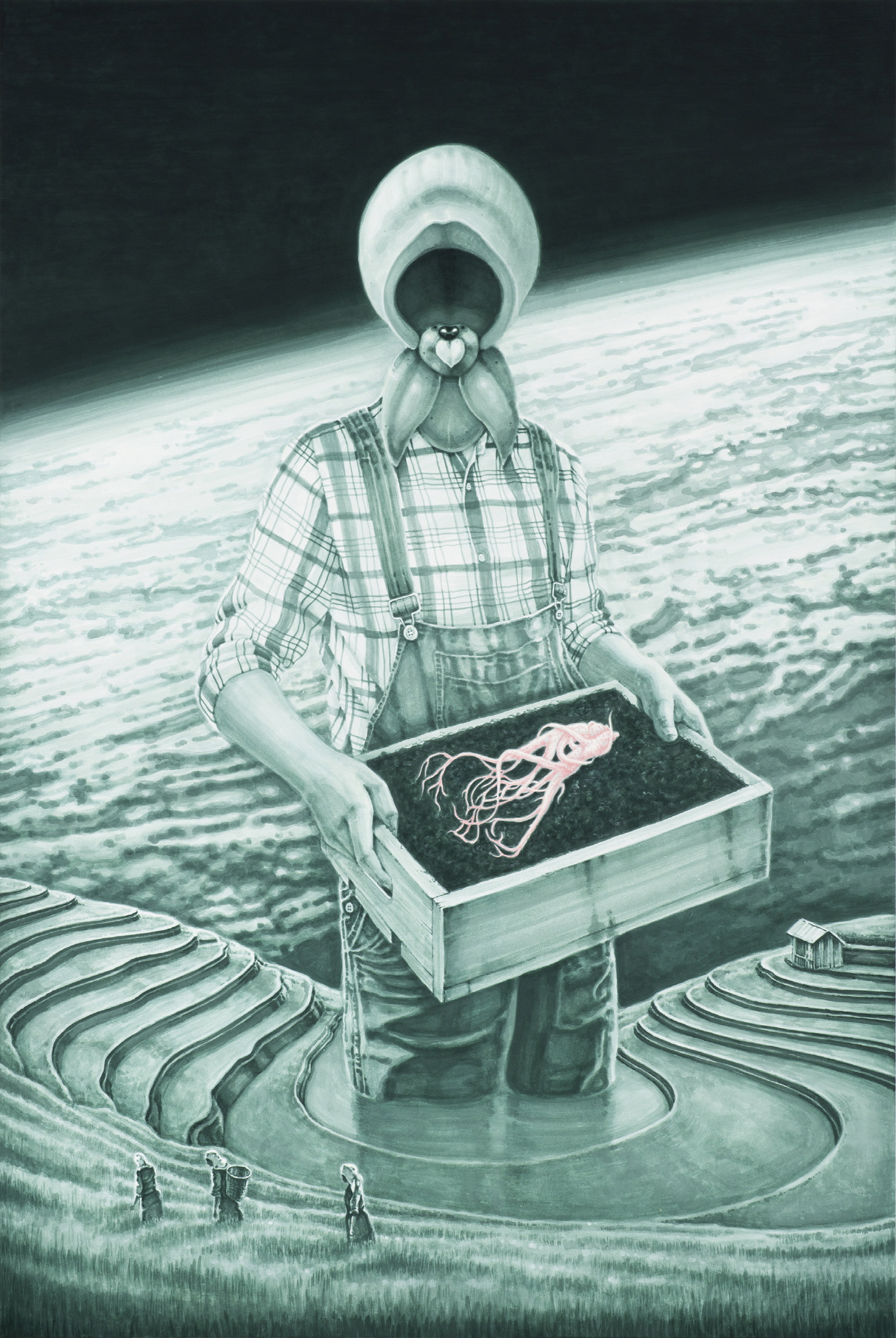
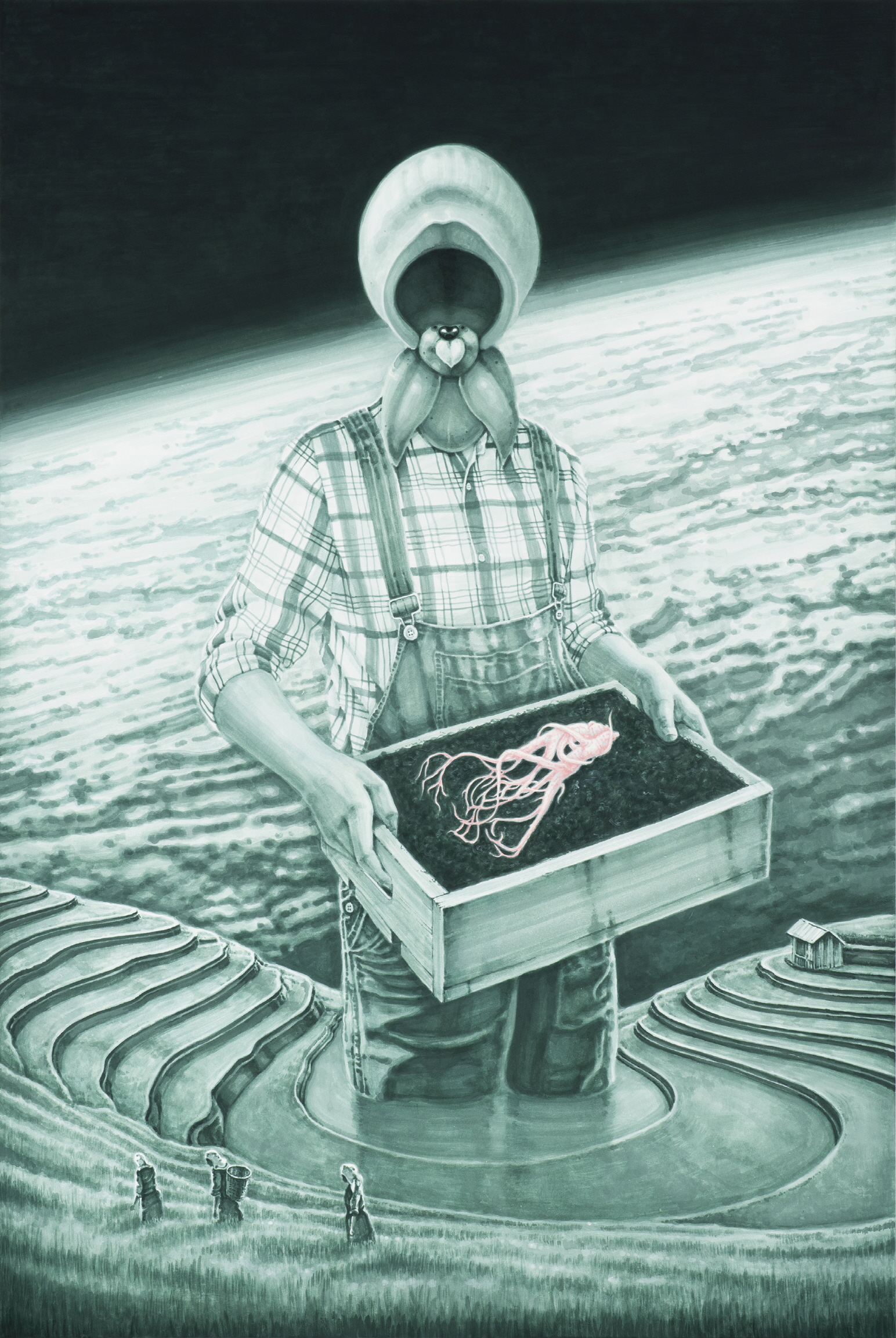
New Type_Gingin

2024
Acrylic gouache on Korean paper, color pencil
194 x 130.4 cm
About The Work

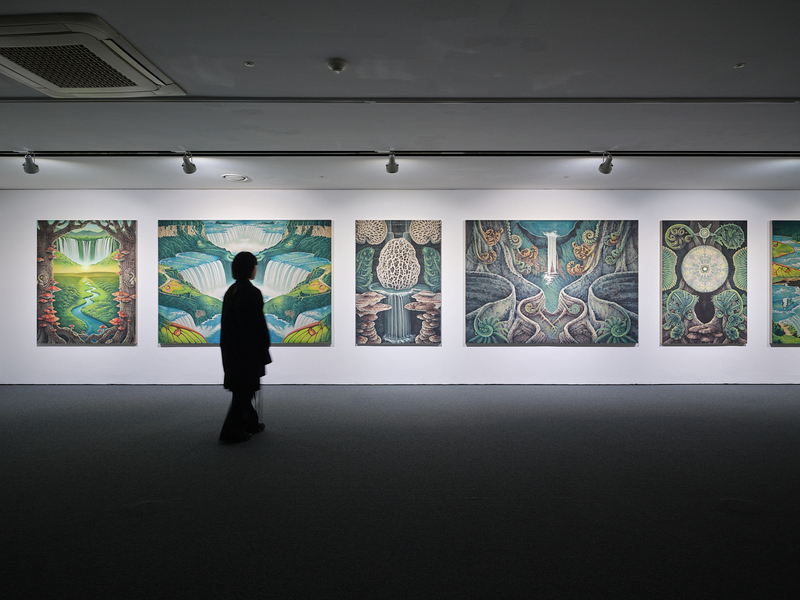
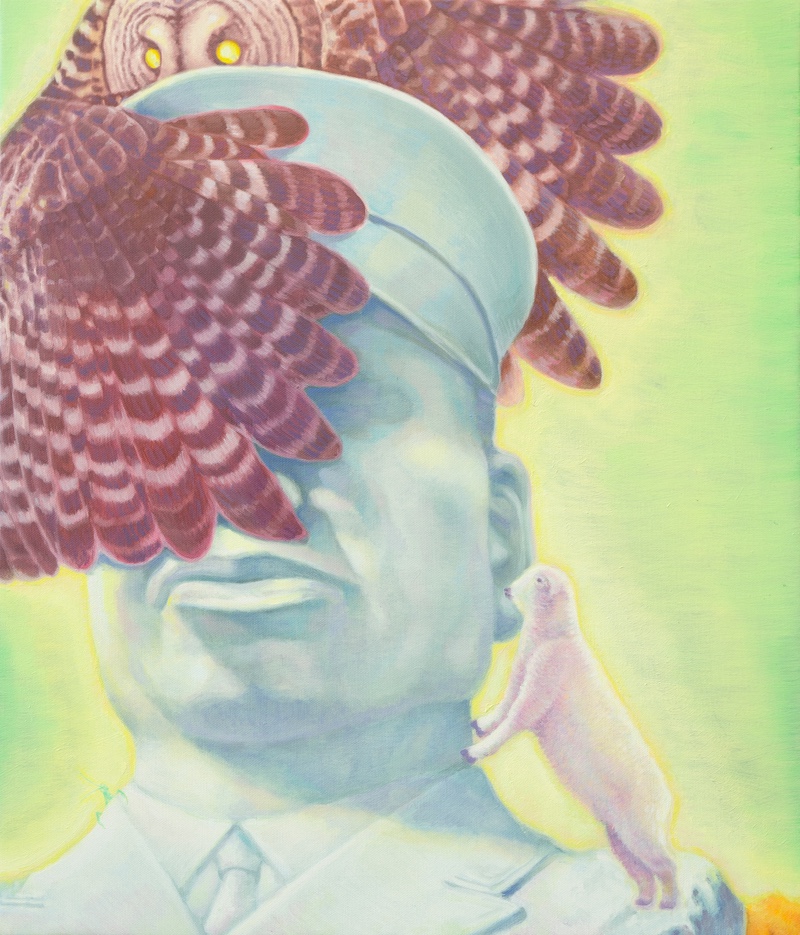
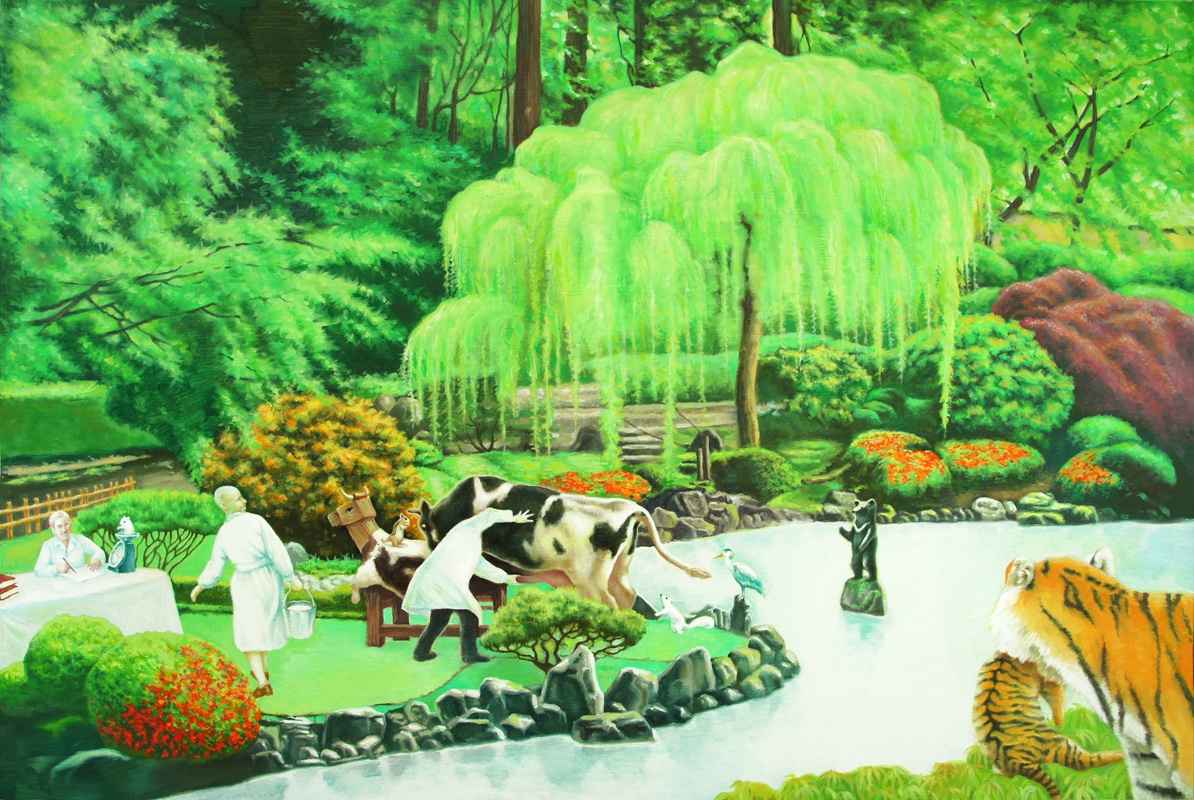
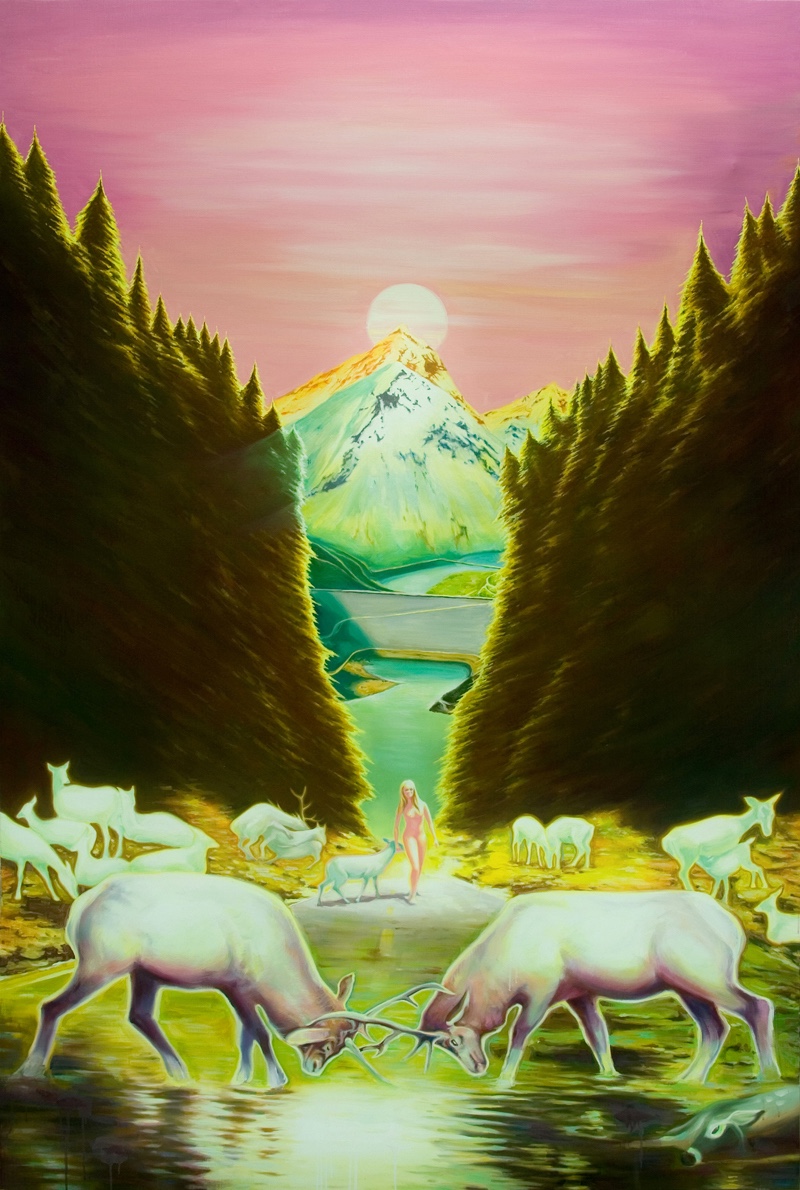
Jongwan Jang reassembles and anthropomorphizes images of nature collected from various media to create surreal landscapes and scenes. Resembling fairy tales, fables, or meticulously rendered religious paintings, his works feel surreal yet prompt reflection on the ways we believe, our psychological states, and the values we hold in our everyday reality.
 
Humanity has long yearned for salvation, envisioning utopias or paradises to fill its sense of anxiety and emptiness. Until the Renaissance, people expressed their imagined "heavens" through visual art, spreading visions of a promised paradise after death. With the advent of modern society, the belief shifted—many began to expect that industrialization, achieved by human hands, might lead to a utopian future.
 
However, in an anthropocentric world that prizes self-serving rationality, modern humanity remains trapped in a cycle of persistent anxiety and emptiness. Jongwan Jang turns his attention to this very condition in his paintings. He captures landscapes that have been artificially altered and dominated by human greed and desire. Rather than portraying an ideal world as purely beautiful, he exposes the bizarre and twisted nature of human desire embedded within such scenery.

Solo Exhibitions (Brief)

Jongwan Jang’s major solo exhibitions include 《Noir Mountain》 (Amado Art Space, Seoul, 2024), 《GOLDILOCKS ZONE》 (FOUNDRY SEOUL, Seoul, 2023), 《Prompter》 (Arario Museum In Space, Seoul, 2020), 《Organic Farm》 (Arario Gallery, Seoul, 2017), and 《I hear your voice》 (Kumho Museum of Art, Seoul, 2014).

Group Exhibitions (Brief)

Jang has also participated in various group exhibitions, including the 15th Gwangju Biennale (Gwangju, 2024), 《Coupling》 (Seoul Museum of Art, Seoul, 2024), 《Tired Palm Trees》 (Art Sonje Center, Seoul, 2024), 《Art Lab for Earth》 (National Museum of Modern and Contemporary Art, Korea, Gwacheon, 2023), 《The 22nd SONGEUN Art Award Exhibition》 (SONGEUN, Seoul, 2022), 《Post Nature: Dear Nature》 (Ulsan Art Museum, Ulsan, 2022), 《Fortune Telling》 (Ilmin Museum of Art, Seoul, 2021), and more.

Residencies (Selected)

Jang has selected for the 8th residency program at the SeMA Nanji Residency in 2014.

Collections (Selected)

Jang’s works are part of the collections of the National Museum of Modern and Contemporary Art, Korea; Seoul Museum of Art; Ulsan Art Museum; Arario Museum, among others.
Works of Art

Surreal Paintings: On the Faith and Anxiety Toward Utopia

Originality & Identity

Jongwan Jang’s work revolves around a fundamental skepticism and anxiety toward the notion of “utopia.” He points out that the ideal world is a fictional construct created by humans, often used to obscure the contradictions of reality. Through excessively idealized landscapes, he reveals underlying unease and nihilism. Early works such as Corner of the earth (2010) and New normal (2010) depict peaceful, archetypal paradises that subtly embed the violence and contradictions of anthropocentric ideals.

This thematic concern expands through the appropriation of societal apparatuses shaped by human desire, particularly religious imagery and capitalist symbols. For example, Happy garden (2013) juxtaposes artificial gardens and hybrid animals within an idyllic setting, evoking a sense of unease. These seemingly heavenly images function as critical devices, exposing how belief systems and consumer desires construct false paradises.

Jang’s thematic exploration is further grounded in his childhood memories. Having grown up in the industrial city of Ulsan, he experienced material abundance alongside social repression and unrealistic glorification of corporate power. This duality is most vividly expressed in works such as his solo exhibition 《Organic Farm》(Arario Gallery, 2017), where the sacrifices and systemic cruelty hidden behind human-centric prosperity are brought to the fore, revealing the latent violence within utopian imaginaries.

In his recent solo exhibition 《GOLDILOCKS ZONE》(FOUNDRY SEOUL, 2023), Jang extends his utopian vision toward space and the future. Figures with orchid-like heads quietly labor in pastoral landscapes, merging sci-fi idealism with real-world climate crises and technological dependence. Here, utopia is no longer a realizable hope, but rather a projection of humanity’s persistent delusions amid a fundamentally flawed world.

Style & Contents

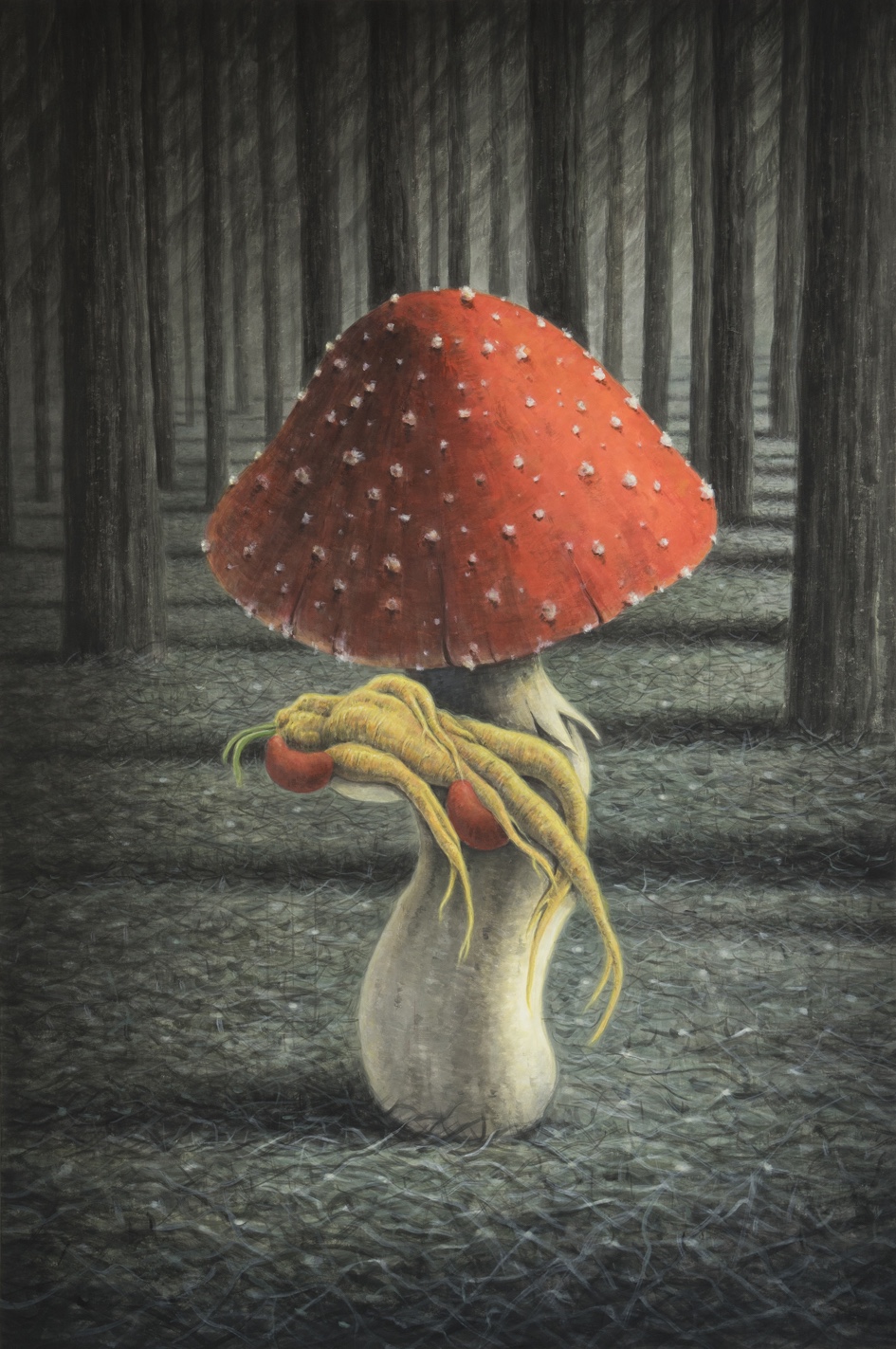
Jongwan Jang began with representational painting and has since engaged in sustained formal experimentation by fluidly integrating various media. His early oil paintings on canvas reconfigure natural imagery through anthropomorphization, reinterpreting the traditional genre of paradise landscapes with a contemporary perspective. Works such as I hear your voice (2014) and Pieta (2019) blend realistic depiction with symbolic composition, producing surreal and layered scenes.

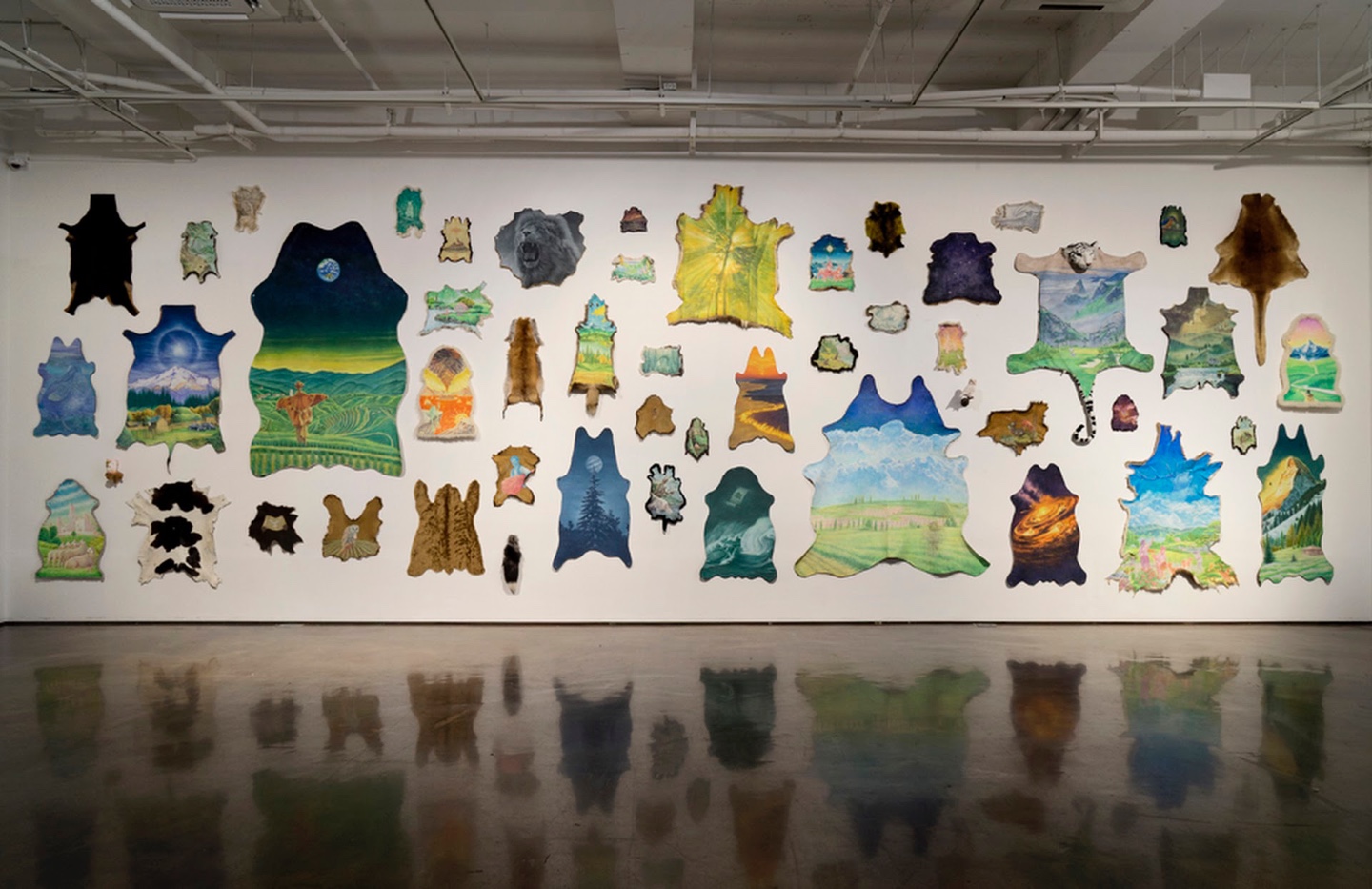
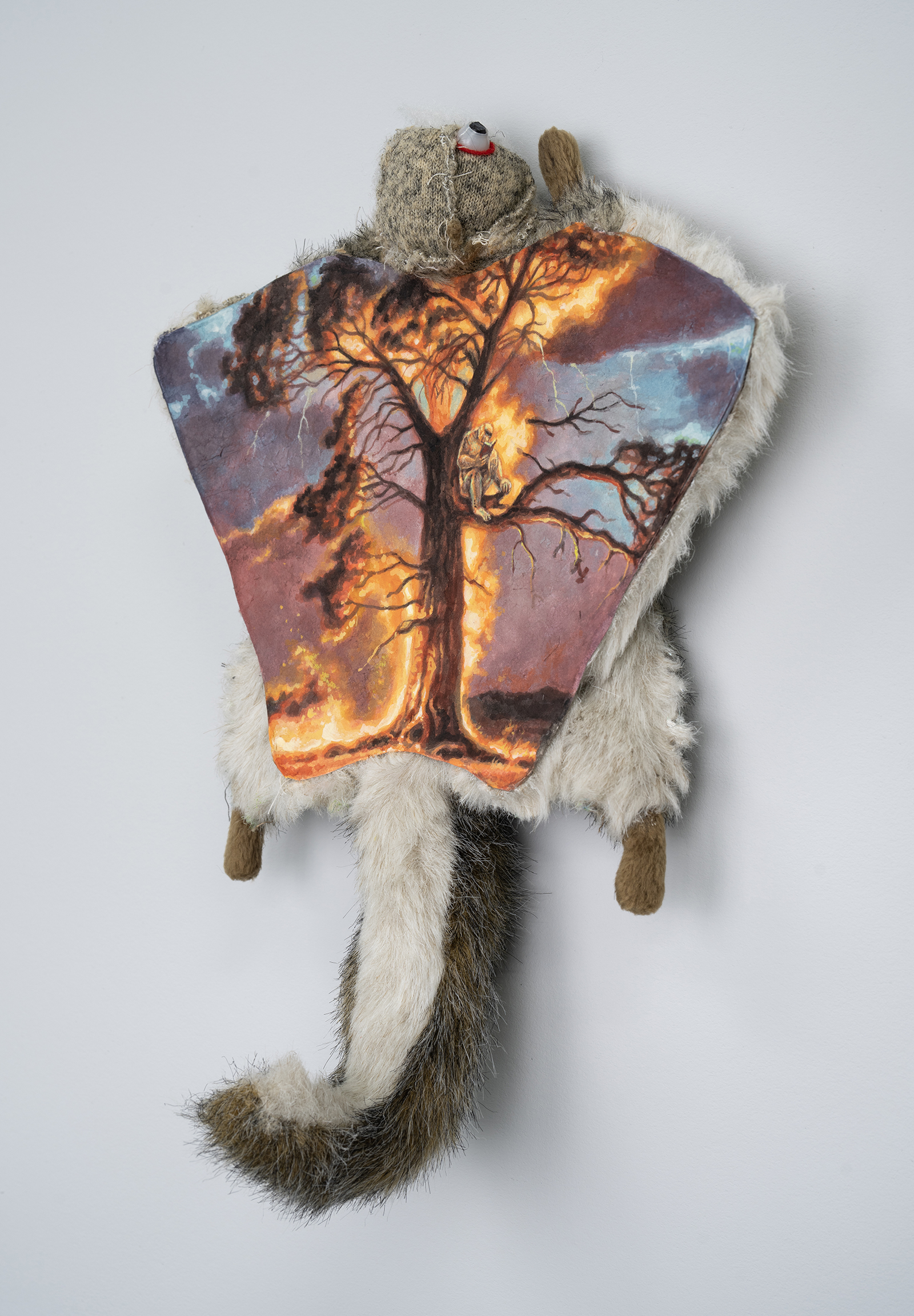
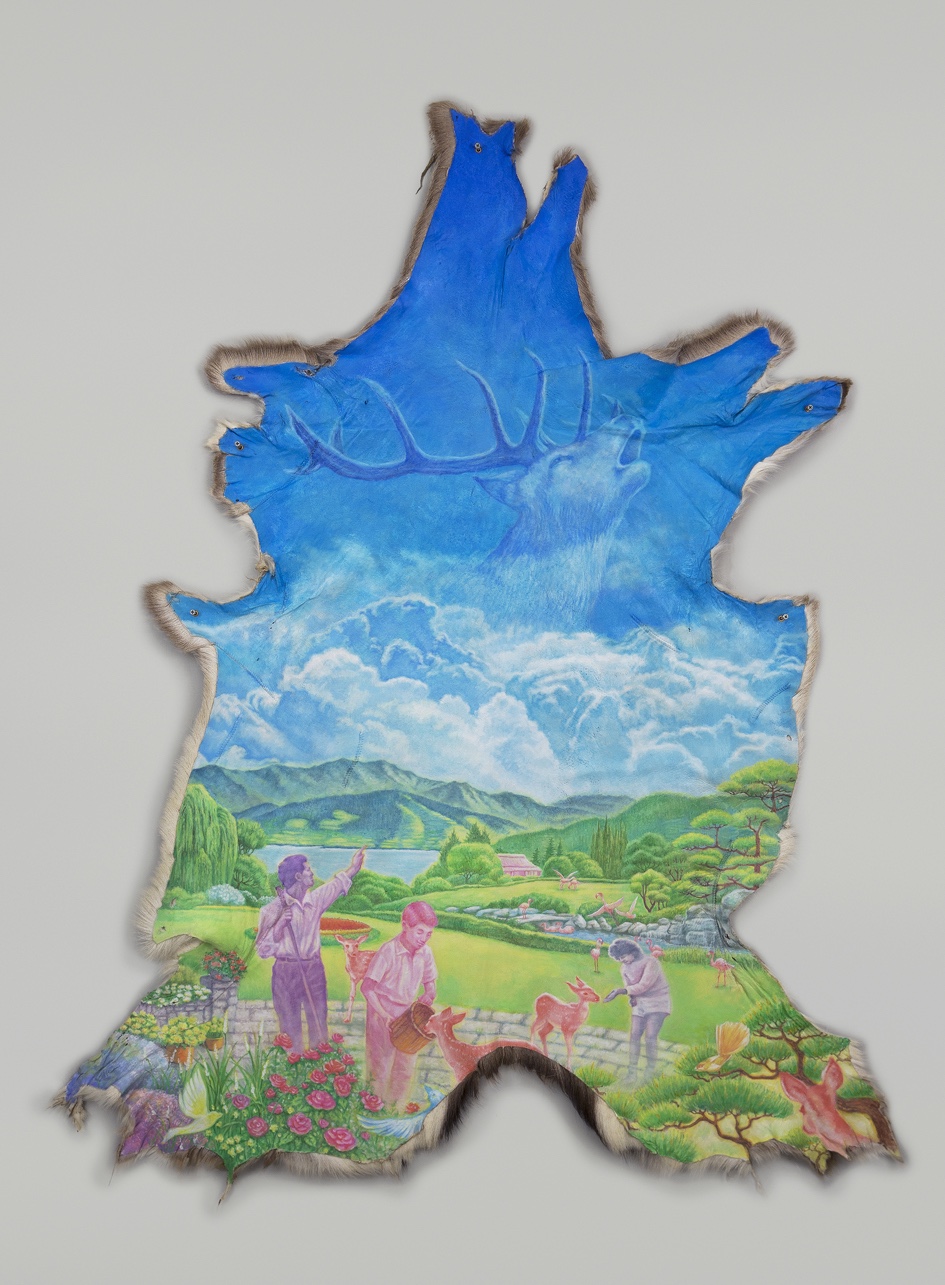
In the mid-2010s, Jang introduced his distinctive “leather painting” series, using animal hides as supports. In 《Organic Farm》, works like He spoke and all was still (2015) and Walk with god (2016) feature idyllic landscapes superimposed on the skins of deceased animals, simultaneously expressing mourning and critique of anthropocentric violence. Even as he transitions to using synthetic leather and factory remnants, Jang retains a meticulous sensitivity to the material presence of death.

Jang expands beyond the genre of painting to experiment with video, stop-motion animation, and object-based installations. Works such as Under the Red Roof (2020) and Yesterday (2017) translate personal anxiety and social hypocrisy into black comedy formats, closely linked to his existing pictorial narratives. Meanwhile, matchbox paintings like F20180004 (2018) represent minimalist experiments using discarded everyday objects, simultaneously exploring materiality and storytelling.

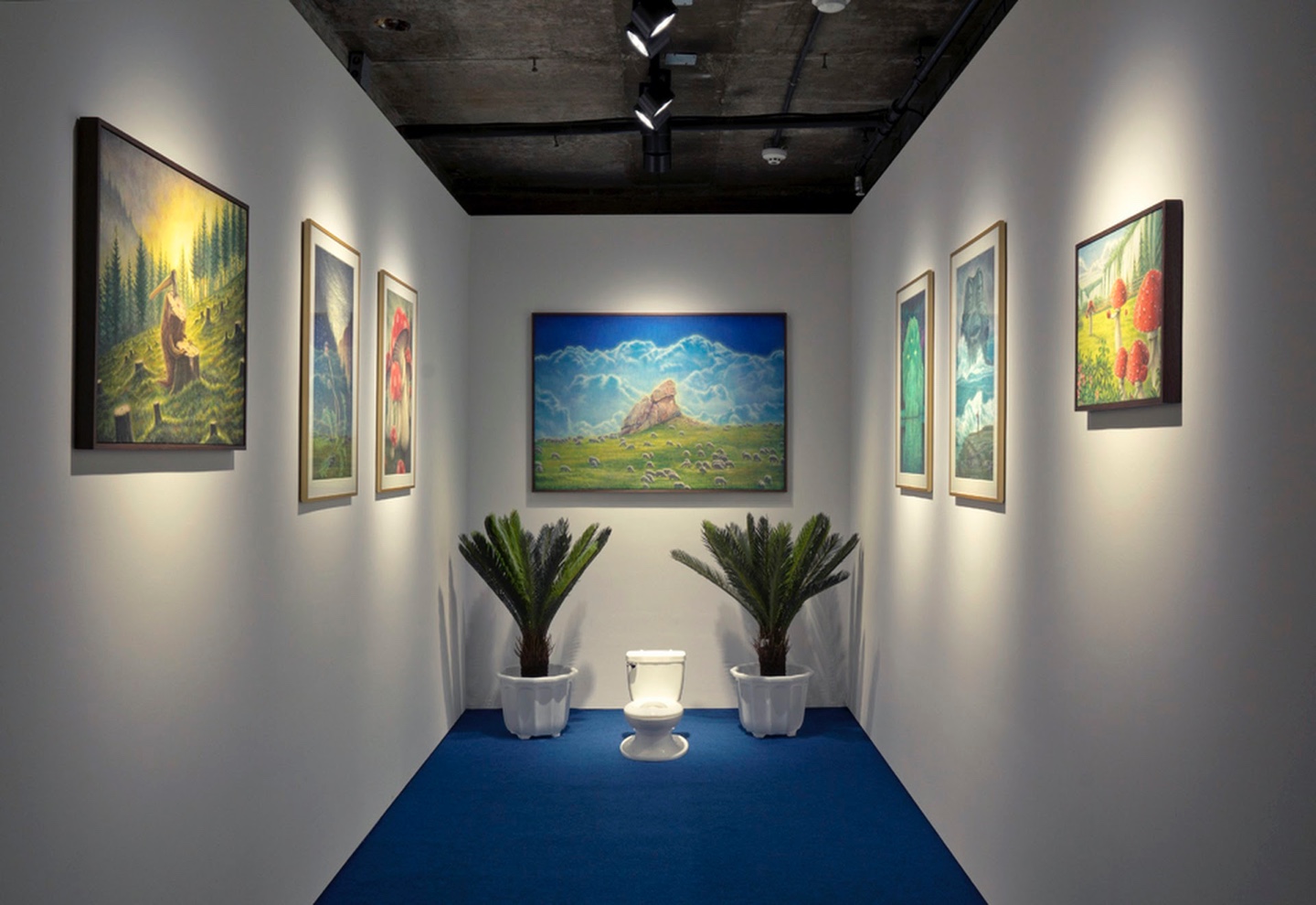
His solo exhibition 《Prompter》(Arario Museum In Space, 2020) marked a turning point, where the entire gallery was treated as a theatrical stage. Through the installation of kitsch objects such as potty chairs and blanket-made flags in a conference room-like setup, Jang critiques political theatricality and the mise-en-scène of authority. This signaled his shift from representational art to spatial composition as a sculptural form.

Topography & Continuity

Jongwan Jang has established himself within the Korean contemporary art scene through his unique visualization of utopia and its inherent falsehood. Traversing painting, object-making, animation, and installation, he constructs a complex visual language that interweaves religious icons, anthropomorphic plants, political emblems, and industrial remnants. His emotionally charged, technically refined paintings that embody unease and futility distinguish him from his peers.

His artistic development moves from early pictorial works to analytical critiques of societal systems and their theatrical manifestations. The trajectory from leather paintings in 《Organic Farm》 to spatial dramaturgy in 《Prompter》, and finally to cosmic agrarian imagination in 《GOLDILOCKS ZONE》, demonstrates an internal evolution across both thematic and formal dimensions.

Jang captures the hidden structures of industrialization, consumer capitalism, and political performance, transforming them into fictional yet sharply insightful visual narratives. His use of allegory, “grade-shifting” (elevating the low, subverting the high), and tactile experimentation—such as layering acrylic gouache on Korean paper or appropriating matchboxes and synthetic leather—signals a constant push toward material and conceptual expansion in contemporary painting.

Looking ahead, Jang is expected to further deepen his engagement with narrative structures and spatial installations. His visual language naturally connects with current discourses around digital technology, ecological crisis, and the posthuman condition. He will likely continue to challenge anthropocentric value systems, constructing surreal worlds where reality and fantasy, past and future intersect and unravel.

Works of Art

Surreal Paintings: On the Faith and Anxiety Toward Utopia

Articles

Exhibitions

Activities