

Walls - K-ARTIST

Walls

2024
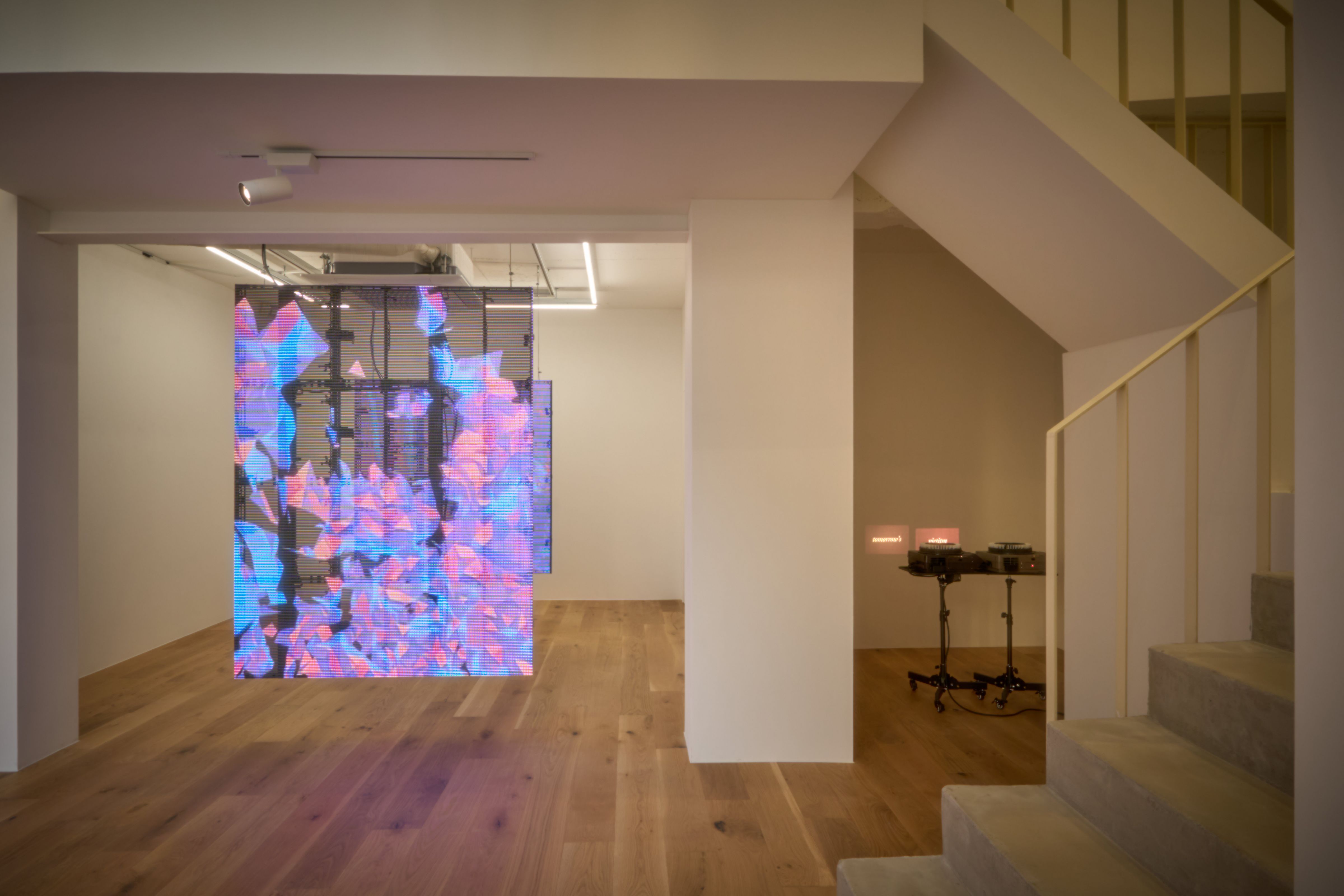
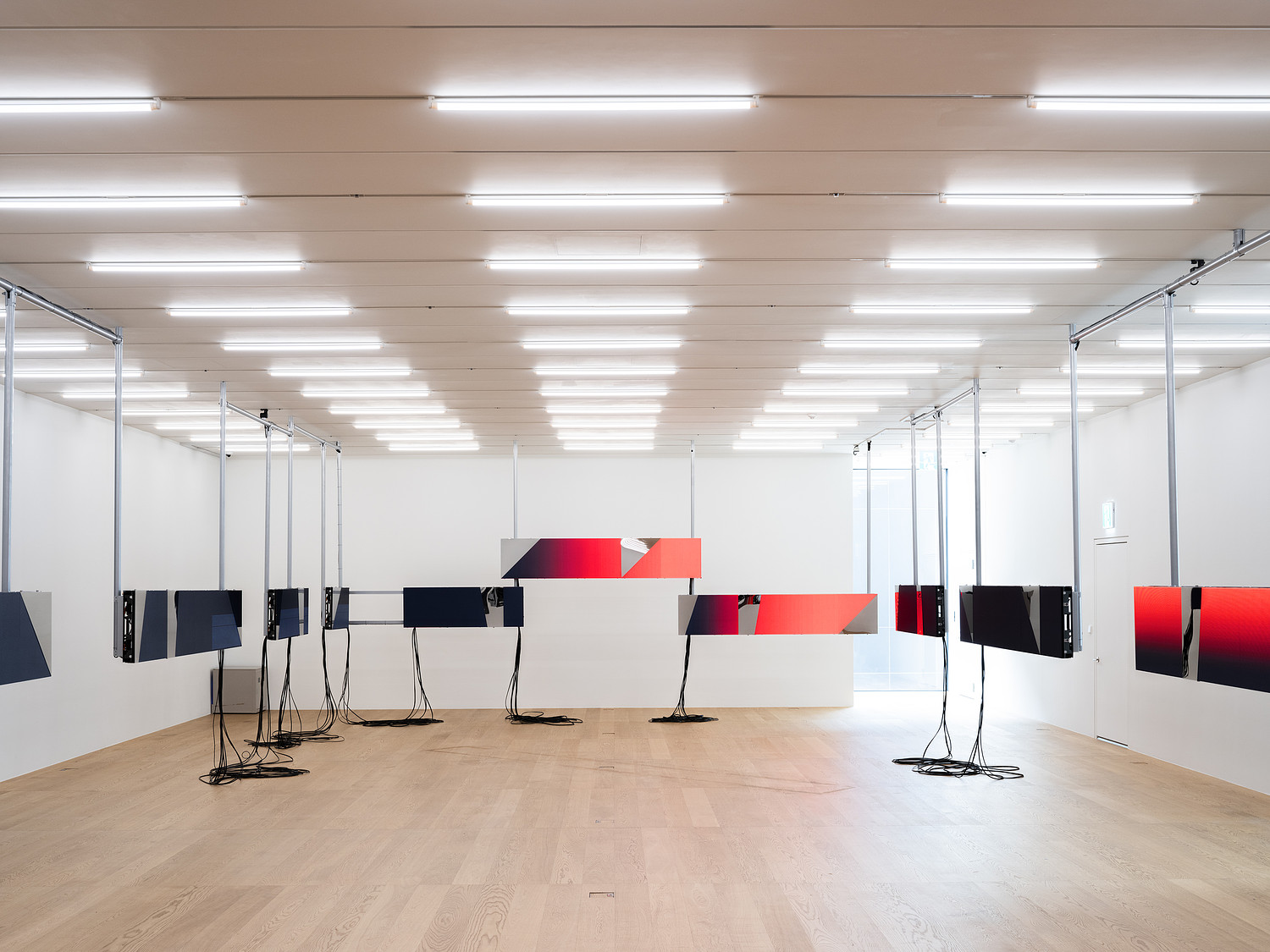
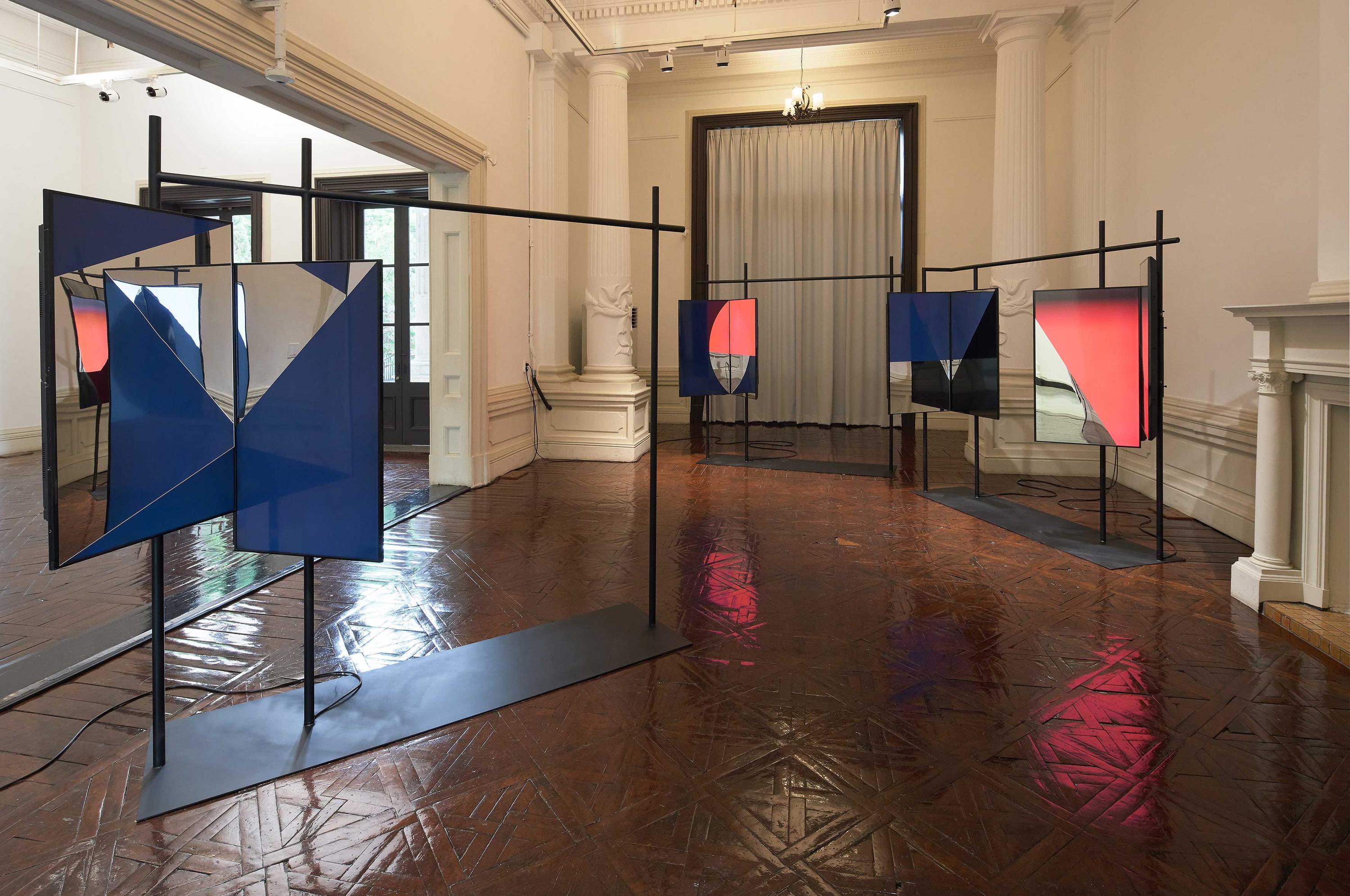
4-channel continuous video, LED, acrylic mirror, sound
Dimension variable
About The Work

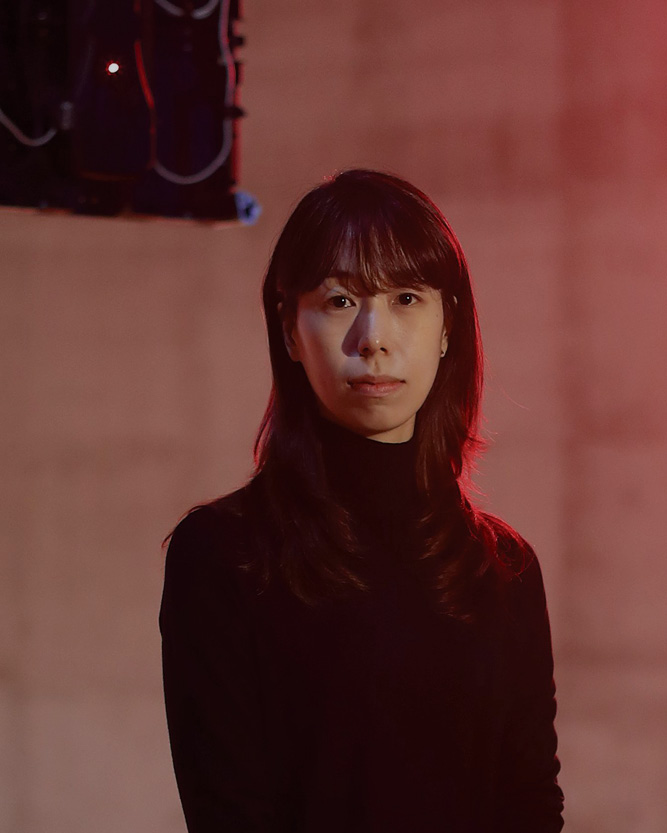
Ahram Kwon creates multimedia installations that reveal reflections on media and its conceptual interconnections in a compressed and metaphorical manner. Primarily using digital screens and mirrors as her main materials, the artist critically reconstructs the illusions of the digital media world that influence real human life and society.
 
She critically explores media that rapidly changes and subtly influences our daily lives through her artworks. She regards the screen today not merely as a device that projects images, but as a complex and structural space where capitalist systems operate to control and design users’ senses, cognition, reason, and emotions.
 
Her work disrupts ordinary perception and induces a reversal of recognition, enabling contemporary viewers—who daily consume, share, and reproduce countless information and images through digital screens—to

Solo Exhibitions (Brief)

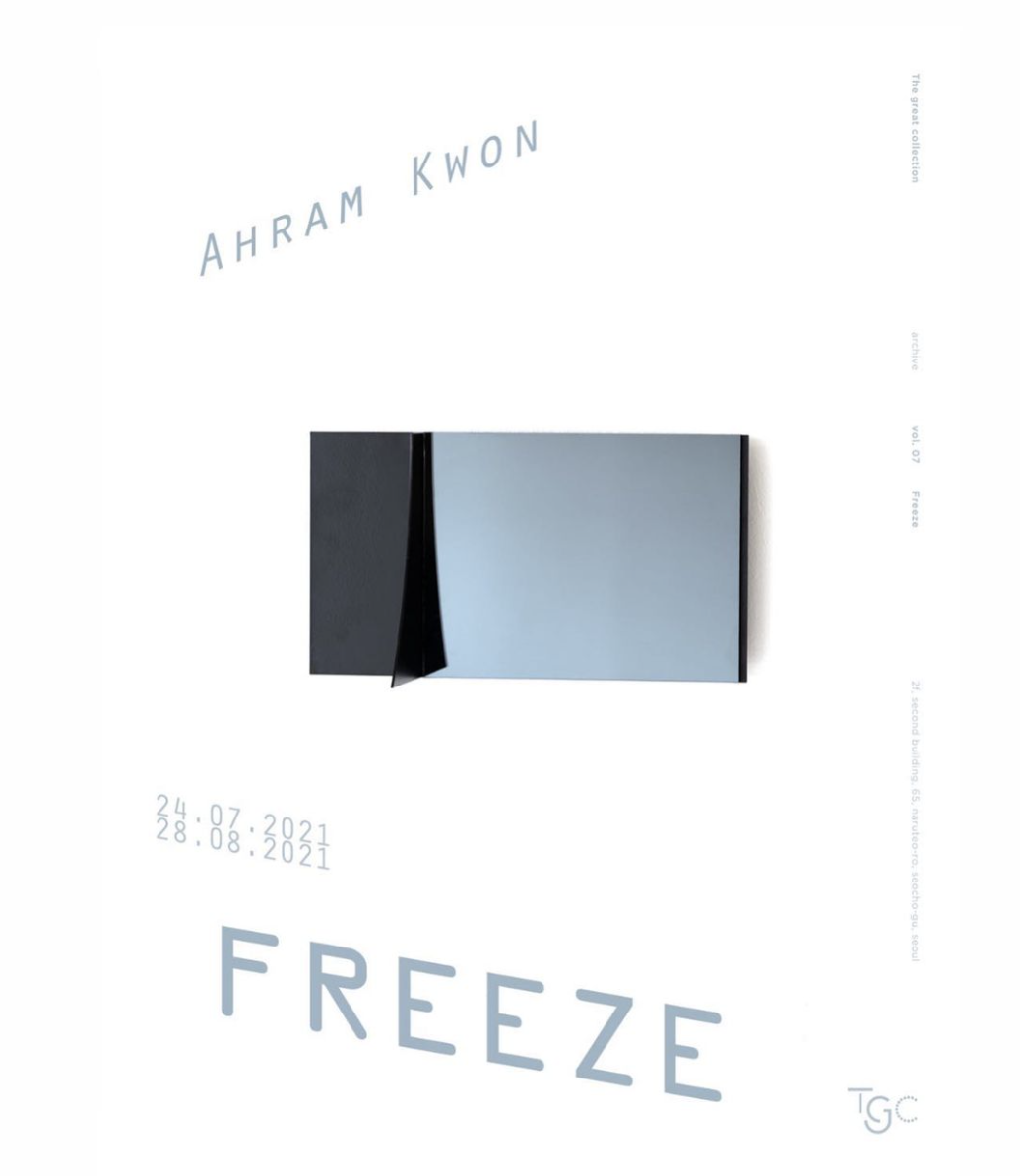
Kwon was presented by solo exhibitions including 《Fever Eye》 (SONGEUN, Seoul, 2025), 《Freeze》 (The Great Collection, Seoul, 2021), and 《Flat Matters》 (ONE AND J. +1, Seoul, 2018).

Group Exhibitions (Brief)

Kwon has also participated in numerous group exhibitions such as 《-Director》 (KICHE, Seoul, 2024), 《Tourism》 (SeMA Nanji Residency, Seoul, 2022), 《Grid Island》 (Seoul Museum of Art, Seoul, 2022), 《The 21st SONGEUN Art Award Exhibition》 (SONGEUN, Seoul, 2022), and 《The Best World Possible》 (Platform L Contemporary Art Center, Seoul, 2019).

Awards (Selected)

In 2022, Kwon won the Grand Prize at the 21st SONGEUN Art Award.

Residencies (Selected)

Kwon has been selected for artist-in-residence programs including Gallery Purple Studio (2024–2025), SeMA Nanji Residency (2022, 2020), Künstlerhaus Stuttgart Residency Program (2016), and MMCA Residency Goyang (2015).

Collections (Selected)

Her works are in the collections of the SONGEUN Art and Cultural Foundation, Seoul Museum of Art, and Seoul Metropolitan Goverment.
Works of Art

The Illusions of the Media World Through the Screen

Originality & Identity

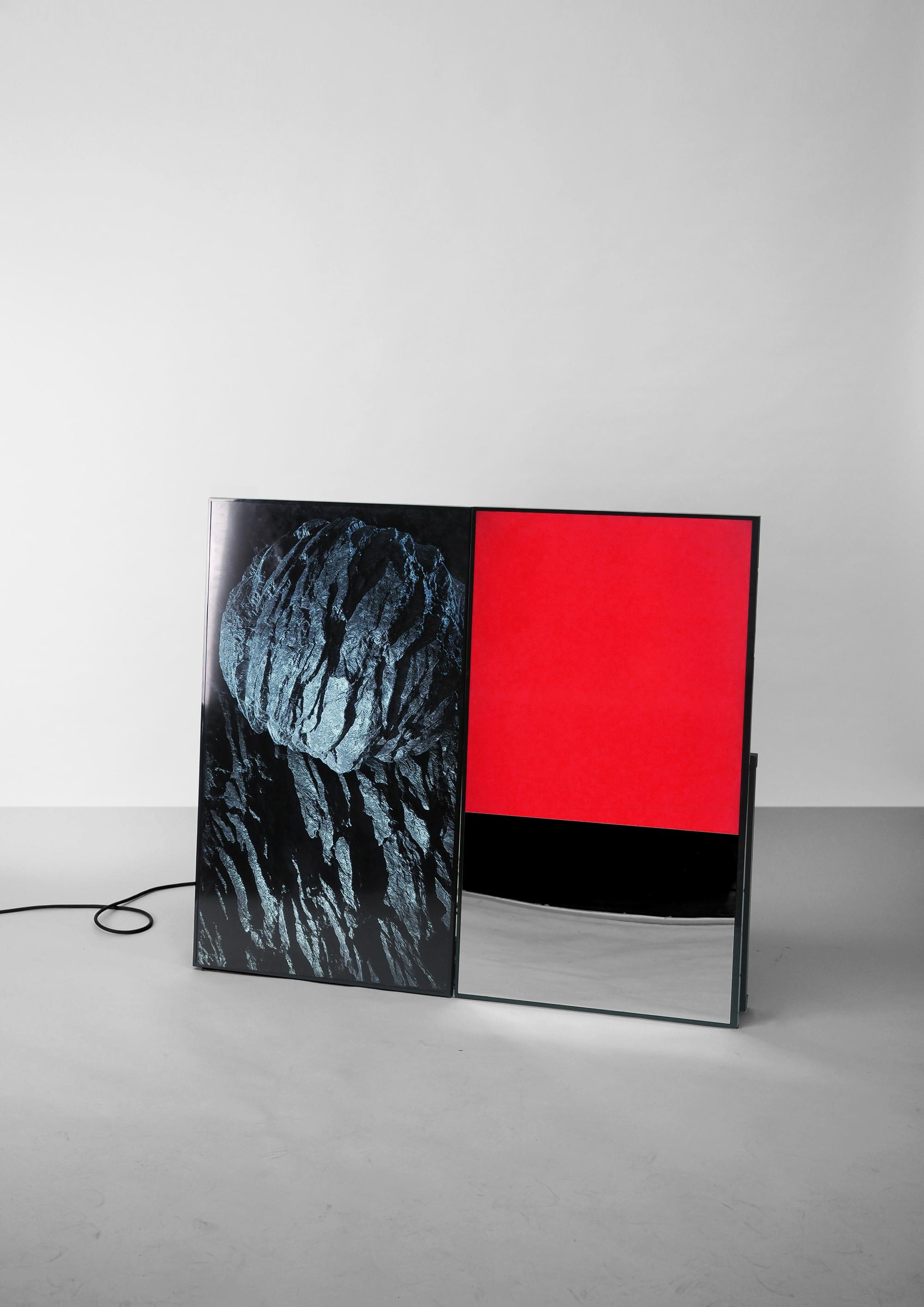
Ahram Kwon's artistic practice begins with a critical reflection on how digital media intervenes in human perception and blurs the boundaries between reality and virtuality. In Flat Matter (2017), the artist juxtaposes various sources of mineral images—self-photographed, online, and artificially generated—to explore how the flat medium of the screen erases materiality and reduces physical objects into homogeneous visual experiences. Through this, she begins to visualize how the three-dimensional materiality of reality is transformed into immaterial illusions in the process of digital conversion.

In her solo exhibition 《Flat Matters》(ONE AND J. +1, Seoul, 2018), this inquiry deepens. Kwon utilizes the sculptural characteristics of screens and mirrors to examine how digital images flatten the real world and restructure the cognitive patterns of their viewers. In this process, she persistently raises critical questions about how digital media designs human sensory and cognitive systems.

In Ghost Wall (2019), presented in 《The Unstable Objects》(Nam-Seoul Museum of Art, 2019), Kwon visually metaphorizes the screen as a ghostly entity that projects insubstantial illusions behind a transparent outer shell by combining screen errors with shattered glass imagery. The information provided by digital media fails to possess substance, instead endlessly replacing and expanding reality through cycles of fiction and error.

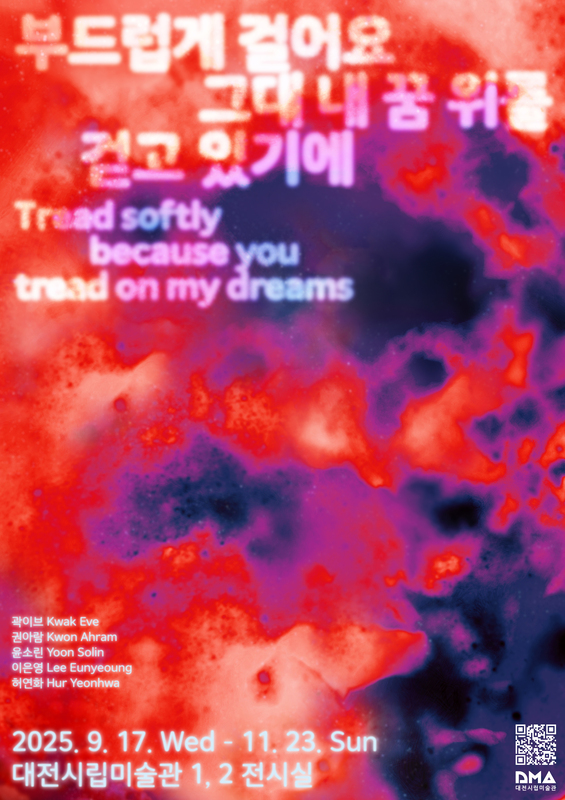
In recent works such as the solo exhibition 《Fever Eye》(SONGEUN, Seoul, 2025) and The Backrooms (2025), this trajectory expands into a critique of the dominant structures of image and information overproduction and consumption within the techno-capitalist system. Through processes that reconstruct physical reality into digital data—such as CCTV, AI sensors, and dataset training—Kwon fundamentally reconsiders the future crisis of datafied sensory systems and the evolving relationship between technology and humanity.

Style & Contents

Ahram Kwon’s early works began with physical installations combining TV monitors, digital screens, and mirrors. In Flat Matter, she visualized how object images lose volume and texture on smooth screens, erasing distinctions between them. This flat arrangement of images became a foundational sculptural approach that continues throughout her practice.

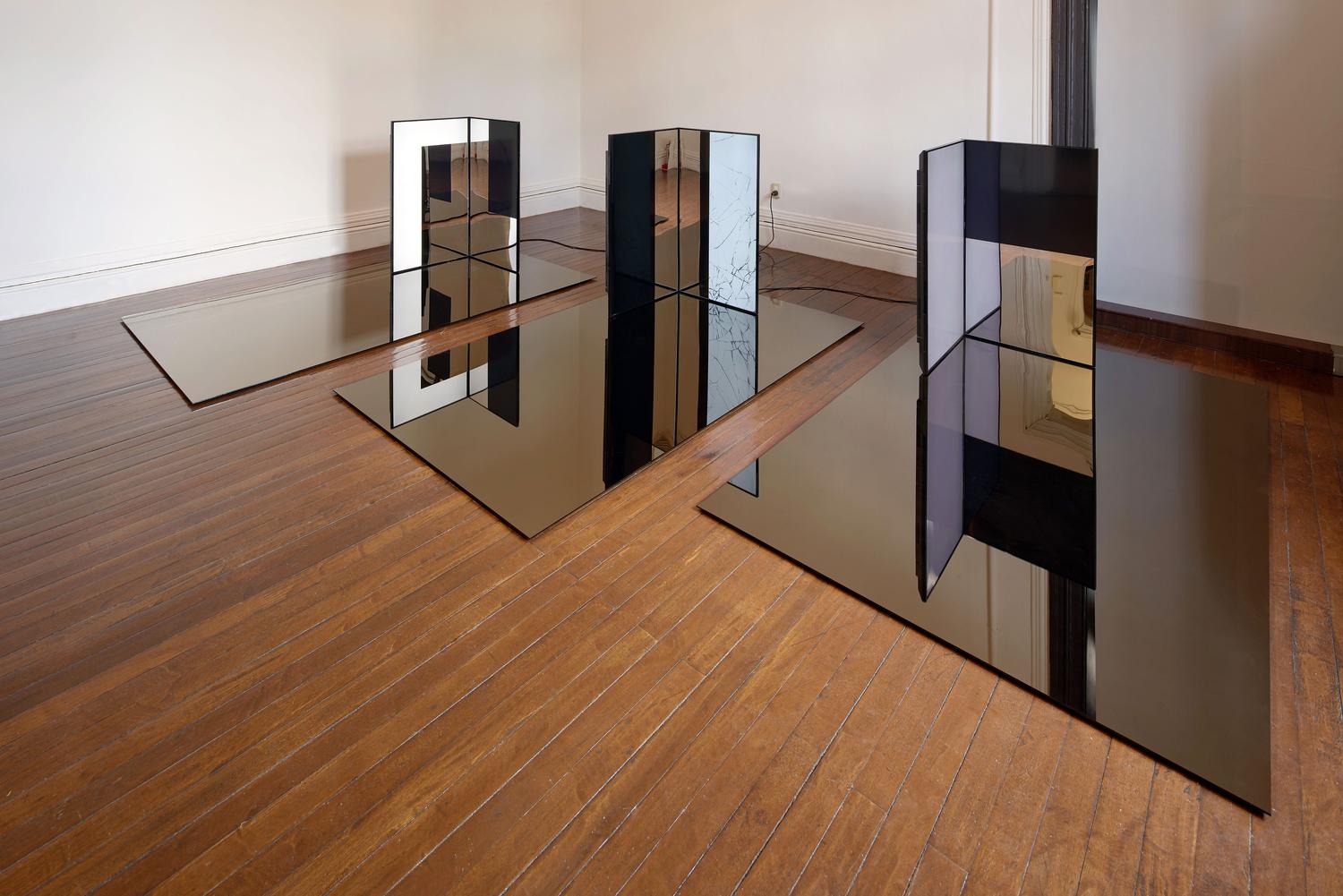
In 《Flat Matters》, she introduced computer error screens like the blue screen and red screen to highlight the inherent imperfections and malfunctions of digital systems. Mirror fragments function as mediating devices that reflect, overlap, and distort the screen images. Works from this period experiment with collisions between digital images and physical installations, revealing the instability embedded in image production structures.

In Ghost Wall, Kwon utilized video imagery, shattered glass patterns, red light, and sound to construct immersive environments, where the material medium of media and its illusory images intersect and destabilize one another. The TV, once a passive receiver, is transformed into a sculptural performer, dominating the surrounding space.

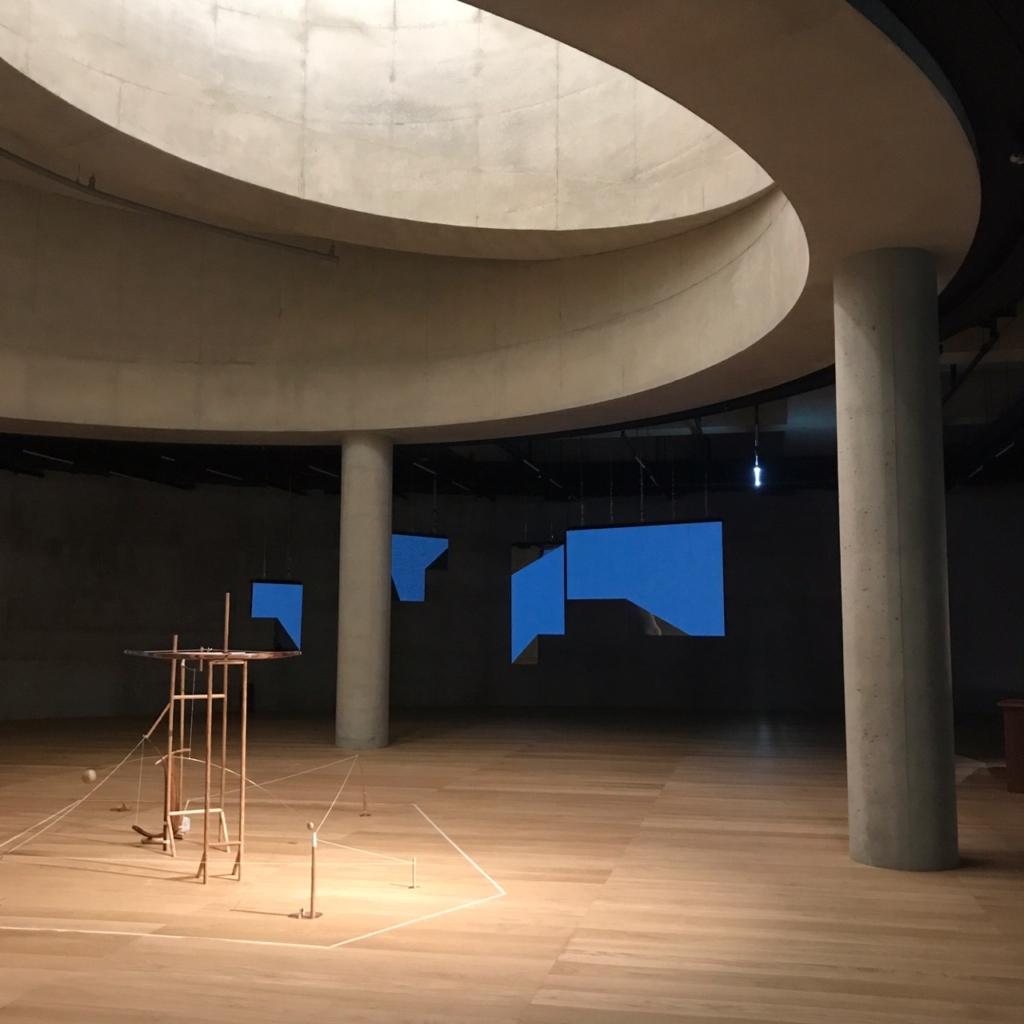
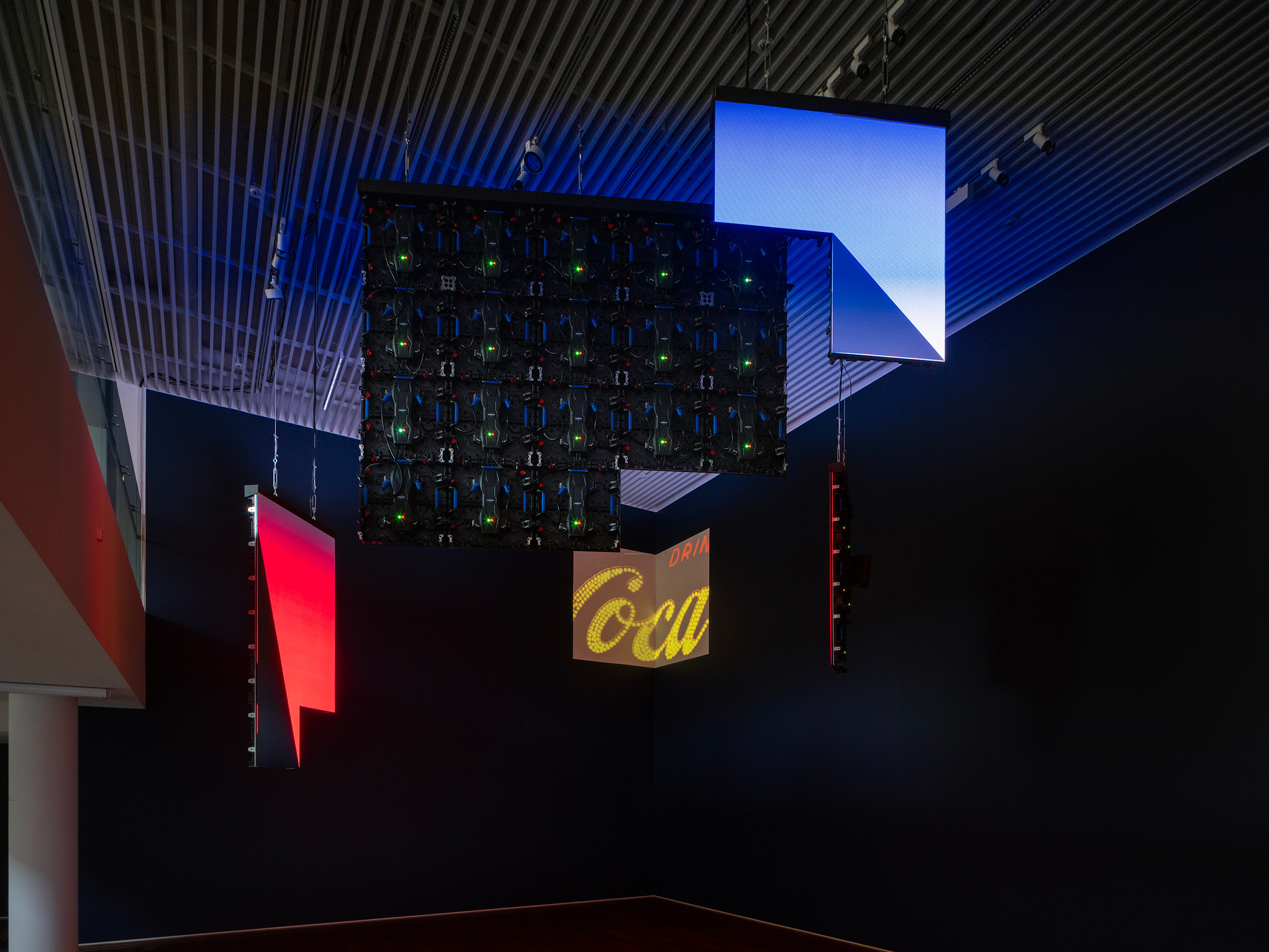
Since 2021, Kwon’s formal experiments have expanded into spatial installations symbolizing the overheated structures of techno-capitalism through the full adoption of LED panels. In Walls (2021, 2024), fragmented LED screens suspended in the air, along with acrylic mirrors and sound noise, visualize the accelerated cycle of production and consumption. In 《Fever Eye》, LED panels, six-channel video, and spatial soundscapes are used to construct hallucinatory liminal spaces where the interior and exterior of the screen merge, creating distorted perception and sensory instability.

Topography & Continuity

Ahram Kwon has consistently examined the screen as a symbolic device of contemporary media from a critical perspective. Philosophical inquiries into how digital media organizes and codes perception, thought, and behavior permeate her entire body of work. Through deconstructing the illusions and transparency of flat images, her formal language of combining screens and mirrors has become a signature from her earliest works to the present.

Starting with digital screens and TV-based indoor installations, her practice has expanded into LED panels, mesh screens, and interactive sound environments. Recently, her works have evolved to reconstruct the very structures of technology, capital, and sensory systems into immersive spatial scales.

Currently, Kwon has established herself as a critical artist who dissects the sensory design mechanisms of media technology at the intersection of contemporary media art. Particularly, her works, which simultaneously explore philosophical perspectives on digital distribution systems and ontological deconstruction of screen media, are gaining attention not only in Korea but also within international media art discourse.

Works of Art

The Illusions of the Media World Through the Screen

Articles

Exhibitions

Activities