
Composition - K-ARTIST

Composition

2012
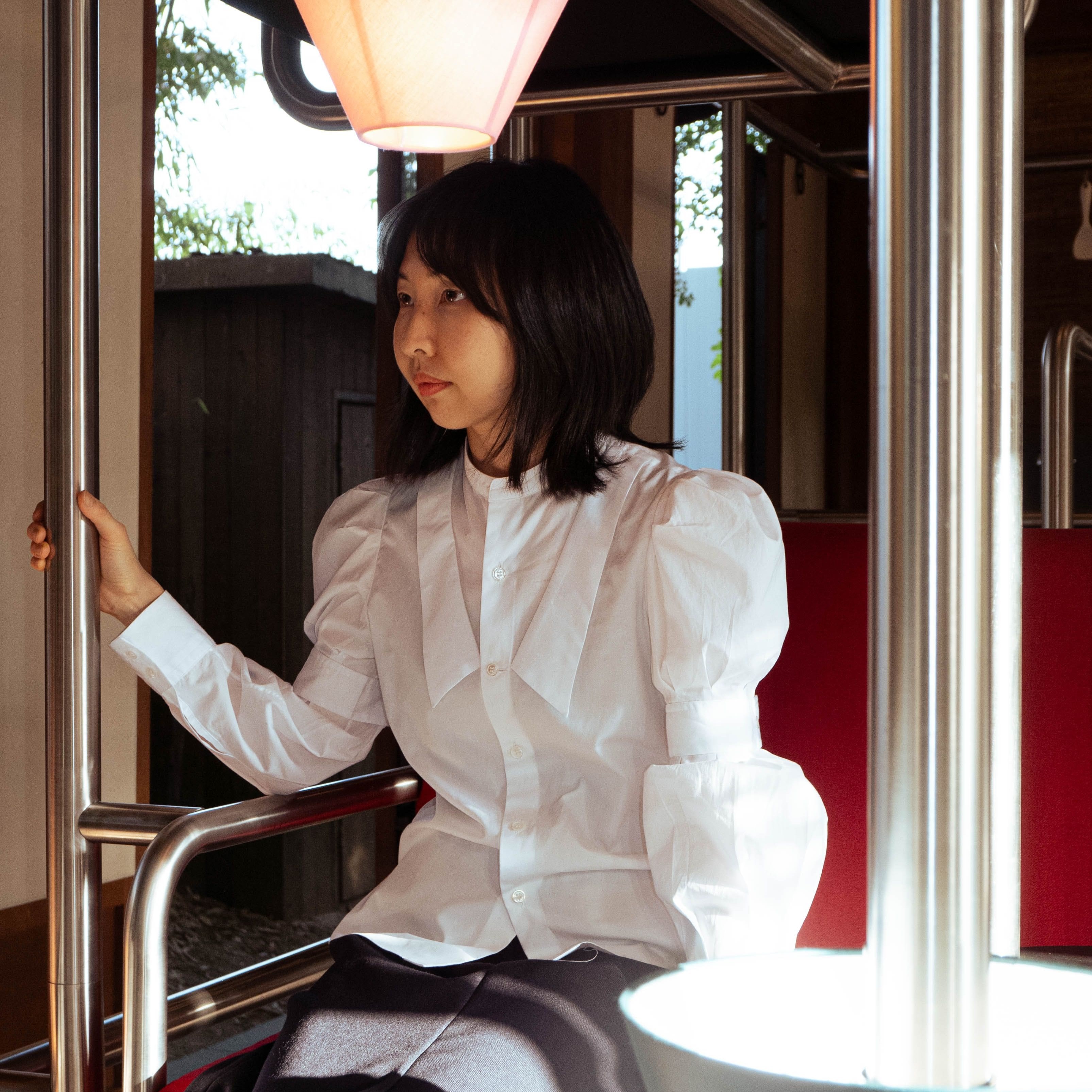
Steel and cello
503 x 712 x 300 cm 
About The Work

Yona Lee has presented site-specific installations using steel— a material commonly found in urban environments worldwide—along with everyday objects. Her work embraces the architectural structure and logic of a given space, while simultaneously subverting its conventional norms and assumptions, ultimately dissolving the vertical hierarchies and boundaries inherent to that space.

Yona Lee has continuously explored the intersection of multiple layers of time and space by combining fluid, linear materials such as stainless steel piping with everyday objects closely tied to our daily lives. Her temporary structures breathe with the context of specific locations, while simultaneously introducing dissonant objects that disrupt the conventions associated with those spaces—thus enabling new and unfamiliar spatial experiences.

Solo Exhibitions (Brief)

Yona Lee has held notable solo exhibitions including 《Wall, Floor, Ceiling》 (Fine Arts Sydney, Sydney, 2025), 《Spatial Layout Seoul》 (Art Sonje Center, Seoul, 2024), 《An Arrangement for 5 Rooms》 (Auckland Art Gallery Toi o Tāmaki, Auckland, 2022), 《Kit-set In-transit》 (Fine Arts Sydney, Sydney, 2021), and 《In Transit》 (City Gallery Wellington, Wellington, 2018–2019). Through these exhibitions, Lee has explored architectural space and the boundaries of public and private domains via site-specific sculptural language.

Group Exhibitions (Brief)

Yona Lee has participated in numerous international group exhibitions and biennales, including Buxton Contemporary (Melbourne, 2024), Art Sonje Center (Seoul, 2023), Dunedin Public Art Gallery (Dunedin, 2022), Busan Biennale (Busan, 2020), Lyon Biennale (Lyon, 2019), Sungkok Art Museum (Seoul, 2016), and Changwon Sculpture Biennale (Changwon, 2016). Her installations often engage with architectural structures and urban environments through materials and gestures that reframe spatial experience.

Awards (Selected)

Yona Lee has received awards including OCI YOUNG CREATIVES (2016–2017); Emerging Artist Award, Alternative Space LOOP; Quick Response Grants, Creative New Zealand (2015–2016); Arts Grant, Asia New Zealand Foundation and Creative New Zealand; Tui McLachlan Art Award (2014); and the University Senior Prize, Elam School of Fine Arts (2009).

Residencies (Selected)

Lee has been selected for major residencies including Artspace Studio Residency Program (2026), Jan van Eyck Academie (Maastricht, Netherlands, 2021–2022), Govett-Brewster Art Gallery (New Plymouth, New Zealand, 2020), Nanji Residency (Seoul Museum of Art, 2016), and Geumcheon Art Factory (Seoul, 2016). These experiences have contributed significantly to her exploration of spatial response and sculptural strategies.

Collections (Selected)

Her works are held in the collection of Museum of New Zealand Te Papa Tongarewa.
Works of Art

Dismantles Spatial Boundaries

Originality & Identity

Yona Lee’s work begins with an exploration of the spaces in which people live, and the movements, habitation, and everyday experiences that occur within them. Born in Busan and having moved to New Zealand in her childhood, the artist draws upon her personal experience of navigating different cultural environments and spatial sensibilities. Living between Korea and New Zealand exposed her to the tensions between public and private space, mobility and settlement, unfamiliarity and familiarity. These experiences form the conceptual foundation of her work, leading her to investigate the relationship between space and human presence.
 
Lee’s installations frequently develop around the idea of “in transit.” The series 'In Transit', which began in 2016 at Alternative Space LOOP in Seoul, reflects the conditions of contemporary life in which movement and connectivity have become routine. Transportation systems such as trains, airplanes, and urban infrastructures reshape how individuals perceive time and space. Lee translates these shifting experiences of physical and psychological movement into spatial structures.
 
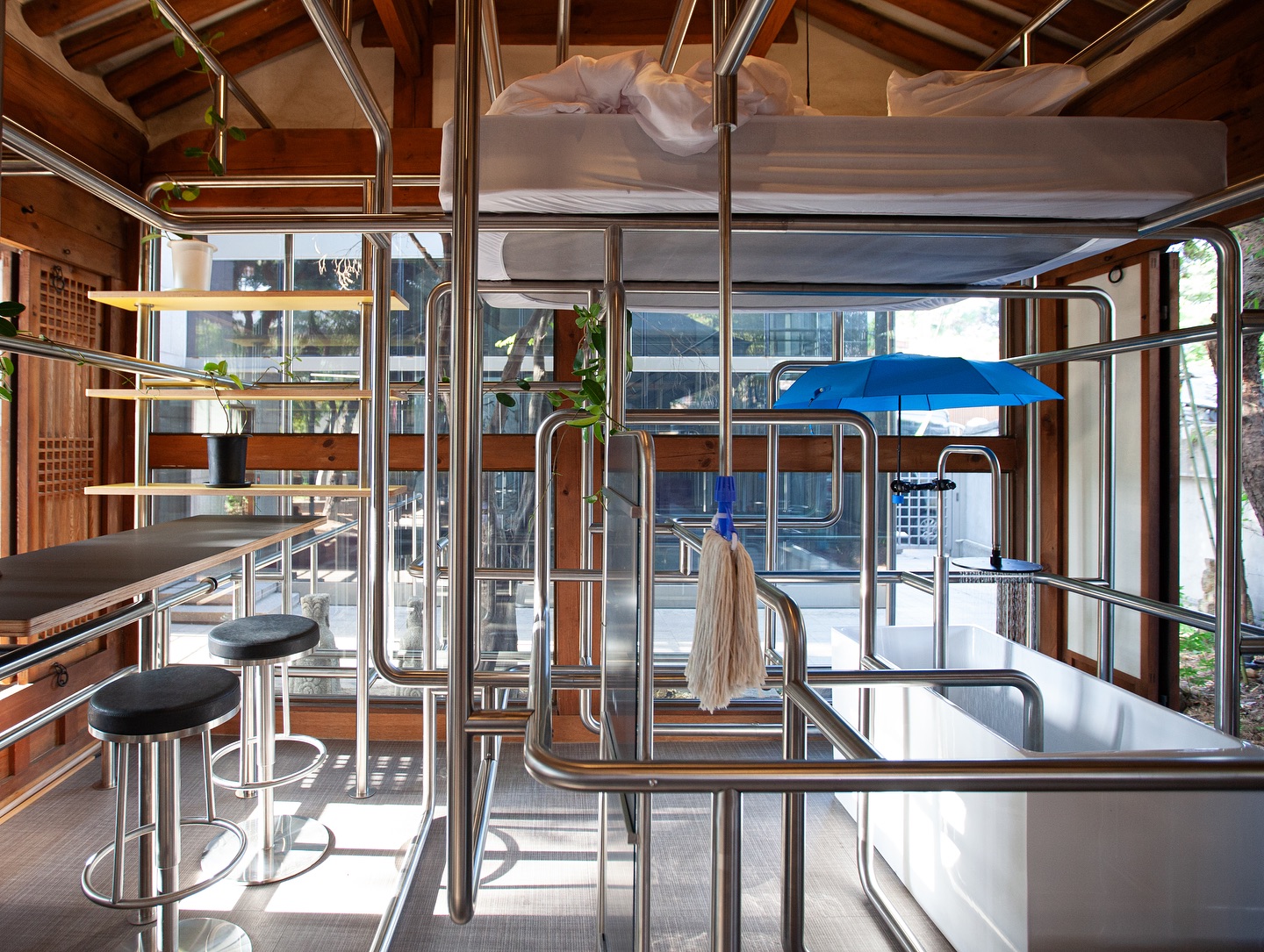
In Lee’s practice, space is not simply a backdrop but a structural apparatus that organizes human experience. Her stainless-steel tubular frameworks evoke public infrastructures such as urban piping systems, transit handrails, barriers, and signposts. Interspersed among these structures are everyday objects—beds, chairs, lamps, and umbrellas—which suggest environments of daily life. Together, these elements reveal the intersections between private living spaces and public urban environments, highlighting how human life unfolds within complex structural systems.
 
Rather than representing specific places, Lee’s work reconstructs the conditions of inhabiting space itself. Moving across the boundaries between mobility and settlement, public and private realms, functionality and futility, her installations question how human identity and modes of existence are shaped within contemporary urban environments.

Style & Contents

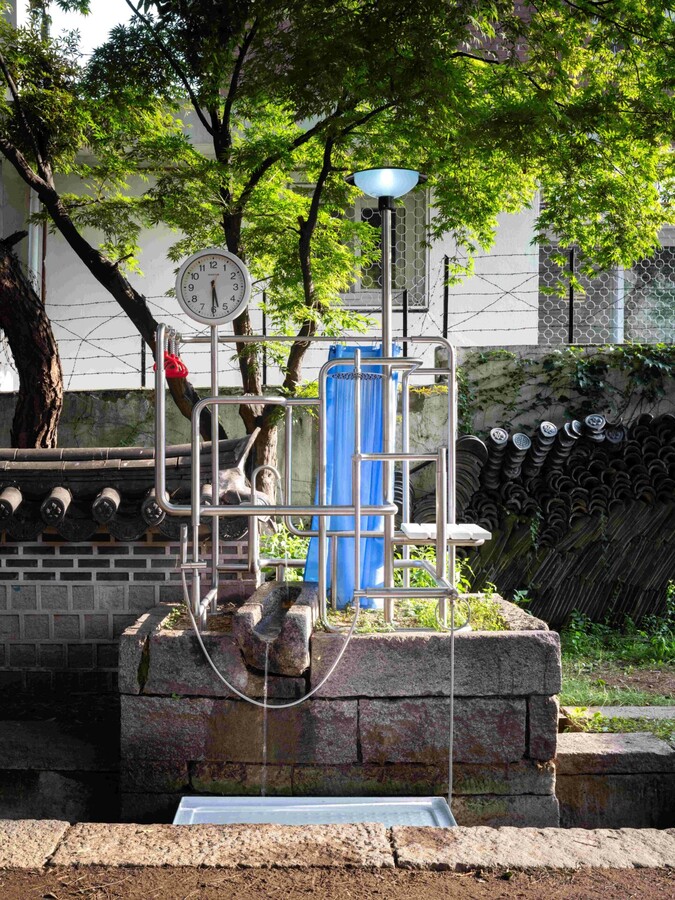
Yona Lee is widely recognized for installations that combine stainless-steel tubular structures with everyday objects. The artist cuts, bends, and welds metal tubing to create networks that extend across walls, floors, and ceilings, often occupying entire spaces like labyrinthine environments. The repeated interplay of straight and curved lines generates both architectural order and sculptural rhythm, encouraging viewers to move through and experience the space physically.
 
Within these structures, Lee places ordinary objects commonly found in everyday life. Chairs, beds, fans, lamps, shower curtains, and public transport grab handles function simultaneously as utilitarian items and unfamiliar sculptural elements. These objects appear as if they have grown from the structures themselves or have been integrated as components within a larger system, transforming the installation into a spatial environment.
 
Lee’s early training as a classical cellist also informs the formal language of her work. The linear metal tubes that traverse space can resemble musical staves, while the objects positioned along them read like notes within a score. Yet for Lee, music functions less as a visual metaphor and more as a framework for understanding relationships—between composer and performer, artist and space, and artwork and audience.
 
From this perspective, Lee’s installations operate less as static sculptures than as spatial performances. The works imply possibilities for use and movement, sometimes inviting viewers to sit, pass through, or inhabit the structures. In this way, her practice moves fluidly between sculpture, drawing, architecture, and performance, producing complex and dynamic spatial experiences.

Topography & Continuity

Yona Lee’s installations are strongly defined by their site-responsive character. Before producing a work, the artist closely analyzes the architectural structure of the exhibition site, often developing computer-generated drawings to map the relationship between the building and her intervention. Through this process, walls, ceilings, staircases, and windows become integrated components of the work itself, transforming the entire space into a sculptural environment.
 
This approach is most clearly articulated in the ongoing 'In Transit' series, which Lee has developed over the past decade. The series establishes a structural language that links space, movement, and the environments in which people live. For an artist who has worked between New Zealand and Korea, urban transportation networks and infrastructural systems represent universal forms of human environment, recurring as central motifs throughout her practice.
 
Lee’s work also continually explores the tension between functionality and form. Many of the objects embedded within her installations appear usable yet are subtly inaccessible or rendered impractical. These gestures prompt viewers to reconsider how spaces are structured and how their usage is regulated, disrupting the conventions that typically govern everyday environments.
 
Ultimately, Lee’s installations function as spatial maps of the complex systems that shape contemporary urban life. While the works adapt to different architectural settings and exhibition contexts, the language of stainless-steel structures combined with everyday objects remains consistent across her practice. This balance between continuity and transformation forms the distinctive sculptural vocabulary through which Lee reflects on the spatial conditions of contemporary life.

Works of Art

Dismantles Spatial Boundaries

Articles

Exhibitions

Activities