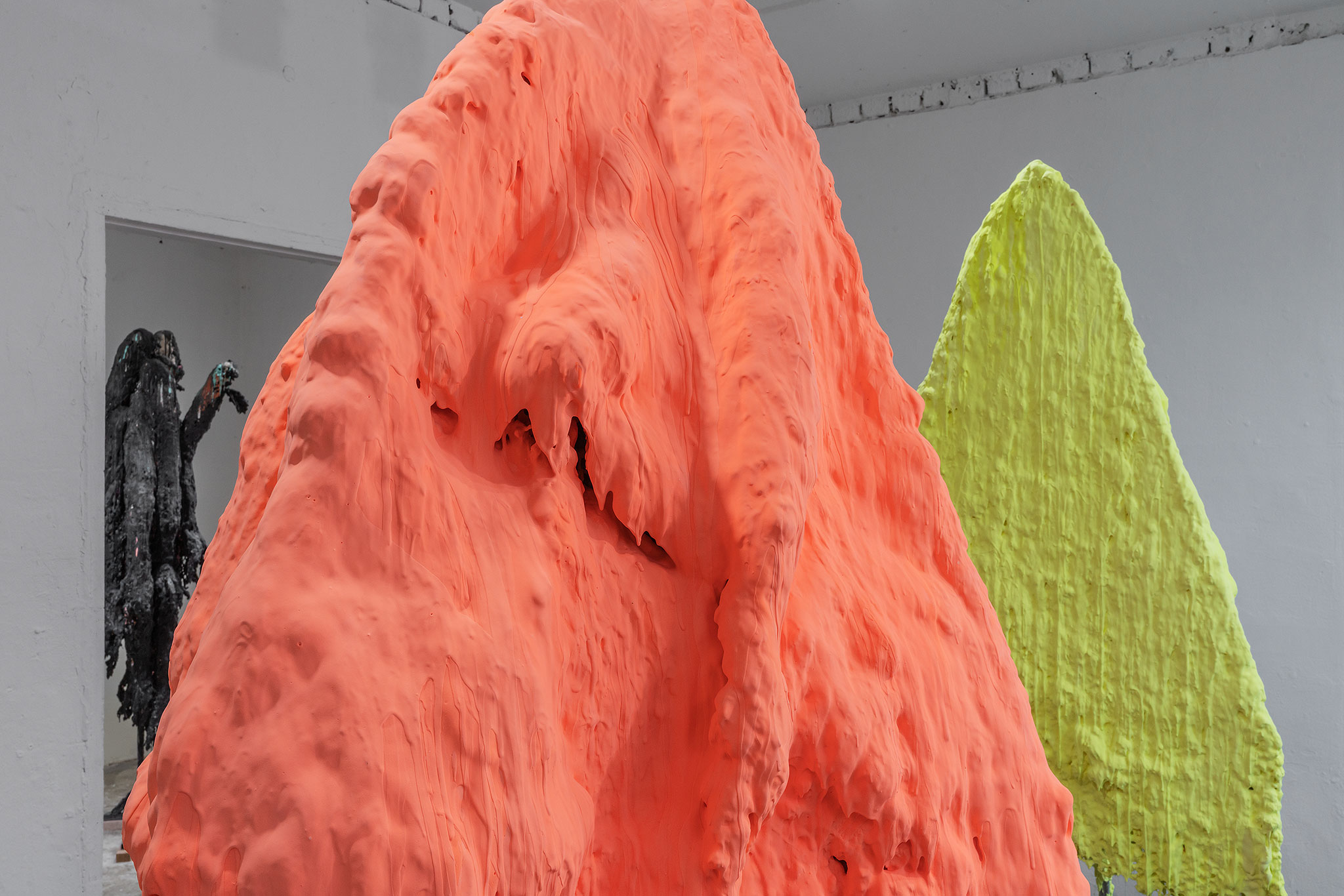
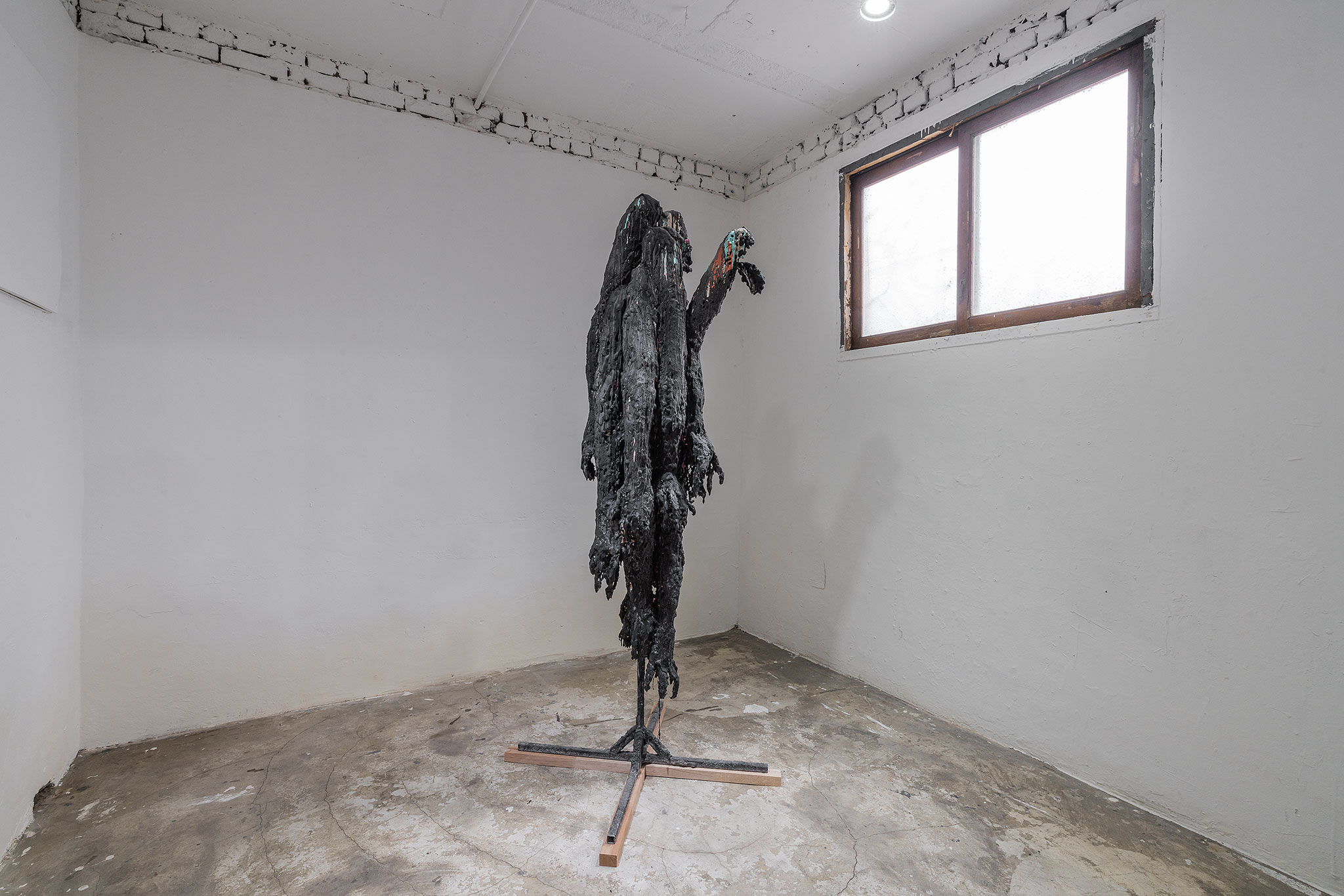
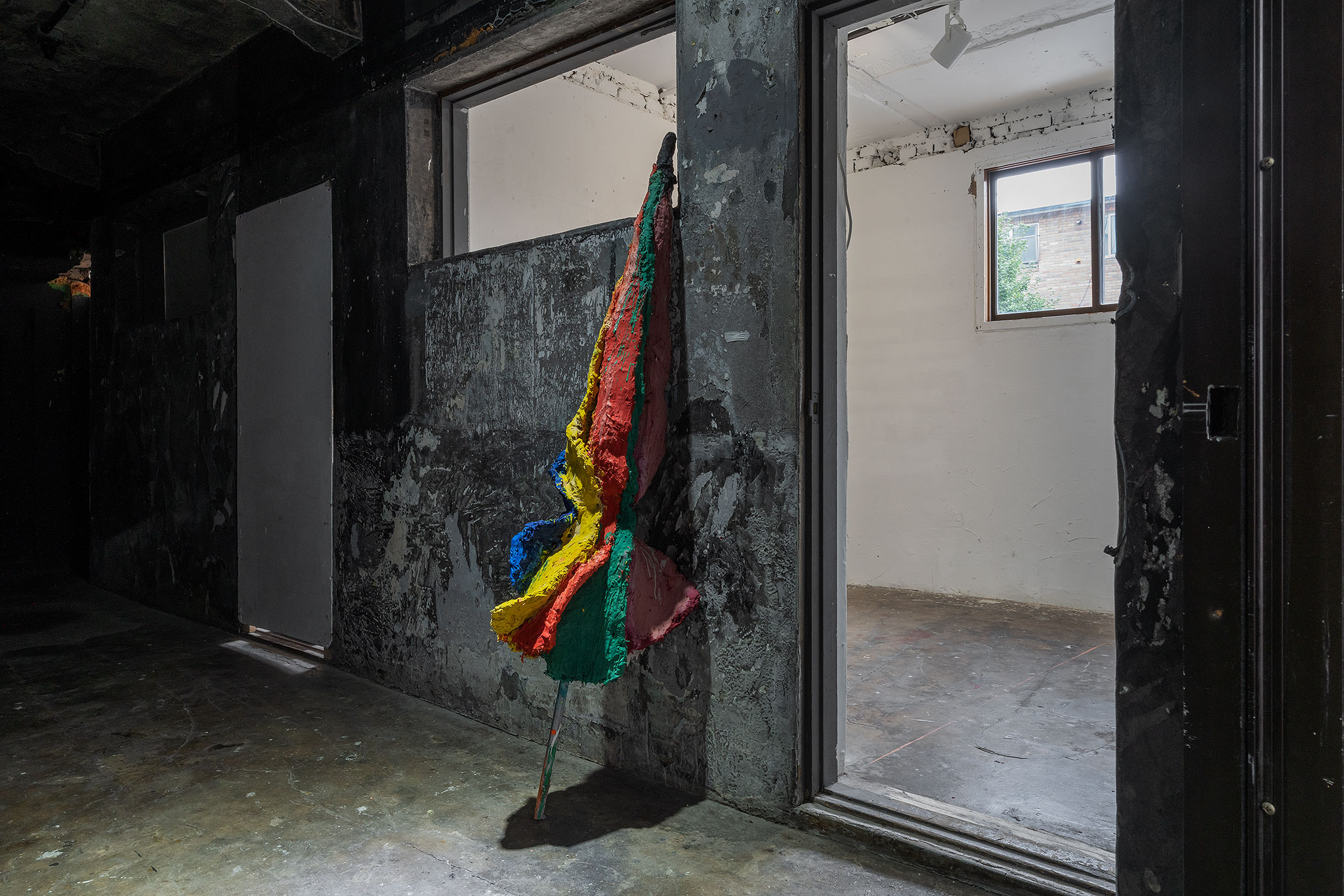
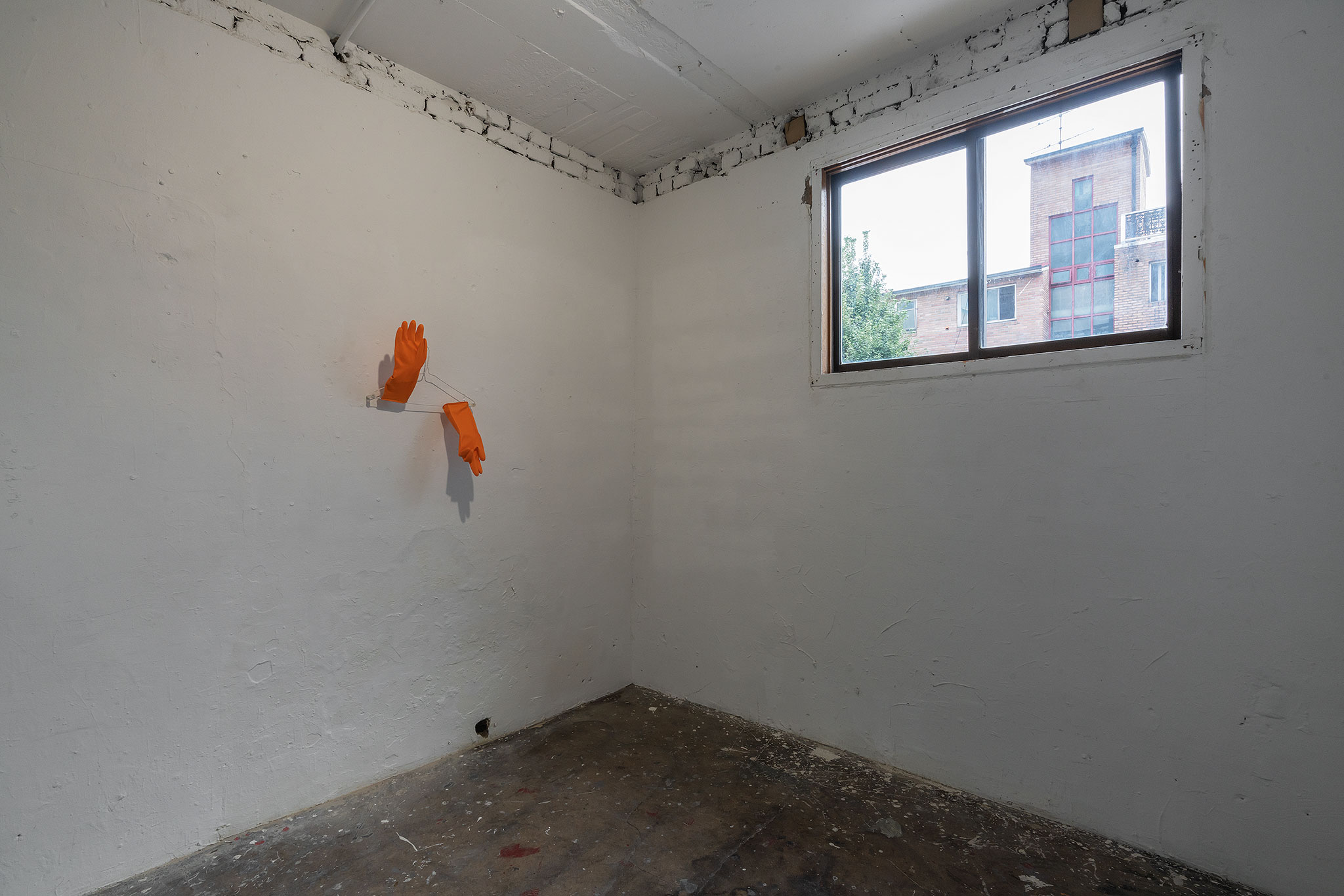
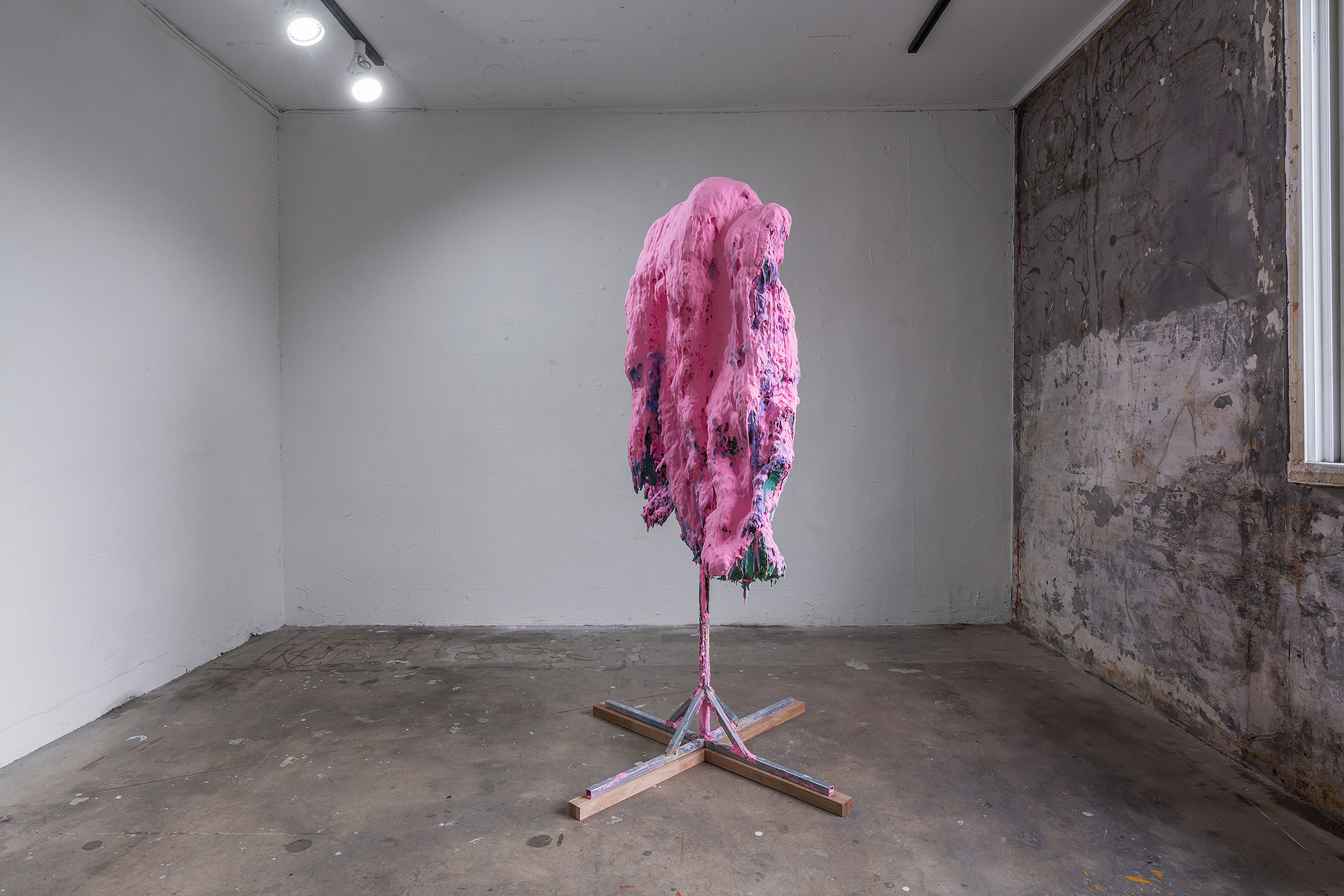
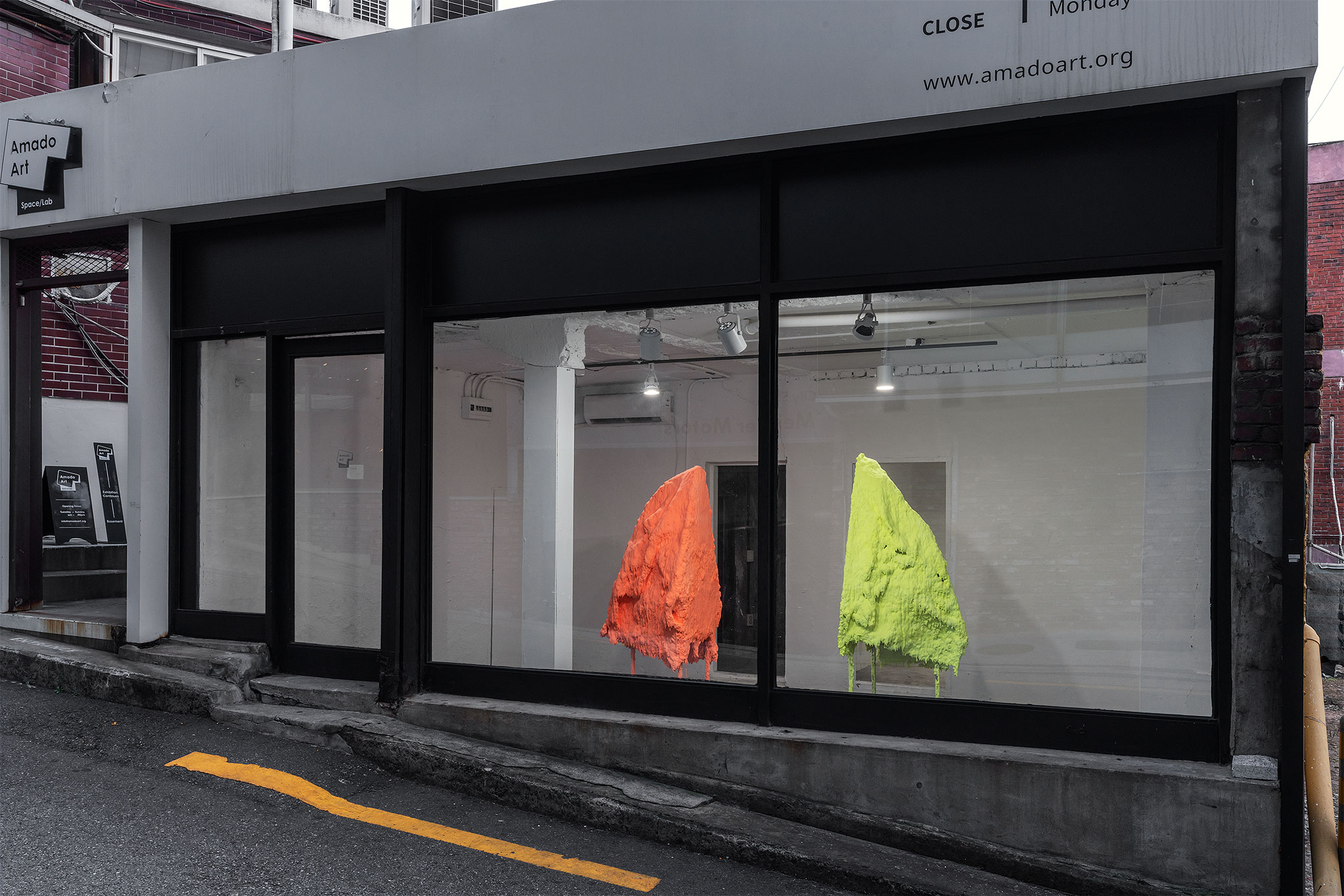
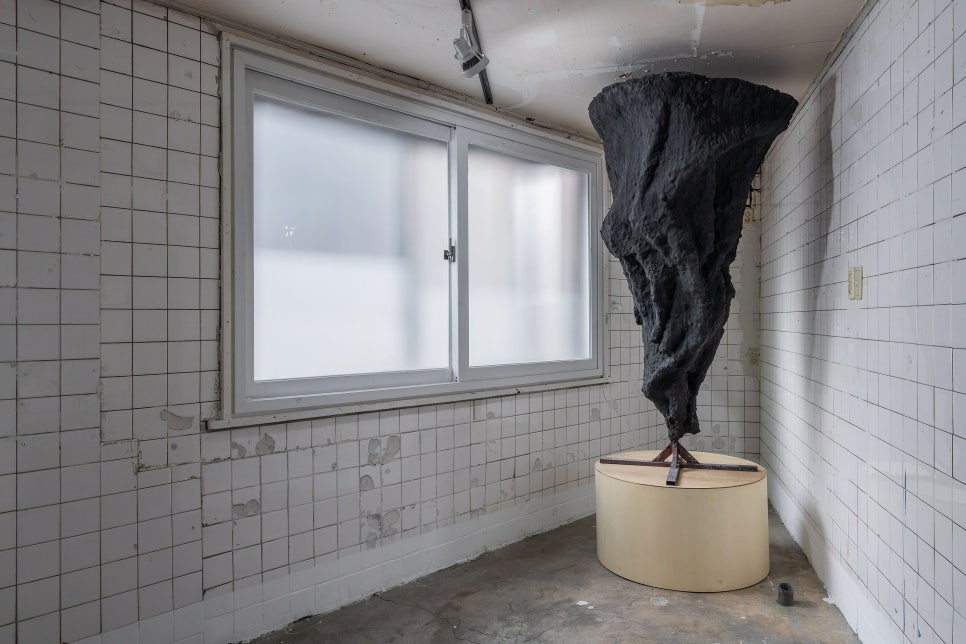
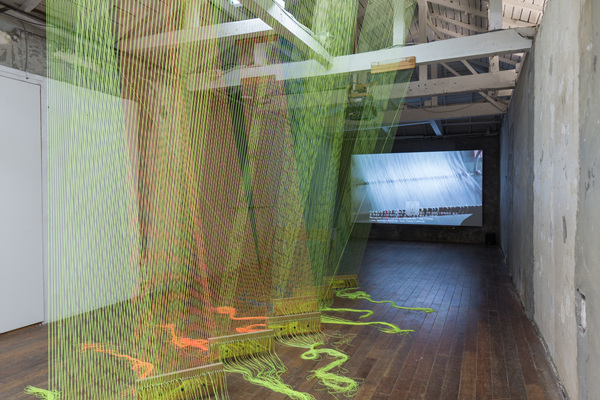
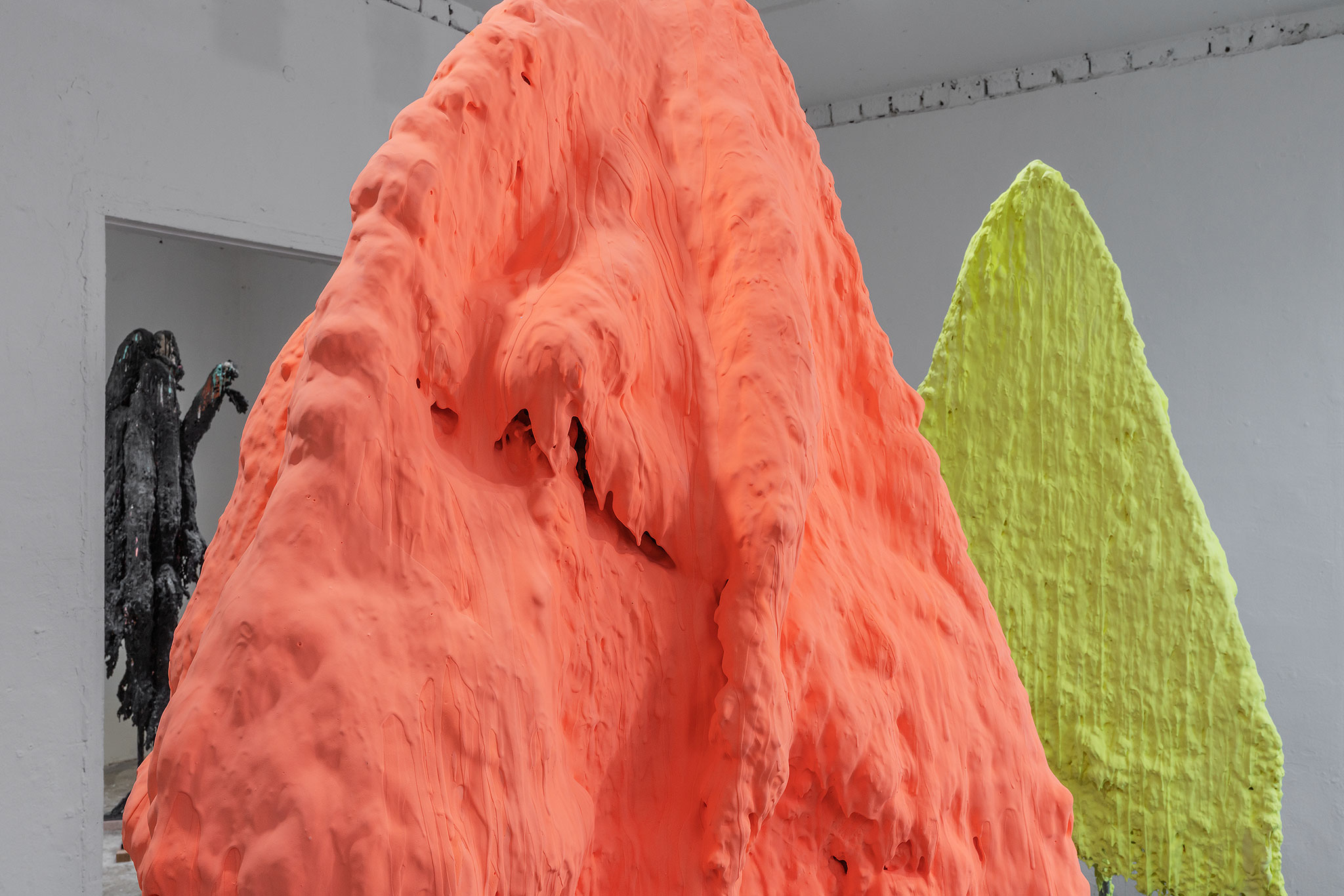
If Mounting on Rocks, We'll See You at the Top, Better a Live Coward than a Dead Hero, and works not included in this exhibition—such as fake rocks made of Styrofoam, stone monuments, and signboards engraved with phrases—were derived from labor the artist experienced firsthand, Tying (2013/2016) addresses the world of real labor from a somewhat more objective distance.
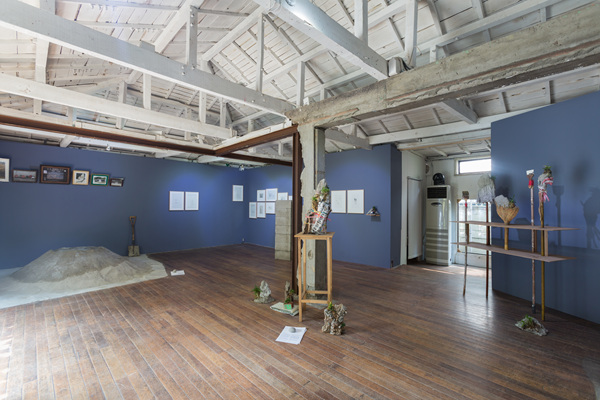
Moving into the adjacent exhibition space, one encounters an installation of dyed yarn under fluorescent lights in a worn interior resembling a small-scale cottage factory. Behind it, a video cuts across time and space by alternating between the calm recollections of the artist’s mother, who worked at a textile mill when she was young, and an interview with a present-day factory worker in Thailand.
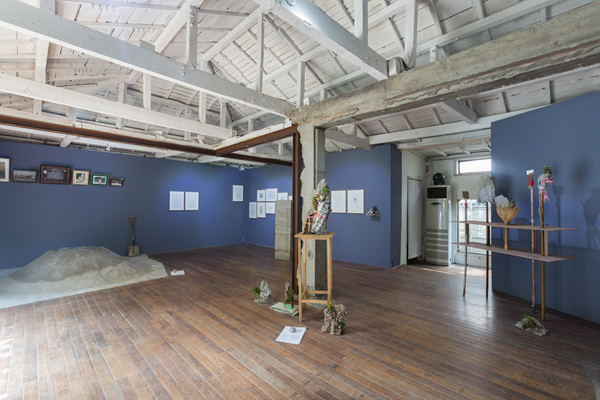
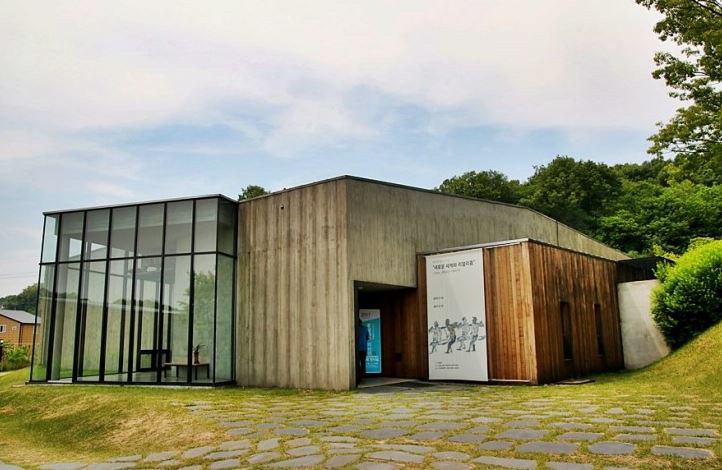
The aged atmosphere of Art Space Pool evokes the textile mill preserved in the mother’s memory, while the video reproduces the repetitive movements of machinery in today’s automated factories. Silk fabric woven by fully automated machinery in the video hangs across one wall, bearing the phrase, “A person who would survive even if dragged onto a field of gravel, and who would go to a field of sand, make a foundation stone, build a house, and live there.”
Its insistence is more tenacious and forceful than the hesitant will to live expressed in “Better to roll in a field of dung than to leave this world.” Installed in a small room on one side of the exhibition, Basement Sewing Rainbow amplifies the lyricism and nostalgia felt in the dyed-yarn installation of Tying, pushing them toward the realm of fantasy. In this work, bowls of water, shards of glass, mirrors, and other materials meet light passing through the wall to create a rainbow, conveying a somewhat hopeful message, like a ray of light entering a life marked by hardship and sorrow.
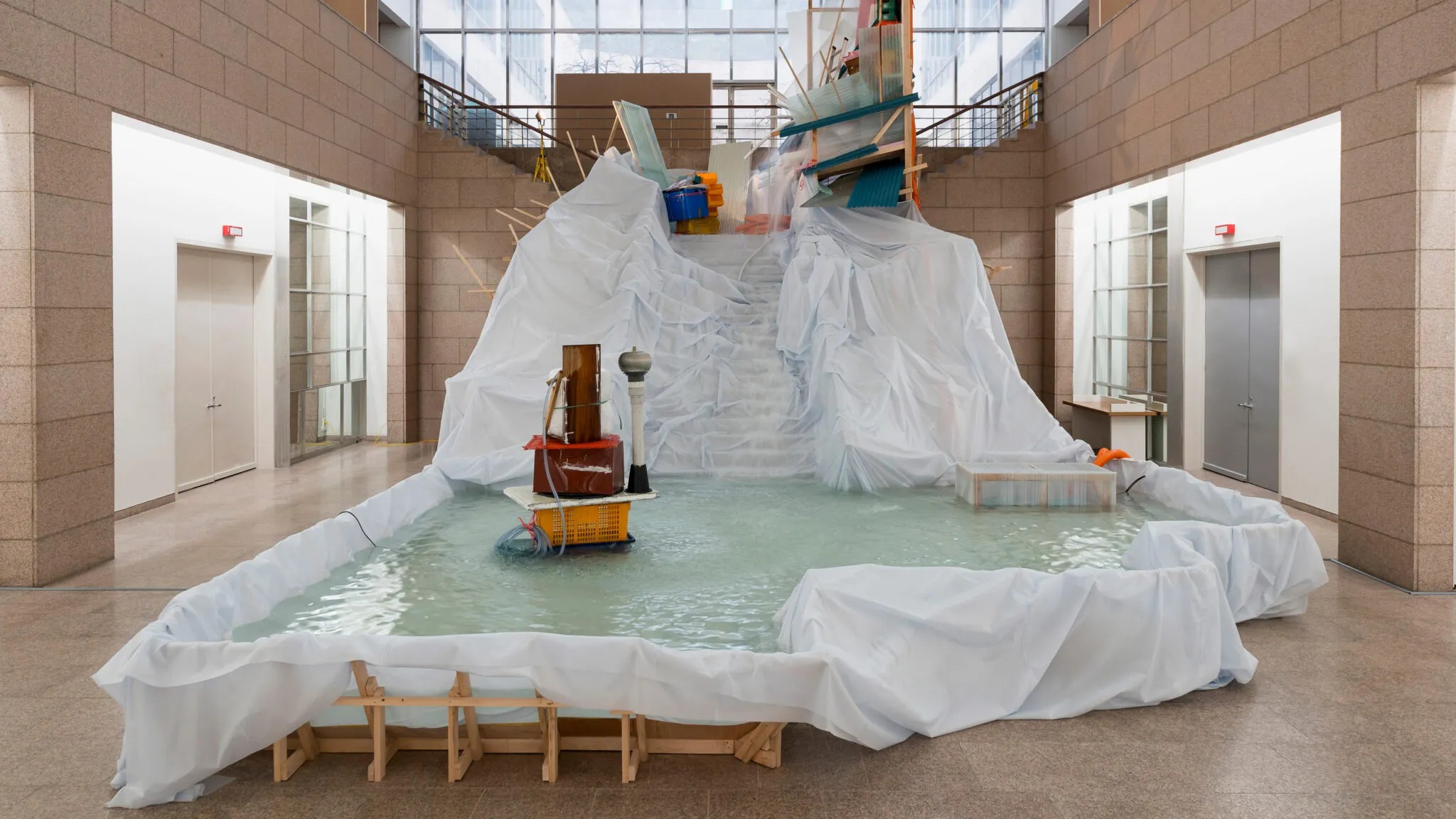
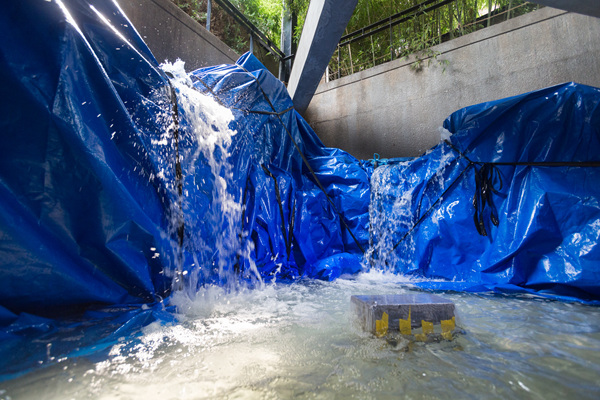
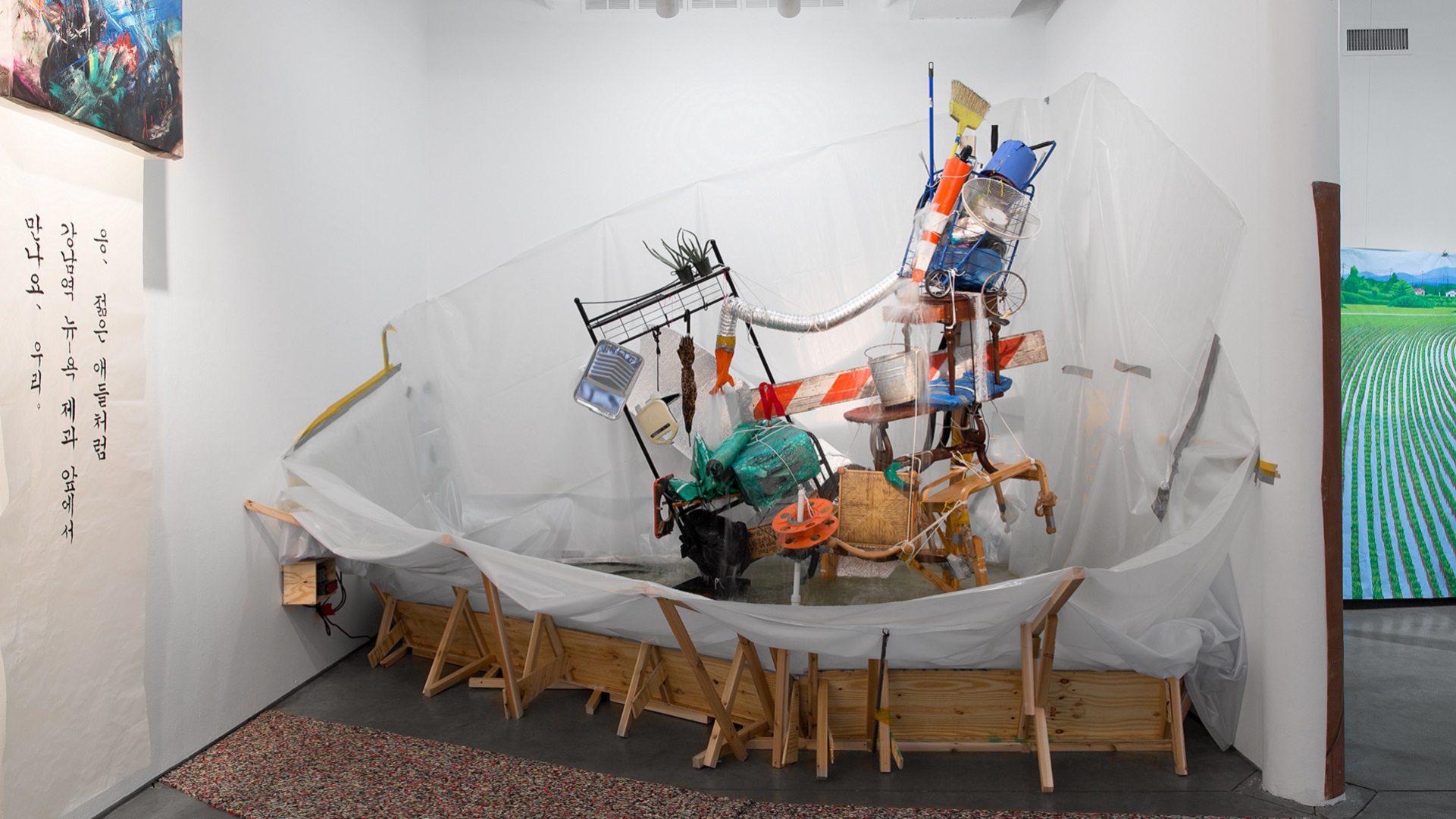
In the basement of the neighboring building stands Waterfall (2016), a work that seems to merge the scenery of a construction site with that of an artificial waterfall in the city. Since Waterfall_Structure of Survival, first presented in a solo exhibition at Mullae Art Factory in 2011, the artist has produced six or seven different versions of Waterfall.
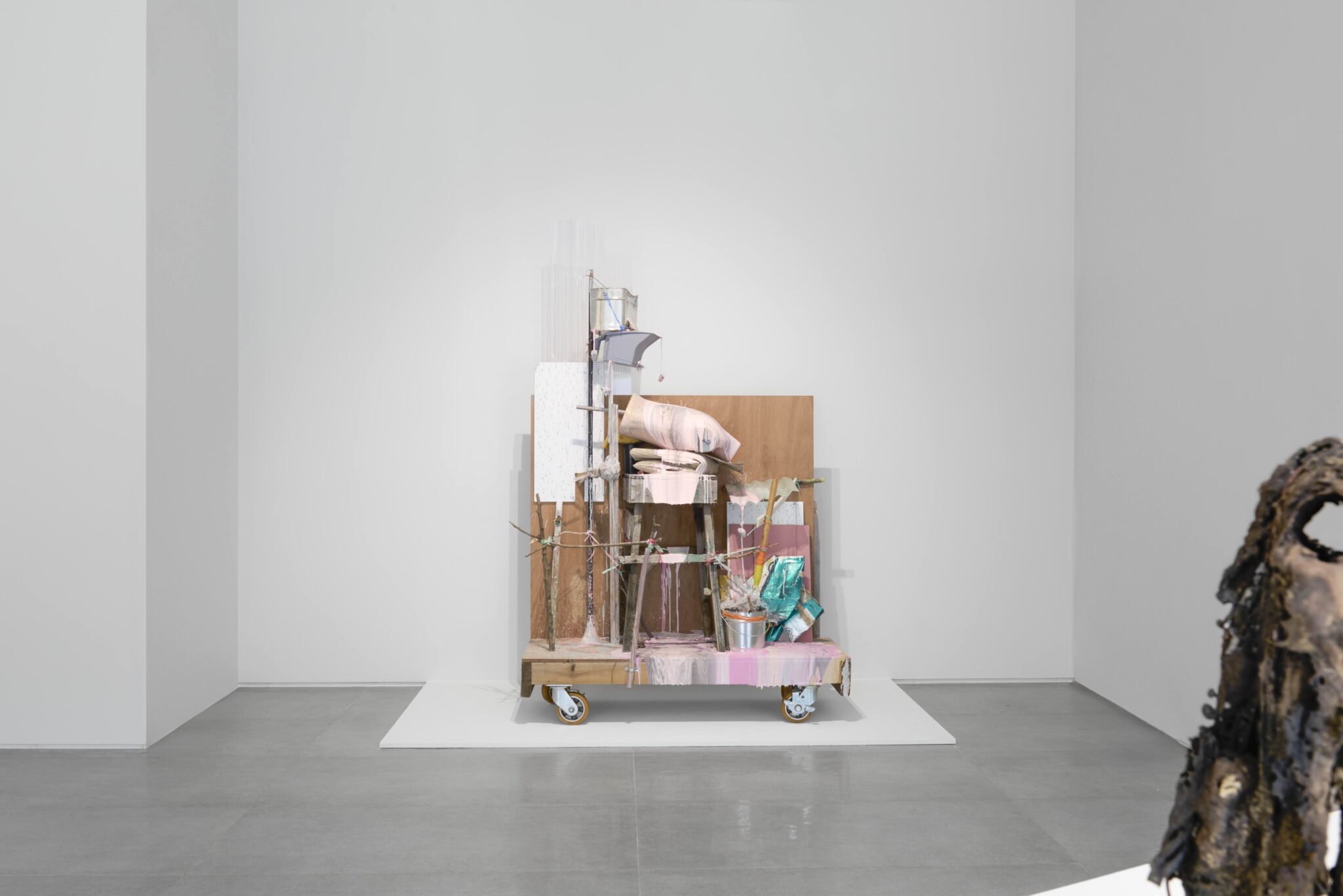
The Waterfall installed in the basement courtyard of Art Space Pool is constructed from only the most basic elements, closely resembling the drawing of an imagined urban leisure facility that Kwon made when he first conceived the series. This waterfall differs from earlier versions, in which water gushed over structures piled high with recycled objects, discarded materials, and assorted found items, intensifying their material presence only to dissolve it through the flow of water.
Here, as though recreating the two-dimensional flatness of a drawing, outlines were sketched onto several wooden panels, cut out, and erected like two or three layers of walls. These were then covered with blue waterproof tarpaulin and tightly bound with industrial rubber straps. The result resembles construction materials stacked in a corner of a building site and covered for protection, or goods loaded onto a truck, wrapped and tied down to keep them from spilling out.
If the earlier Waterfall works seemed to pull out and expose everything that might ordinarily be hidden beneath a tarpaulin, this work instead wraps and covers those things, moving—like the Mounting on Rocks works—toward an aesthetics of artificial scenery resembling the ridgelines of mountains and cliffs.
Perhaps because of the familiarity of this construction-site-like scene, Kwon Yongju’s artificial waterfall feels more natural and more real than the artificial waterfalls found in cities that imitate spectacular natural scenery. On a small screen placed on a table in front of the waterfall, videos showing water cascading through earlier Waterfall works play continuously.