Women Artists of the Korean Women’s Painting Association, Are You Strong?
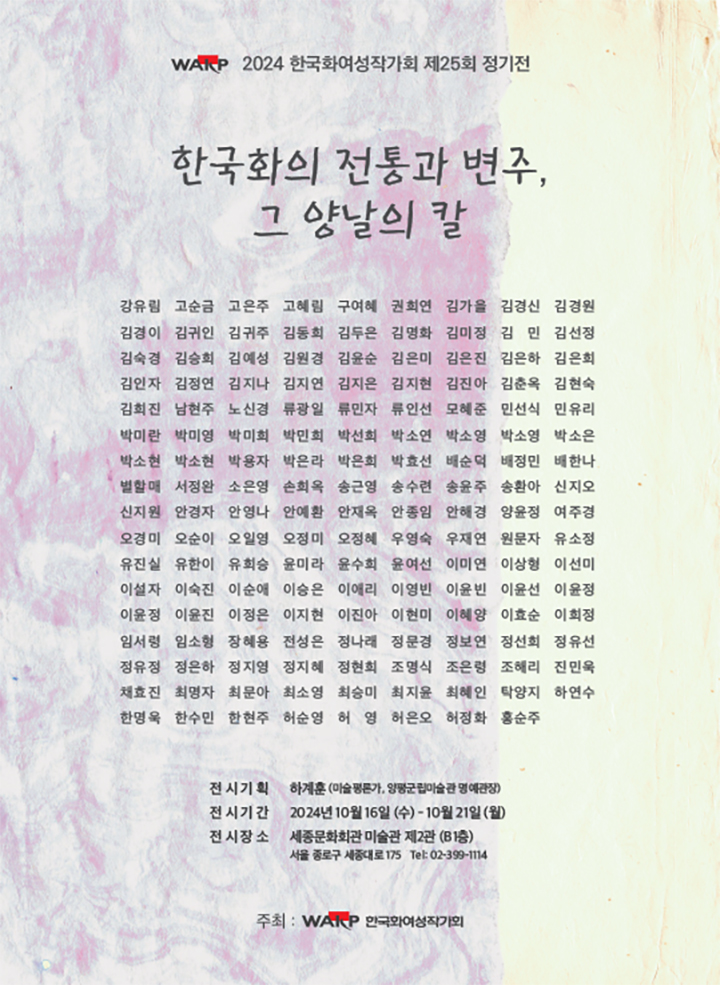
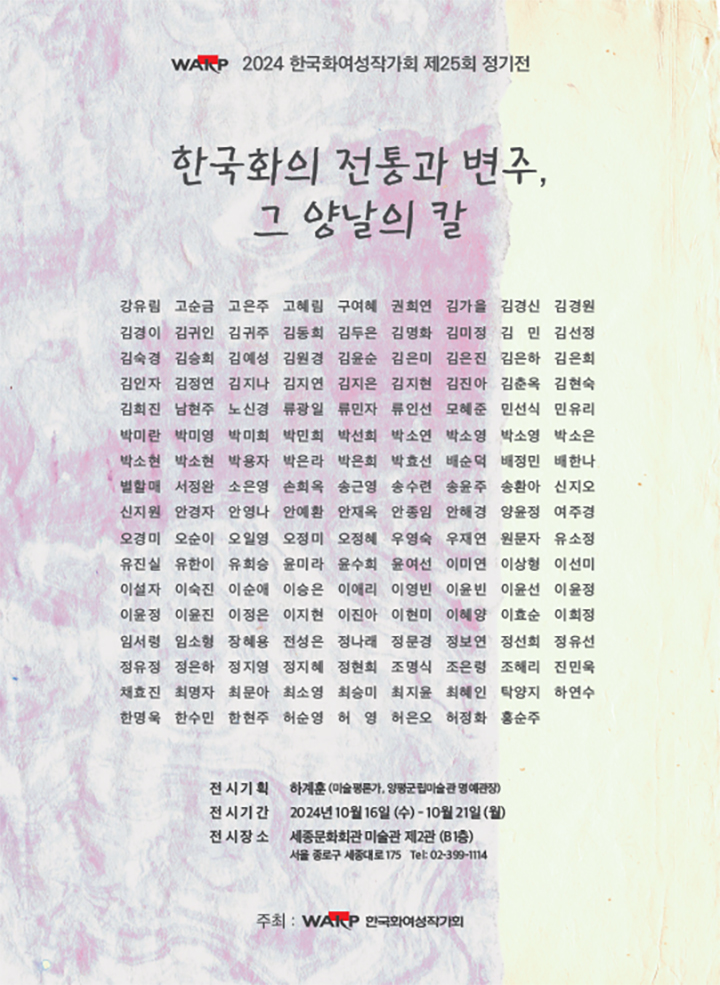
Are you strong? We tend to assume that this question is directed at men. Until recently, asking such a question of a woman might have seemed to miss the point. Because the frames of “women = beauty” and “men = strength” have historically been imposed upon our lives from childhood, most people have lived without escaping them.
This was especially true before such historical turning points as the Industrial Revolution and the First and Second World Wars. As a result, the formulas of men as yang (陽) and women as yin (陰), and men as belonging outside the home and women within it, remained firmly established for a long time as paradigms governing society.
It is also fair to say that, confined within this social framework, Korea’s modern and contemporary art world developed under male leadership. Organizations and associations exclusively for women began to emerge as part of the movement to dismantle the injustices arising from this context.
Women’s universities, the Korean Women Entrepreneurs Association, the Korean Women Journalists Association, and the Korean Women’s Painting Association all appeared in Korean society within this context, and these developments have been met with both encouragement and criticism.
The Expansion of Space and the Diffusion of Experience
Let us go back approximately five hundred years. In Europe at that time, those around Christopher Columbus took it for granted that if one ventured far enough out to sea, one would reach the edge of the earth, beyond which lay an unknown world beneath a precipice. Fear and ignorance surrender the space of our lives to terror, fantasy, and distortion.
Created several centuries later, Francisco Goya’s The Sleep of Reason Produces Monsters, although its interpretation is not entirely definitive, is generally understood as a work containing criticism and satire of the superstitions and harmful customs of his time. Korean painting artists should understand that beyond paper and ink lies a world of canvas, acrylic, and oil paint, and that approaching this realm will not reveal the kind of precipice described in the story of Columbus.
Of course, not everyone needs to board a ship and race toward that precipice. Nor should they. Some will preserve the traditional spirit and techniques of Korean painting. Yet, like Columbus, others must at least once be able to overcome their fear of the precipice beyond the horizon.
Usefulness and Use
The dictionary defines “usefulness” as “the value of being useful” or “a field or area in which something may be used.” “Use,” meanwhile, is defined as the passive form of “to use”: “the place where money, an object, or something similar is actually employed, or its purpose.” Therefore, the works created by artists must be put to meaningful use.
In the process of creation, artists need to clarify the usefulness of their work—that is, the purpose of their creative practice. Only works produced through the professional spirit and aesthetic consciousness of an artist, beyond the recreational activities of amateurs, can earn recognition from peers, seniors, and younger colleagues in the art world for their effort, talent, and value, and thereby establish the legitimacy of their creative practice.
The British art critic Alan Bowness divided the process of an artist’s growth and success into four stages: first, recognition by fellow artists; second, recognition by critics; third, recognition by dealers and collectors; and finally, public acclaim. The path of artistic creation is thus the process of striving, together with one’s peers yet also through one’s own rigorous efforts, to become an artist of genuine value.
The Originality and Uniqueness of Art Despite the Age of Digital Reproducibility
Korean painting has preserved a long tradition throughout Korean history, but with the advent of the twentieth century, its place in the history of Korean art gradually came under threat. This was due to the growing interest in Western painting techniques introduced through Japan, a sense of self-denial under colonial rule, and curiosity about new European and American art movements that entered Korea in the aftermath of the Korean War.
As Korean society underwent rapid modernization during the twentieth century, every sector—including art education, modes of living, and the economic system—became increasingly Westernized. As a result, Korean painting found its position narrowing not only within the art world but also within everyday living spaces.
Amid these changing currents surrounding Korean painting, some artists challenged tradition, while others experimented with new forms of convergence between tradition and modernity. Still others resisted the tide of Westernization and sought to preserve the archetypes of traditional painting, bringing us to the present.
Korean traditional painting, which has no direct equivalent in the West, is undoubtedly a valuable cultural asset. However, discussing Korean painting, or Eastern painting, in opposition to Western painting is largely a distinction based on materials and form, and has little to do with the subject matter of a work or the identity of its creator, both of which may be considered more important in artistic production.
Accordingly, some have questioned whether Korean painting should be understood not as a specific genre, but rather as any work created here and now that reflects our own consciousness.
The Current State and Future Challenges of Korean Ink Painting
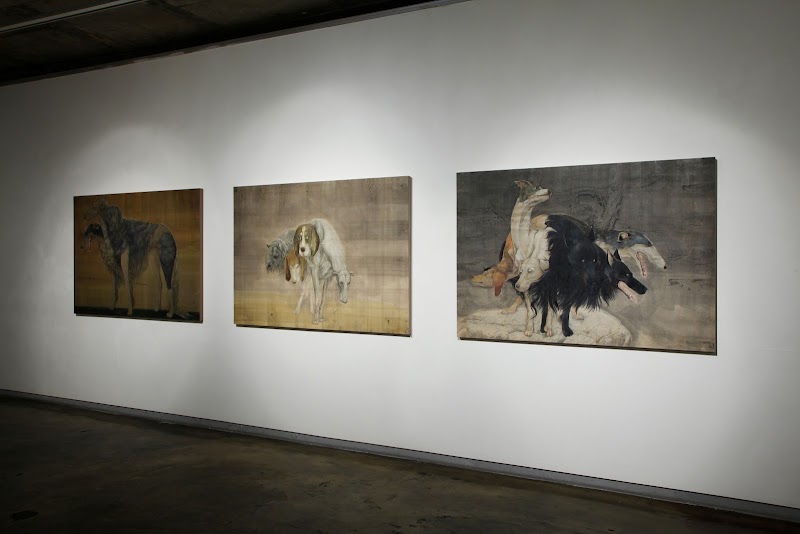
Ink painting (水墨畵) is widely recognized as a form representative of the traditional painting of Korea, China, and Japan. Like oil painting or watercolor, the term identifies the material used and thereby indicates the work’s physical character. Developed over thousands of years primarily in Korea, China, and Japan, ink painting may be regarded as a foundation of East Asian art.
Since the time of Columbus, as world history came to be centered on Western Europe and North America, this painting tradition with its exceptionally long history has received comparatively less attention in art-historical research and the art market. Nevertheless, the artistic value created through ink should be treated as significant regardless of time and place, and it may at any point be examined anew and reassessed.
One of the key distinctions between ink painting and conventional Western painting lies in the use of the limited materials of ink and brush. The process makes visible a wide variety of brush traces, whose meanings and symbolism are far deeper, more ambiguous, and more evocative of the imagination than those found in other forms of painting.
Compared with brushes used for oil or acrylic painting, the brush used in ink painting is softer and more difficult to control. Dipping it in ink and drawing strokes across xuan paper therefore demands that the artist handle each movement with heightened sensitivity. The subtle differences and variations produced by the traces of the brush and the gradations of ink must generate a symbolism capable of creating a far deeper impression than that of Western painting.
Above all, because revision is virtually impossible in ink painting, the trajectory of a single brushstroke and the trace of ink it leaves behind acquire a kind of formal absoluteness. Becoming an ink painter therefore requires prolonged training in precise manual technique, along with sustained investigation into the material properties of ink and paper.
Although ink painting demands a highly refined level of technique, it also requires profound spirituality and imagination in its content, addressing invisible values that descriptive painting centered on realistic representation finds difficult to attain. When depicting a flower, therefore, the artist must go beyond rendering it with the accuracy of a botanical illustration and convey its fragrance and dignity.
Likewise, a portrait must capture not only the likeness of the sitter’s skeletal structure and musculature but also the person’s character and spirit. In truth, this spirit of ink painting is difficult for ordinary people to sustain.
Even so, the fact that ink painting has preserved such seemingly impossible fundamental principles, or canon, over a long period of time—although some may regard them as outdated—can be understood as a way of safeguarding the value of art and preventing the essential values of the human spirit from being diluted or eroded by changes in time and environment.
Aristotle referred to the faculty through which all animals, including humans, perceive objects, retain them in memory, and form images of them as the “common sense.” Going a step further, he argued that human beings are the only creatures capable of higher-order thought that exceeds common sense.
In painting, the creation of works that combine realistic depiction with a certain degree of imagination may therefore be considered a matter of common sense. Yet when this stage is surpassed, human beings can generate the higher forms of thought and philosophy that they alone are capable of producing, and ink painting may be understood as one of the visual forms through which this process is realized.
Since the Renaissance, Western painting adopted the application of perspective and the creation of three-dimensional volume on a two-dimensional surface as central functions of painting. Until the emergence of photography in the modern era—a new technology capable of accurately capturing the form of an object—these techniques served as important criteria for determining the quality of a work.
Although the aims of representation may have shifted with the development of materials such as tempera, oil paint, and acrylic, Western art fundamentally pursued verisimilitude: the sense of plausibility produced by the representation of objects within the pictorial surface. This naturally required detailed depiction, supported by scientific advances that facilitated the techniques necessary for such representation.
The Western-centered art world continues to regard the incorporation of the present and everyday life into artworks as an important value. As digital images are generated and transformed at an ever-accelerating pace, and while expectations grow around the so-called Fourth Industrial Revolution, one of the foremost concerns in Western or Western-style art remains the issue of virtuality and its resemblance to contemporary reality.
By contrast, ink painting possesses an inherent inclination toward seclusion and restraint, contemplation and transcendence. These qualities may naturally have encouraged a relatively passive response to change. While Western art has passed through repeated moments of transformation brought about by the invention of new techniques and machines, the world of ink painting has reached the present without actively embracing changes in the external world or pursuing major transformation. In this sense, the weight of history has settled upon ink painting.
From the perspective of Western art, ink painting is closer to abstraction than realism. It is symbolic and suggestive rather than explanatory, poetic rather than prosaic, and transcendent and reclusive rather than mundane. Of course, it is not necessarily desirable to explain ink painting through such binary oppositions. Nevertheless, it cannot be denied that this form of analysis helps clarify its distinctive character.
In Korea, the tradition of ink painting underwent considerable disruption as it passed through the Joseon Dynasty and the period of Japanese colonial rule. In this process, it is noteworthy that in the 1930s Kim Yong-jun advanced his theory of “Southern School ink painting” in an effort to reverse the prevailing tendency under Japanese imperial rule, when the Korean art world was dominated by color painting and ink painting was dismissed as a “relic of the feudal era.”
Some scholars have also criticized the way in which the tradition extending through such Joseon-era artists as Jeong Seon, Kim Hong-do, and Jang Seung-eop became imbued with Japanese stylistic influences during the colonial period, allowing color-oriented painting rather than ink painting to dominate the Korean art world. One such figure was Byeon Yeong-ro, who contributed On East Asian Painting to The Dong-A Ilbo in 1920.
Because Korea’s modern history passed through a colonial period in which Japanese imperial oppression deprived the country of autonomy in politics, economics, diplomacy, and other fields, the remnants of Japanese imperialism also became something to be overcome in the cultural sphere.
Viewed within this historical trajectory, it was in some respects natural that literati painting centered on ink should be emphasized as one means of eliminating colonial remnants from the field of art. From liberation through the 1950s, the rejection of the Japanese character associated with color painting contributed, in this context, to a comparatively favorable evaluation of ink painting.
According to Song Heekyung, Korean contemporary art in the 1960s followed this tendency toward the restoration of ink painting, while traditional genres such as true-view landscape painting and genre painting were reexamined in order to heighten national consciousness. From the 1960s onward, so-called sketch-from-nature landscape painting became increasingly widespread.
This style may be understood as combining traditional Korean landscape painting with Western modes of representation. The tendency can be seen as the result of the direct and indirect introduction of Western culture, centered on the United States, following the Korean War that began in 1950, and its subsequent convergence with Korean traditional culture.
In this way, ink painting, which had continued from the Joseon Dynasty as part of Korea’s artistic tradition, began seeking a path toward modern ink painting by integrating new elements through encounters with two external forces: Japanese imperialism and the new culture of the West.
Considering this history, modern ink painting may be said to have partially accepted change while striving to overcome influences imposed or absorbed from outside and to preserve Korea’s distinctive spirit and techniques. In practice, however, developments unfolded somewhat differently. Through the 1970s and 1980s, the tradition of ink painting gradually lost its depth and substance.
The reasons can be found in many areas, but above all, the direction of Korea’s social development became overwhelmingly oriented toward Westernization. Tradition and the past came to be regarded not as things to inherit but as things to overcome and discard. In the field of art, calligraphy and painting briefly attracted attention in the art market during the 1970s, alongside ceramics, as objects of interest within the trade in antiques.
Yet this interest merely passed through the market, functioning less as genuine artistic engagement than as a form of decoration through which those who had achieved economic success in Korea’s rapidly developing society could display their social presence.
In the catalogue for 《The Eye on Modernity: Korean Modern Art—Ink and Color Painting》, held at the National Museum of Modern and Contemporary Art, Korea in 1998, curator Kim Hee-dae described the difficulties faced by exhibition organizers in a field where research on Korean ink and color painting remained limited, specialists were scarce, and an atmosphere prevailed in which authenticity could not be determined with precision.
One might add that by this time the speculative interest in Korean traditional art that had emerged in the 1970s had already disappeared from the art market, while attention was shifting toward works embodying Western aesthetics. It is therefore reasonable to suppose that the exhibition’s organizers may also have questioned whether such a project reflected the interests of the wider public.
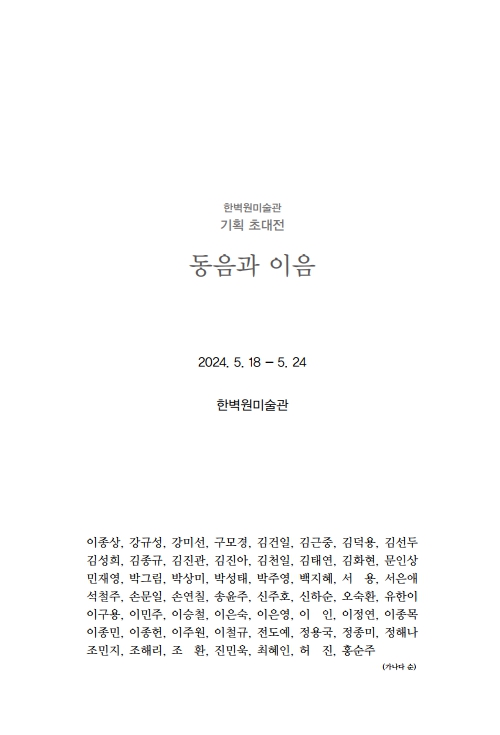
Concern over the state of Korean ink painting at the time also appears in an essay contributed by the senior artist Lee Jong-sang to the catalogue for 《The Fragrance of Ink, the Form of Ink: Contemporary Ink Painting from Korea, China, and Japan》, held at the National Museum of Modern and Contemporary Art, Korea in 2001.
In his essay, Lee pointed to the difficulties confronting ink painting amid the multilayered ruptures that had emerged in the search for a new identity for Korean art, including the division between North and South Korea, the divide between Eastern and Western art worlds, and the separation of abstraction from figuration.
At the time, artists responsible for carrying forward Korea’s traditional painting were mainly trained at art colleges such as Seoul National University and Hongik University, and they in turn educated later generations. An examination of the artistic tendencies of professors in university departments of East Asian painting, along with the ideas they promoted through their activities and writings, provides an indirect sense of the situation facing Korean ink painting during this period.
Yet the environment within art colleges was not favorable to ink painting. In the educational system divided into so-called Western painting and East Asian painting, the Korean art world was increasingly centered on Western painting in terms of student enrollment, the proportion of graduates who continued to work as artists, and the attention of the art market.
This tendency was further intensified around the time of the 1988 Summer Olympics, when the government liberalized overseas travel and relaxed regulations on study abroad. Most Korean art students who pursued education overseas went to Europe and the United States, reinforcing the Western orientation of the art field. In effect, under the slogan of “globalization,” the government can be seen as having encouraged Westernization.
Moreover, beginning around 1990, as the Cold War order between East and West collapsed, the numerous international biennials that emerged in the art world largely presented works far removed from the spirit and forms pursued by ink painting. It must therefore be acknowledged that the international art environment was not favorable to the revitalization of ink painting, whether in Korea or elsewhere in East Asia.
It is therefore entirely natural—and perhaps even an inherent obligation—to take concrete action to revitalize ink painting. Even Oh Chi-ho, known primarily as a Western-style painter, wrote in a 1946 contribution to Sinmunhak that “East Asian painting has long been the original art of Korea and must continue to be Korean art in the future,” while also warning that “we must understand that turning our backs on the course of a new history can lead only to self-destruction.”
The principal task of ink painting today, then, is to harmoniously fulfill two responsibilities: preserving the foundations of tradition while refusing to turn away from the currents of the times.
How, then, can this mission be realized? Rather than pursuing short-term results, I would first recommend establishing medium- and long-term goals and carrying them out through sustained practice. It is certainly important to introduce contemporary ink painting to today’s artists and audiences and to share it with them.
More important, however, is the need for a systematic form of education that communicates the genuine meaning and values of ink painting to younger generations who will lead our society in the future. Such education should enable them to approach ink painting actively, enjoy it naturally in everyday life without resistance, gradually internalize it as part of their own culture, and ultimately enter more deeply into its core values.
If such plans are carried out as intended, the next generation will be able to cultivate a rich community of accomplished artists who cherish ink painting, as well as scholars and curators devoted to its study.