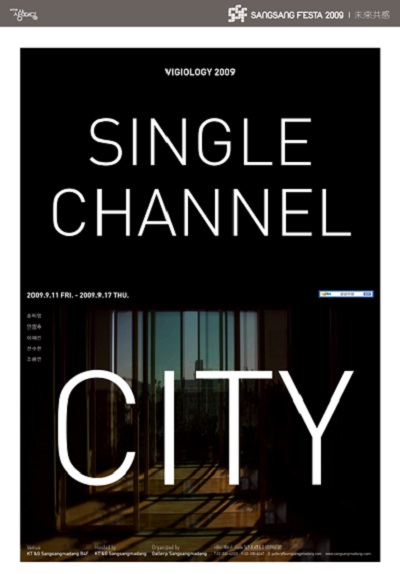
Walking the Screen.
For those enduring bleak and weary days, the four seasons of Seoul unfold. The city, transformed into both theme park and gallery, offers an endless excess of orchestrated events and spectacles. Seoul is no exception. Clouds drift rapidly above the heads of hurried citizens, while sheets of A4 paper scatter across the tops of high-rise buildings.
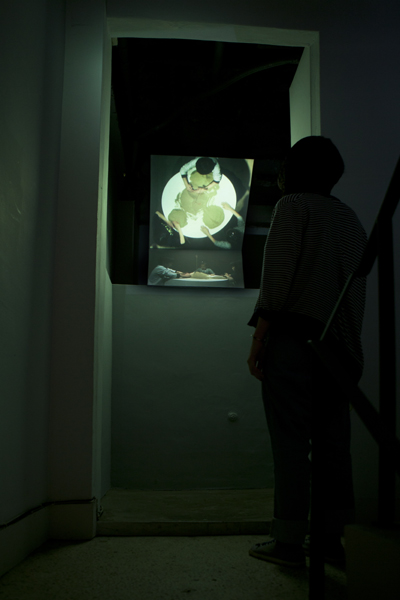
Underground dwellers gaze through small windows resembling television monitors as the seasons pass like wind. Inside high-rise apartment living rooms, people struggle simply to exhale.
There is a film titled La Strada (1954). Accompanied by its sorrowful music, Gelsomina and Zampanò embody the lives and sorrows of those carrying the burdens of reality upon their shoulders. Beneath this narrative lies the catastrophe brought about by the transition from traditional society to industrial society.
Yet once we leave behind the countless films that move us so deeply and step outside the theater into the streets, we are greeted instead by the desires of capital, endlessly reproducing universal emotions as commodities.
In the early 1980s film Videodrome (1983), the protagonist powerfully reveals suspicions and fears surrounding new media through the motifs of video and syndrome. Through the medium of video, desires moving between reality and hallucination become ambiguous — are they truly my own, or do they belong to another?
The film metaphorically addresses the condition of those living within the age of images and media. This perspective becomes even more explicit in The Matrix. Mythic and spectacular, The Matrix can be seen as another version of Videodrome.
Our lives unfold through continual contact with moving images across countless genres and textures. Within everyday life, something — whether we call it consciousness, the unconscious, or something else entirely — continually shapes and influences our awareness.
Even aesthetic and emotional life is not free from such conditions. Yet alongside these operations of power, movements of resistance inevitably emerge, and it is often through artists that we encounter them.
Within and beyond the realm of art, familiar situations repeatedly arise around media. Media is often described as something open in every direction. Interactivity is presented as evidence of this openness. In reality, however, this is not always the case. Questions of subjectivity, power, gaze, and spectatorship inevitably become entangled.
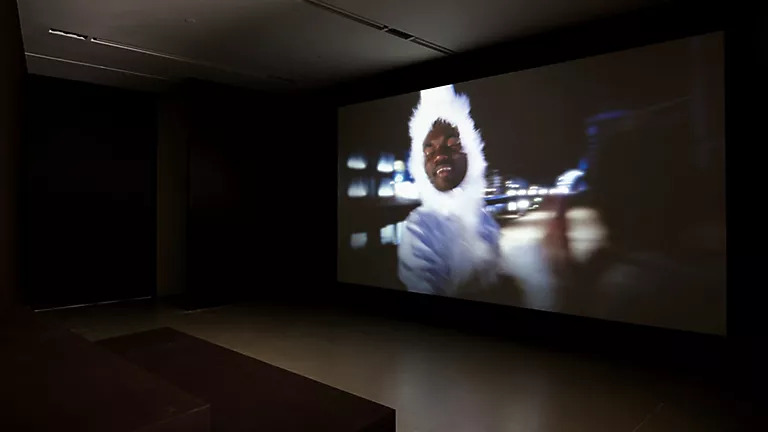
To put it somewhat radically, while a single-channel video may appear open toward the viewer’s gaze, the viewer is simultaneously exposed before that very single channel. The dynamics of interaction are therefore unequal and irreversible.
We are also prompted to reflect upon the notion of “Totalitarian Interactivity” proposed by media theorist Lev Manovich. As he writes: “Western artists see the Internet as a perfect tool for dismantling all hierarchies and returning art to the people. By contrast, as someone who once lived under a communist regime, I cannot help but see the Internet as resembling a communal apartment during the Stalin era.
There was no privacy there. Everyone monitored one another, and what one saw were endless lines of people waiting to use shared facilities such as bathrooms and kitchens.”
The unfamiliar concept of “Totalitarian Interactivity” carries a nuance that fractures the optimistic vision commonly associated with “interactivity” in the discourse surrounding media art. By combining the seemingly contradictory terms “totalitarianism” and “interactivity,” it opens up an entirely new field of perception.
It compels us to reconsider the political-economic, cultural, and artistic contexts through which the notion of “interactivity” is unconsciously accepted and allowed to function. One might argue that such pessimism or understanding is exaggerated, or only possible within the specific experiences of a particular time and place.
Although Manovich’s writing addressed the Internet and electronic information society, it can also be applied more broadly to media culture and new media culture as a whole.
The ambiguous term “single-channel video art,” along with the forces still rushing toward it — or emerging from it — may ultimately be impossible to fully grasp unless one inhabits a border-like existence similar to Manovich himself, who moved from the former Soviet Union to successfully settle in the United States.
Or perhaps such perception is only available to a very particular few, such as Nam June Paik, who experienced life as a colonial subject before becoming part of the Western avant-garde, later emerging as both a successful cosmopolitan and artist.
Perhaps encountering the impressions, lived conditions, or even poetic premonitions of an evolving world of advanced new media through one of the oldest media forms — single-channel video — is itself such a rare experience.
The emergence of new media continues to make the world increasingly compressed, erasing the safe distances between people, cultures, and places. As a result, artists — along with their intuition and inspiration — gradually become narrowed and conventionalized. For artists, only the eternal recurrence of everyday life and boredom seems to remain possible.
In this sense, the countless theories and aesthetics surrounding single-channel video in contemporary art may ultimately become myths, strained constructs, or allegories riddled with errors. Of course, the histories of other genres, forms, and movements in art are no exception. The unsettling symptom present in Videodrome is also the “symptom of interactivity” described by Manovich.
Similar signs can be found repeatedly in the public’s alternating fascination with and indifference toward art and artists, as well as in artists’ own fascination with or indifference toward art and the public. Extending this argument further, such conditions may transform into forms of fascism within media culture or even artistic fascism from the perspective of aesthetic politics.
But then, what does any of this ultimately mean? Perhaps the kitsch and melodrama of endlessly repeated emotions are simply part of human life itself. And within the everyday rhythms and temporalities shaped by the rise and decline of media forms, the consciousness, memories, and images that have been accumulated and formed can always generate entirely contradictory perceptions and ideologies.