DOOSAN
Gallery New York is pleased to announce a group exhibition 《다시-쓰기
Translate into Mother Tongue》, which is curated by three
participants of DOOSAN Curator Workshop program in 2012, from July 25 to August
24, 2013.
DOOSAN
Curator Workshop program is a professional nurturing program which is devoted
to supporting promising new curators and developing Korean contemporary art.
The program selects three new curators every year, and holds regular workshops
and seminars, and an opportunity for them to co-organize an exhibition at the
DOOSAN Gallery.
The 2nd DOOSAN Curator Workshop in 2012, Michelle Dayeong Choi,
Michelle Soyoung Kim and Minhwa Yun were selected. Various workshops and
seminars took place throughout one year, and an exhibition co-organized by the
three curators was opened in January and will be opened July, 2013, jointly at
DOOSAN Gallery in Seoul and New York.
The
exhibition 《다시-쓰기
Translate into Mother Tongue》 began by examining the life
and art of Theresa Hak Kyung Cha (1951-1982). For Cha—who produced a diverse
range of work as a photographer, video and performance artist, and
writer—“language” was of utmost importance. Her interest in language originated
in her formative childhood years, during which she was required to consciously
undertake the study of foreign languages such as English and French.
Cha took a
profound interest in a language’s grammatical structure and systematic
arrangement of characters, and accordingly realized diverse artworks that
scattered characters, erased and repeated contexts, and reduced themselves to
their fundamental components. Throughout this process, Cha remained fixated on
the transformation of language and its meaning, as determined by its function
and application.
Three
curators invited eight artists to create artworks with the motif of Theresa Hak
Kyung Cha. The curators gave the artists the book Dictee,
which the artists subsequently dictated again, and encouraged the artists to
incorporate a layer of Theresa Hak Kyung Cha into their own bodies of work. As
such, this exhibition takes notice of the obsession with and resistance towards
one’s “mother tongue” that emanated from Cha (who was herself bi-lingual and
tri-lingual), and each participating artist accordingly translates this
resistance and attempt at language into a new narrative.
In this exhibition,
these new narratives are connected via defiant and dislocated dictation
(Kichang Choi and Young Eun Keem), the collision of grammatical structures and
tenses of differing memories and languages (Hong Goo Kang and Sasa Shun), the
weaving together of metonymics (Sanghee Song and Young Gle Kim), and the
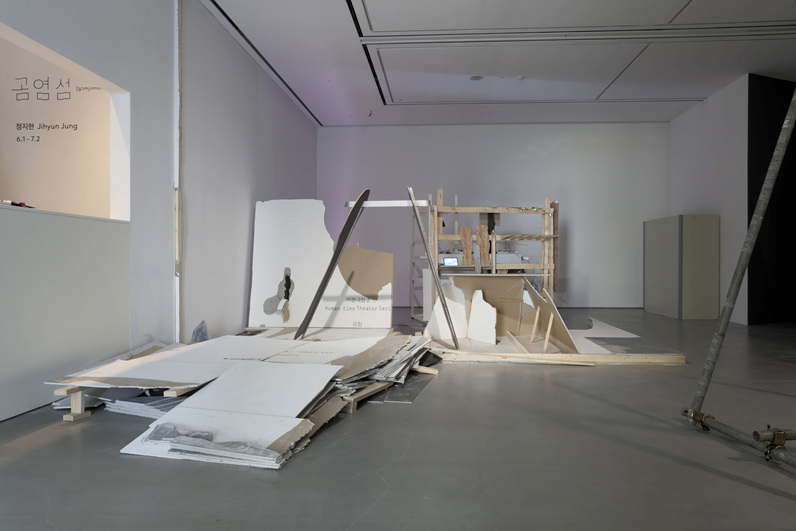
difficulty of flawless translation (Miyeon Lee and Jihyun Jung).
Dictee,
while meaning “dictation,” is fundamentally disrupted and dislocated in Theresa
Hak Kyung Cha’s practice. Rather than settling into the basic and passive act
of transcription, Cha reveals the discrepancies that arise when one fails to
fully inhabit such a process, by “imperfectly” writing it out. This condition
is likewise evident in Kichang Choi’s Fortune Timer. Systems
such as saju or fortune-telling attempt to categorize and define life into a
set of predetermined structures; yet, the work exposes the indifference
inherent in such “readings,” which neglect and exile aspects of life that
cannot be fully subsumed within any single category.
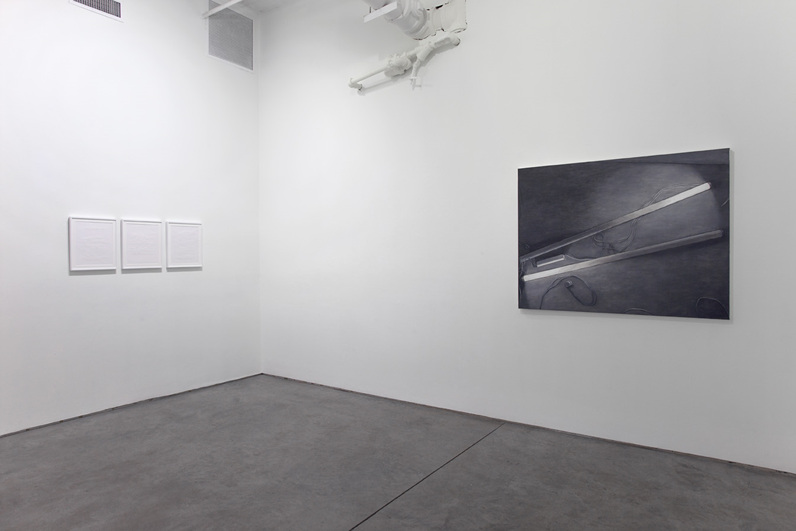
Young Eun Keem’s
Etude for One Handed Blind transforms a Braille score based
on Czerny. While Czerny’s compositions can be performed with a single
hand—allowing even a physically limited performer to play—the artist imagines a
performer who is both unable to use one hand and unable to see. This condition,
in which one can neither reach out to read Braille nor press the keys,
resonates with Cha’s experience of writing—or being unable to write—in a
foreign language, as well as with the disjunction between life and the
determinism of fortune-telling in Choi’s work.
Cha’s
method of deliberately misaligning grammar and tense—repositioning past
memories into the present and conflating historical events with personal
recollections—is extended in the works of Hong Goo Kang and Sasa Shun. Kang’s
Lost Memory draws upon family photo albums that he
discovered and collected by chance in restricted development zones. After
reconstructing and coloring the photographs, he briefly inscribes narratives
about the anonymous figures depicted, only to erase them.
Similarly, in Shun’s
Hypnosis/The Whereabouts of Stories, the artist reenacts a
past war he has never experienced, based on the diary of a deceased soldier.
Here, the artist’s memory overlaps with others’ photographs and diaries,
rendering it impossible to distinguish whose memory it is. Both Kang and Shun
raise questions about where such shared memories reside, and when a memory can
be said to exist once it is reenacted in the present.
Within
Cha’s work, the incompleteness and non-singularity of “language” are
articulated through various forms of metonymy. The Korean language, Chinese
characters, and anatomical diagrams derived from both Eastern and Western
medicine that appear in Dictee function, for those
unfamiliar with them, merely as images that resist legibility. In this sense,
language is rendered as no different from abstraction, its meaning inaccessible
and deferred.
This mode of linking disparate elements through a single trace of
association extends into the works of Sanghee Song and Young Gle Kim. Song
collects the wounds and material traces left behind by migration and dispersion
across human history, unfolding them through metonymic structures—translated
into postcards in postcards, and into motifs such as
beavers, Hermes, and satellites in Spirit and Opportunity.
Likewise, Young Gle Kim reconstructs memories of her mother by weaving together
childhood fairy tales, photographs of historical figures, and folklore into a
metonymic narrative.