

1. The Dynamism of Narratives Toward the Archetype
 
There was a time when people believed that the enlightened could explain everything and bring total clarity to the world. In the age of Enlightenment, Jean-François Marmontel, contributing to Diderot’s Encyclopédie, proposed that narrative requires an audience. For him, narrative necessarily entailed a kind of stage to be orchestrated, and paradoxically, this view presupposes the existence of an archetype prior to performance or exhibition. It is this archetypal narrative that acquires flesh, blood, and sinew as it is performed and exhibited.
 
This relationship with the archetype can also be applied to the relationship between narrative and exhibition. Here, narrative—whether or not it explicitly presupposes its own “stage”—is always grounded in performativity, in its condition of being exhibited. The artist is both one who exhibits their own archetype and one who is, in turn, exhibited. The act of embodying a story and presenting it is, in a sense, mystical and primordial. The earliest stories to be recorded and exhibited were myths, and the act of presenting a story inherently contains the archetypal structure of god–myth–believer.
 
Like believers who encounter the divine only through faith, all viewers can intersect with this fundamental structure only in an expanded state. It is impossible to determine the archetype prior to such expansion. Therefore, the performativity of exhibition is always dynamic. This agnosticism of imagination and belief is inevitably repeated across all exhibitions in the field of art, even in its narrower sense. Certain works, in particular, actively adopt this structure of agnosticism. Among these, mythological motifs function as powerful carriers of archetypal meaning within the realm of art.
 
For instance, traditional Korean folktales and shamanistic beliefs continue to be reborn in the present, functioning as key narratives that enact contemporaneity. Haegue Yang has consistently engaged with narrative and the domain of literature since her early career. Especially since the 2010s, she has focused on giving form to mythological motifs drawn from folktales and shamanistic traditions, foregrounding the manifestation of narrative.

For Yang, narratives grounded in mythological motifs serve as clues pointing toward universal archetypes found across disparate elements. These narratives grope toward an unreachable archetype, linking one to another. What Yang renders visible through this connectivity includes, from a diasporic perspective, the homeland and the foreign land; the colonized and the colonizer; the human and the divine; the earth and the sky. Though these appear to belong to entirely different categories, they share a commonality in being connected as symmetrical counterparts.
 
The fundamental and structural resemblance among disparate entities serves as a key to understanding the universal that Yang seeks. As the artist herself suggests, narratives across the world may differ, yet they share structural affinities. As Yang’s works attest, narrative is a longstanding index that interweaves the realms of literature and art, pointing toward universal archetypes. Although we can never fully reach these archetypes, literature and art draw them into a stage accessible to us, endowing them with flesh and vitality. The stage is a site of connection.
 
In Yang’s practice, the essence of the medium lies in this performativity of connection, and it is precisely because this performative dynamism is not singular that it can resonate with the universal. The universal, in implying the archetype, is always mythological. Even when her works appear unrelated on the surface, they often evoke a mythic atmosphere, likely due to Yang’s persistent inquiry into the existence of the archetype. If the most universal and fundamental existence can be signified by the concept of the divine, then in Yang’s gaze, narrative becomes a dynamic movement toward that divinity. Her works are the very mediating forms that give shape to this dynamism.

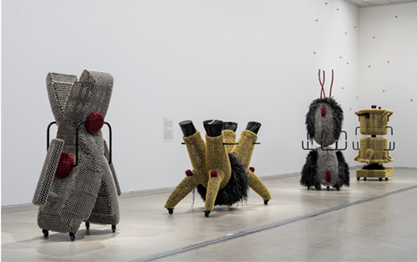
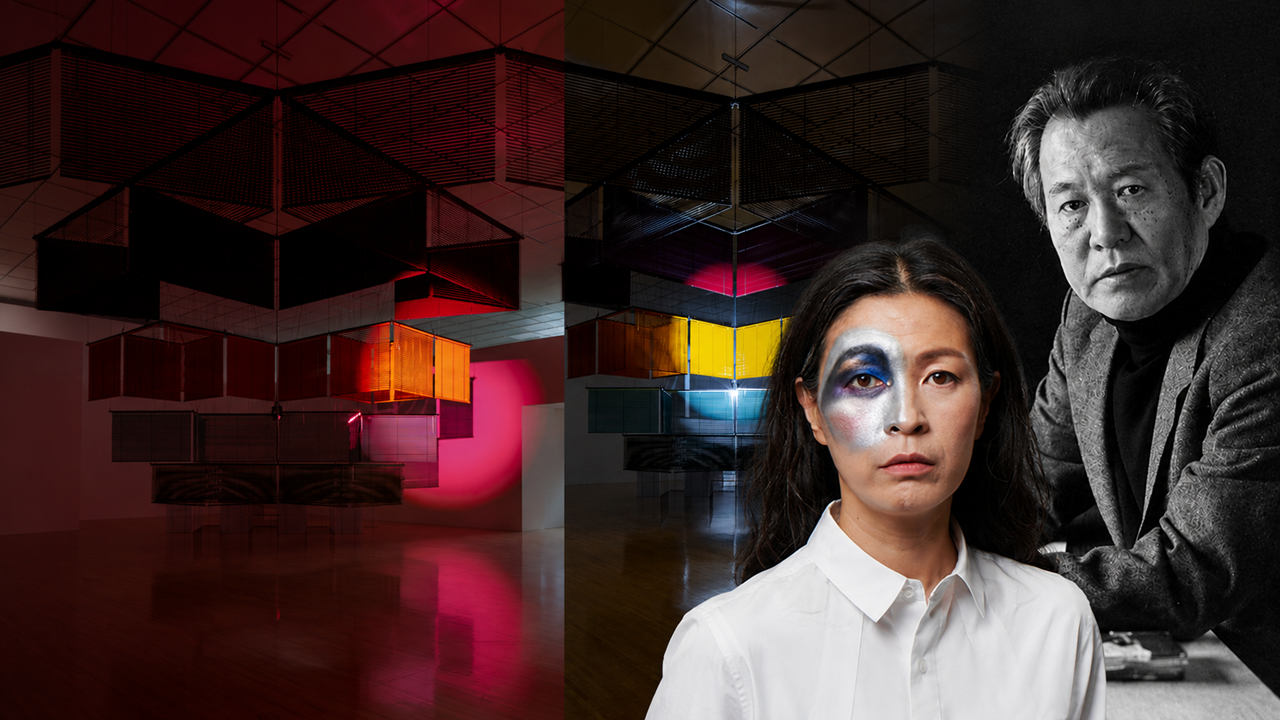
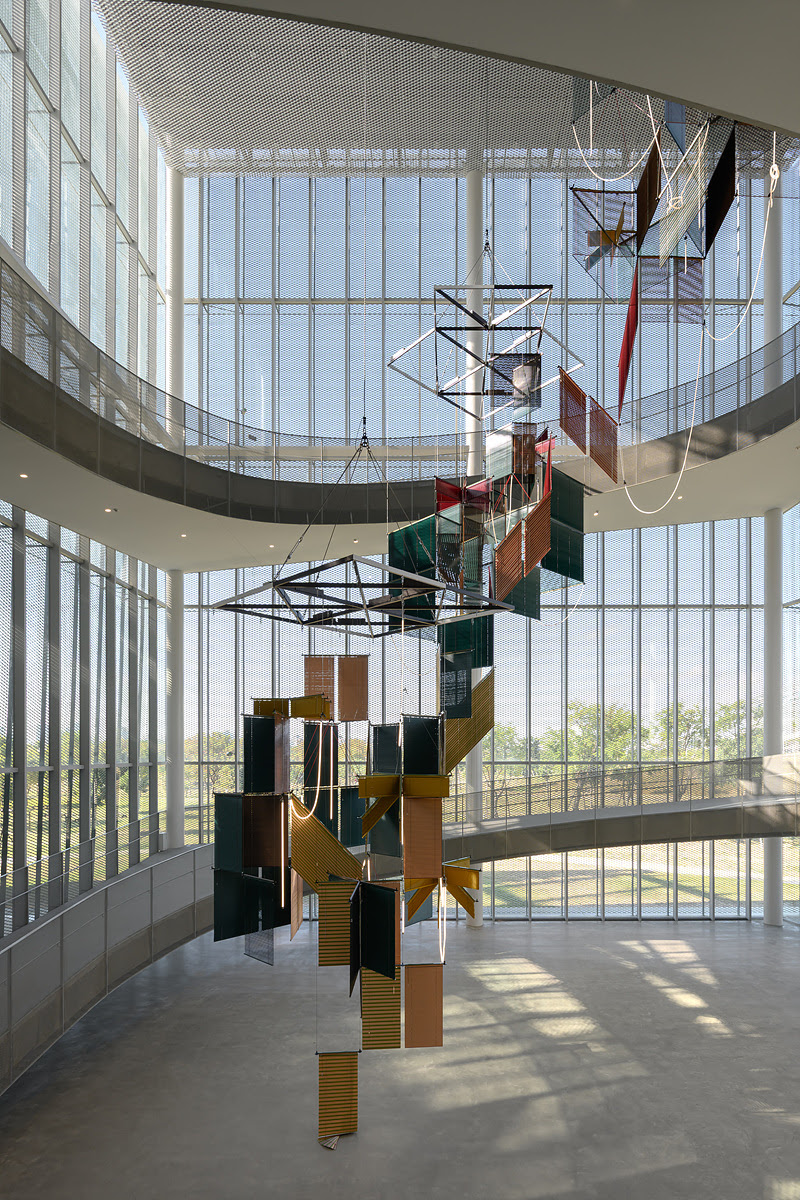
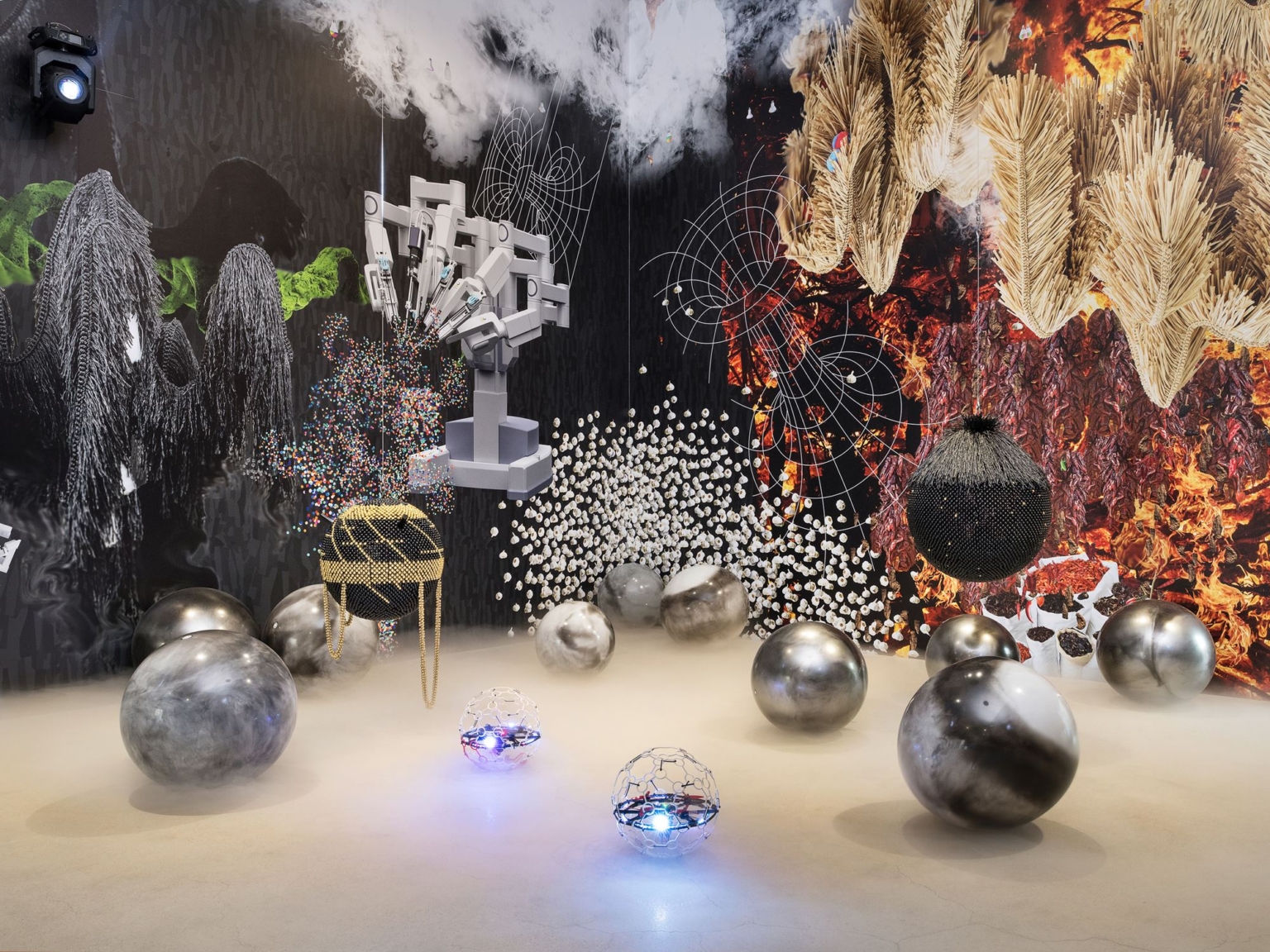
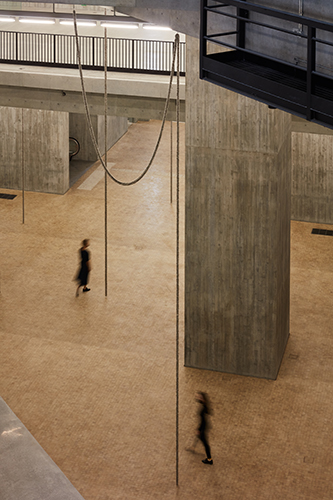
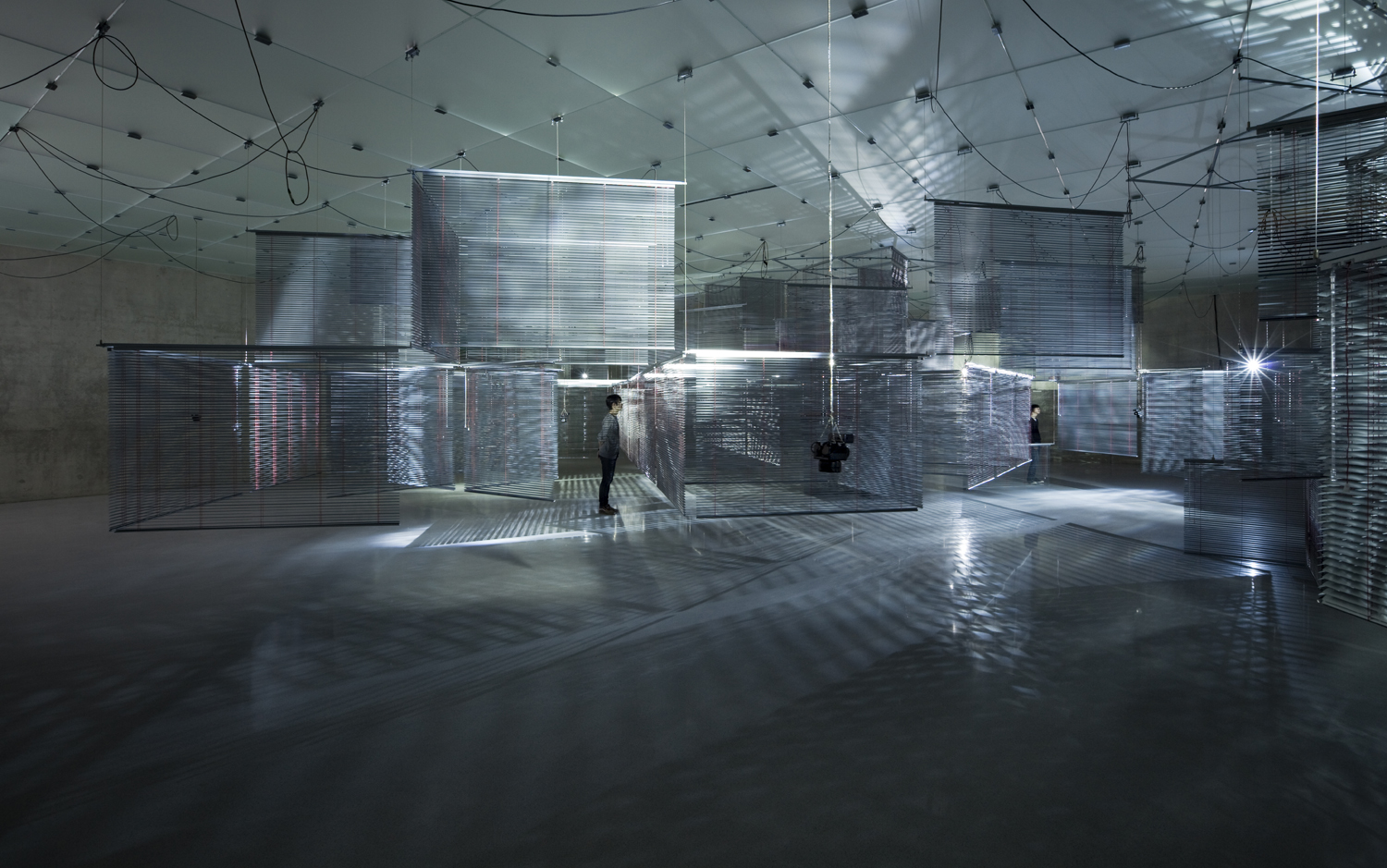
Installation view of 《MMCA Hyundai Motor Series 2020: Haegue Yang―O₂ & H₂O》 © MMCA

2. The Narrative of the Medium Between Hostility and Love
 
Haegue Yang has consistently pursued a body of work closely intertwined with narrativity since her early career. Her early works, in particular, were deeply influenced by Marguerite Duras. As both a member of the colonized and an inhabitant of the colony, Duras’s work bears witness to a diasporic identity that emerges in the interstitial space of belonging fully neither here nor there. Her attempts to “move beyond the closedness of a single text” manifest multiplicity and intersection.

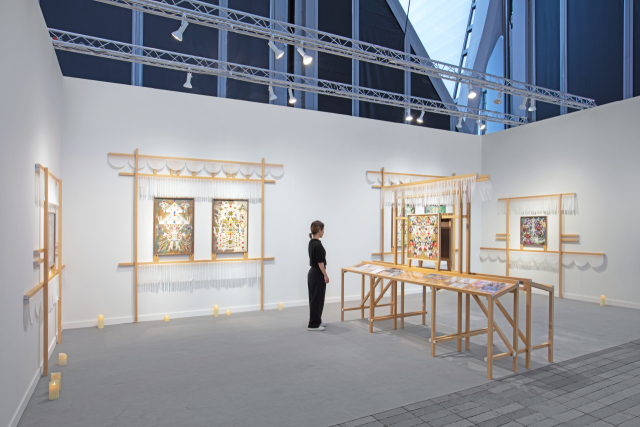
Yang expresses her engagement with Duras by organizing a Marguerite Duras film festival in Korea, appropriating La Douleur (The War), and presenting 5, Rue Saint-Benoît (2008), titled after Duras’s home address. In her 2010 solo exhibition 《Voice Over Three》, she incorporated Duras’s film The Malady of Death as part of her installation Series of Vulnerable Arrangements – Shadowless Voice over Three, revealing a sustained affinity with Duras’s work. In the same year, she also published an artist’s book of the same title, adding her own epilogue to the Korean translation of The Malady of Death (translated by Jung Hee-kyung).
 
Both Yang and Duras begin from the most intimate and private experiences, and through repetition, circulation, and reproduction, they re-present singular statements in self-reflexive forms. In these works, Yang’s use of a single material to construct multiple configurations resonates with the formalist practices of writers such as Marcel Proust and Samuel Beckett, staging the absence of a unified subject.

This absence attempts a decentering and points toward what may be discovered in that void. Through her subsequent trajectory, Yang appears to trace back from this emptied space toward concepts such as the universal, the archetypal, myth, and the divine. The distinctive identity of her practice today is closely tied to this ongoing engagement with narrative.
 
In her exhibition 《Arrivals》 at Kunsthaus Bregenz in 2011, Yang made a rare use of music. Igor Stravinsky’s The Rite of Spring (1913), inspired by ancient Slavic pagan rituals, serves as a key reference. Based on a sacrificial rite performed to praise the god of spring, the ballet score provoked one of the most intense controversies in the history of performance, while also being described—by Stravinsky’s collaborator Nicholas Roerich—as possessing a universal, cross-cultural resonance. The simple yet lucid structure of such primordial ritual enables an imaginative pursuit of the universal that transcends individual cultures.
 
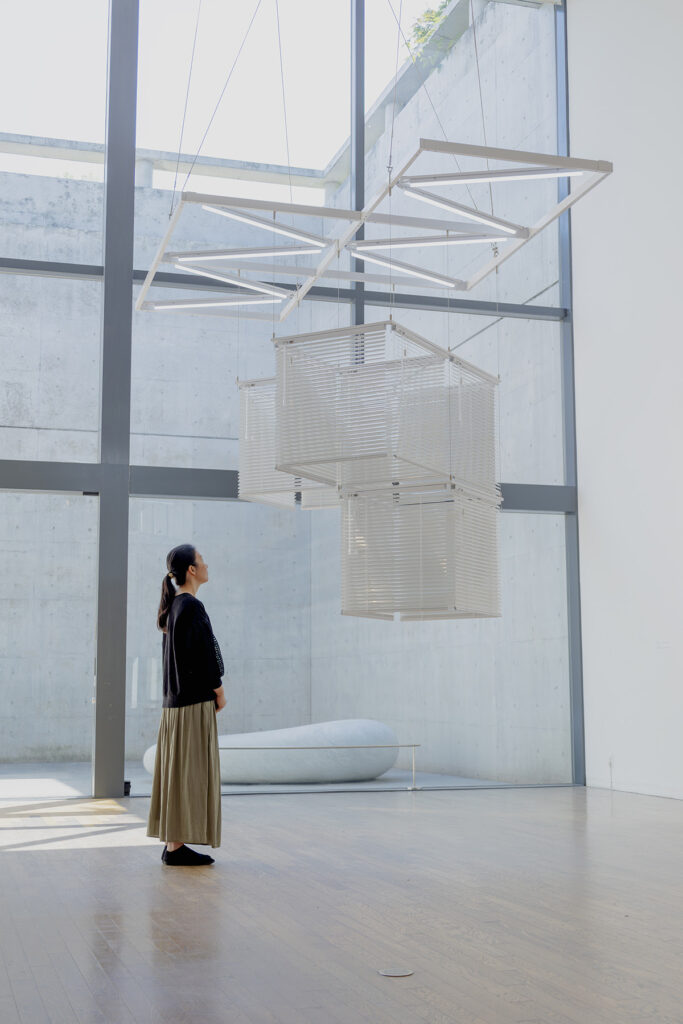
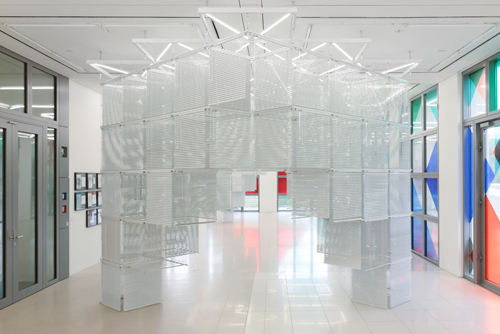
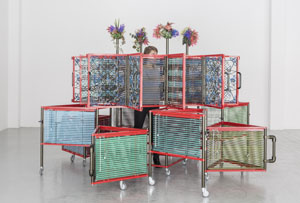
In the exhibition 《Arrivals》, Warrior Believer Lover consists of thirty-three light sculptures. If the warrior is one who fights and the lover is one who loves, then the believer is one who believes. If the warrior implies hostility and the lover implies love, the placement of the believer between them in the title suggests that the movement from enmity to love is a longing to reach the unknown other through belief alone.
 
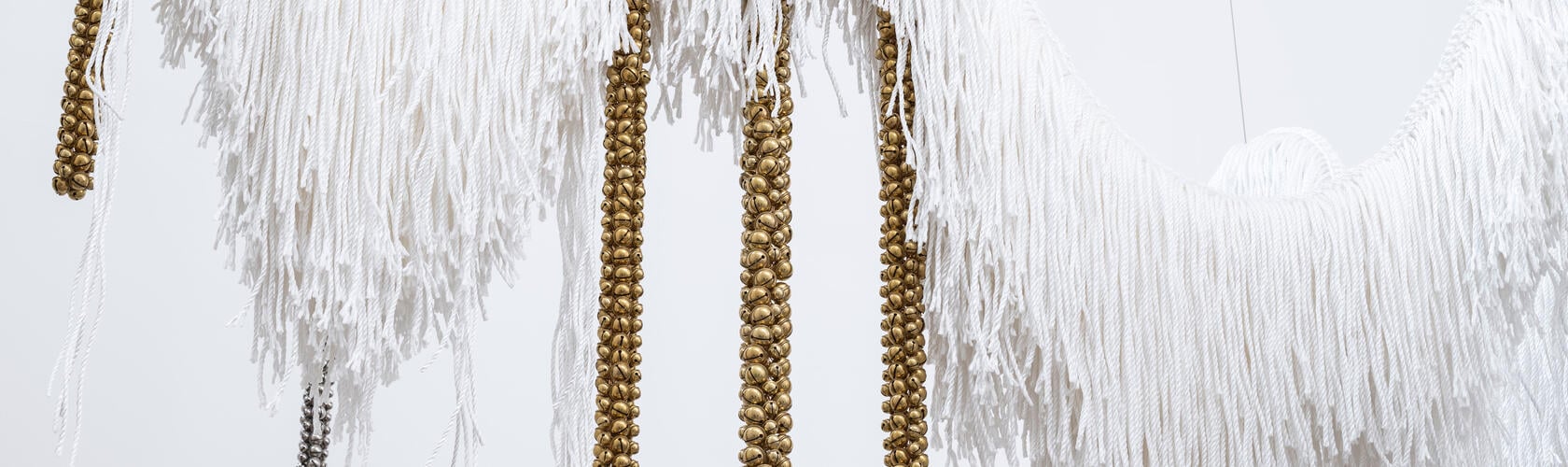
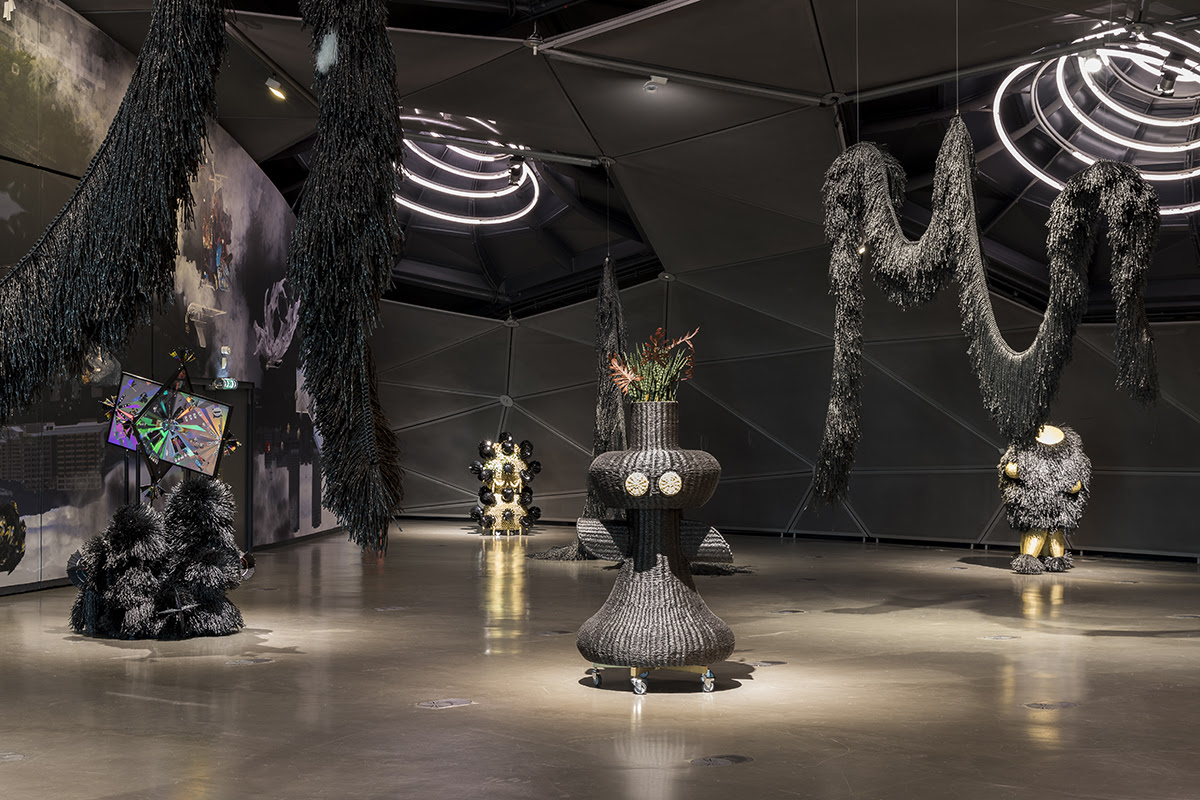
Since 2013, Yang has developed the ‘Sonic’ series, establishing connections with objects associated with shamanistic practices. This body of work, which includes sub-series such as ‘Sonic Dance’ and ‘Sonic Figure’, consists of performative sculptures composed of interlinked bells mounted on wheeled structures.

Through the mystical symbolism of shamanism, these works transcend the level of everyday objects, or rather expand their potential for connection. In shamanistic rituals, bells are instruments shaken by the shaman alongside a fan when invoking spirits; commonly referred to as chilseong bangul or muryeong, their sound is believed to summon divine presence. In this way, the bell becomes a medium that surpasses the surface of the everyday, linking humans to invisible entities perceptible only through belief.
 
The pursuit of the most primordial and fundamental is also revealed through the motif of kinship, such as siblings. Titles such as Sonic Dance – Half Sister, Sonic Dance – Twin Sister, and Sonic Dance – Twin Brother articulate narratives of paired beings. Sisters, brothers, and twins imply the existence of more than one entity; yet what the viewer encounters is only a single form.

Ultimately, this singular abstract mass forms a pair with the viewer who confronts it. If that figure is one’s twin or kin, it inevitably resembles oneself. In this way, the viewer is compelled to project themselves onto the form that appears to commune, through countless bells, with something invisible. The work gains dynamism through the bells that produce sound in response to movement. Its curvilinear, organic mass evokes the image of a crouching, writhing human body—one that resembles the self, emerging as if breaking through a soft membrane into birth.
 
Sonic Figure – Vigorous Stretcher takes on the form of a human figure standing with its legs slightly apart. The torso, where two arms would normally be, is composed of long, unfixed tassels. Enveloped in bells, these dynamic forms produce a collective sound the moment they are rolled on their wheels. This evokes the image of an organic being calling upon and communing with the divine. Just as shamanistic rituals reach toward the gods, the ‘sonic’ moment orchestrated by Haegue Yang opens, if only briefly, a stage that connects to the divine.
 
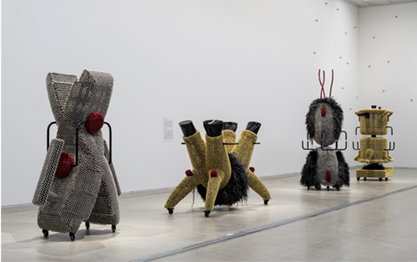
The ‘Sonic Household’ series, which drew attention through the exhibition 《MMCA Hyundai Motor Series 2020: Haegue Yang – O₂ & H₂O》 at the National Museum of Modern and Contemporary Art in 2020, includes works such as Ironing Scissors, Side-Stepping Hair Dryer, Double-Layered Pot, and Clam Tongs. As their titles suggest, these works take the forms of scissors, a hair dryer, a kettle-like pot with a gas burner, and tongs.

Enlarged to slightly exceed human height, these everyday “appliances” are entirely covered with bells in gold, silver, and red. In doing so, they manifest the dynamism of the medium that seeks to connect with the universal signifier of the divine. The universality of these commonplace objects—found in the everyday lives of many—becomes visualized as the concept of the divine.
 
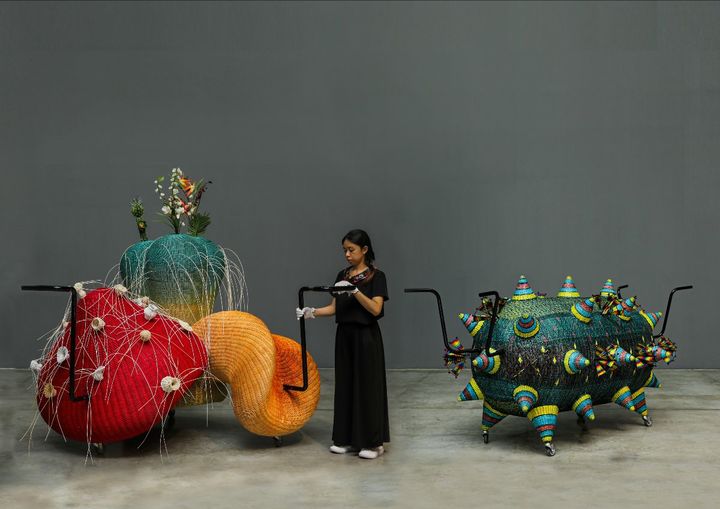
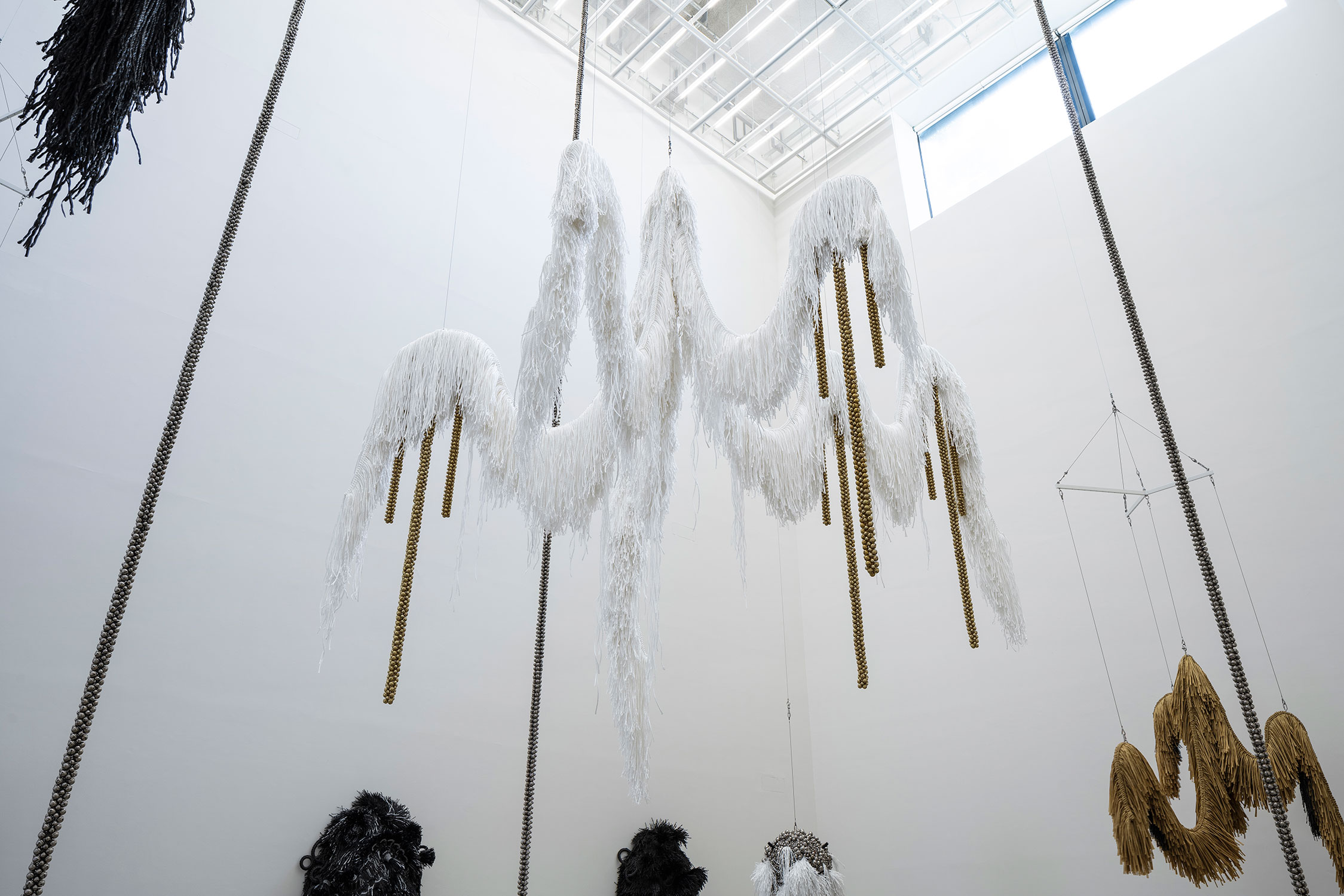
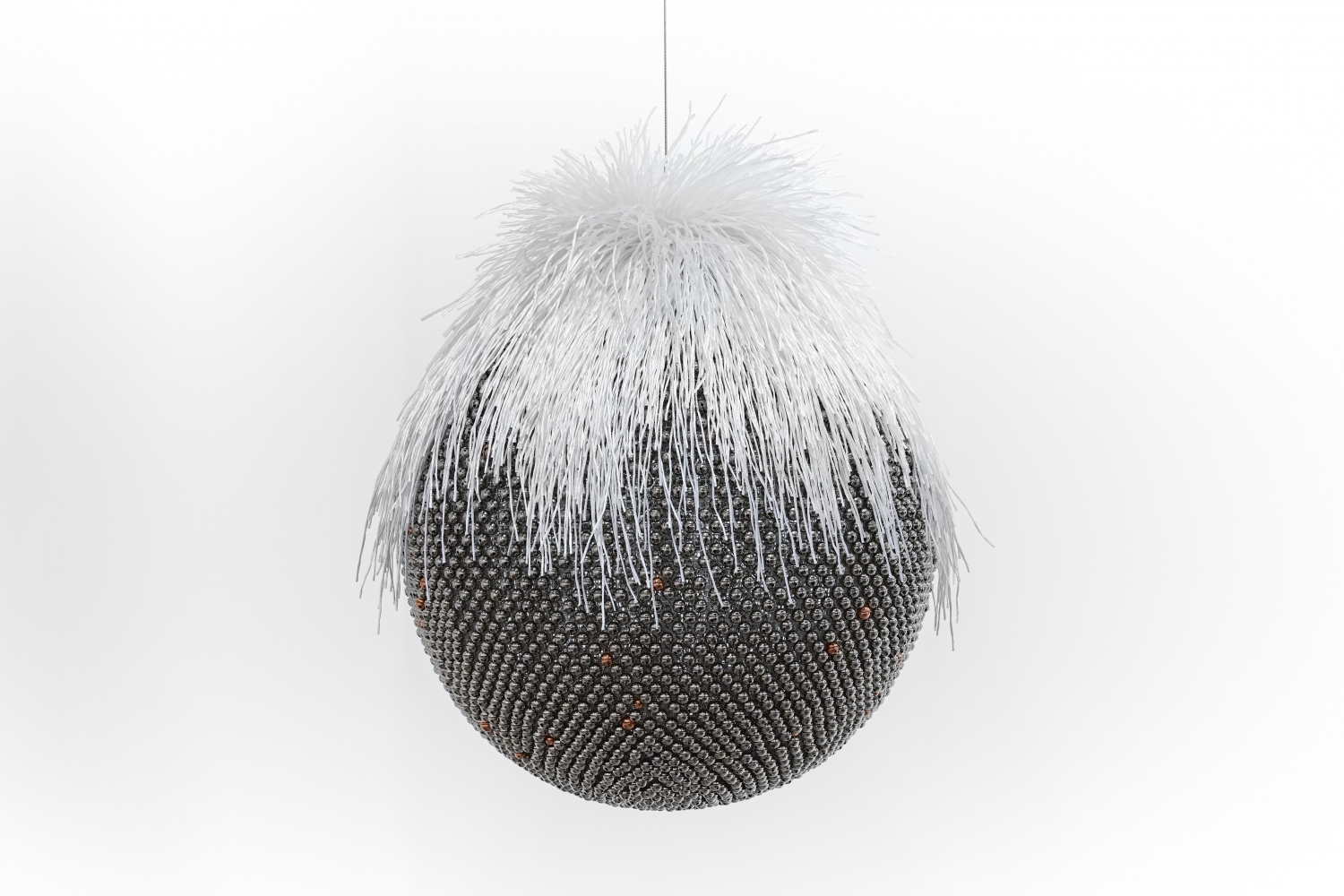
The mediating character of Yang’s work is further clarified in the ‘The Intermediate’ series, where it is explicitly named as “intermediate.” The term itself combines “inter,” meaning between, and “mediate,” meaning to connect or transmit. This body of work foregrounds the ubiquity of straw craft, a practice found across human history. Beginning with anthropomorphic forms such as The Intermediate – Female Natives (2016), and extending to religious architectures from different cultural contexts such as The Intermediate – To El Castillo (2015) and The Intermediate – To Borobudur (2015), the series eventually arrives at Korean traditional narratives with The Intermediate – Frost-Faced Fertility Imoogi (2020).

While these works take on diverse individual forms, they are fundamentally united by their construction from woven straw. At the same time, it is significant that this straw is not purely natural but shaped by human intervention. Straw craft made from artificial straw suggests that the search for the universal and the archetypal is inevitably tied to its artificial and industrial reproduction.
 
If materials such as straw and bells render visible the horizon of intersections and the processes of connection through their tangible properties, Yang also works in the opposite direction by granting materiality to narrative itself. Her practice is thus underpinned by a cyclical structure in which materiality gives rise to narrative, and narrative in turn generates materiality. If the ritual bell functions as a medium that bridges the invisible divine and the here and now through its physical presence, then archetypal narratives such as the Imoogi myth or the folktale of The Sun and the Moon Siblings are, in Yang’s work, endowed with precisely such materiality.

 
3. Neither God nor Human
 
Within the ‘The Intermediate’ series, works such as The Intermediate – Frost-Faced Fertility Imoogi (2020) and The Intermediate – Carbon-Faced Male Seven-Legged Imoogi (2023) give form to the mythological unknown of the Imoogi. The Imoogi is an intermediary being that exists before becoming a dragon; although it is divine, it has not yet ascended and thus cannot be considered a true deity. To become a dragon, it must endure a thousand years of waiting in cold water. Dwelling in lakes, ponds, and rivers, the Imoogi is said to rule over all freshwater creatures.

Unlike dragons, it does not command rain, storms, lightning, hail, or dark clouds, but can only summon clouds. Imoogis are even said to fight among themselves over territories. While dragons in folklore are sacred beings endowed with inviolable authority, the Imoogi is often depicted as a malicious creature that harms humans and is hunted by heroes. In this sense, the Imoogi occupies an intermediate state—divine yet not fully divine.
 
Just as the Imoogi exists between states, the rope that rescues the siblings in the folktale The Sun and the Moon Siblings also spans heaven and earth. Haegue Yang’s exhibition 《MMCA Hyundai Motor Series 2020: Haegue Yang – O₂ & H₂O》 at the National Museum of Modern and Contemporary Art in 2020 prompted many viewers to reflect on a sense of “Korean-ness,” and among the works, Sonic Rope evoked this traditional folktale.

The artist herself has explicitly stated that Sonic Lifeline Rope was inspired by this narrative. If the Imoogi represents the potential for ascension, the rope serves as the medium that enables it. Climbing the rope to the heavens, the siblings become the sun and the moon while retaining their humanity, existing as both human and divine. In the folktale, the rope remains a symbolic element without concrete materiality; Yang renders this symbol tangible through the material presence of a rope composed of bells.
 
The Imoogi legend and the folktale The Sun and the Moon Siblings, though distinct narratives, both imply a universal archetype as stories of connection between two worlds. The mystery of mythological motifs as universal archetypes lies in their presence across cultures, transcending any single region or nation. Yang’s gaze is directed precisely toward the core of this mystery. Just as one of the earliest recorded narratives—the Sumerian myth of Gilgamesh—concerns a figure who is both human and divine, humanity’s enduring exploration of boundary-crossing and connection is structurally intertwined with modes of belief in the divine.
 
Haegue Yang has noted that, in her 2020 exhibition at the National Museum of Modern and Contemporary Art, the folktale The Sun and the Moon Siblings was explicitly referenced, yet she was surprised when this was interpreted as “Korean.” This is because the tale, while rooted in Korea, also embodies a universality that can be found and understood across cultures.

Although each narrative differs—for instance, the object connecting heaven may not be a rope but something else, or the direction of that mediation may be reversed, as in Jack and the Beanstalk—they share the common and universal feature of serving as a medium that connects heaven and earth. As the artist has remarked, “Regardless of the artist’s intention, interpretation belongs to the viewer. Whether it is ‘Korean’ or ‘universal’ is not something I can easily determine, but for me, it was the belief in the universality embedded in this tale that allowed me to connect it to my work.”
 
In Yang’s terms, the act of gazing toward the universal must ultimately be articulated through the notion of “belief.” If one who believes is called a believer, then, as suggested by Warrior Believer Lover, the believer occupies a position between the lover’s affection and the warrior’s hostility. Belief is a medium that is always directed toward something, situated between love and enmity. The nature of such a medium, which resists settling into a fixed pole, inherently produces a sense of transience.

The half-divine Imoogi, shaped by human hands, takes on form yet never becomes a dragon. The ringing of the ritual bells that summon the divine accompanies us only momentarily before fading away again and again. What remains possible, then, is an unceasing journey that endures this transience. The narratives of folktales and shamanistic belief are, in essence, such journeys of belief unfolding over time, marked by recurring traces of universal patterns found across different parts of the world.
 
Yang’s works are often described as difficult or ambiguous. Rather than offering explanations that unravel secrets, they seem to manifest the very condition of secrecy itself. If we find ourselves drawn to these bell-laden figures, woven straw forms, and fleeting, ungraspable moments despite the difficulty of deciphering their identity or meaning, it is perhaps because we are already implicated in that mystery.

The greatest enigma of what may be signified as the divine lies precisely there. Mythological narrative, in groping toward the unknowable mystery of agnosticism, draws us toward the medium, for that mystery implicates us all.

References