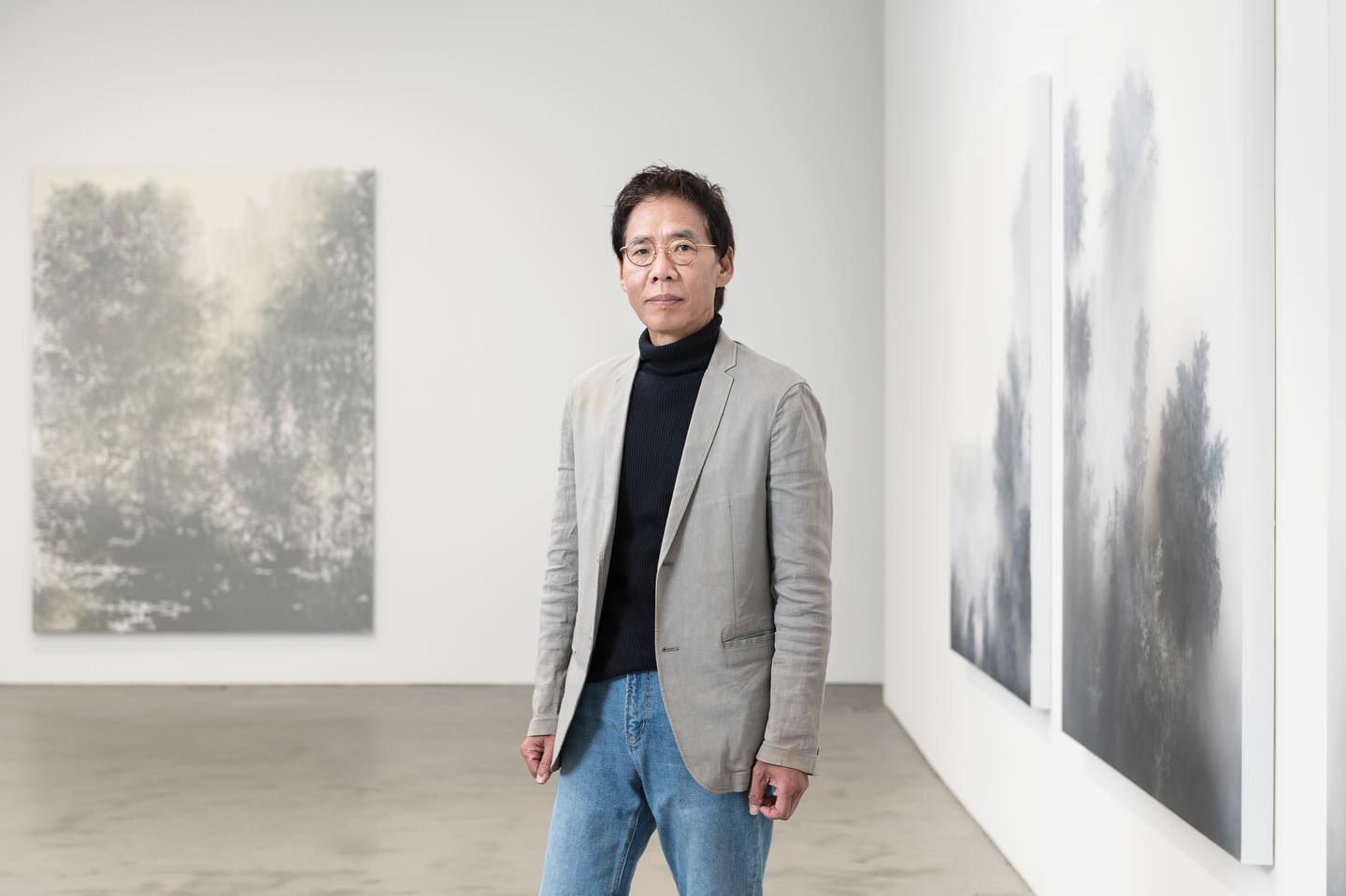
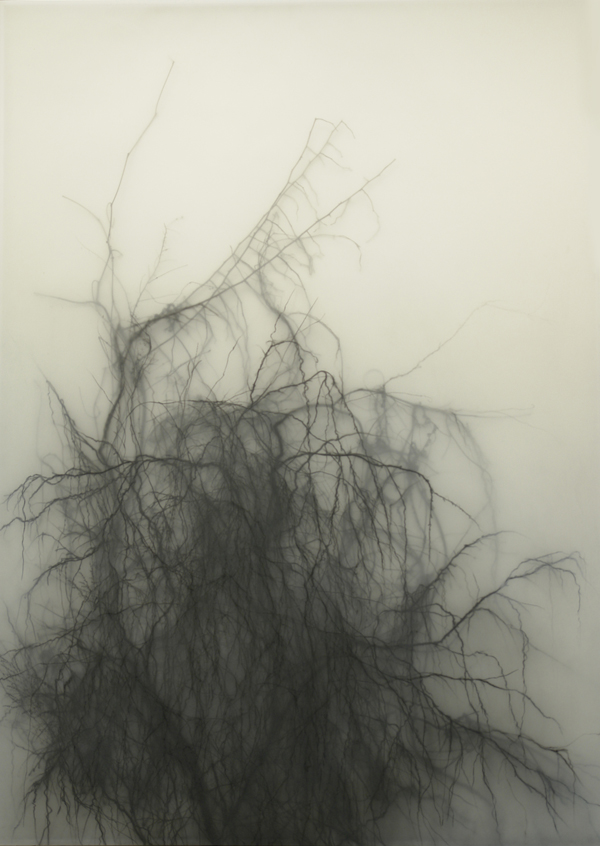
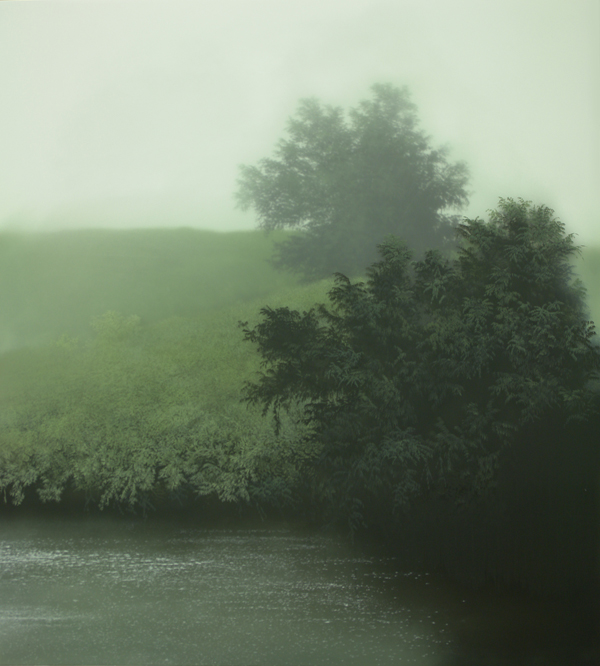
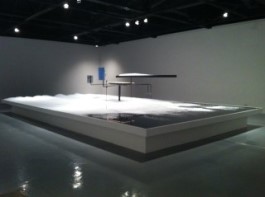
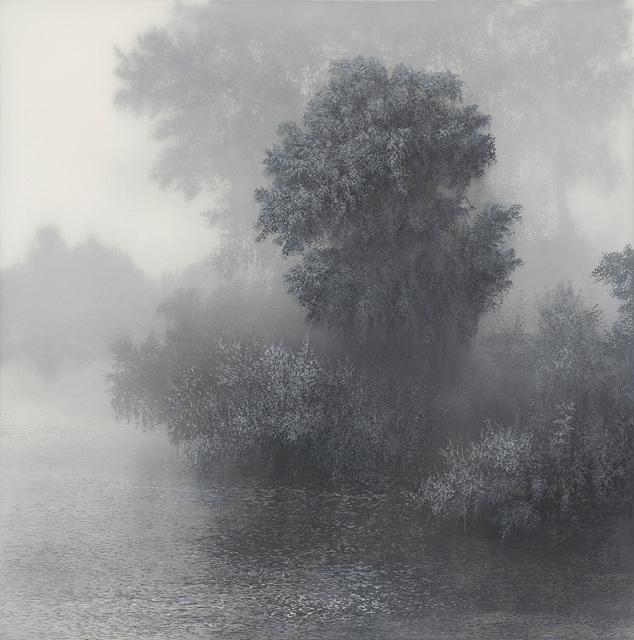
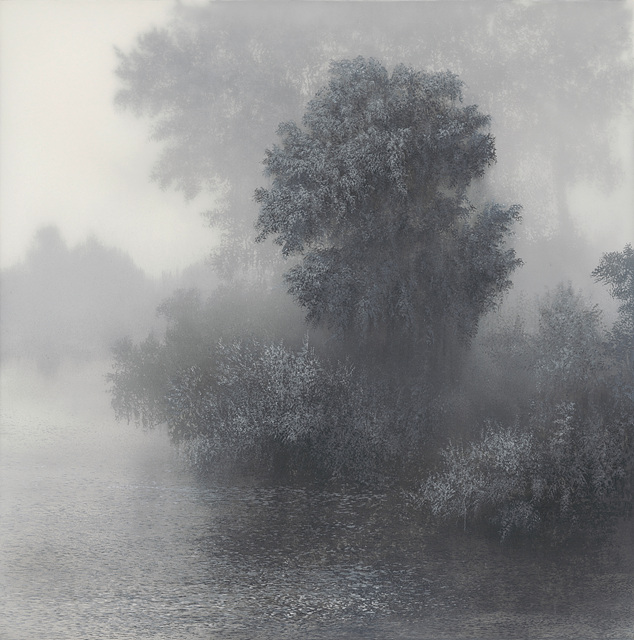
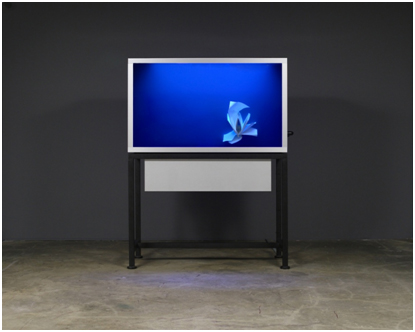
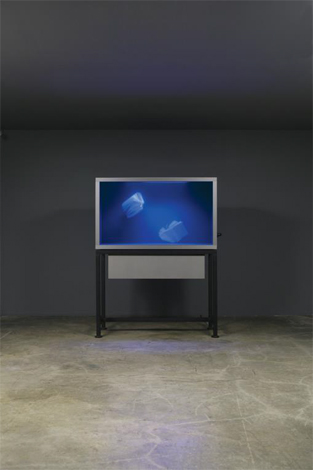
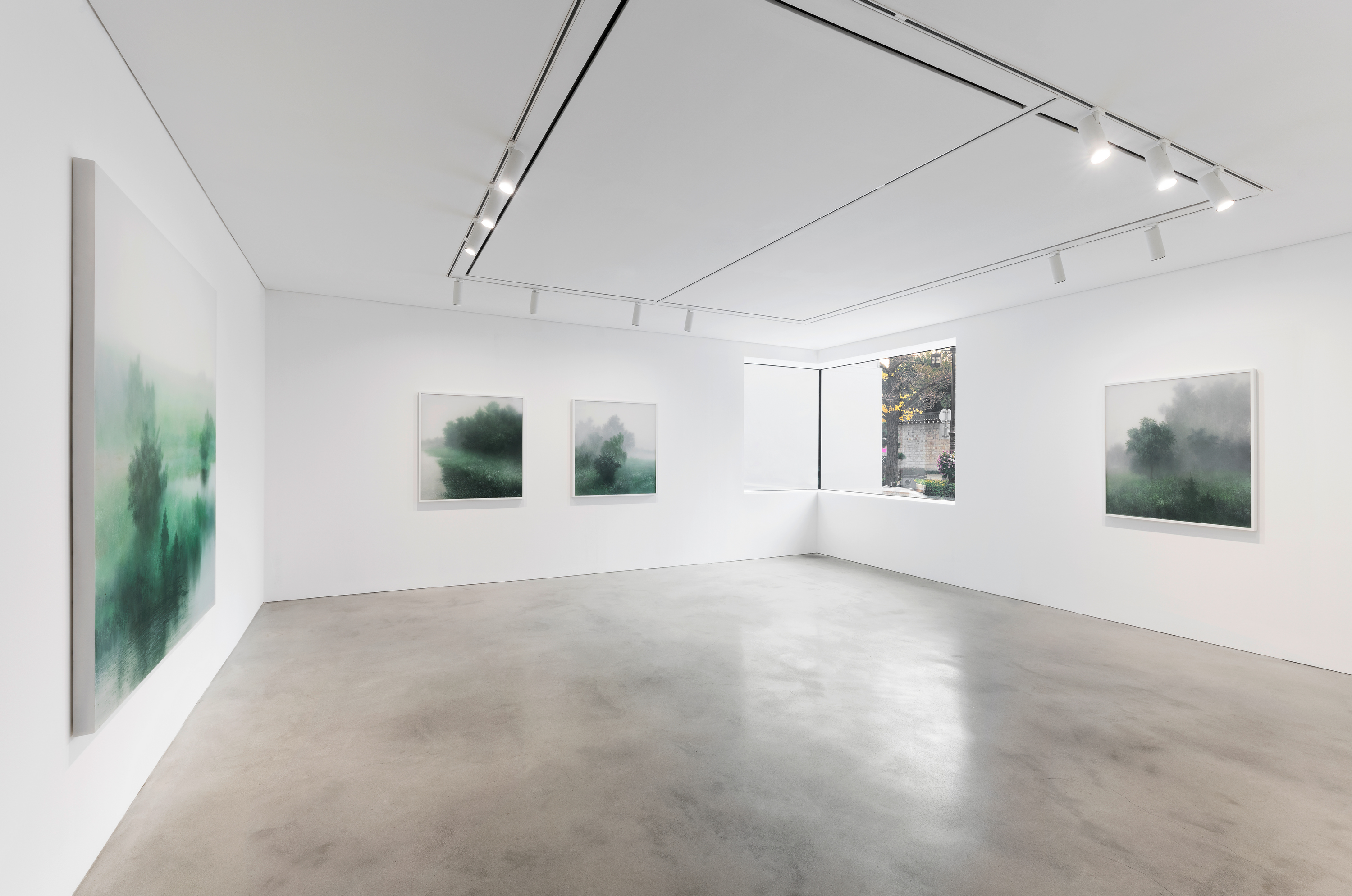
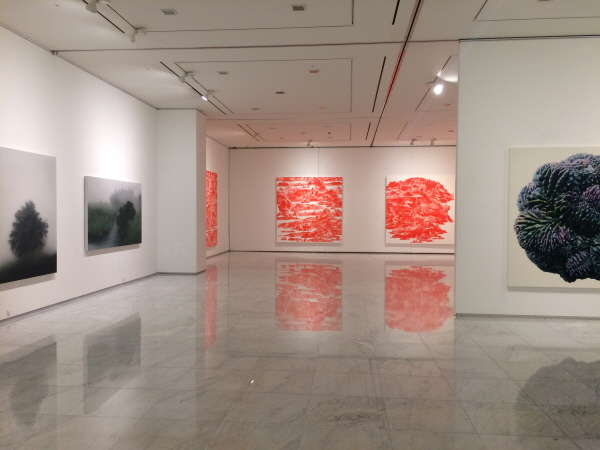
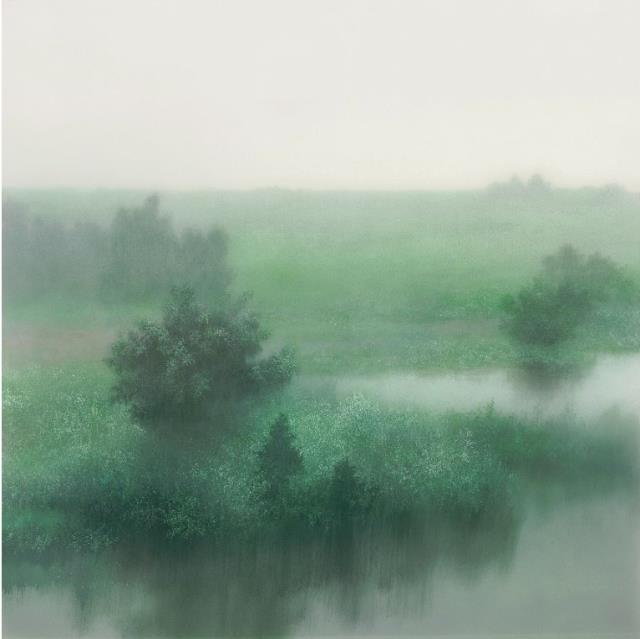
Rhee states, “The primary motifs that interest me are water and mist.” The formal devices that create a dreamlike, watery haze consist of plexiglass or polyester fibers arranged at regular intervals above the canvas. As in earlier exhibitions where he used enormous tanks, removing the layered panels from the canvas would release the vapor inside—dense and charged with latent movement. The flow of fluid elements such as water and mist becomes possible through precise structural mechanisms.
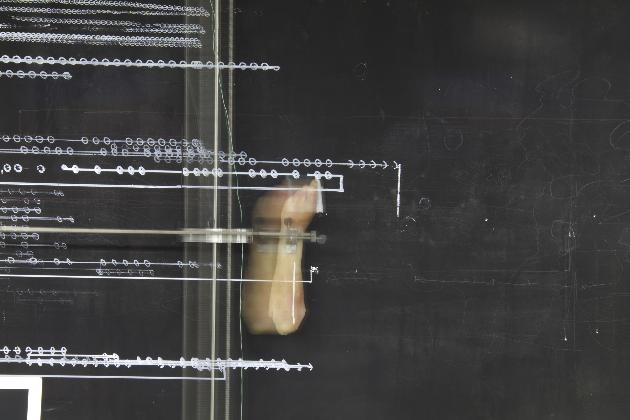
His interest in devices or forms that interact with appearing and disappearing reality leads to a reflection on language. In A Thousand Pages (2022), resembling open pages, sentences from Wittgenstein’s Tractatus Logico-Philosophicus appear. Rather than precisely indicating or defining, the mist-like text shares the philosopher’s skepticism about how closely language can approach the essence of reality. The horizontal layers formed by the alignment of letters—straight lines absent in nature—become an image of text itself.
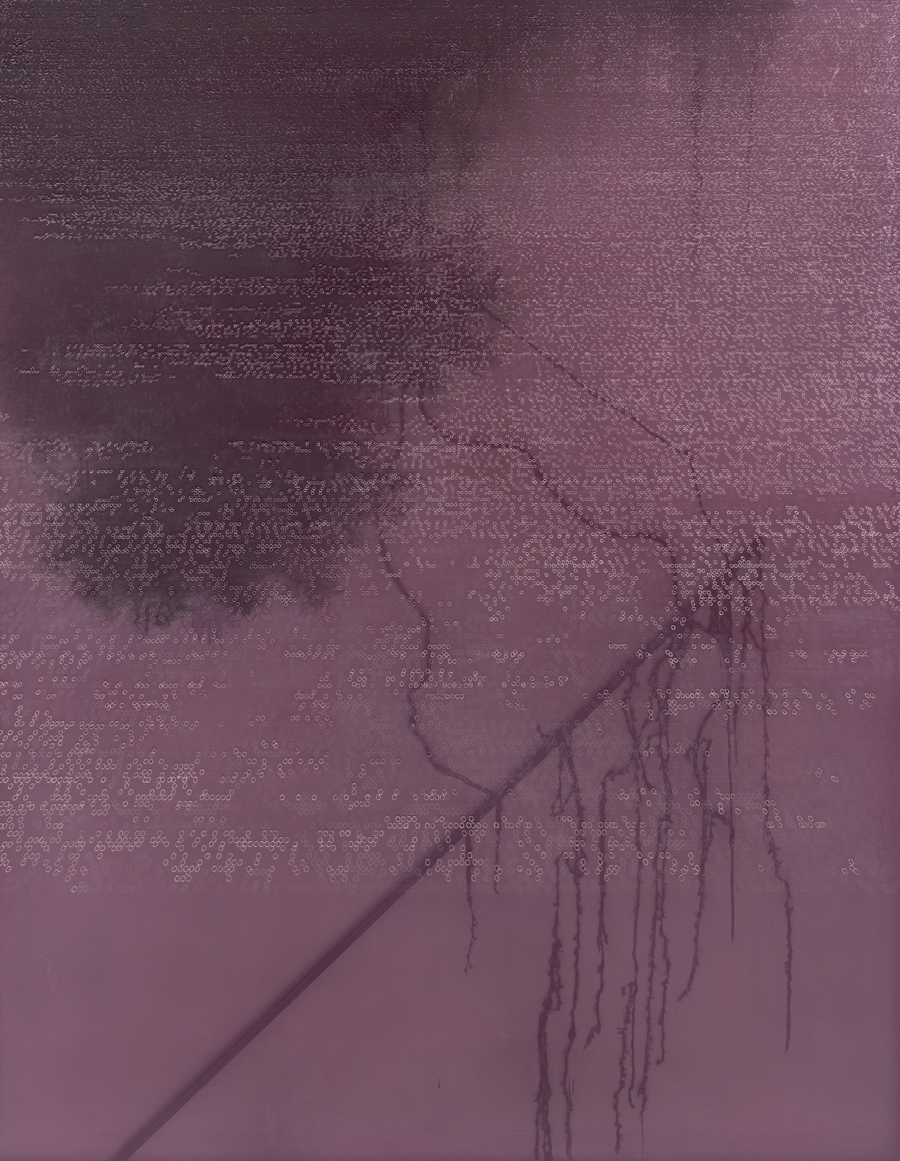
After a thorough self-reflective stance toward language, the artist sympathizes with the later Wittgenstein’s turn toward mysticism—a shift in belief in the transparency of language premised on epistemological certainty. This is less agnosticism than an affirmation of the uncertainty of reality, akin to modern physics’ logic of indeterminacy (Heisenberg) or modern mathematics’ logic of incompleteness (Gödel). Stains that overtake horizontal patterns reminiscent of text, or lines that trickle downward, suggest positivist certainty bruised and damaged.
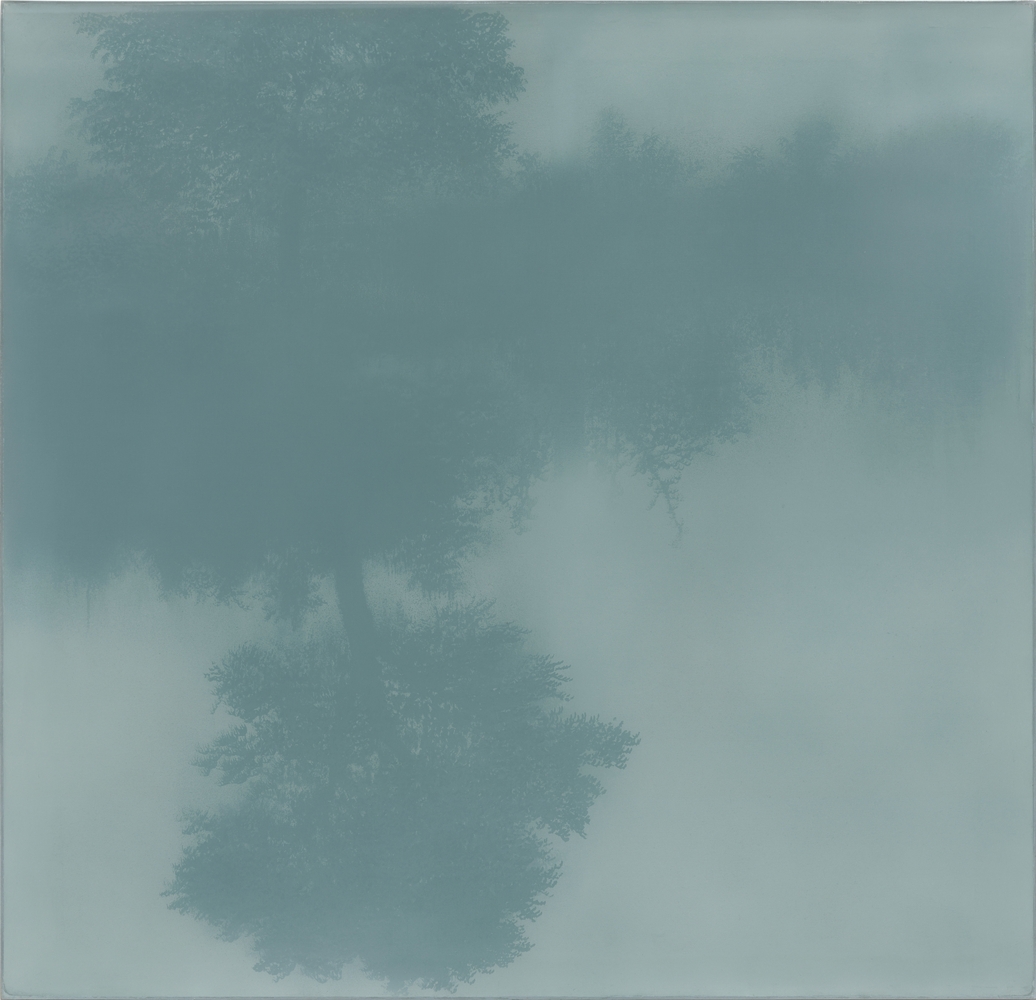
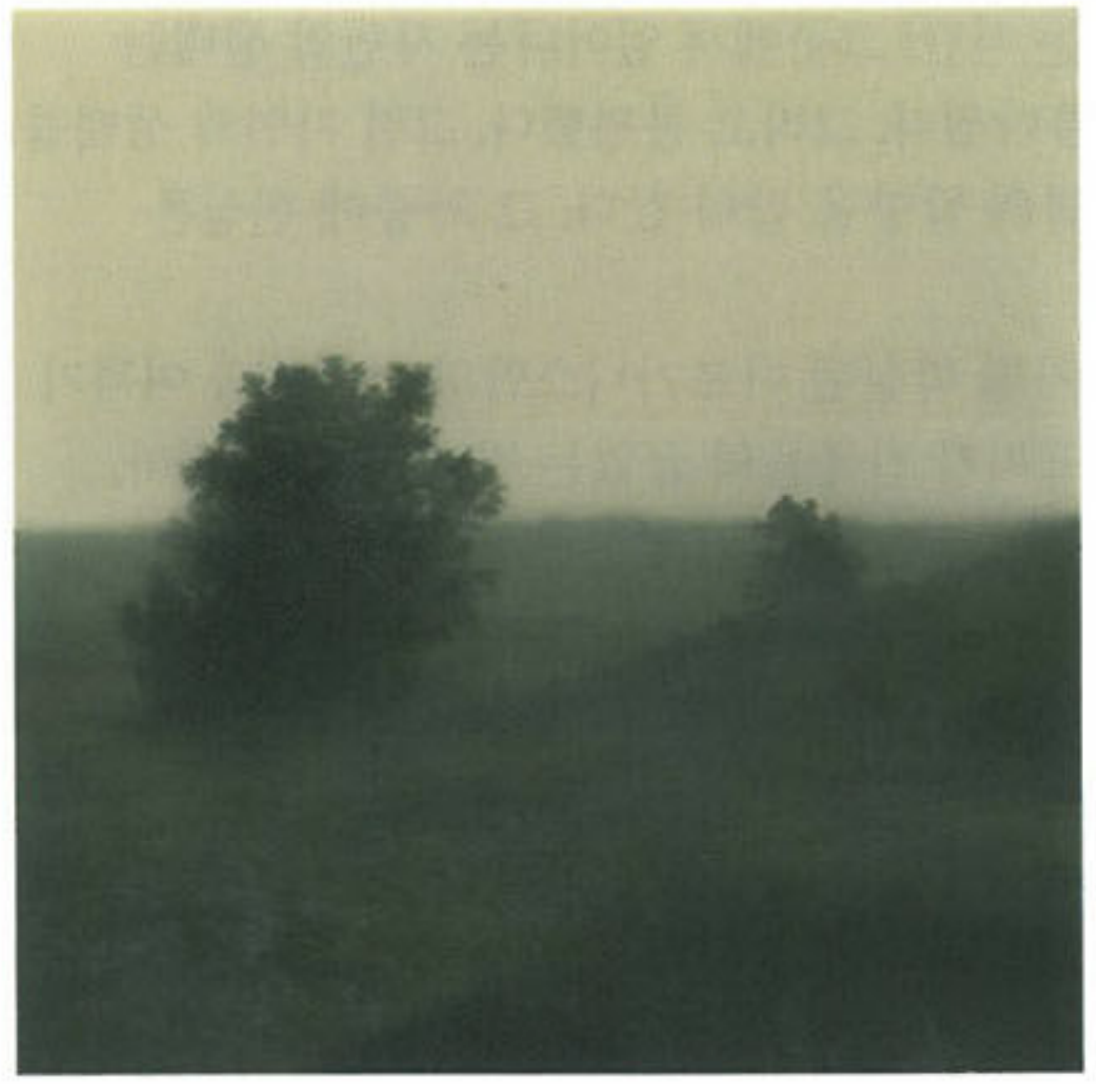
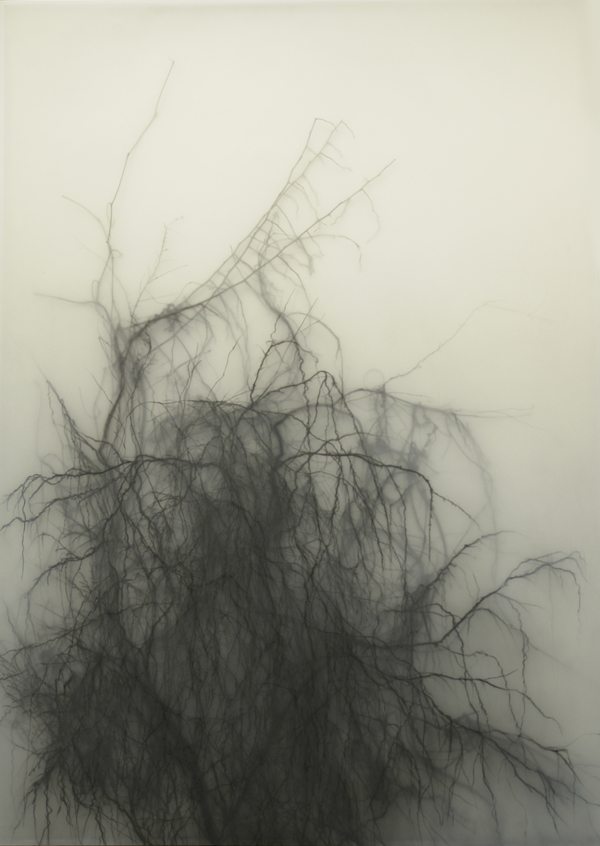
The more reality is investigated, the more complex it becomes, perhaps serving as the driving force of the work. In Passage to Illogic A (2021), contemplation of an illogical or irrational world appears in the title itself. Though the stain recalls a tree reflected in water, the reflective reference point disappears—like the thin horizon separating sea and sky on a cloudy day. The horizon, an explicit or implicit coordinate axis for a landscape painter, is consumed by dark blotches. With neither destination nor compass, we must pass through that uncertain domain.
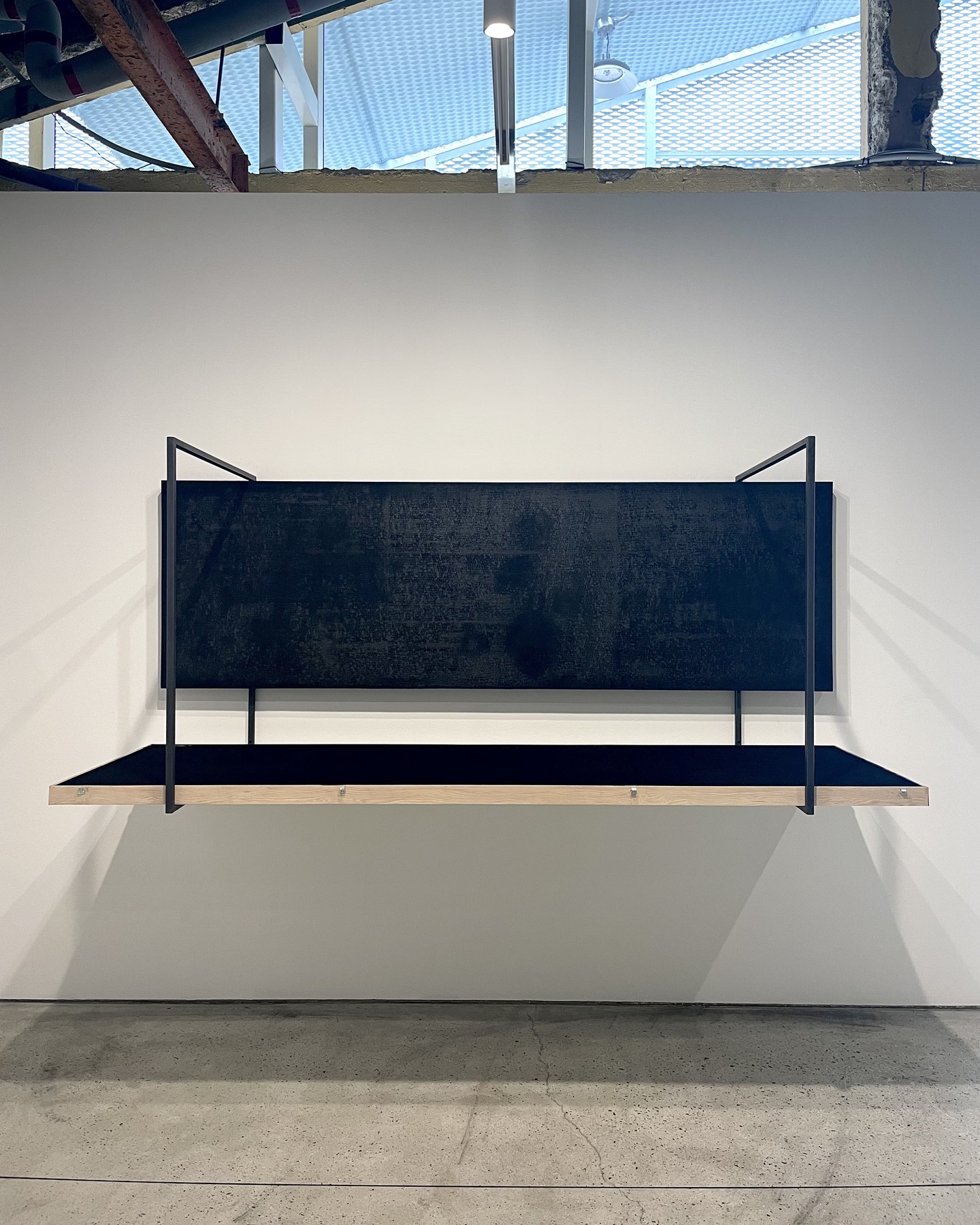
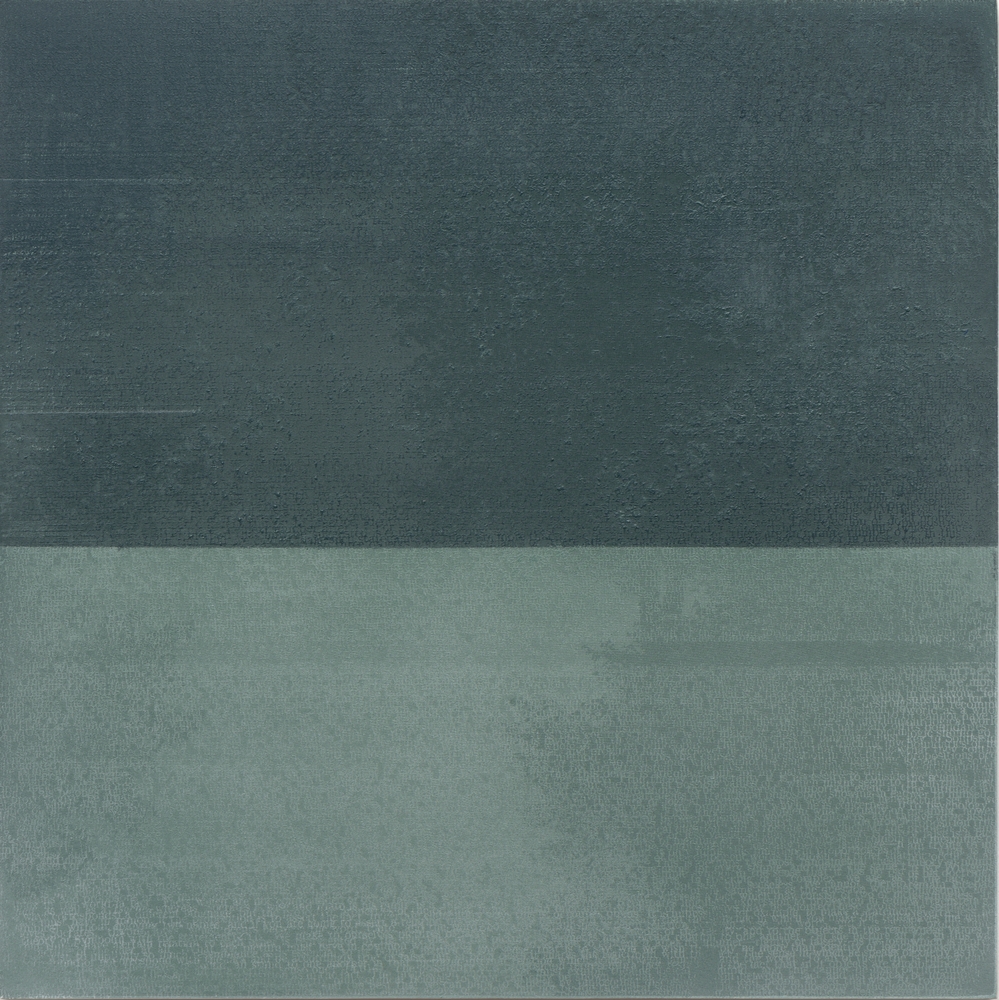
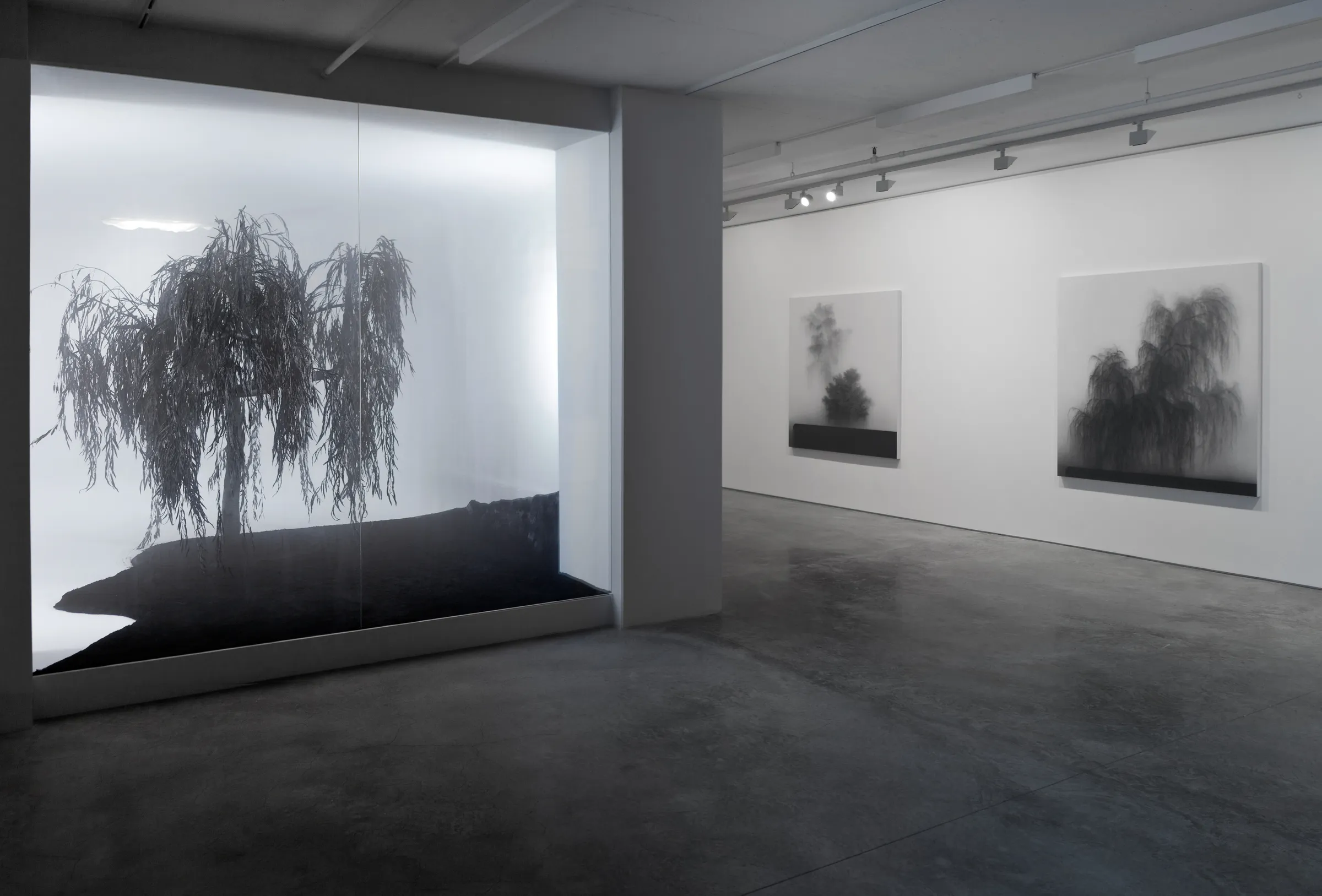
“Passage” is also a keyword Rosalind Krauss introduced to describe sculpture after modernism. She described a shift from the rational transparency of modern sculpture to irrational opacity, with the objecthood emphasized in Surrealist objects and Minimalism marking a crucial watershed. In Black Shadow – The Void (2022), which employs various materials beyond canvas, ink appears to bleed into thin paper or cloth. In the image resembling a large stain, the lower blank area may be water or air—it is impossible to tell.
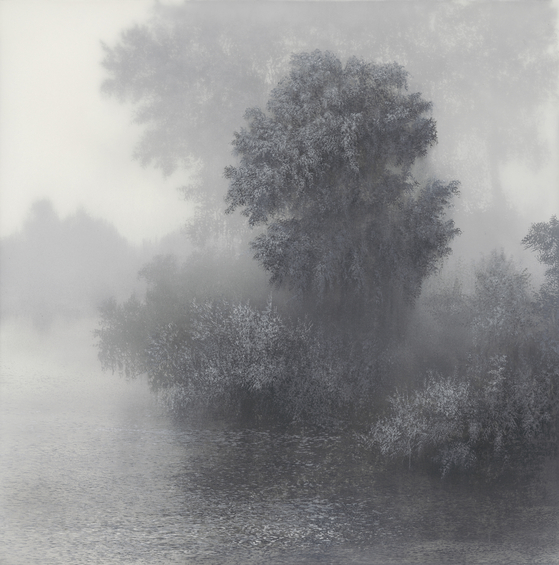
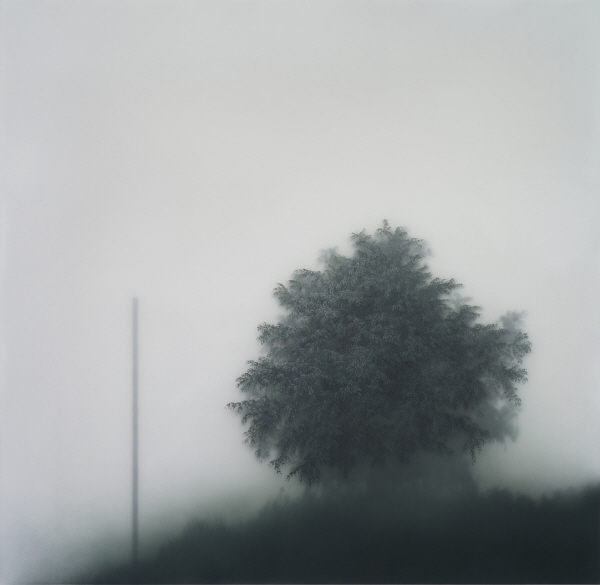
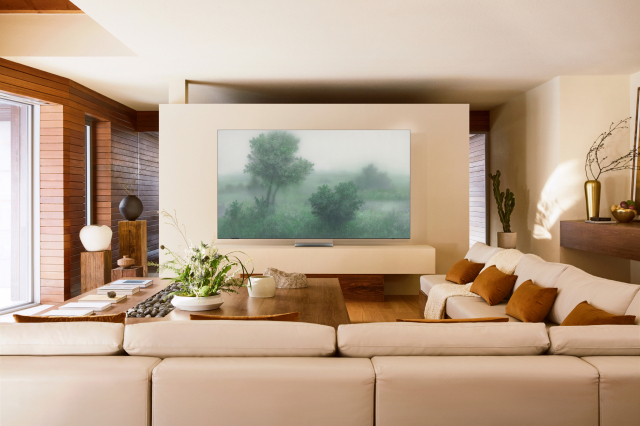
Such ambiguity arises because Rhee’s landscapes do not provide a single totalizing viewpoint. The vocabulary in the title—Black, Shadow, Void—leans toward negation rather than affirmation. Images evoking forests dampen the viewer like a humid day. They seek communication unlike spectacle, which relies on visual clarity; unlike the typical consumer-society mode of recognition, understanding, possession, or disposal. In Where You Stand D-1 (2022), foreground, middle ground, and background emerge within the blur.
Nature, with countless layers and textures whose making cannot be known, is the aspect of reality. Reality is not grasped at once but approached infinitely along an asymptote. Works tinted green—the representative color of nature—evoke wetlands or rainy seasons. Our affinity for humidity has primordial reasons: life on Earth originated in the primeval sea, and both origin and growth within that environment depend on water. Vegetation in the works connects sky, earth, and water through verticality.
Rhee’s mist-filled landscapes are mysterious, yet in modern times mist also suggests pollution such as yellow dust. The unknown carries ambivalence—both fascination and fear. Additional layers laid over the canvas blur silhouettes like bruises on the body. Through tonal differences, objects appear and disappear across multiple strata. Rhee’s experiments capturing processes of generation and extinction endow painting—a static medium—with latent movement.