Crash:
A Gaze That Does Not Grow
Have we
ever considered whether Disneyland—known as a dreamland for children—is in fact
a place that targets the fantasies of adults? It suddenly comes to mind that
Astro Boy, who once made us clench our fists in excitement while watching
television as children, was created as a character who never grows up. That
same childlike figure later seems to have been transposed into the Teletubbies,
unfolding dreams and fantasies for children.
The
Deconstruction of Atomaus
Mickey
Mouse is widely known as the iconic symbol of Disneyland in the United States.
But what exactly is Disneyland? It is a place visited to offer children moments
of adventure and delight—but are those who find joy there truly limited to
children alone? Upon reflection, Disneyland appears to be directed just as much
toward adults seeking temporary liberation from the order and obligations of
the real world.
While staying in Disneyland, one can forget the weight of
reality. In a space where one interacts with fictional characters and
experiences an imaginary world, it becomes possible to escape the regulations
and constraints imposed by various organizations and social groups, and to
momentarily set aside the burdens carried on one’s shoulders. Mickey Mouse thus
functions as an eternal childlike figure that enables escape from reality.
Astro
Boy, the Japanese animation character, symbolizes goodness that triumphs over
evil. No matter what hardships he encounters, the android Astro Boy unfailingly
fulfills his mission. What, then, does it mean that such a figure—burdened with
heavy responsibility—was created as a child who never grows?
If, like Robot
Taekwon V or Mazinger Z, an artificial being tasked with protection should
naturally be depicted as an adult, how are we to understand the fact that Astro
Boy is not? Here, we may begin to glimpse the psychology of modern individuals
who long for the innocent mental world of children and yearn for eternal
childhood.
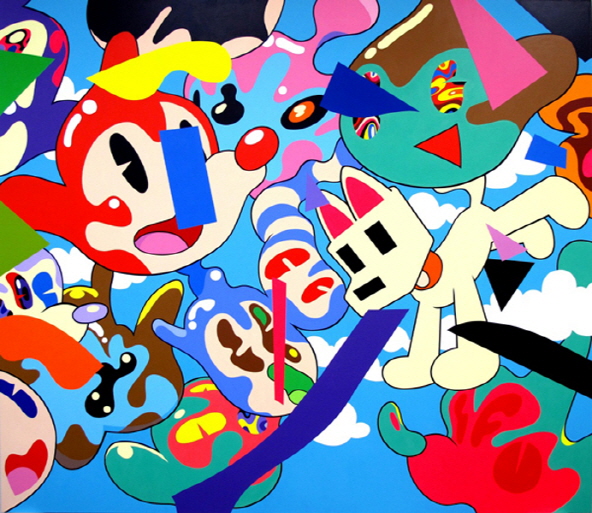
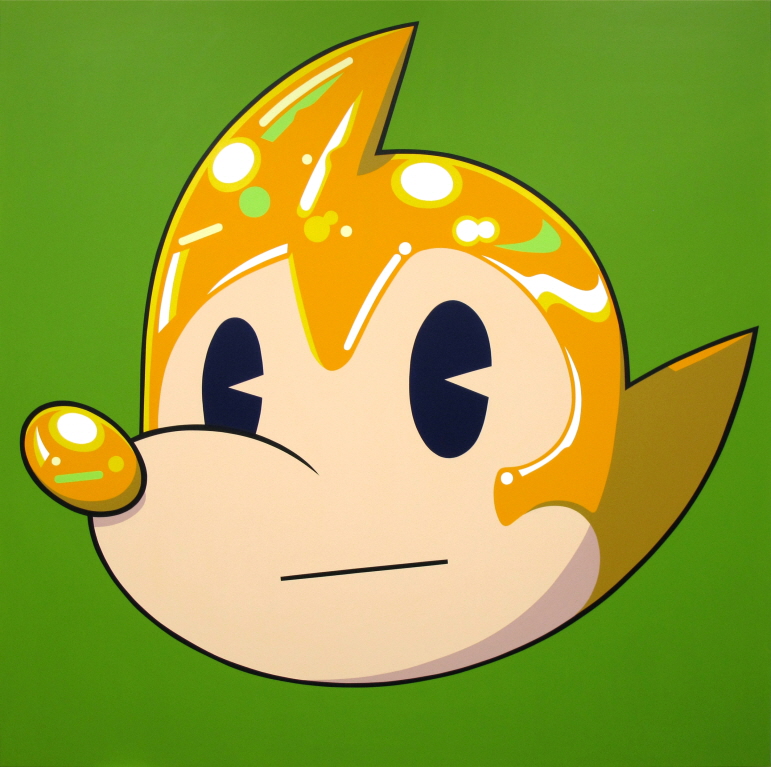
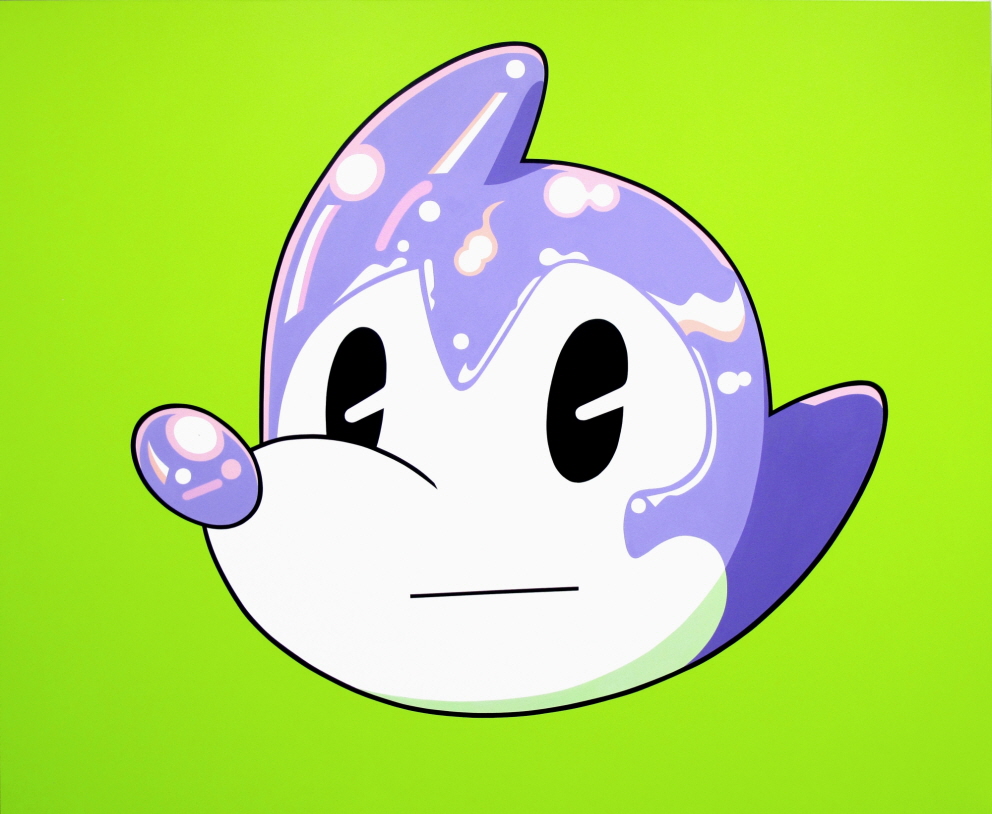
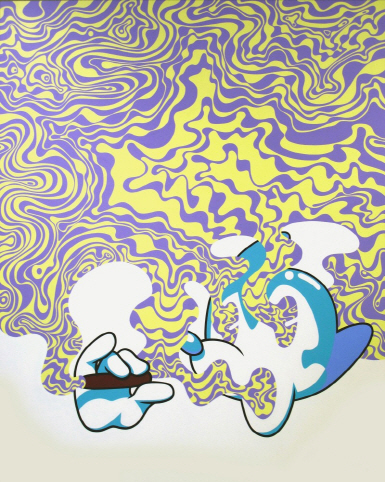
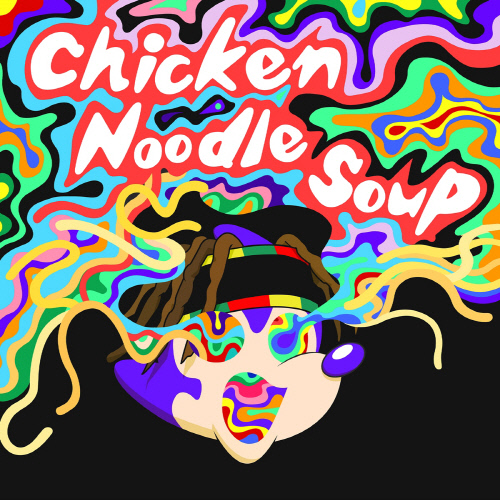
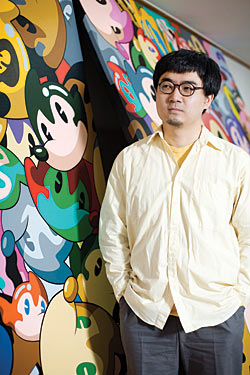
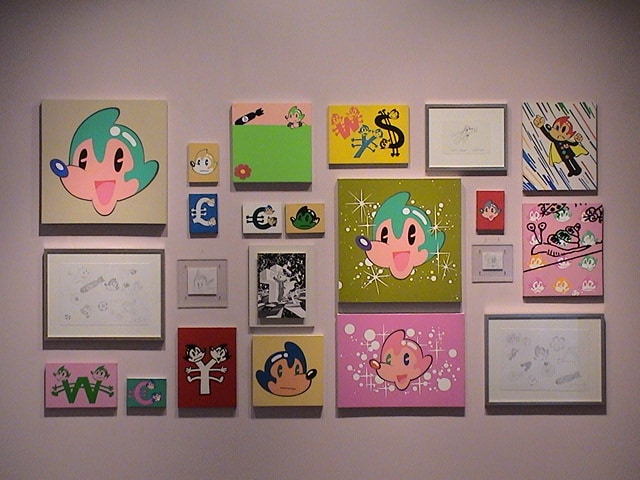
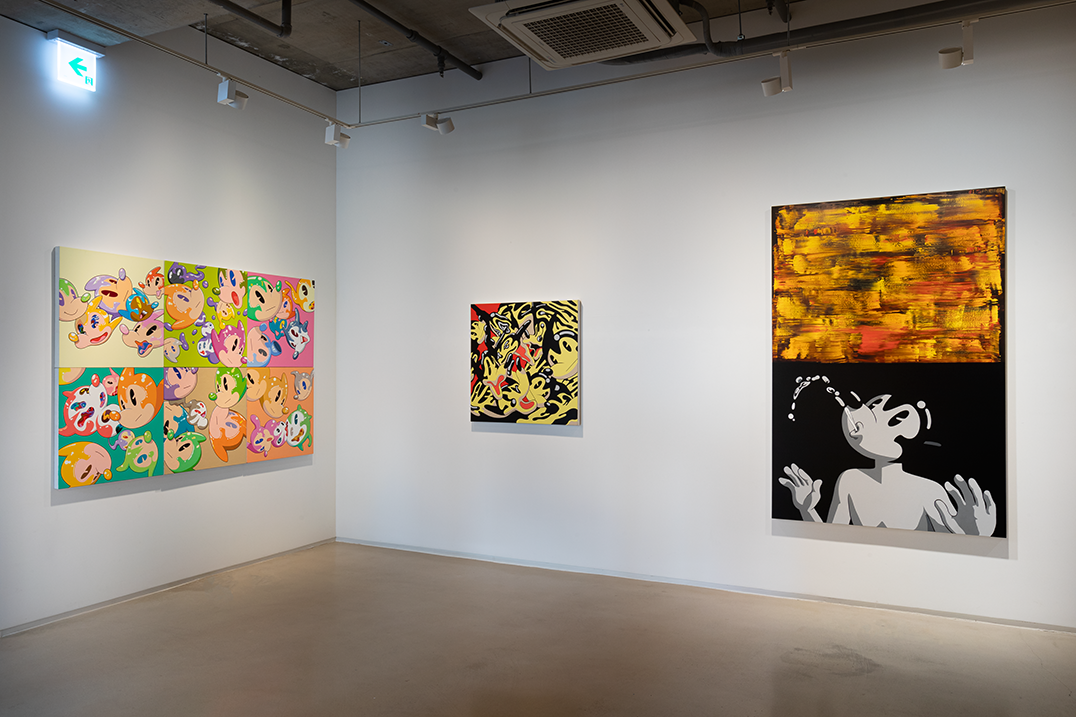
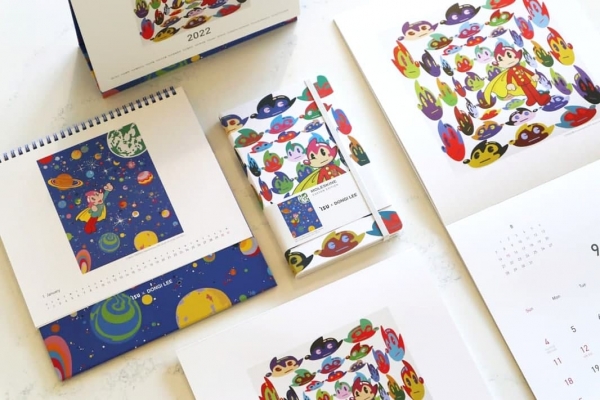
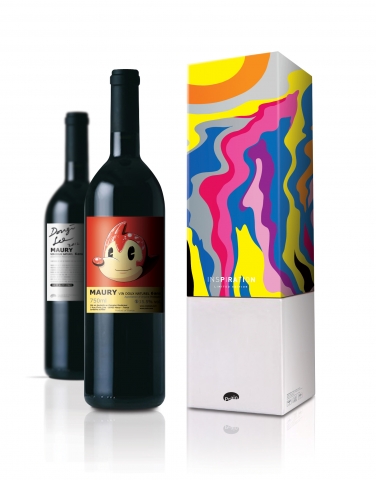
Atomaus,
created by Lee Donggi, is a composite figure merging Mickey Mouse of Disneyland
and Astro Boy from television, embodying the dual qualities of both characters.
By appropriating the outward image of popular cartoon characters, the artist
captures a new way of gazing at life.
Through Atomaus, he appears to express
the psychological anxiety and emotional panic experienced by modern individuals
within a competitive society. In this sense, Atomaus is not merely a cartoon
image on the surface, but a product shaped by the artist’s unconscious desire
to reflect reality. Let us now attempt to “read” Atomaus.
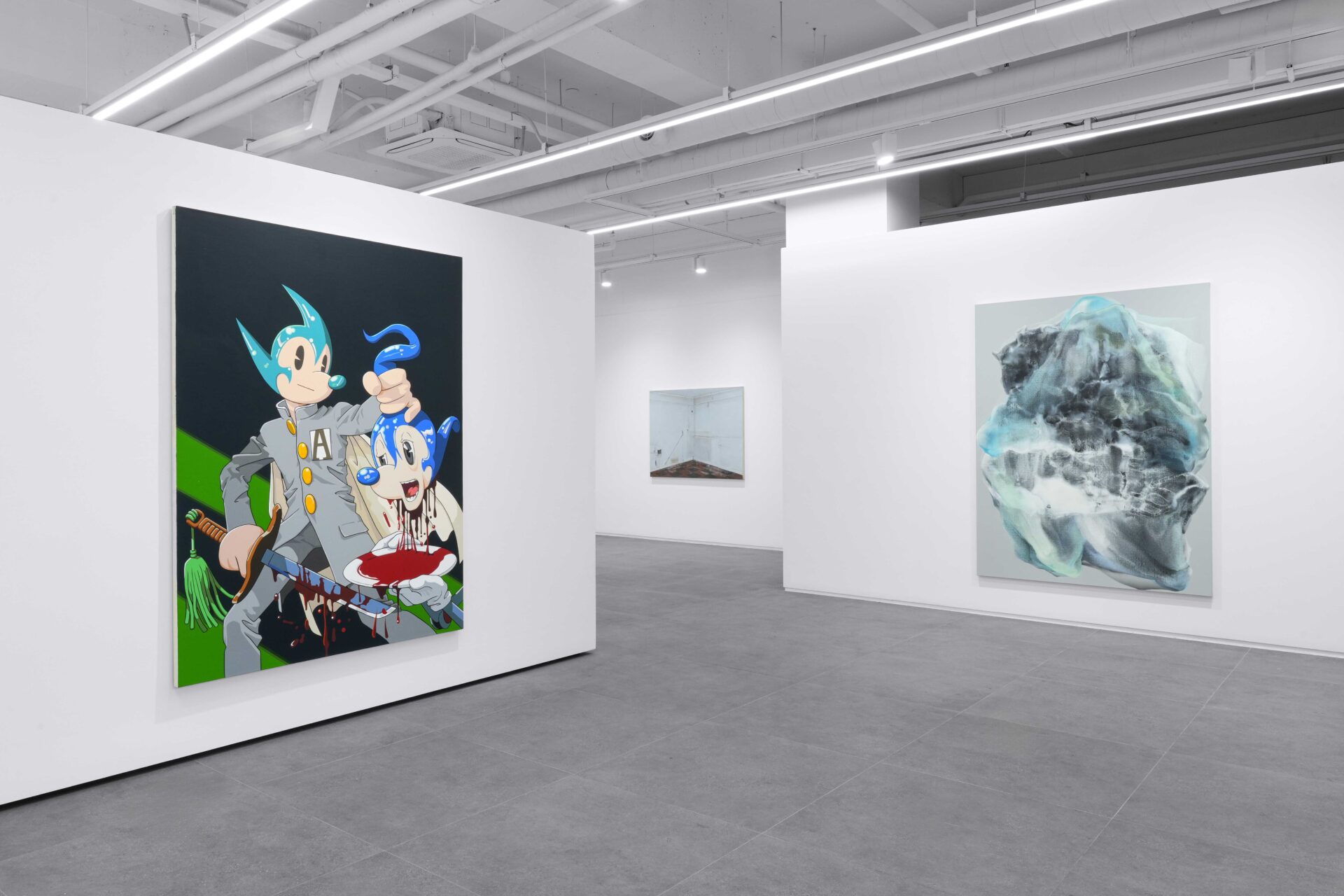
The
most striking aspect of Atomaus is his attire. He is almost always depicted
wearing what appears to be a school uniform or a formal uniform. With its
raised collar and tightly fastened buttons, the uniform instills in the wearer
a sense of belonging to a particular group and functions as a device of escape,
allowing one to assume an identity different from one’s real self.
While the
uniform suppresses individual taste and emotion as a non-autonomous form of
dress, it simultaneously provides reassurance that one is not excluded from the
group. It enables the wearer to forget their vulnerable self and, at times, to
transform into an image of strength beyond reality. In this sense, the uniform
serves as a refuge from reality. Put differently, Atomaus—who longs to escape
reality—attempts to secure anonymity by hiding once again behind the uniform.
The
psychology of Atomaus can also be discerned through the capital letter “A,”
either inscribed on the left chest of his uniform in place of a name tag or
worn around his neck. While “A” clearly refers to the initial of Atomaus, it
seems to signify more than that. It can also be read as the first rank in a
sequence—A, B, C—indicating the highest or the best (Ace). Here, we encounter
Atomaus’s “super complex.” Just as Batman does not bear a “B,” and among
Superman and Spider-Man, only Superman bears the “S” representing “super,”
Atomaus’s “A” reflects an obsession with supremacy.
This “A-complex,” another
name for the super complex, is a byproduct of a competitive modern society that
prioritizes being the best, and at the same time, one of the most childlike
mentalities found within adult society. The letter “A” may also signify Atom or
Art, both of which can be interpreted as markers of a power complex grounded in
the logic of strength.
In
images where Atomaus, wearing a uniform marked with “A,” drapes himself in a
cape, raises his super nuclear fist, and soars through the sky, we encounter
yet another layer of psychology: a violent masculinity. The notion of violence
may seem unexpected in a playful cartoon character. Yet the cape, imbued with a
sense of awe toward flight, and the aggressive gesture of the nuclear fist
appear as manifestations of primary, instinctive desires—to display power and
to destroy.
However, this moment of triumph is fleeting. Soon, we find
ourselves with a bitter smile upon realizing that Atomaus has landed not in a
place of evil or enemies, but in the pastel-colored landscape of the
Teletubbies’ meadow. Pastel colors exist in the gaps between primary colors. They
signify incompleteness and immaturity, while also implying artificial
manipulation. It is, in essence, the psychology of Atomaus—unfinished and
unformed.
Public
Documentary Art
Lee
Donggi’s solo exhibition is largely divided into two parts: Atomaus Land,
composed of works featuring Atomaus, and Public Documentary Art, consisting of
documentary-style comic works.
The
documentary comic works began in the early 1990s with MAN &
WOMAN, LEFT & RIGHT, and HUMAN &
HERO. By presenting opposing concepts within a single frame, these
works address the black-and-white logic of modern individuals, who tend to
prefer direct, binary judgments—yes or no, right or wrong—when approaching
objects or phenomena. However, these works were soon overshadowed by the
emergence of Atomaus and did not gain widespread recognition. Nonetheless, by
juxtaposing different elements within a single image, they can be understood as
attempts to merge art and popular culture.
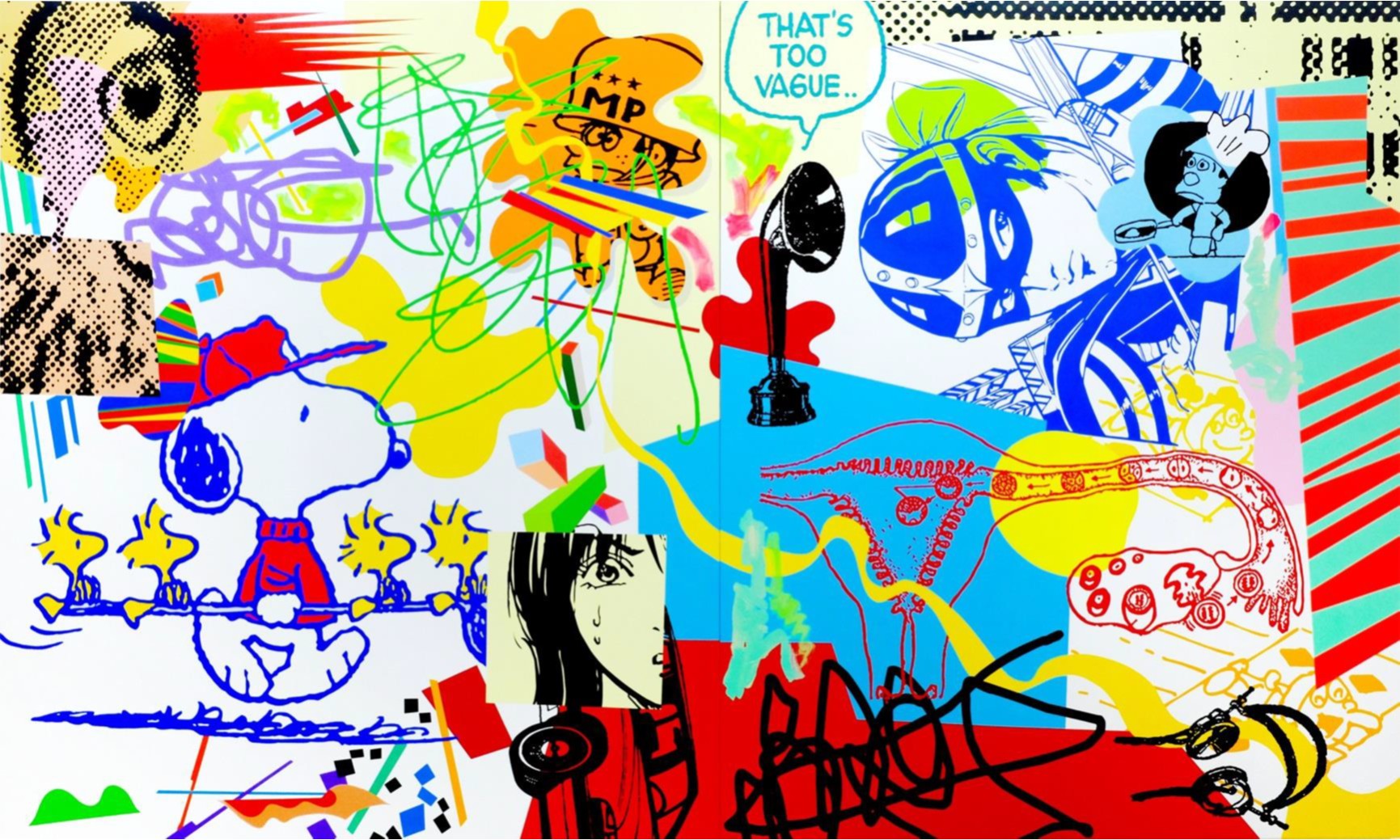
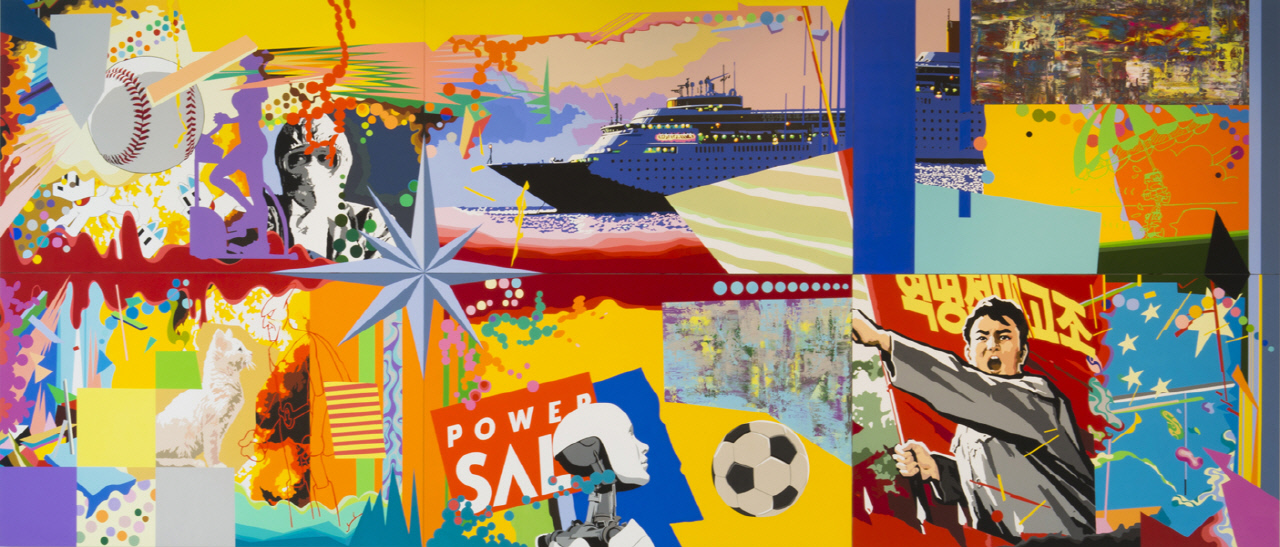
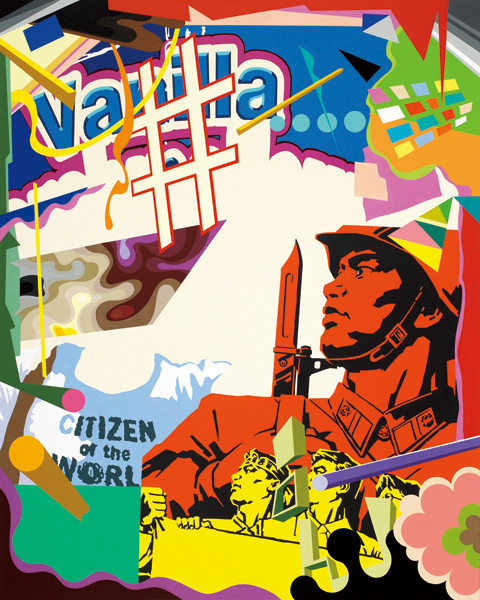
The
artist enlarges and recreates single panels from serialized comics such as
Violence in a Closed Room, Crash,
The Chairman’s Son, and Boxing. He has
also produced works including Modern Girl, Modern
Boy, Lee Sang, Wanted (Shin
Changwon), Alopecia, and more recently
Airplane Crash. These works reconstruct visual images that
are easily encountered through mass media—comic books, advertising leaflets,
literary magazines, newspapers, and television. Because these images are
already widely familiar, viewers can readily recognize what is depicted.
This
raises an inevitable question: among the countless images delivered to the
public, what common thread connects the scenes selected by Lee Donggi? We may
cautiously note that these images share a focus on socially significant moments
in contemporary society. Many of the scenes and figures depicted involve
airplane crashes, traffic accidents, or individuals such as public icons and
wanted criminals who generate social impact. As such, they often embody
destructive and sensational qualities.
At
first glance, the combination of real, newsworthy events and their
representation in comic form appears incongruous. However, the dissonance
between seriousness and lightness feels natural rather than awkward. This is
because Lee’s work reflects the everyday experiences of modern
individuals—particularly the frequent collisions between reality and fiction
that we encounter in our daily lives. Although it may seem somewhat different
in nature, Check, which depicts a 100,000-won cashier’s
check, also belongs to this continuum of works where reality and fiction
intersect.
Within the coexistence of its real monetary value and its
worthlessness as a disposable piece of paper, the public unconsciously
experiences the irony of reality and fiction becoming intertwined in everyday
life. Through the unexpected format of documentary comics, the artist presents
a light approach to an inherently violent world. In this sense, these works are
not fundamentally different from Atomaus, in which the violent tendencies of
contemporary individuals are concealed.
Crash
The
artist suggests that whether or not the psychology embedded in Atomaus is read
by the public is not of great importance. Through the image of Atomaus, he
seeks to significantly reduce the distance that contemporary art often imposes
on audiences, offering instead an unexpected sense of pleasure. However, such
an interpretation alone feels insufficient.
Upon closer examination of
Atomaus—arguably Lee Donggi’s trademark—it becomes apparent that the figure may
function not only as the artist’s alter ego but also as a projection of
ourselves living in the present. Despite possessing the outward form of
adulthood, we inwardly long to remain in a state of eternal childhood.
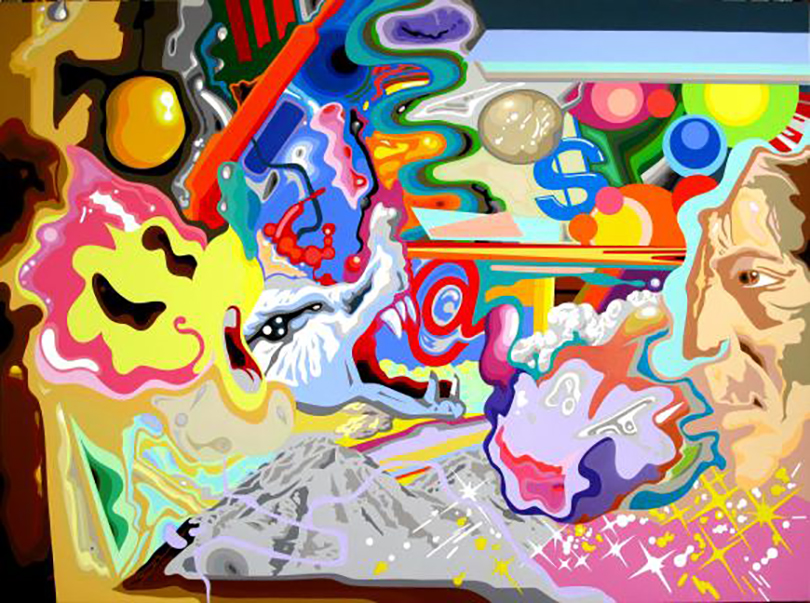
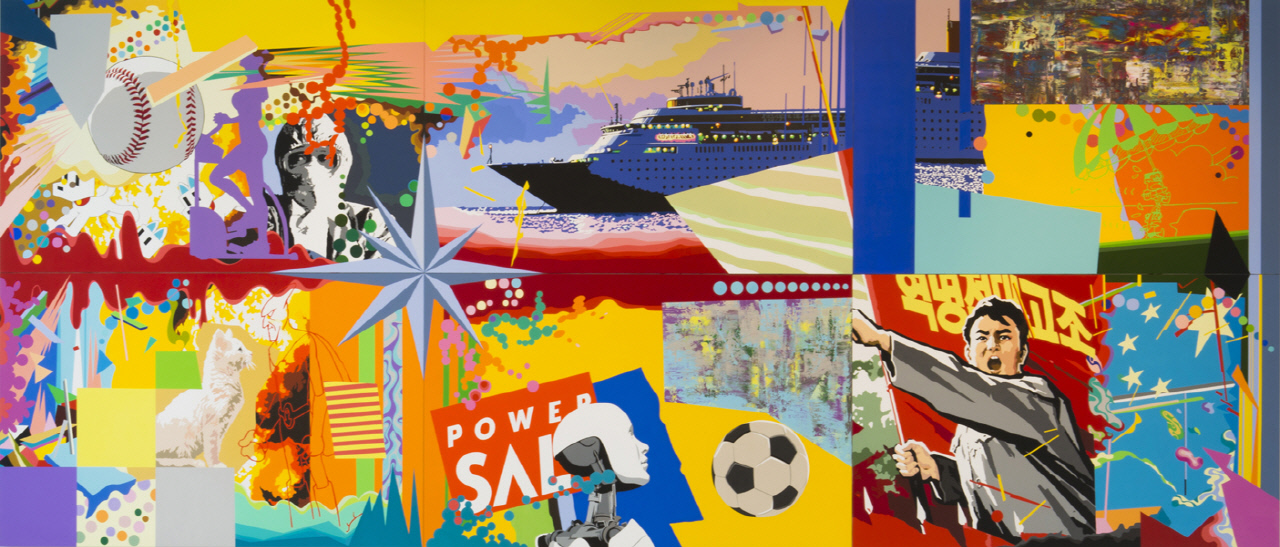
By
appropriating and replicating familiar cartoon characters—iconic images of
popular culture—Lee Donggi addresses the collisions between reality and fiction
that we encounter within the complexities of everyday life. In other words, the
artist re-presents the weight of daily existence through the form of comics.
Ilmin
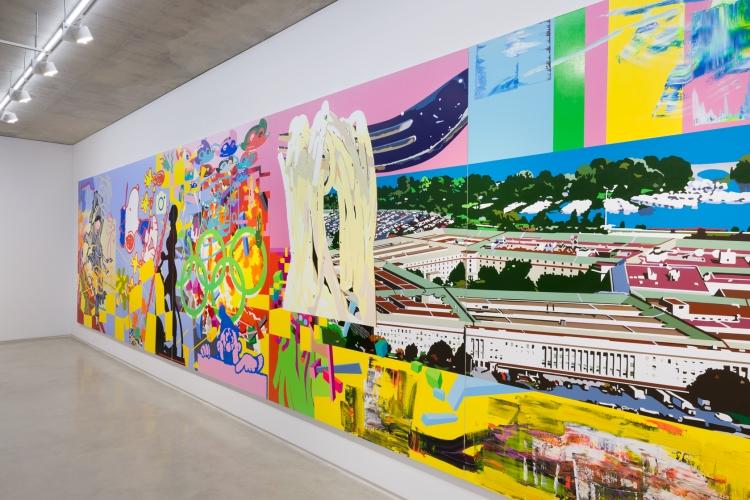
Museum of Art presents 《Crash》 with the view that this exhibition may also
serve as an opportunity to consider the notion of “Korean Pop Art.” In fact, it
can be said that the concept of Korean Pop Art has rarely been properly
addressed within the Korean art scene. This exhibition is thus anticipated to
open a space for such discussions.