1. In negativity: unvisibility and impossibility
Negativity
is mightier than positivity. Of course, people see positivity as pertaining to
good, love, benevolence, and ultimate powerfulness and tend to want to believe
“though not for now, eventually the positive is the good”. Yet many examples in
human history attest to the fact that negativity is always more powerfully
effective than positivity while being provocatively stimulating. For instance,
one’s saying “no” agitates the mind of the interlocutor at least ten times more
than his or her saying “okay”. Also, “cannot see” or “is impossible” affects
people or situations more deeply and more powerfully both physically and
psychologically than their opposite counterparts. Just as almost toxically
spicy foods with a large dose of capsaicin cause pain in our tongues and
brains. Particularly, towards the reinforcement of social prejudices by adding
to the literal definitions of words the doxa such as disabled,
crippled, incompetent, disconnected, forbidden, closed, renunciative,
incommunicative, and frustrating. Although negativity does not necessarily mean
something worse, more wrong, more inferior, or more evil than positivity, we
have in general used negative words in such a sense.
In this respect, it is likely that using “can’t see” and “impossibility” as
keywords as in the title of this article can be quite risky and foster far more
misunderstanding than understanding in discussing the art of Ham. Nonetheless,
it is my argument that the analysis of her art should begin with taking as its
focal point negativity represented by the keywords of “unvisibility”2 and
“impossibility”. The point of this strategy is not to elicit suggestive
responses or short-lived attention on the part of readers or viewers by use of
the powerful force of negativity. Also, it is certainly not my intention to
discolor Ham’s art with negative prejudices. On the contrary, it is employed
because I want to emphasize that the creative act of Ham entails the extraordinary
impetus in the negative, the difficulties worthy of being endured, and the
possibility of the disparate entity that does not easily succumb to
compromising into positivity.
Also, because her art is replete with the
potential possibility of ethical and aesthetic interpretation that can be
obtained only in—not through—negativity. A paradigmatic example can be found in
that negativity takes on, in Roland Barthes’ sense, “only paradoxical formulae
(those which proceed literally against the doxa)”3 and
constantly self-generates productive discordances and awakening tensions. This
is why this writing starts with negativity, that is, negative words and
negative attributes rather than targeting ephemeral stimuli and resulting
mechanical agreement and dialectical convergence.
What is at stake most basically in the field of visual art is literally
“vision” or “visibility”. And the art of Ham starts from blindness or/and
unvisibility. This analysis indeed needs to be carefully delivered. First of
all, “blindness” by which I intend to mean here has nothing to do with visual
inability or rational/cognitive limitations. Rather, it means the artist’s
performativity—namely, the artist’s immersing of herself into situations
without any practical calculation. Also, “unvisibility” does not relate to the
concealing of truth or the deletion or repression of being, as the opposite
counterpart of visibility. Instead, it refers to what Ham is obliged to endure
when she works with certain acts, incidents, processes, and objects that are
opaque, uncertain, and unstable: the totality of the conditions of not being
able to see, not being able to know, not being able to understand, not being
able to comprehend, and not being able to grasp with her hands/consciousness.
Yet unvisibility here may be related to factors such as concealment,
discrimination, and suppression in the respect that it originates not in what
is natural or supernatural but in the interface between structural
conditions—social, cultural, political, economical, and so forth. In other
words, Ham takes an obscure, suffocating course as she engages herself in those
processes through which concrete artistic outputs can be hardly expected and in
the relationship with those subjects whose potential crises owe to the sensitivities
in the political, administrative, social institutional contexts—for example,
the color of yellow one accidentally come across in streets, defection brokers,
North Korean embroidery workers, etc. There is no visible substance, no profits
from it, and no clear answers in such undertakings. Still, what are clearly
there are an artist’s voluntary will and methodology to carry on those
endeavors even in darkness.
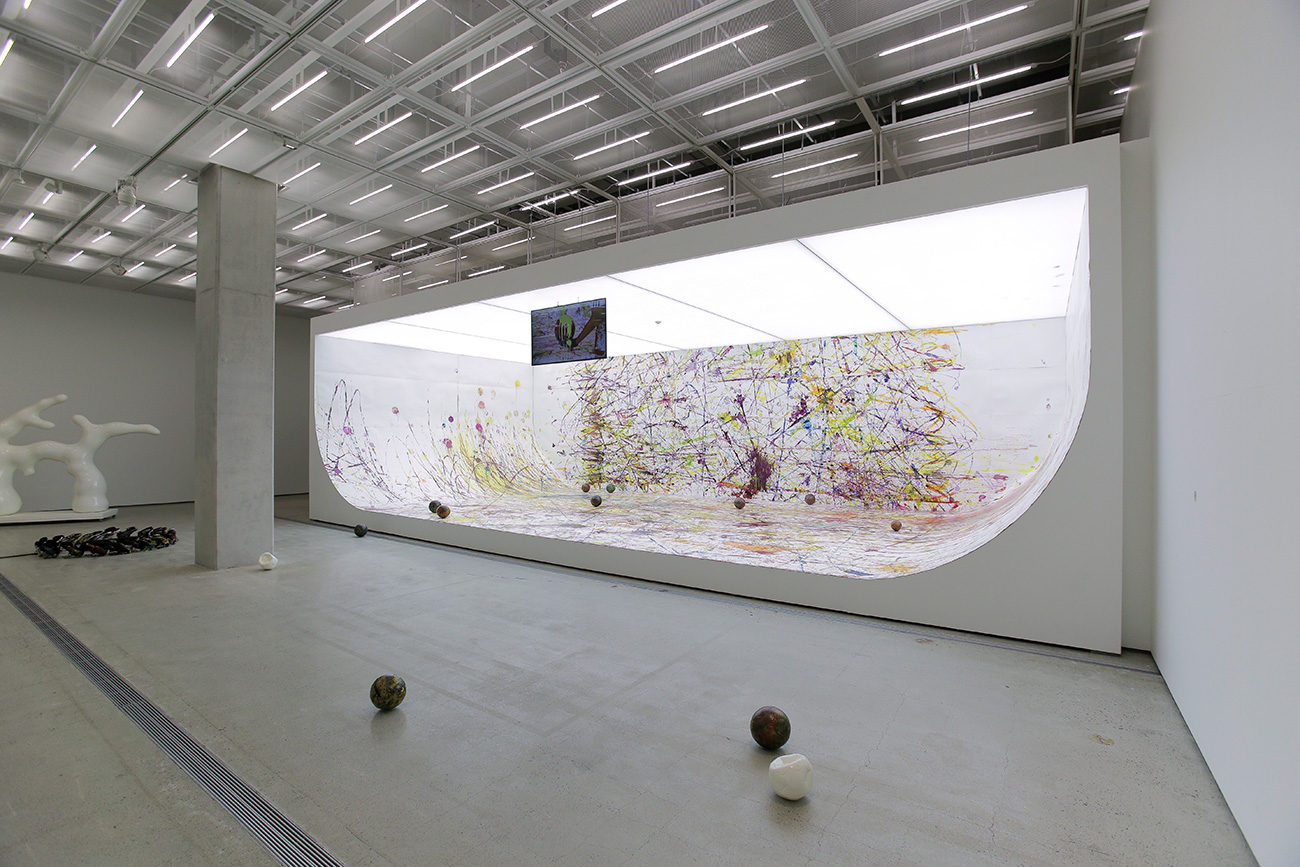
For instance, Chasing Yellow (2000-2001), one of
Ham’s earlier works, is an 8-channel video installation for which she recorded
the lives and conditions of those yellow entities—people in yellow clothes and
yellow objects—that she encountered by chance in various regions in Asia and
followed blindly. In conducting this work Ham was not an artist-master who
designed a riskless work plan, calculated things for a specific image output,
and weighed the pros and cons. Rather, she was a sort of situationist in the
street who was readily enduring the negativity originating from not knowing how
things were to go and being unable to be certain about whether or not her
doings would produce a successful artistic outcome. Another good example would
be “Embroidery Project” whose theme was “What you see is the unseen” on which
Ham has worked since the late 2000. This work will be more closely examined
later in this article. To encapsulate it for the time being, it is a project
for which Ham sends designs to embroidery workers in North Korea through a
broker who works in China to have them custom-make a large embroidery piece and
structuralized—from the physical process of mounting the embroidered fabric
onto stretch bars to the establishing of the art-institutional context of an
exhibition—it into a contemporary work of art.
This project is bounded by some
originating conditions: there is considerable difficulty in forming any
communications among those involved in this project, not to mention making
direct contacts or formal contracts; the process is of blindness and great
possibility of failure since losses, dangers, responsibilities by any
unreasonable happenings or unfortunate accidents are solely on the artist
alone. This is due to the political tensions between South and North Korea, the
difference in the political regime, the instability of the given situations,
and the continuous existence of unforeseeable variables. Ironically enough,
however, the work made through these processes enables viewers to be
entertained by the material certainty and blinding spectacles of multicolored
embroidered images and the hypersensory concreteness of the images made from
countless stitches. It is of paradox in the respect that a creative endeavor
undertaken in the negative conditions of unvisibility and impossibility
engenders breathtaking visibility and overflowing sensory pleasure. To use
Barthes’ words, a paradox that runs counter to a doxa is born from this
artist’s art of unvisibility and become part of reality.
Ham’s unvisibility is antipodal to hyper-visibility. The hyper-visible
perceptions and sensations that are imposing, like the gaze of the Big Brother,
and scrupulous justify the rationalization that since the subject of
absoluteness/light/power is always right and powerful, one would better to
conform to norms and order, because then everything will be fine and the world
will be free of problems. This can be exemplified by the American humanism,
transcendental ethics and moralities, the genius theory, and the theological
metaphysics. A writer posits that on the other side of this hyper-visibility is
“invisibility of subordinate positions”4. It seems that the writer
wants to make an antithesis between invisibility and hyper-visibility by
defining them respectively as a kind of sacrificial offering and as a total and
indisputably powerful vision to which absolute authority via willful negligence
is granted by invisibility.
But it is my contention that hyper-visibility
should be coupled with the active “unvisible,” not the passive “invisible”. Not
the relative and subordinate perspective of the weak but the perspective as an
independent being whose quintessential nature is constituted of negativity. In
other words, the choice of foggy uncertainty and vain relations over guaranteed
profits and outputs resulted in the birth of negativity, which is the very
agent that allows unvisibility to evade the superior/subordinate relation
between the powerful and the weak, and this unvisibility is the counterpart of
hyper-visibility. I believe it is quite persuasive to put Ham and her work in
the purview of the unvisibility in this sense and context.
In July 2016 when I am writing this article, Ham is working on a new project.
But I cannot exclude the possibility that the project would maintain its being
only as a critical description in this article, not being able to be realized
into immaterial data or an aesthetic object. Even when it is materialized, the
impossibility for it to be present or to be shown may remain. The project’s
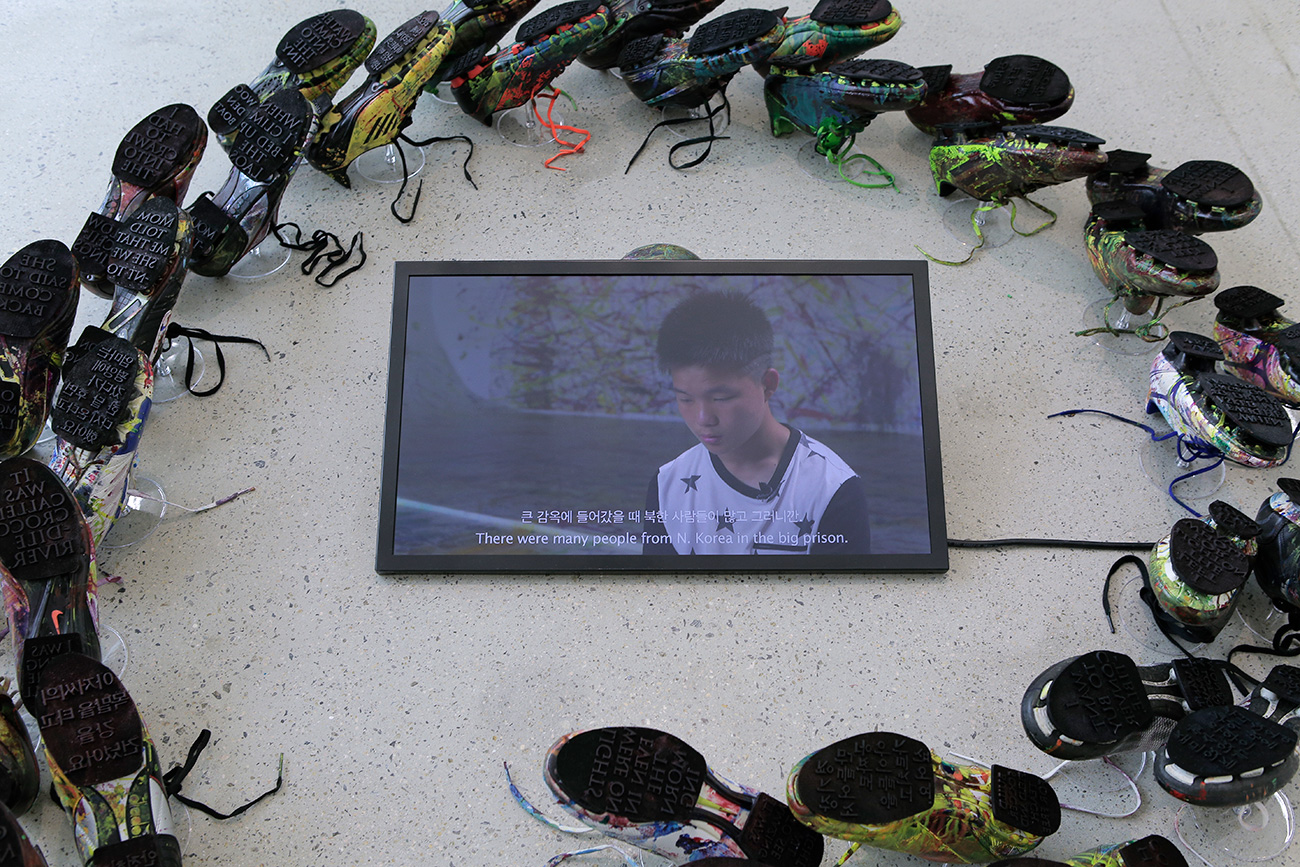
objective is to document in video images the journey of those who attempt the
defection from North Korea, that is, the course of the defection attempts of
those people who have no choice but to carry out the defection at the risk of
their lives despite the lurking immense danger. As if to prove its danger,
uncertainty, difficulty, and complexity, this project has made no progress for
months since the launch of the project. Also, I have been hearing that almost
all sorts of ridiculous and shady variables are taking place and there has been
continuing a problematic situation that even the artist cannot figure out how
things are going.
Ham’s intent behind this work lies not in increasing social
agitation by ruffling issues considered sensitive to public security
authorities or in creating a sensation so that she can be in the limelight.
Also, neither in bolstering the public interest in human rights in North Korea
nor in conveying messages about political liberation through a work of art. The
reason she has planned this much serious work of documenting those who are
trying to defect from North Korea in spite of the distress and difficulties to
which she is not obligated to expose herself is that it is of reality that
cannot be reduced to any abstract value of money, any fetishistic value of
commodity, or any phantasmagoric exchange system of capitalism. What the artist
desires to address are that if it is possible to put a price on “ending up as a
failure” or “realization of impossibility,” then their prices would be higher
than everything else and that their performative values cannot be reduced to
money or commodity by any capitalist methods of calculation. These intents are
the ingredients for the possibility of disparate beings of which Ham aims to
inform us through negativity and for the ethical and aesthetical meanings that
can be obtained only within the trajectory of negativity. The ingredients that
await the practice of paradoxical criticism beyond the doxa-based
interpretation that is formed merely by adding negative prejudices.
In 2002 Afghan and Iraqi refugees in the Sangatte Red Cross camp in France
attempted to get to England through the Channel Tunnel. Georges Didi-Huberman
commented on Border (2004), a documentary film of
their attempt by Laura Waddington, “It is not, despite the sheltering darkness,
rendered invisible bodies, but of ‘fragments of humanity’ that the film just
manages to succeed to reveal, so fragile and short as are their appearances.”5 A
look at Waddington’s film in fact reveals the point that Didi-Huberman sees as
admirable: the desperate endeavors of the beings who are imperfect and unstable
but living with desires that can be thwarted by no powerful Other can be sensed
in the violently jolting video images of poor quality. My applause to Waddington’s
incomparably remarkable ability to express them in her work of art.
Suddenly, Ham’s aforementioned currently on-going work intersects with
Waddington’s Border in my mind. In Border by Waddington it
is made visible that desires for freedom intrinsic to humanity nestle in the
shadows/weakness/pains of the world that are unknown and invisible to us. Yet
Ham is all alone enduring the impossibility of her current work—that is, the
impossibility of capturing the desire for existential liberation and
life-risking actual acts of those attempting to defect from North Korea and
presenting them to us as objects to be viewed—that can be shared by no one.
Waddington was able to finish her work after all despite many difficulties. But
Ham might not be able to do so. I have no intent to compare these two cases.
Nonetheless, I should say that this project by Ham does negativize the ruthless
pressures of reality precisely because of its negative possibility of failure
and its possibility of limiting its continuation, just like negatives in
photography that have died away in this digital era.
2. Phantom footsteps? The dynamics of creation
The word “theater” derived from the Ancient Greek word “to see”. To this
linguistic fact one can add the interpretations that a theater is basically a
space for the pleasure of seeing and that visibility is an attribute inherent
in the form of presentation of a theater. Also, it is my view that when the
dynamics of Ham’s creation is marked by “unvisibility” as discussed above, then
her work, paradoxically, is, by destiny, latent with
non-theatricality/non-presentability/non-presence. The paradox deepens more
when one takes into account the harsh ecology of contemporary art where a work
of art’s not being on display is sufficient enough to negate its existence as a
work of art. That is the very thing that I am trying to “see” from now on: the
phantom existence of paradox.
Whether intentionally or because circumstance does not allow, Ham carries out
most of her works under very difficult conditions. And each and every work by
the artist are granted the status of an artwork only when their content and
form have met, and this attests to the fact that Ham is an artist whose pursuit
of completeness is persistent and tenacious in terms of not only visual quality
but also the promise of their visual embodiment. One might say that there are
many artists like her in the contemporary art scene and that the majority of
contemporary artists are focused in the pursuit of pluralistic and intellectual
art. Yes. It is true. Ham is, too, a contemporary artist in this respect. Yet
we need to point out one aspect that differentiates this artist from others in
the contemporary art scene. It has to do with the uniqueness of her aesthetic
practices from which Ham has stubbornly refused to derail for nearly two
decades. To describe the very aspect, I want to coin a critical phrase based on
the title of her solo show at Kukje Gallery in Seoul in 2015. That is, the
distinctive and core nature of Ham’s work concerns a “phantom process”.
What I intend to put forward using this phrase, which is a paraphrase of the
exhibition title, 《Phantom
Footsteps》 are two points. The first is that, as the
artist intended in the first place, works of art are “metaphoric of the
paradoxical mechanism through which what is not substantial embodies what is
substantial, like the footsteps left by a phantom,” and here “the ‘phantom’ is
a general term that refers to those desires and illusions that govern and
control life and society.”6; the other point is that the phase can
be used to define the entire body of Ham’s works, not her particular work or
exhibition. What I aim to convey with the word “phantom” is not negative as in
“non-substantial,” “non-essential,” or “impossible to realize”. Rather, I want
to emphasize that for each and every work Ham has explored what is new in terms
of theme, material, idea, form, medium, methodology, and technique. Under all
circumstances, her work has not boiled down to an art object only whose
appearance is art-like and has been reduced to neither a mere mechanical system
nor everyday cliché.
Thus, “phantom process” points to the fact that the
dynamics, passage, and qualitative attributes of her exploration are not
transcendent but instead constantly cross between being and non-being, like a
phantom. At the same time, it addresses that the very nature of Ham’s art is
rooted in the unfixed process that readily endures the dynamics of change in
spite of the fear or difficulty that is destined to be caused by her art-making
process of such ambiguity, uncertainty, and inderterminacy. This is also why
one needs to pay attention to the noticeably frequent use of words like “such”
and “some” in her titles of both her works and exhibitions. As a determiner and
pronoun, these words are used for rather extensive, unclear, and vague
reference, and Ham has been realizing this linguistic sense through her
art-making process and works.
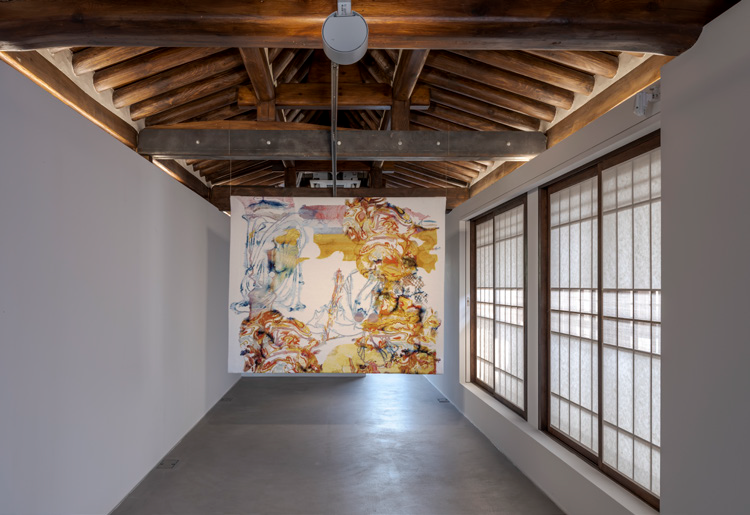
Let us analyze the art of Ham characterized by these properties of uncertainty
and inderterminacy by taking her What You See Is the
Unseen/Chandeliers for Five Cities shown at 《Phantom Footsteps》 as a paradigmatic
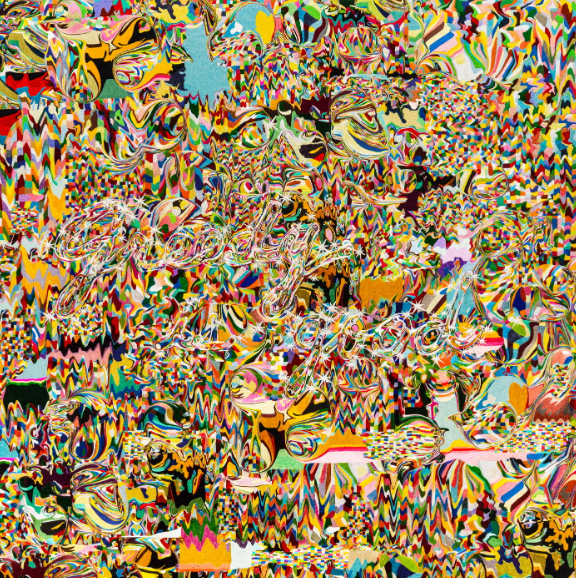
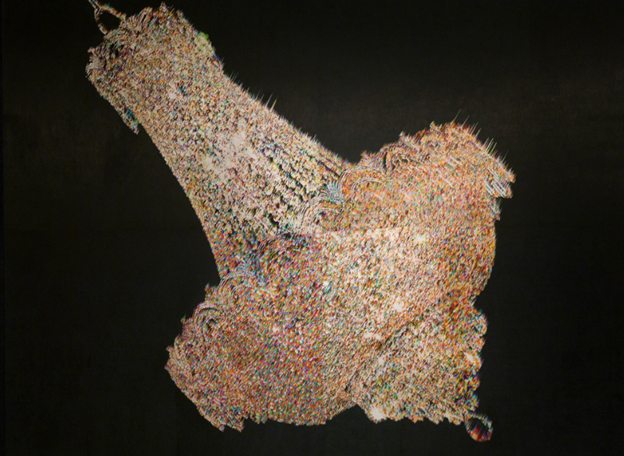
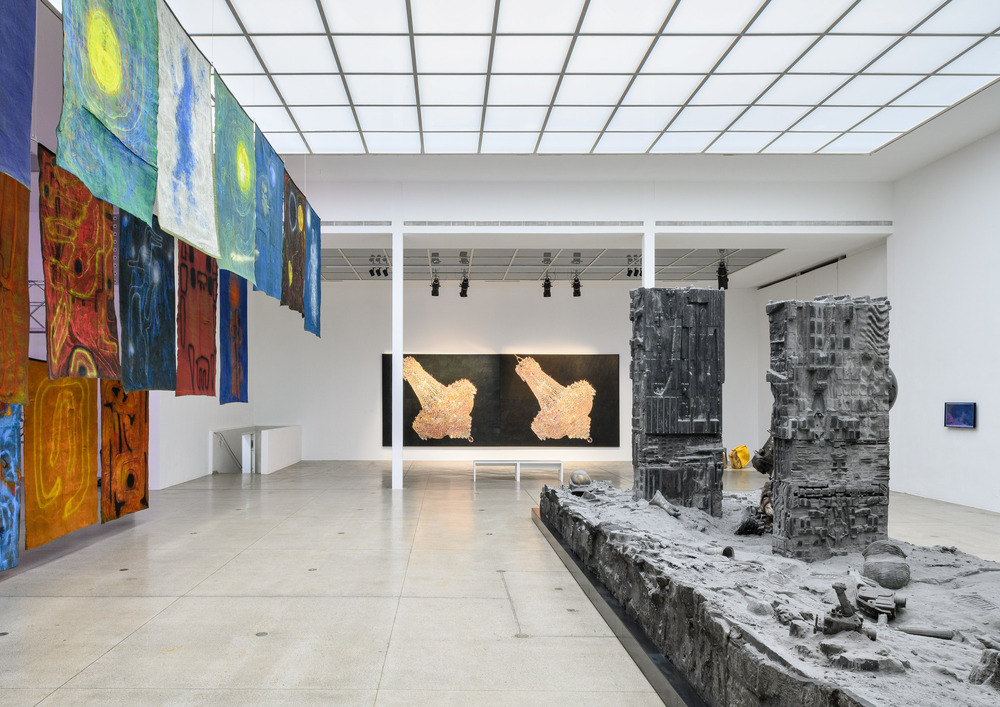
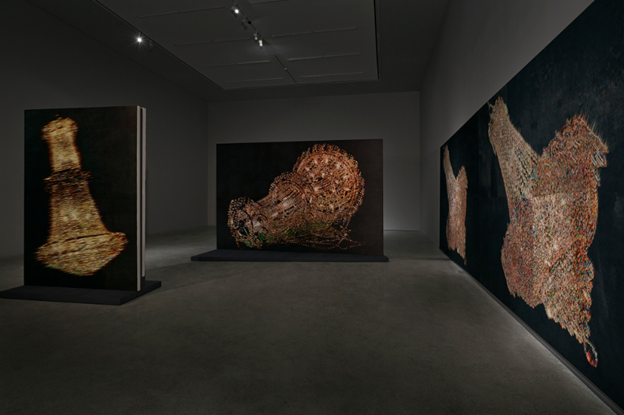
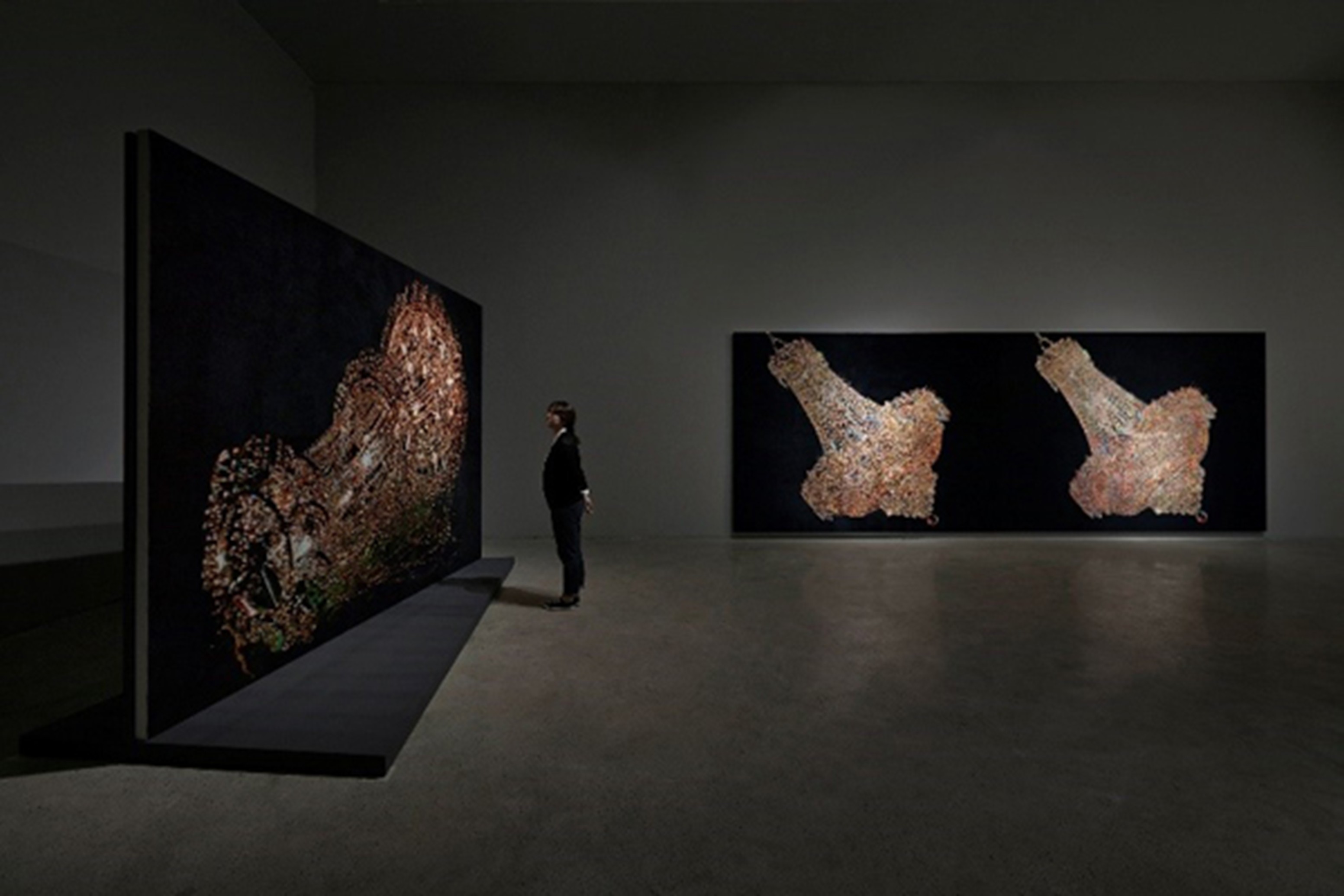
example. This chandelier “Embroidery Project” (named by the artist) creates a
massive, bewitching, and irresistibly beautiful landscape in a dimly lit
exhibition space. This rapturous spectacle owes to the enormous scale of the
work whose dimensions are approximately thirteen meters in width and three
meters in height, consisting of four conjoined canvases, the materials, labor,
and time that were invested in an immeasurable value and amount, and the
unbelievably remarkable embroidery skills. These basic factors elevate the huge
embroidered chandelier into a dimension that parallels a kind of digital
universe, transforming the light reflecting from each and every strand of
high-quality silk thread into a sea of electronic pixels.
Yet what is really
captivating here is the fact that what one obtains via the aesthetic product
produced through the investment of such tangibly certain materials and labor is
in fact an eye-blindingly beautiful illusion. It is a visual experience of the
aura of a single-time presence that is inevitably ephemeral. In other words,
the undeniable materiality and concreteness of the work is ironically what
leads viewers to an aesthetic pleasure through which they are absorbed into a
sensory trance without being able to perceive its substantiality. Another thing
that is astonishing and more important than this is that all of these four
large-scale chandelier embroidery works—one diptych and two individual
paintings—are completed using a problematic/phantom production process that is
very dangerous, nebulous, and unstable and even no one but the artist cannot
take responsibility for when something bad might happen. These works stand
monumentally while taking hold of the space/time of reality with no difficulty,
possessing an artistic aura that takes viewers’ breath away. What in Heaven’s
name is problematic/phantom in their production?
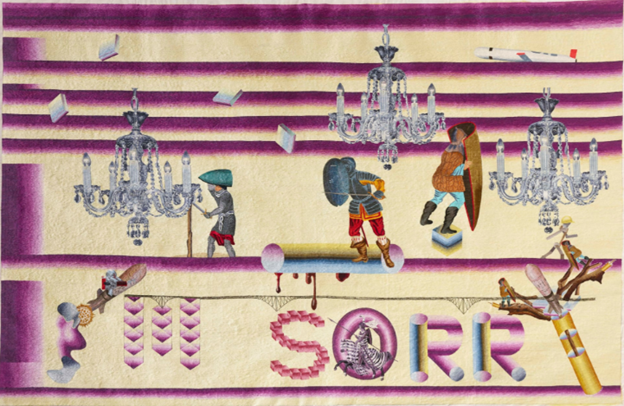
For “Embroidery Project” Ham designs, models, and lastly frames the embroidered
canvas by her own efforts. Yet she entrusts the embroidering to others. Here
there is nothing peculiar about the fact that she does not do the handicraft
for herself since the contemporary art scene has been not unfamiliar with
“collaboration” and “subcontracting” at all. But in Ham’s “Embroidery Project”
it has a totally different significance. To state the key point only, all those
with whom she interacts/collaborates during the process from the initial
contracting to receiving and paying for the work, which would be part of her
work are anonymous people in North Korea or China. And since they are
anonymous, all the procedures from ordering to receiving and payment are unclear,
uncertain, and unstable. Far from meeting them in person, she works with those
people with whom it is impossible—for political, contemporary historical,
social, national security-related reasons—for her even to talk to on the phone.
About this Ham described with the following pregnant words: “Let’s say it
requires 10,000 steps, then I walk 9,999 steps out of 10,000 with nothing
determined, with no direction, and in a state where it is totally impossible to
foresee what is ahead.”7 Her face was telling me that she had
already accepted the unendurable psychological stress and physical hardships
caused by those 9,999 footsteps, but there still was a hint of “the fate of the
artist”.
But no one forces her to work with so much difficulty. Then why does she do so?
The primary answer lies in the artist’s intent. One day, Ham found a propaganda
handbill from North Korea. This triggered a “desire to communicate with
anonymous, random people in North Korea” in her mind, and she looked for a way
for her own artwork to function as a sort of handbill. Then, she secretively
had Chinese middlemen deliver the images she designed or redesigned from the
images she found on the internet to embroidery workers in North Korea so that
they could translate them into pieces of embroidery and paid them to get the
embroidery products. As she employed this form of trade of a sort, Ham expected
that the embroidery workers in North Korea would brood over the words and
images that her drawings deliver like a “handbill”, try to decode the meanings
of the allegories, and stretch their imagination.8
When this is
the answer from the artist’s perspective, we need to go further. Namely, the
other answer is for the work to go beyond the visual-centrism of visual arts
and to mirror the structural impossibility of Korea’s contemporary
politico-historical realty by putting up with the illegality, irrationality,
anxiety, and disadvantage that the structure and process of “Embroidery
Project” bring about inevitably. One’s simple curious question like “Wow, who
in the world has done this unbelievable piece of embroidery?” leads to other
queries about where it was made, who made it, who delivered it, what process it
went through, and how they communicated, and ultimately to a critical
rethinking of the problematic history and concrete reality in relation to the
coexistence of two different political regimes of North and South Korea. In
this sense, the title “What You See Is the Unseen” can be interpreted in two
ways.
On one hand, what we see in the physical appearance of the chandelier
embroidery work itself is the outcome of the unseen of the phantom making
process that the artist underwent, and on the other hand, what we see contextually
in the work is the phantom, seditious/covert(?) handbill-like relationship that
manifests in the ongoing tension between North and South Korea that has been
inundated with the fratricidal war, mutual vilifications and assailments,
antagonism, conflicts, and ruptures since the 1948 division of Korea. Yet I
hope that the readers of this text would not conclude Ham and her work to fall
into the category of “politico-socialist art”. For what makes the appreciation
and criticism of Ham and her art valuable lies not in defining them
categorically but in understanding them never cease to seek the courses and
methods that correspond to specific themes and forms. What is pivotally
important here is that Ham’s artistic practices cross back and forth like phantom
footsteps between presence and absence, between the substantial and the
insubstantial, between existence and dissolution, between continuity and
change, and between possessing and unrewarding contribution. An aesthetic
judgment on the significance of the crossing or on the unfixedness demands a
reexamination of the starting point of the “Embroidery Project,” that is, the
early phase of Ham’s art.
3. Clear and distinct perception? The authenticity of art
“Art
is a guarantee of sanity.”9—Louise Bourgeois
Ham
started to commit herself fully to her “Embroidery Project” in 2008 when she
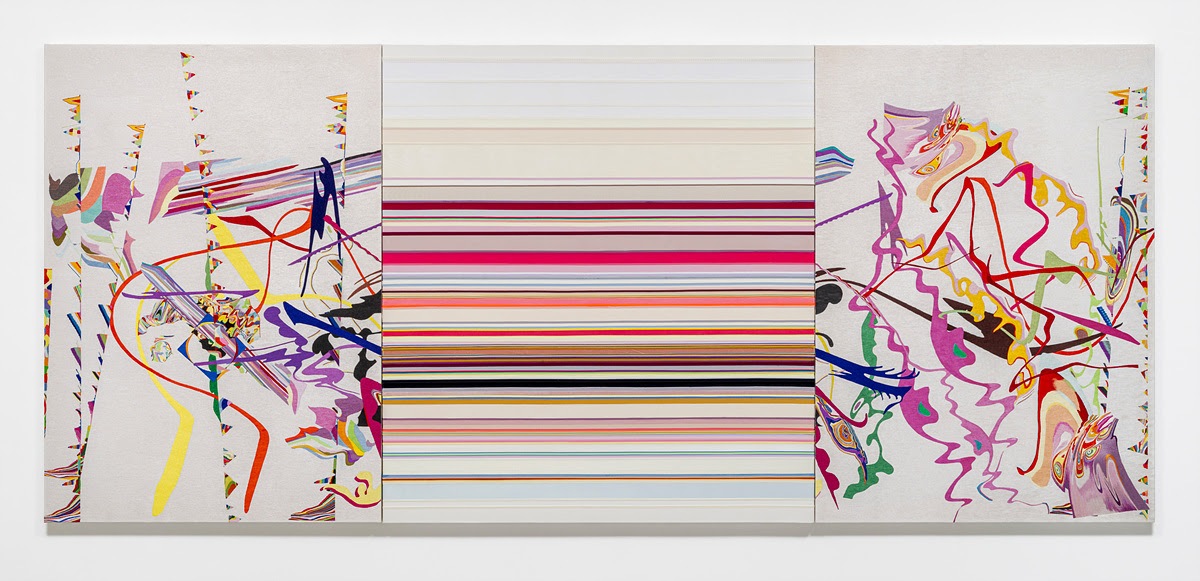
had her third solo show 《Such Game》 at Ssamzie Space in Seoul. Here she showed works ranging from
a diptych consisting of black-and-white embroidered images of the mushroom
clouds in Hiroshima and Nagasaki, which are typically symbolic of the ending of
the World War II to small-scale colorful embroidery paintings onto which the
artist transferred the communist propagandas from North Korean textbooks. But
the content was coherently linked in the respect that they were based mostly on
her critical perspective towards historical facts and political reality. Here
is a good point to address an intriguing context. Ham had her first solo show
in 1998 when Korean society was highly unstable due to the IMF crisis amongst
other problems. The venue was Alternative Space Loop that laid the foundation
for the radical transformation of the Korean art scene by creating one of the
first alternative spaces for young artists in Korea.
And the show’s main work
was a fragile and variable installation work comprised of grids of matchsticks.
During the next many years since then, Korea has undergone increasingly radical
changes, and Ham has become an established artist with a long, accomplished
career. Despite the length of time of eighteen years that has passed, her art
has always been seeking something new refusing to be confined by mainstream
artistic practices with respect to the use of materials, the expression of
details, and so forth so that content and form are interrelated in terms of not
only visual but cognitive perception as well since her early works like the
above-mentioned matchstick structure. This variability within continuity or in
reverse the continuity of the new is perhaps what enables one to appreciate
Ham’s art both inexhaustibly and from a new angle every time.
Then what are the explicit factors that serve to secure this balance of
continuity and variability? What are the consistent elements that join the
installation consisting of grids of matchsticks (1998), the embroidery diptych
of the mushroom clouds in Hiroshima and Nagasaki (2008), and the four
chandelier embroidery works (2015), and the elements that differentiate them
from one another. Aesthetically, the continuity of Ham’s art from the late
1990s to the present is obtained by the emphasis upon the unseen, the absent,
and the minority. And the variability is assured by the fact that what is
unseen, absent, and minor defies to be restricted by some particular motifs,
mediums, modes, techniques and so on. The embroidery works shown in 《Such Game》 reawakened the fear caused by the
atomic bombings during the World War that had been submerged beneath social
consciousness by 2008 and simultaneously functioned like translucent—since they
give visible forms to the unseen—mirrors vaguely reflecting the life of civilians
who were victimized by the then ongoing war between the U.S. and Iraq and the
conflicts between North and South Korea that the 2007 South-North Korean Summit
was not able to resolve.
This interest of Ham in issues related to historical
consciousness, the formulation of politico-social commentaries, the marginal
and weak, and concealed facts can still be detected in her 《Phantom Footsteps》 in 2015. One can
observe this aspect to some extent in that “five cities” in the title of the
aforementioned chandelier embroidery works refer in fact to the great powers of
the U.S., the Soviet Union, China, the Britain, and Germany that agreed upon
the division of Korea into North and South at the 1945 Potsdam Conference while
excluding the countries directly concerned of North and South Korea—Until now,
only four chandelier embroideries have been made, and my question is “Until
when would the last city-chandelier embroidery piece remain unseen and
absent?”.
Between her 2008 and 2015 solo exhibition, however, there are some significant
differences as well as similarities. We should probably use the word “growth”
or “breakthrough” to be more accurate. In recent years Ham’s works have been
incomparably more outstanding in their aesthetic composition, refinement, and
exquisiteness than ever and of ample and multilayered contexts. Great works of
art do more than just please the eyes of viewers or provide sensorially
interesting experiences. Rather, by bridging such visual pleasures and
intriguing experiences with the arguments addressed by the works or their
inferential potentialities, they lead viewers to more concrete and more
in-depth thoughts and to richer and more lucid visions. And I believe that
Ham’s recent works have reached this level of maturity. In other words, they
arrived at the world where the sensory and the intellectual and the affective
and the rational are not incomparable with each other—that is, the world of
“aisthesis,” the term used by ancient Greeks to refer to “sense-perception”. It
pertains to “every mode of perception obtained via the sense centers of the
body including tasting, touching, hearing, seeing, and smelling”10.
Or if I agree to the fabulous idea of the sculptor Louise Bourgeois and define
art as a “guarantee of sanity,” I believe that Ham’s recent artistic
practices/acts can be classified in this artistic category whereby practice
that includes conceiving, contacting, negotiating, persuading, waiting, being
patient, guessing, giving up, enduring hardship, carrying forward, producing,
exhibiting, and returning to the beginning to start all over again help her to
retain sanity.
As a matter of fact, even René Descartes who has been dubbed the father of
rationalism and tabbed as a philosopher who privileged reason over the senses
in order to prove the certainty of the subject understood the senses in the
same category of intellectual activity. For example, in an anecdote Descartes
is sitting by the fire, wearing a winter dressing-gown and his eyes are wide
awake when he looks at a piece of paper. When he calls into doubt whether he is
awake or he is dreaming, he realizes what the senses tell him may be false, but
the reason that meditates the doubt cannot be denied. The famous epistemic
proposition posited by Descartes as the first principle of philosophy, “I
think, therefore I am (cogito, ergo sum)” is the very doubt argument.11 Yet
according to Descartes, “thoughts” never exclude the senses. Rather, it “means
everything that is within us in such a way that we are immediately conscious of
it” and not only the intellect (intelligere), the will (velle), and the
imagination (imaginari) but also “the senses (sentire) are thoughts (cogitare)”12.
To sum up, “I” that doubt, affirm, deny, will, refuse, imagine, and sense
“think”13. This is the conclusion of the ontological arguments of
Descartes who sought philosophically to arrive at clear and distinct truths.
From this I attempt to draw an argument that might not be that meaningful
philosophically but would be valuable to certain aesthetic questions in
relation to the creative endeavors of the artist. The questions are as follows:
concerning the art of Ham that we have examined so far, “Why and how an artist
continues to create in spite of all kinds of uncertain processes, uncertain
procedures, insubstantiality, and even no practical interests?” and “Who and
what makes it possible?” When I say that these questions are aesthetically
valuable, it is not because some abstract art theory can be deduced from them.
Rather, it is because an opportunity to understand some aspects peculiar to art
can be given by an examination of the actual art-making process of individual
artists and some concrete episodes that such a theory neglects or ignores.
To
answer those questions, the unique raison d´être and methodology of Ham’s
art lies in her inevitable pursuit of truths/facts feeding on the whole process
of the unstable and variable sense perception of life. Why “inevitable”?
Because the artist cannot avoid it even when she does not want to do it or it
is accompanied by horrendous hardships. Some might think that these critical
remarks of mine are trite and bear little, but after observing Ham’s entire
working process, I cannot dare to embellish its sincerity/veracity with those
words that might please hipsters. Instead, it might be possible to describe
Ham’s working process in a more poetic way by quoting the words of Bourgeois as
follows: I am on a “journey without any destination in sight” and “I have been
to hell and back. And, Let me tell you, it was wonderful.”14
4. Guilty pleasure? From absence to artistic perception
Let us imagine that there is an artist who switches objects whose ownership is
clear and definite with other things, steals them, and puts them on display in
a huge cabinet of the kind that one can easily find in a museum. Then what
would you think of him or her? Probably, you would not be able to expect
certain sincerity or veracity of that artist. For it is an illegal act and is
seriously unethical. And even if we are open-minded enough to suppose that he
or she did so in the name of art, it might appear as just an act of sheer
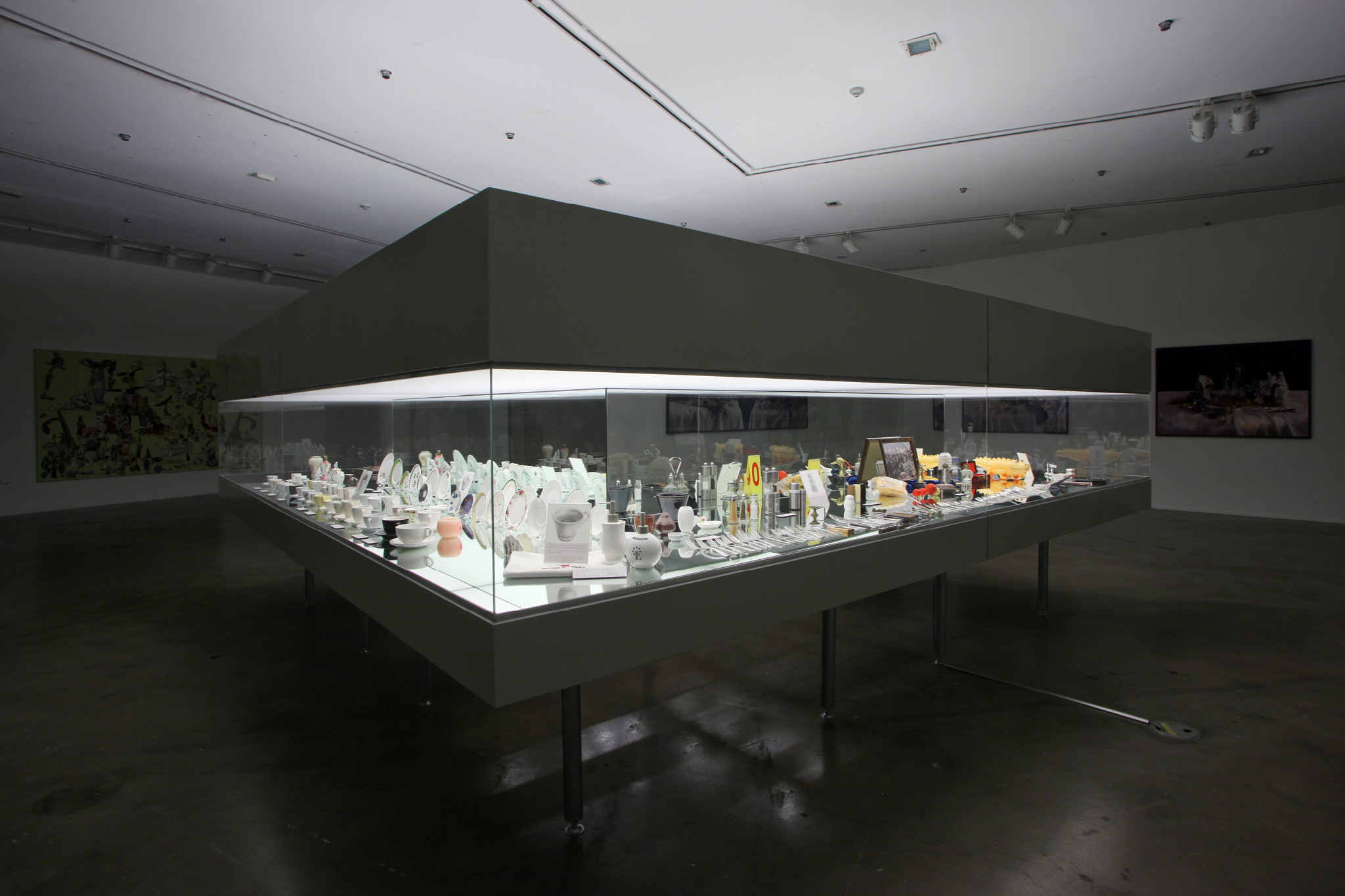
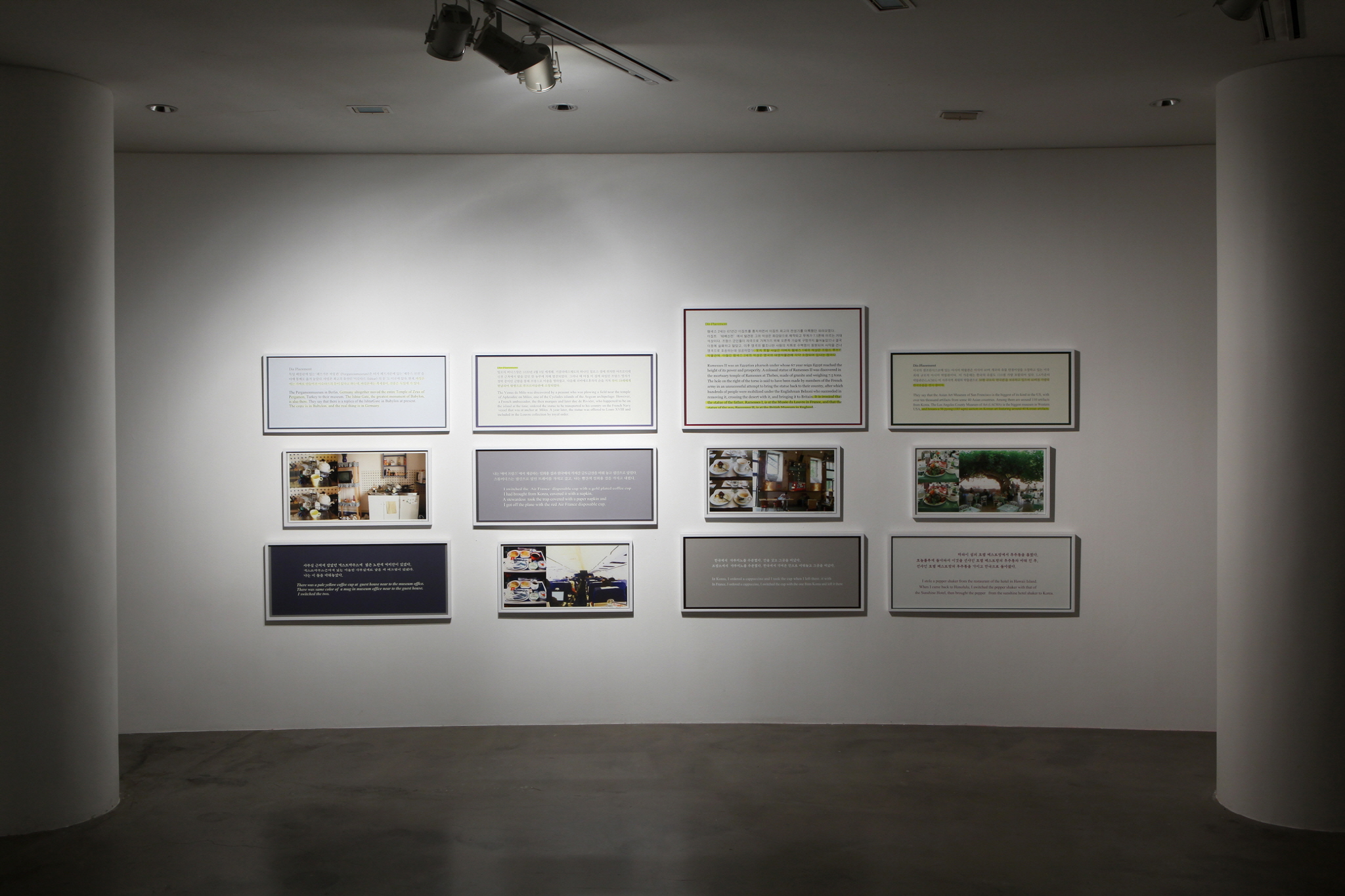
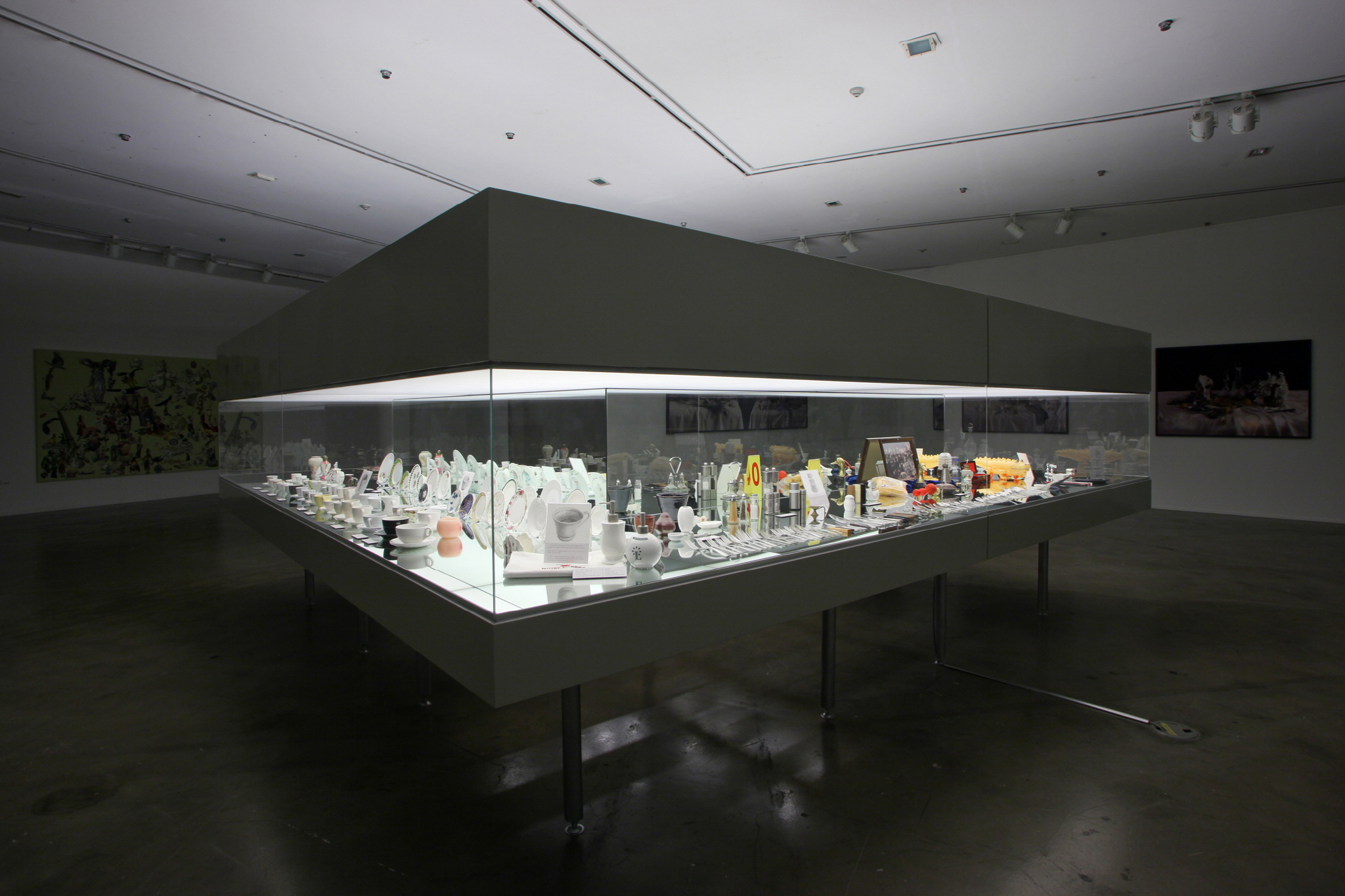
bravado and fallacy. And Ham did such an act. Her Switched Stolen
Objects Ham consists of the photographs and texts that relate to a
series of happenings in which she stole trivial objects and switched them: for
example, she stole a cappuccino cup in a café in Korea, went to a restaurant in
France, and switched a cappuccino cup there with the one that she stole in
Korea. Also in Museum Display 2000-2010 those sundry items
that she purloined during the period indicated in the title throughout the
world are displayed using exhibition engineering skills and idioms. Under these
circumstances, how silly I was to have stated above that Ham has been pursuing
truths and/or authenticity in her art. Obviously, at this point, you are now
frustrated by and skeptical about not only this writing of mine but the artist
herself as well.
Yet there is a strong paradox by which you can be rescued. That paradox has
been nourishing the art-practical and intellectual judgments of Ham who “sublimates”
illegal or futile acts into “meaningful forms of artistic consumption” and
regards “society” that has been suffering from all sorts of problematic
phenomena as “texts to read into”. First, since way before Ham stole those
object in all over the world and showed them through Museum Display
2000-2010, the powers of the world have been doing the same thing
from the times of imperialism and colonialism onwards. And you can witness the
result of what they have done in those influential museums in the West such as
the Louvre, the Pergamon Museum, and the Metropolitan Museum of Art—the great
cultural heritages of mankind. Ham’s work mirrors the mechanism of such history
and cultural politics. Having understood the background and critical insight that
motivated and is addressed by Museum Display 2000-2010, both
domestic and global art institutions have exhibited this dangerous large-scale
installation work so that the opportunity to revisit not only the specific
historical paradox but also the contradictions within the institutional system
of culture and art can be shared with art viewers.
Second, Ham’s intent can be
fairly ascertained by accepting that the passage of human desire does not
necessarily channel towards, at the level of nations and peoples or
individuals, the law-abiding and the morally and ethically good. In fact, it is
more likely that the opposite is true! This can be elaborated by, for example,
the so-called “guilty pleasure,” namely, the psychological tendency not to be
able to stop doing things that give you pleasure although they make you feel
guilty, and instead to be more seduced or tempted by the feelings of sin that
pleasure causes. Here we can figure out the “purpose” of Ham’s acts of
switching and stealing miscellaneous objects here and there. But before talking
about it, what needs to be said first is that it does not mean that Ham herself
is driven hopelessly by such guilty pleasures. Instead, what is significant
here is that the artist pinpoints such ironic, double-sided, and paradoxical
aspects of our desires. It is also meaningful to understand that
cultural-historical consequences of human activities are what her works seek to
reveal. In this respect, it should be stressed that Ham’s works themselves are
vestiges of “such/some” that are quite human but are concealed/absent in the
order of reality and the ecology of the real, where the utterable and
representable prevail in dominance.
In
conclusion, in the art of Ham the simultaneous diversification of image, sign,
text, and meaning is built on the notion of absence. After all, Switched
Stolen Objects is an artistic practice that is only possible via the
incident of the absence of objects in specific space/times. And What
You See Is the Unseen/Chandeliers for Five Cities is validly
established only when it is premised on the absence of North Korea as “the
unseen”, of the politico-social ideologies of North and South Korea, and above
all those anonymous people in China and North Korea who have been working with
Ham on the “Embroidery Project” for nearly eight years. Something, someone,
such thing, and such a one that cannot be identified as “this very thing” or
“this very person” function as imperative elements as a negative does in
photography. Yet it does not end here, not by any means. It is with these
imperative elements that made unseen that the imagination of enriched images,
the destruction and reconstruction of signs, the formation of an endless chain
of signifiers, which refuse to converge into a single signified, and the close
knitting of texts start. This series of sense-perceptual performances spark
moments of pleasure in the minds of the viewers of Ham’s art. Like the working
process of the artist, those moments, too, are simultaneously of narrow
precariousness and sober positiveness, and in this sense those moments are as
unfixable as phantom footsteps.
1.
This is the extended version of my article in the exhibition catalogue of
Kyungah Ham published in the first half of 2016. Refer to Kang Sumi, “An
Aesthetics of Some and Such: Kyungah Ham’s Unfixed Art,” Kyungah Ham
Phantom Footsteps, Kukje Gallery, 2016, pp. 7-21.
2.
There is a difference between unvisibility and invisibility. Unvisibility is
more intentional to “refuse to see” than invisibility. As the art historian
Krista Tompson argues, for example, black people are more unvisible than
invisible in the Western culture. But the “unvisibility” that I use in this
writing is different from that in Tompson’s analysis in the respect that I use
the word in the sense of the tenacious continuity of the being/situation’s
ambiguity and heterogeneity outside the gaze of the subject, beyond not
seeing/being seen by the gaze of racial and politico-cultural discriminations.
Krista A. Thompson, Shine: The Visual Economy of Light in African
Diasporic Aesthetic Practice, Duke University Press, 2015.
3.
Roland Barthes, Richard Miller (trans.), The Pleasure of the Text, HILL
and WANG, 1975, pp. 54-55.
4.
Pascal Beausse, “The Constructing the Family of Man”, The Family of the
Invisibles, Exhibition catalogue, Seoul Museum of Art, 2016, pp. 24-33. Refer
to p. 27 & p. 33.
5.
Georges Didi-Huberman, Survivance des lucioles, Hongki Kim (trans.), 반딧불의
잔존 (Survival of Fireflies), Gil Press, 2012, p. 152.
6.
Kyungah Ham, Kyungah Ham: Knock, Knock, which is Ham’s unpublished
portfolio. (All of the artist’s statements quoted in this article are from
this. Hereinafter referred to as “Kyungah Ham”), 2015, p. 114.
7.
My interview with the artist done on December 29th, 2015.
8. Kyungah
Ham, p. 84.
9.
Bourgeois’ longtime assistant, Jerry Gorovoy’s recollection.
https://www.youtube.com/watch?v=JFFWJyuda3g
10.
KANG Sumi, Aisthesis. Thinking with Walter Benjamin’s Aesthetics,
Geulhangari, 2011, p. 271.
11.
René Descartes, Discourse de la méthode · Meditationes de prima
philosophia, trans. by Choi Myung-Kwan, Seokwangsa, 1987, p. 30; pp. 77-90.
12.
René Descartes, Principia Philosophiae (1644), trans. by Won
Seok-Young, Acanet, 2012, p. 13.
13.
René Descartes, Discourse de la méthode · Meditationes de prima
philosophia, ibid., p. 86.
14.
Jerry Gorovoy, ibid.
15.
KANG Sumi, “The Politico-economics of Art and Artistic Consumption: Kyungah
Ham’s Switched Stolen Objects,” Rediscovering of Seoul Life, Hyunsilbook,
2003, p. 128.
16.
In Ham’s “Embroidery Project”, North Korea is, as a trigger of absence, the
matrix of this project and at the same time the mechanism by which all the
procedures are phantomized for the very reason that it is absent and cannot be
seen. To be more accurate, primary “absence” concerns not the absence of North
Korea as a regime or a nation but an unseen entity, an entity that evades the
lawful and the system, the process that is not permitted to be made known to
the public, and the fact that exchange with North Korea is suppressed.