Exhibitions
《Stereoscope》, 2023.07.29 – 2023.08.12, Post Territory Ujeongguk
July 26, 2023
Post Territory Ujeongguk
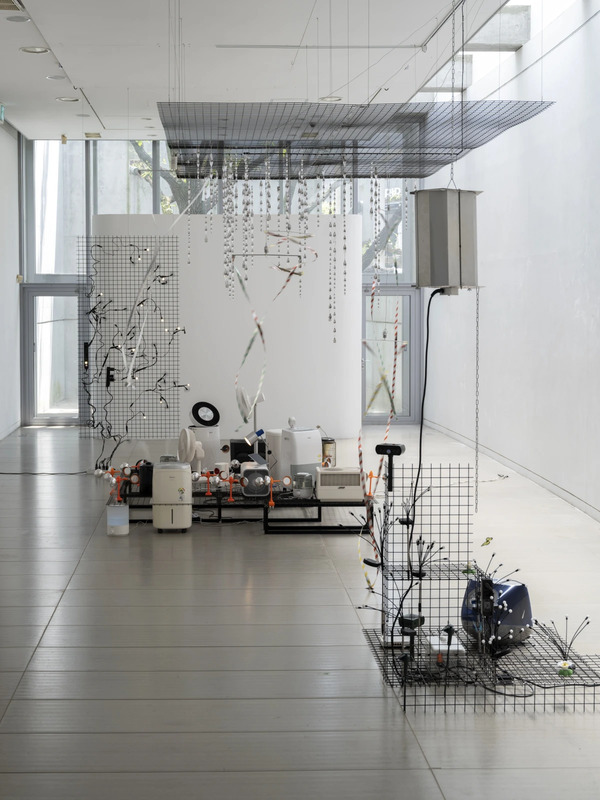
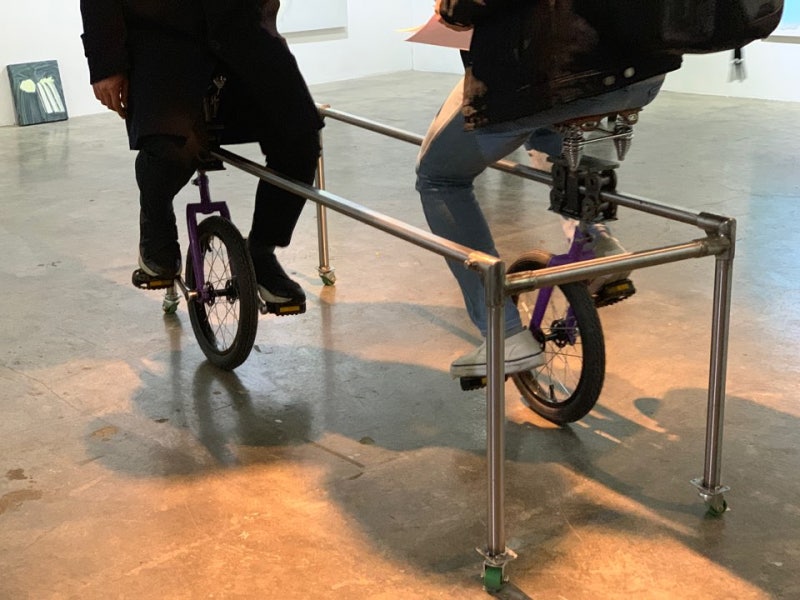
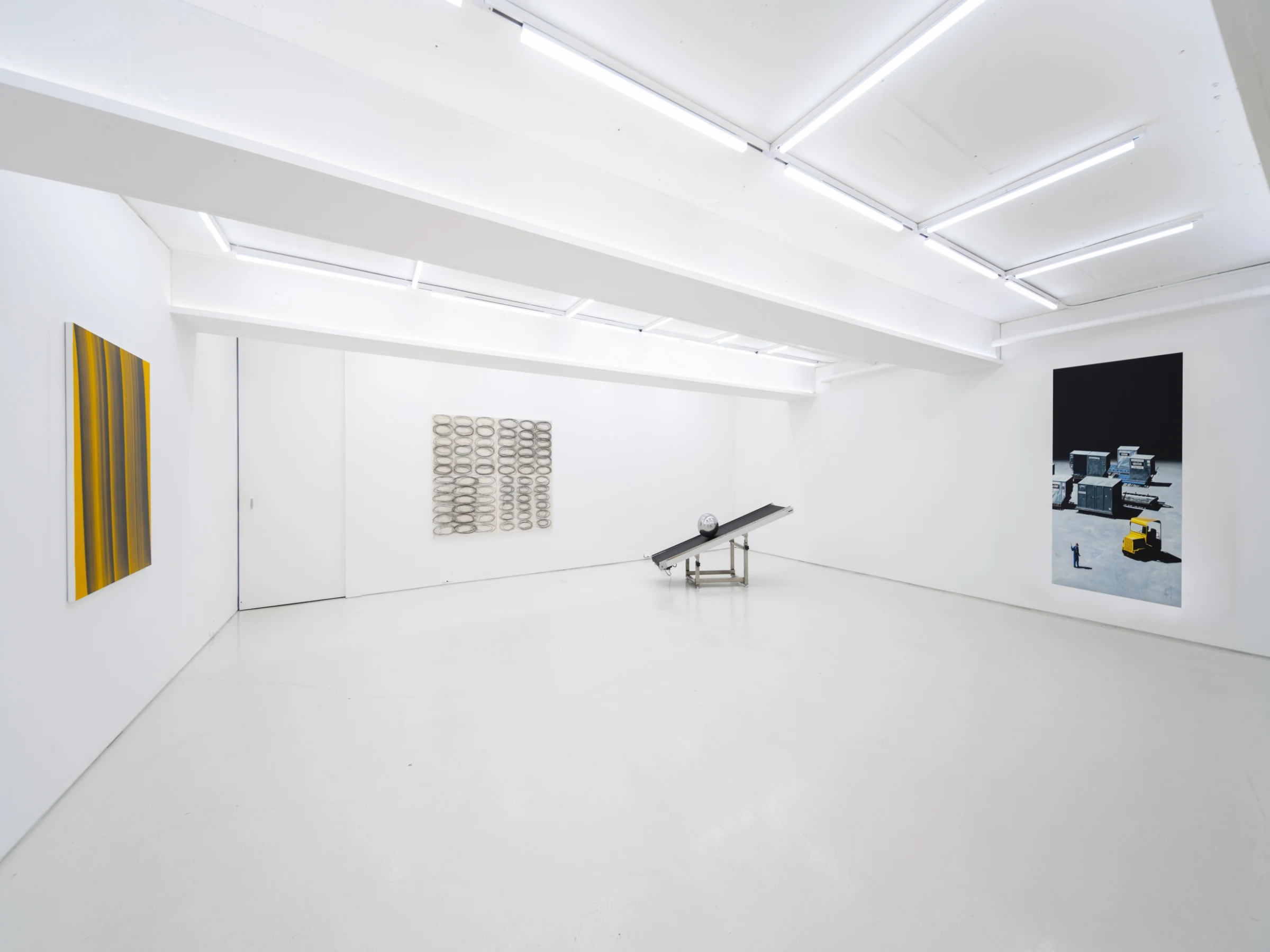
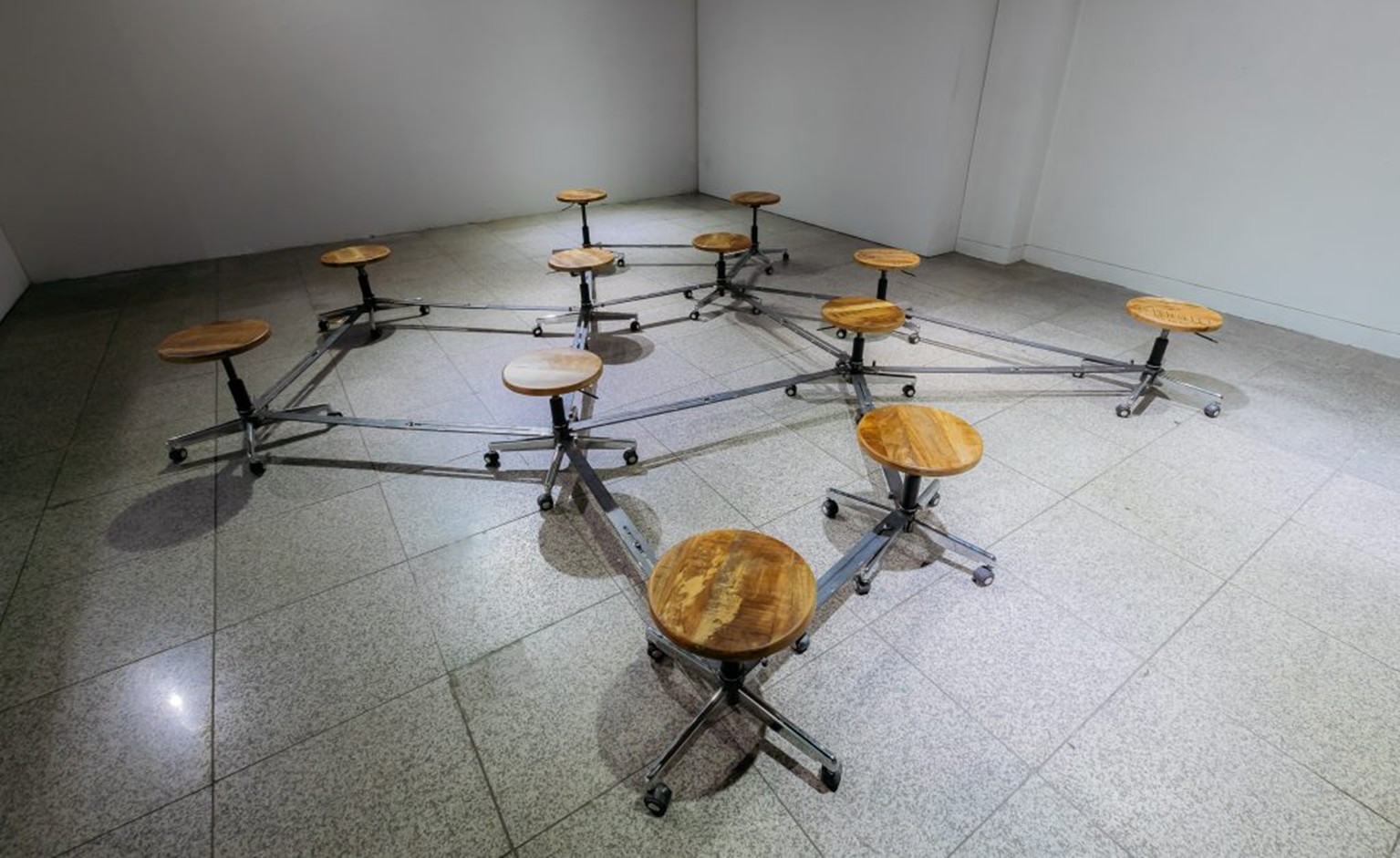
 Cho Ho Young, Moving
Walk, 2023, Mixed media, Dimensions variable ©Cho Ho Young
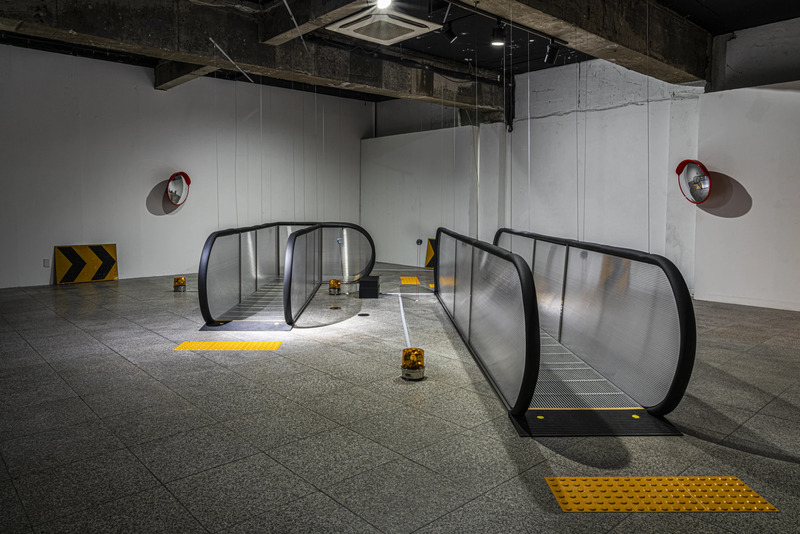
Cho Ho Young, Moving
Walk, 2023, Mixed media, Dimensions variable ©Cho Ho Young
The
“phenomenon” that appears before our eyes refers to what is perceived—that is,
an object that has entered consciousness. It is not an object that exists
independently and is confronted by the self, but rather an object perceived by
the self, in other words, an idea. Embedded within this process is a clear
tendency of humans to orient themselves toward certain things in order to
preserve their sensory nature.
Such individual structures do not allow us to
understand or see either ourselves or the world “as it is,” but instead lead us
to accept what consciousness has already composed and manipulated in advance.
Cho Ho Young seeks the essence of existence within this world constructed by
sensory perceptual systems.
This
attempt unfolds particularly from an epistemological perspective, taking the
form of inductive reasoning through the observation of experience. In this
process, the body functions as a crucial element in conducting experimental
practices of observation. Cho Ho Young’s solo exhibition 《Stereoscope》 searches for a decisive moment
in which cognitive experience is expanded into a more three-dimensional form,
building upon feedback received from participants in her previous solo
exhibition 《The Nth Ringing of the Bell》(Space Hwam, 2022), which presented learned behavioral patterns in
an experimental format.
The
exhibition title “Stereoscope” refers to a device that creates depth by
juxtaposing and combining two images. Comparable to contemporary 3D images, the
stereoscope works by presenting two photographs taken from slightly different
angles to each eye, causing binocular disparity that produces an illusion of
depth closer to reality.
French novelist and critic André Maurois once
explained Marcel Proust’s recollection—triggered by tasting a piece of
madeleine soaked in tea in In Search of Lost Time—using
the example of a stereoscope. In this sense, memory generates a “temporal
stereoscopic image” that brings together two different moments—past and
present—through the same sensation.
What, then, is Cho Ho Young’s stereoscope?
It can be understood as the artist’s “cognitive stereoscopic image,” which
captures contradictions within an object through observation and grants them
depth via a third perspective: an embodied cognitive system grounded in the
body.
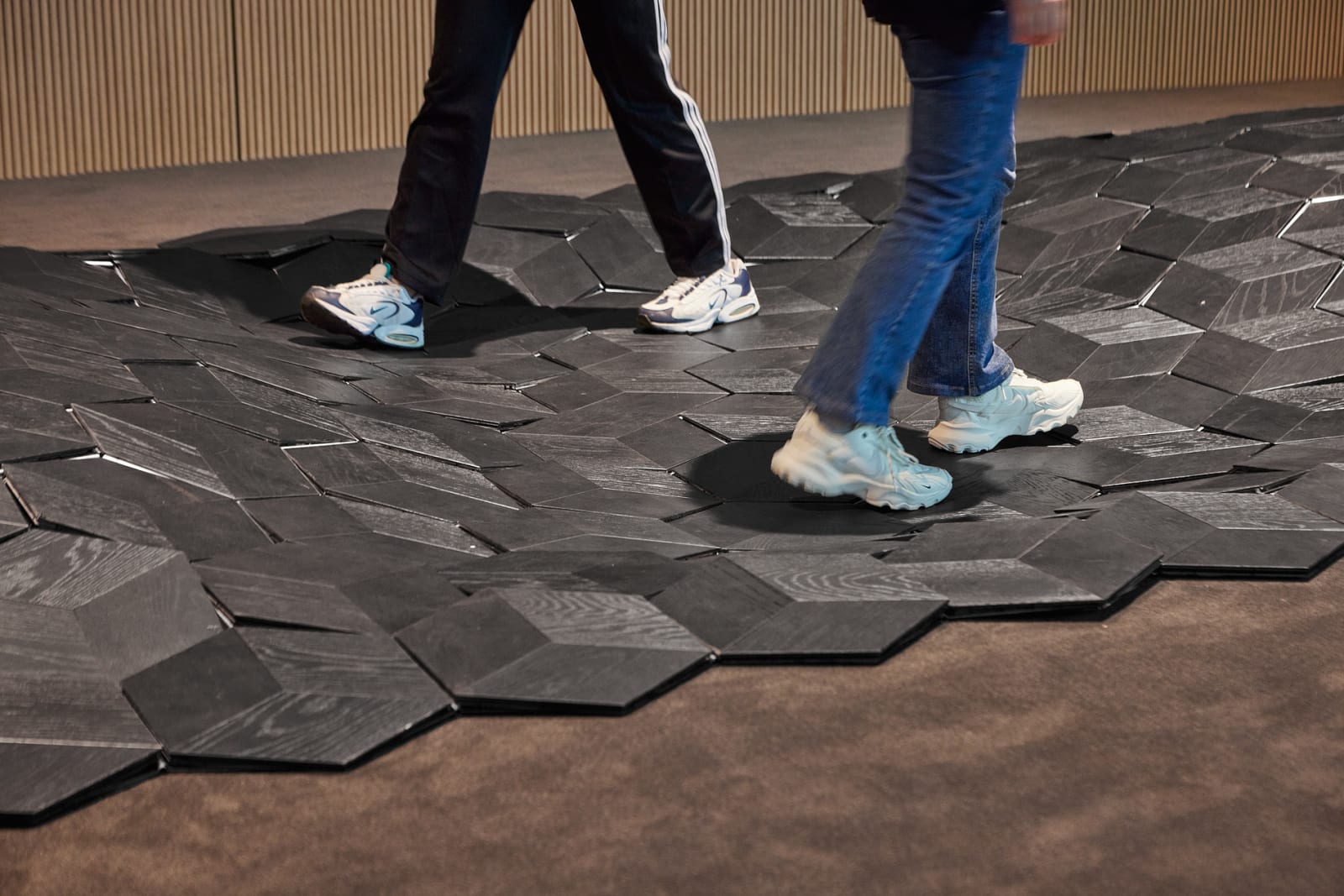
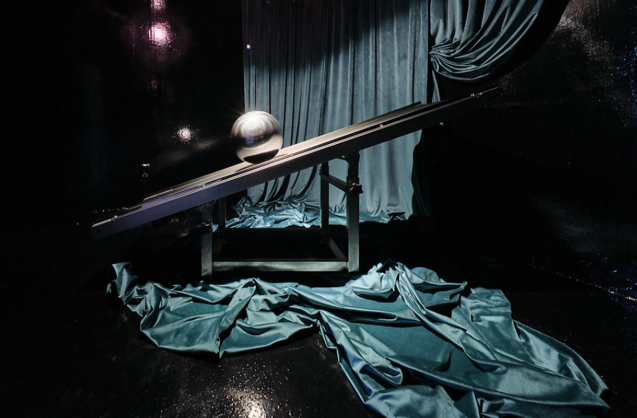
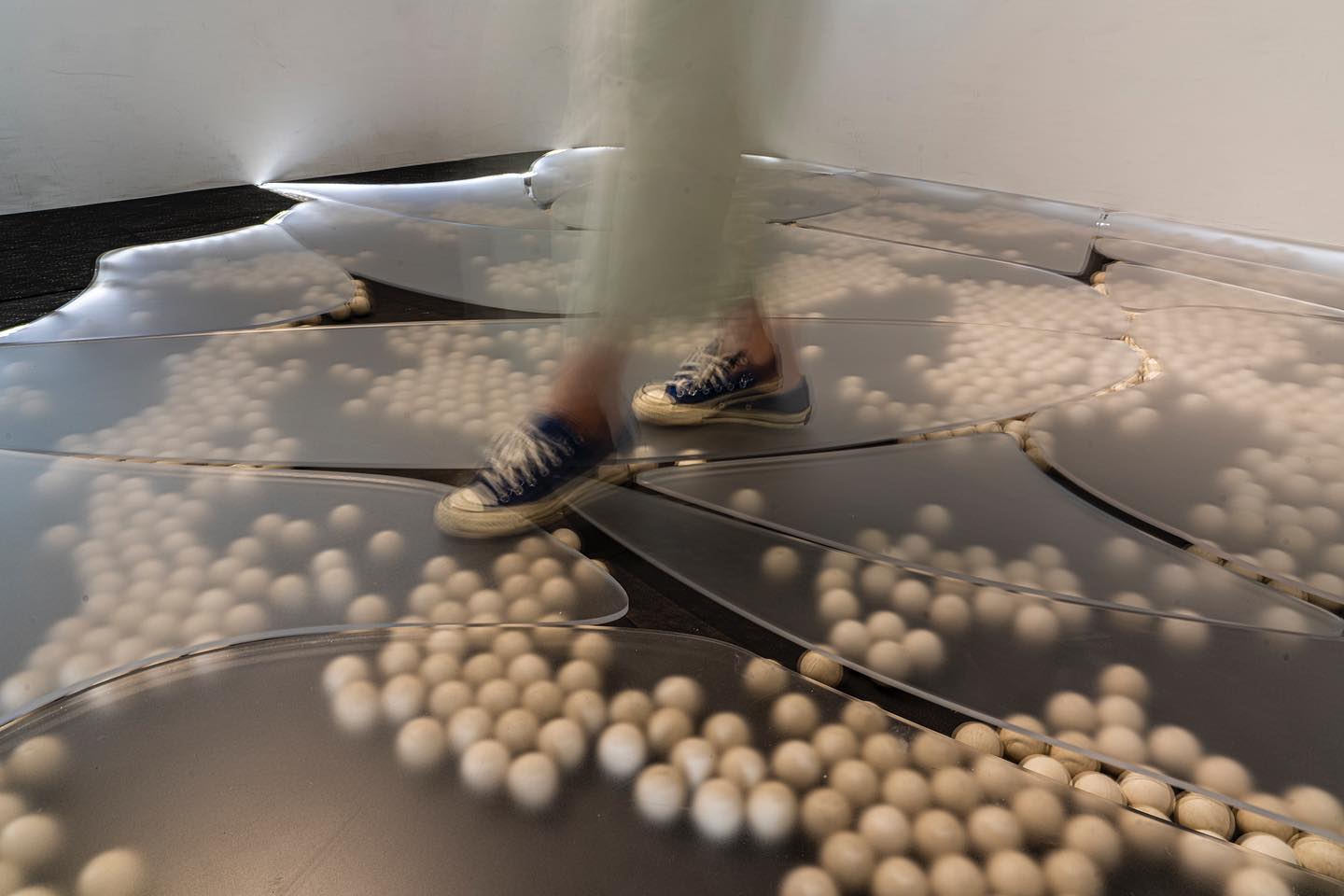 Cho Ho Young, A Patch of
Ground: Fragmented Ground, 2023, 500 Rubber balls, acrylic panel,
Dimensions variable ©Post Territory Ujeongguk
Cho Ho Young, A Patch of
Ground: Fragmented Ground, 2023, 500 Rubber balls, acrylic panel,
Dimensions variable ©Post Territory Ujeongguk
What
Cho Ho Young focuses on in this exhibition is not the content of experience,
but its structure. To this end, she dismantles the objects of everyday
experience and their associated actions, subtly twisting them to stage a kind
of theatrical apparatus. Light, sound, and materials—used to search for the
fundamental form of objects—guide the movements of viewers.
Acting like prisms,
the work’s devices assist in understanding the essence of objects from multiple
angles, dispersing established modes of perception into layers of varying
wavelengths. When the body fully senses such an apparatus environment, deeply
ingrained habitual behaviors and inertial movements are summoned, and moments
of awareness emerge through experiences that differ from expectation.
At the
precise moment when an unfamiliar sensation toward an object is detected, it is
as though the previously closed opposite eye opens, and the object’s
stereoscopic relief slowly comes into view.
Ultimately,
the essence the artist seeks is discovered through this process of sensory
reorganization. In other words, the object is experienced only along the path
of tuning the frequency of temporal gaps that arise between new perceptual
experiences—formed by questioning and doubting habitual sensory inertia,
assumptions, and the certainty of preconceived representations.
The unfamiliar
sensation of taking a first step, followed by another and another, evokes a
paradoxically familiar yet strange feeling. Through this, Cho Ho Young’s work
not only realizes fleeting moments in which objects are revealed in their raw
state—without the aid of front/back or up/down orientations—but also reawakens
our own bodies and movements, entangled as they are within ideas and reality,
illusion and presence, knowledge and experience.
Shin
Jiwon (Independent Curator)