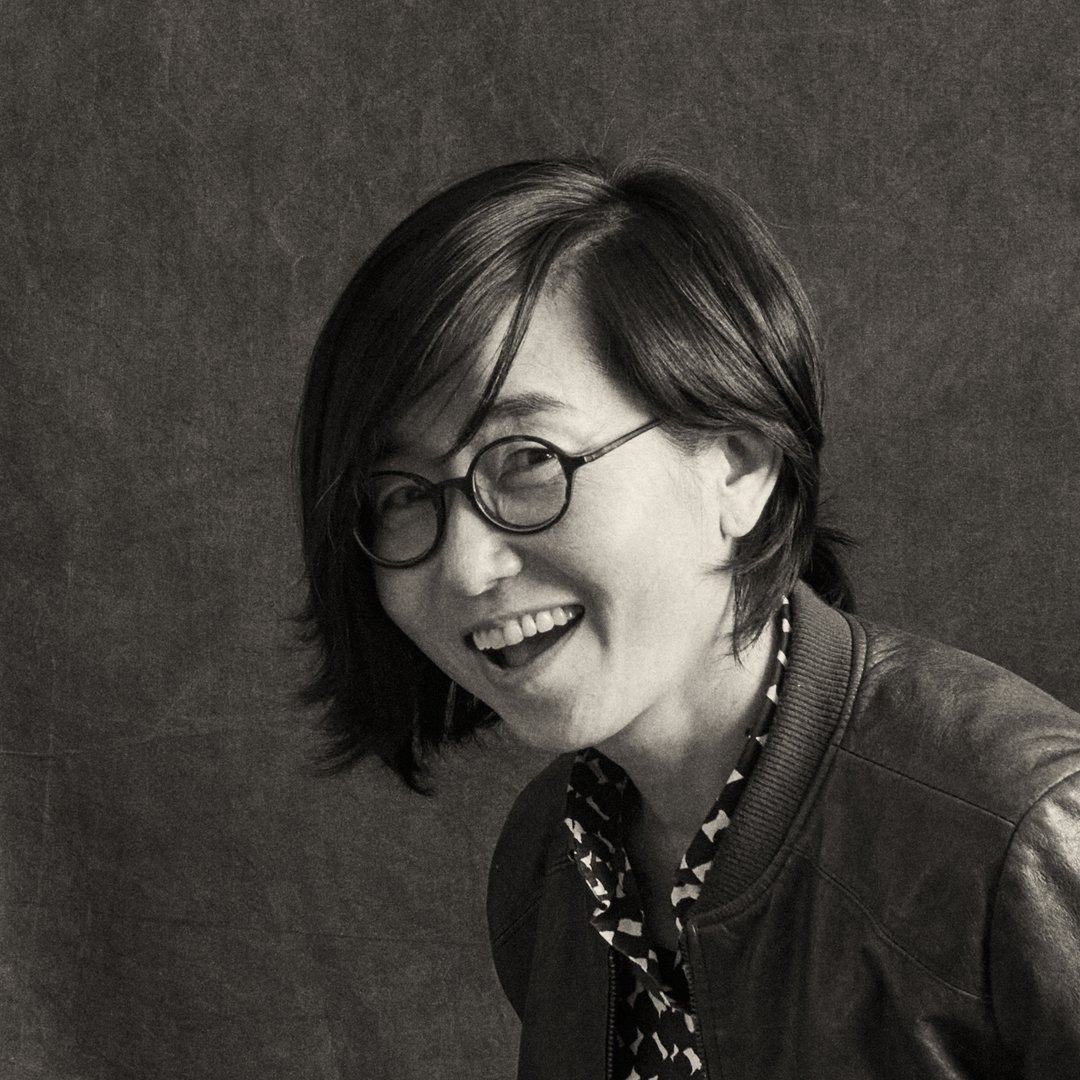
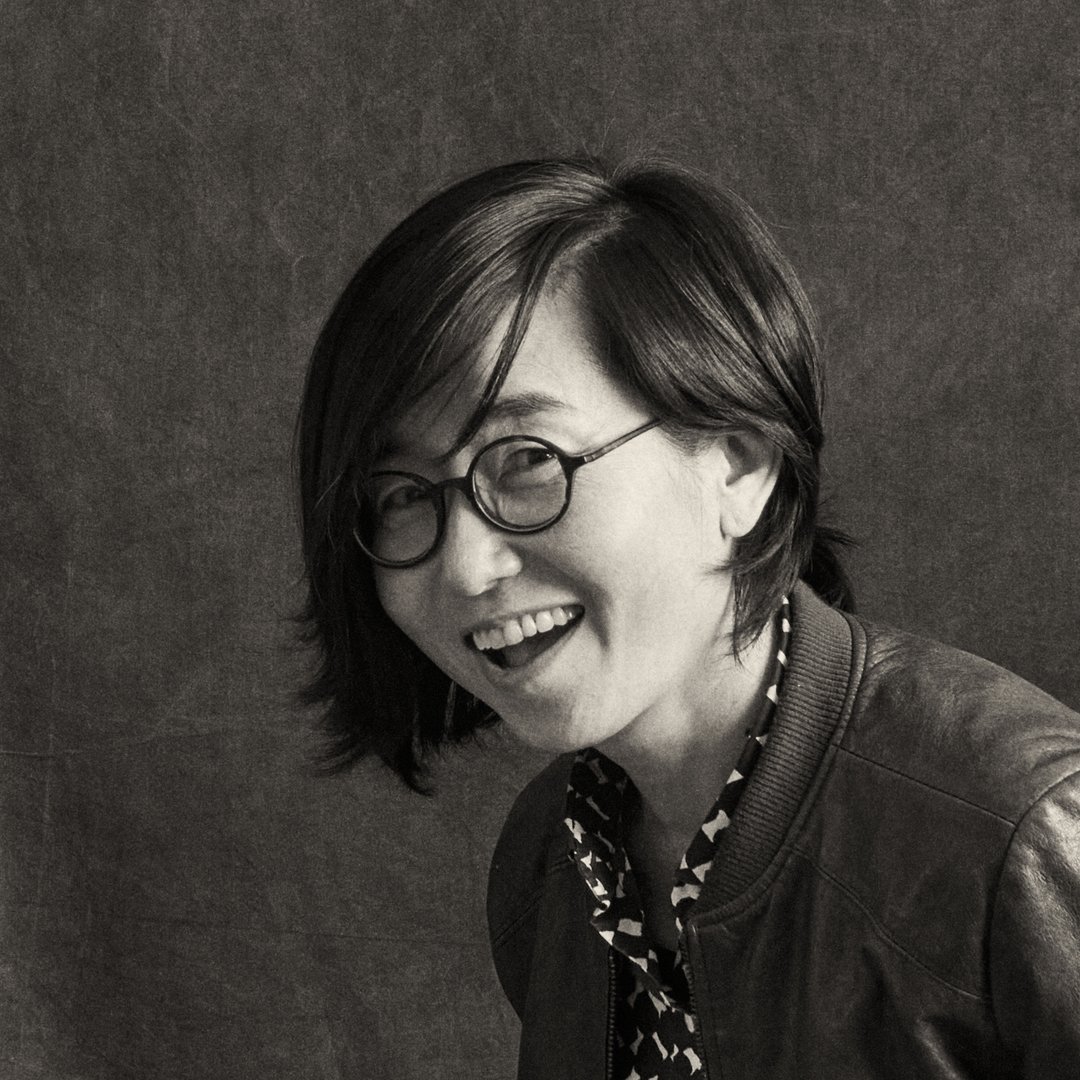
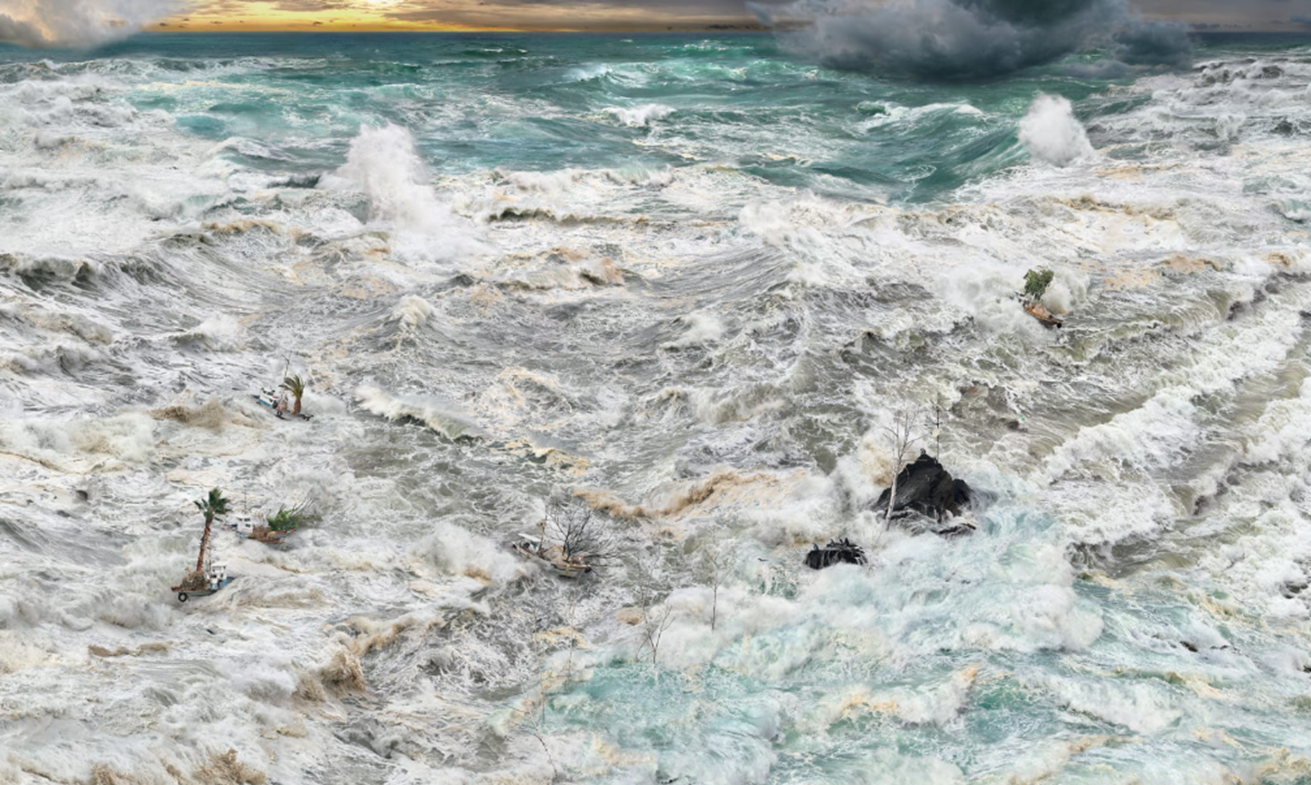
Won Seoungwon received M.F.A. from Kunstakademie Dusseldorf in 2002 and Kunsthochschule für Medien Köln in 2005. She is represented by Arario Gallery and currently lives and works in Seoul.

Won
Seoungwon’s artistic practice begins with the question, “Where do stories come
from?” Her early work My Life(1999) documented the small
objects inside a 2×4m room—pill packets, letters from her mother, socks, and
pieces of bread—through 628 photographs that were then compiled as a single
work, marking the starting point of transforming the most ordinary traces of
her life into a visual narrative. From this work onward, her interest shifted
toward “the life she can actually hold onto,” leading to a belief that a small
room, its objects, and individual memories can form an entire ‘world.’
Thereafter,
‘space and desire’ became the core axis of her practice. In the
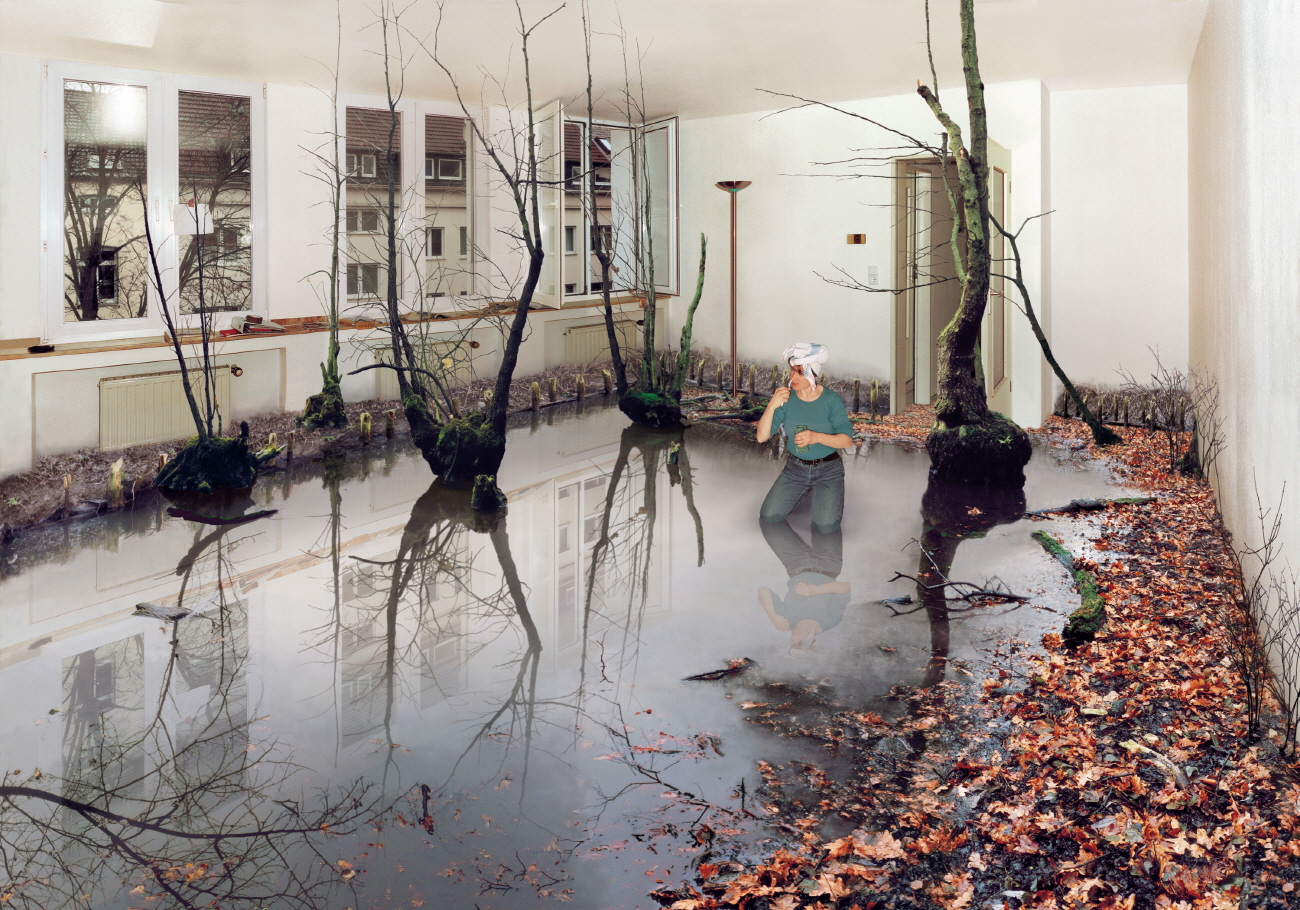
‘Dreamroom’(2000–2004) series, she traveled around the world to collect images
that construct the ideal rooms desired by herself and her friends. On top of
real one-room apartment photographs, she overlays landscapes such as swamps,
rocks, and primeval forests to construct surreal environments. Works such as Dreamroom-Seoungwon
(2003) and Dreamroom-Tina(2000) place the narrow,
suffocating spaces of reality against “the landscapes of desire lying beneath,”
foreshadowing the consistent attitude across her practice—seeing reality and
imagination simultaneously.
From the
late 2000s, her subject matter expanded outward—from herself, to those around
her, and then to broader members of society.
The Tomorrow(2008) series and the exhibition 《Tomorrow》(Alternative Space LOOP, 2008)
begin from daily episodes of family, friends, and colleagues, forming fictional
village scenes where past, present, and imagined future intertwine. The ‘Seven
Years Old’(2010) series presented in the solo exhibition 《1978, Seven Years Old》 reconstructs the
artist’s first experience of separation from her mother through her niece and a
symbolic tree, turning a personal trauma into a narrative of healing. Here, the
young niece stands in for the artist at age seven, and the tree symbolizes the
absent mother, demonstrating how rewriting one’s own life can open up a path
toward empathy.
Since the
2010s, she has expanded from personal narratives to the identities and
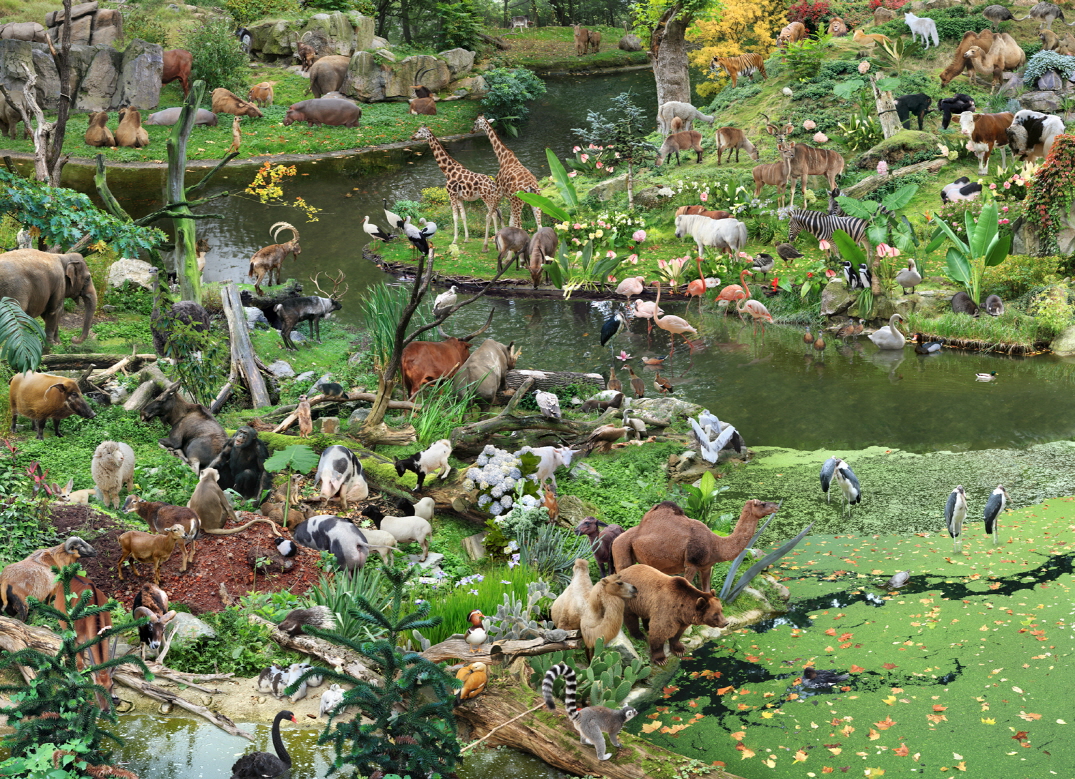
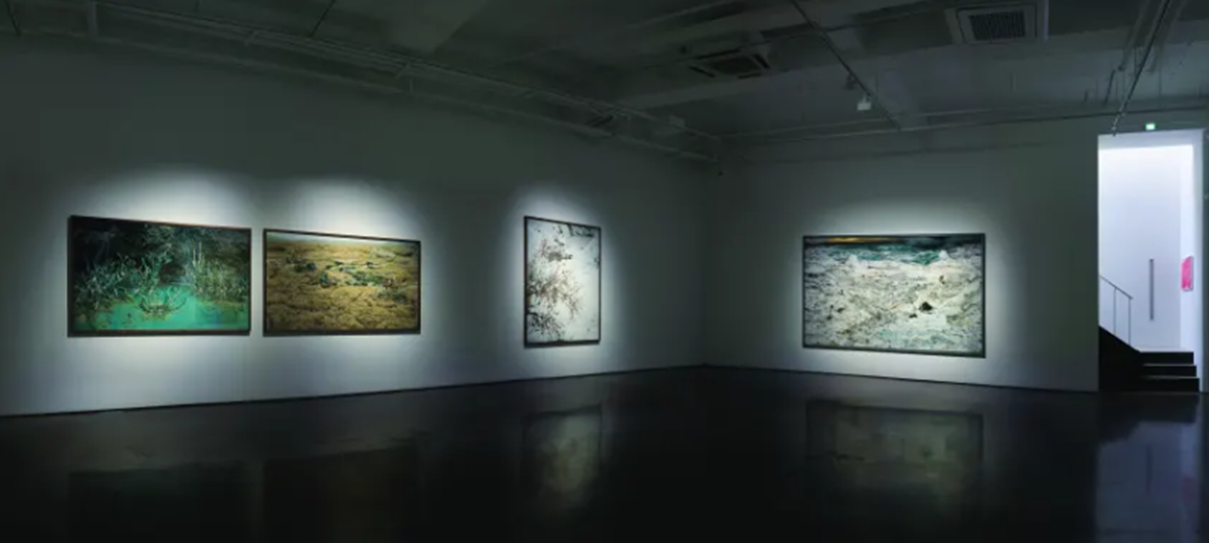
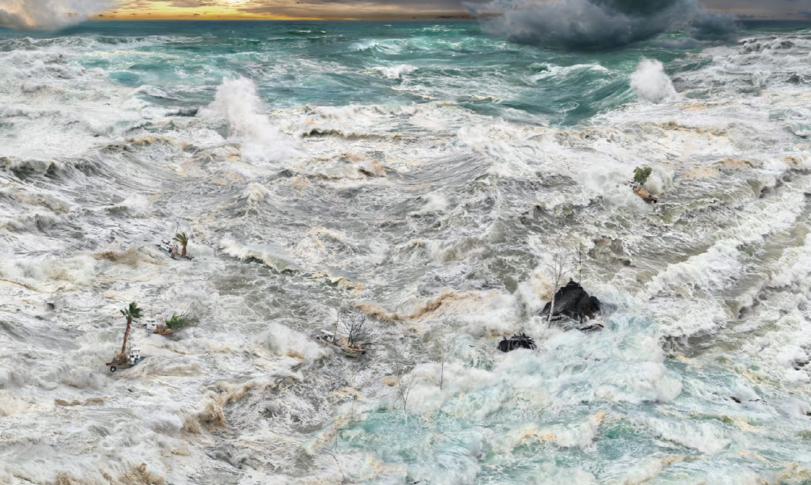
emotional structures of ‘social subjects.’ In her solo exhibition 《The Sight of the Others》(Arario Gallery,
2017), works such as The Quarries of Financiers(2017) and The
Sea of Journalists(2017) metaphorically transform specific
professional groups—public officials, journalists, financiers—into rocky
mountains, seas, or clusters of animals, questioning how occupations define
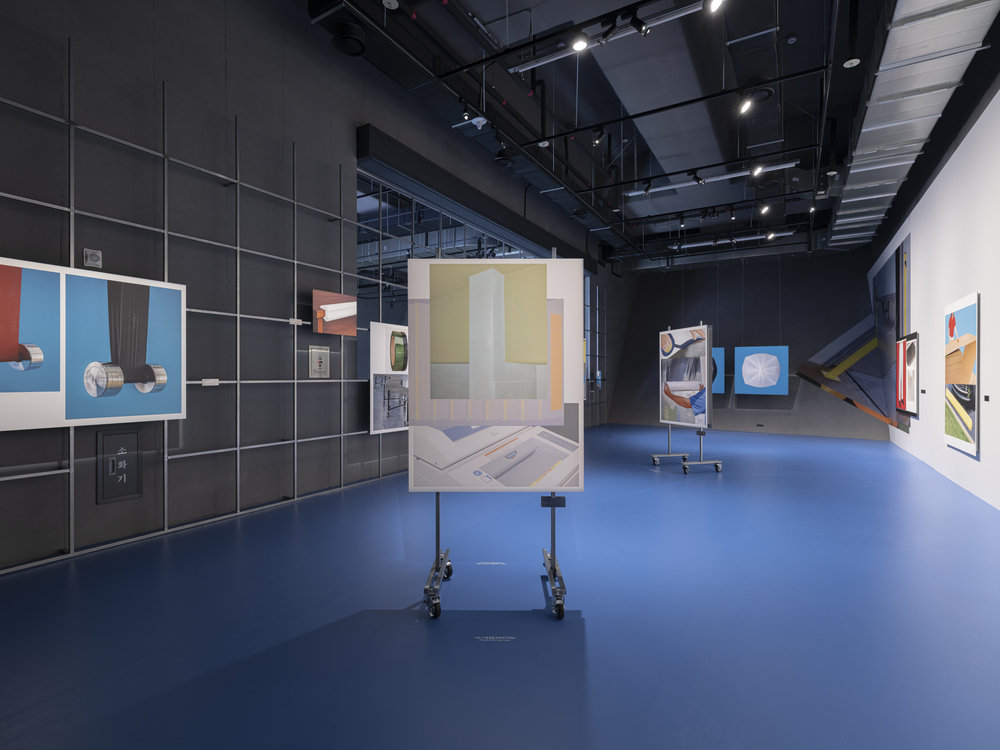
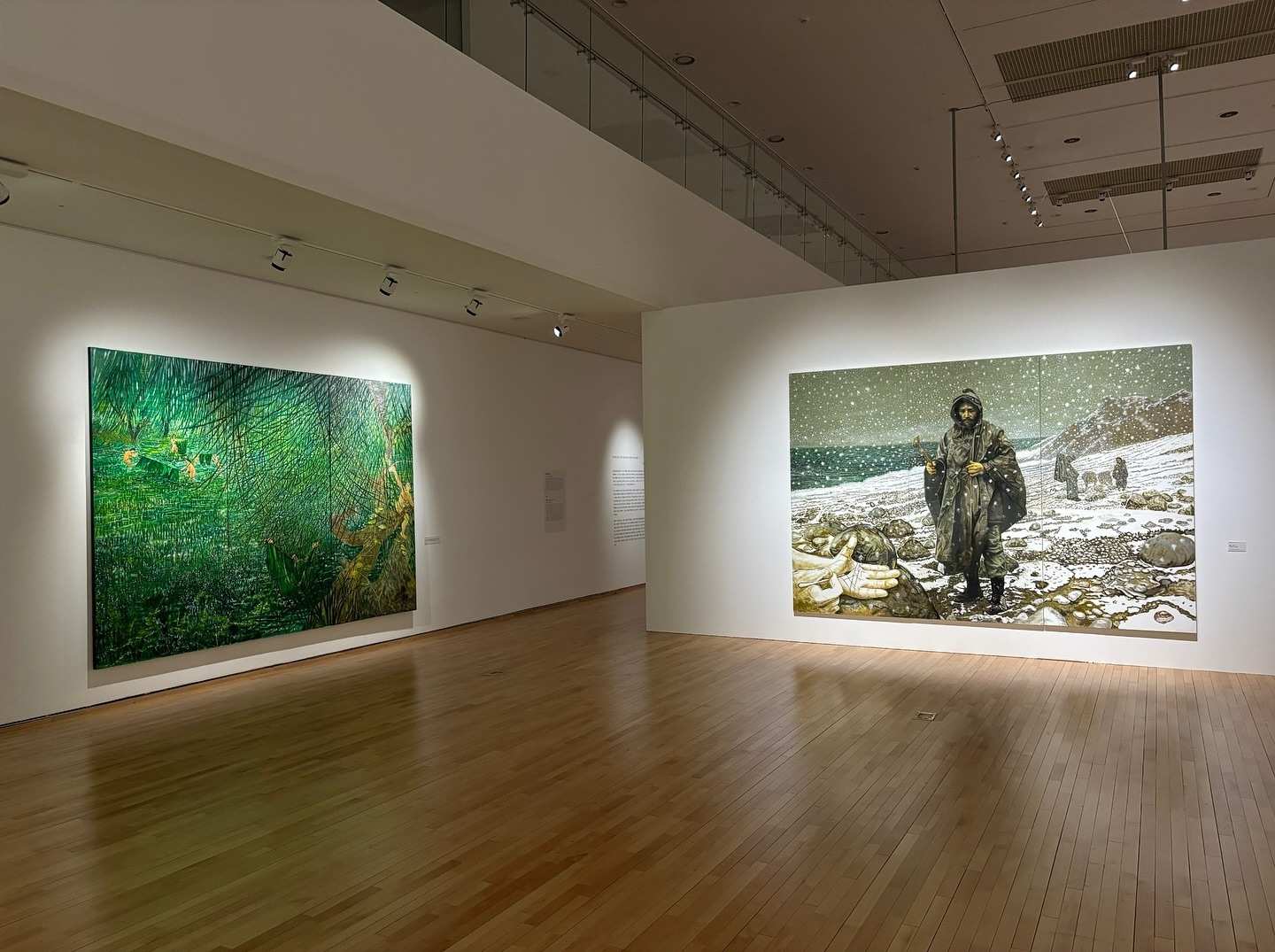
lives and identities. In her recent solo exhibitions 《Freezing
Point of All》(Museum Hanmi, 2022–2023) and 《The Inaudible Audible》(Arario Gallery,
2021), she visualizes superiority and inferiority coexisting within “successful
people,” as well as loose networks and anxious mental states, through motifs
such as icy mountains, trees, droplets of water, and ‘Ordinary Loose Network,’
thus addressing the psychological landscapes of contemporary individuals on a
more universal level.
Formally,
Won Seoungwon’s work is based on digital photo-collage, while in content it
encompasses a hybrid of painting, installation, and literary narratives. She
records subjects with meticulous precision—photographing a single tree in as
many as 60 segments—and assembles hundreds to thousands of images into a single
scene as if composing an “image novel.” While My Life
constructed an installation-like arrangement of objects inside a room, this
spatial sensibility later becomes absorbed into fictional landscapes, making
the picture plane itself a stage and a world.
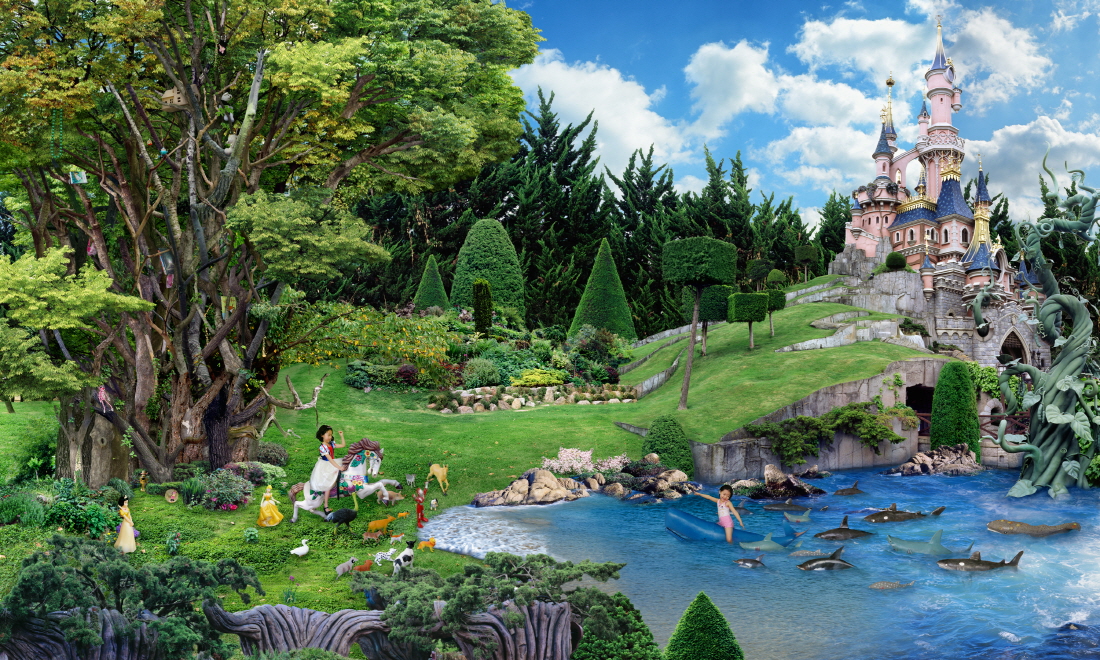
In series
such as ‘Dreamroom,’ ‘Tomorrow’, and ‘Seven Years Old’(2012), the imagery
always contains “fragments of reality we have seen somewhere,” yet through
their unconventional combinations they form worlds of entirely different
layers. Works such as Seven Years Old–The Chaos Kitchen(2010),
Seven Years Old–Azalea Boiled Rice and Chrysanthemum(2010),
and Seven Years Old–Bed-Wetter’s Laundering(2010) transform
familiar domestic spaces into psychological environments that simultaneously
hold anxiety and comfort, through excessive objects, flora and fauna, and
strangely scaled elements. The narrative is conveyed without text, with each
scene composed like a children’s story—carrying emotional rise and resolution.
Over time,
her collage approach has evolved into more complex and increasingly abstract
forms. In 《The Sight of the Others》, the barren rocky terrain, naked trees, sagging electric wires, and
lightbulbs in The Quarries of Financiers symbolize
professional desires and insecurities, and the circulation of capital.
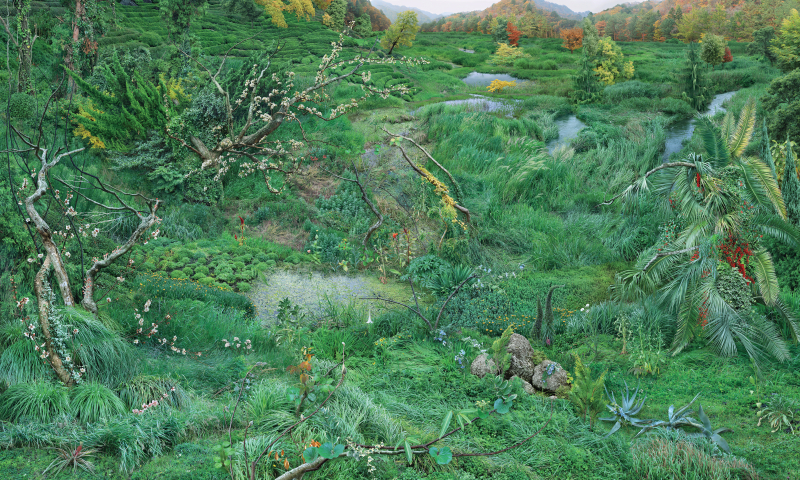
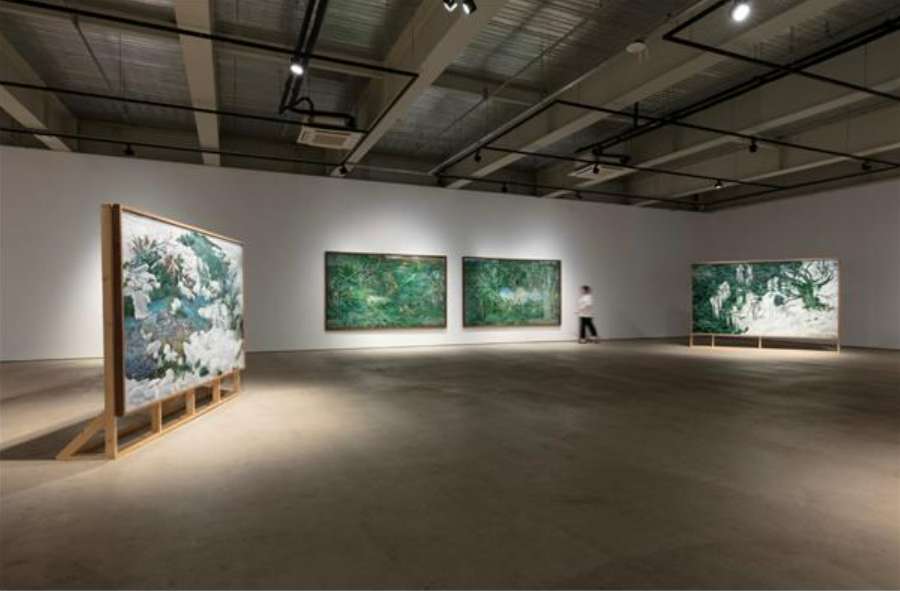
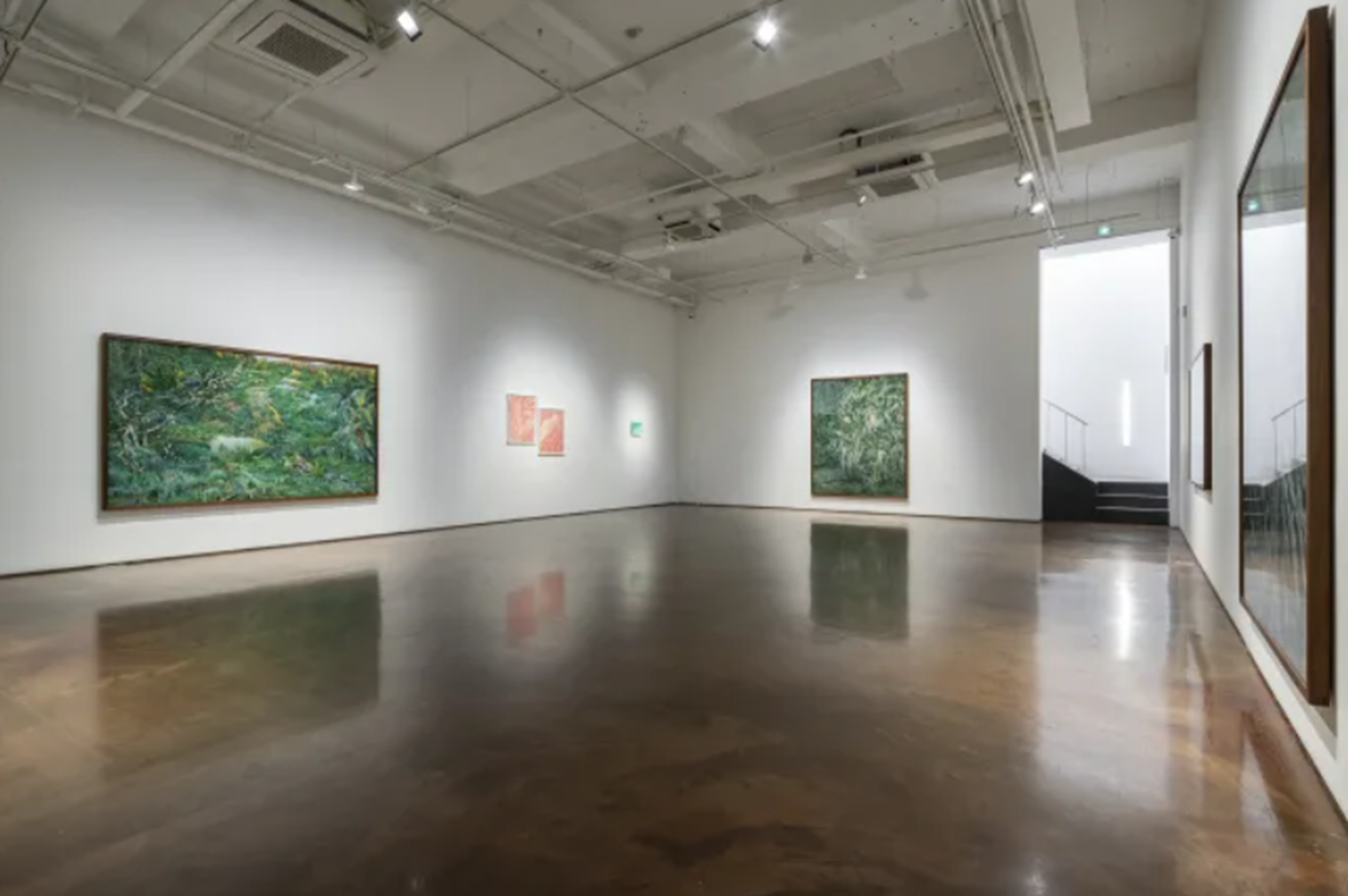
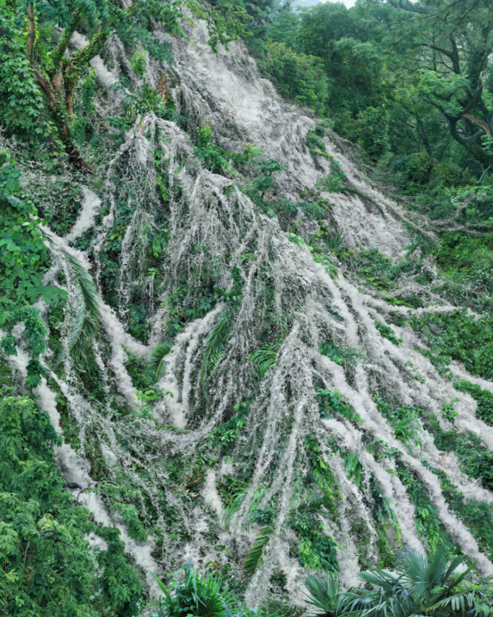
Meanwhile, works such as The Grass That Used to Be There(2022)
from 《Freezing Point of All》
and Grand Waterfall(2021) and Ordinary Network(2021)
from 《The Inaudible Audible》no
longer reveal specific figures or occupations directly. Instead, motifs such as
ice, droplets, branches, grass, and loose networks metaphorize “poorly handled
inferiority,” “fragile bonds,” and “willpower that grows even in frozen conditions,”
shifting the content toward psychological and emotional planes.
The
distinct sense of estrangement in her compositions stems from technical
decisions. Although based on real landscapes, the scenes are never taken in a
single shot but stitched from many segments with slightly mismatched
perspectives and vanishing points, producing “impossible landscapes.” The near
absence of shadows flattens the image, yet within it coexist multiple times,
seasons, elevations, and distances simultaneously. Tens of thousands of shots,
thousands of selected elements, and thousands of hand-crafted layers—along with
up to ten hours of daily labor—reinsert analog temporality and physicality into
a digitally constructed medium. In this way, form and content are inseparable:
as she describes, “it’s not the forest, but the story of each tree”—the forest
in her work is not a natural sum, but a fabricated relationship formed by
thousands of edited fragments.
Won Seoungwon has established a distinct position in contemporary
Korean photography and image-making by merging staged photography with
narrative-based imagery. Within the strong documentary tradition of Korean
photography, she has built a unique middle ground of “fiction grounded in
reality” by capturing real objects and landscapes and reconstructing them into
newly imagined worlds. Over the past 20 years since My Life,
her work has demonstrated that photography can exceed documentation and become
a psychological and narrative space.
This approach is reflected in her recognition and institutional
presence. Through solo exhibitions such as 《The Sight of the Others》, 《Freezing Point of All》, and 《The Inaudible Audible》, she has examined the
lives of social others, her own childhood anxieties, and the inner structures
of the successful. She has been selected as the recipient of the 23rd DongGang
Photography Award in 2025, establishing her as a key figure in contemporary
Korean photography. Her works are housed in major Korean museums—including the
National Museum of Modern and Contemporary Art, Seoul Museum of Art, Gyeonggi
Museum of Modern Art, Museum Hanmi, and GoEun Museum of Photography—as well as
international institutions such as the Osthaus Museum (Germany), Santa Barbara
Museum of Art (USA), and Mori Art Museum (Japan), enabling diverse
interpretations of her work across cultural contexts.
Her practice holds strong potential for broader international
reception, thanks to the universal resonance of her themes—superiority and
inferiority, anxiety and relationships, profession and identity, childhood
wounds and adult self-understanding. At the same time, the dense symbolic codes
drawn from Korean professional structures, social systems, and familial
dynamics maintain a grounded locality. It is anticipated that she will continue
to develop “expanded narratives dealing with social subjects, collectives, and
psychological structures,” persistently generating new scenes at the boundary
between reality and imagination.
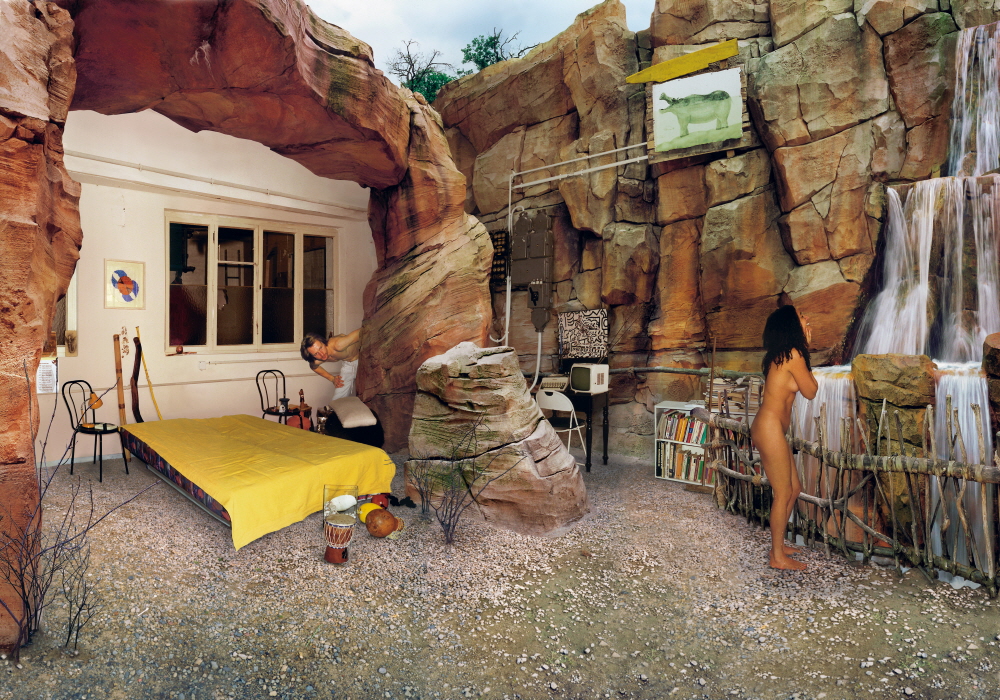 Won Seoungwon, Dreamroom-Eliane
& Fabian, 2001 © Won Seoungwon
Won Seoungwon, Dreamroom-Eliane
& Fabian, 2001 © Won Seoungwon
In
'dynamic' Korea, everything changes so rapidly that nothing can be properly
perceived and remembered before it is gone already. This perhaps explains why
the images in Won Seoungwon's 《1978, My
Age of Seven》 (2010) and her other works evoke
such great feelings of nostalgia. It is obvious that Won recently collected the
images from all over the country, but they are reminiscent of the scenery and
atmosphere of the 70s, when the artist was a child.
The collage of dwellings
and living environments required a great deal of time and effort by Won, and
they are disappearing at this very moment. The atmosphere she creates is nearly
a world away in time and space. The past and present become an archive, revived
as cells in the scene of an unknown place and breathe. Won's works are a montage
of discontinuous fragments of space-time, and they are so vivid and fresh that
they could easily be taken for a real landscape today.
She collected all the
disparate images in her works with collectomania's enthusiasm from all over the
country, and they seem entirely appropriate in their proper places in her
landscape, filled with symbols of the yearning and hope, the dreams and
adventures, and the pains and frustrations of her childhood. The more
intense the meaning of a symbol, the greater the density of images of her
landscape composition. Tacit things such as narrow alleys, shabby houses, a
tiny vegetable garden, and a poor neighborhood shown in her virtually produced
spectacle exude strong feelings for humanity.
Distant
scenery and times past put travelers on the journey of life at ease. However,
even if the gap in space-time can be bridged, a childhood incident cannot be
forgotten. This childhood incident, which Won cannot forget, is everywhere like
a wound. What coiled up in each and every scene are empty holes and cracks
demanding to be filled and cleared through endless deciphering and
interpretation. Although the accident that deeply traumatized the artist
actually happened on a certain day of a certain month of a certain year, the
truth is of a more fundamental dimension.
According to psychology, trauma
starts with experience of birth. The event of meeting one's mother after being
perfectly protected within her womb itself becomes a source of successive sufferings
with a storm of excitement beyond capacity and all traumas one inexorably
experiences in life afterwards. The traumatic moment Won focuses on occurred
when she was seven years old. She had to be separated from her mother, who had
been a part of her, in order to enter the symbolic structure of society. It was
then that little Won Seoungwon was left alone as her mother, a daughter-in-law
of a head family, entered the workforce.
Won
says that her memory of the year when she became seven years old is especially
strong. She recalls earlier and later times much more vaguely, but
remembers events from that one year in the most trivial detail. These events
left strong marks on her body and soul, and her works have been her means of
healing and reconciliation with her past. Her work involves difficult processes
repeated over and over again, through which Won communicates with others, be
that other people or her higher self.
In Won's works, the most private is the
most universal. Her early work My Life(1999), which is
related with her recent works, was produced out of desperation to review
everything she owned one by one in her 2x4 meter room when she underwent the
crisis of having to discontinue her studies in Germany. My Life(1999),
an installation consisting of 628 photos of everything she had in her room and
related memos, pushed Won, an artist who had studied sculpture in Korea, to
switch from large conceptual works to smaller but inner-reaching works.
After My Life(1999), she did works exploring
cause-and-effect between space and the individual.
The ‘Dream
Room’ (2000-2004) series was produced like a photo shoot of a dream of
people’s desires in modern society who all live in a
small, box-like places. A room of Won's friends changes into a space where
their desires are projected: the small room transforms into a big room. It also
emphasizes that space is an extension of the human body and that the soul
resides in the body. ‘Dream Room’ is a space where an individual’s psychological issues or illnesses are healed. The ‘Tomorrow’ (2008)
series includes virtual landscapes comprised of incidents that actually
occurred and the main characters involved in them.
To switch to drawing and
photography from sculpture and installation was to shift from a macroscopic
dimension to a microscopic dimension in terms of contents and form. Increasing
the density and intensity of a work will cause concreteness and uniqueness to
come into confluence with universality and generality. Despite the fact that
Won uses digital language characterized by unlimited copying and speed, the
creation of her work is extremely labor-intensive, much more analogue-like than
even analogue itself. She can produce only ten pieces in two years.
The
scenes mingled with facts and illusions are impossible to separate and may be
painted. However, Won intends to use index characteristics of photography
to guarantee reality and truth in her work, though drawing is as important as
photography. Her drawings are often exhibited along with her photographs for
this reason. She makes countless alterations to her photography, but she does
her drawings at once and reveals the process of bloody conflict between
consciousness and unconsciousness very vividly. Her drawings are more
straightforward than her photographs connected with metaphor and metonymy.
When
drawing, her mind and hands are connected directly and do not make many
corrections. Her work on dragons, which combined all the dragons that appeared
in her dreams when she was preparing to hold a solo show, and works that depict
the helping hands of family members whether they were close to her or not
strongly reveal dreams and unconsciousness, and reality of memory. Photography
starts with an intention, while drawing provides an opportunity to trace back
the intention. Whatever the case, the end result is not yet decided. Her
scrupulous work aspires to wholeness, but this wholeness is open to countless
possibilities.
The
long journey to find things and scenes in reality begins when an idea sketch is
done. Then, the hundreds of scenes collected by the camera during the journey
are assembled as an exquisite collage. Like the 'found objet' of surrealists,
there must be moments when thing are found that embody the artist's intention
and desire, with numerous coincidences and inevitabilities having been crossed.
It is in the gaps of space and time that otherworldly things are created with
such great effort, and though they are otherworldly, they were born from
reality.
It is not easy for Won to find necessary things amid such indifference
in society where everyone goes about his or her own business without a care
about anything else, even though she started with a purpose and scenario.
Fortunately, she only tries to find things that are ordinary, not novel. Daily
life is structured into a new event. Elements of incidents in the past and
facts in the present are combined and manipulated to produce new incidents in
the past that are not fixed immovably. Causal relationships or
chronological time and successive space are fragmented and reedited as images
of uncertain creation.
Incidents which cast shadows on Won's work are such
episodes in reality and at the same time psychological incidents. And, meaning
and location of the present, which are moved out of context for reprocessing,
also vary. The past and the present are open to the future. As such, the next
scenes are not determined like rolling dice.
Although
there is a skein of thread here and there to trace the way through a maze on a
little girl's journey to find lost things, her destination is as uncertain as
her starting point. Like a garden in Borges's novel in which forked roads
frequently appear, it is possible to make simultaneous selections rather than
choosing one road or the other. The road is structured into context every time,
reinterpreted and rewritten, and moves towards the future in a different way
each time.
Even a single incident that cannot be forgotten unfolds into a
pluralist universe in which the single incident can be replayed in many
different variations. Symbols within space-time which is structured into a new
context, do not mount clear answers that should be deciphered, but serve as
momentum for questions to be raised successively. Riding on tortuous ranges of
life confronted like a rootstock, her story branches endlessly towards an
unknown direction. This is a dimension of art, which is unlike science or
history. This flexibility and variability of art differs from a strategy to
find a solution through accurate reproduction.
Despite all the efforts Won has
made, her fundamental incident and wound are not solved or cured, because fear
of injury is the other side of desire that should not be fulfilled after all.
Only seeming reality where the past and the present come together, which cannot
be defined as either reality or fiction, shows itself. Won maximizes the
possibility of choice and discovers freedom in it by finding potential in
reality, dividing the potential into endless fragments, and reassembling
them.