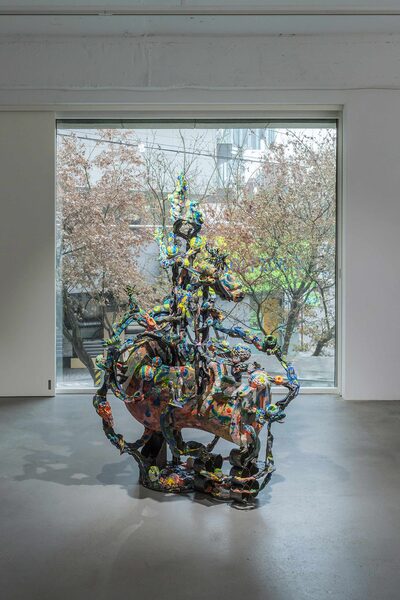
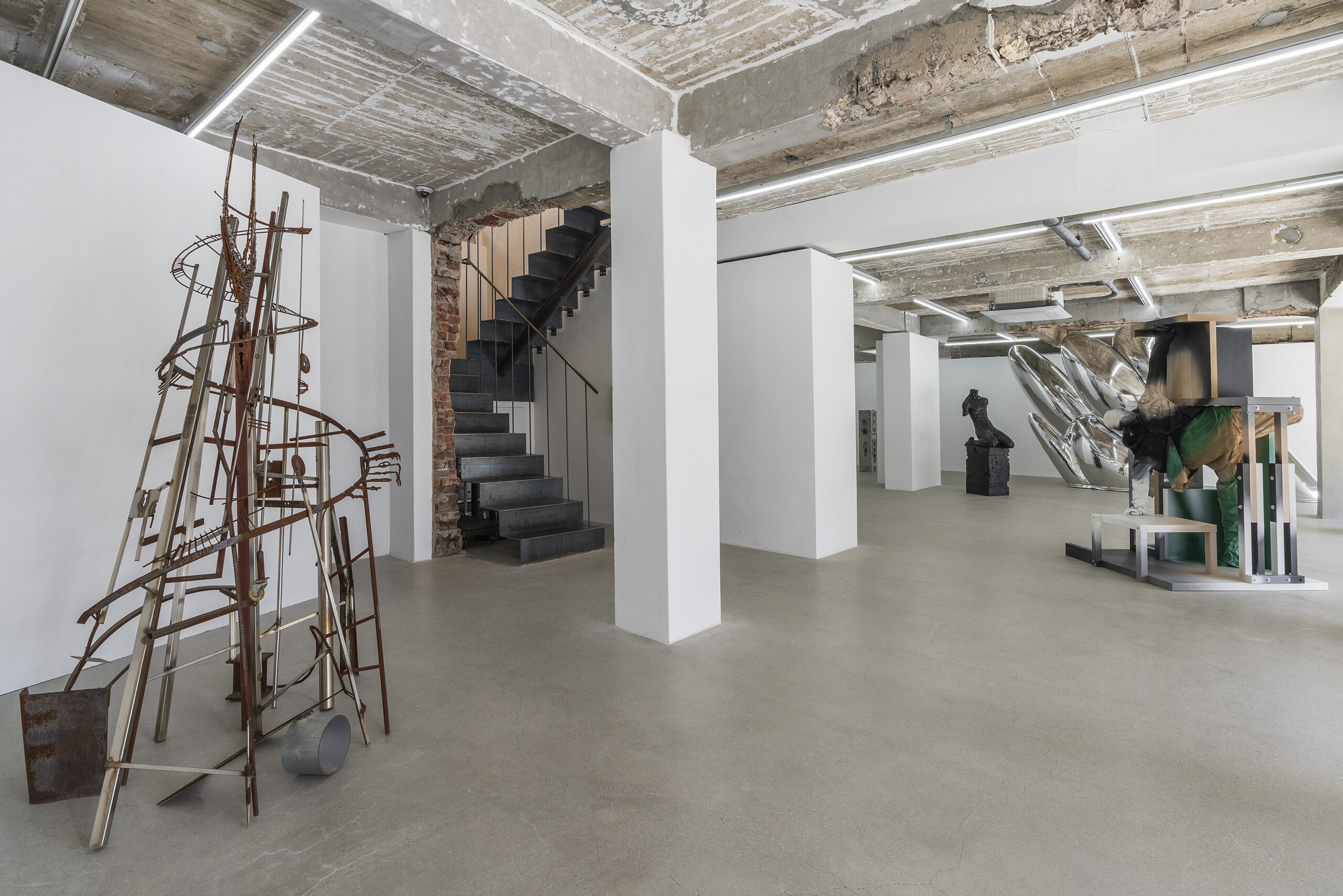
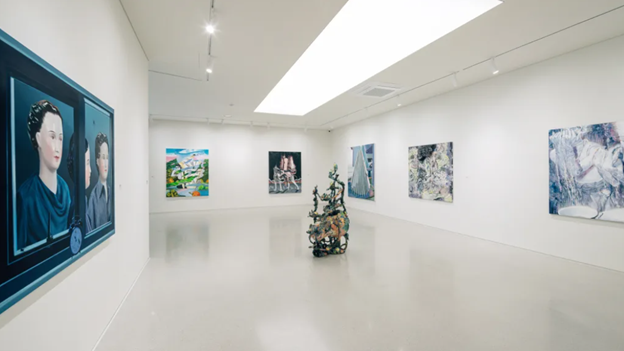
Installation view © Ulsan Art Museum

The following introduction is a modified version of Injury Time1, based on which this exhibition was entitled. Here’s to imagining a world in which a not-yet-finished past determines the spatio-temporality of the present, and things that have already happened can be reversed.
 
‘Injury time’ is a sport term that is a synonym for “additional time:” in soccer, it refers to the same amount of time taken up to address an athlete’s injury being added after the official game time has been depleted. This exhibition, based on the premise that contemporary sculpture is poised on the brink of an “injury time,” questions which injuries this time was given in return for and how the extra time can be used for a productive purpose (or to reverse the current situation).

Is contemporary Korean art, which explored new options through the medium of Western art and then experimented with “re-Koreanizing” such Western influences, an irreversible injury for artists today? Or, has such experimentation produced meaningful outcomes that will help artists of the 21st century to find a way out of their trapped-in state? Are the similarities between the artworks of (Korean and Japanese artists) Na Haesuck and Kume Keiichiro, Gu Bonung and Satomi Katsuzo, or Kwon Jinkyu and Shimizu Takashi disgraceful? If Kim Bokjin’s Standing Woman (女人立像) (1924) was modeled on Auguste Rodin’s Eve (1881), and Choi Manlin’s Eve (1958) referenced the works of Germaine Richier, are the Western-influenced Korean elements of Kim and Choi’s work invalid?

《Injury Time》 observes contemporary sculpture as the physical traces of a particular historical period and questions the type of relationship that these sculptures have with the past as well as the inconsistencies that occur from this relationship. It defines “extra time” as the hybridity and ambivalence of today that was created by an injury (or exaggerated sense of injury) from the past and suggests a new role for sculpture as agents of reversal in a spatio-temporal environment in which nothing is off limits anymore.

Installation view ©Museum Head

The exhibition begins from the methodologies of replication and exclusive ownership that are found in contemporary sculpture. Kang Jaewon, Kwak Intan, Oh Eun, Lee Choonghyun, and Choi Taehoon have, each in their own way, journeyed through (and accepted elements of) previous genres/schools of sculpture. They apply artistic experiments of the past to the present and toe the line that divides art and commercial product through familiar artistic concepts. They also link historic incidents with contemporary technologies to explore new sculptural formats, structures and textures. In 《Injury Time》, the artists come face-to-face with their creations as if with history itself, and distance themselves once more from this history. They use their previous work as the basis for rediscovering their experiments in a new realm and pushing back the boundaries of these experiments even further. The creations of these five artists, for whom the past is both a reference point and object of exclusive ownership, are displayed within this exhibition not as the passive symbols of time. Rather, they exist as representative of the key to grasping a still-ongoing time/space that serves as an impetus for the fixed, immobile relationship between art and the current age.

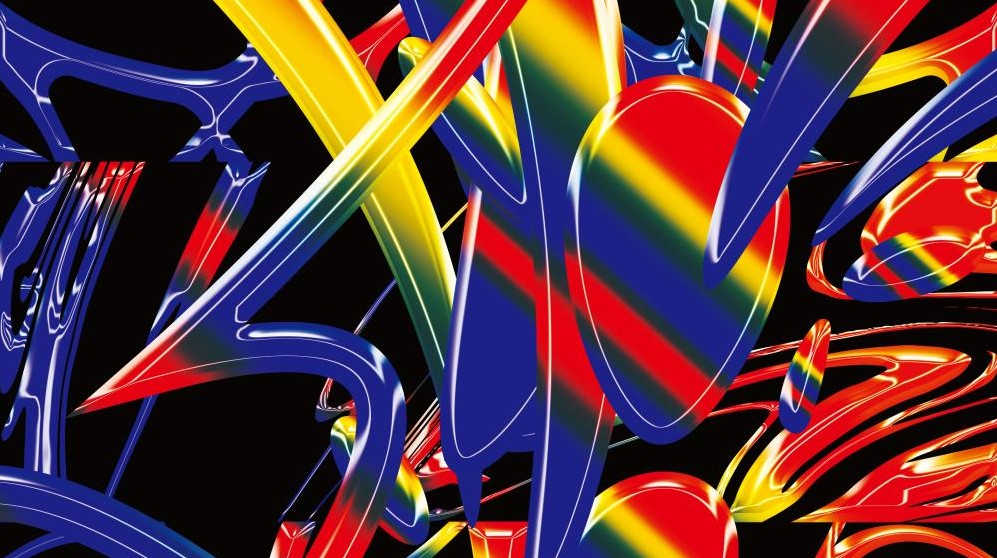
What aspects of previous schools of sculpture are the artists using? Where are they applying these aspects to? By being apologetic or critical toward the past, which makes up (a part) of them, how are they bringing up the problematic aspects of past sculpture into the present? Kang Jaewon uses a 3D program to create and edit three-dimensional shapes, suggesting that this is how sculptures may come to be produced in the future. Rather than first coming up with a concept and format and then shaping the artwork based on these, Kang establishes the foundations of the sculpture via computer program by skewing, twisting, bending, and applying gravity to the shape created by entering a few default values. Exo2_crop (2021), which is featured in this exhibition, is the outcome of using a computer program to crop, enlarge, and skew the angles of parts of past sculptures. In other words, the massive balloon-like sculpture whose color makes it look like a giant mirror, is the three-dimensional print-out of a shape that can be replicated or saved any time via computer program. The thin membrane, which is assisted by an air pump, is a material that is neither independent nor unique but can go back and forth between past and future as well as two-dimensionality and the digital. Kang’s creations, by taking on diverse formats and sizes (e.g., 3D printing, metal casting, inflatable material), give voice to the doubts harbored by contemporary sculpture about three-dimensional material, volume, and texture.

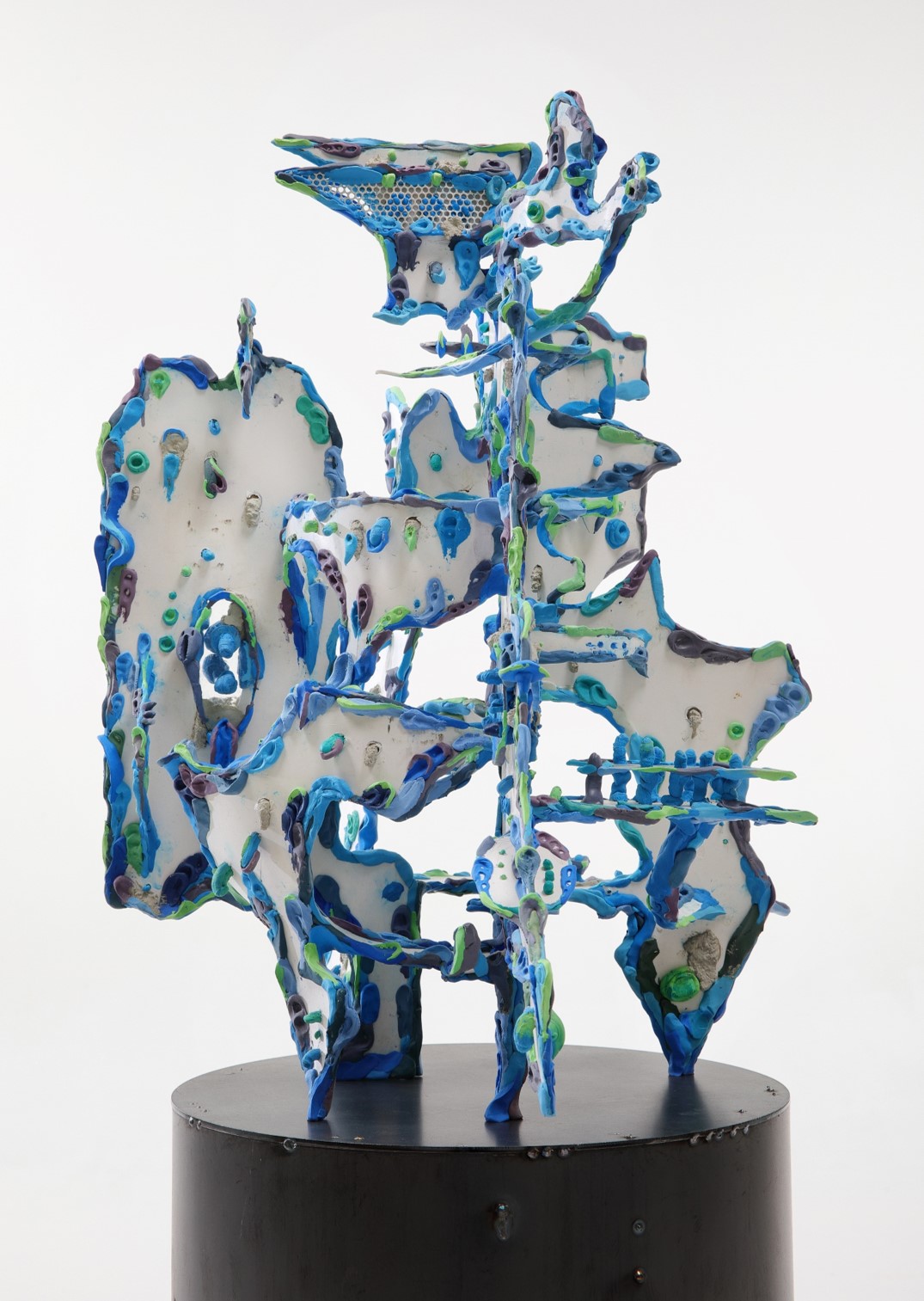
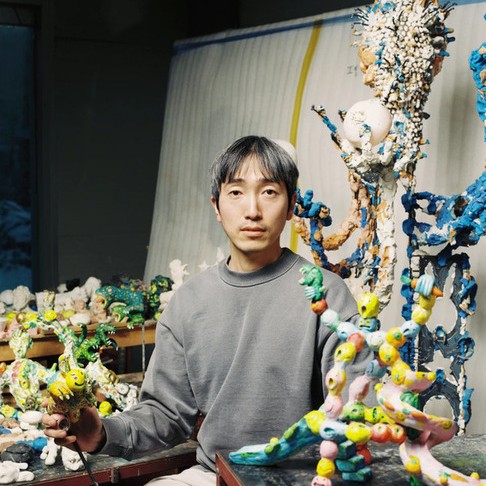
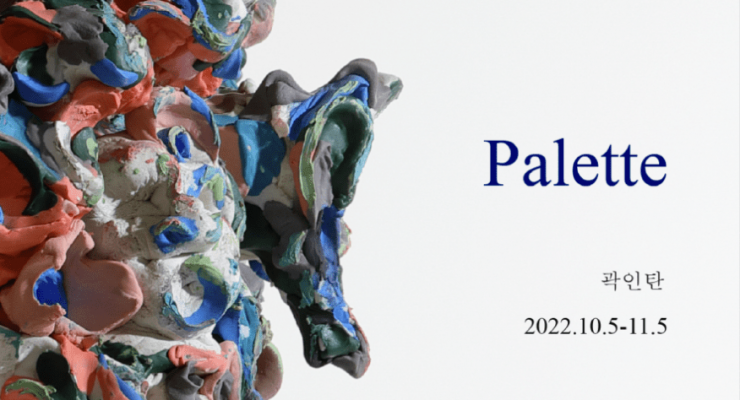
Kwak Intan explains his work as “an attempt to gather together fragments that refused to leave my brain and turn them into a sculptural format.” His creative process, which is compared to the process of coming face-to-face with obsessive compulsion, is like a relay race whose destination is unknown, in that it overlaps/repeats several shapes and textures. This is also the outcome of Kwak’s referencing of plate images of paintings and sculptures and re-purposing what he learned into new shapes, formats and textures. Movement 21-1 (2021) begins from the artist imagining that he has set the subject of The Out of Control of Compulsion (2020), which was featured at a recent solo exhibition, and Person sitting on gate to hell (2020) and is taking him somewhere very quickly. It, like Kwak’s previous creations, references multiple artworks. It is also, however, more focused than previous creations on a touch-inviting texture and the destruction and rebuilding of shape. By citing Unique Forms-1 (2019), Gate-1 (2019), and other previous creations, Kwak expresses the need not to accommodate references superficially but to create things that penetrate (and, eventually, come out at the end of) them. Movement 21-1 is not merely a remnant of the past or a passive rebuilding of it. Rather, its format suggests that the character is still very much interested in new conflicts and journeys.

Installation view ©Museum Head

In his most recent solo exhibition, Lee Choonghyun juxtaposed a 3D figure in a computer program with a minimalist sculpture, giving the visitor the paradoxical experience of the art exhibition and sculpture as fictional entities. The artwork for this exhibition, which is displayed in Museumhead’s outdoor area, has physical height but, at the same time, does not bisect the real from the fictional or 3D from 2D. Trinity (2021) looks like a geometric remodeling of three cubes from a computer program. It may seem to be a modification of a common minimalist format. Ultimately however it is not a simple juxtaposition of minimalism in 2D and 3D, it is the creation of a perceptual and experiential substance. The two-dimensionality and façade-emphasis of the screen and minimalism are replaced in Lee’s creative process with diagonal, half-sided pieces that each have a different texture, color, and movement. Placing three sculptures of the same style (but different shapes) in a row brings to mind historical events that are characterized by a repetitive or dramatic quality, which eventually leads back to discourse on the replicable screens, plaza, easily-consumed ornaments, and 3D installations/sculptures in public areas that are referenced (or intentionally brought together in conflict) by the artwork. All of these things are made very clear when a fictitious 3D object hurtles into, is replaced by something else in, experienced in a real space or vice versa.

Oh Eun explores the formative Korean sculpture, which seems all but discontinued in the current age, and its monumentality within a 21st century context. Oh approaches formative sculpture not from the perspective of tradition or historization but as something that can be combined with a condensed version of her personal experiences. In other words, it is the “commemorating of a commemorative act”—a repackaging of attempts to overcome a particular situation, disaster, or injury. It is in this way that the artist transforms Sohn Heung-min and the injured human body into bodily movements that overcome the limitations of one’s current circumstances. She also, as usual, includes a few moments of Korean art history. Minor Injury  (2021) refers to Bahc Yiso’s gallery space of the same title, directing our attention current discourses on othering, what it means to be a minority, and solutions/means of addressing the needs of such groups. The body that has been segmented or enslaved to disability that appears in Minor Injury and Last Minute Goal (2021) brings to mind the human sculptures made in the 1980s by Ryu In. Oh, who has studied art history extensively, shows us the status of Korean art today, the as-yet unorganized accomplishments of Korean art, and her increasing visibility as an artist that very much resembles a last-minute goal.

Choi Taehoon blends commercial products with sculpture’s functions and cultural status to create artworks that critique or invalidate the sociohistorical context they are based on. His three solo exhibitions, which have been held since 2018, featured creative reconfigurations of the components of DIY products. In 《Tractor》 (2020), through which he was featured alongside curator Yoon Min-hwa, Choi presented sculptures on the tension and energy that exists between standardized objects and bodies (mannequins). For this exhibition, Choi blends two disparate styles: the one from 《Tractor》 and the one that pervades 《Self-portrait》, a solo exhibition held in 2020. DIY furniture parts are joined together horizontally and vertically in unconventional ways and the standardized wooden pieces are imbued with a tense energy by draping them with spray paint and body parts or clothing. The sculpture, which drew life from clay and marble, is easily replaced with a mannequin, which ends up playing the same role as the objects that are usually used to connect or prop up a structure. The object-mannequins make us think about contemporary materials, culture, and the imitations of movement—all of which are not at all related to the idea of an “eternal body.”

By juxtaposing two seemingly disparate worlds, 《Injury Time》 spotlights contemporary sculpture as a medium that can be linked to or severed from the past. The artworks in this exhibition overlap past and present, 2D and 3D, memory and experience, and replication and creation. It often presents all of these things as faulty statues of reality. Private and post-historical sculpture, which, rather than being public or historical in nature, can be replicated, copy-pasted, cropped or reconfigured at any time. In this way, such works are declared as unique entities and achieve a mixture of diverse psychological states and conditions. The five artists’ attempts to explore the past do not end with lifeless reenactments of time or history: rather, they take on the qualities of and showcase the current age as an onlooker of the past. They do not attempt to build monuments to or try to write a full report of past truths. Instead, they draw our attention to the endless conflict that history brings about in its time difference with today. For the artists, the past is not a relay race or a spatio-temporal entity of control or oblivion: it is our constantly-intervening, discordant present. This is perhaps the point that this exhibition strives most to portray. We too will have to keep striving to discover how art is discrepant from a particular subject or time/space and where and how such discordance is enacted in our present. The extra time that this exhibition has done its best to embody is not a Mobius strip. It is a helical space/time that produces discrepancy as well as spaces through which we can escape from such limitations.

 
 Kwon Hyukgue
 
(1. The above-mentioned article was published in the Critiques section of Audio Visual Pavilion Lab (No. 4). Kwon Hyukgue, “Injury Time,” Audio Visual Pavilion Lab (No. 4), 2020, pp. 81-88.)

References