1. Pleasure
People’s
attitude towards art tends to be more conservative than progressive. This is
especially true when it comes to painting, with its long history and ingrained
values. For the majority of people, any painting by Leonardo da Vinci is
automatically a masterpiece, by default. On the other hand, most experimental
paintings by contemporary artists are presumed to be immature and incomplete.
Likewise, with regards to artistic theories and concepts, people tend to latch
onto widely circulated ideas and narratives, eschewing more eccentric
interpretations. Thus, every artist who has gained an exalted place in art
history is labeled a “genius.” Then, as implied by the definition of the word
“genius,” we embrace the myth that the great artists (almost all of whom are
white, European, males) created their masterpieces through some combination of
superior talent and the divine intervention of the muse. No matter how much
time passes, or human reason advances, or culture flourishes, people still want
to believe in these myths. It reminds one of Picasso’s comment that he focused
on “finding” rather than “research relating to modern painting,” which was long
remembered1, and we love to believe that Van Gogh had to suffer in
order to create his incredible works. We love to suggest that the liberating
energy of Basquiat’s graffiti is the result of his unique artistic spirit as a
minority artist who was inspired by the street. But in perpetuating these
myths, we never stop to consider that such concepts—genius, talent, the muse,
and the secret creation of divine inspiration—are merely aesthetic claims from
a certain perspective, primarily compiled under the influence of
nineteenth-century German Romanticism.
Many
people would be surprised to learn of a more radical theory about the muse,
first put forth by Aristotle in Politics and
reintroduced by Pascal Quignard in La Haine de la Musique (The
Hatred of Music), his argument for an aesthetic critique of music.
According to Quignard, Aristotle suggested that, while singing or playing an
instrument, the mouth and hands of the muse “are occupied exactly like those of
a prostitute who, with her lips and fingers, inflates her client’s physis in
order to make it stand below his belly until he ejaculates.”2 Thus,
Quignard suggests that the creation of an artwork is not necessarily the free
and independent act of an artist, but is rather bound to something, somewhere.
According to Quignard, this binding is the state of “being captivated by
sorrow.” Moreover, as memories are accumulated, this captivation by sorrow
sinks and collects at the bottom of the artist’s soul—and in the artist’s
works—like dregs at the bottom of a vat of wine. But while Aristotle’s sensual
analogy may shatter some of the illusions that people harbor about the mythical
status of the artist, most will find Quignard’s theory somewhat stifling. After
all, of all the words or images that he could have chosen, Quignard asserted
that artistic creation and the aesthetic pleasure of a viewer were simply
“dregs” ensnared by sadness.
2. Sketch
Now
turning to Sunny Kim’s artwork, one may consider my critical analysis to have
already begun since my focus – and if possible, to delve into at depth – is
Kim’s concentration on “painting” practices, one of the oldest art forms. When
making a painting, Kim engages in a series of blind steps, never knowing if the
end result will be successful. But this process does not reflect her adherence
to a grand methodology or her dependence on inspiration from the muse. To some
degree, of course, this description may be applied to any contemporary artist.
As such, it may be discussed as an issue that is universal to contemporary art,
but it is particularly crucial for an effective analysis of Kim’s work. Since
2012, Sunny Kim has intensively and methodically focused on creating paintings
at her own pace, which has allowed her to find her own path and results.
Through this process, Kim has been able to create paintings that resonate with
an individuality that cannot be absorbed by the universal.
Here
exist the purpose and intent of this essay. In order to fully explore this
process, this article focuses on Kim’s work from the past five years (I will
discuss later why I separate this time period). Moreover, rather than simply
discussing Kim’s “paintings” per se, I wish to discuss her overall work, which
has been focused primarily—but not exclusively—on painting. In this way, we can
better understand her creative trajectory and methodology, as well as what she
hopes to achieve through the work of painting, as an artist operating outside
the frame of conventional ideologies of art. Rather than manifesting the
transcendental “genius” of the artist, Kim’s works express her experiential and
performative questions and doubts as a working subject. Rather than being
inspired or produced by a divine muse dwelling in her head or her fingertips,
her works are the tangible result of a laborious process. Rather than embodying
the perfect freedom of creation, her works represent the constraints of
invisible forces, as well as the artist’s incessant attempts to strain against
or comply with those constraints.
3. Obvious Matters and Opposites
Back
to 2001, Sunny Kim (who was then in her early thirties) introduced herself to
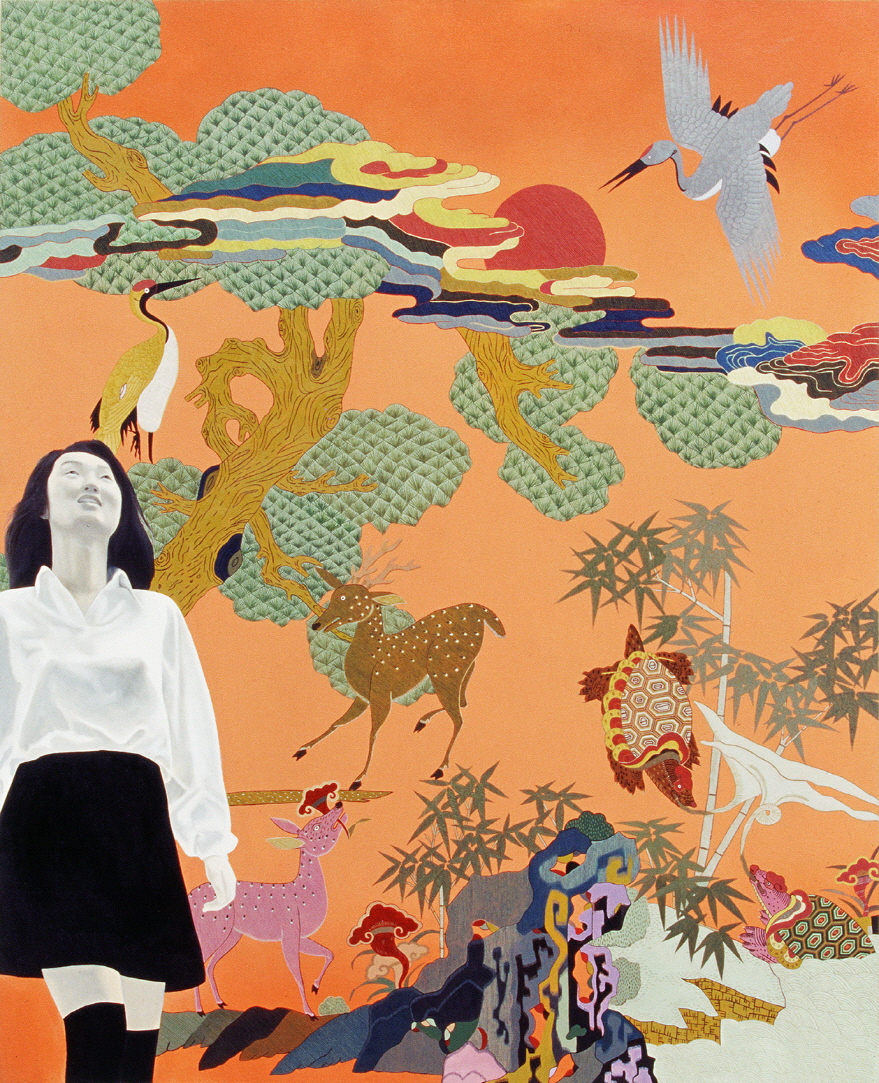
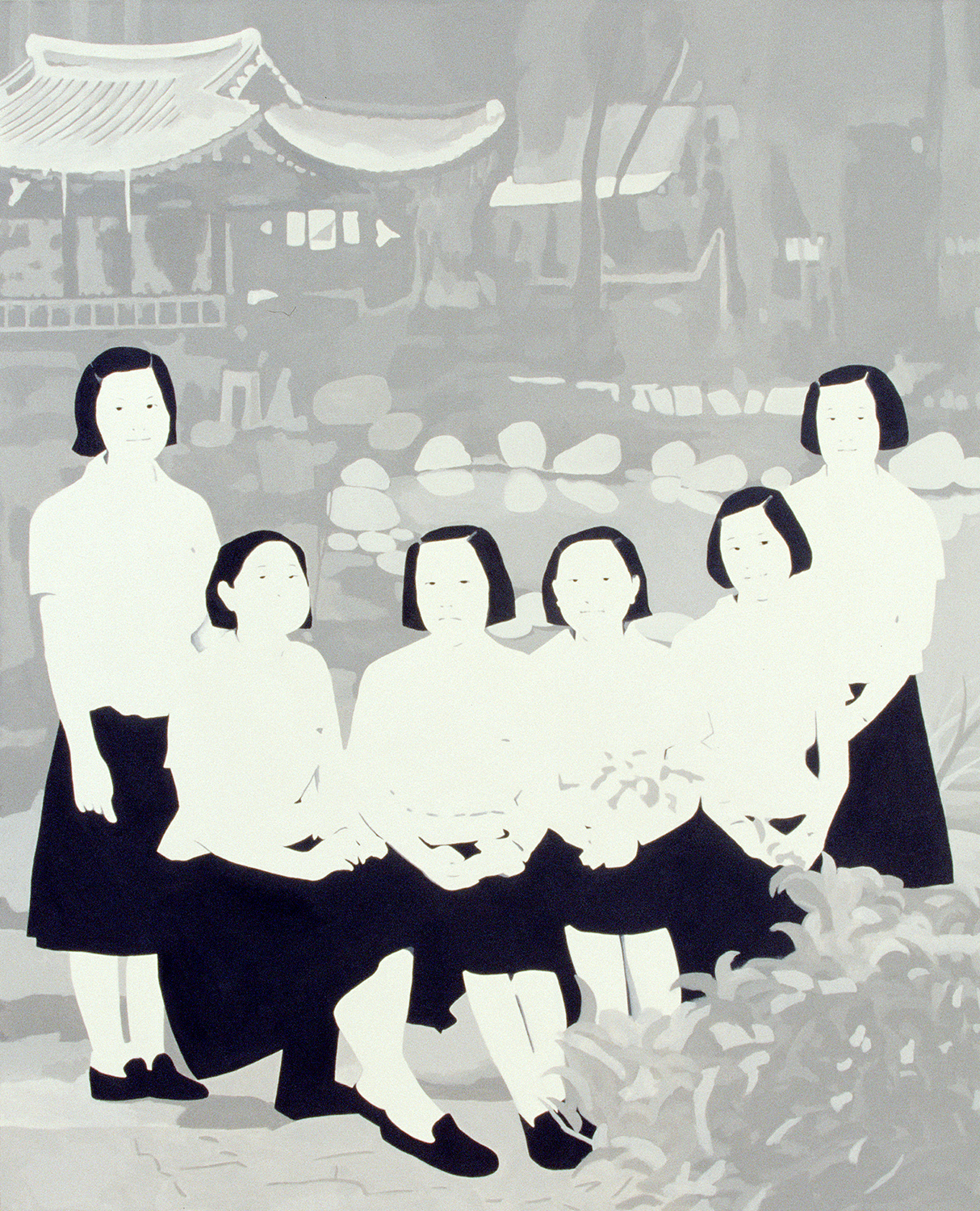
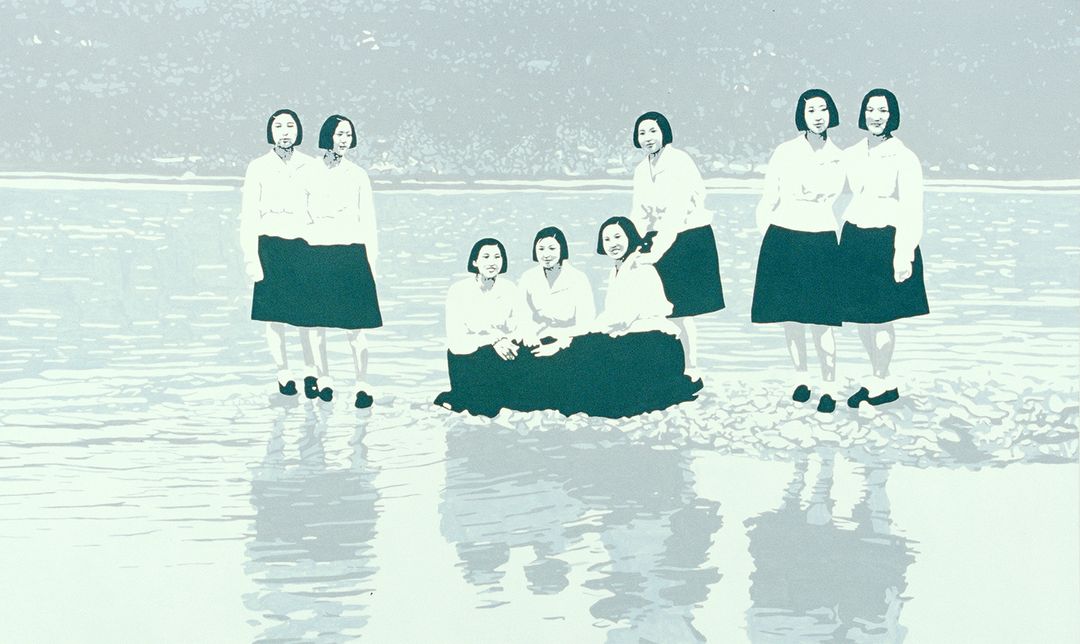
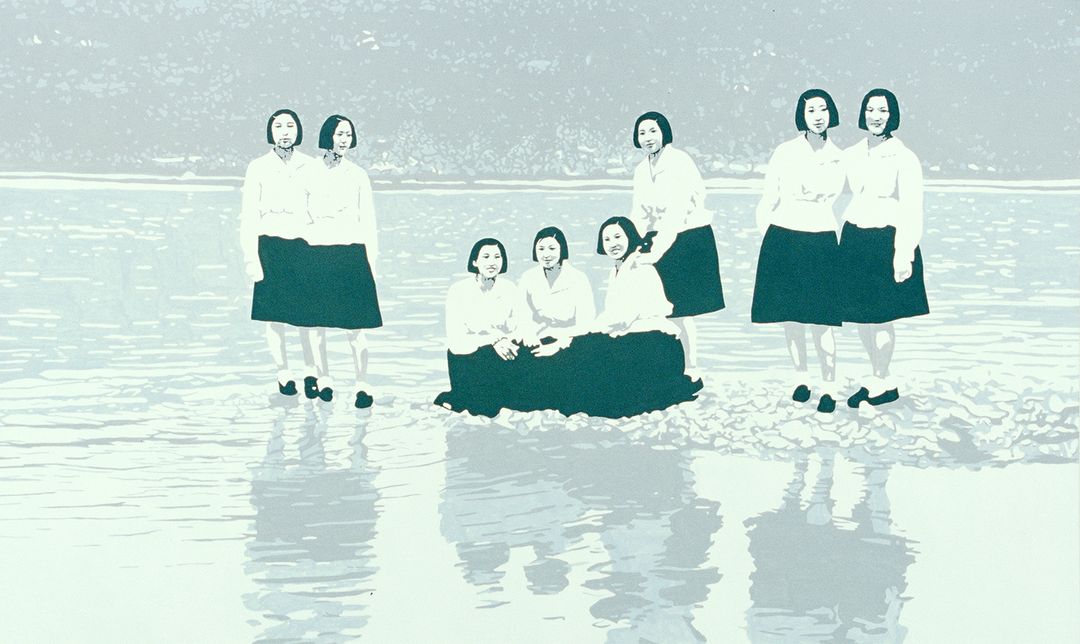
the Korean art field with her first solo exhibition, 《Girls in Uniform》 at Gallery Sagan in Seoul.
As suggested by the title, the paintings of this exhibition depicted girls in
school uniforms. The paintings seem to capture images from a bygone era,
reminiscent of faded photos developed from damaged film. While the overall contours
of the figures are visible, the details, like their nose or fingers, are hazy.
The surrounding landscape, if it exists at all, is fragmented into areas of
light and shade. Indeed, the sharp contrast between light and darkness
dominates these canvases. But rather than a cold, dry sensation, these works
exude a strange mixture of emotions: longing, nostalgia, comfort, and regret.
At first glance, the subjects seem to be Korean school girls from the Japanese
colonial period (1910-1945), but the styles and subtle details of the uniforms
indicate that they are more recent, perhaps from the 1970s or 80s, when Korea
was developing at breakneck speed. But the paintings do not seem to portray
Sunny Kim’s memories of her own past, nor do they match the time or space
around the turn of the millennium, when Korea became affluent, despite the
financial crisis of the late 1990s. Herein lies the core of Kim’s early works
(if we were to distinguish between her early and recent works for the sake of
formality), which clearly depict images from the past, but not images from
“her” past. What do these images represent, and why did she paint them?
In
1983, when Sunny Kim was in the eighth grade, her family left Korea and moved
to the United States. Thus, she became part of the “1.5 generation” of
immigrants, who come to a new country around the time of their early
adolescence. She grew up in the U.S., where she studied painting at the Cooper
Union in New York City and earned her master’s degree in Combined Media from
Hunter College. After initially preparing to launch her career as a young
artist in the U.S., she decided for personal reasons to return to Korea in 1998
and started her domestic career as an artist through her first solo exhibition.
Thus, for about fifteen years, Korea existed only as a blank space for Sunny
Kim, devoid of memories or experiences. Interestingly, after having moved from
and back to her homeland for reasons beyond her will, the first works that she
showed in Korea were about blankness, absence, and existence – or what is
believed to have existed – within emptiness. In sentence form, these paintings
would use past progressive tense and the subjunctive mood: “While I was gone,
these girls would have been taking this or that photo…”
The(se) girl(s) with
bobbed hair attended all-girls middle and high schools in the 1980s; they went
on field trips to Gyeongju; they assumed chaste poses for a group photo beneath
the eaves of a Korean traditional house; they wore fitted uniforms with a white
top, broad collar, and black skirt; they stood facing straight forward, with a
modest but buoyant smile. As the title states, they are “girl(s) in uniform.”
These images are not derived from Sunny Kim’s memories, but nor are they
something that she has forgotten. In The Art of Forgetting, neurobiologist
Ivan Izquierdo quotes and affirms two key ideas from other scholars: that
forgetting is the most striking aspect of remembering, and that what we
remember is who we are.3 In this context, the paintings of
Sunny Kim cannot be understood solely through the relationship between
remembrance and oblivion, as her works evince certain layers or dimensions
where neither her memories nor her subjectivity exist. Perhaps these dimensions
are occupied by the collective social memory of Korea, including what has been
forgotten. But no matter how she tried, Sunny Kim could not occupy or coexist
with these dimensions. Notably, the Korean title of this series includes the
word “교복” (“Gyobok” which means “school uniform”), as
opposed to the more general term “uniform,” another disjunction that reflects
the impassable distance between Sunny Kim or the girls in her paintings. But
the gap between them is even larger than this.
The
paintings of 《Girls in
Uniform》 do not document the past or record specific or
detailed figures. In fact, it is difficult to determine if they are traces of
actual existence. But by representing banal and stylized old photos as vague or
incomplete figures, Kim touches upon something that transcends individual
existence: the loss of an entire era. By conjuring this parallax view,
precipitated within social memories, the paintings ultimately evoke the fickle
nature of human existence. The abstract and psychological qualities of the paintings
make them difficult to visualize or rationalize. But as images that are
familiar from our current stereotypes, they address residual matters and
conditions of the present, while also drawing our attention to fleeting
emotions and unconscious perceptions that we usually choose to ignore.
Although
the images themselves are distinct and apparent, they also arouse complex,
invisible, and multi-layered effects. In this early phase of her career, Kim
may not even have been aware of such effects, but that does not mean that they
were not an influence or inspiration. At that time, she was primarily
interested in exploring how to paint something beyond memory or experience, or
how to use the medium of painting to visualize the ever-changing reality
through the parallax view. These issues are part of the mission of many
contemporary artists who choose to express themselves through painting, the
oldest and most conservative artistic field. But at a superficial level, the
paintings of 《Girls in Uniform》 might still be read as the artist’s attempt to re-visualize
photos of the past, in order to stir nostalgia and melancholy.
In
my view, this was before Sunny Kim became aware of this mission. At that time,
she seems to have been dedicated to amassing such paintings, steadily producing
diverse images of girls in school uniform, with different backgrounds and
motifs. But in 2012, she began tapping into the core of the medium of painting,
boldly discarding two-dimensionality and pursuing various routes.
Interestingly, it was only by abandoning the fundamental condition of
two-dimensionality and adopting a methodology of diverse expressions, media,
and interpretations that she was able to approach the essence of painting. This
process is reminiscent of her back-and-forth relationship with Korea.
4. Acknowledgment of Being
The
photography resources that Kim used in 《Girls in Uniform》 were not social or
historical documents, but rather found images, not taken from the artist’s
personal or family album. The photos are not indexed or attributed, so the
people in the photographs cannot be identified. As such, they are anonymous,
and their meanings and functions are opaque. Nonetheless, to Sunny Kim, they
weakly but persistently attest to her own presence – I/we, here and
now – in a specific time and space that she did not actually experience.
Meanwhile, to the viewers, they attest to the presence of the girl(s),
there and then. Although Kim altered the figures and changed the meanings of
the original images, the figures still exist as beings that cannot be deferred
or replaced.
One of the first painters who experimented with capturing the
essence of photography, rather than simply using photos as tools for sketches
or paintings, was Gerhard Richter. According to Richter, “[A photograph] is
absolute, and therefore autonomous and unconditional.”4 Similar
to Richter, Sunny Kim uses photography as a raw material. Yet due to the
absolute, autonomous, and unconditional attributes of the medium, the
photography of the schoolgirls must have limited Kim’s freedom of expression.
Or, recalling the theory of Pascal Quignard, the existence of the schoolgirl(s)
is what captured Sunny Kim with sadness. Of course, Kim “actively”
painted 《Girls in Uniform》 through
her own creative intentions and desires for free expressions. But at the same
time, she was “passively” drawn to the leitmotif of “girls in uniform” via
photographs of a time and space infused with sadness, or some emotion beyond
the sentimental. The sadness is inevitable, because the time and space had
vanished from Kim’s own existence, leaving a gap in her experience and memory.
The resulting works are an attempt to represent that gap.
Sunny
Kim’s paintings are the result of this collaboration between passiveness and
activeness. In her creative process, she actively pursues her own artistic
expression and aesthetic judgment, but she does so from a restrained or passive
position. She cannot look away from the indelible presence of the girls at the
ontological level, the presence that is both “being here and now” and “having
been there and then.” Like Gerhard Richter, Kim attempts to utilize the
objective and material quality of photography as the controlling agent of her
subjectivity and thought, and also to revitalize the accidental and active
depiction of a subject who escapes from this passive position. In short, she
creates her paintings via the feedback between activeness and passiveness. They
are an acknowledgment of being, of the people who surely existed but are now
blank or absent in one’s memory. They embody the times, lives, experiences,
memories, images, controlling powers, the energy of expression, and the desire
to act. Of course, they also embody Sunny Kim, the subject that all of these
elements and influences converged upon, moved through, and released from.
5. Leap in the Dark
We
are living in the era of artificial intelligence, when AI-interfaces like Siri
read our minds, answer our questions, and choose our music. The self-learning
and constantly improving AI program AlphaGo can now defeat the world’s best go
players utilizing adept strategies that people cannot comprehend. In the
future, our present era may be defined by our capacity to develop and improve
AI technology. What is most astonishing is that we have created this advanced
technology, which may ultimately supersede the human species, despite having
only a rudimentary understanding of our own minds. For the most part, the
territory of the human brain is dark and unexplored. We do not even know how
the different areas of the brain function or interact. Indeed, new procedures
such as fMRI (functional magnetic resonance imaging) or PET (positron emission
tomography) scans show that even our simplest thoughts involve simultaneous
activity among various parts of the brain.
Some
readers might be surprised by my sudden segue into the world of neuroscience,
but these ideas have great relevance for our understanding of Sunny Kim’s
recent creative output. Like today’s neuroscientists, Kim has taken a “leap in
the dark,” a term that serves as both the theme and title of her recent
exhibition. Taking such a leap means acting without being certain of the
result, a spirit that defines Kim’s current painting process. For the last five
years or so, Kim has consciously discarded the painting methods that she
studied and mastered, and she also avoids making any concrete plans or
calculations before embarking on a project. Instead, she seeks to immerse
herself in whatever phenomena, incidents, conditions, thoughts, and perceptions
that she may encounter while she completes a painting, or better yet, while a
painting becomes complete on its own.
She leaps into the darkness, courting
hardship by exposing herself to knowledge, experiences, and feelings that she
might otherwise have chosen to avoid. In doing so, perhaps she intends to shift
the meaning onto her own practice of painting. Although the concept of
“painting” is filled with ideas about tradition, authority, genius, and
masterpieces, it is still just a common noun, a huge dark zone that is ready to
be explored. The fact that we have yet to understand the workings of our brain
fills us not with dark despair, but with the light of investigation. Similarly,
having traversed her “girls in uniform” period, Sunny Kim is now ready to leap into
her new mission. Perhaps, like Haruki Murakami, she believes that the capacity
of our “high-powered cerebral cortex” is derived from such abstract thought, a
vital component of the creative process.5 Other artists have
acknowledged the significance of this factor in the production. For example,
discussing his own theory of creation, Gerhard Richter said:
“When
I paint an abstract picture (the problem is very much the same in other cases),
I neither know in advance what it is meant to look like nor, during the
painting process, what I am aiming at and what to do about getting there.
Painting is consequently an almost blind, desperate effort, like that of a
person abandoned, helpless, in totally incomprehensible surroundings—like that
of a person who possesses a given set of tools, materials and abilities and has
the urgent desire to build something useful which is not allowed to be a house
or a chair or anything else that has a name; who therefore hacks away in the
vague hope that by working in a proper, professional way he will ultimately
turn out something proper and meaningful.”6
Despite
some poetic exaggeration, Richter’s statement seems to summarize what it means
to be an artist making a painting. To the viewers, Kim’s recent works,
presented under the grand title of Leap in the Dark,
seem to be complete artworks of superior aesthetic quality. But to the artist,
they must be manifestations of the ambiguity, anonymity, purposelessness,
nonexistence, and insecurity of the painting process, imbued with all of the
desperate effort, judgment, and emotion contained in every step. Or perhaps the
paintings themselves exerted pressure on her. Either way, Sunny Kim did not try
to hide or overcome these aspects of the creative process, nor does she
exaggerate or beautify her artistic capacity. Instead, she ardently activated
these negative qualities as elements of her work, concentrating on transforming
them into an aesthetic style.
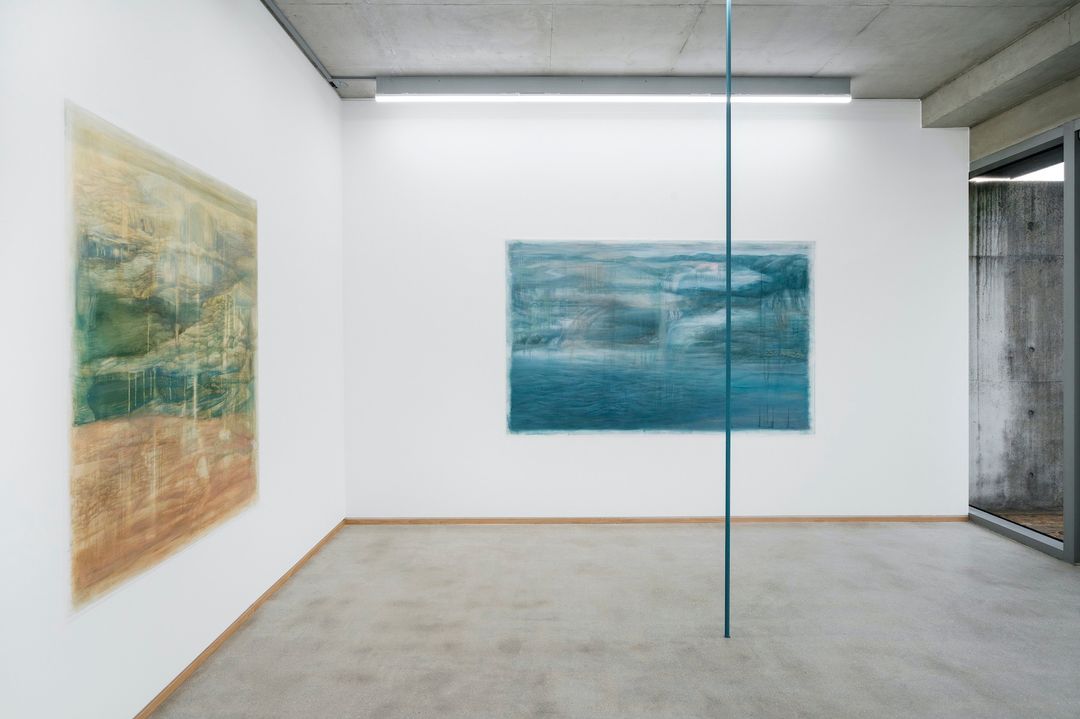
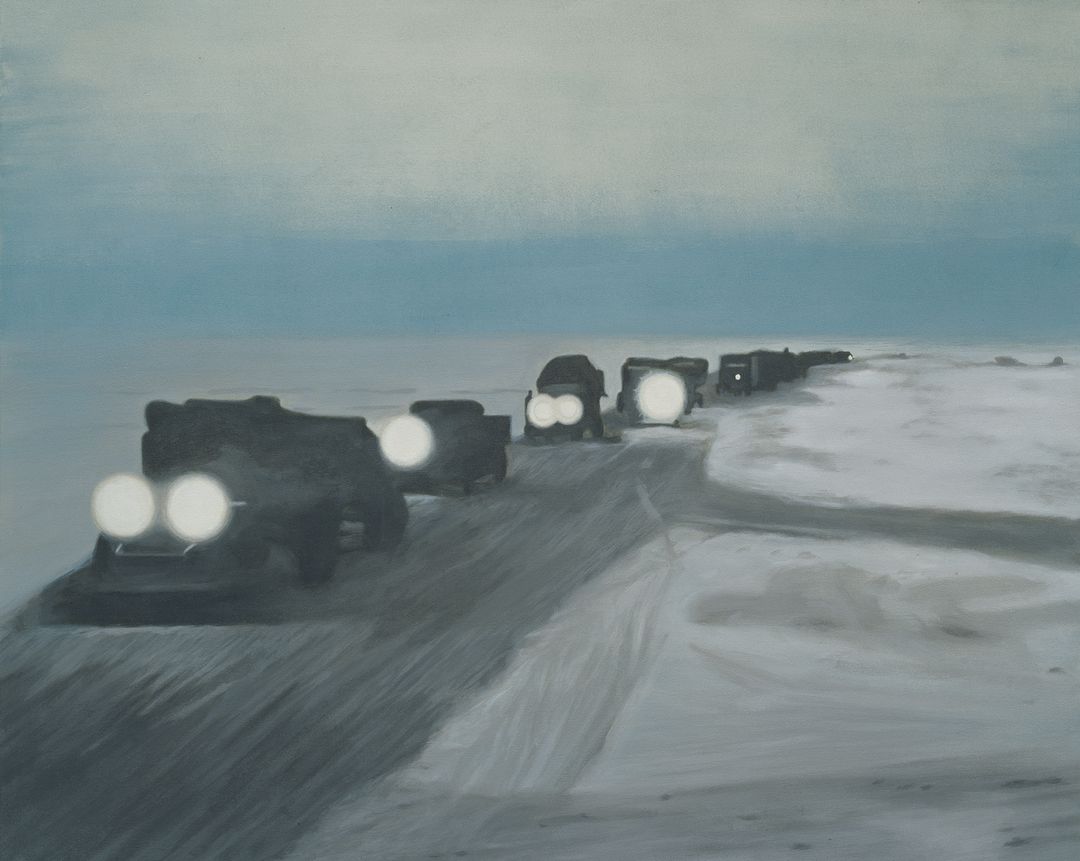
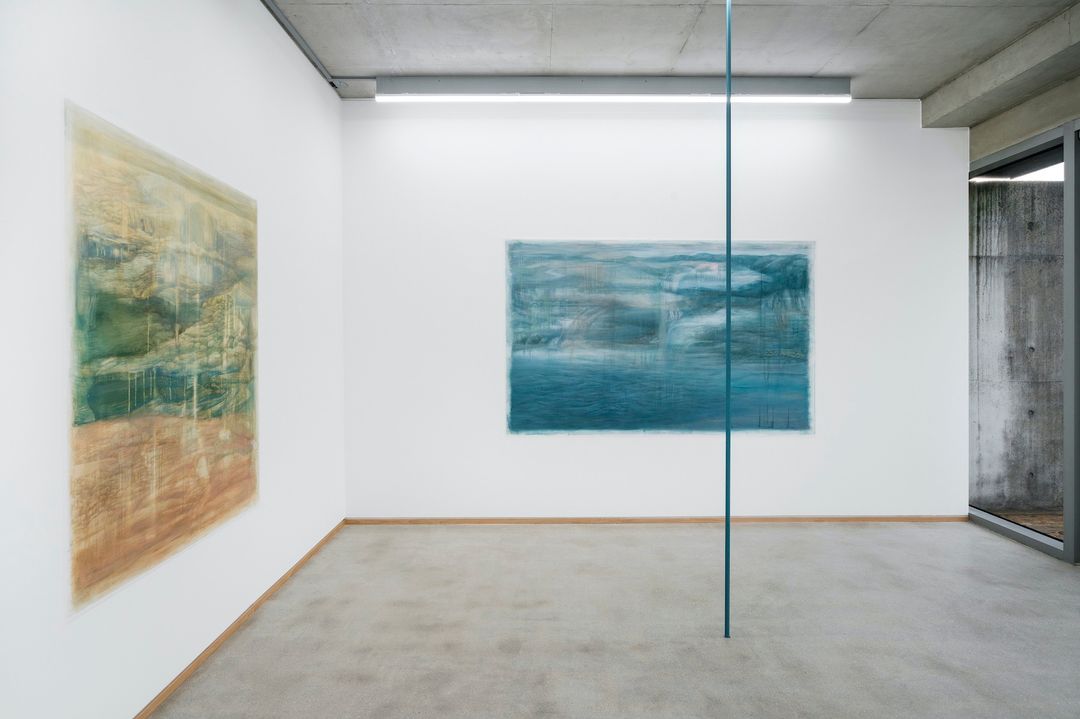
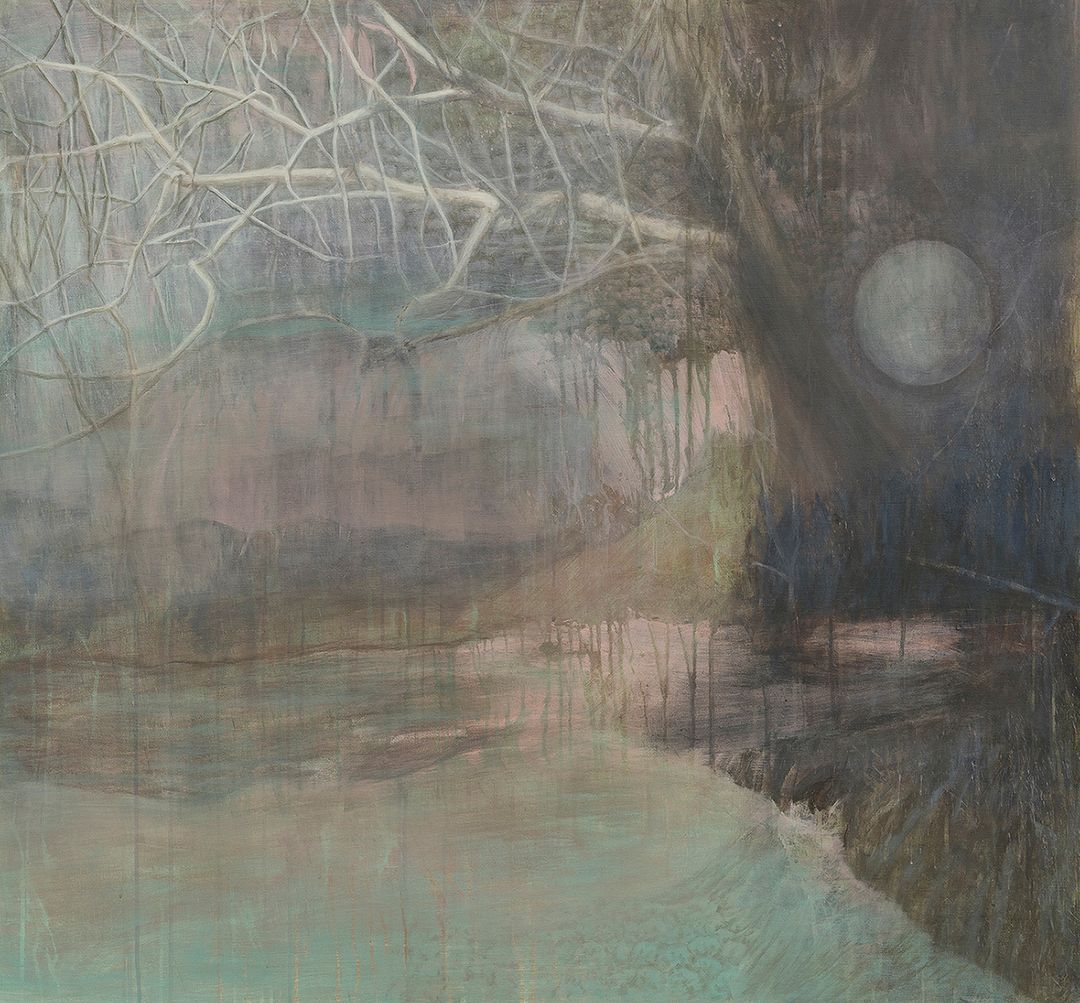
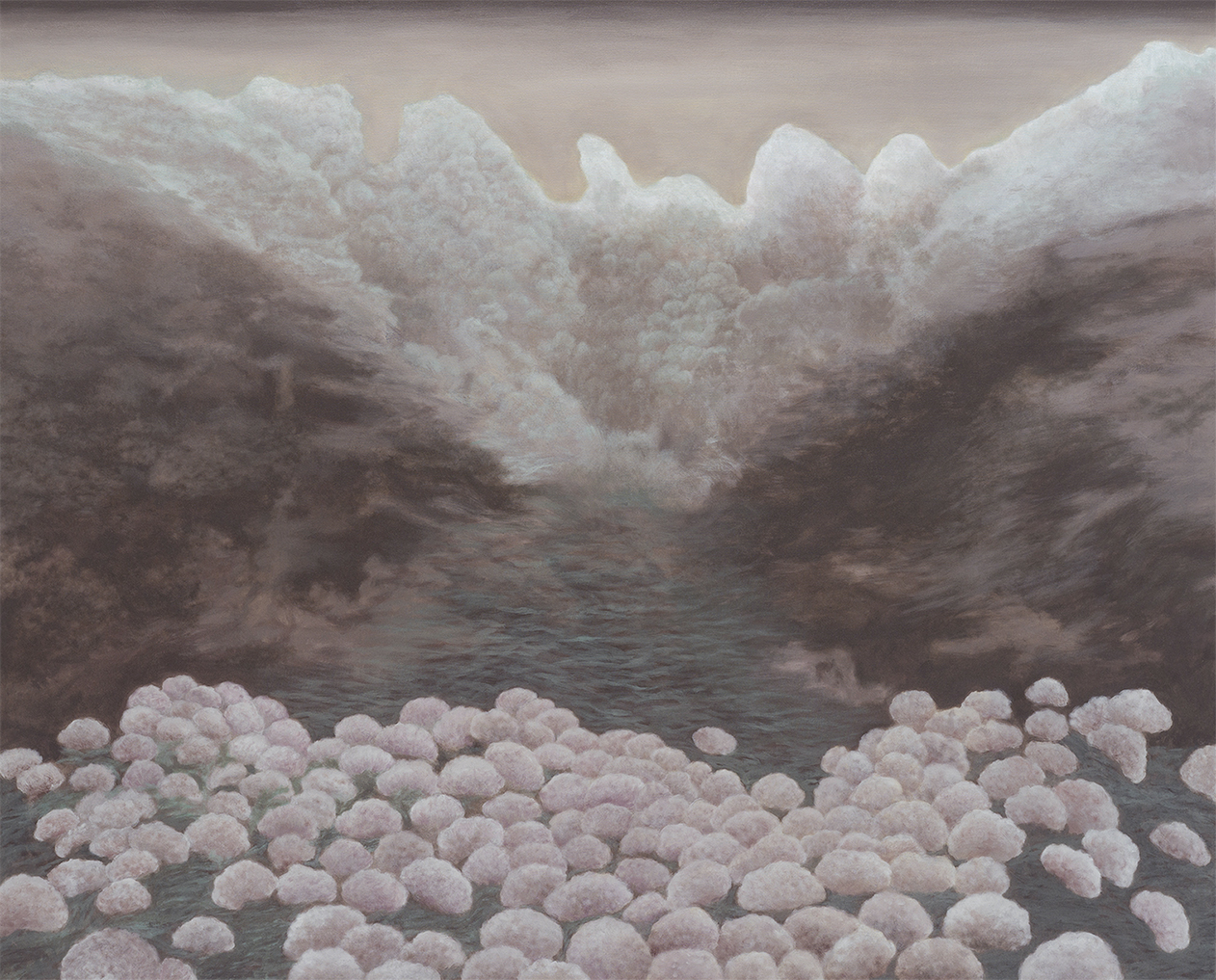
The
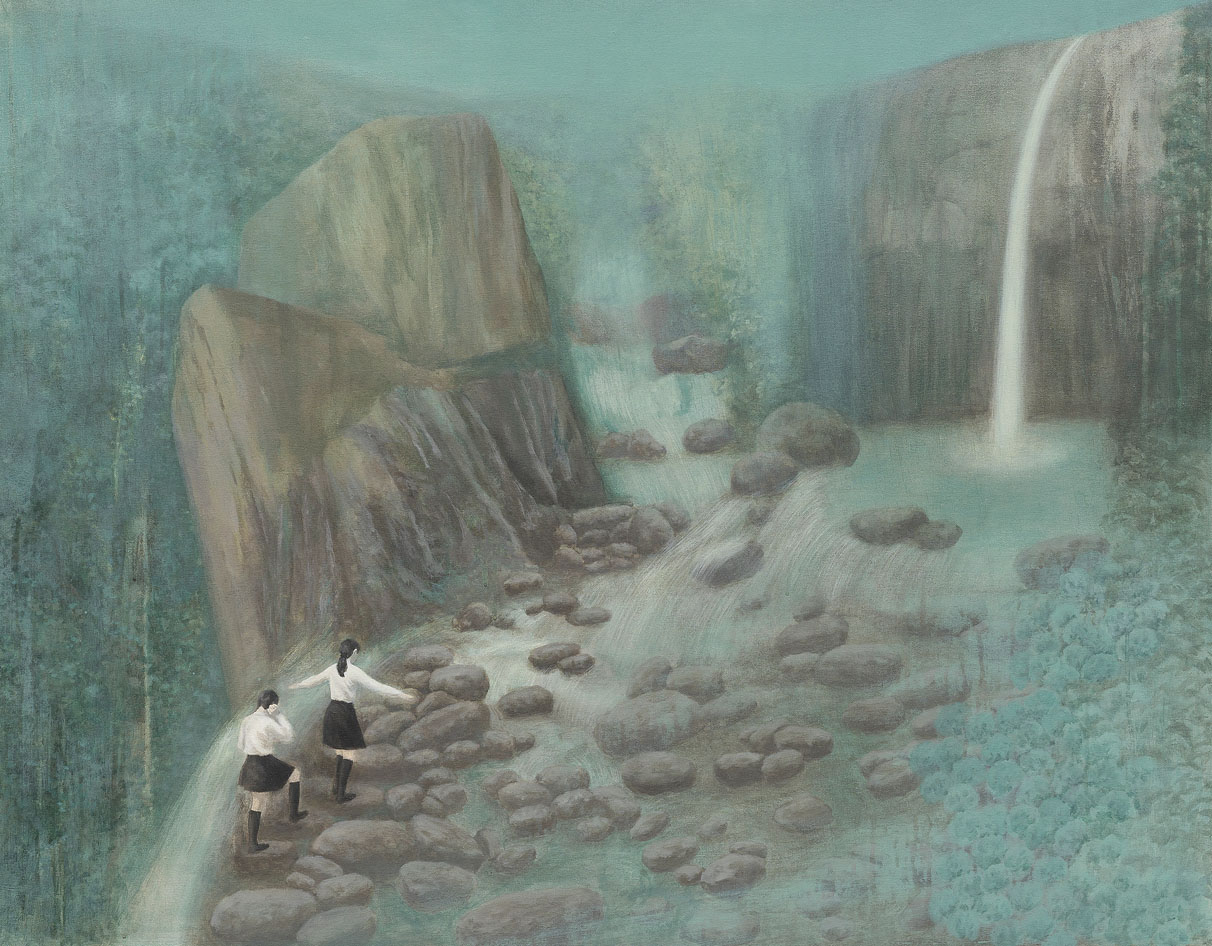
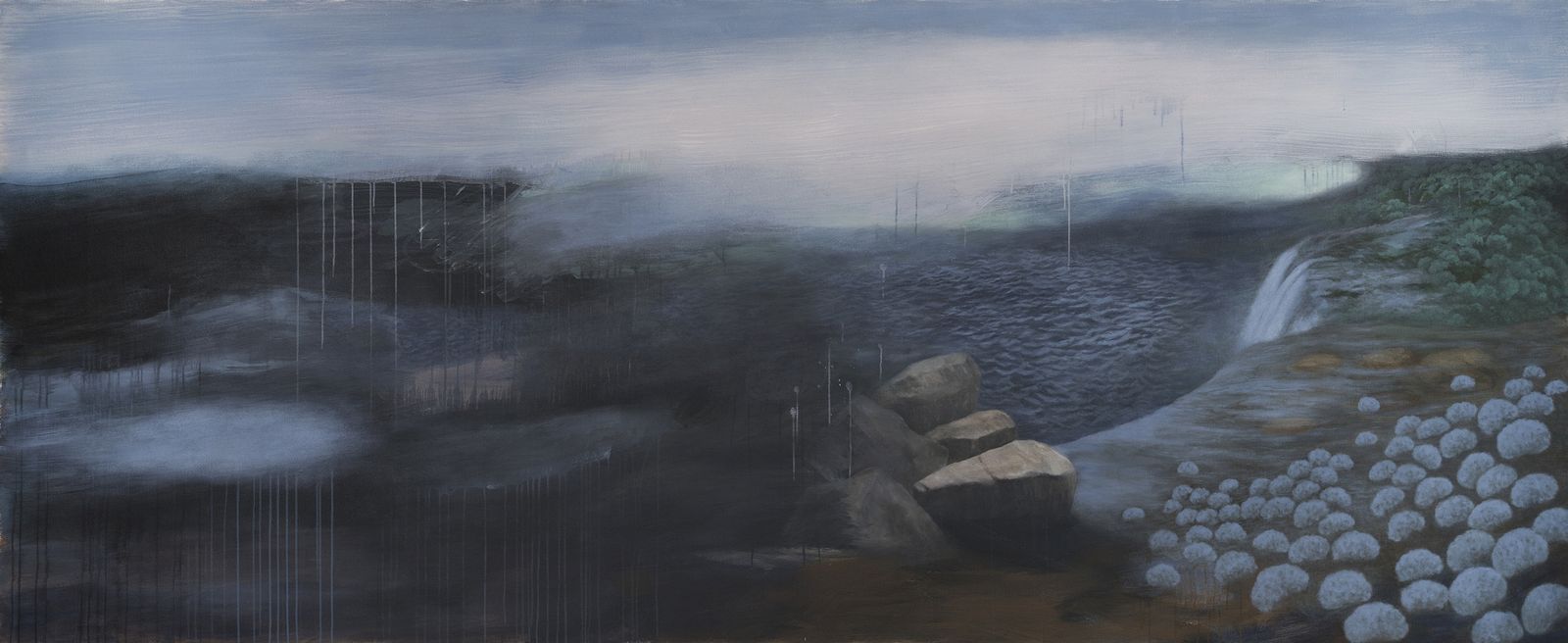
three recent works that most clearly demonstrate this sensibility are Well,
Reflect, and Encounter, which resemble
landscape paintings with a dark tone, if they must be classified. In truth,
they are very different from conventional landscapes, but they also cannot be
called abstract or conceptual paintings. In terms of the theme, they lie on the
boundary between landscape paintings and abstract paintings, or perhaps they
alternate between the two, dynamically swapping genre conventions. For example,
the lower part of Well contains an
incomprehensible line that is cut very abruptly, with rough brushstrokes
underneath. Meanwhile, the upper part of Reflect is
largely achromatic, and the depicted valley of the landscape is neatly divided
with a vertical line. Finally, about one-third of the canvas of Encounter consists
of a dark, dingy area, showing traces of the downward flow of the paint. Most
viewers, being accustomed to the conventions of balance, harmony, and moderation,
will likely be embarrassed or aghast to see these paintings, which willfully
break the harmony of the scene, confuse the motif of the landscape, and
interfere with the viewer’s satisfaction of being immersed in the virtuality of
the image. But Kim said that the paintings “had to be that way, they couldn’t
have been otherwise.”7
According to her, she began Well with
only a fragmentary idea of painting a well surrounded by rocks in the upper
part of the canvas, an unconventional composition. Then, while she was
painting, she experienced a certain state in which the work itself seemed to be
leading the process. Feeling the need to include this odd sensation in the
work, she depicted the dizzying traces of confusion, frustration, compromise,
persuasion, and success that she experienced. Like the works of El Greco, she
sought to give her viewers a more substantial and physical experience of the
work, beyond simply gazing at an imaginary landscape. Thus, rather than
striving to conceal the fact that Well is a
painted presence, she openly confesses to the chaos and absurdity that are
churning just beneath the surface of the finished work. The a forementioned
elements of Reflect(i.e., the achromatic area and
vertical lines) and Encounter (i.e., the dark area
and flow of paint) can also be understood in the same context. On one hand,
these details are included in the landscape as visible elements on the canvas.
But at the same time, they testify that the landscape is neither an imitation
of nature nor a representation of reality; it is rather a creative performance,
both the act and achievement of an artist who leaped into the dark path of
creation. In these works, Sunny Kim is attempting to verify her painterly
existence, an agenda that is at odds with the mechanical objectivity of
photography. In the process, she subverts the myth of a painting as the result
of a genius’ subjectivity. The conventional ideology of art history simply
cannot be applied to her paintings, which were created by her willingness to
abandon convention in favor of uncertainty.
Hints
of Kim’s desire to verify her painterly existence can also be seen in earlier
works, such as Under the Purple Sky, Dark Clouds, and Waterfall. These
paintings contain certain forms, rendered with expressive brushstrokes, but
what exactly are they? Misty mountains at dusk? A mass of clouds before a
downpour? Waterfalls beneath an overcast sky? These paintings seem to have been
made before the artist firmly committed herself to an aesthetic style, and they
do not fully convey the artist’s confession that they are paintings. Instead,
they function by conveying traces of the artist’s contemplation, or by
psychologically or emotionally enticing the viewer. Although Kim’s artistic
concept may not have been fully developed at the time she created these works,
they definitely feature provocative and experimental elements that go beyond
the mere depiction of forms.
6. Integration in Painting, like an MRI and Tomography
“Would
writing be to become, in the book, legible for everyone, and indecipherable for
oneself?”8
As
referred to at the beginning of this essay, my position is that Sunny Kim’s
artwork can be divided between the early and recent. From this perspective, I
reviewed her work over the past 16 years. 2012 is the clear year of that
divide. That year, she began moving away from the canvas with performance works
such as Still Life (2012, Culture Station Seoul
284) and Landscape (2014, Incheon Art Platform),
which delineated various media and genre conventions. They can be called
“performance works” for the sake of convenience, but there is no simple term to
describe these works, in which Kim articulated and self-replicated her previous
paintings. Kim has explained that Still Life and Landscape were
originally intended to be part of a trilogy exploring the nature of
contemporary painting, along with a piece called Portrait that has not yet been
realized. Still Life and Landscape may
be thought of as the outcome of Kim’s journey, in which she departed from the
primary path to painting in order to return to it via a different route.
To
make an unusual analogy, this process is reminiscent of an MRI (magnetic
resonance imaging) that makes images of our body or brain. Unlike X-ray
photography, MRI involves taking many cross-sectional photos from various
angles and then combining them to create a comprehensive three-dimensional
image that can greatly enhance our observation and understanding. In a similar
way, Sunny Kim has meticulously contemplated every aspect of her early paintings
of “girls in uniform”: her images, creative methods, materials, expressive
techniques, apparatuses, etc. Prior to 2012, her paintings were
indiscriminately executed or lumped together, but she has since begun to divide
them by their themes, elements, methodologies, and qualities, and to look into
them with different sensory devices.
This
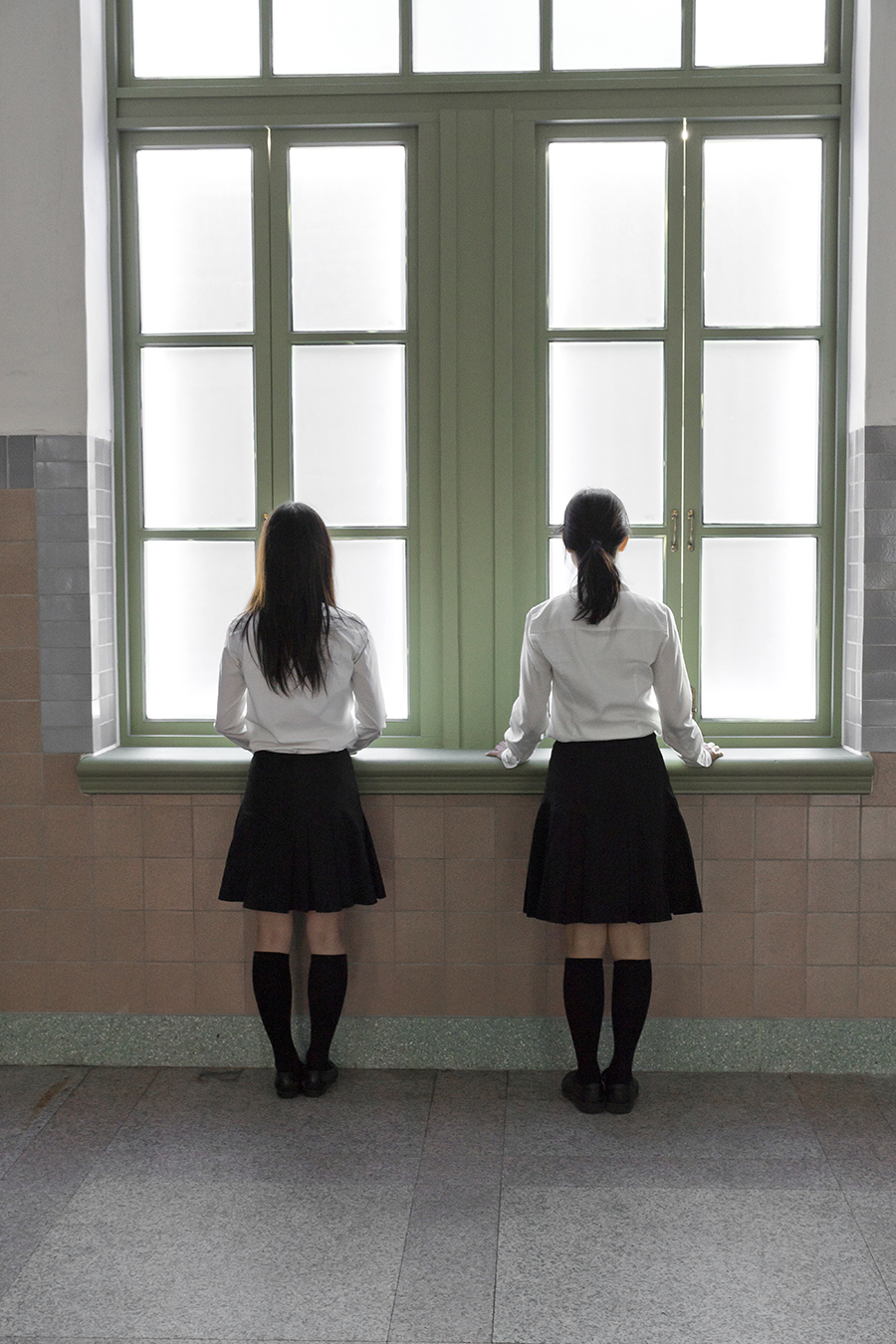
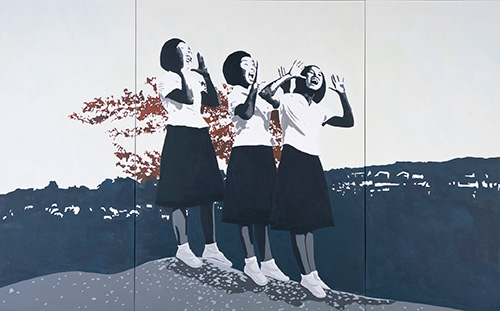
work is exemplified by Landscape, which Kim performed
six times at the Incheon Art Platform, from May 23 to 25, 2014. With the
audience looking straight ahead, images of Kim’s landscape paintings were
projected in the center of a dark stage. Three girls appeared, looking as if
they had been cut out of the Girls in Uniform painting
series. They wore white blouses, black skirts, black socks (pulled up below the
knee), and black loafers. In a situation outside of any specific time or space,
with no clear context or narrative, the girls made very subtle and ambiguous
movements, as if they are in a vacuum. Sometimes they slowly approached the
projected landscape, or they walked towards the audience, placing their hands
around their mouth as if to shout into the crowd. Obviously, they are people,
not a landscape, but the viewers come to feel as if the girls are permeated
with the faint tones and colors of the background landscape. At the same time,
the silent landscape seems to come alive, as if it is breathing through the
nuances of the girls’ gestures and clothing.
This
is the sense that I experienced while watching the performance, and it is what
I remember most today. As usual, the specific details or inessential aspects
have faded into oblivion. To me, the performance sliced the conventional lump
that we call painting into topological cross-sections, which were then
reassembled along the axes of time and space. This is what I remember, in any
case. If memory is who we are, then the I who remembers Sunny Kim’s Landscape am
nothing but the subjecthood of memories formed by Sunny Kim’s Landscape.
It does not matter if those memories are big, small, many, few, strong, weak,
rough, or subtle. It does not matter if Sunny Kim was present, or if she
experienced similar sensations, for these are the memories and the existence
built through the artwork. In “girls in uniform,” Sunny Kim could not avoid
passiveness, due to the absence of memory and experience. Then, by pushing her
painting into darkness, she contributed to forming the experiences of other
people. Thus, she became the active subjecthood who, like Hansel and Gretel,
leaves a trail of big and little pebbles that will not be lost in the forest of
memory and oblivion. Relating to Maurice Blanchot’s thought about writing, if
Sunny Kim must continue painting “seen by everyone and indecipherable to
herself,” she will continue to do so.
1. John
Berger, The Success and Failure of Picasso, translated by Kim Yunsoo,
Seoul: Mijinsa, 1989, p. 39. The original text from:
http://www.learn.columbia.edu/monographs/picmon/pdf/art_hum_reading_49.pdf
2. Pascal
Quignard, La Haine de la Musique, Korean trans. Kim Yujin, (Seoul: Franz,
2017), pp. 10-11. According to Quignard, ancient Greeks used the word physis,
meaning “nature” or “growth,” as a euphemism for the penis.
3. Ivan
Izquierdo, The Art of Forgetting, Korean trans. Kim Youngseon (Paju:
Prunsoop Publishing, 2017), pp. 20 and 28. The former idea is from
neurobiologist James McGaugh, while the latter is from philosopher Norberto
Bobbio.
4. Gerhard
Richter, Gerhard Richter-Writings 1961-2007, eds. Dietmar Elger and Hans
Ulrich Obrist (New York: D.A.P, 2009), p. 45.
5. Murakami
Haruki, 기사단장 죽이기 (Killing Commendatore) Vol. 1, Korean
trans. Hong Eunju (Paju: Munhak Dongne Publishing Group, 2017), p. 432.
Menshiki, one of the major characters of this novel, speculates that the
meaning and significance of our brain comes from abstract and metaphysical
thought, a necessary condition of our inability to fully comprehend the brain’s
function or capacity.
6. Gerhard
Richter, ibid., p. 142.
7. From
my conversation with Sunny Kim on July 20, 2017.
8. Maurice
Blanchot, The Writing of the Disaster, trans. Ann Smock (Lincoln and
London: University of Nebraska Press, 1986), p. 2.