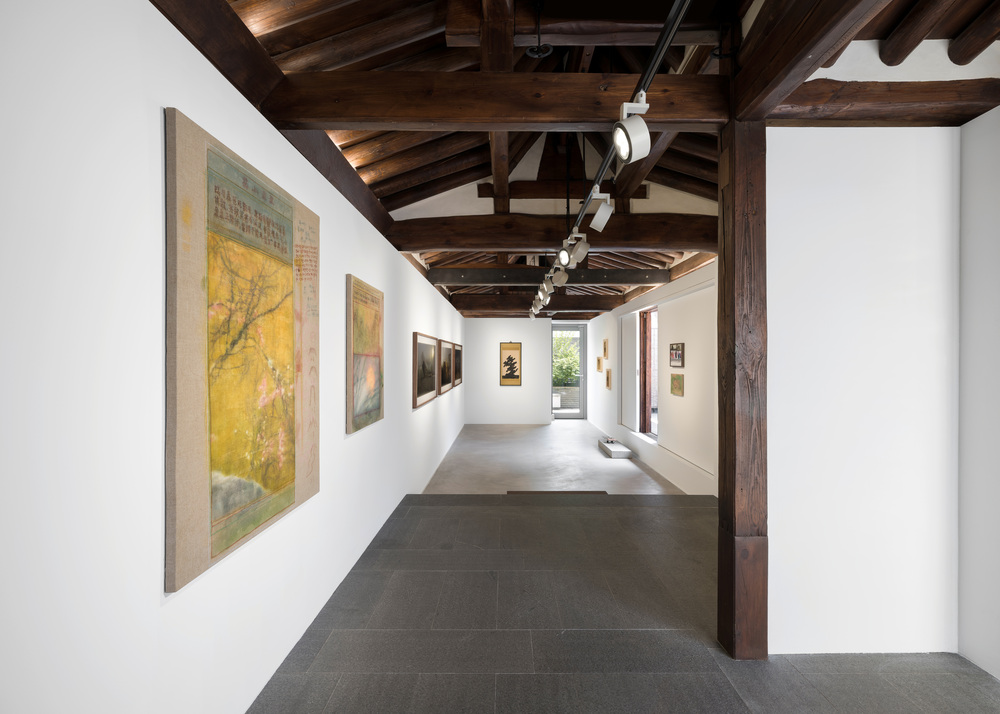
At
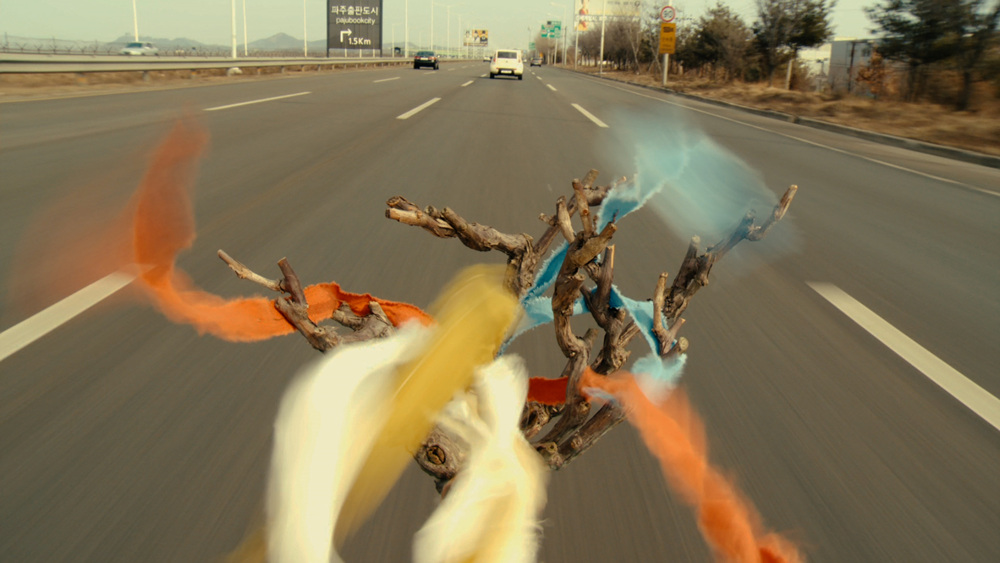
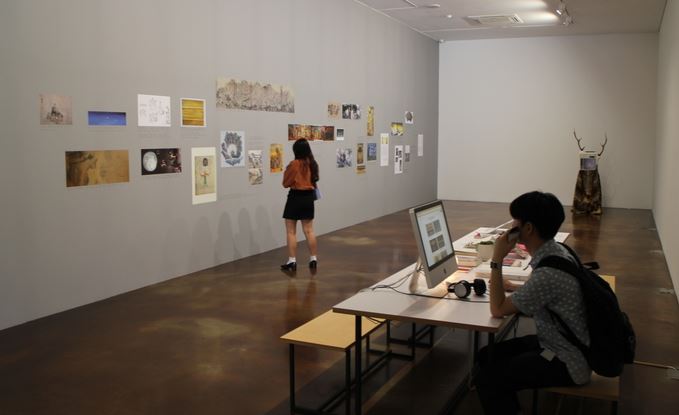
the far right corner of the first-floor exhibition space stood a telex machine
on a pedestal covered in leopard print fabric. The telex had a slide tray and
deer antlers mounted on its head. It was clearly a metamorphosed telex. Then
what is the “body” of this transformed figure? After reaching the telex, the
audience could loop back and re-examine Small Art History,
proceed to the archive by the entrance, or walk behind the wall to view Citizen’s
Forest. Upon exiting Citizen’s Forest, one
again encounters the archive and can ascend to the second floor. On the second
floor, viewers encounter Bright Star, Chilseongdo, MoonWalk,
and finally The Way to Seunggasa in sequence.
Thoughts Stirred in the Heart
The
gallery was a gut-dang—a shamanic space—where the aesthetics of conjuring and
ritual intertwined, a vessel of prajñā
pāramitā ferrying one from the saha world to the Pure Land.² When the world and its people
are not at peace due to calamity, they are in a state of mi-an (未安)—unpeace—and
thus a gut must be performed.³ When peace returns, an-rak (安樂) is achieved, and that is the realm of purity.⁴ However, the
circumambulating walk from the first floor to the second and back again, like a
pilgrimage or participation in a dwitjeon (back shrine) ritual yard,
was mi-an. Because the ghosts boarding the prajñā pāramitā vessel and the shamanic gut-dang had not yet attained peace.
The
shaman with antlers—the great deer shaman of the gut-dang—was the slide TV. It
is said that the Buddha gave his first sermon at the Deer Park (ṛṣipatana), but another way to see it is that a deer-shaman gave the
sermon there—thus, ṛṣipatana as
a place of shamanic revelation. The message of the deer-shaman was media. With
San-shin (Mountain God), San-ryeong (Mountain Spirit), Sam-seong (Three
Saints), and Chil-seong (Seven Stars)—none of whom belonged in a Buddhist
temple—intervening in the ga-ram (temple compound), the shaman in
leopard print roared, bursting into a lion’s sermon.⁵ That sermon, mediated through
media, was projected onto the wall, delivering the “voice of heaven” [divine utterance or oracle]. In
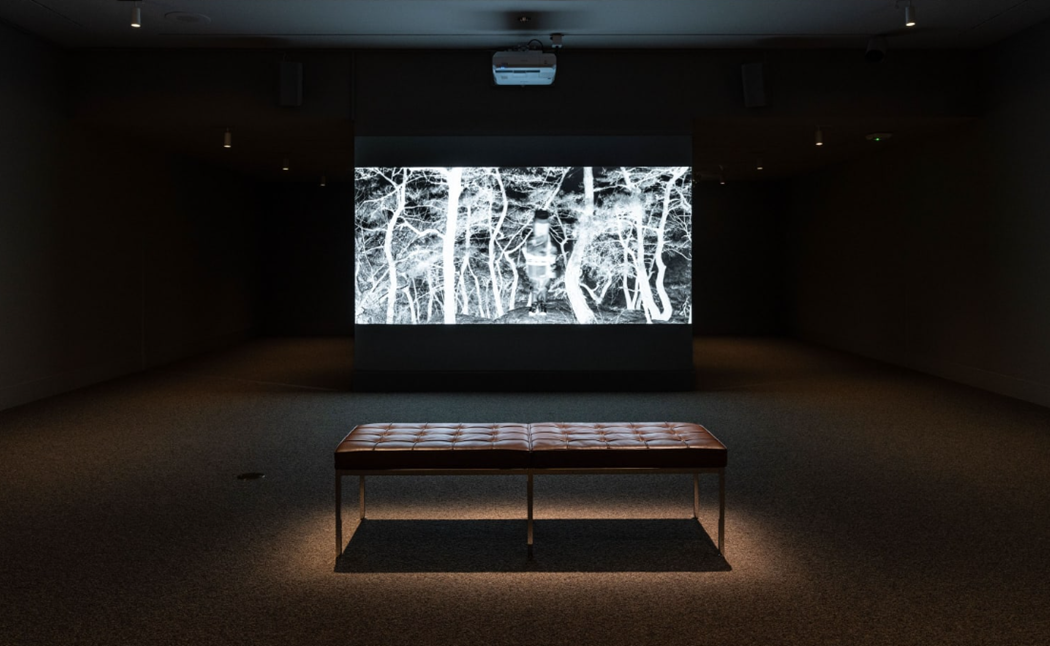
truth, Small Art History (2014/2017) and Citizen’s Forest (2016) are languages of that sermon.
Art
history is a chronology of images. Chronology cannot escape the narration of
time. To renew that narration, one must either embed image algorithms into it
or fracture time and open the algorithm’s extensibility toward all ten
directions (śífang). Only by negating time can
a heretical language be born. Heresy is trickery. Let us not forget that the
word “art” (美術) originally meant “the
great deer shaman who performs magic.”⁶ When trickery of “meaning” is unfolded in all ten
directions and connected through images, speech is born on the first floor.
That speech could interact in real time with visitors to the gallery. The slide
TV was a telex. In mechanical terms, the telex was a teleprinter-based
communication service allowing direct dial-up between subscribers for data
transmission. Even without a recipient, the telex could automatically print
incoming messages on paper tape. The archive table at the gallery’s entrance
and the deer-shaman telex together had “printed” the image algorithms of Small
Art History as if they were revelations from spiritual
resonance.
One
cluster of “image-speech” (畫語) in Small
Art History relied on a myth of wells that connects foreground
and background. In such a time, where the past and future coalesce, this world
and the next are opened in a single continuity—a twilight hour when “the sound
of the temple bell rings through the cloister, and suddenly / all the men of
the capital vanish, and the world is transformed / into one of only women.”⁷ In France, it is called the hour
of dogs and wolves; in Korea, it is the hour when goblins emerge. It is the
hour when shadows vanish from the well. When the shadow disappears, the depths
below are illuminated. The abyss connects seamlessly with the world above; the
well becomes a singular aperture without sides. The tale of an egg rising from
such a well is told in the Samguk Yusa. Park Chan-kyong draws upon this
and weaves together nianfo rebirth, the verticality of East and West,
celestial ascents, and the “one true mind” of immortality by juxtaposing works
by Kim Hong-do, Ed Ruscha, Hieronymus Bosch, and illustrations from the Chinese
mythology compendium Classic of Mountains and Seas. Min Joung-ki’s Ten
Thousand Pinnacles of Mount Geumgang (1999) is a masterstroke
that brings these mythic and religious perspectives of the well into the plane
of reality. Min not only transforms conceptual narrative into a realism-based
aesthetic but also reveals that a landscape itself can be an image of a “bright
whirlwind.” This whirling landscape corresponds to the feng shui geography of
Sindoan—a circular form of Ja Mi Won Guk (Purple Forbidden
Enclosure), said to be the most auspicious site. This is none other than what
Laozi referred to in the Tao Te Ching as “the gate of myriad
wonders.”
Back
Shrine, 100 Scenes of the Korean War That Made Me Cry, The
Lemures, Military Immortal Crossing the River, Sindoan, Portrait
of Filial Piety, Portrait of Songho,
and Embrace, along with the rest of the plates, are
phantom images of a moment when this world and the next collide upon the
surface of the well. The unfolding of those phantom images into a montage is
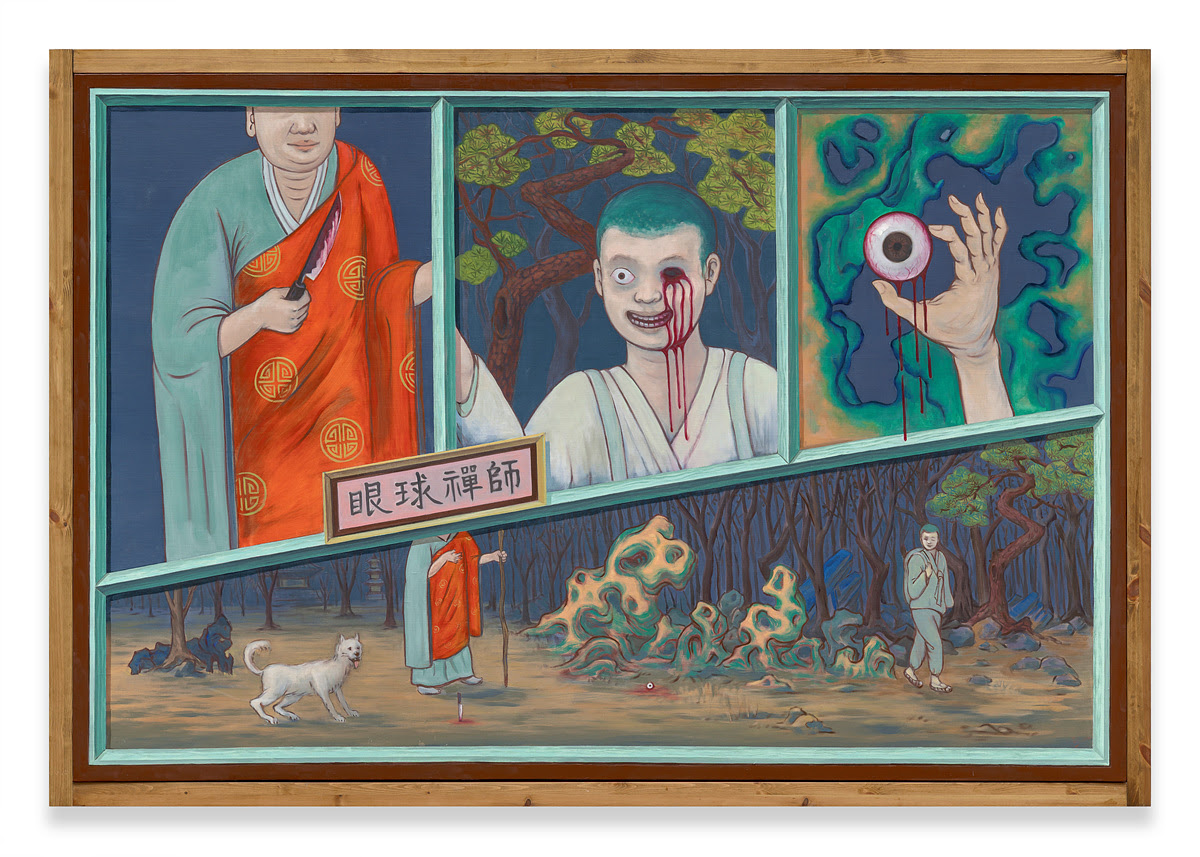
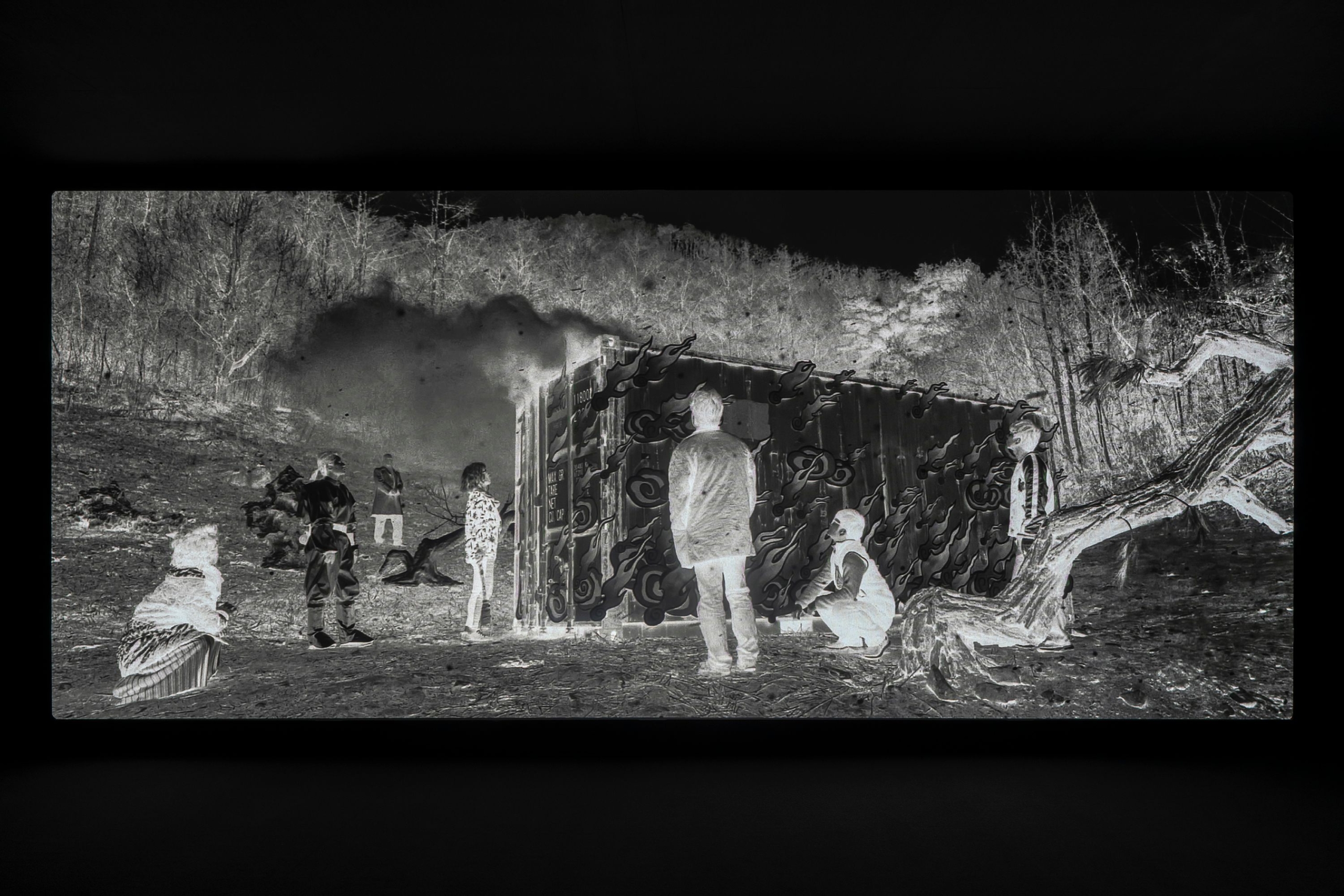
precisely what Citizen’s Forest becomes. “No
matter how filthy the mire, it is fine,” said Kim Soo-young. “No matter how
filthy the tradition, it is fine. No matter how filthy the history, it is
fine.” When such mire, tradition, and history are clothed in the imagery of Oh
Yoon, the result is a video composed of fragmented narratives of “countless
reactions.” During the 1970s and 1980s, when Western modern aesthetics had
reached their peak in Korean painting, Oh Yoon created The
Lemures as a gothic counterpoint—much like how Bosch, in the
Renaissance era, parodied the optimism of reason and science through his
paintings of medieval pessimism.⁸ Park Chan-kyong has already referred to this as “Asian Gothic.” For example, in his keynote
lecture at 〈Media City Seoul 2014〉, he emphasized that the world and Asia cannot be viewed through the
framework of the “nation-state.” He proposed observing unexpected
relationships between peripheries beyond Asia and added:
“Like
Claude Lévi-Strauss’s bricolage, Asia is itself a process of transformation
that reconstructs itself through shifts in time and perspective. Chinese
philosopher Wang Hui, resurrecting the postwar Japanese thinker Takeuchi
Yoshimi’s idea of ‘rewinding the West,’ argues that Asia must fulfill the
positive values of Western modernity—such as democracy and equality—more
thoroughly. Wang Hui expresses this with the oxymoronic phrase ‘modernity
against modernity.’ Once freed from the frame of modernity, Asia will become a
space overflowing with ‘strange modernities.’”⁹
Slipping into Tradition, into the Real
Not
only in Korea, but across the foundation of Asian modernity, a complex mixture
of concepts such as colonialism, the Saemaul Movement, anti-superstition
campaigns, tradition, ideological conflicts, Red Army/South Korean Army,
West/modernity, fake reality/actual life, fantasy, modernization/urbanization,
contemporary history, self (individual/subject) and others (the Other),
modernism, and capitalism persists. All of these concepts of modernity
(including “modern” and “modernization”) may be ideological by nature. The sad
shadow of this male-centric and violent ideology is etched deeply into The
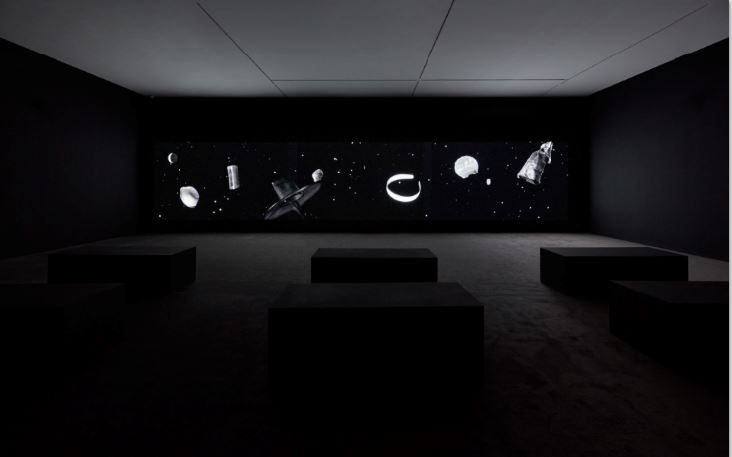
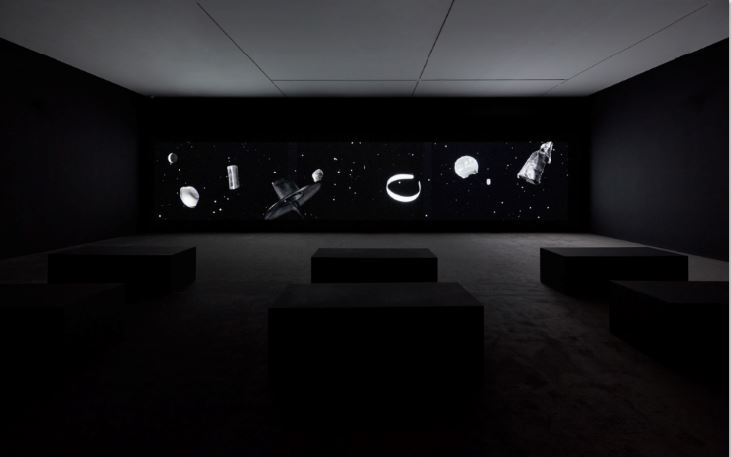
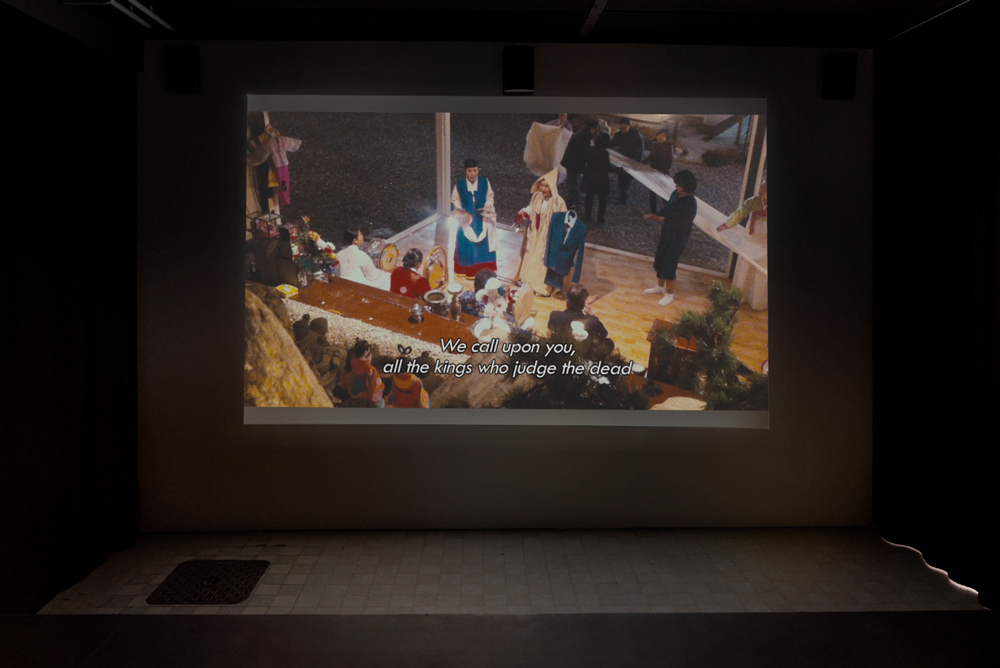
Lemures. The fragmented and discontinuous scenes of Citizen’s
Forest revive this shadow. As a cinematic device to pacify the
restless spirits roaming the nine heavens, the gut performed in the film
becomes a shamanic rite—both jin-ogwi gut and shigim-gut. The
extended video, like a long scroll of time, loops from beginning to end. The
conclusion of this appeasement is a Milky Way of Park Chan-kyong-style objects
replacing the symbolic relics of Kim Soo-young’s “countless reactions”—objects
like chamber pots, headbands, long pipes, ancestral tablets, bullets,
copperware, herbal medicine signs, shrines, leather shops, pockmarked faces,
blind eyes, infertile women, and the ignorant.
However,
there is a major difference between The Lemures and Citizen’s
Forest. Oh Yoon’s painting, by deploying a gothic visual grammar
across several frames, drenches the viewer in an emotional state of empathy
with the horrors of modernity. Whether through pathos or resonance, once a
viewer is drawn into the image, they cannot easily escape. In contrast, Park
Chan-kyong’s video does not demand emotional immersion or cinematic absorption.
Viewers may even find themselves expressing discomfort through a sense of
detachment or alienation. This alienation—this estrangement—is as coldly
cynical as the water Bertolt Brecht once poured over his audience. Yet without
such distancing, it may be impossible to gaze directly upon “modernity.”
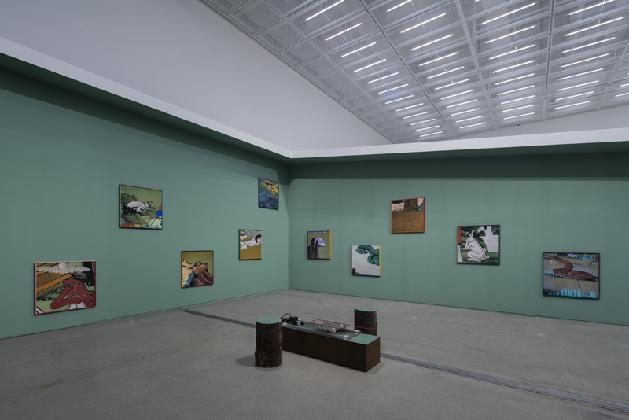
The Bright
Star and Chilseongdo series,
created in collaboration with Kim Sang-don, originate from the shamanic tool
called myeongdu (明斗/明圖). The symbolic meanings of the myeongdu, a brass ritual
mirror, are dual. The convex front is a mirror, while the back is uneven and
engraved with the sun, moon, seven stars (Chilseong), and Sanskrit characters.
Usually, a string is attached through a loop at the center. The artwork
includes three front-facing and three back-facing versions of the myeongdu,
presented on birch panels painted with dancheong patterns, alongside
works where artificial leopard print fabric is substituted for the center, and
others showing both front and back sides. The inscriptions on the back read:
North Star (北斗), Star-Mirror (星明斗), Seven-Star Mirror (七星明斗), and North-Star
Seven-Star Mirror (北斗七星明斗).
The
National Museum of Korea houses a “Bronze Mirror with Dragon and Cloud
Patterns” from the Goryeo dynasty. Dragons and clouds are shamanic symbols
associated with rain. In Jeju shamanism, the Chilseong god appears in the form
of a snake (dragon). The seven stars are also the seven sons of Princess Bari,
who became stars upon their deaths—this links to the origin stories of
afterlife deities in jin-ogwi gut and shigim-gut. The space
of Bright Star and Chilseongdo corresponds
to a celestial realm, connected to the antlered shamanic telex on the first
floor. Siberian Tungusic shamans wore massive antlered crowns and bronze
mirrors during their sacred rites. Just as prayers are offered to Chilseong,
the shaman acts as the medium of the Seven Star deity—and it was through
the myeongdu, as the corporeal manifestation of that deity, that the
divine face was glimpsed. A viewer ascending to the second floor after
seeing Citizen’s Forest might encounter the bright
spirits of the pacified souls in these “bright stars.”
The
Way to Seunggasa reads like a series of steps taken by the
viewer, who has internalized the bright star, along the ascetic journey of a
living Buddha (saengbul). Seunggasa is a temple that enshrines Seungga-daesa,
known as the “living Buddha.” Sitting in a blue or red chair beneath a parasol,
the viewer watches the slide projections. The “I” who chases these images
eventually meets eyes with those on the journey. It is the moment when reality
and unreality intertwine. Under a parasol arranged like
a dwitjeon (back shrine), one prays with makgeolli for blessings,
draws a myeongdu, and interprets the fortune based on the number of grains
of rice. In that instant, “I” become them, the viewer, the Seunggasa monk, and
the shaman—a curious transformation.
Come
to think of it, we forgot MoonWalk by Michael
Jackson. Why, then, did Park Chan-kyong suddenly insert MoonWalk so
incongruously? Perhaps it was to suggest that, after that strange experience,
time no longer moves toward the future, but rather slides into an invisible
real—called tradition.
Published in the Fall 2017 Issue of 〈Hwanghae Review〉
—
¹ Based on the press release distributed by Kukje Gallery.
² The boat of prajñā pāramitā is also
known as panya-yongseon (般若龍船). The main hall (daewoongjeon) in a Buddhist temple compound
(ga-ram) symbolizes this boat.
³ In classical literature, “an-nyeong” first appears in The Book of
Songs (Shijing): “When war is pacified and peace (an-nyeong) arrives…”
In Zhuangzi, it is written: “Desiring peace for the world, he saved the
lives of the people.” It was not originally a greeting, but a word meaning
“peace.”
⁴ When one is not at peace, one is in a state of mi-an (未安). An-rak (安樂) means peace and
bliss—equivalent to Anyang Pure Land (安養淨土).
Park Chan-kyong presented I Want to Be Reborn, in Anyang as
part of the Anyang Public Art Project in 2010. The city name “Anyang” (安養) is itself borrowed from the Buddhist term for the Pure Land. Park
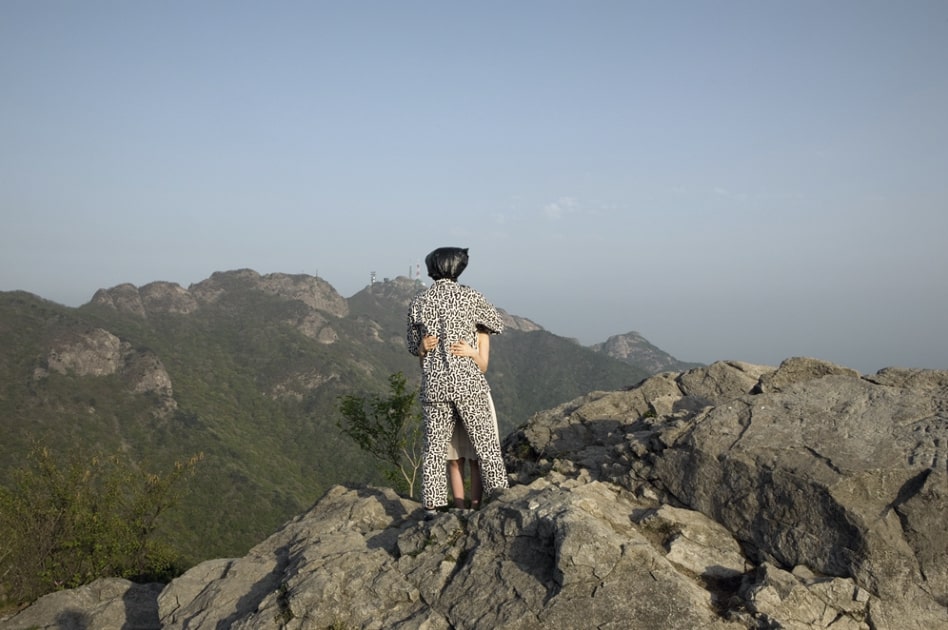
interpreted the ideograph “An” (安), where a woman stays
at home, wears a hat, and when inverted, appears to be hanging, as melancholic
symbolism of Anyang as a city of mi-an, an unpeaceful modernized town.
⁵
During the indigenization of Korean Buddhism, Mountain God Halls (Sanshingak)
and Mountain Spirit Shrines (Sanryeonggak) were incorporated into temple
complexes. The Mountain God (Sanshin) is typically depicted with a tiger.
⁶
The character 美 (“beauty”) is derived from
“great deer antlers,” symbolizing the ancient shaman. 術
(“art” or “technique”) originally referred to magical skill and those who
wielded it—called bangsa (方士)
or jin-in (眞人).
⁷
Kim Soo-young, 〈Colossal Roots〉 (1964), from Colossal
Roots, Minumsa, 1974.
⁸
Bosch was criticized by Renaissance contemporaries as a “Gothic Revivalist” or “Medievalist.”
⁹
Park Chan-kyong, “Ghosts,
Spies, and Grandmothers—Theme
as Pattern,”
keynote lecture, Media City Seoul 2014.