Exhibitions
《Times》, 2020.04.01 – 2020.05.05, Kumho Museum of Art
March 30, 2020
Kumho Museum of Art

Installation
view © Kumho Museum of Art
Rahm Parc
has explored the possibilities of valid images and contemporary painting within
a reality where the boundaries between the virtual and the real have become
increasingly blurred, working across painting, installation, and performance. 《Times》 serves as a culmination of Parc’s
exploration of painterly language across various media, synthesizing those
concerns into the format of painting, while completing her visual language that
represents today’s multilayered time-space and transitioning toward her next
research.
While Rahm
Parc’s work may be categorized alongside other contemporary artists who
interpret the sensorial qualities of digital environments through the medium of
painting, her approach to the formation of artistic language takes a distinctly
different direction. Rather than simply reproducing digital textures or
specific phenomena, Parc brings the structural language and systems inherent to
digital technology into the domain of traditional painting.
She
regards painting as a symbolic language system and a tool for communication,
internalizing the computational mechanisms that drive contemporary
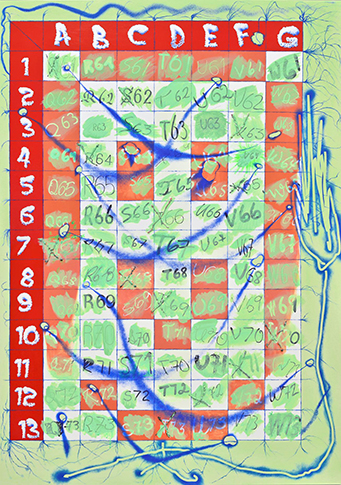
technological environments and presenting them visually. Inspired by the
structural matrix of rows and columns in everyday spreadsheet programs, she
devises a pictorial system in which colors within her paintings function as
indexes within this matrix. Each colored plane refers to and points toward
another, operating as an arbitrary symbolic system that generates visual
movement. The entire exhibition functions as a virtual apparatus, propelled by
the chain of such visual references and driven by a non-physical form of
energy.

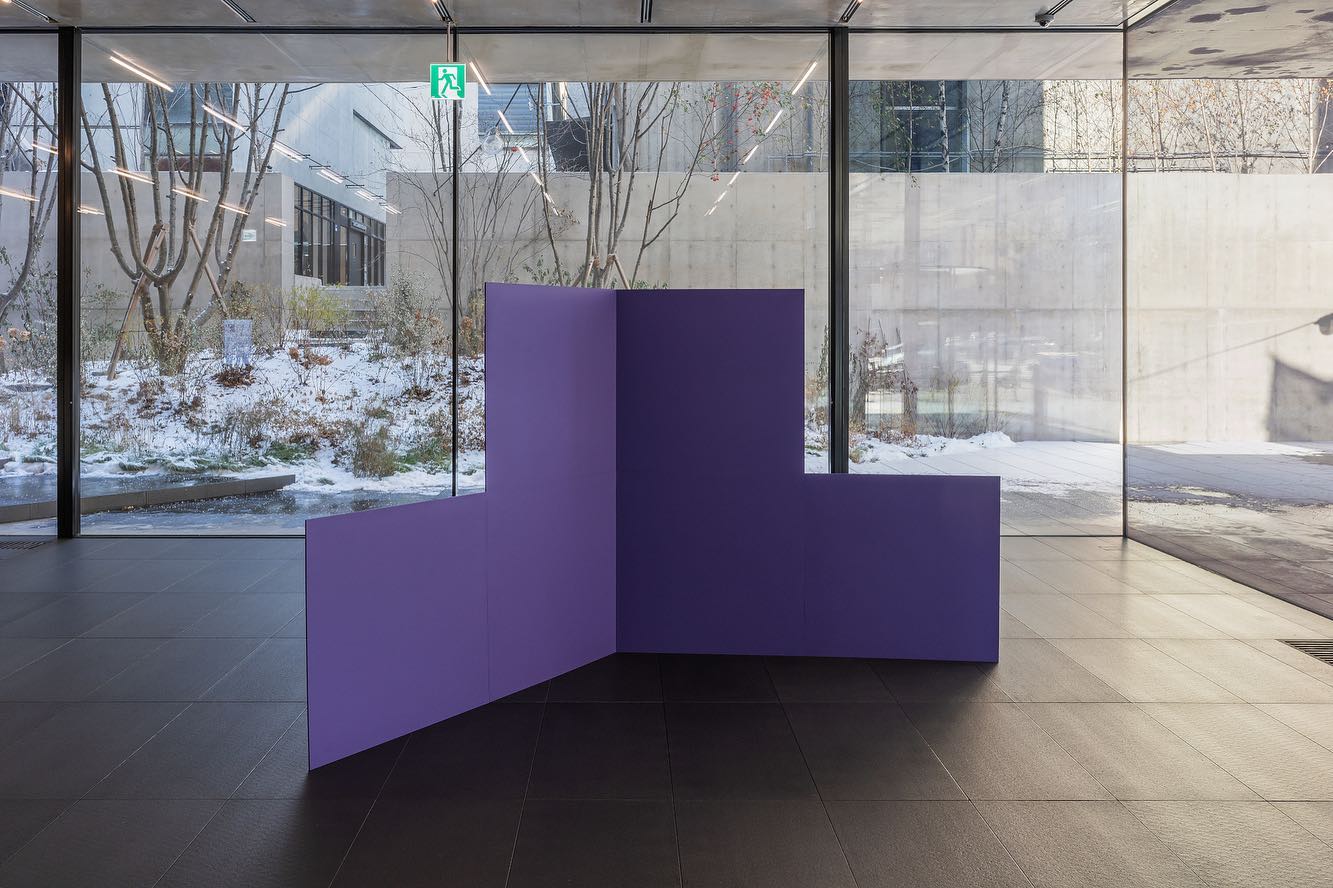
Installation
view © Kumho Museum of Art
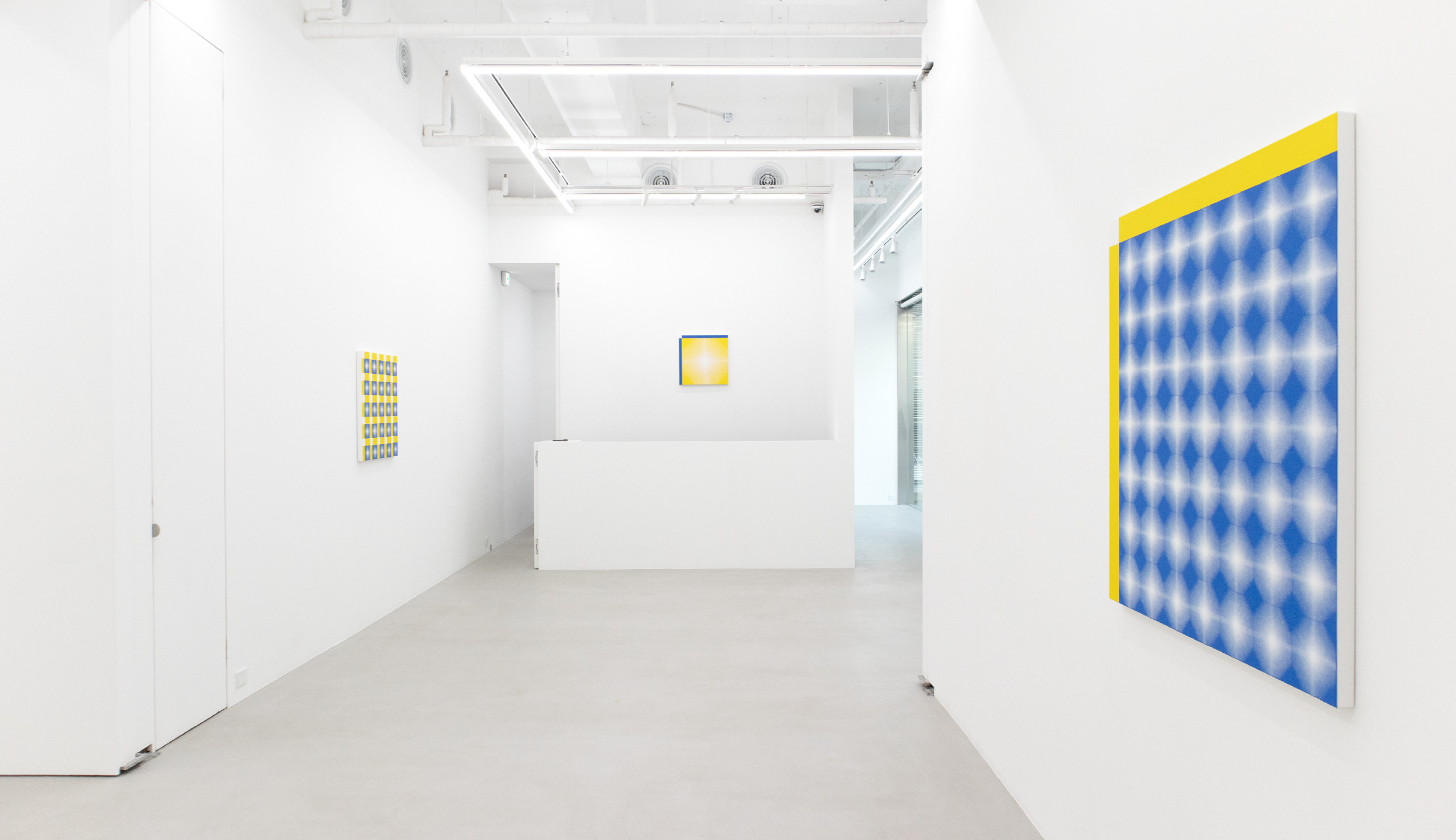
Before beginning each painting, Rahm Parc conducts digital
drawings using spreadsheet software, filling individual cells with color to
construct images. The designs created within the software are then translated
onto canvases of various sizes and proportions. The paintings, composed with
standardized colored paints, take on a modular structure that fills the gallery
walls.
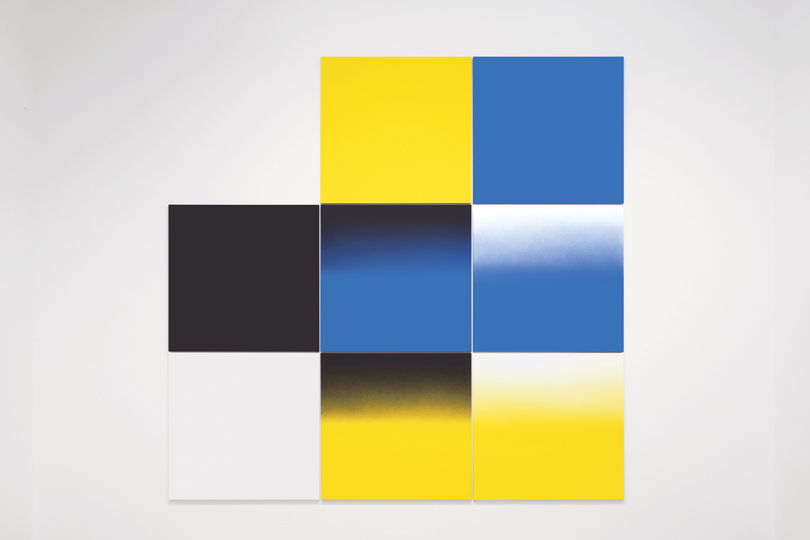
The gradients painted with stencil brushes indicate and reference
the matrix of cells, where each cell is indexed by its respective color,
evoking effects such as infinite convergence toward a single vanishing point,
the generation of kinetic energy, or a visual sensation akin to ascending and
descending stairs.
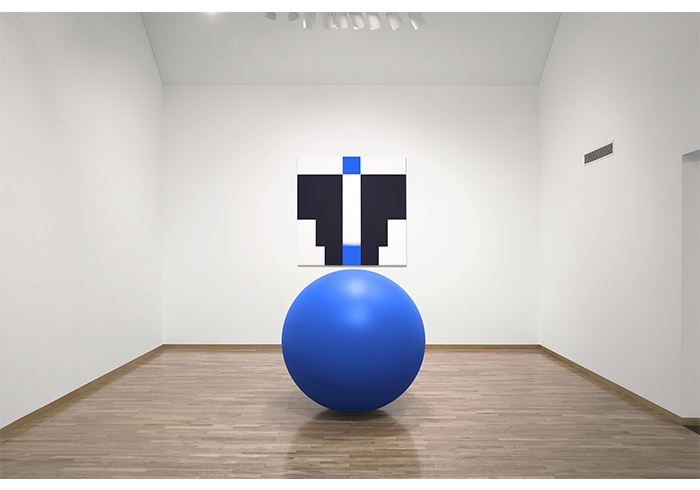
Two blue spheres of different sizes, Eye-Finger(2019–2020),
embody the contemporary perceptual experience in which sight and touch operate
in sync, as if they were a single organ. The work functions like a scaling
mechanism that expands and contracts the space, naturally guiding the viewer to
"zoom in" from the outer gallery to the inner exhibition space. The
spheres also reference a matrix of blue lines and rows located elsewhere,
transporting the viewer through time and space.
The large-scale, eight-canvas work Times(2019–2020)
generates a clockwise visual movement, resembling an imaginary clock. Though
the work appears to translate images from software into physical objects on
canvas, resembling a diagram processed through mechanical information handling,
it ultimately resists being reduced to a simple system of inputs and outputs.
Rahm Parc’s paintings operate as devices that propose and induce
the free movement of images. They fluidly expand, fold, and reconstruct the
rigid walls of the exhibition space, as well as the firm constructs of time and
space, within the realm of imagination. Each colored plane points to another
time-space coordinate, generating the viewer’s visual movement. By creating
these virtual images, Parc invites viewers to engage in a playful pursuit of
tracing and following these movements.
The modular canvas units not only comprise the entirety of the
structure but also imply the potential for rearrangement into other forms,
simultaneously suggesting alternative configurations and referencing imaginary
coordinates.