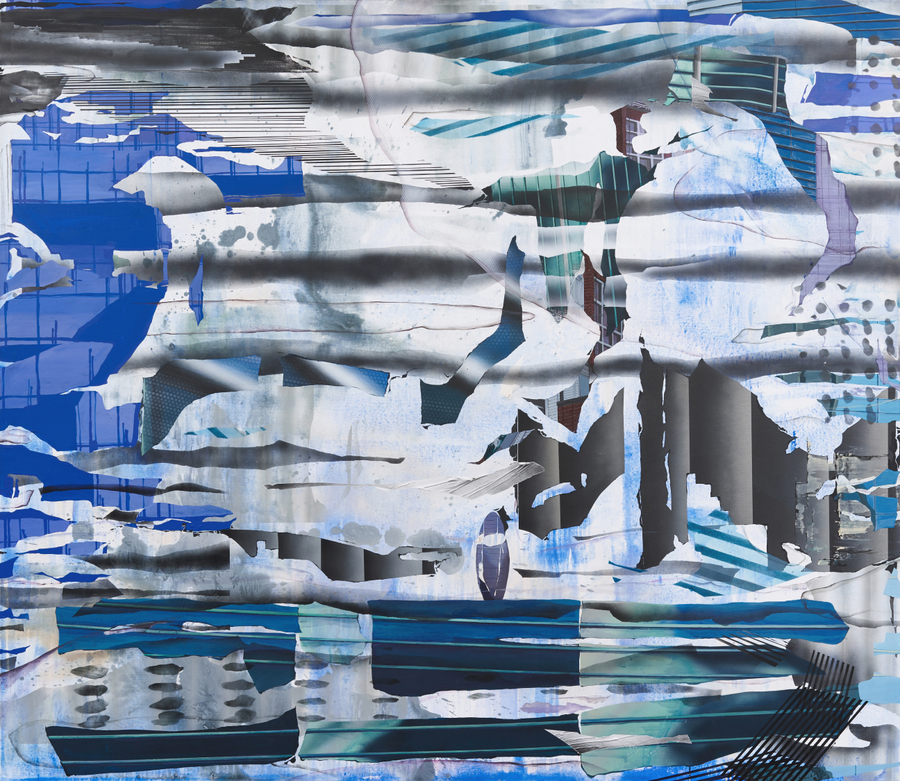
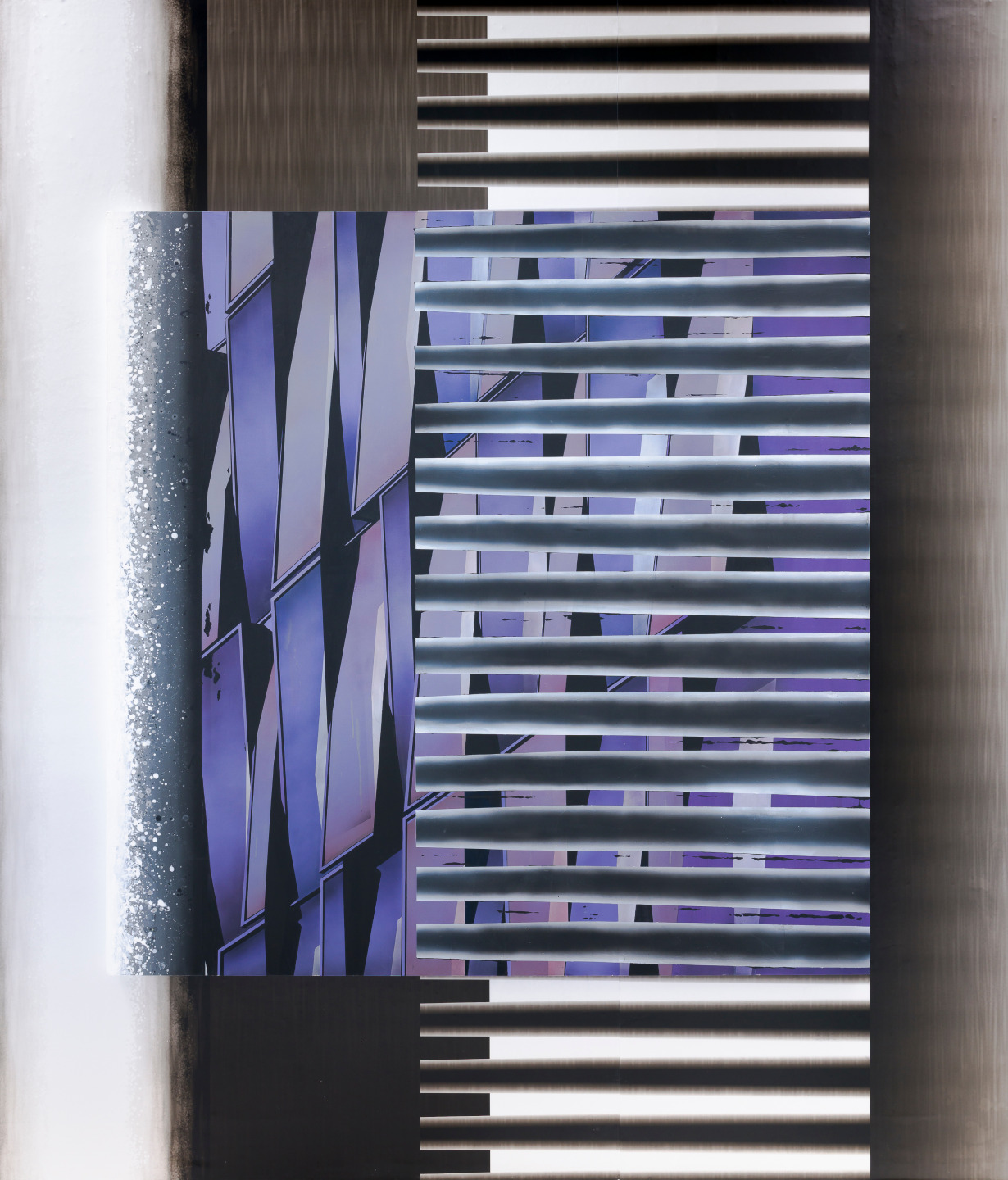
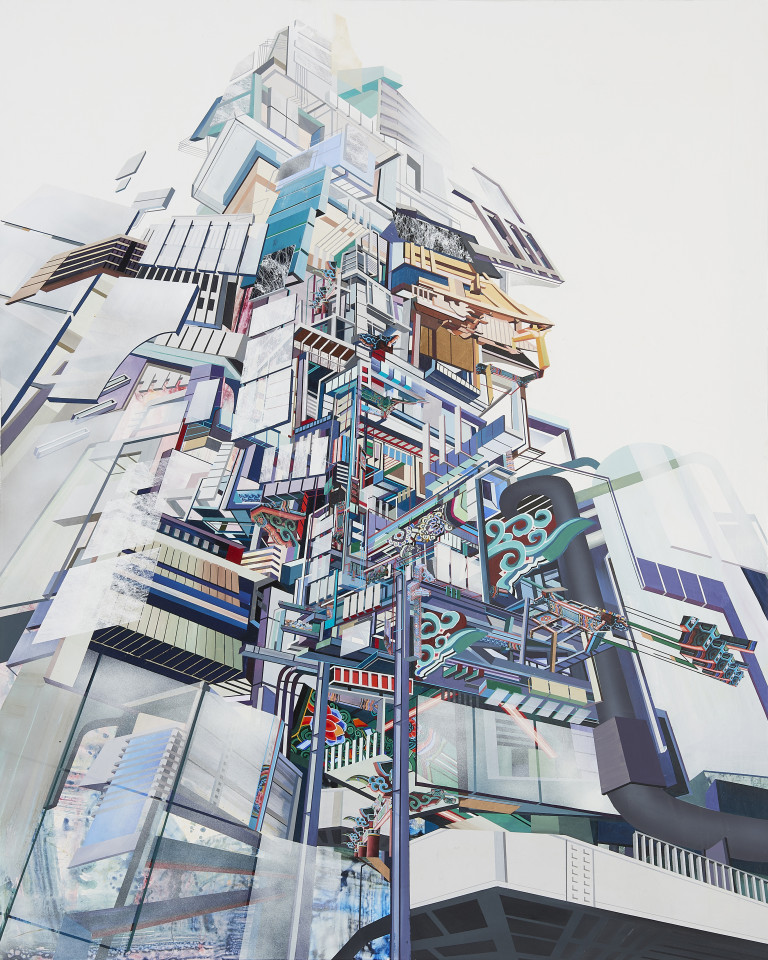
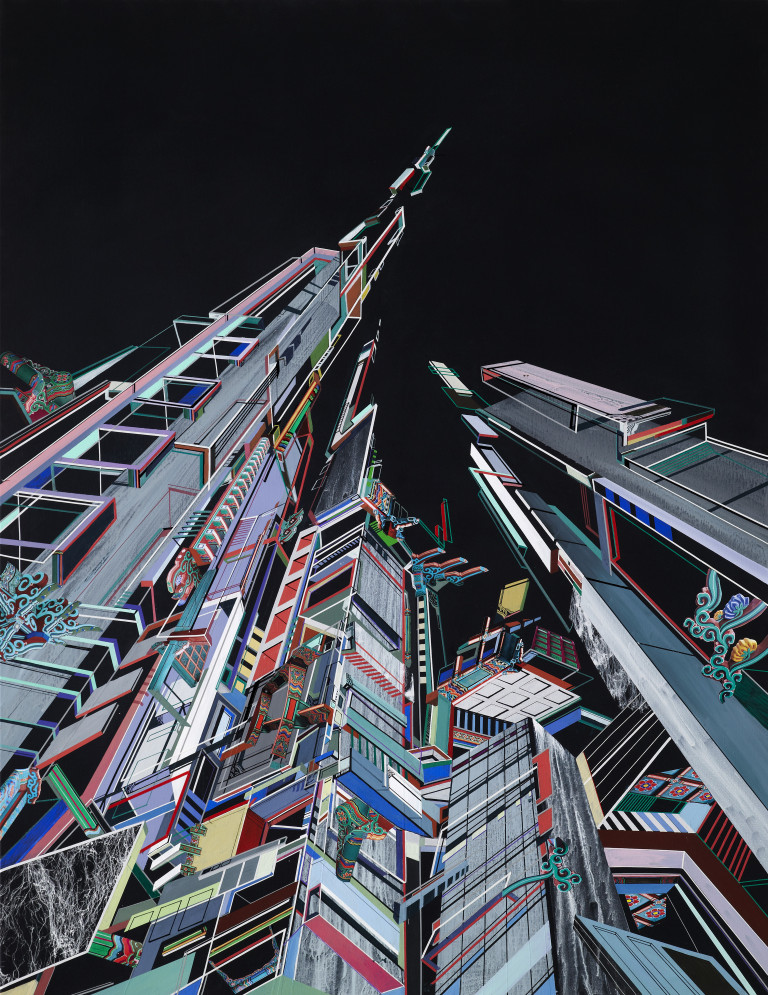
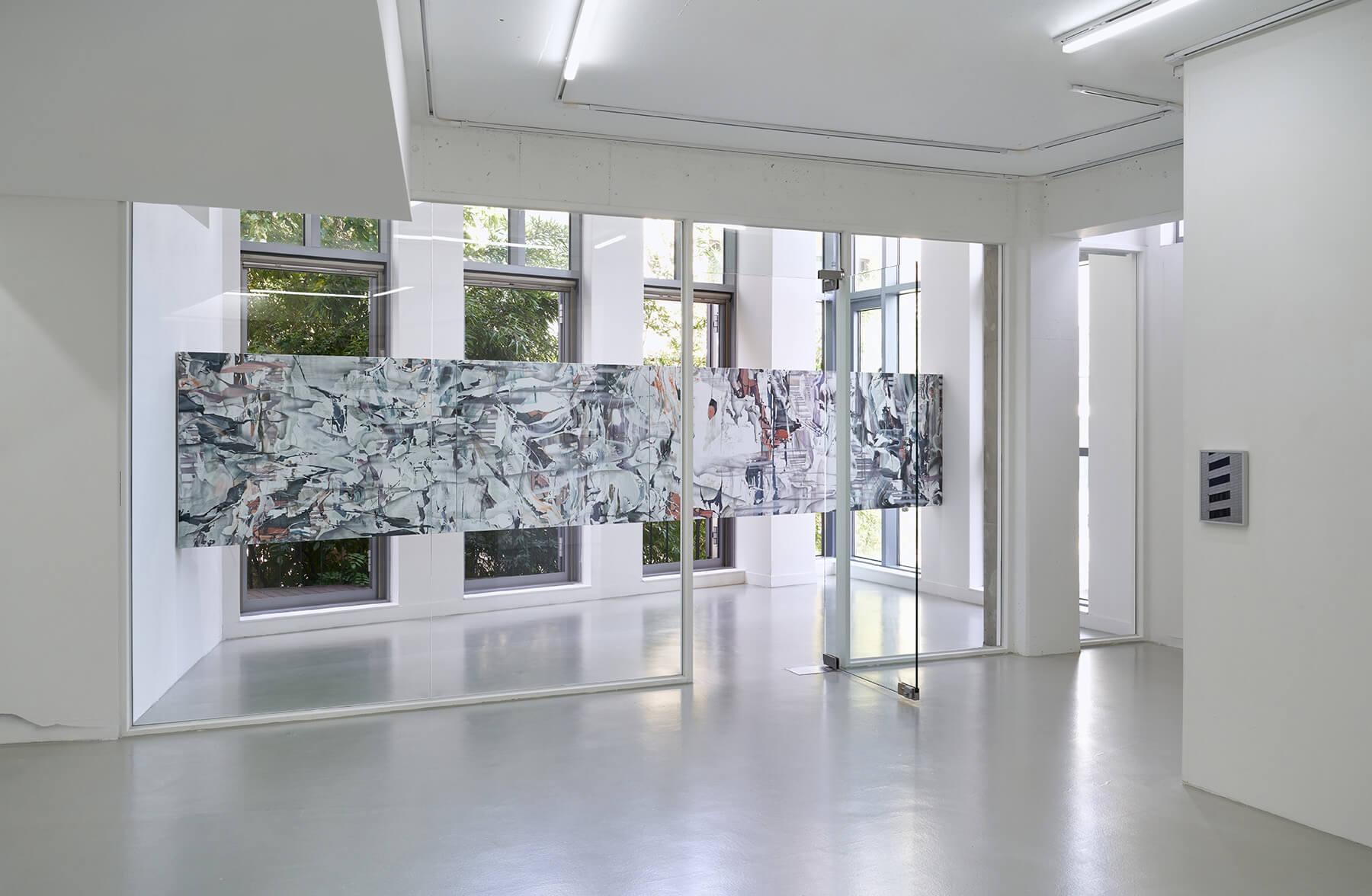
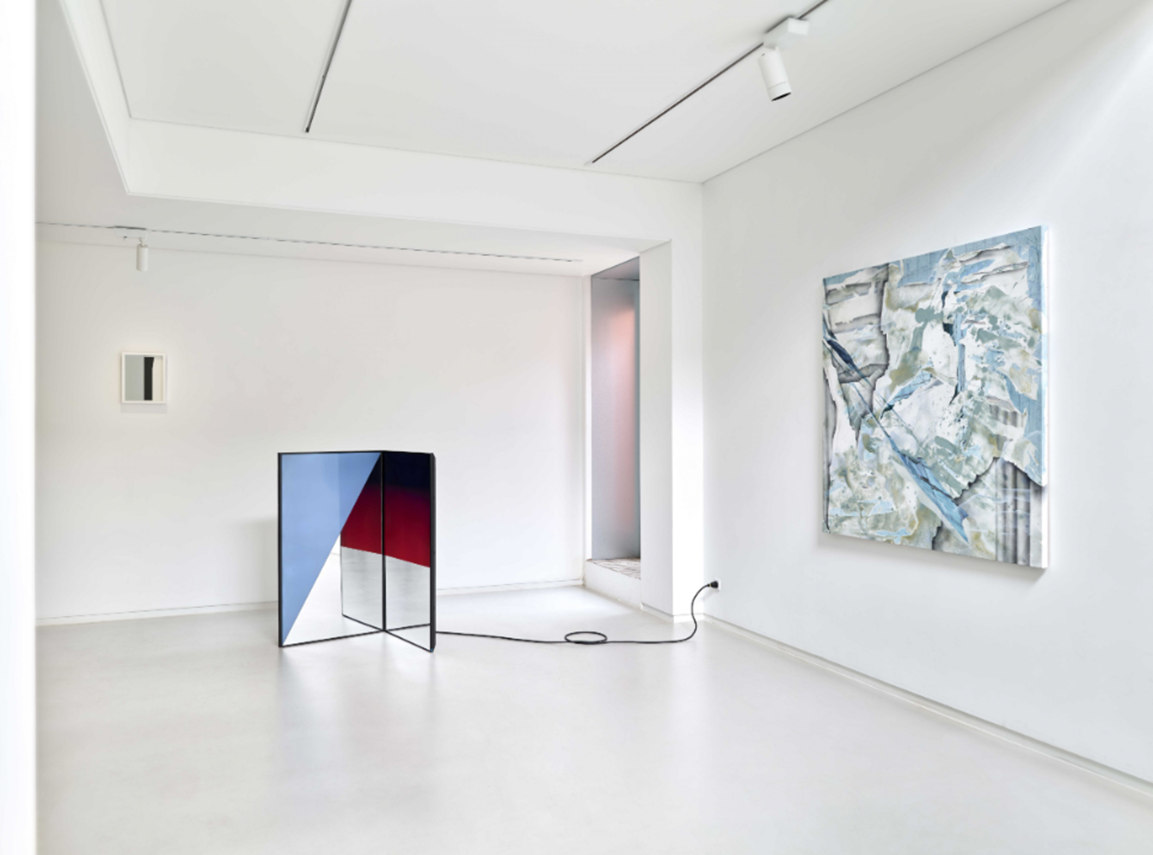
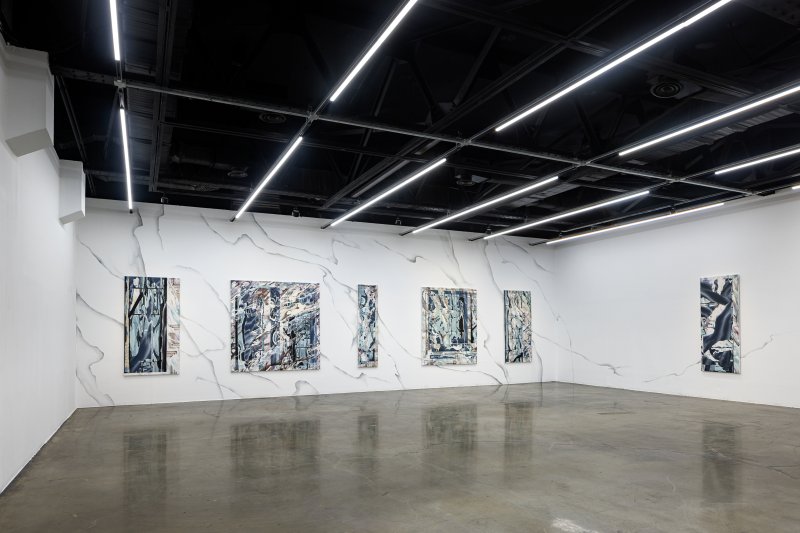
The reflection and penetration of
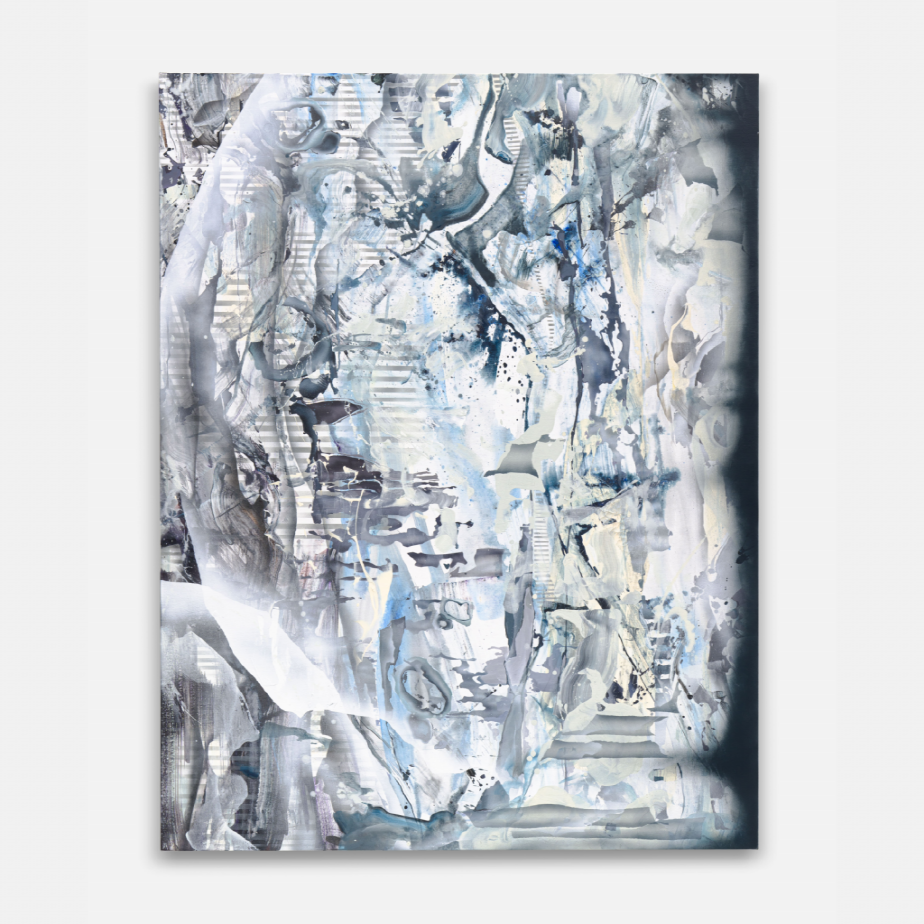
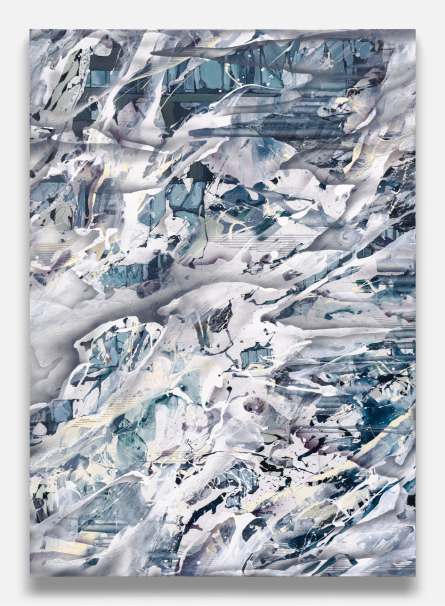
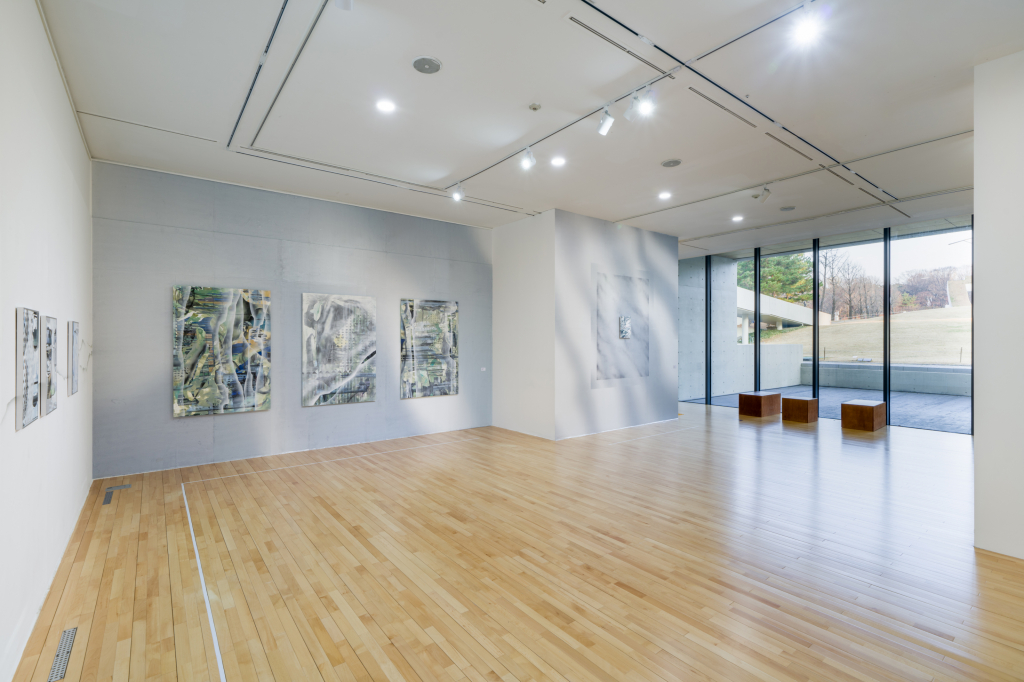
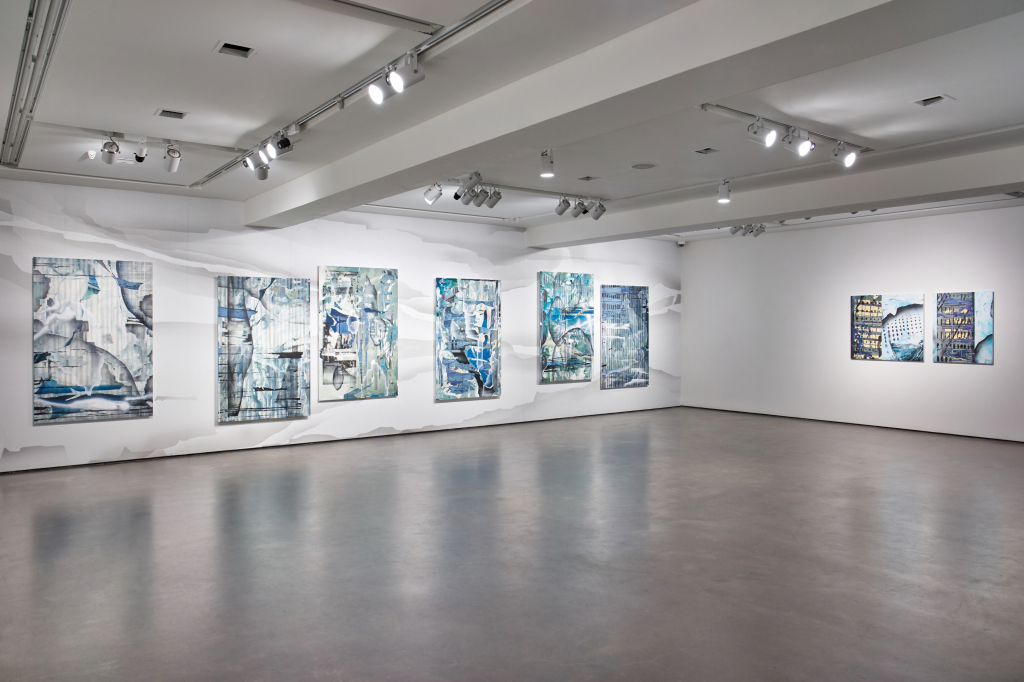
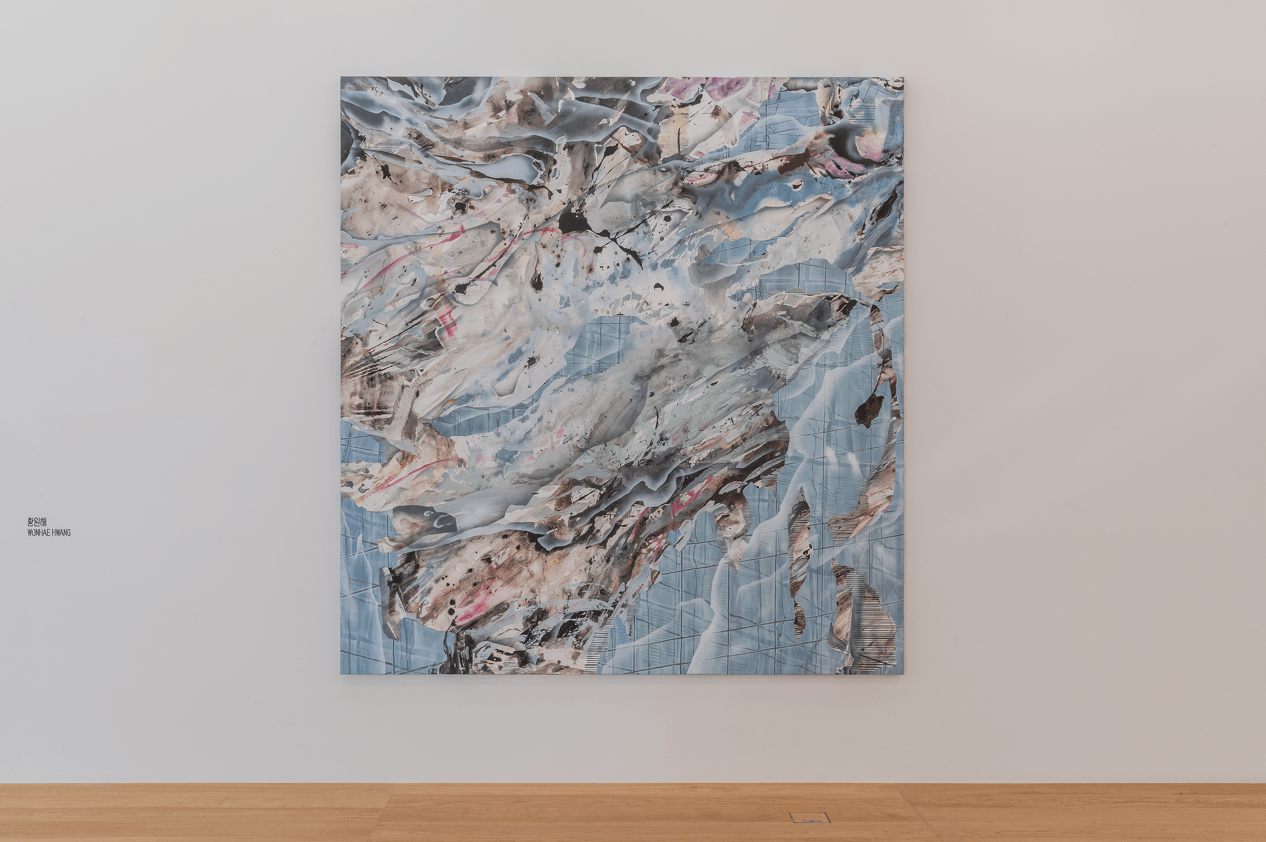
facade with glossy glass and the fragmented screen tone[1] permeated on the
incomplete architectural structure are the important materials for Wonhae
Hwang’s recent artwork. It is disassembled and recombined in the canvas and
presents a new material landscape. Such a repetitive outcome makes the
complexity of the screen with the bluish movement of the images. However, the
experiments on scenes that the artist takes are quite straight forward.
Discovering the combination of materials, drawing it, and breaking up the
symbol and the physical connection are what she tries to cultivate on the
canvas as she immerses herself in the form of painting. She compares this
method to a kind of cross processing.[2]
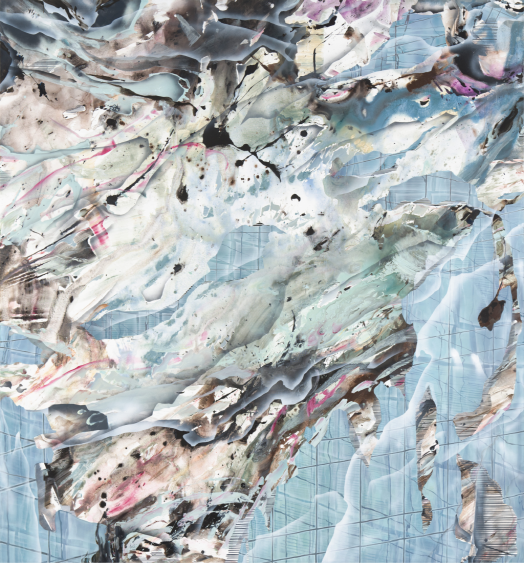
Ignoring the bumpy surfaces of
the real three dimensional environment, the images created by combining the
pattern obtained from the outer layer of the building and the screen tone are
overlaid with a landscape structure that is completely different from its
original state.
Although the initial composition
of the work has a transparency to follow up the traces, the final state of the
painting and the process to determine its surface are not simple. The landscape
that the artist has been paying attention changes over time, and it tells us
why such the surfaces emerged. 〈Phantasmagoria〉 (ARTSPACE BOAN, 2018), which captures time and space at the
historical level, like the words ‘Crack-ing/Reconstruction/Flake’ appearing in
the title of the work, has taken the artist's attention all the way, and the
language of creation and dissolution of the entire architectural structure
became the relevant reference for determining the images.
What the artist wants
to focus at this point is a visual record of the traces, memories, accumulations,
and conflicts of the city Seoul as well as physical space of it. The images
deviate from the frame, overlapping or even penetrating through the cracks on
the walls, but it still grasps the pictorial rhetorics of the flat surfaces.
The attempt to blur the boundaries between real and virtual spaces with the
frame of the canvas is more evident in 〈The Forth Wall〉 (ARTSPCAE Hyeong, 2020).
While the previous works combined
the historical characteristics of the architecture with its unique visual
elements, the recent works seem to focus more on the physical effect itself
which produces the surface. This can be found on the artist’s attitude toward
the materials as she refers to the characteristics of the materials as
‘Suspension/Slurry/Emulsion’. This changes mean that the artist’s intention
towards the image collection tends to capture the passive relationships of
objects as they are. Rather than adding arbitrary interpretations on artificial
things, including nature, it focuses on observing the actions and reactions.
This brings up the images of the giant facade and the commercial advertising
billboard in the city mixing with light reflection at the moment when the
substances in a small glass flask reacts chemically. Currently, Wonhae Hwang’s
perspective seems to linger between the observation and seeing. Looking at the
outside world and reproducing the scenery are the old habit in the history of
painting. It is very trivial and natural things, and the huge events and the
consequences can not be forecasted.
Landscape, the conventional name
“At this moment, the conventional name, landscape, is no longer enough for us.
This word somehow seems to mean nothing more than a hand skill, and my whole
body rejects it. ... Now I suggest the following words: Earth life, a picture
of earth life.”[3]
In the past, landscape paintings
were regarded as a low quality work that simply satisfies visual entertainment
compared to historical paintings featuring saints or heroes. Only the landscape
paintings with the appearance of figures and events in religion or mythology
were barely appreciated. On the other hand, this genre, which has been pushed
aside from the art academism, is guaranteed freedom from existing rules and
ideas. This might be the reason that modernism after classical art is closely
related with the subject of landscape.
The illusion of the city becomes another
concept of nature, and it is frequently encountered around us more than the
real living nature. Given this situation, how can Wonhae Hwang’s painting be
interpreted? Can it be said that the classical artist's [4] perspectives to
treat everyday life as an organism so-called earth-lifepainting rather
than ‘the conventional name of landscape’ may provide an open ending to each
image that otherwise explained roughly on the same level with today’s
technology and new generation? To not penetrate historical events into daily
scenes captured by artists, and to continue aesthetic experiments by observing
the new organic properties of the earth environment are similar to artists’
independent attitudes who work on landscape painting beyond of the mainstream
of historical painting.
Collage and Mash-up, an
Overlooked Technique
What kind of forms does the technique have beside the broad concept of painting
genre? The most eye catching points are the two-dimensional combination between
the three-dimensional architecture and the screen tone which is a virtual
shading effect. This combination is emerged in the form of a collage that goes
back and forth between the real and the digital. If the collage from back then
aimed at absence which is the opposite of representation, it is now embodied in
the overall painting process of conception, production, and arrangement as a
skill. It belongs to the same category as mash-up [5] which takes a key role in
the production of images in contemporary art, and they are mixed with each
other and have a great influence on image production.
However, ironically,
traces of these techniques (especially in painting) are again deleted with ‘the
hand technique’. ‘The hand technique’, which has been neglected, is not just
treated as a mere tool of representation, but rather becomes a factor that
secures intentional ’ambiguity’ in the image created by digital technology.
Wonhae Hwang’s artworks do not depart from the logic of digital convergence,
which finds an appropriate connection between technology and concepts. By the
brush strokes and margin among the planned images in a virtual environment, the
artist gives the screen an appropriate abstraction, and at the same time the
physical interaction and the expression of the work are emphasized.
In this
exhibition, the artist has an intention to keep the flatness of painting in her
own way through the recognition of audiences facing the artificial object in
the canvas as she crosses the ambiguous boundaries between the compromised
perspectives and the frame. The artist explores the substantial matter of the
landscape we have passed by and is looking for a new space for another quality.
[1] A tool in media
animation production used for gray scale shadow, shape, and pattern. In this
paragraph, it means a tone for paper manuscript used in the past. Recently,
there is a computer manuscript for the same purpose. See National Institute of
Korean Language.
[2] Beside the standard values
already determined in photography such as the film manufacturer, lights, and
chemical substance, the customers intentionally change the standard values to
affect the outcome.
[3] Lee Hwajin, 2018, Association of Western Art History,Carl Gustav Carus 『 Nine Letters on Landscape Painting (Neun Briefe über
Landschaftsmalerei, Leipzig: Fleischer』(1831),
[4] Carus uses the neologism
earth-lifepainting (Erdlebenbildkunst) to criticize landscape painting
tradition and modern perspectives on nature. Based on the philosophy of
Friedrich Wilhelm Joseph Schelling, Carus asserts the oneness of nature and
human spirit.
[5] Gunkel, David J,『Of Remixology: Ethics and Aesthetics after remix)』, MIT PRESS, 2016.