Sculpture has recently been making a comeback in Korean art,
following painting. A growing number of artists are calling themselves
sculptors, researching new sculpture techniques and working hard to produce
powerful sculpture works. Several special exhibitions have highlighted their
work, either individually or collectively. But the term “comeback” implies that sculpture had
disappeared, and this claim is too easily refuted. How many sculptures have
appeared in our urban landscape since the Building Artwork Policy was
introduced, in 1995? It can safely be said that the production of sculpture has
never decreased in quantitative terms. But when it became a legal requirement
to insert sculptures into the urban scenery in affiliation with buildings, the
genre’s fate headed toward a sort of upside-down
ready-made. Things that should have been works of art were apathetically
produced and then neglected in non-artistic contexts where no one expected to
see an artwork, evoking a sense of skepticism about the very nature of art
among the few people who actually looked at them.
While the concept of creating a particular object known as an
artwork, based on traditional aesthetic media such as painting or sculpture,
cannot itself be wholly denied, it long ago started to be seen as somewhat
obsolete. In Korea, video and digital media emerged as new areas of interest in
the exploration of media at least as early as the 1990s, while there has been a
growth in works produced using various conceptual approaches that go beyond
medium-centric thought to reconsider the divisions of art itself. At the same
time, art galleries have changed from specialized and exclusive abodes of
artworks—as distinct from everyday objects—to open stages, allowing the symbolic, architectural and
performative arrangement of various heterogeneous items. This is a well-known
story. Relatively less discussed is the fact that, within this changed artistic
environment, creating sculpture has suddenly become an enigma. Many artists who
majored in the genre have avoided describing their works as sculpture, even
when these works are indeed three-dimensional; even more frequently, they have
expanded their work into media installation or changed direction altogether and
moved into video work.
It was in this climate that Minae Kim majored in sculpture, in the
mid-2000s. Over the past 10 years or so, while sculpture as an artistic topic
sank below the surface and then came back up, she has constantly explored
sculptural questions. But her approach is far from being one of dominating
spaces with monumental masses that redefine the concept of sculpture. On the
contrary, she recognizes a specific space for exhibition as a mold and pedestal
of sculpture, from which an eccentric object is drawn to subtly disturb the
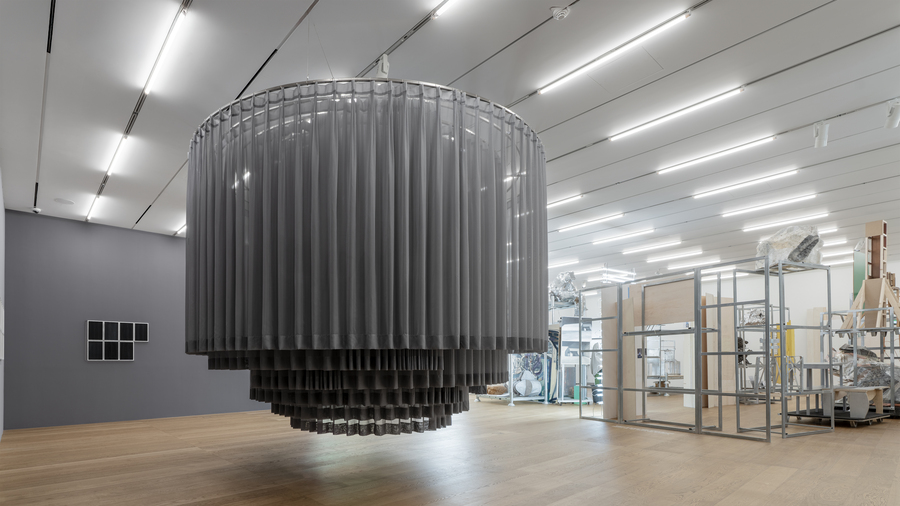
order embodied in the space. In her works, sculptural elements have the
capacity to open and reveal the gaps between objects and space. They redefine
sculpture as a new issue, unconstrained by its traditional media—the totality of materials and convention to create an artistic
volume.
Minae Kim is known for work that cleverly latches onto the
architectural order which is physically constructed to program the types and
ranges of events in the space, then throws it into confusion, altering spatial
perception in unexpected ways. A typical example is Relatively
Related Relationship (2013), a work in which Kim borrowed
railings as a form and installed unidentified railing-type structures in
various places throughout the exhibition hall at MMCA Gwacheon as part of
the New Visions 《New Voices
exhibition》 (2013). Railings are normally devices
used to limit movement and prevent injury at points where changes in level
occur, such as flights of steps. But Kim’s
railing-shaped structures posed as safety barriers, preventing access to works
to protect them from damage by viewers, or confusingly blocked lines of flow,
or guided the eye along imaginary lines of movement, as if a path led up beyond
the ceiling, in the absence of an actual staircase. Such works reminds of the
tradition of the institutional critique, such as shutting exhibition rooms
completely or smashing up the floor, and of the phenomenological approaches
that cause viewers to newly perceive the exhibition venue as a purely physical
space. Yet they do not yield easily to such reductive classifications.
Just as Kim’s objects
belong in no specific category and constantly evade our grasp, so do her
spaces. At first, the artist seems to have recognized the space as a physical
and systematic institution, both an external environment and a framework
already internalized inside her, then attempted to explore this confining space
through sculpture. As an MA student, she attempted several works made from
boxes featuring cutouts exactly the right shape for holding specific
sculptures. In some (030516, 2005), the sculptures are
inserted into the cutouts; in others (040111, 2004-7), they
have come out of the boxes and are staring blankly at the empty holes from
which they have emerged. Finally, the sculptures disappear completely, leaving
several hundred empty boxes with cutout profiles of figures waving hello or
goodbye (Hi-Bye, 2006-7). The link between objects and space
is not one of ping-pongesque reciprocity in a single place, but one that
advances constantly to new places and changes constantly into different forms.
There is more than one way to move from here. Kim could have gone
beyond sculpture, or left art altogether for the world outside. She didn’t, but that does not mean we should jump to the conclusion that she
failed, ultimately, to escape the yoke of the system. Rather, Kim has driven
her own vehicle of space and objects, a strange contraption with a wheel on one
side and a brace on the other, tottering around wherever she wanted to go.
Though she herself does not claim to have been exploring sculpture until now,
she has maintained a constant awareness of the rules that define the
sculptural, at once reflecting them and working to find oblique angles of
escape from them. Because each of her works began with different,
externally-determined conditions, it is hard to sum up her entire trajectory in
a single chronicle. But Kim has developed types of technique in response to the
contexts of their work, and it is possible to trace the paths of these types as
they evolve through constant repetition, or undergo unpredictable
transformations.
First are works that send contradictory signals between movement
and stasis; works that, put simply, represent situations of stalemate. By
adding to an existing space a minimal number of objects imitating the
architectural elements around them, Kim creates situations where all directions
are open but we do not know where to go (Blind Alley, 2010),
or where we are given a clear direction in which to go, but no way of doing so
(Distant Stairway, 2011). The objects she has introduced are
thus similar in outer appearance to functional objects but useless. This effect
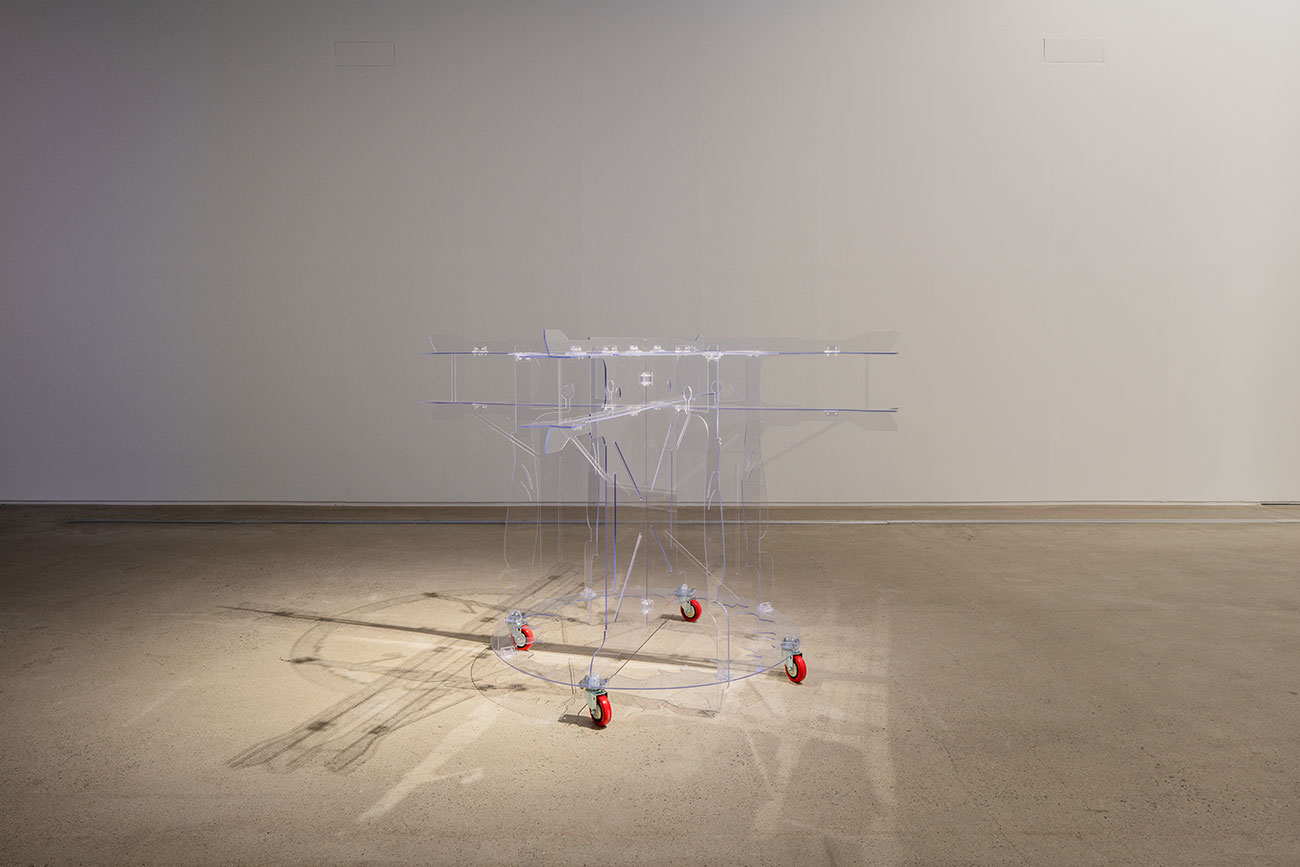
finds its most extreme expression in Rooftoe (2011),
an imitation column, added below a truss where no column is needed, with a
wheel at its base. At first glance, the work looks like a column that must stay
in place, without moving, but it does not actually need to be there. It stands
there, neither a proper object nor a meaningful architectural element, while
the red wheel at its base serenely bears the burden of twofold redundancy.
This approach, mainly formed at Kim’s college while studying in the UK, was both a response to spatial
programs for producing work and training artists, and an exploration of the
impossible position for sculptures as neither everyday items nor architecture.
Moving further towards works for exhibition halls, the self-denying qualities
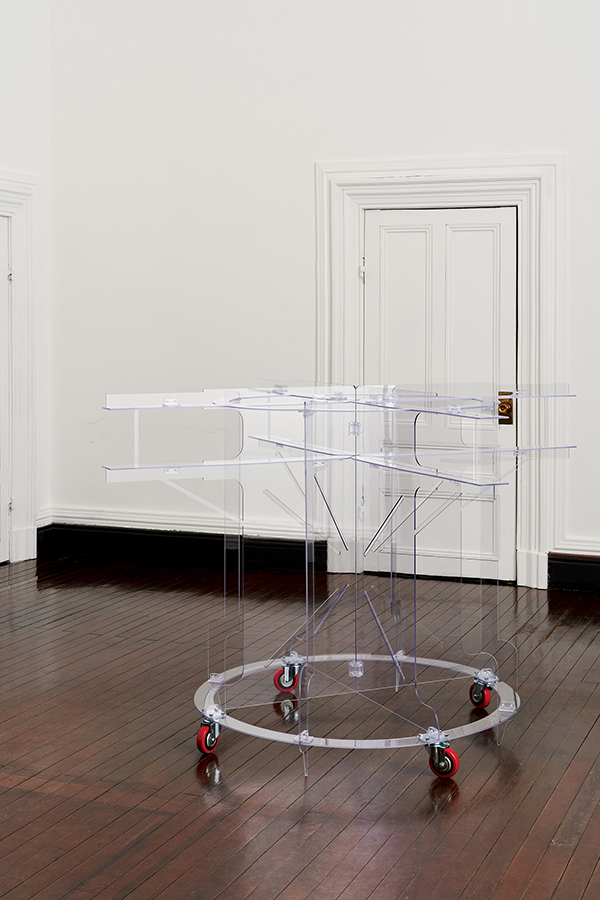
of objects grow stronger. Here, we find structures that fit perfectly into the
square corners of the room when stood up, but have only one leg, with a wheel
at its base, so cannot stand up by themselves (A Set of Structures for
White Cube, 2012), works made from three connected wooden crutches
that can stand up by themselves but have lost their original function of
movement (Free-standing Sculpture, 2012) and works that
invalidate their own specificity by accepting all the functions and meanings of
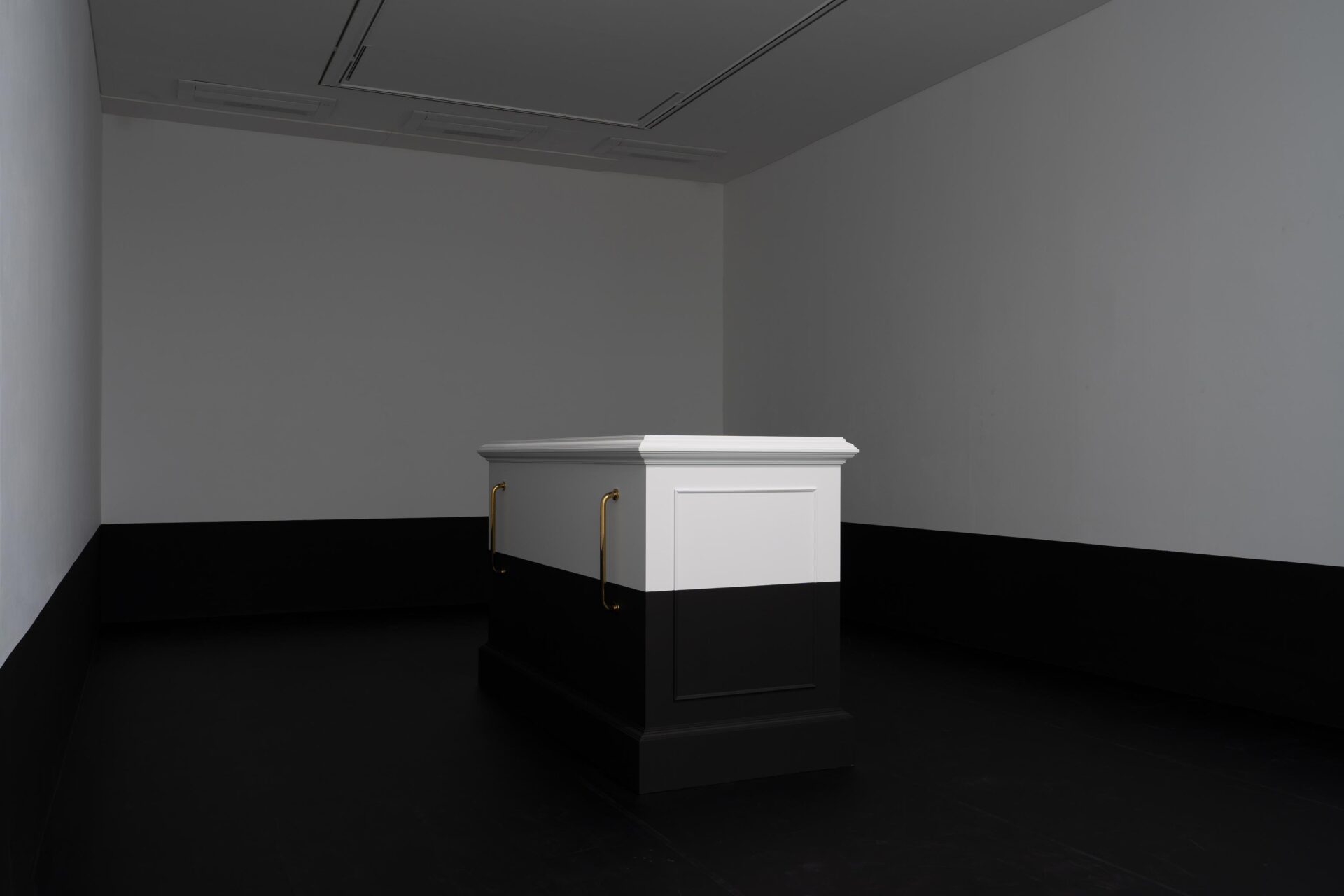
objects that are legally allowed into the exhibition venue (Golden
Pillars – Table, Plinth and Object, 2012).
The artist did not stay for long in this blind alley in which
objects had to assert and prove themselves. By this time there were already
plenty of venues that, unlike classical White Cube with its principles of pure
space exclusively for exhibiting artworks, upheld the historical character of
their locations and the architectural qualities of their buildings, opening
themselves to extra-artistic contexts. This provided Kim with room for new
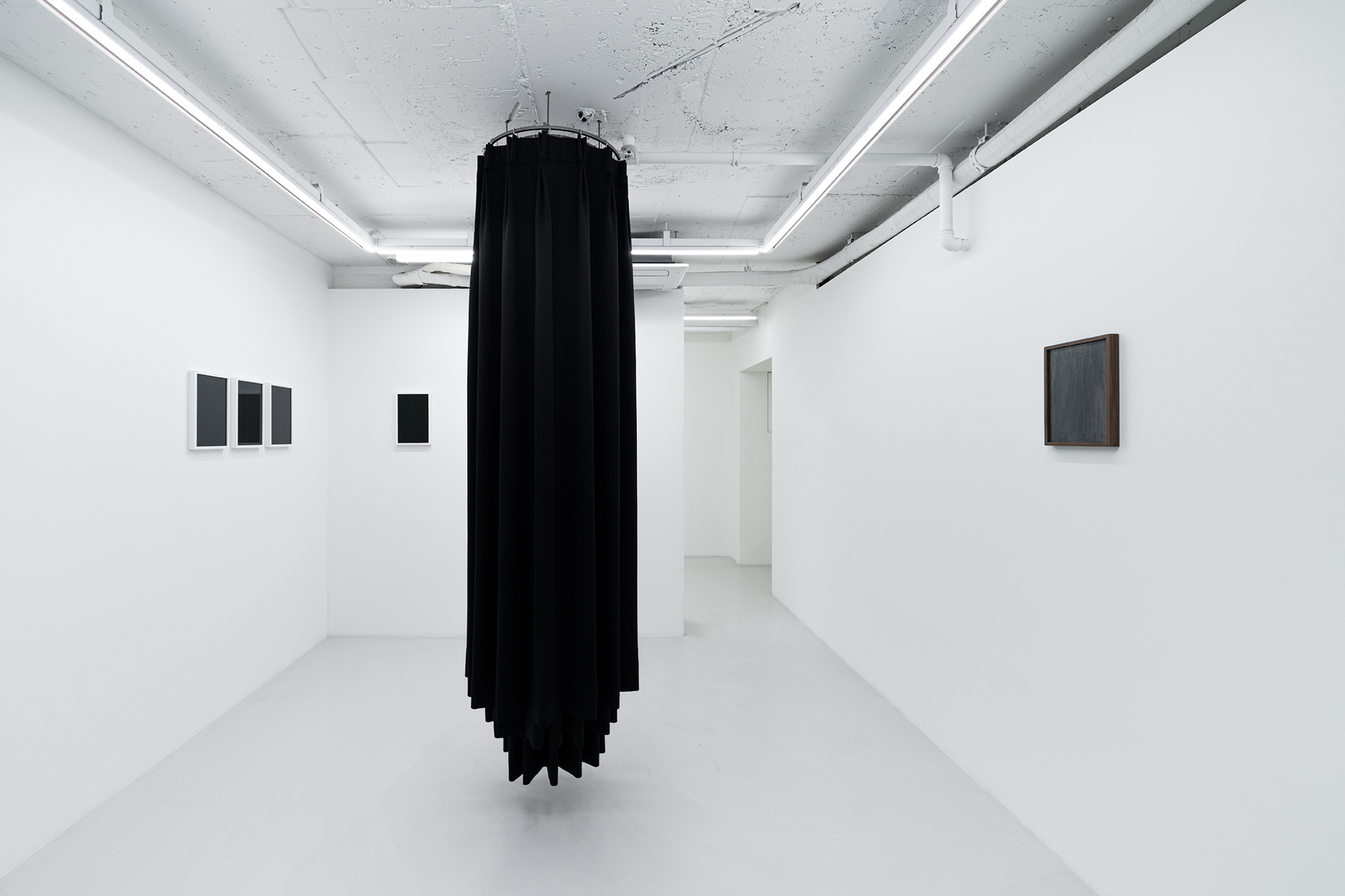
experimentation. She focused on making objects abandon the will to move or its
opposing lethargy, physically or virtually reflect and multiply the spaces in
which they were placed. To this end, she introduced walls and curtains, windows
and mirror frames, or simply flat objects of various sizes, transparencies and
reflectances. The forms of fake windows recur with particular frequency. Kim
installs framed canvas and lighting in the shape of windows on the inside and
outside of an external venue wall (Behind the Scene, 2012),
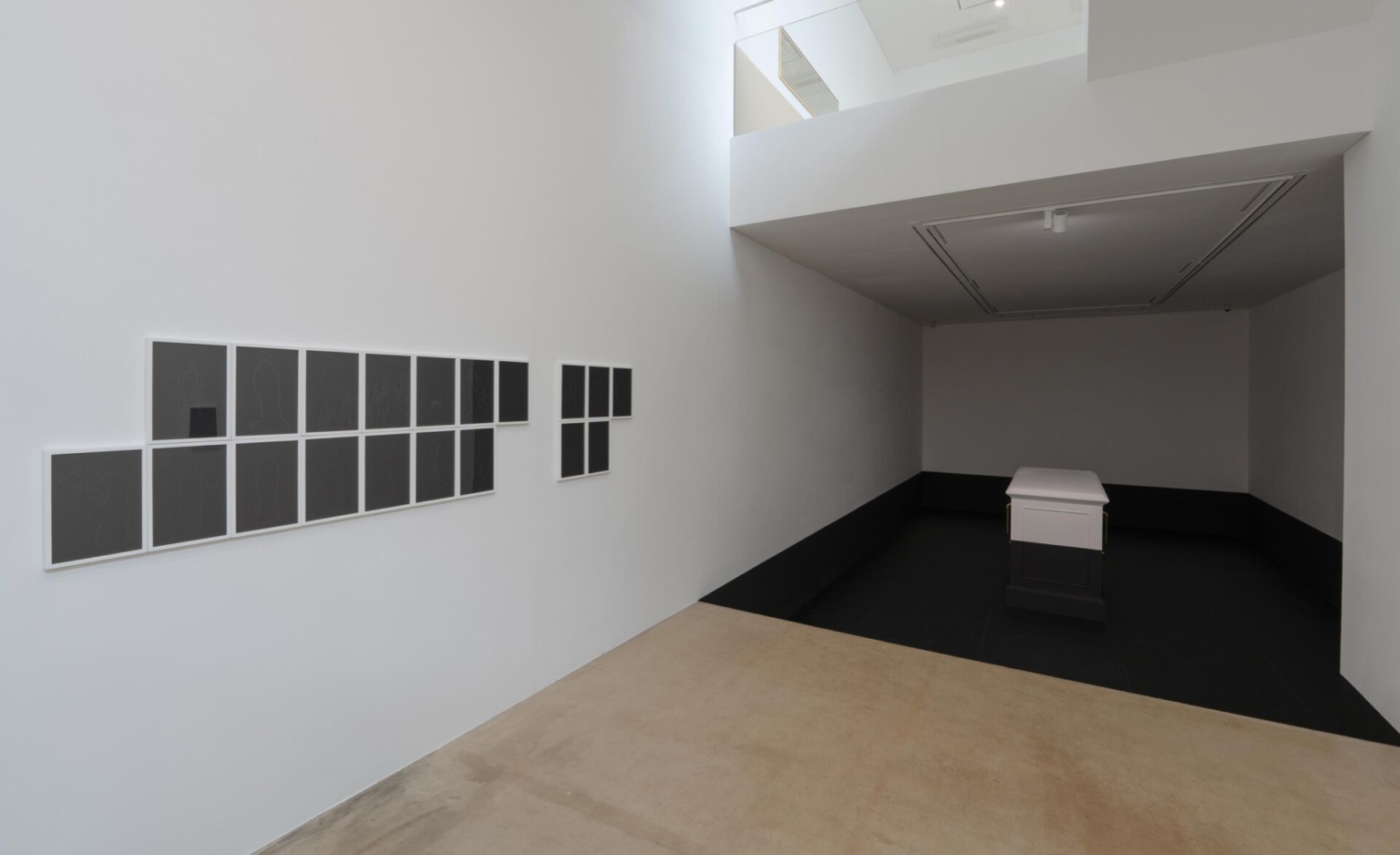
or hangs a mirror on the front and back of a partitioning wall between two
identical police cells (La Reproduction Interdite, 2012),
creating the illusion of a window. Such devices, as intended by the artist, not
only deceive the eyes of viewers but function as a type of public screen,
inducing viewers to imagine what lies beyond them—spaces that do not actually exist and therefore cannot be confirmed.
Strictly speaking, these were not completely new experiments but
repeat attempts at the approach taken by Kim in 2008 at her first Seoul solo
exhibition, 《Anonymous
Scenes》. But while in 2008 she focused on materially
presenting the spatial illusions she had experienced around her, and the
fantasies they triggered, within the exhibition space, her works this time
adopted a structure that was comparatively open to the unknowable memories and
imaginings of those passing through the space at that moment, including the
artist herself, or those who had occupied it in the past. This approach was
further solidified in 2013’s Richard
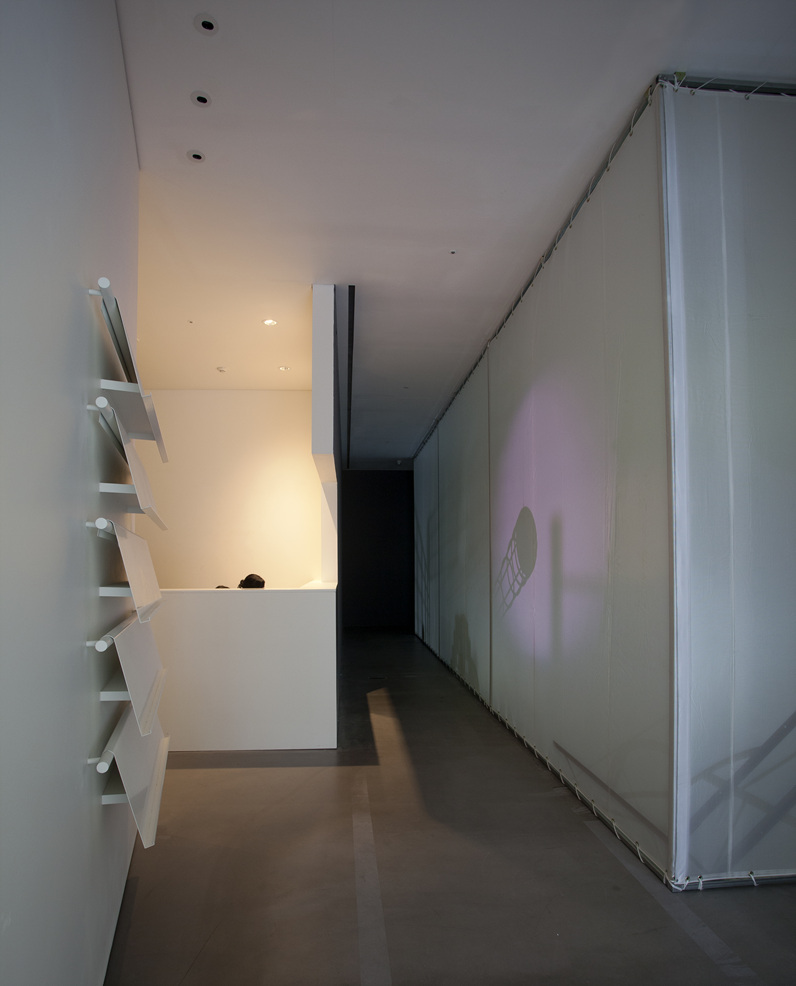
Smith, a one-day project in collaboration with curator Kwon Hyukgue.
For this work, based in a project space at a shopping arcade in a residential
area due for redevelopment, Kim posited an imaginary figure who had lived in
the neighborhood and created ambiguous situations that allowed viewers to
imagine meeting him. Here, the artist and viewers were placed in the same
predicament of having to conjure an image of an unknown being based on only a
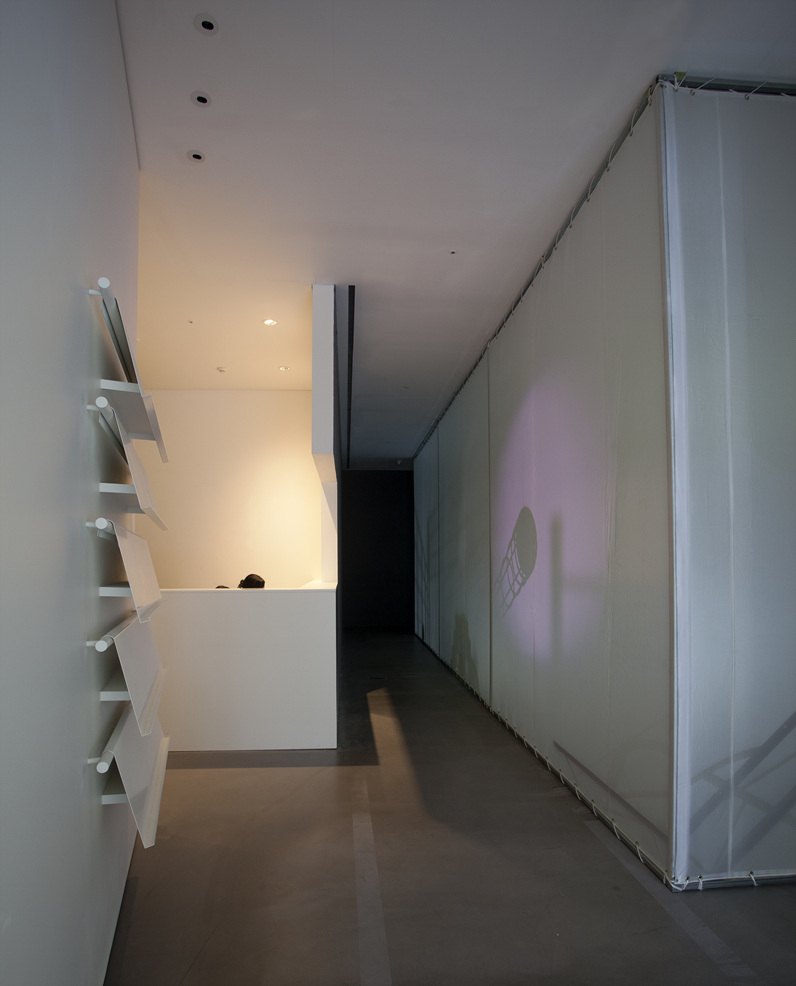
small handful material remains. Ingeniously, the entrance to this space, with
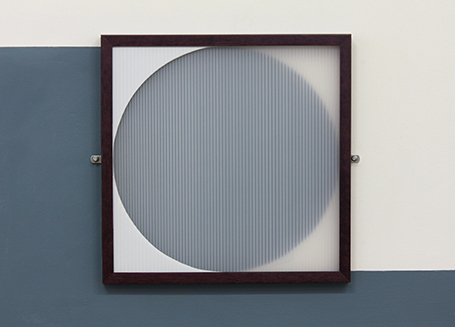
its shutter half pulled down, bore a strong similarity to Continuous
Reflection, a work displayed at Kim’s 2008
first solo exhibition, in which the artist installed mirrors on the exhibition
space wall and pulled shutters partially down over them, reflecting an earlier
experience in which she had mistaken the corrugated pattern on a wall for a
shuttered door. To those who remembered the 2008 work, this produced the
fantastical feeling that the space beyond the mirrors back then had transcended
space- time and opened out in London.
Creating such virtual leaps and jumps has been a key driving force
in Kim’s subsequent works. The huge pink and black
rubber balls that appeared at her at her second solo exhibition, 《Thoughts on Habit》 (2013), implied a
new kind of motility, able to roll or bounce off anywhere. These elements
appeared repeatedly in subsequent works, changing form into guises such as
immaterial light-based images (Black, Pink Balls, 2014),
graphic surfaces stuck to exhibition space walls (Conditional Drawings,
2015) or small, hard snooker balls (Black, Pink Balls,
2018). Just as divining the future in scattered rice grains is closer to
resolving compulsive anxiety about a specific future possibility than to
actually reading the future, these balls deliberately introduce randomness,
rather than being mechanically subordinated to the given conditions and
responding routines of the artist’s work.
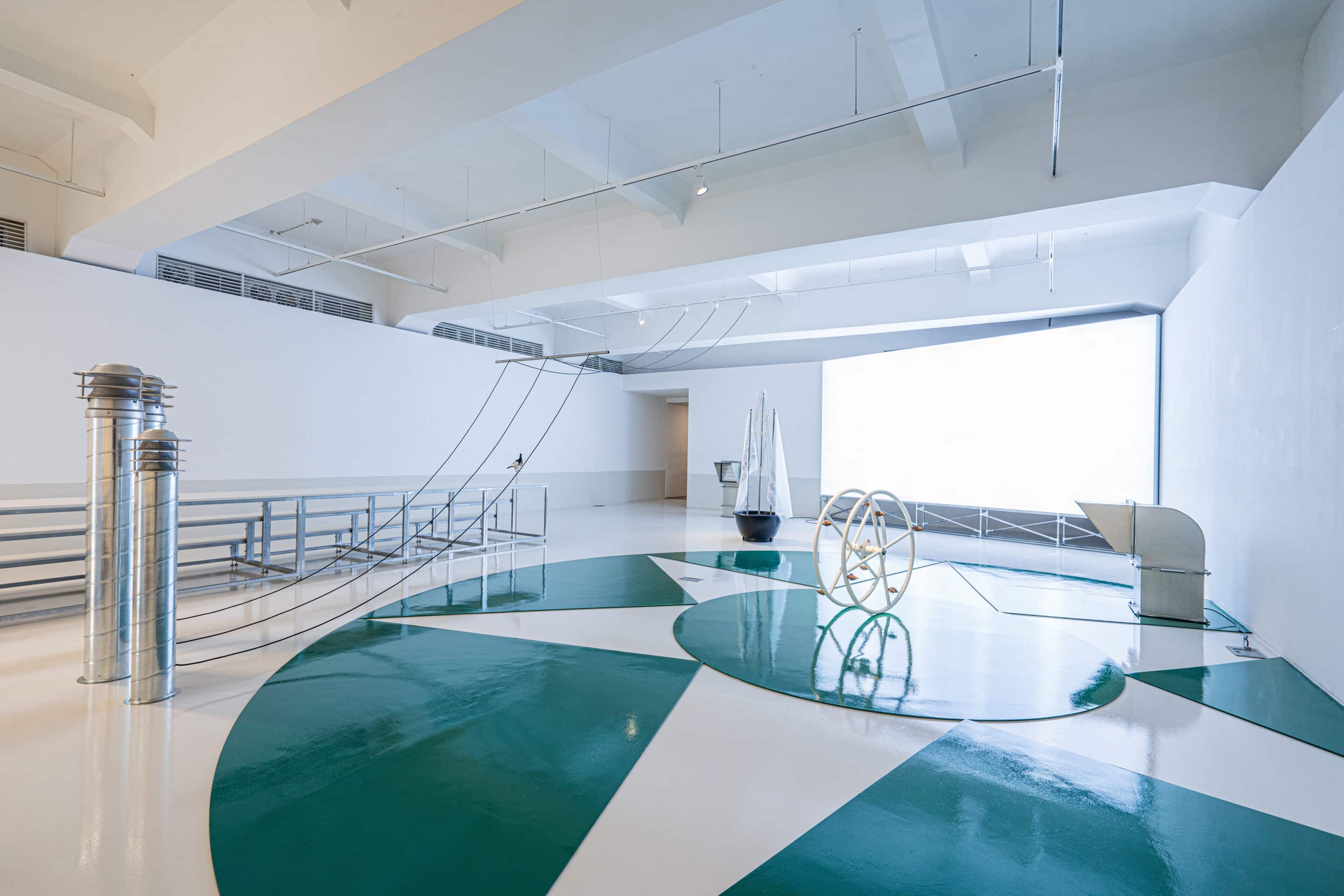
Recently, Minae Kim has focused not on physically occupying space
but on emptying it as far as possible while evoking strange thoughts,
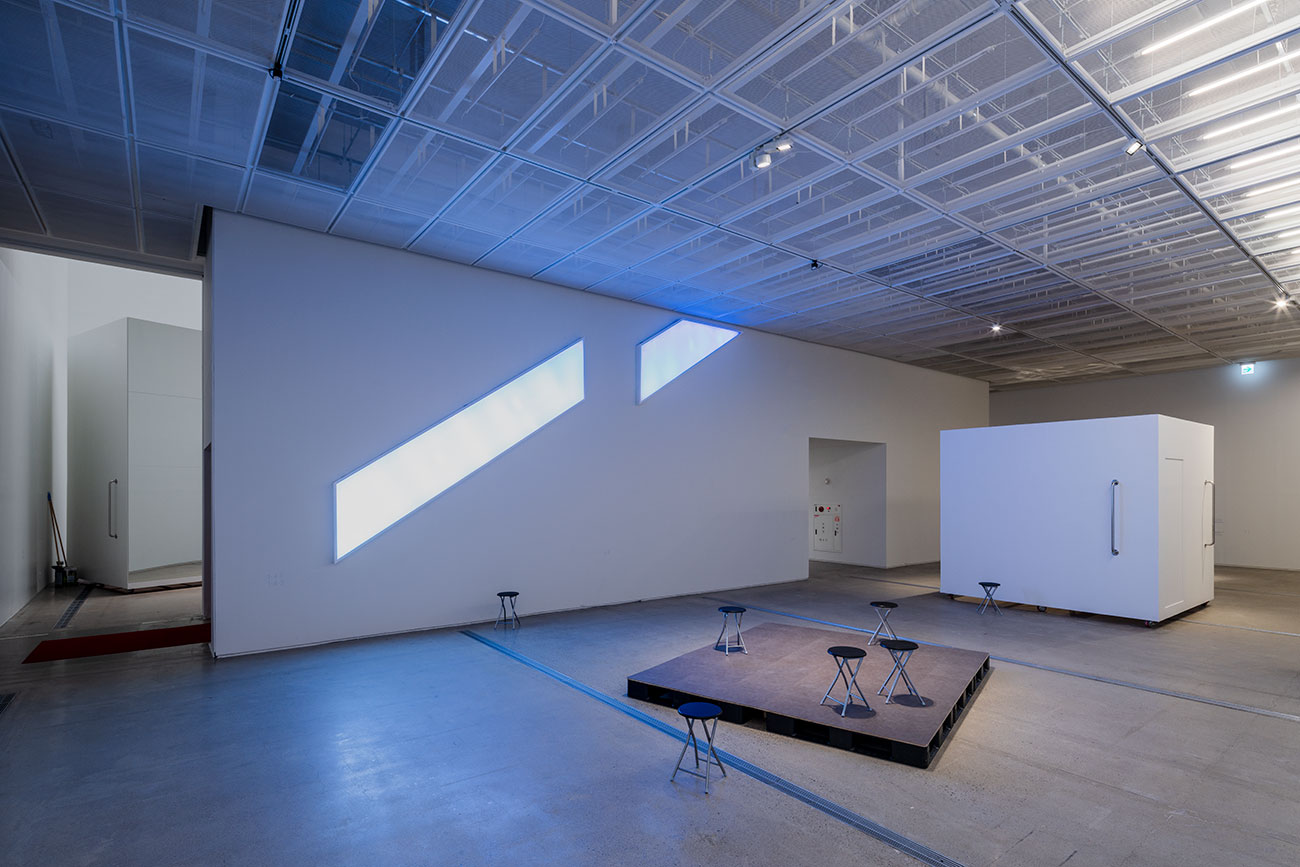
impressions or instructions that swell like phantoms within it. In her 2018
exhibition 《GIROGI》, she used unexpected methods to transform the exhibition space into
a kind of moving image. Generally, white outlines of birds that appear fat in
comparison to the size of their wings are expanded to fill the walls,
irrespective of their original sizes. Moving light and sound give the
impression that the birds move momentarily though, of course, this is not
actually the case. While, in several senses, the question of how sculptural
things could move is one that ran through Kim’s
previous works, 《GIROGI》 offers
the most recent answer. Sculpture remains in a liminal space between
agoraphobia and claustrophobia, leaving us uncertain how to feel. But within
this space, it moves endlessly. Whether we must call the results of these
movements sculpture or see them as the invention of another medium, has yet to
be decided. It seems, perhaps, that the artist wants to leave it undecided for
as long as possible.