1. Kang
Hong-Goo’s photographs resemble dreams. Deserted streets
where time is lost, masses of dark shadows, and strange unidentifiable traces
in his photography recall the impressions of nightmares. But to say that Kang’s photographs resemble dreams isn’t to say
that his works represent the strange and familiar scenes we often experience
and ruminate on. It is not surface similarities but the structure of “dream work” that his photography
borrows, and furthermore, his photographic “therapy” is connected to the interpretation of dream.
In the ways the
narrative and imagery of a dream ingeniously utilize the techniques of
condensation, substitution, and symbolization to reconstitute the codes of
system and desire, capital and prophecy, Kang’s digital
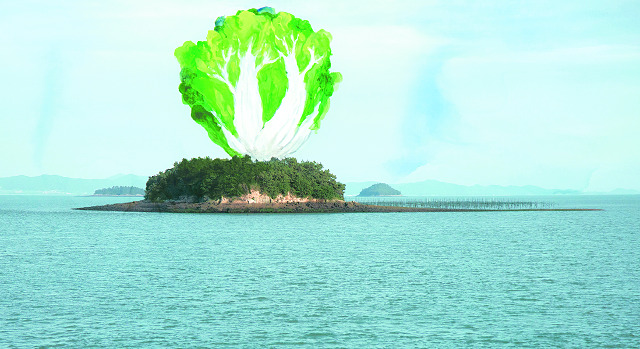
photography composes landscapes and imaginations and histories. Brilliantly
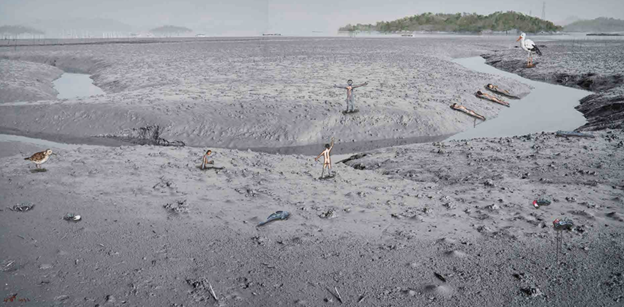
burning trees, a row of architectural facades with no buildings behind them, a
giant barracuda plopped on a street, and someone’s
bizarrely elongated back lounging on a beach. These are some of the images that
Kang has borrowed from the techniques of dream. And it is through such
techniques that his photography suggests the entities that threaten us from all
sides in the reality in which we unwarily live in, or it suggests the condition
of that very threat.
Kang’s photographs, therefore, are not mere copies or scans of dreams as
they may seem at first glance. And here’s the reason
why the children’s story of the photo studio of dreams
cannot apply to his work. Kang’s photographs are dreams—or more precisely, the screens upon which dreams are projected. As
we enter the theater, we are confronted with bizarre, preposterous, and fearful
situations that unfold in front of our eyes in real time. His digital
photography is not premised on past tense, on which photography is
ontologically dependent, and a sorrow for things past, or its future-tense
form, i.e., death. In that his work is a present-tense experience of dreams, it
perhaps resembles cinema.
But Kang’s photography is
closer to a rear-screen projection made with light shone in front of the viewer’s eye than to the cinematic projection, in which light is thrown
from behind the viewer’s head. On the horizontal
widescreen of his photography, the viewer’s head-on
confrontation with the camera blurs the consistent focus of the image, and the
overlapping screens and obvious seams twist the retinal contemporaneity. Kang
obliquely comments that just as a dreamer does not make his dreams, the
photographer is not the agent of his photography. According to the artist’s “set-up,” we
the viewers build up spatially these present experiences, in which reality and
unreality, and guilt and desire crisscross. Kang’s
photography creates, just as our dreams do, architectural labyrinths in which
our bodies can spontaneously respond to crude, abrupt, and absurd situations.
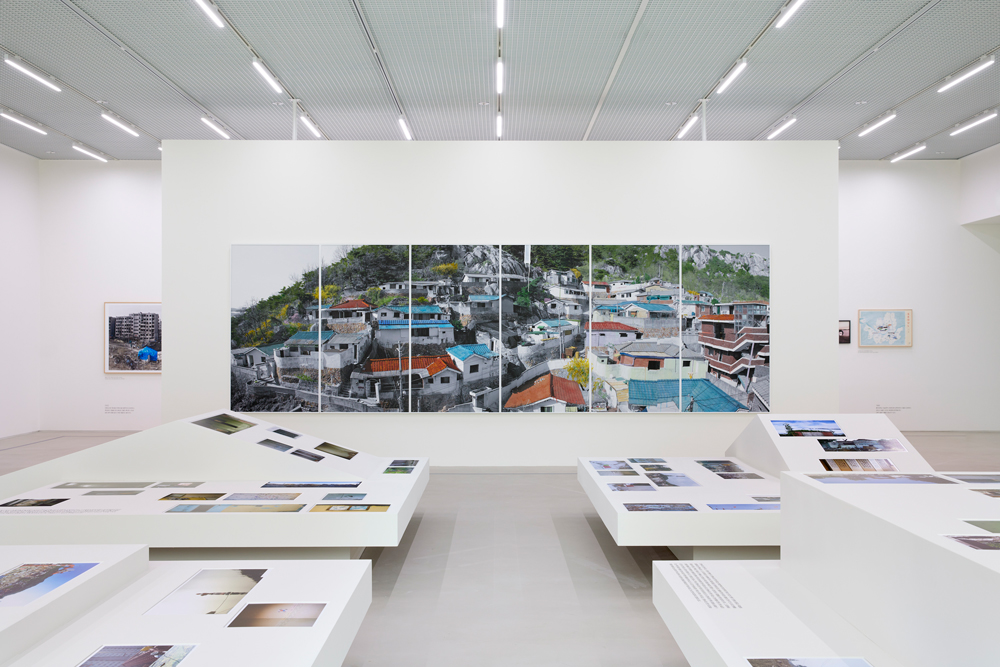
2. In
the present exhibition, viewers find lures that tempt them into a site of
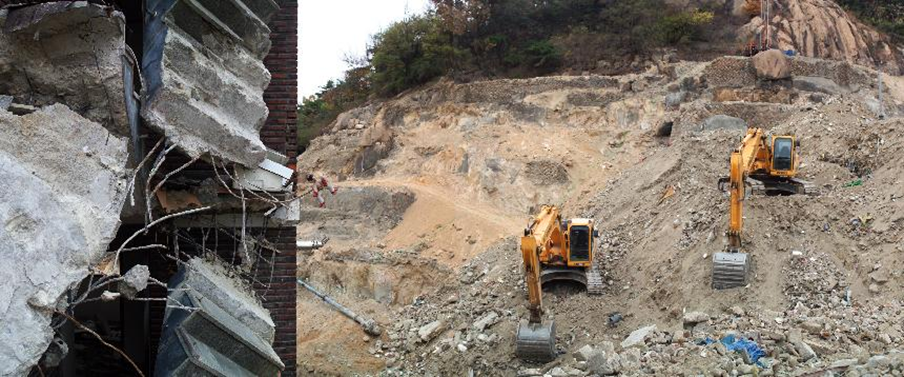
super-fast demolition and super-sized construction where one may have an
experience of surrealistic sublime, a maze-like place that one cannot tell if
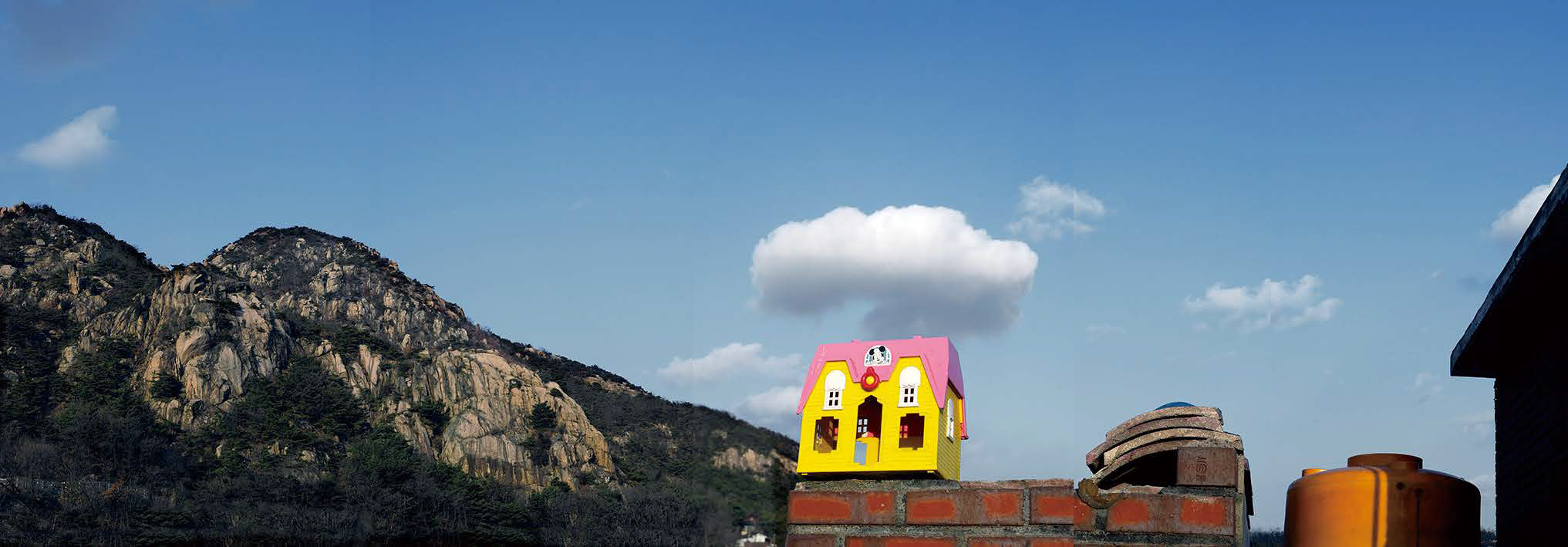
it is a dream or a reality. They are toys that the artist must have found on
construction sites in the periphery of a city. A toy house—called "Mickey’s House" because
Mickey Mouse is painted on it—sticks out among enormous
excavators and piles of scrap metals. Mickey’s house
appears in front of a row of houses on the brink of being reduced to powders,
on some precarious garden fence in a shantytown, on snow, or on a green lawn.
Even within a single scene, this toy house can function as a metaphor in the
sense of “Home Sweet Home” or
as a metonym in the sense that it is meant to belong to a household. In another
vein, it is an icon if the formal similarities were to be focused upon, and an
index when the generative relationship between the toy and the photograph is
considered. The toy house, which is especially outstanding against an
achromatic site of ruination and construction and the monochromatic nature
because of its brilliant palette, also operates as a kind of hypertext that
connects different individual photographs. Does this mean, then, that the
artist intends to play games of signs with this toy?
If
we were to make a distinction, the focus here should be on not sign but play.
In other words, the focus of this photographic series should be on the artist’s process—i.e., roaming around to find
the “found object” and
creating some witty simulations with it when he spots appropriate scenes. This
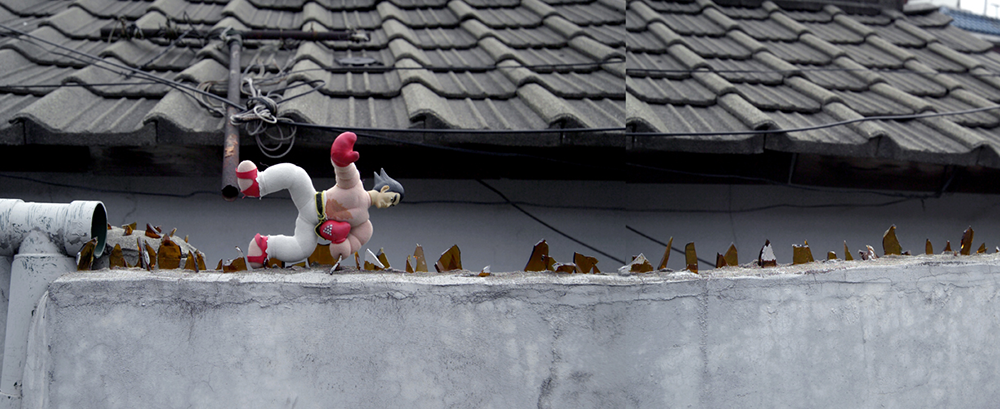
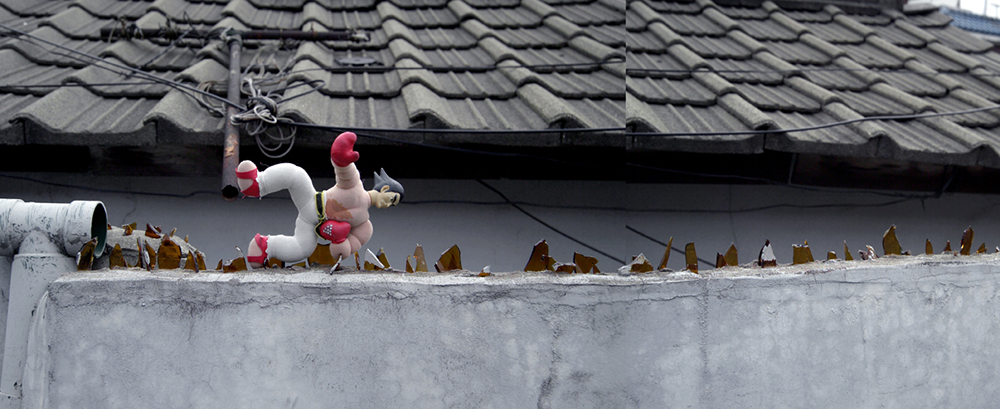
aspect of execution in the series is once more emphasized with the second toy,
which the artist has named the “trainee.” According to the artist’s research,
this toy takes its form from the fictional character Kazuya Mishima, a martial
arts warrior in a Japanese computer fighting game.
Kazuya jumps on dangerous
electric wires, hops over shattered glass, and climbs over precipitous walls.
Kang titles his photographs, in which this trainee’s
posture and size freely change, according to a lexicon of Chinese martial arts
novels. Following the trainee’s role-playings, viewers
see him in an encounter with Mickey’s house in one
scene, and while engrossed in such a visual pun, our eye often loses the
contexts that the toys are situated in and get comforted by the indexes, i.e.,
the toys.
In
this way, in Kang’s work is a
mixture of ideological signs, political landscapes, and the willfulness of
execution all mixed in different ratios. One of the most distinguishing
characteristics of his work is that it keeps pushing viewers outside its frame.
That is, objects like Mickey’s house and the trainee in
his digital pictures are read more productively alongside images, such as “squatter pics” or “required elements” on the DCinside
website, a ground zero in popular contemporary Korean visual culture.1) Seeing
Kang’s photographs one is naturally reminded of the
current social phenomenon of “digital invalids” abusing such images, and this is how the significance of Kang’s photography may be understood from a different angle.2)
Now that
the digital camera, the scanner, and the Photoshop have become cultural
necessities, and blogs and homepages constitute a standard of one’s social education, the drive that places his work in museums is not
the inertia within the art system that has made photography a viable artistic
medium but may be found in the power of cultural popularism that renders art’s courtship of photography powerless. And perhaps in an inverse
reaction, Kang, an artist especially sensitive to the speed of change in mass
media and technology, has fallen for the attraction of board games rather than
digital games; instead of creating manipulated images out of “required elements” with computer
programs, Kang has been capturing landscapes with actual toys. This capturing
also includes evidence of living in this era, in which distinction between
actual things and hybridized things itself has grown meaningless.
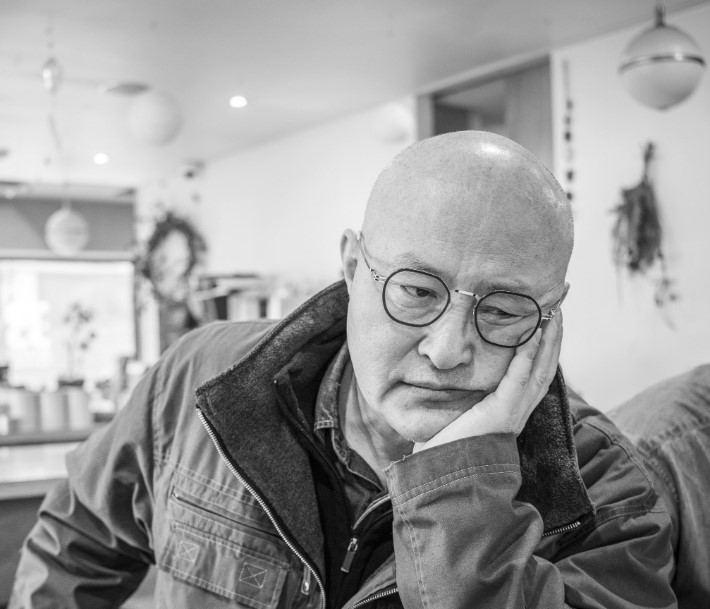
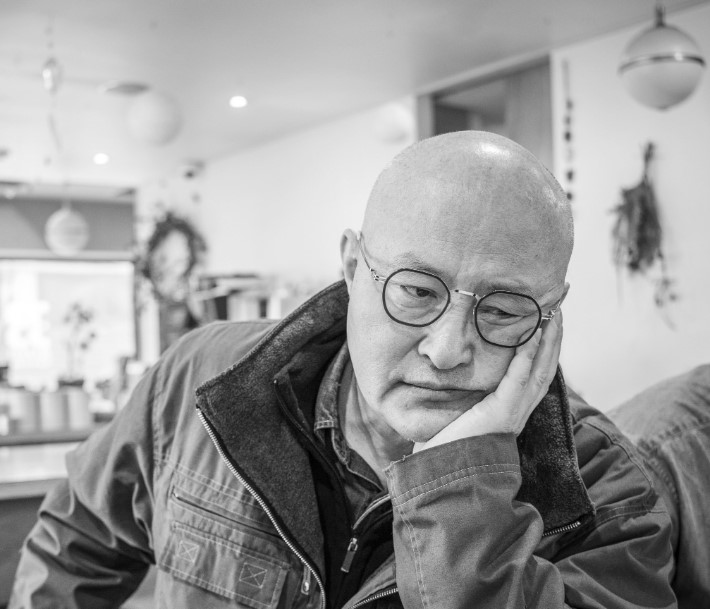
3. Kang
Hong-Goo is not only an artist but also an author of books on visual cultures
and has previously worked as a TV personality and a lecturer. In other words,
he has taken on multiple roles over the years. Fittingly for someone who has
mastered a variety of cultural texts including sci-fi movies, detective novels,
horror comics, and martial arts pulp fictions, Kang’s photography contains in it the artist’s
history of cultural education.
His cultural literacy, however, does not
manifests itself in his photography simply in terms of broadening the range of
references and selections but becomes more obvious in the ways in which he
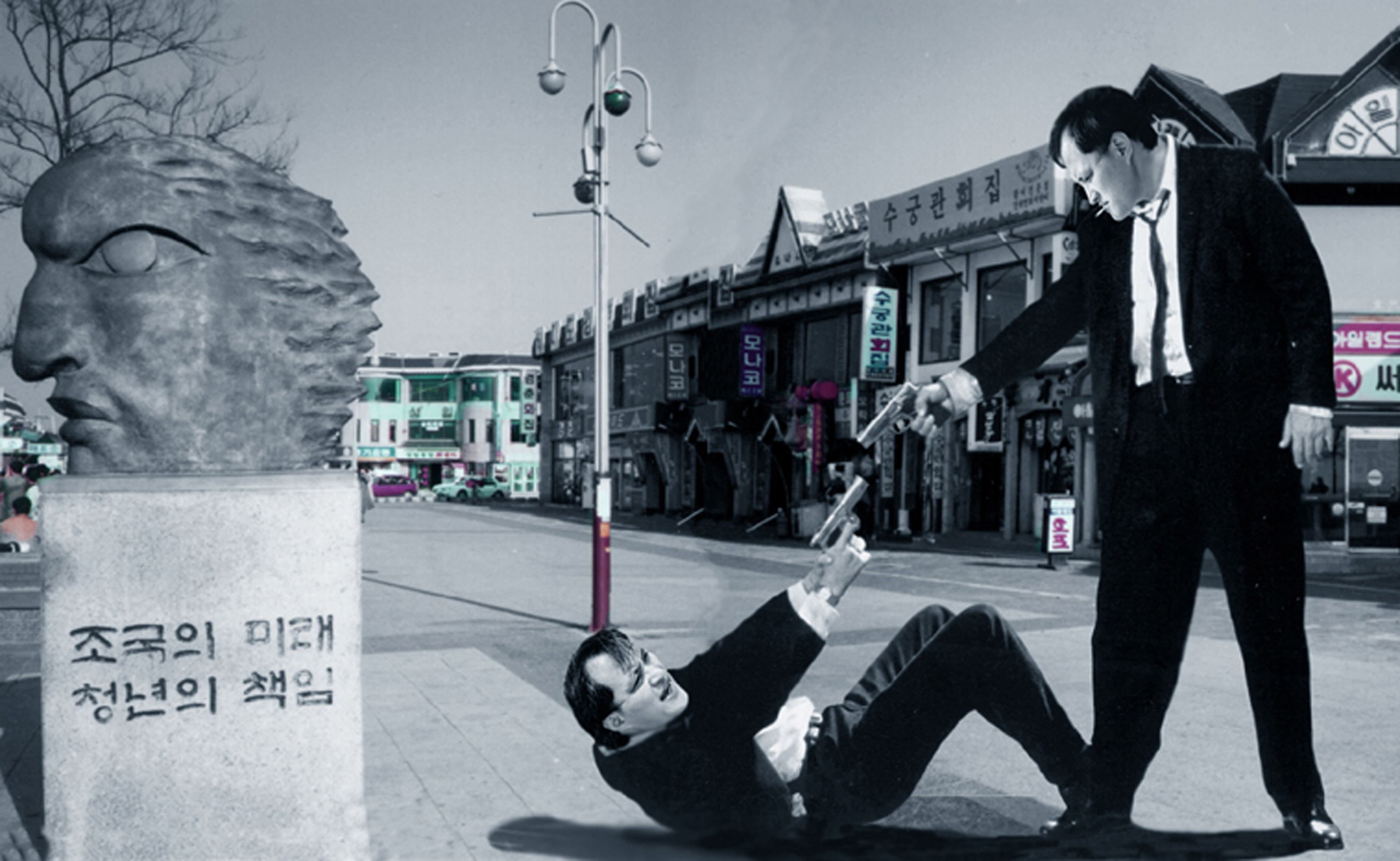
practices intertextuality. While his work exhibits, for instance, a range and
diversity in its parodies and pastiches of Quentin Tarantino’s films, Manet’s nudes, Meindert Hobbema’s landscape of village roads, and Kim Jeong-Hee’s traditional Korean landscape, what is more notable is the ways and
processes in which these sources are quoted.
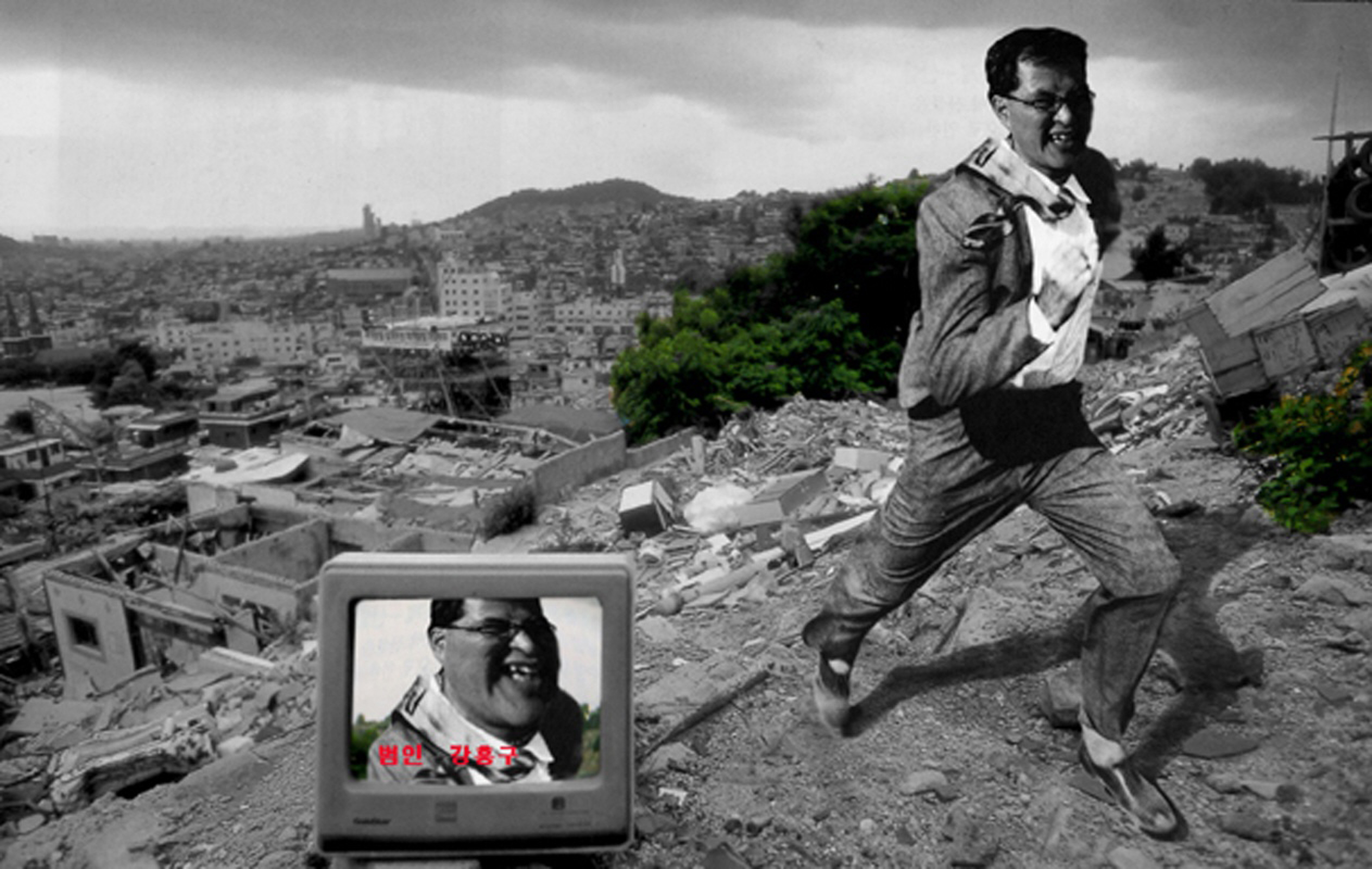
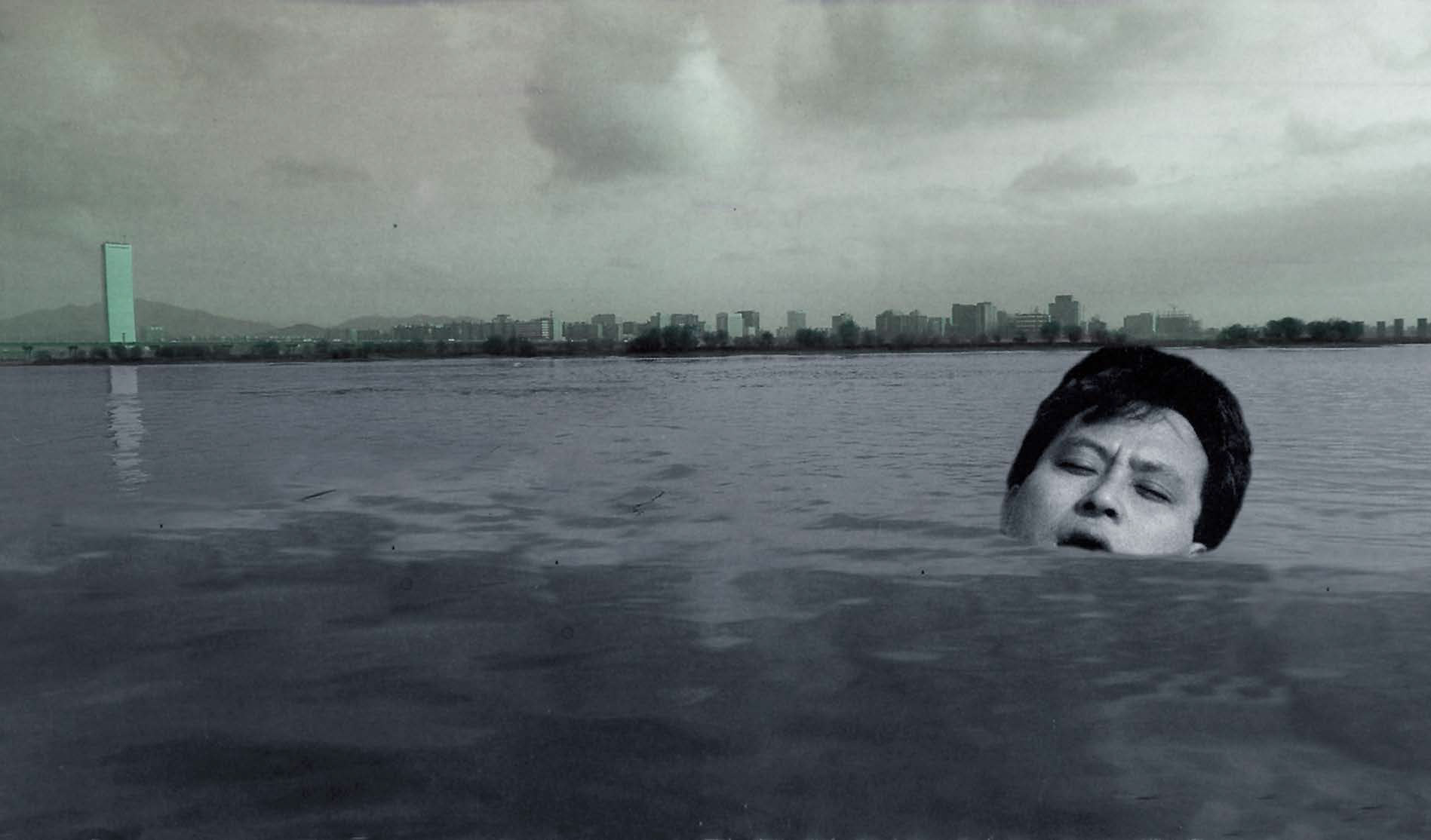
In
his earlier work, Kang often made photomontages, for instance, cutting and
pasting his own portraits within appropriated film stills, advertisements, and
other commercial images. This method of editing, which was limited to
juxtapositions and partial combinations of images evolved into a more complex
recombination of whole picture frames through overlappings and repetitions.
Consequently, he began to make his own photographs more frequently, and effects
such as exaggeration, distortion, shock, and alienation, rather than mere
collision began to characterize his work. Furthermore, as he started to apply
the more complex montage techniques which surpass typical genre films and
narrative conventions to horizontally expansive individual works and a series of
works produced around the same time, the series even earns certain
monumentality.
If
we consider Kang’s photomontages
with his own writings, the data he has collected, sketches, drawings, and still
photographs, his photographic theory seems to be more akin to John Heartfield’s rather than El Lissitzky’s. As art
historian and critic Benjamin Buchloh has argued, in the wake of Lissitzky,
photography, now as “factography,” has established a cultural literacy, with which it educates
the public. If the Russian avant-gardists aspired to supercede the material
limitations of constructivist sculpture by circulating thousands of
mass-produced photographs, in our era, digital photography has made possible a
single picture to self-replicate into thousands and distribute them in the same
resolution. Of course, Kang’s factography conjures a
far more dystopic vision than the utopian one of the Russian avant-gardes.
Kang’s panoramic photographs not only mobilize all kinds of texts before
and after themselves but also encompass sounds and smells. In that light, they
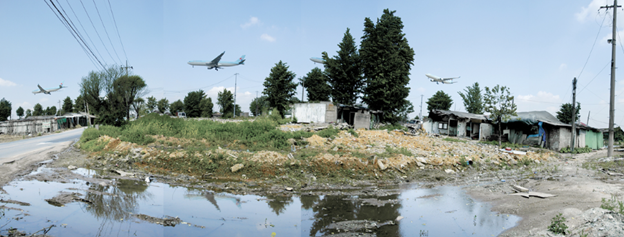
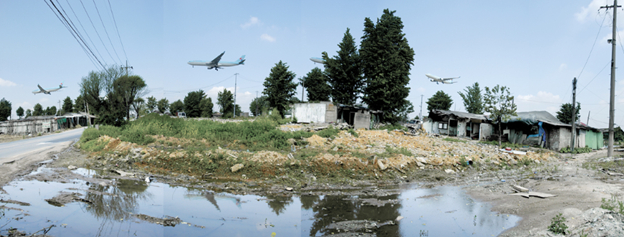
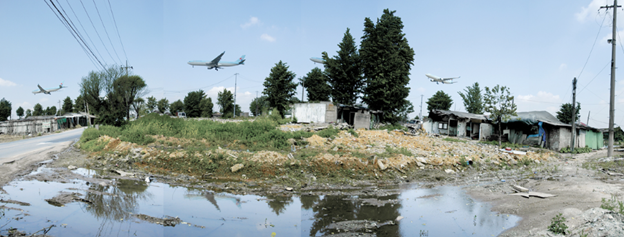
are quite multimedia. Especially notable from his body of work is the series of
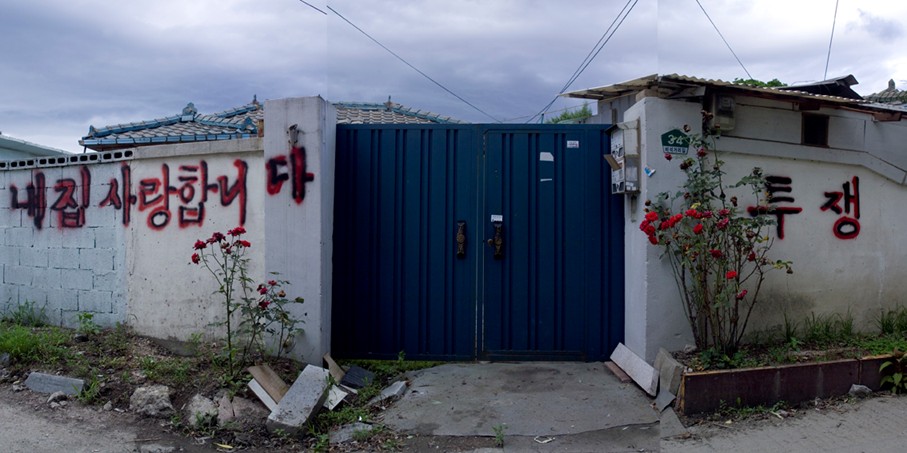
images made from a town called Ohsoi-ri near the Gimpo Airport in Seoul. The
repetitive placement of an image of an airplane flying low through the series
of the landscapes of the town, which are all 280-centimeter long, effectively
conjures the effect of the oppressive loud noise an airplane would produce in
proximity.
The pool of water in which a dump truck has crashed is rendered with
an exaggerated perspectival technique, again making viewers effectively imagine
its rancid stench. While optically traveling through this landscape strewn with
piles of trash, fields of green onions, airplanes in the air, and discarded
shoes, all appearing in the same resolution, viewers feel with all senses the
fact that Ohsoi-ri has lost its placeness and has been absorbed into a temporal
zone of development.
This
naturally formed village, which is marked on the map only with the designation
of “Ohsoi Crossroads,” is
plainly edited into a space of future holocaust in Kang’s photomontage. The vanishing point in the photograph replaces the
town hall, from where one allegedly could have surveyed the whole village
visually, and becomes a symbol of the massive conspiracy of development. The
vanishing point of the perspective that organizes this image is emphasized like
the conspiracy theory that explains the whole world. It lucidly visualizes the
power behind the rumors that the townspeople were driven out by arson and that
even children were murdered. Just like all conspiracy theories, the vanishing
point in Kang’s photograph is indescribably seductive
and fatal.
4. Kang’s landscape photographs, as seen in the ‘Ohsoi-ri’ series, at first
glance seem composed around single viewpoints. But on closer inspection of
their operations, it becomes clear that their internal and external texts cross
with one another, imploding the perspectival spaces. The photographic
perspectives Kang realizes in his work often interfere with themselves, as
exemplified by Furgitive 8 (1999), a photographic
recreation of Hobbema’s painting, The
Alley at Middelharnis (1689); Kang obstructs the vanishing point
on the horizon line with a self-portrait.
This kind of “disruption operation” is also evident
in the artist’s trademark method of manipulated
composition. In his Who Am I series, the artist
replicates his self-portrait into multitudes, dispersing the viewer’s gaze throughout the picture. After graduating from handmade
processes to digital cameras and computers, Kang has been employing
picture-suturing as the main method of disrupting the viewer’s gaze. He states that his main objective there was to make
large-scale landscapes out of digital pictures. Although he has not been able
to accomplish the objective due to technical and financial reasons, he was able
to create, after quite a few trials and errors, stitched, horizontally
expansive landscapes that are panoramic in effect.
In
terms of the way of seeing that is required, panorama pictures share
similarities with handscroll paintings. While most of Kang’s photographs are shown in full lengths, viewers can rarely see the
whole pictures in a single viewing. Consequently, they can view only sections
and must put them together in continuum like the frames of a moving picture.
In
Kang’s panoramas, the viewer’s
gaze encounters each one of different camera gazes that are sutured in
individual frames, which are slightly overlaid upon one another or distorted.
The eye scans these long pictures from left to right—or
in the opposite direction—in “temporal” manners. There is the obvious
distinction, of course, in that one views a handscroll painting by rolling and
unrolling, while a panoramic photograph is seen by the viewer’s body moving along the length of it.
The
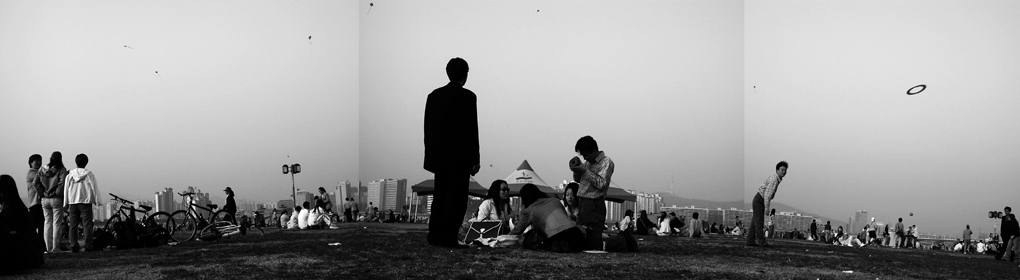
most representative handscroll-style photographs in Kang’s work can be found in the The Han River Public Park series.
Presenting group portraits of people enjoying walks in the park with distant
sights of skyscrapers and massive bridges in the backdrops, these photographs
may be considered a kind of typical genre pictures on the subject of a lazy
holiday. Strewn with people bearing comic facial expressions, pairs of lovers
and groups of friends, homeless and drunkards, and periodical appearances of
Ronald McDonalds and flying kites, all of which are unfailingly captured by a
relaxed camera’s eye, these pictures provide much to
read for viewers.
Here,
what grabs our gazes and guides the temporality of visual appreciation in this
over-five-meter-long panoramic picture is not the several vanishing points
marking the picture but the horizon where the river and the park meet. The
method of viewing required by this beautiful landscape—one follows the picture horizontally following the flow of the river—places The Han River Public Park less
close to Impressionist paintings of parks than to traditional scroll paintings
like Jang Taik-Dan’s Chungmyung
sangha-do, which the viewer unrolls into a section of a manageable
length at a time to see unfolding scenes of transportation of cargos, changing
lifestyles and households, and streets tightly surrounded by buildings.
Admittedly, to make this comparison only based on similar viewing experiences
while ignoring the obvious differences in terms of time, location, and medium
might be a risky set-up for understanding broadly the work in question. In that
sense, perhaps better comparisons may be found in a tourist village that
recently opened in China or the film set for a recent Korean movie with a
storyline set in the Song Dynasty, both of which are based on Jang’s handscroll painting. At the same time, Kang’s photographic series, in ways that are highly distinct from such
realizations or physicalizations, creates a kaleidoscopic world that can
broadly address traditional genre painting, its epistemes and structures of
sensibilities, and even the self-referentiality of mass media.
5. Is
the film set, said to be based on the streets depicted in the handscroll
painting, a fiction? If people can enter to enjoy the view of the set, does it
become a reality? Is the “fantasy-action-melodrama” said to be being shot in the set a fiction? If the movie is
actually made and widely released, is the theater showing the movie real? Or,
is the handscroll painting, which creates this endless linkage of
representation of representation, an original? Or is it a copy of something
else?
Pressing “pause” on
this dizzying series of questions and playing the landscapes we are looking at
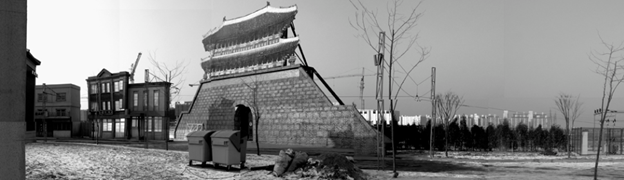
frame by frame in a slow motion—this is how Kang’s series of drama sets operates. Kang made the series by taking
pictures of sets “in actuality.” As seen in the images per se, these sets, which were created
for historical or martial arts dramas, do not look anything like what we
encounter when watching the films and TV dramas. Aided by the intervention of
high-definition cameras, editing techniques, and cutting-edge computer graphics,
films and dramas these days reveal very few detectible fissures or seams.
In
Kang’s photographs, it is the “dross in gold” one would seldom see in
movies and dramas that takes the center stage. Soaring apartment buildings are
visible in the far background of the TV drama Age of Outsiders,
and people dressed in current fashions along with cars appear in a scene
supposedly set in Japanese colonial period. Even worse, one of the photographs
zooms in on the backside of the façade of a mock Dongdaemun and a pile of trash
thrown in front of it.
Kang even leaves the seams and traces of the suturing of
these pictures. These anachronistic indexes dispel the usual effects of
black-and-white photographs—taste for things past,
symptoms of art photography, and evocation of nostalgia. In such ways, Kang’s photographs of drama sets distort the future tense of digital
photography, which seems to exponentially self-replicate, and the past tense of
slowly discoloring black-and-white photography.
All
of Kang’s landscape photographs are captured by the
artist busy on his feet on a variety of contemporary sites from nearby towns to
distant tourist spots. As if a documentary photographer, he deals with
the “existence” of
contemporary sites and specific incidents or people. Paradoxically, however,
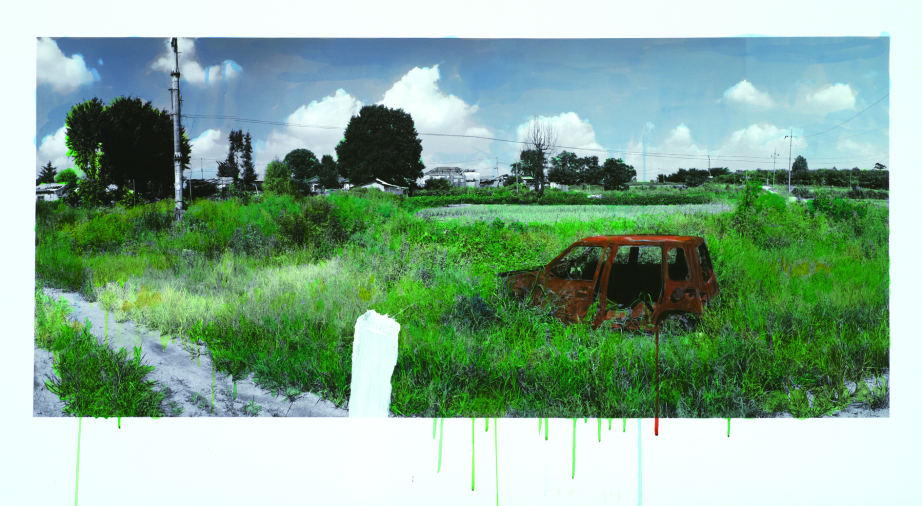
these landscapes all appear as if they have been just excavated after having
been submerged under water for a long time. One sees deserted, desolate
streets, garbage stuck here and there like waterweeds and mosses, collapsed
buildings, and mere traces of urban structures, and the survivors roaming these
scenes of devastation seem like mummies that are just awakened. In the
submerged landscapes, Ohsoi-ri and Apgujong become sites for pillaging, and Sehando
and Gosagwansudo turn into plunders.
Through
its era of development in Korea, the monstrous forces of the desire for
super-modernity, imagination of civil engineering, and economic fascism have
razed or sunk peopled towns and storied villages. As if nothing had happened,
then, high-rise buildings and massive apartment complexes are built up, or
highways and dams are laid down. In recent years, the former sets of popular TV
dramas and movies have become tourist spots, bringing considerable profits to
local governments.
In a similar way, those places that have been sunk in
sacrifices may one day emerge like ghosts and start attracting people to them.
Finally, our dreams and unconscious have turned into currencies—no paper money but those that circulate invisibly via the magnetic
strip of the credit card and the bytes of the Internet banking. Are all these
waking dreams, or precognitive dreams, or deja-vus? That’s what Kang Hong-Goo’s photograph keeps
asking us.