Let me begin with an unintended spectacle
that inspired me while visiting Choi Jeonghwa’s solo exhibition 《Natural color, multiple flower show》, which filled
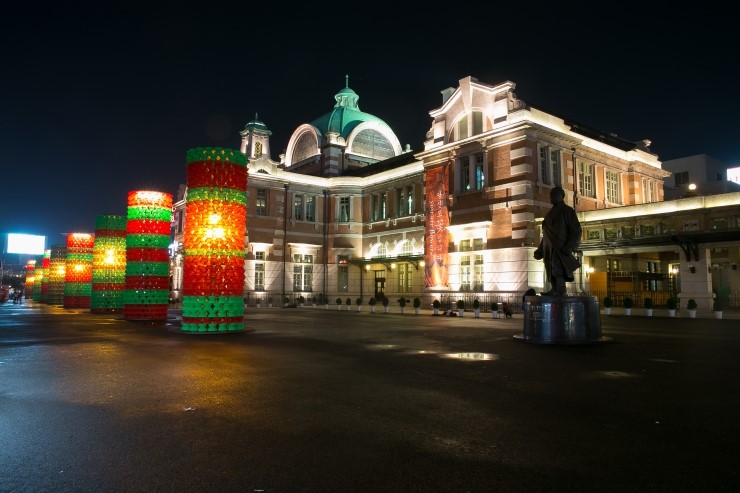
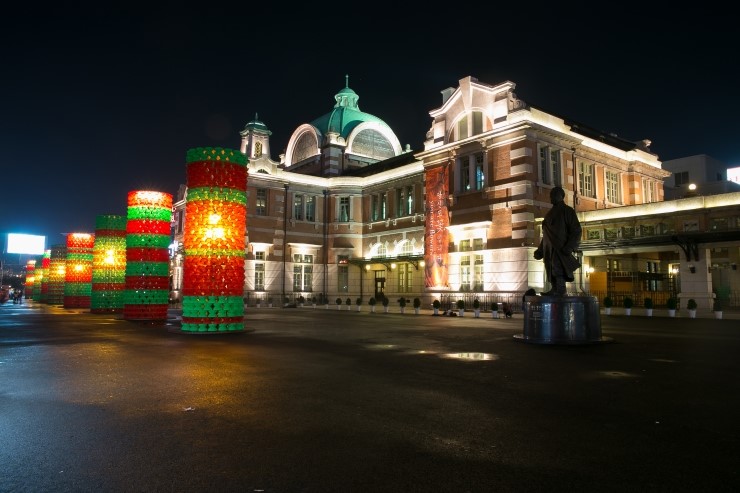
the entirety of ‘Culture Station Seoul 284’. Outside the former Seoul Station
building, beneath the shade cast by the plastic sculptural tower
Everyday of Flowers — made by stacking green and red baskets
in alternating layers — I found myself watching a group of homeless people
resting in the plaza.
The cylindrical stacks of vividly colored baskets, surely
constructed from inexpensive materials, and the unhoused people lying idly
beneath them seemed oddly synchronized. Looking back at places where Choi
Jeonghwa’s works have appeared in recent years — Daegu Art Museum (2013),
‘Culture Station Seoul 284’ (2014), Leeum (2014), and Gallery Park Ryu Sook
(2014) — one realizes that his works permeate exhibition spaces of very
different spatial characters without friction. This must be due to their
all-weather adaptability.
By “all-weather” I mean a quality whereby
the work does not assert its presence independently but breathes with the space
in which it is placed. His installations — composed of crude colors and plastic
materials — do not stand out most in the white cube; rather, they create
compelling tension when colliding with spaces layered with time. Thus the
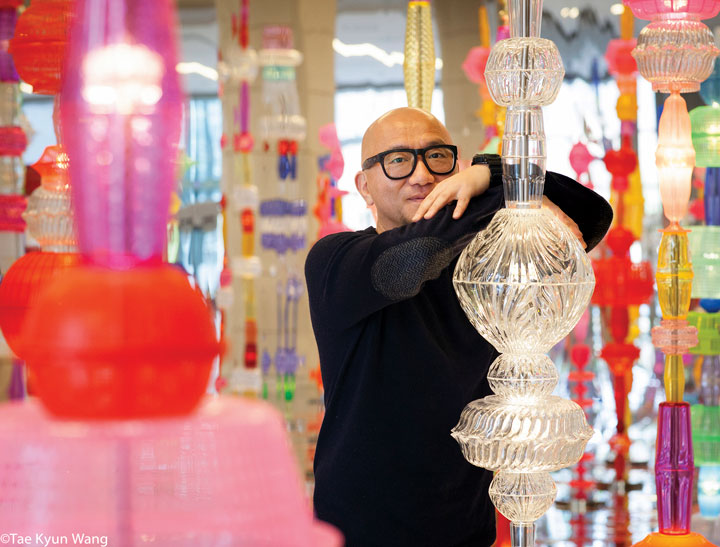
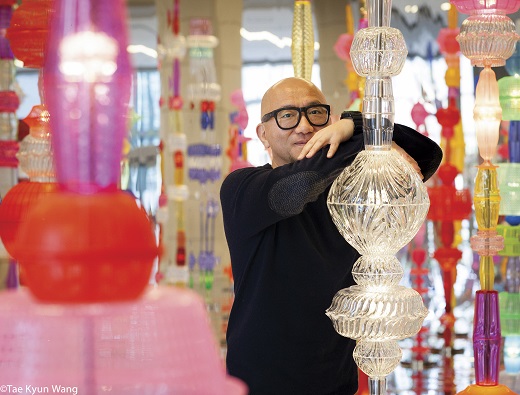
plastic lighting work Alchemy installed in the wooden
interior of Onyang Folk Museum, or the flamboyant plastic installations
contrasting with the aged interior and exterior of the old Seoul Station,
produce the same visual tension.
The pinnacle of this visual contrast
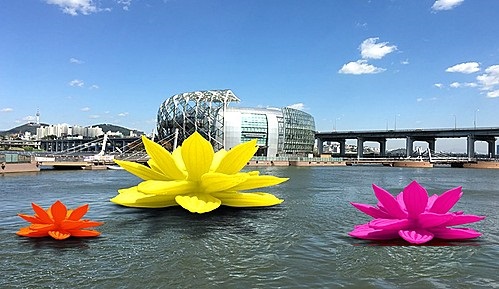
between work and site may be the balloon-flower installation
Beautiful, beautiful life (2012), suspended at the very
center of the ceiling of Prague’s Salvator Church. The intervention of dazzling
play objects into the stillness of the sacred space — and the sudden blooming
of polychrome objects inside the church’s monochrome interior — was likely
unprecedented since the church’s opening. Yet the work does not damage the
liturgical function or identity of the church; it merely performs a temporary
shift of situation before disappearing, and thus becomes charming rather than
objectionable.
The solo exhibition 《Natural color, multiple flower show》 at ‘Culture
Station Seoul 284’ demonstrates a general thesis possible when contemporary
visual art turns anarchically left — or reveals the total face of a readymade
artist. Although the absolute standard of artistic skill has long moved from
the artist’s handcraft to his discernment, 《Natural color,
multiple flower show》 shows the genuine value of entirely
selected ready-made art: the artist composes aesthetic completion solely
through choosing and arranging industrial products.
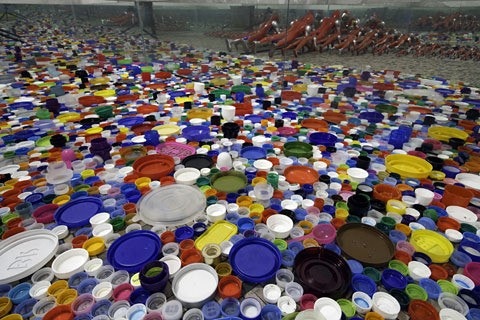
Objects previously not considered art
become something else when stacked high like fortresses into unprecedented
monuments, or when their bodies swell through air inflation. Overwhelming
institutional aesthetics with crude polychrome color and aggressive volume has
been Choi Jeonghwa’s formula. Filling the exhibition halls of ‘Culture Station
Seoul 284’ entirely with manufactured goods stands on the same line as his 2006
Ilmin Museum solo exhibition 《BELIEVE IT OR NOT Staged》, in which he filled the assigned exhibition space with objects brought
by more than thirty acquaintances.
At the core of reading Choi Jeonghwa is
recognizing that his weapon against the administrative art system resting in
outdated aesthetic habits is merely a mass offensive of plastic. Anyone in the
art world who has felt suffocated by institutional aesthetics would have
experienced both futility and catharsis watching the fortress of institutional
art easily collapse before his plastic assault. The emphasis of his aesthetics
lies not in aggressively confronting the opponent but simply placing a huge yet
hollow pile of cheap plastic before it.
The assumption that such grand visual
spectacle uses low-cost manufactured materials — even the thought that damage
would not incur great material loss — becomes an unexpected source of emotion.
It collides with the common belief that works of similar scale demand
proportionally expensive materials. Admirers of his counterattack against stale
aesthetics often cannot easily accept the paradox of his rise into the
institutional mainstream.
This contradiction stems from our
internalized hierarchy of visual art. Discovering the niche of plastic
commodities once considered non-art, Choi Jeonghwa turned plastic and total
polychrome into his brand. Though neither can be copyrighted, anyone using them
aesthetically risks being seen as his derivative. His long career as an
interior designer likely sharpened an instinct for audience and consumer
demand. Ironically, his horizontal reconstruction of aesthetic hierarchy
elevated him to the top of institutional art. The monumental scale of his
installations expanded the exhibition space into public territory, making his
work subject to universal visual culture beyond the art world — perhaps
precisely what he intended. Thus he became an artist without boundaries.
Just as he crosses the boundary between
art and interior design, his sensibility produces a ‘strange aesthetic
pleasure’ when conflicting elements share the same space-time. Many examples
follow the motif of the plastic lighting Alchemy at Onyang
Folk Museum: Japanese monster toys enshrined inside antique wardrobes, antique
handcrafted chairs beside mass-produced ones, folk craft combined with cheap
decorations — a chaotic aesthetic carnival where artworks and decorative
objects mix.
Such coexistence of contradictions appears
fully in 《Natural color, multiple flower show》 at ‘Culture Station Seoul 284’, like a midway settlement of hoarding
compulsion. The protected vitrines encircling shabby objects felt paradoxical,
as did the collected assortment of sittable chairs. Unlike design exhibitions
classifying chairs by lineage and style, these ranged from plastic chairs
roughly tied with vinyl string to cushioned ones topped with styrofoam —
A Feat of Flowers — collected without hierarchy. His
criterion likely lies not in archival value but in the owner’s persistence in
extending use. Through these accumulations, one can infer the sensibility that
formed him.
Choi Jeonghwa’s schedule, which has
expanded more abroad than domestically, likely stems from the fact that a
creative attitude and ethics ignoring hierarchy have been received more
generously in the West than in his own country. It may also be because an
exotic taste appealing to Western audiences permeates his work. Paradoxically,
that exoticism sometimes becomes a cause for his undervaluation within the
Korean art world. Consider the apartment, established as Korea’s standard
residential culture: natural for locals, yet strange to foreigners. Likewise,
Choi Jeonghwa’s polychrome plastic brand may be interpreted abroad as an exotic
cultural taste from the margins of East Asia.
Domestic responses, however, are
contradictory. Those who grew up in Korea during its developing-nation period
may interpret his work as a satirical monument amplifying the values of that
era. Citizens unable to perceive stacked industrial products as art may respond
with uncritical indifference. Artists who strictly distinguish art from non-art
may harbor antipathy and fail to associate Grand Flower —
made by embedding glass fragments into cement — with childhood memories of
broken glass lining neighborhood walls for security. Such rigid separation
prevents imagining non-art (glass-lined walls) metaphorically as ‘urban glass
flowers’ produced by developing-nation housing culture.
Twisting bureaucratic aesthetics has long
been Choi Jeonghwa’s aesthetic formula. Because of this he has sometimes been
misunderstood as a celebrant of bureaucratic taste and popular kitsch. Looking
closely at the collection preserved in the vitrines of ‘Culture Station Seoul
284’, certificates and trophies occupy a large portion. Certificates and
trophies are institutional reward devices marking individual achievement.
The design of official certificates is
uniformly tasteless; though unintended, communities receiving them become
accustomed to aesthetic vulgarity. Enlarged gold-painted national medals may
appear to mock the sloppy ethics of a sloppy reward system. Yet that likely was
not the production intent, as he has not bared the teeth of criticism but
presented visual questions. The same applies to the enlarged benevolent-faced
traffic-police mannequin: encountered inside the exhibition rather than on the
road, it produces unfamiliar pleasure but does not ridicule the guardians of
traffic order.
Because of their volume and strong color,
his installations — especially powerful outside institutional exhibition spaces
— nevertheless display all-weather adaptability even in low-ceiling commercial
galleries. Among the works in the solo exhibition 《Tathata》 at Park Ryu Sook Gallery, a notable piece
is Relatum–Dialogue (2014), created in collaboration with
the luxury champagne brand Dom Pérignon. Two green-and-black circular glass
sculptures made by bundling shattered fragments of forty 1.5-liter Dom Pérignon
magnum bottles and 150 soju bottles rest separately on two wooden bases. It
parodies Relatum, a minimalist series by Mono-ha master Lee
Ufan (invited with him to last year’s Setouchi Triennale). Some media
interpreted it as an homage to the senior artist Lee Ufan, yet considering Choi
Jeonghwa’s history of inflating and twisting bureaucratic aesthetics without
malice, he likely treated the senior artist the same way.
Still, there is overlap between the
Mono-ha master and Choi Jeonghwa. Expanding scale through repetition (stacking)
is his fixed formula. Even trivial objects, when gathered into identical units
and stacked layer upon layer, generate overwhelming synergy with crude color,
becoming an inimitable aesthetic brand. Repetition amplifies decorative value.
From Present of Century, which combines the three Greek
column orders — Corinthian, Ionic, Doric — to small works like the lighting
installation Alchemy, and vertically oriented structures
such as Everyday of Flowers and Kabbalah,
he imprints a monumental brand through repeated units. Much of Lee Ufan’s
series similarly became branded through countless repetition.
On the wall of Gallery Park Ryu Sook was
Choi Jeonghwa’s self-written poem ‘As if’.
It is a rare short artist statement
expressed not through visual but textual information. Reading the poem ‘As if’,
one senses his starting point is the intuition that “a plausible realization is
art ‘as if’” (part of the text). Accepting Choi Jeonghwa’s sensibility may
depend on whether one permits that ‘as if’ intuition. The aesthetics of ‘as if’
often remain difficult for institutional art to accept. As large as the
physical volume of his stacked installations is the opposing nonphysical volume
of resistance toward them. Criticism explaining him tends to converge into
repetitive interpretations — perhaps because institutional art depends
excessively on theory. According to the ‘Mehrabian rule’, only 7% of
communication is textual, 38% vocal, and 55% visual. Observing critics respond
to his monumental works — born from ‘as if’ — with unreadable long prose
suggests the alienation of criticism itself.