Searching for a Lagrangian point
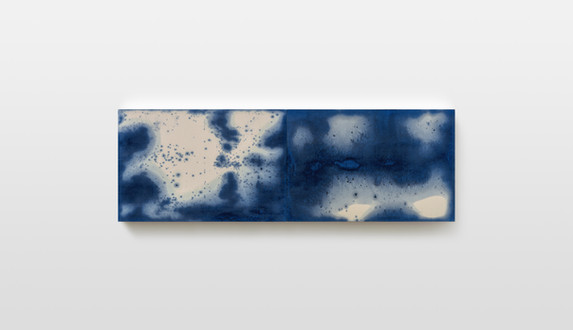
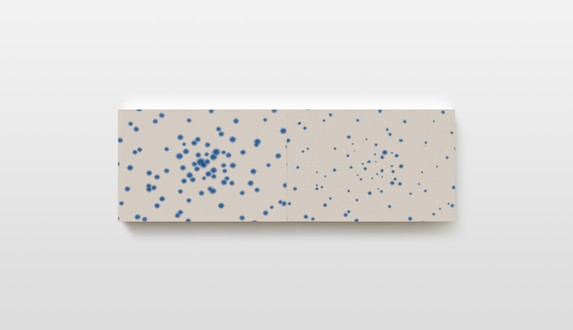
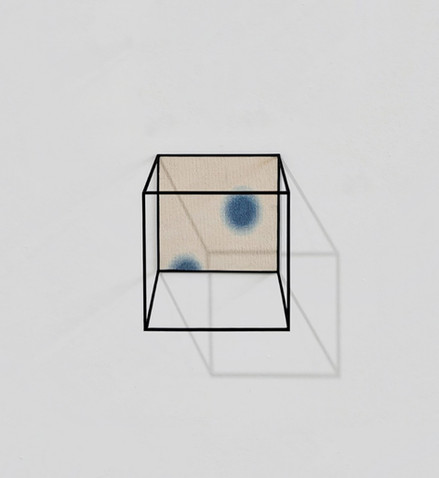
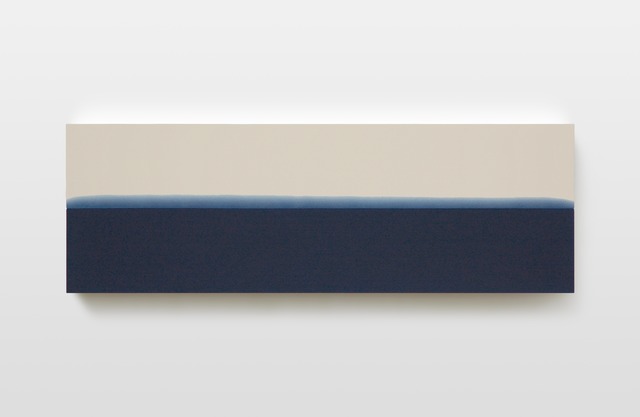
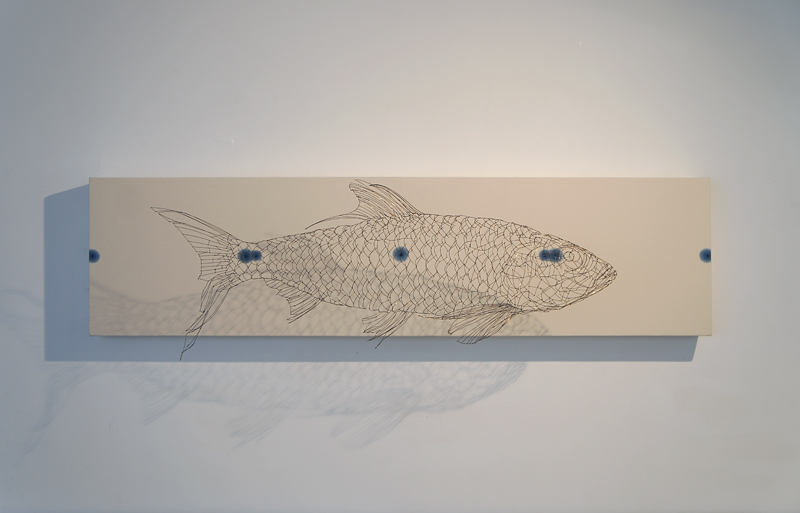
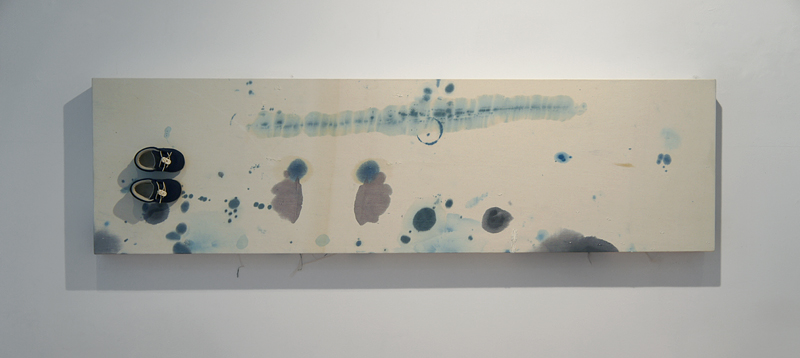
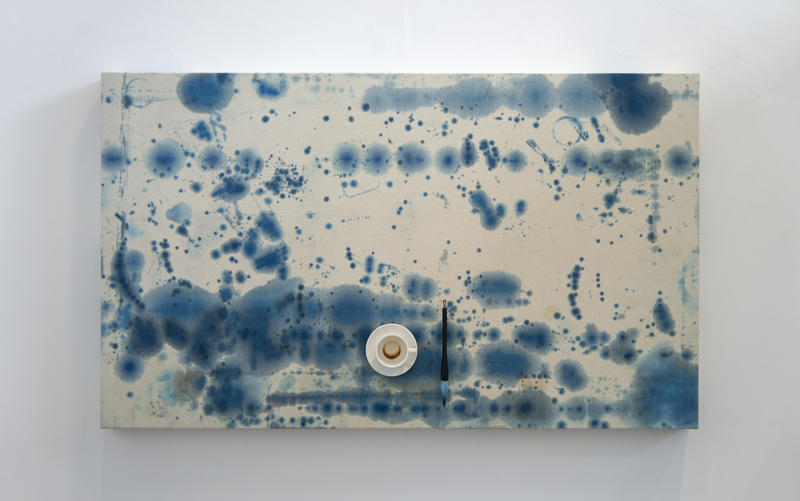
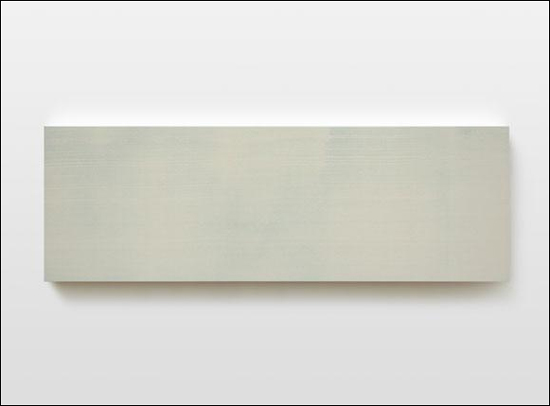
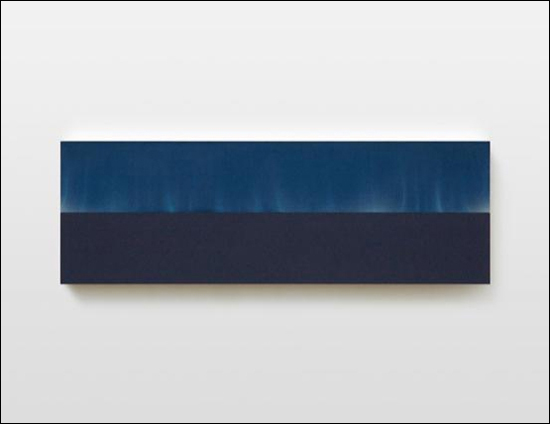
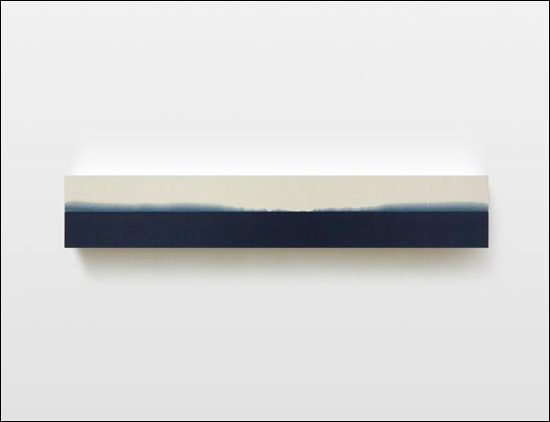
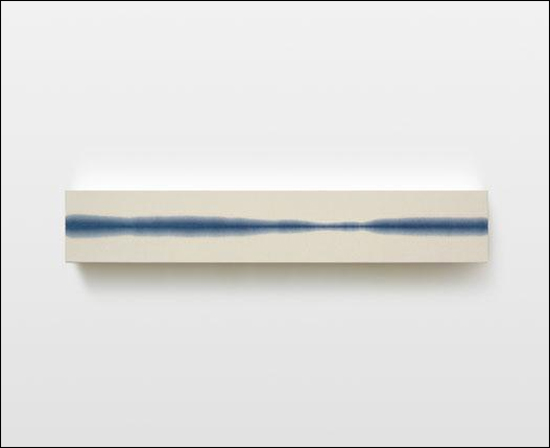
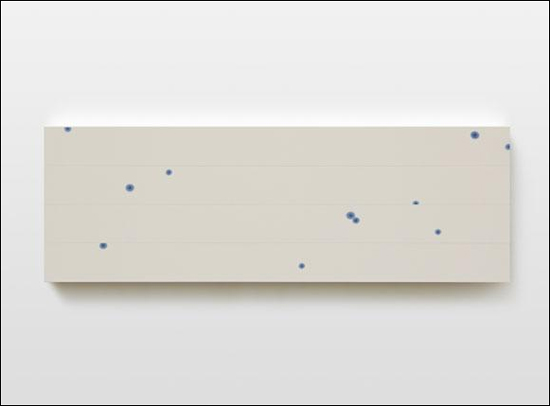
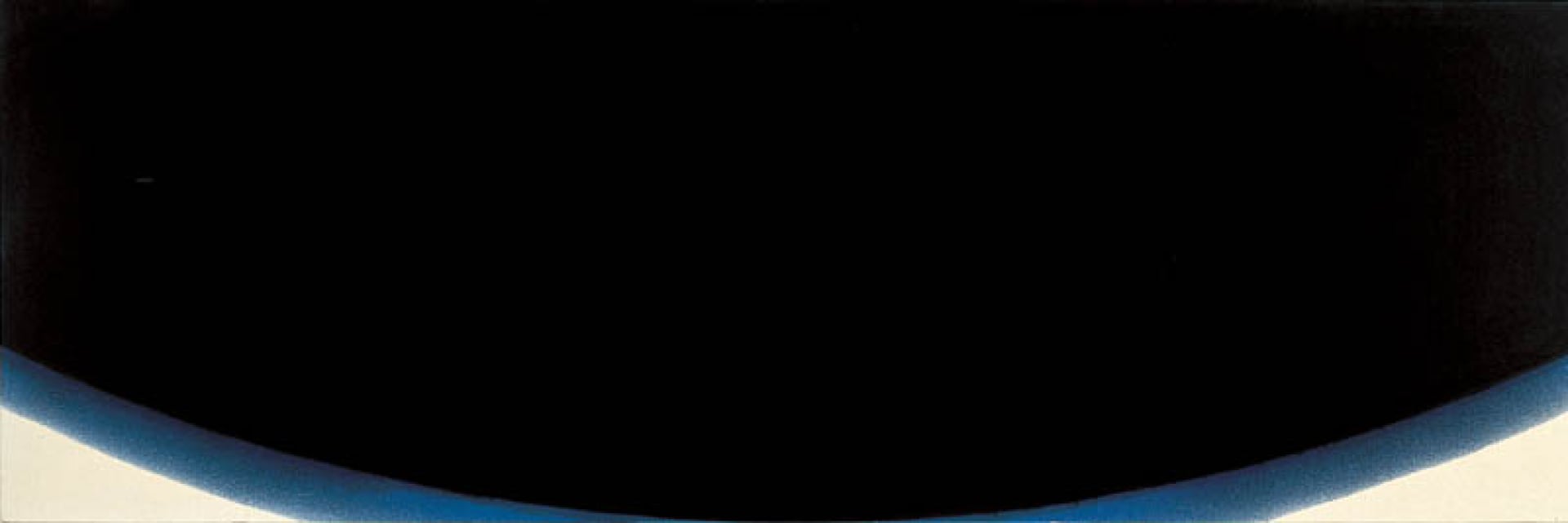
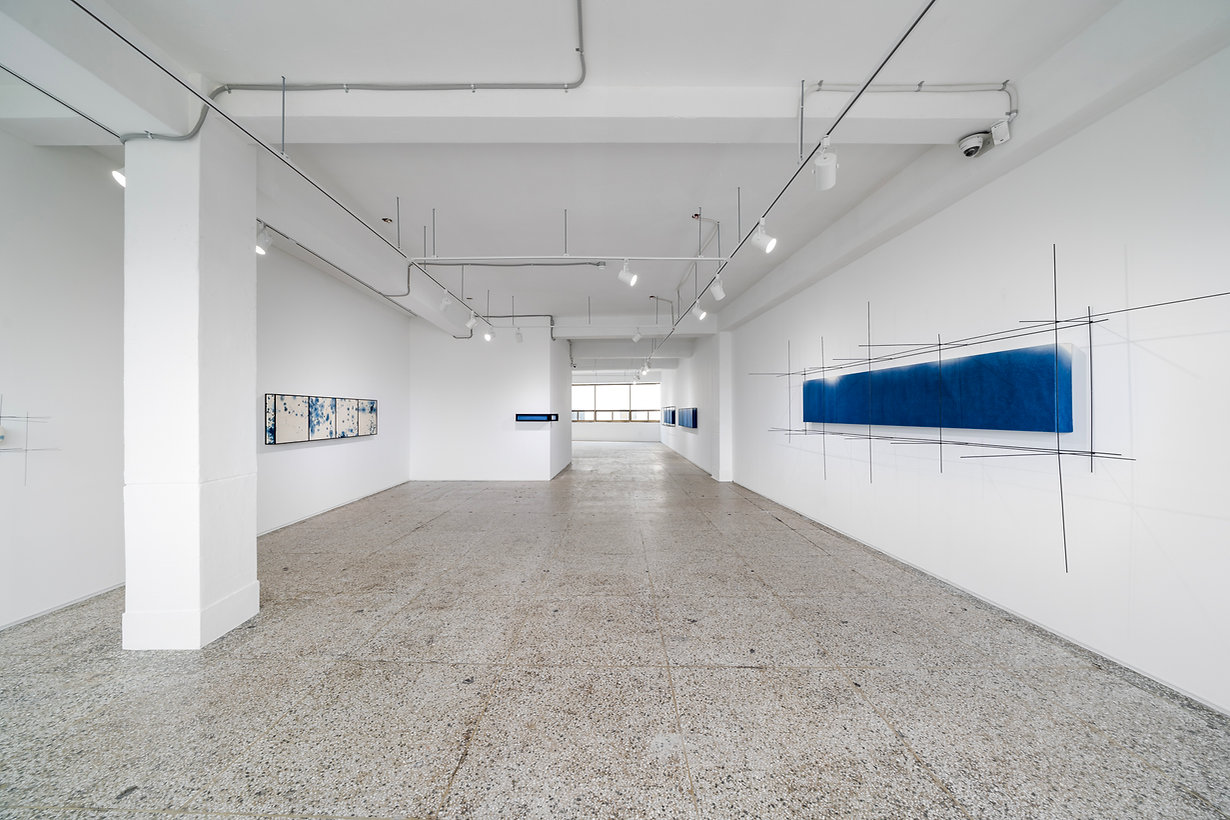
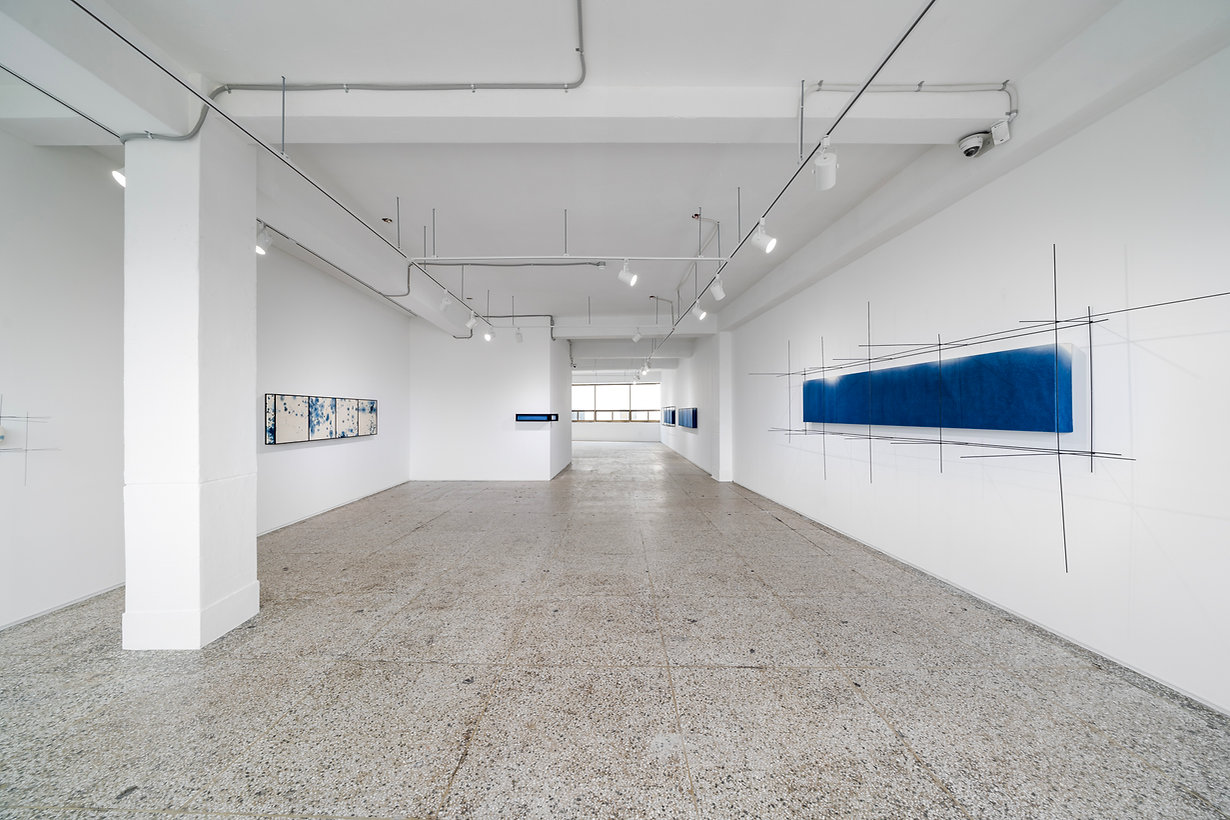
Several lines cross over a thick canvas. Viewers can see blue paints spreading on the fabric between the frame-shaped structures that divide the space horizontally and vertically. They would have to move a bit to identify what the work is all about, and then suddenly stop, encountering a moment filled with lines and planes, colors, light reflected in the work, shadows hanging on the wall, and air in between. That is their own Lagrangian point.
The Lagrangian point, which refers to a point on the orbit that forms a gravitational equilibrium between the two celestial bodies, is a special solution to an unsolvable three-body problem. Unlike a two-body problem like the gravitational action between two points clearly identified by Newton’s universal gravitational pull, the point where mathematician Joseph-Louis Lagrange found an exception of zero gravity in a three-body problem that could not be formulated was named the Lagrangian point.
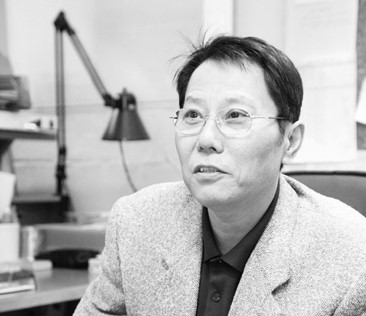
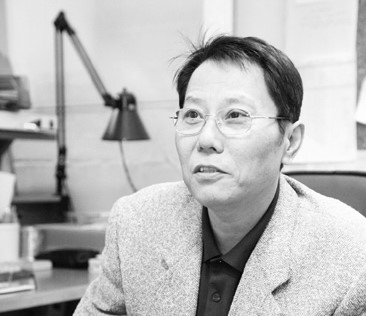
This astronomical term, which comes from sophisticated mathematical calculations, conjures up a very humanistic landscape, such as a moment of enlightenment, found in a vast universe where no clear answer can be found. Inhyeon Lee, who works on ‘L'épistémè of Painting’ with a philosophical name taken from Foucault’s concept, personally is immersed in astronomical observation in his free time, which is beyond amateurism. His solo exhibition 《L'épistémè of Painting - Lagrangian point》 implies the nature of himself as an artist that does not want to be biased in any way amid various elements in life just like the names of words of different attributes in parallel.
Michel Foucault stated that every discourse has a structure of perception that is the background of it, and that it has a classification of the times like a stratum. He named the system “L'épistémè.” Lee took the episteme to name his work ‘L'épistémè of Painting’. As the name suggests, his work is a journey to explore the art historical structure that forms the perception of painting. Upon his release of his work of L'épistémè of Painting for the first time, he raised a question on the “history of frontal facets” based on which he conducted a multi-layered exploration of painting, that is, a two-dimensional visual art. A painting on the wall is often considered to have a frontal facet.
However, the contemporary art had undergone a tumultuous period to the point of having a part of a partitioned plane dubbed as a painting. In other words, he is telling the audience that the face or the frontal facet of that painting, which is showing its face in a good condition, was built in the collision of numerous discourses through a series of works emphasizing side aspects of painting instead of the face.
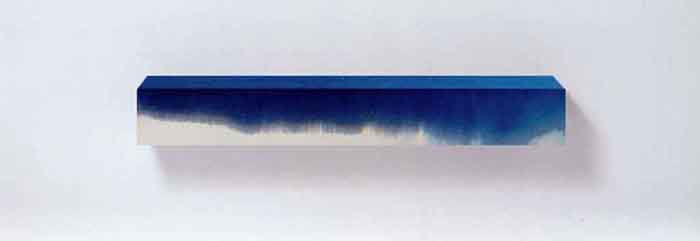
The way Lee induces the audience to think about the perceptive structure in painting is not confined to the form of canvas with thick sides. He has been excluding his distinctive touch as an artist in the production process. Images that maximize the romanticist images of an artist – as in “an honorable stroke of a master artist” – have been overthrown in many ways. For instance he put the so-called paint on a cloth without having a brush touch the canvas for an almost fluid paint to almost drip. Or he used a canvas cloth wrapping around a long wooden stick and used instead of a brush, or the cloth wrapped around the brush again for his work.
All such work, emphasizing the physical properties of his work and dismantling the concept of an artist-driven completion expands the realm of visual appreciation, and provides something to consider on the perceptive structure of understanding painting. Thus, not every work of his is not a completed piece per se: rather, it is called ‘L'épistémè of Painting’, a name given to his continuous work which flows in tandem with his every act of contemplating on art and his life.
His work titled L'épistémè of Painting also has such subtitles such as Painting Seen from the Side, 4D Perspective and Refurbished. These subtitles were derived from the then circumstance of thoughts of his. For example, Refurbished was an exhibition curated with works using cloths used as pedestals or to test the concentration of paints, and works reconstructed from previous versions. Here are layers of meanings breaking down the framework of the ideas on the main vs. the peripheral, the incomplete vs. the complete, and the past vs. the present.
The history of such intriguing subtitles – encouraging the audience to look sideways at the frame of painting that requires what is face-to-face and completeness, to view a work in consideration of the time spent in the making of it, and to rethink the concept of completeness of a work, presents the experience of the “Lagrangian point” that exists exceptionally amid the chaotic disintegration of painting. The years of production for his works exceeding 30 years point to a milestone between the past and the present, and the combination of frames and canvases in his works toward a point between spaces, is a memorable experience, just like a single moment incidentally photographed on a continuous path in his artistic journey.
What is noteworthy in Lee’s work, who refers to his exhibitions and works under the one name of L'épistémè of Painting, is the name of his work called in real life. His work is sometimes called the names representing figurative characteristics of the work, such as “Yangsuri” and “Mississippi.” Lee usually accepts these terms which are like nicknames used by his acquaintances to refer to his works that cannot be distinguished otherwise, that is, by title alone.
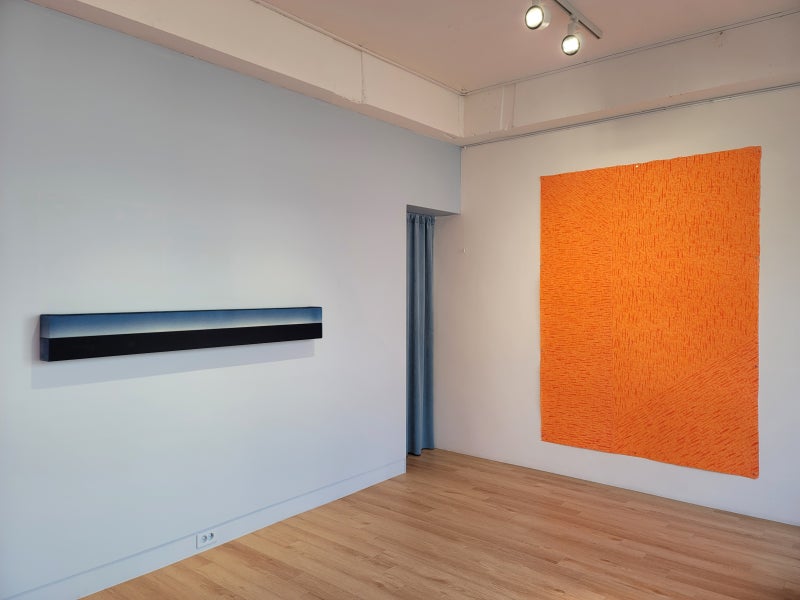
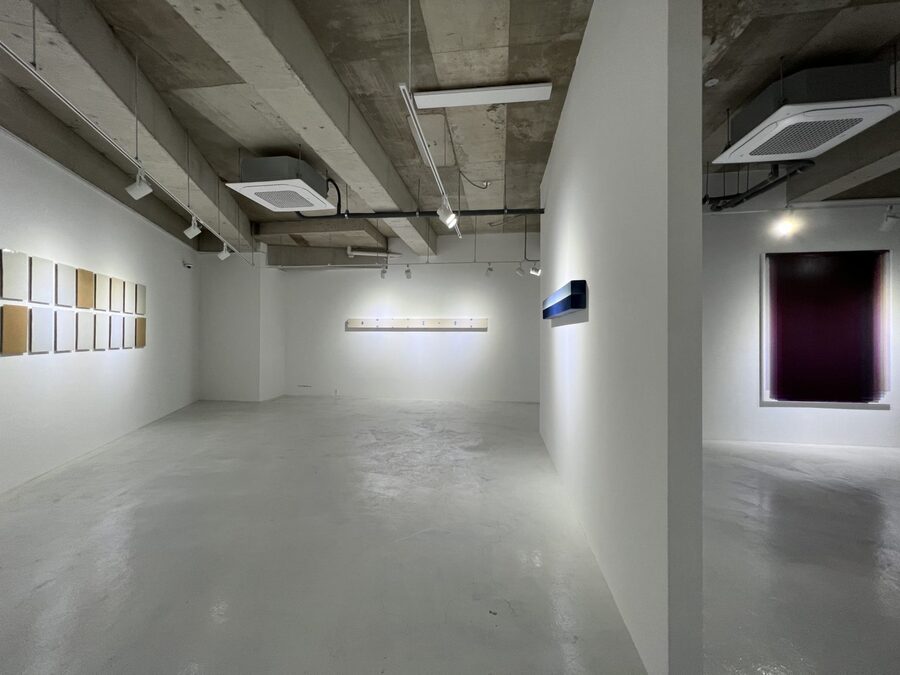
This exhibition will also exhibit his works with various nicknames: “Scaffolding” – a term used on construction sites that allows people to walk around for constructing exterior walls; “Blue-and-White Porcelain” being reminiscent of smudging blue paint; and “Transformers” equipped with exceptionally thick black frames. Lee’s inclusive attitude of accepting the use of these terms which are not the official titles illustrates his view of art and pragmatic attitude of disagreeing with the rigid thinking formed by the history of painting throughout all those years.
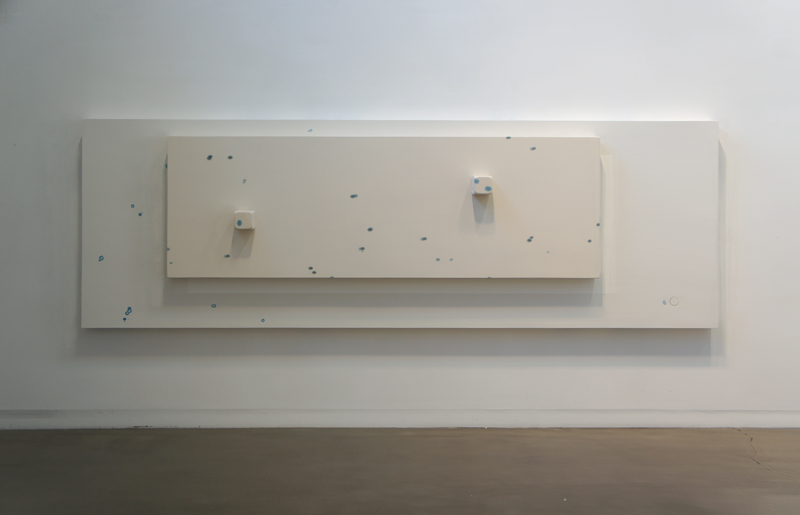
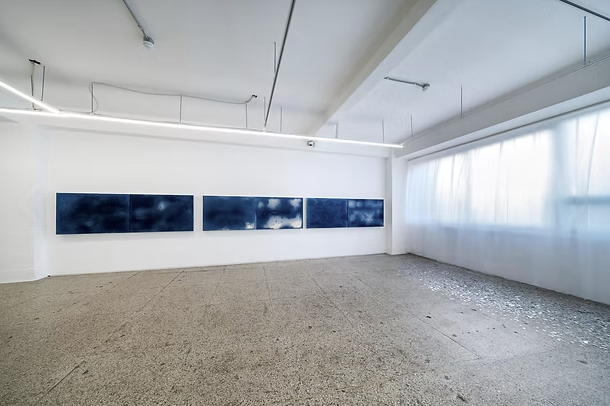
Lee’s open-mindedness as such can also be found in the figurative characteristics of each work. The so-called “works including frames” exhibited in 《L'épistémè of Painting - Lagrangian point》 bring about a variety of variations in the space that determines the interior and exterior of the work. The frame that enters the area of his work does not limit its space but obscures its limitation or boundary. The frame used to block a work or limiting a space includes even infinite space in his work depending on the shadow created by the instant light and the angle of view. By embracing the frame, his work easily transcends the limitations of space and time and starkly crosses the conceptual division of independence.
This spatial composition also extends the audience’s experience of appreciating works to an infinite level. His work suggesting the audience to see sideways as they are seeing it as a thick painting now encourages them to enjoy the frames that stretched out into the air and the shapes created by canvas. The viewers must continue to move to see the work and find their own angle of liking. As they do so, a single piece of work does not have a fixed image and has a different appearance from time to time depending on whether the viewers are standing, slightly bending their knees, or sitting down.
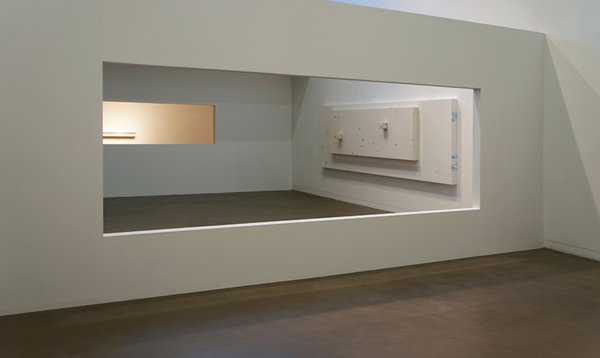
Here, it is obvious that various conditions such as the weather on the day of seeing it and the emotional state of the viewers come into play. Lee further expands such an experience by combining separate works into one frame and installing the two works as if they are connected along the wall of the gallery bent at perpendicular angles. His work varying infinitely depending on the beholders embraces all kinds of coincidences and resist uniform notions such as frontality and completeness. The artist and the audience see his work from their own perspective at different Lagrangian points.
Coming back to 《L'épistémè of Painting - Lagrangian point》, and getting immersed in the figurative beauty of each piece and the flow in between, and the aesthetic harmony created by the sophisticated lighting on them, You might feel the presence of an uptight person being as tight as a stretched-out string there. He completes a work that excludes his artistic touch with sensitive concentration and intense labor and plans an incidental show in the stream of thoughts that never stops in his mind. At the same time, he is immersed in the same level of concentration and attitude for things such as meeting up his acquaintances, looking at the sky, and tasting delicious cakes, and high-quality alcohol.
His work, which distinguishes art from life and asks questions about linear thinking that makes the beginning and the end, is put into action by Lee in every moment of his life. Lee’s Lagrange point stands in the middle of L'épistémè of Painting, as an exquisite and sensitive point in intersections in and out of painting, the artist and the audience on his work, his past and present works, and his work and daily life. I hope that we will all find our own Lagrangian points through his oeuvre being open to everything in 《L'épistémè of Painting - Lagrangian point》.