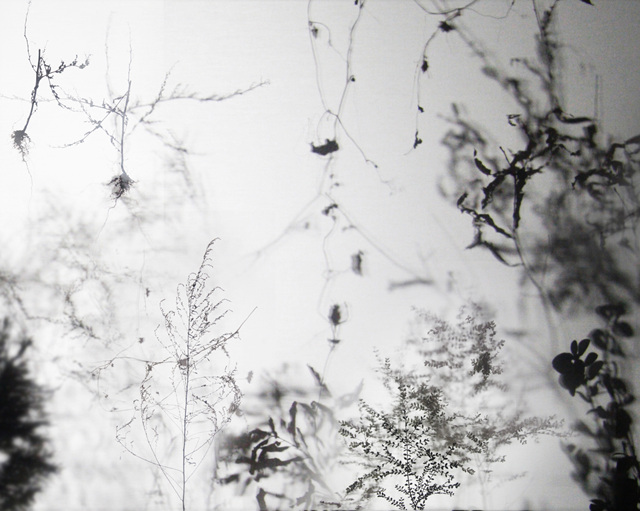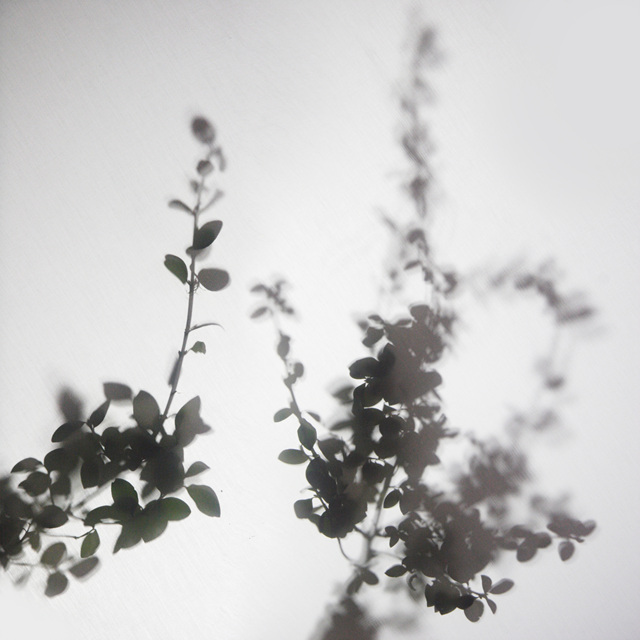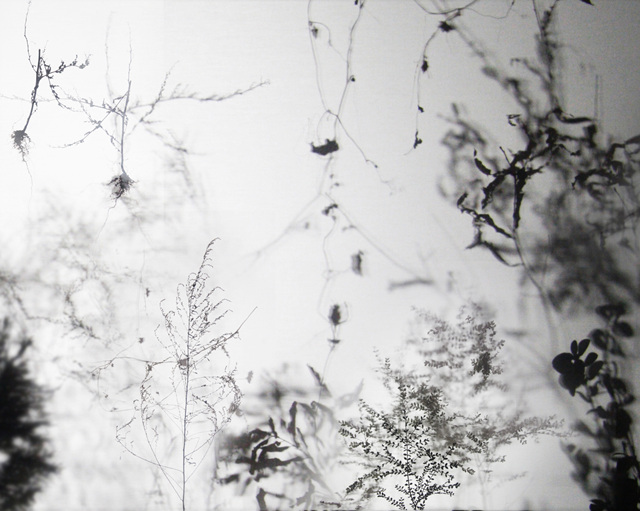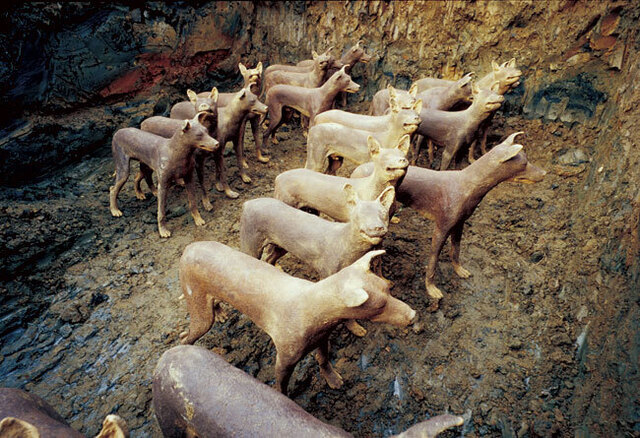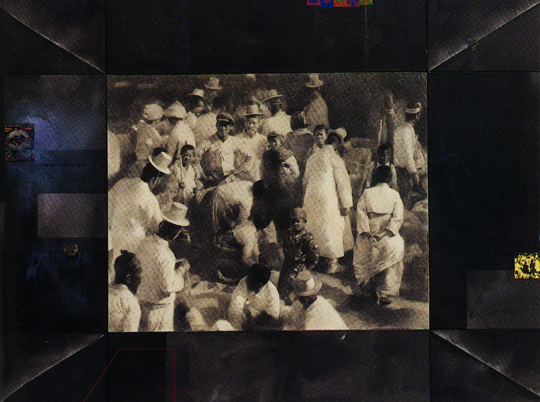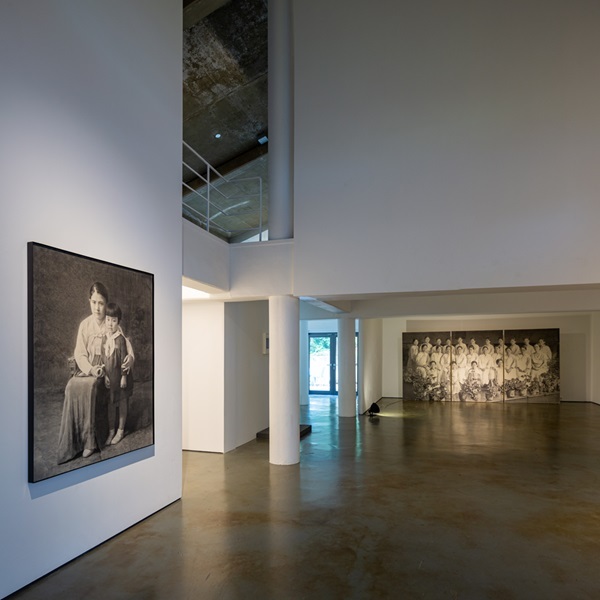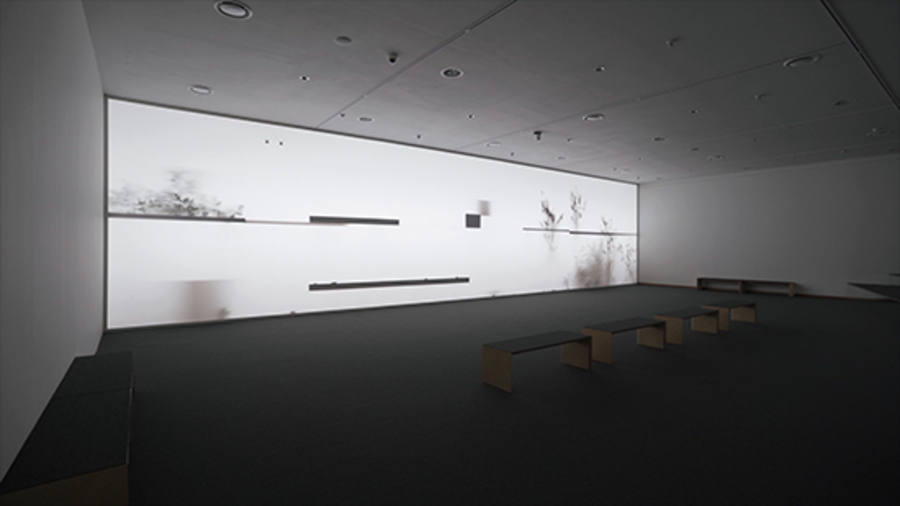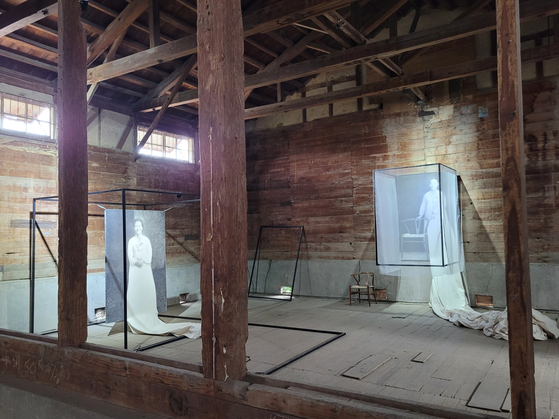
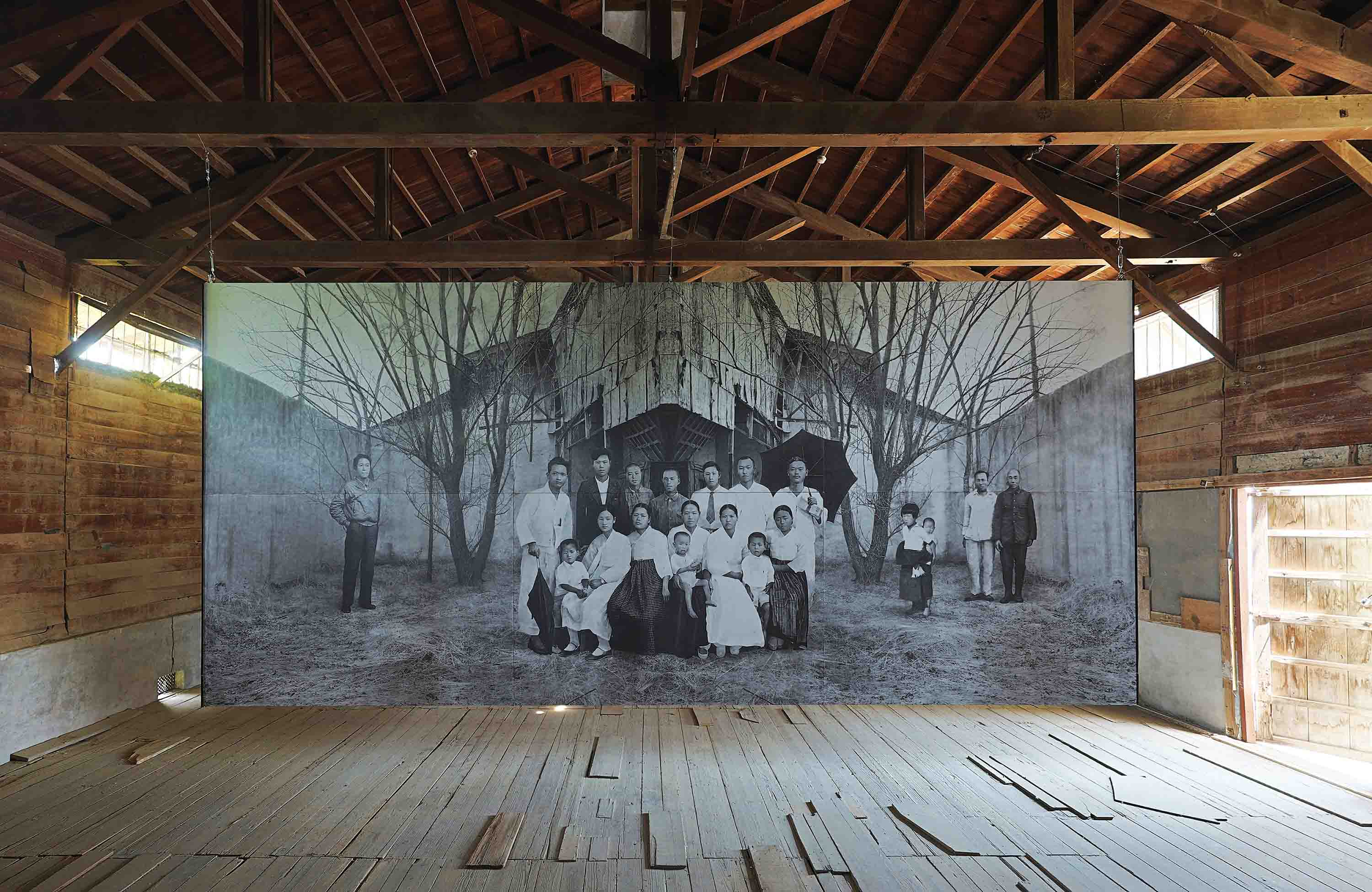
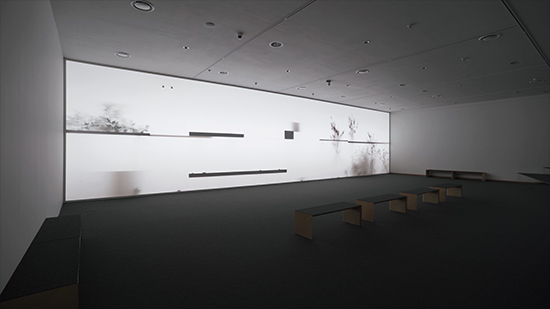
Cho Duck Hyun, Garden of Sounds, 2014, Objects, screen, LED lighting, contemporary music, 1160 x 370 cm © Cho Duck Hyun

Cho Duck Hyun’s exhibition 《Garden of Sounds》 is both a delicately realized mural installation and a simple stage designed for music. The space, where shade and sound intermingle, also functions as an indoor garden. Various plants placed within a stage measuring 13 x 4 meters, and within an inner width of 4.5 meters, cast diverse silhouettes onto the enclosed white stage curtain. The shadows cast upon the white surface unfold gradations reminiscent of ink painting.

This peaceful scene, in which subtle movements are sensed within stillness, even makes one forget that the work employs a format reminiscent of the electric signboards that dazzle the eyes of city dwellers. His work evokes not only ink painting but also shadows cast upon the white paper windows of a traditional Korean house (hanok), shadow theatre, ink animation, inlaid patterns, pressed flowers, and black-and-white photography. As Christian Boltanski, the artist of the work Shadows (1986), once remarked, “In Greek, the word for shadow carries the meaning of writing with light.”

Therefore, a shadow is the earliest photograph. The work also recalls slow-moving images. With music added to the installation, the shared sensory and formal resonances of the work expand infinitely. The minimalist stage forming one wall of the exhibition space possesses an inclusive diversity, drawing in everything around it like a blank white sheet.

This synesthetic installation does not remain merely a background for the contemporary music of Claude Debussy and Isang Yun; rather, it is the product of dialogue closely intertwined from the stages of planning and conception. The artist explains that his interest in Isang Yun arose from the composer’s musical philosophy, which is grounded in the vast language of nature—something incomparable to the short and powerless span of human life.

The black stains on the white ground that form the tonal basis of the work were inspired by Isang Yun’s handwritten musical scores preserved in Tongyeong. This is not simply a translation of contemporary music into contemporary art, but a correspondence between the two and a deeper encounter at their origin. The various plants arranged within the wall reveal their presence not through their physical forms but only through their shadows; yet they possess the depth of black-and-white photography—more profound than color photography—and a poetic atmosphere more evocative than prosaic reality.

This garden, a microcosm situated between nature and the artificial, is what philosopher Heinrich Rombach called a “living structure.” The overlapping of garden and stage suggests that this tranquil space-time is quietly stirring with something within. The powerful structure forming the wall simultaneously functions as a sensitive surface that records, in real time, the traces of even the slightest movements of air.

This device does not imitate reality; rather, it allows reality itself to draw the image. It reveals that the art of gardening itself is created in cooperation with nature. Nature is chosen, yet within given limits it unfolds and folds itself without coercion. The sewing lines required to create the vast curtain become paths for humans. Along them appear groups of people journeying through life.

The small human figures along the horizon that crosses the curtain transform the small plants—mere grasses in scale—into a vast forest. Yet it is not a primordial and chaotic forest that might evoke fear in humans, but a utopian landscape with a path opened through its center. It is a garden as paradise, a place of happiness without painful labor.


Cho Duck Hyun, Garden of Sounds, 2014, Objects, screen, LED lighting, contemporary music, 1160 x 370 cm © Cho Duck Hyun

The fact that images unfold through shadows suggests that the work itself occupies a modest position while generously embracing others. In A Short History of the Shadow, Victor Stoichita reveals that shadow preceded the mirror as the origin of representation. The author, who argues that the birth of artistic representation lies in the “negative image,” emphasizes that the fundamental principles of these two images—shadow and mirror—differ both optically and ontologically.

According to Stoichita, the primitive nature of the earliest act of representation described by Pliny lies in the fact that the first pictorial image was not the result of direct observation of the human body, but rather a representation that captured the body’s shadow. The mirror model that became dominant after the Renaissance reflects the same entity from the front, whereas the shadow illuminates the other from the side. It is not a copy of the original—that is, mimesis—but the creation of something that merely resembles it: simulacra. The stage that echoes these phantoms drifting within finite forms becomes a space-time where the magic of substitution unfolds.

Nature and humans projected onto the curtain are indices of transience—small points inscribed within infinite space and time, precisely because they are all ephemeral shadows. Human life resembles that of actors who briefly appear on the stage of nature before disappearing. Sound (music), which emerges and fades within time, is also ephemeral.

Yet such ephemerality is itself an essential characteristic of life. An important element of the exhibition is music: beginning with the opening performance of Isang Yun’s ‘Two Viola Meditations’ (performed by Jinhee Jeon), a series of performances took place throughout the exhibition period. Even the plants that appear like specimens exist upon a vibrating stage that flows with time like music. The stage becomes a site where diverse temporal forms are composed.

Within this overall flow, stillness and silence also become part of meaning. As in mural painting, music here is not merely a background but an essential element for a living stage. In Sound and Symbol, Viktor Zuckerkandl points out that when people say the universe is alive, they do not refer to its movement but to its harmony—that is, its sounding together.

Light and color, smell, taste, solidity, fluidity, roughness and softness, heat and cold—all these may also be found in the inanimate world, but sound is the only phenomenon that can be produced solely by living beings. In Cho Duck Hyun’s work, sound belongs entirely to living life and enables us to look out upon the world just as much as visual art does.

References