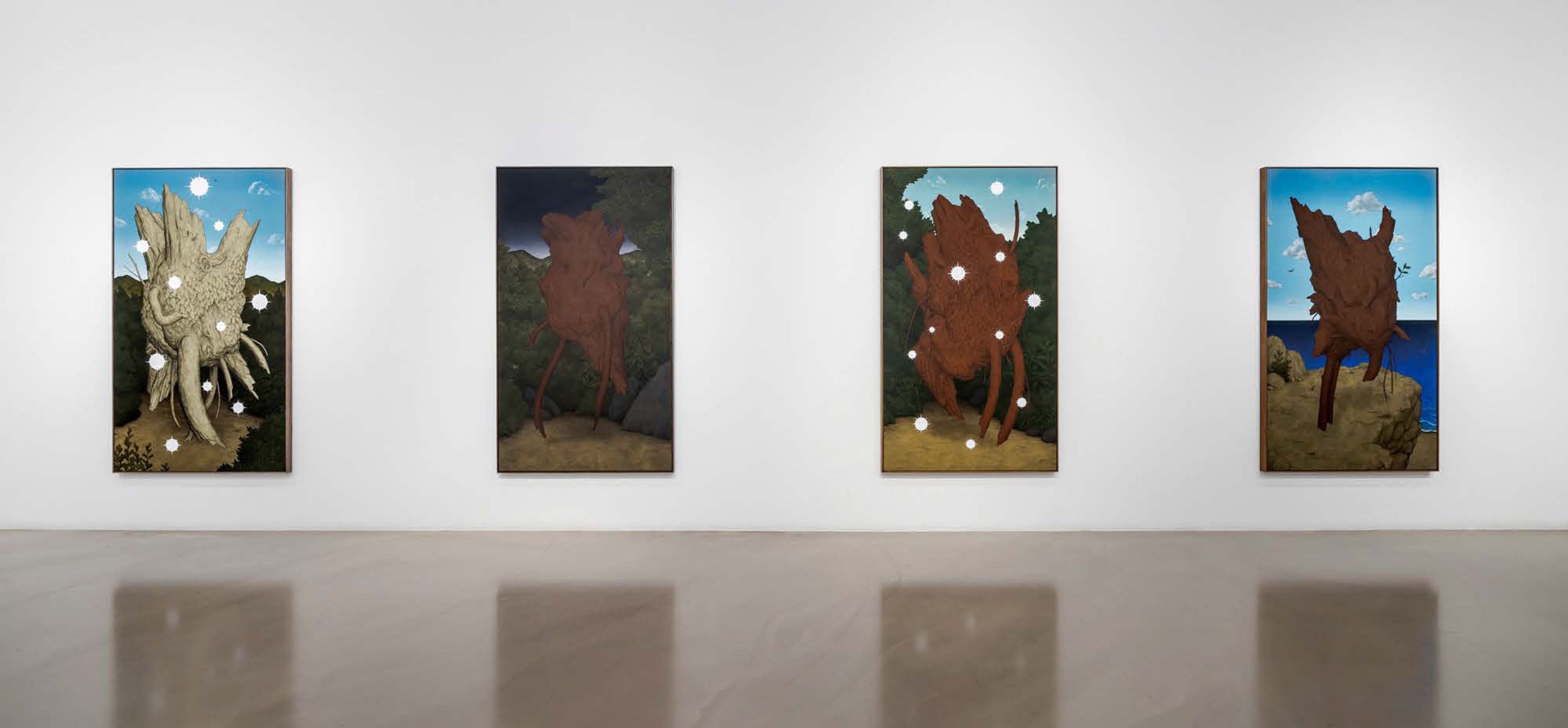
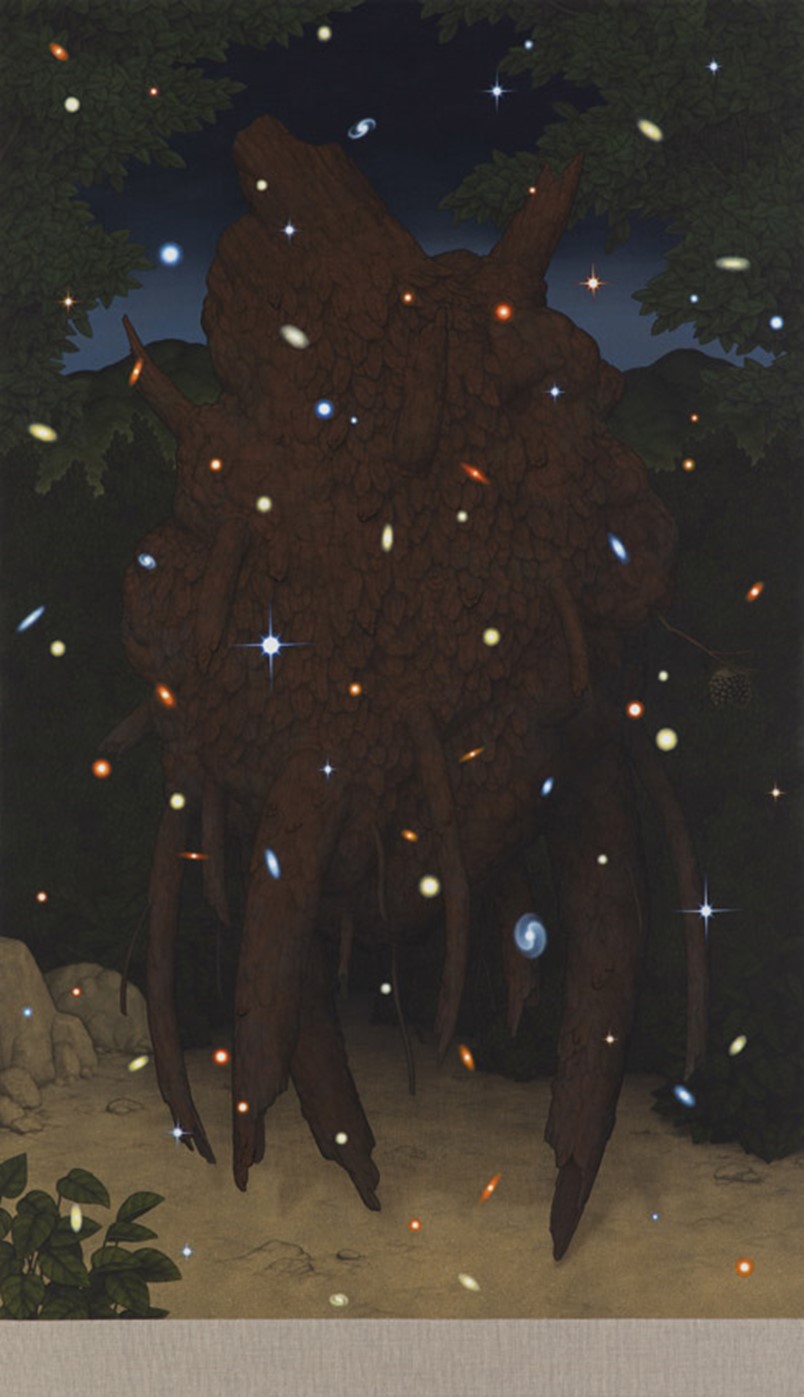
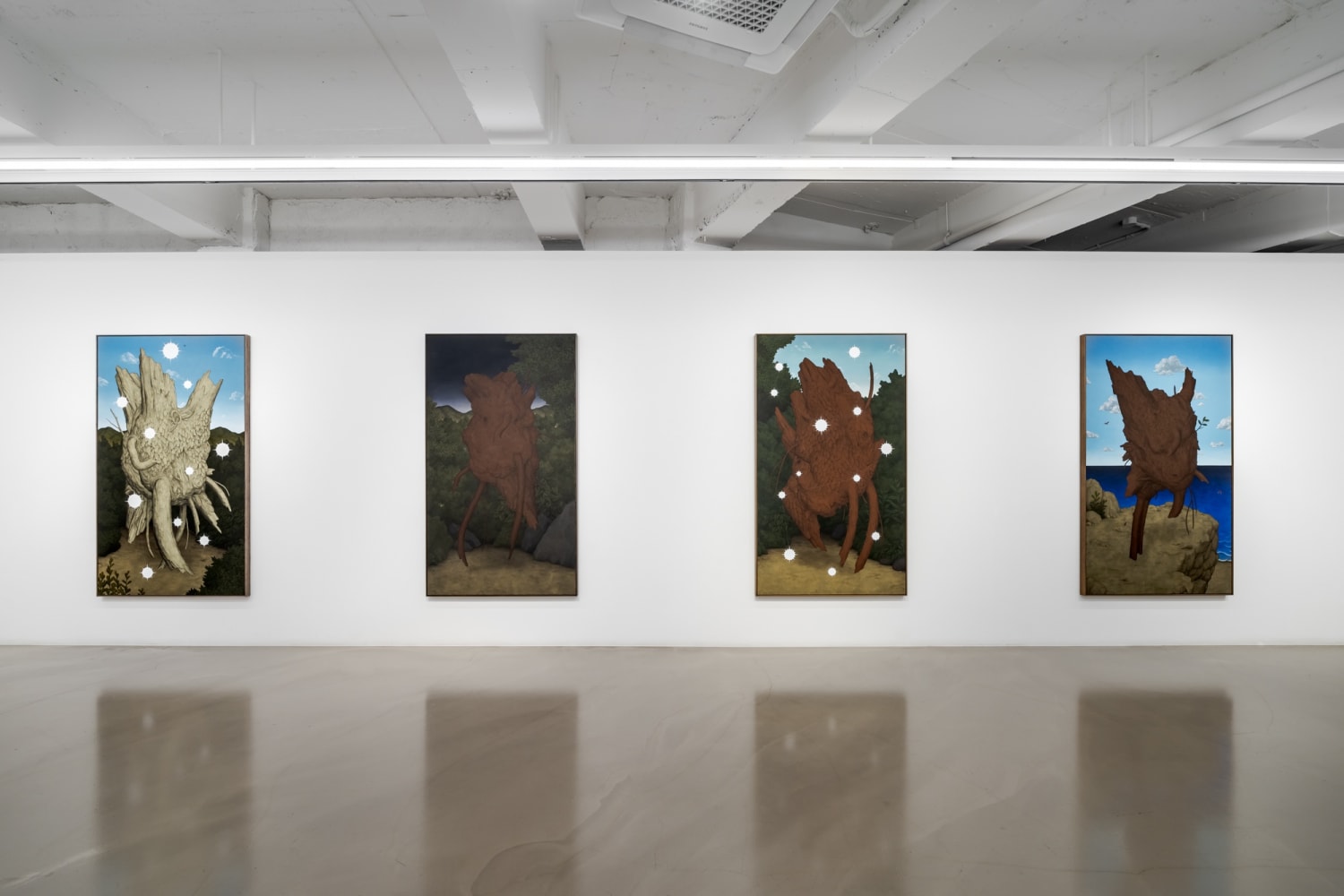
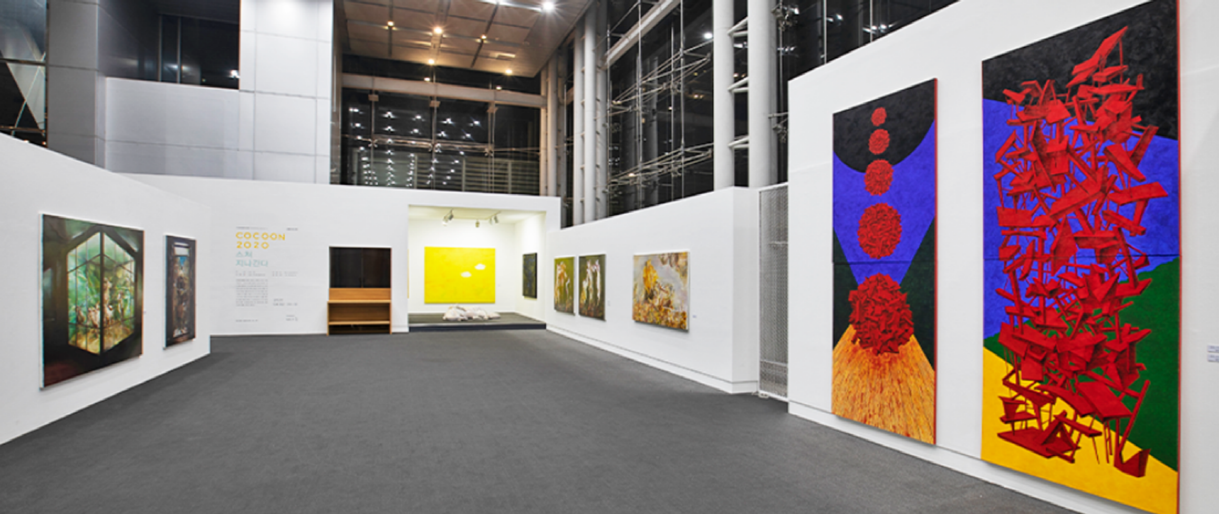
Jaeseok Lee’s paintings, which have previously unfolded surreal
landscapes through the fragmentation and deconstruction of anthropomorphized
objects and mechanized bodies juxtaposed in unfamiliar ways, have recently
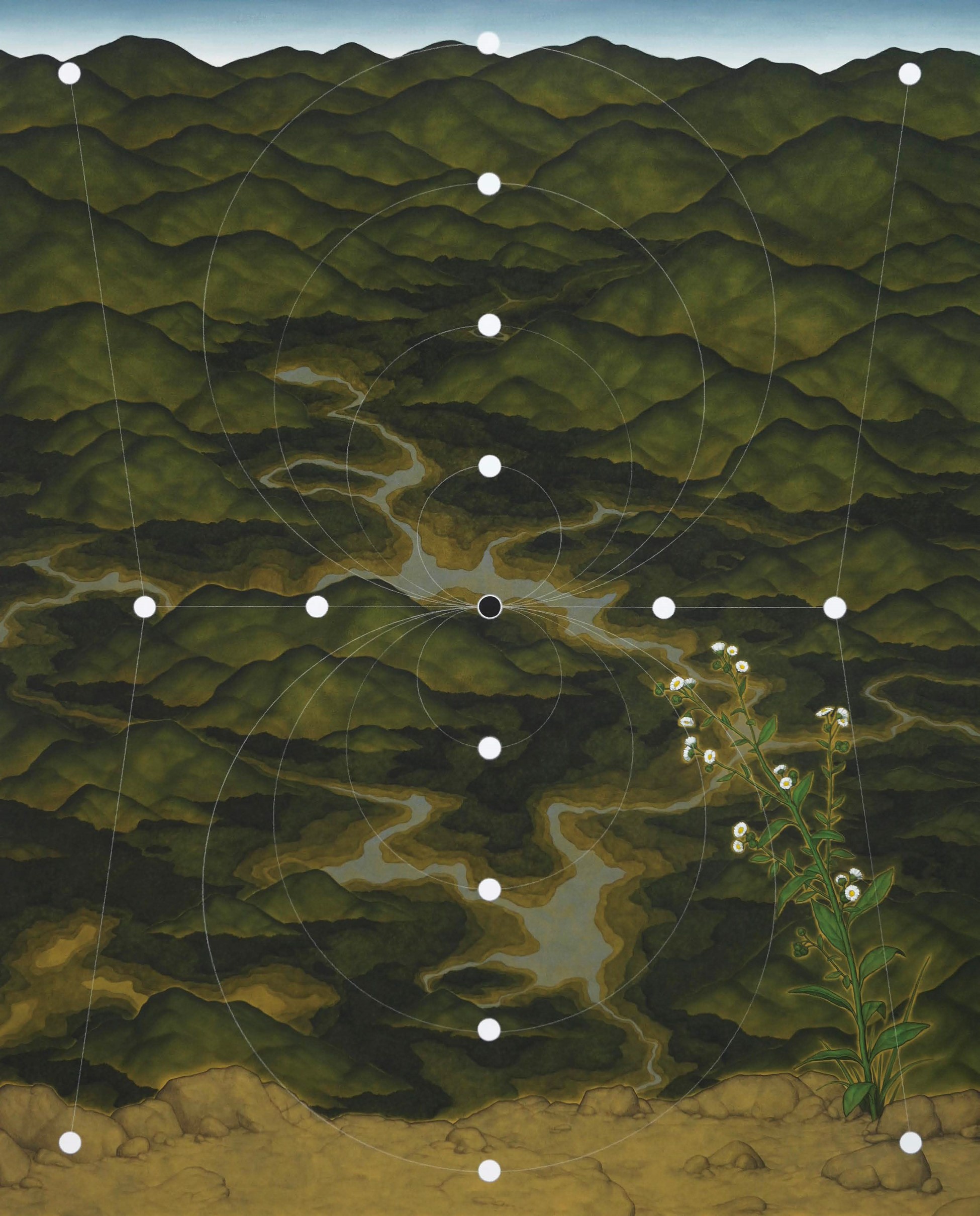
undergone a significant transformation. His latest work, Linkage(○―○―●―○―○)(2024),
exemplifies this shift. Departing from a fixed, singular viewpoint that he had
consistently adhered to, this piece presents an expansive mapping-like
composition where multiple perspectives and positions coexist simultaneously.
The entire surface is covered with layered mountains, creating a map-like
format where every location exists at once. The mountains, valleys, and rivers
are flattened and abstracted into a pattern without hierarchical distinctions, making
the work resemble an abstract painting. In contrast, the foreground at the
bottom of the painting is meticulously rendered, depicting dry, cracked earth
alongside a single summer flower in full bloom. The barren, arid ground,
seemingly incapable of sustaining life, starkly contrasts with the deep
blue-green mountains and rivers in the distance, emphasizing the resilience of
the lone Erigeron flower standing amidst the desolation. Lee’s masterful use of
trompe-l'œil further amplifies the symbolic vitality of the summer flower,
infusing the composition with an otherworldly, surreal beauty.
“…It was the kind of painting that only those on an airplane could
see. When you ascend above the clouds in a hot air balloon… glimpsing the
serene blue sky momentarily through the mist… at that altitude.”
The juxtaposition of the infinitely monotonous flat landscape with
the meticulously detailed summer flower symbolizes an alternative reality
constructed and arranged by the artist—a metaphor for the world in which we
struggle and exist. In this sense, it parallels the virtual environments of
computer games, which present another reality that can be accessed instantly
with the flick of a switch or the press of a button. The flattened depiction of
mountains, valleys, and rivers, structured into a web-like space of interlinked
symbols (○) and signs (○), visualizes yet another form of reality—the World
Wide Web (WWW), an endless, interconnected digital realm.
Since 1989, the internet has provided a virtual space that can be
entered at will, offering an alternative reality and location. Through the
aesthetics of Surrealism, exaggerated sexual imagery, science-fiction-inspired
motifs, and computer game aesthetics have become some of the most readily
accessible visual experiences. Lee, having spent countless hours in his middle
school years immersed in game programming, once disclosed his deep engagement
with digital world-building. At one point, he received an opportunity to
collaborate with an indie game company, where he was responsible for designing
backgrounds and maps. This process involved placing pixelated texture tiles
onto a virtual grid, layering elements, and integrating objects like trees,
grass, and rocks—an approach akin to cartographic mapping using aerial
photography. This formative experience has profoundly influenced his artistic
practice, allowing him to merge traditional perspective techniques with the
hyper-realistic, three-dimensional illusions exclusive to web and gaming
environments, thereby amplifying the visual impact of his compositions. “By
presenting a virtual space within the canvas, as perceived through my
perspective, along with the interactive (or seemingly interactive) images within
it, I aim to blur the boundary between the real and the virtual.”
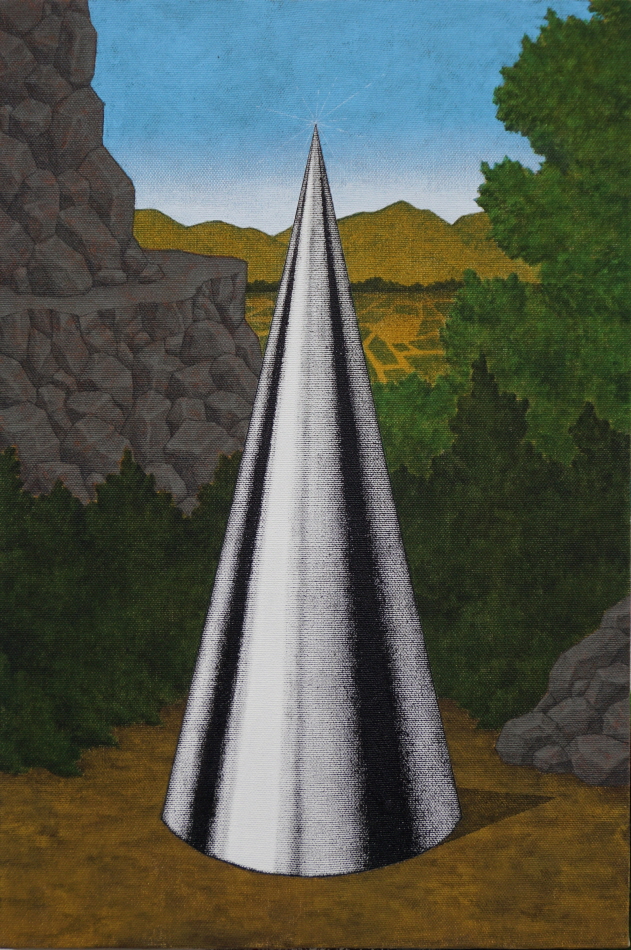
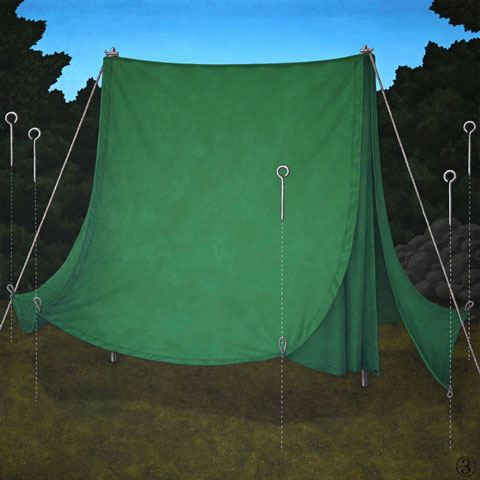
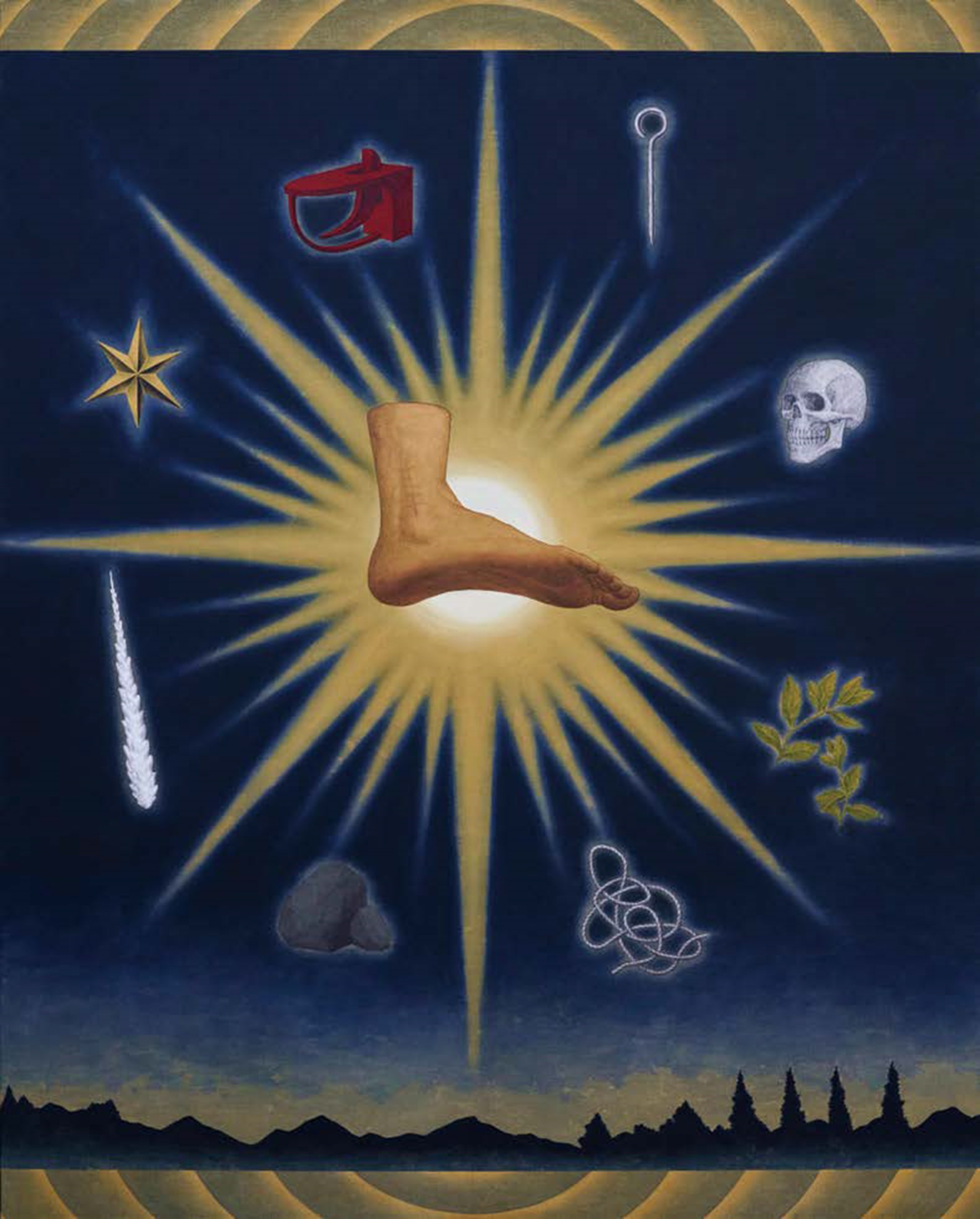
Within his works, Lee employs natural elements or objects—either
singular or multiple—as symbolic motifs, spatially charting them as
coordinates. These symbols, connected through points and lines, serve as a
visual language that links reality with the virtual, different worlds with each
other. The gravitational pull of the central sign (●) materializes through the
repetition of linking symbols (○), extending the mapped space omnidirectionally
across the canvas. Much like a spider’s web or constellations in the night sky,
the world unfolds endlessly through these connections. By mapping out and
structuring a game-like virtual space from an omniscient linker’s perspective,
Lee demonstrates how the game world, while similar to reality, also diverges
from it. The expanded visual range permitted by virtual environments grants
perspectives that would otherwise be impossible in the physical world. This
spatial logic, fundamental to gaming imagery, is seamlessly integrated into
Lee’s painting compositions.
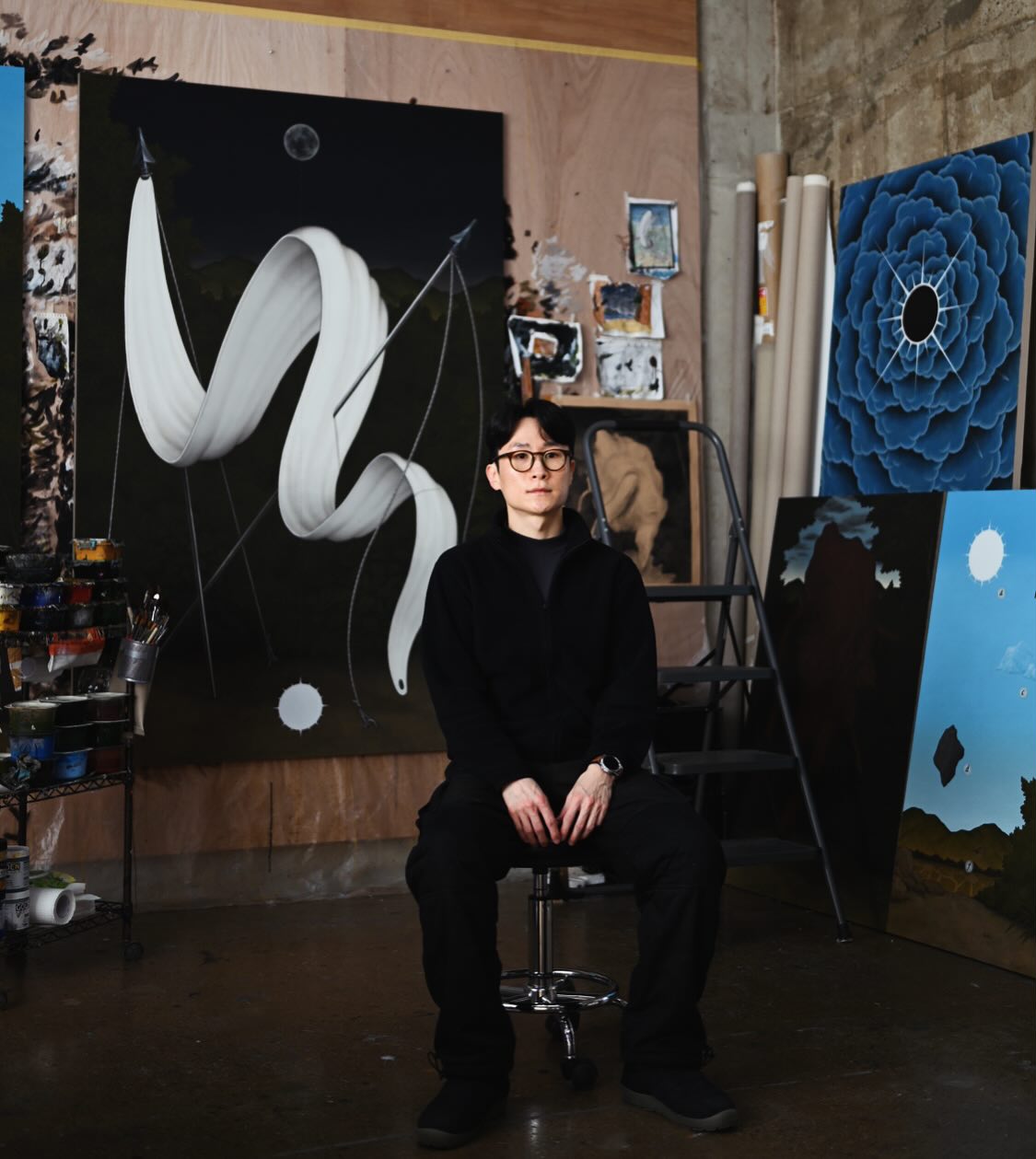
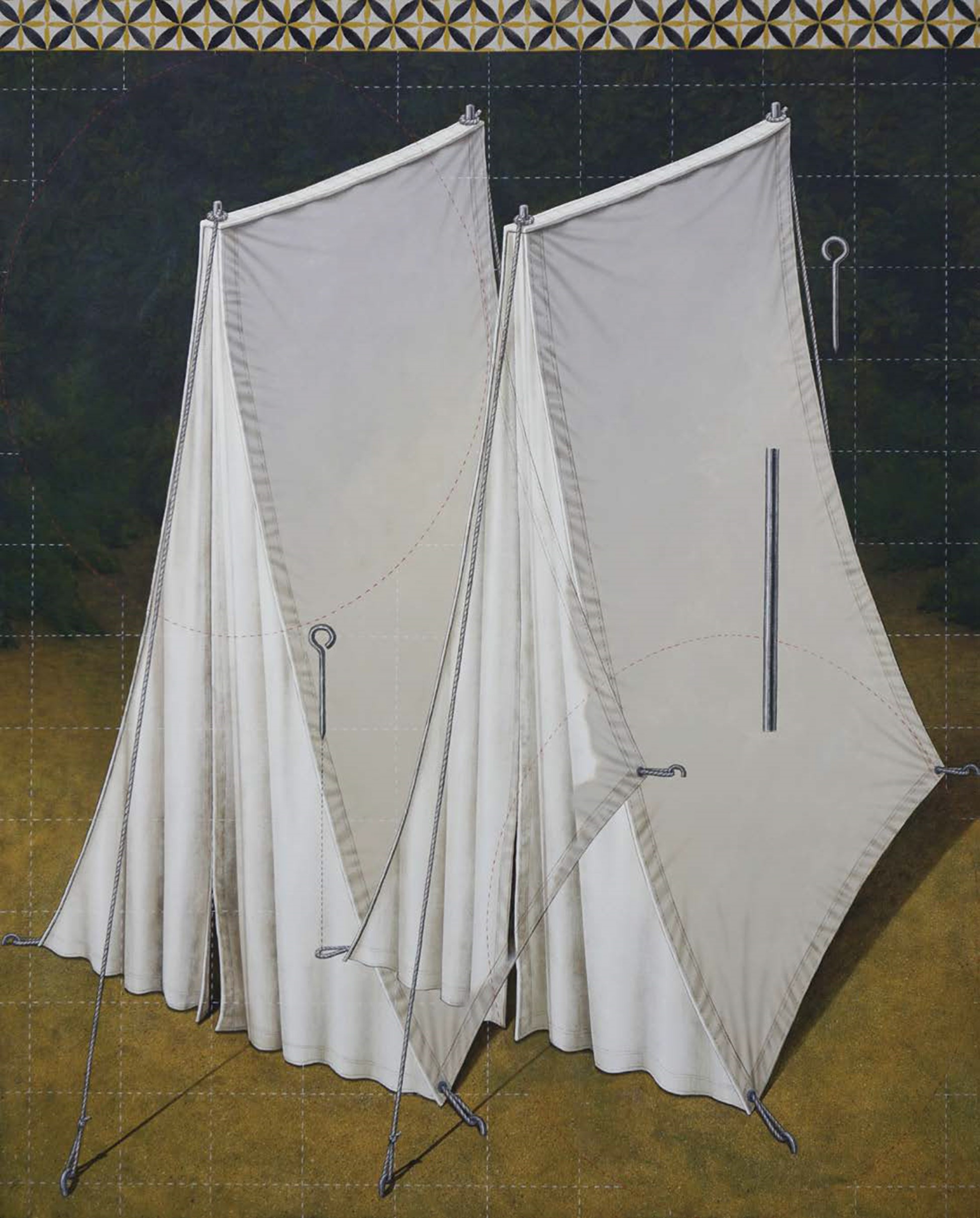
Most of Lee’s works are meticulously constructed around regulatory
lines—strict grids that dictate the structural arrangement of motifs. This is
evident in his earlier works such as Fragment (2016), The
Instructions with the Body (2018), and Body Masses
(2018), as well as in recent pieces incorporating linkage symbols, such as Linkage(○―○―●―○―○)
(2024), Range of Fire_3 (2021), Connected
Islands (2022), Pine Tree (2022), Connected
Yet Separated Boundaries (2022), and Constellation_2
(2023).
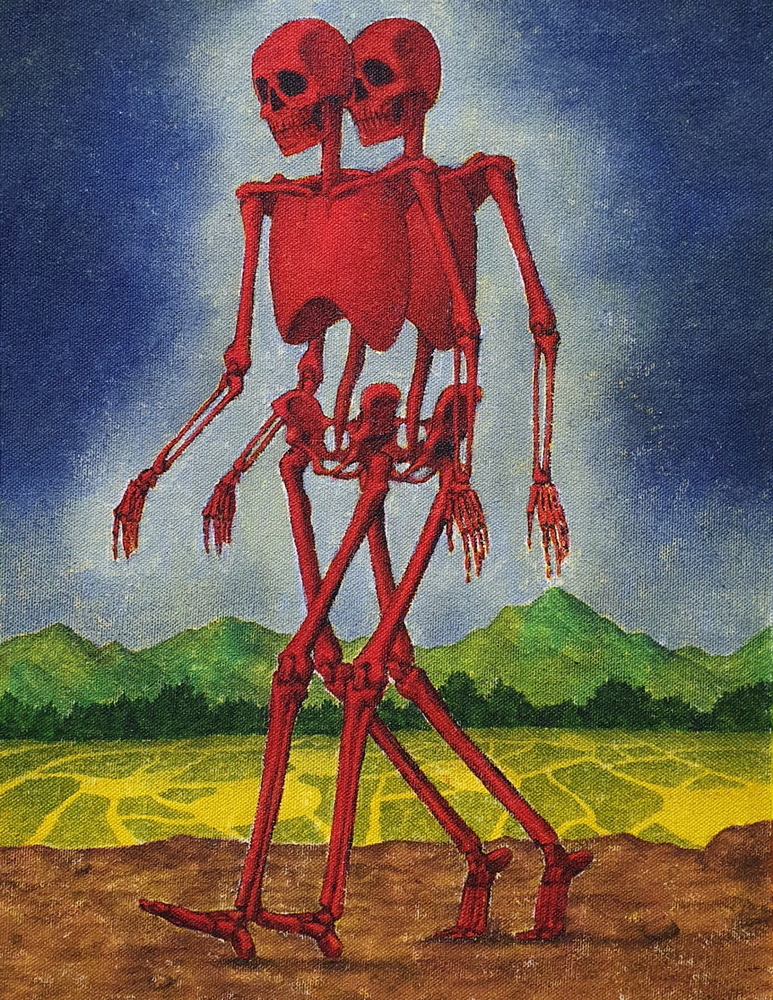
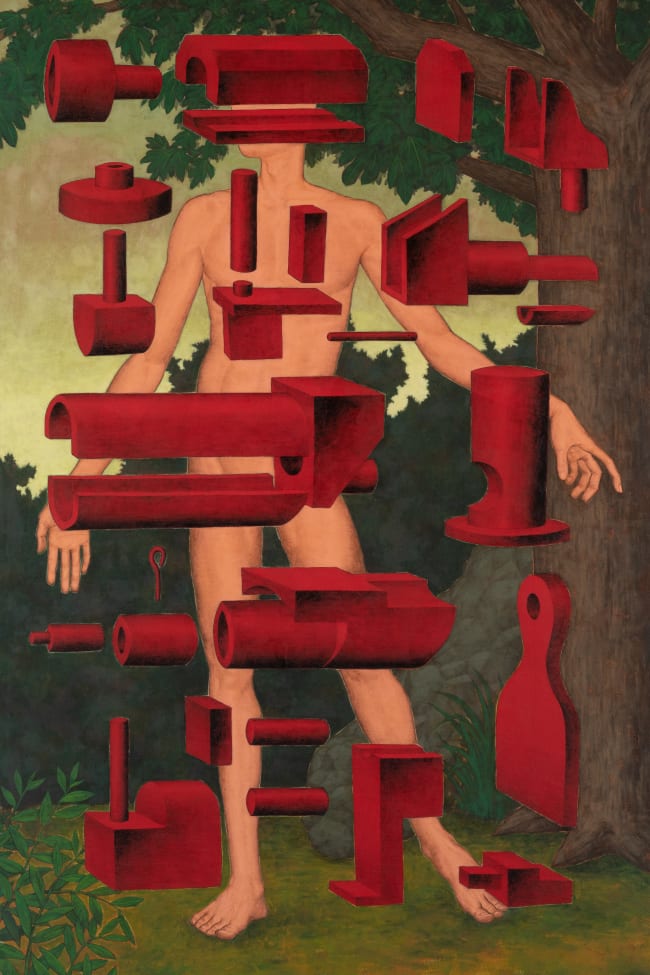
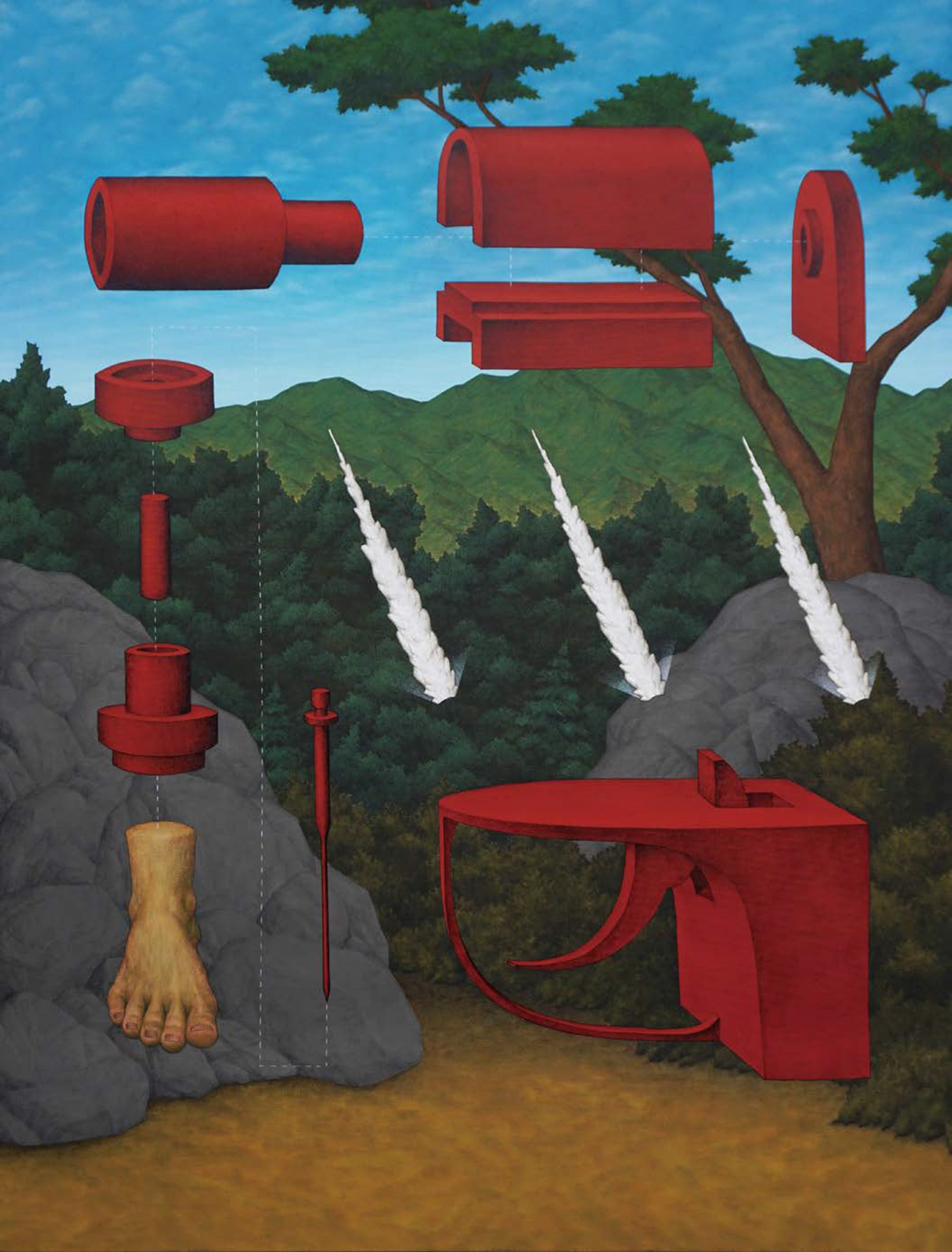
In his earlier works like Fragment, The Instructions with the Body,
and Body Masses, Lee filled the canvas with scattered, fragmented human bodies
and mechanical or geometric forms, reminiscent of disassembled model kit parts.
Within these compositions, the human body transformed into machine-like
structures, and mechanical components took on anthropomorphic qualities. In
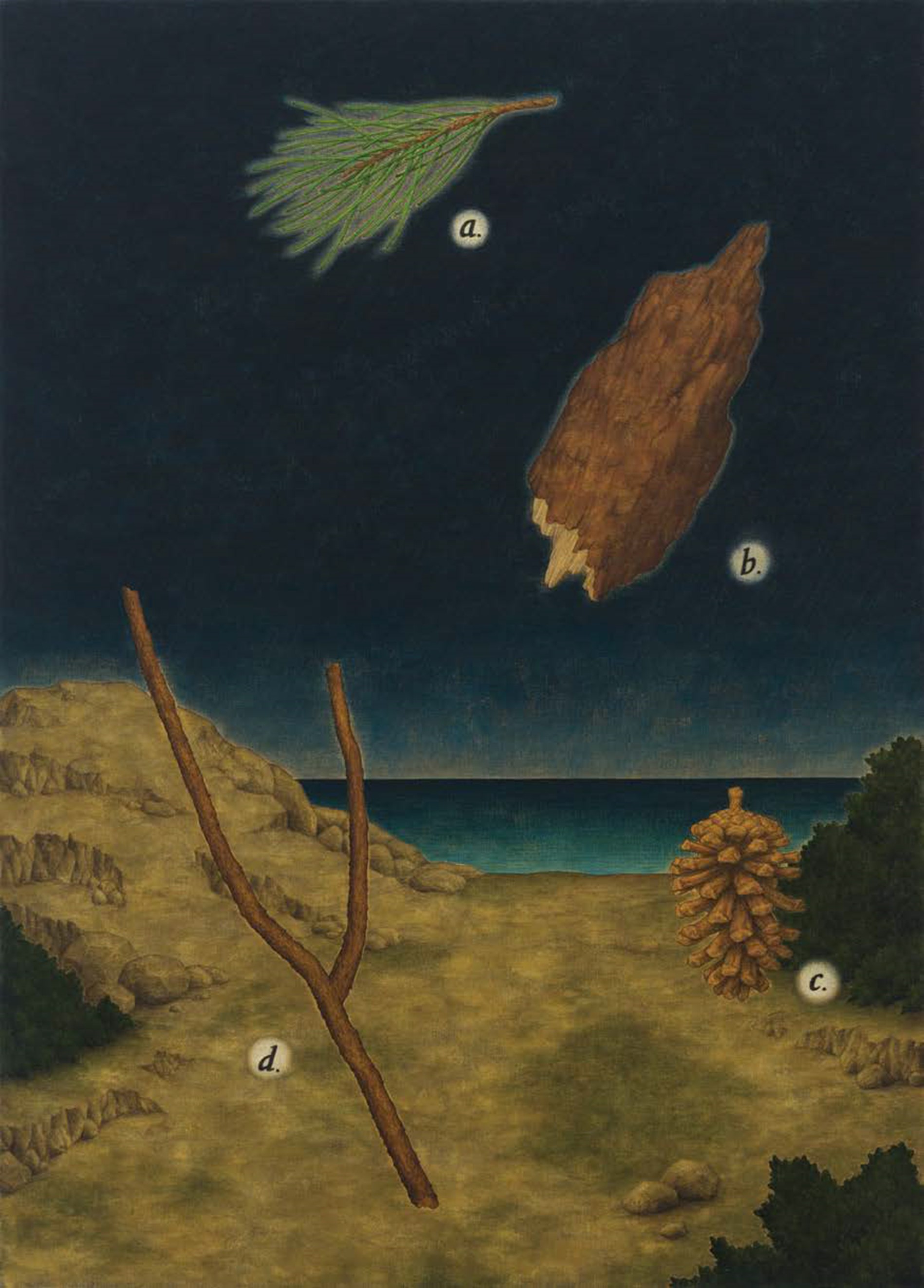
contrast, later works such as Range of Fire_3, Connected Islands, and Pine Tree
replace these modular arrangements with interconnected symbols such as numbers,
letters, stars, and circles.
The modular structure of earlier works suggests two key
implications. First, it establishes a new relational framework between the
human body and objects. Second, it acknowledges the contradictions inherent in
modern systems of order—industrialization, nationalism, and
digitization—despite their alluring sense of structure. Lee highlights the
notion that just as a firearm’s function is optimized through the precise
assembly of its components, so too is a body’s functionality reinforced by the
seamless operation of its internal organs. Through this structural analogy, the
fundamentally disparate entities of firearms and human anatomy are united
within a singular, systematic world. Consequently, in works like The
Instructions with the Body and Body Masses, human bodies and mechanical
components are fragmented, severed, and arranged within the same hierarchical
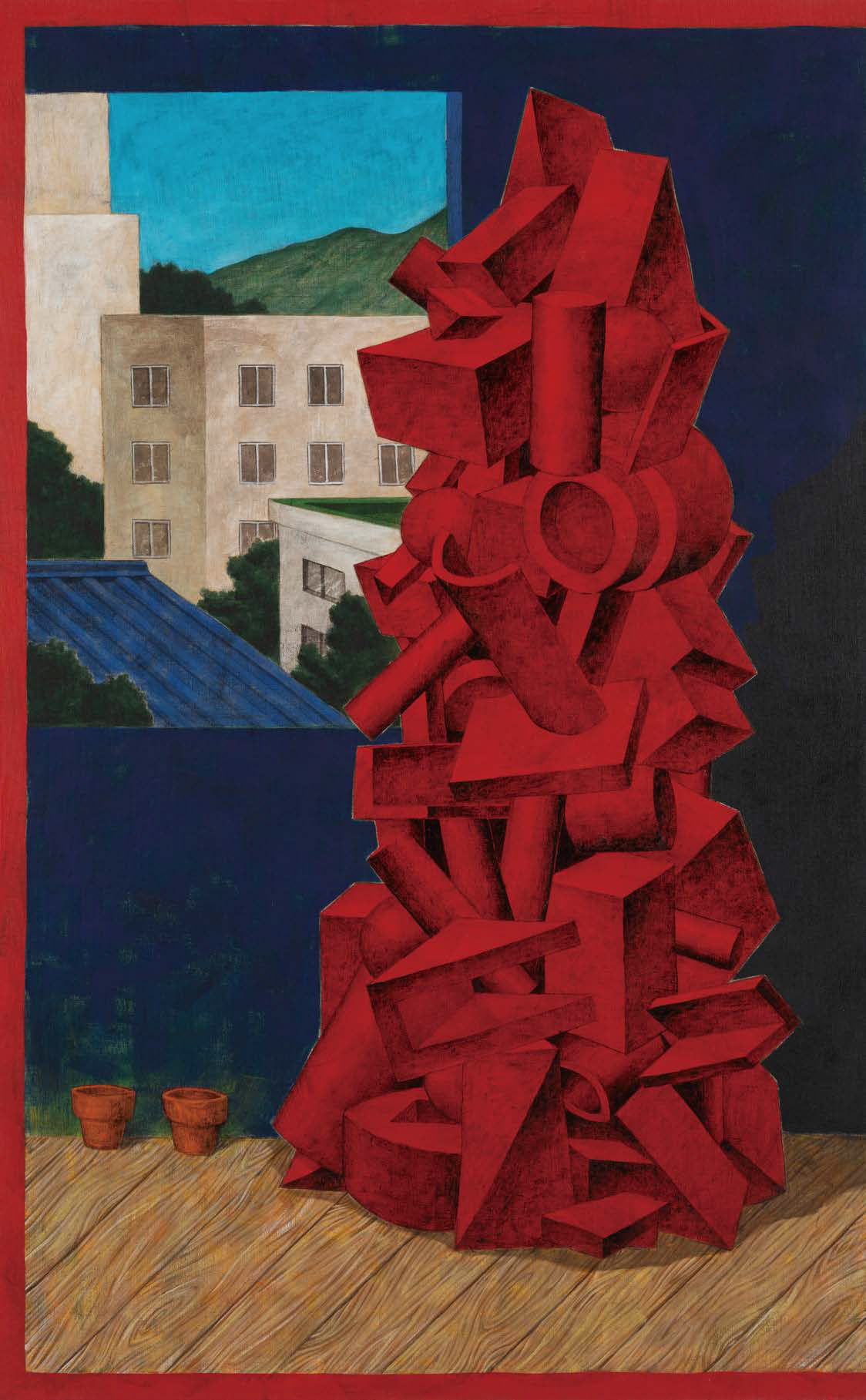
structure, while his self-portraits in Studio Scene substitute his figure with
an accumulation of red geometric forms and tools.
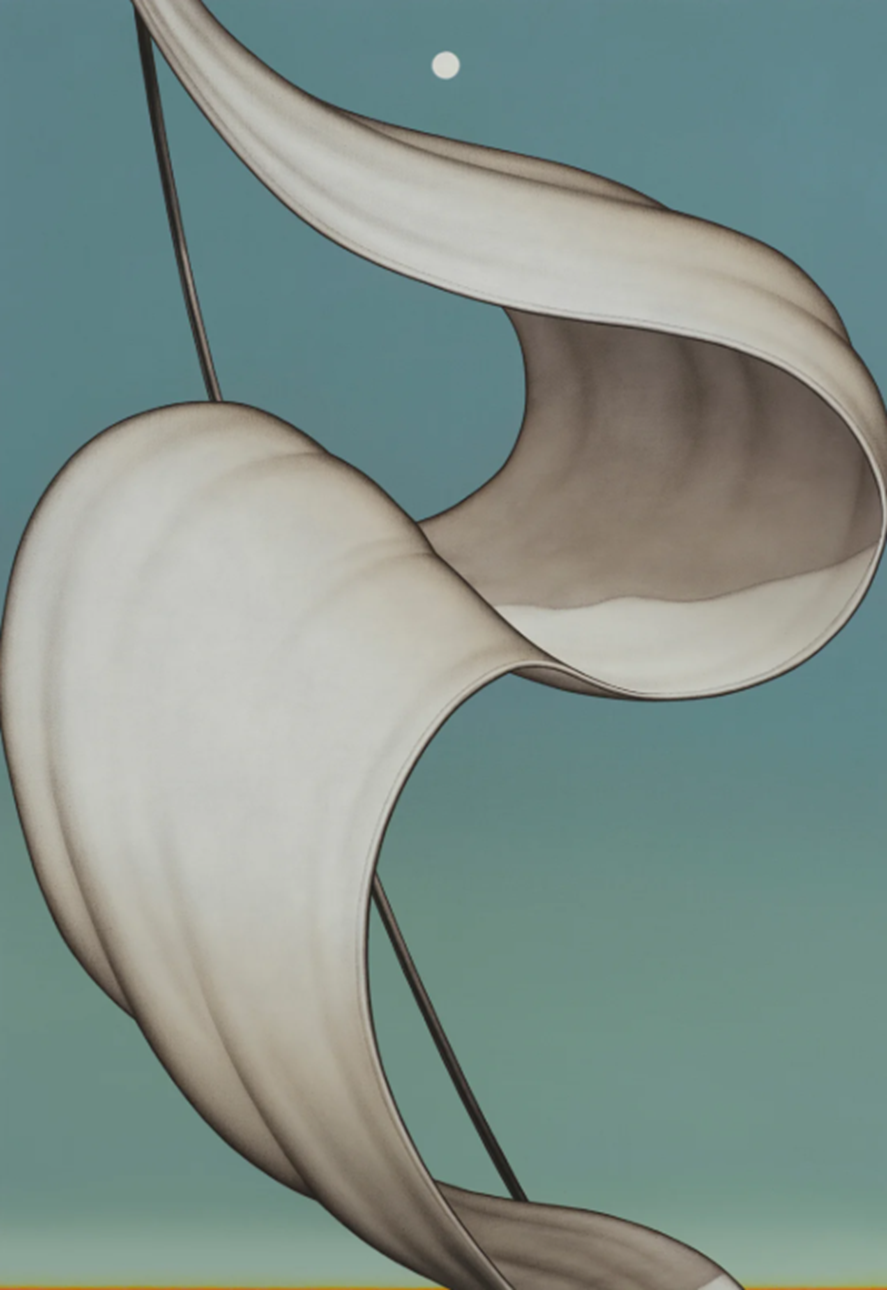
Lee’s works thus foreground objects—firearms, geometric forms,
tools, and machines—by anthropomorphizing them or using them as avatars of the
artist himself, thereby reconfiguring the relationship between humanity and
objects. The surrealistic and illusory nature of his paintings emerges from
these juxtapositions of discordant images—realities colliding and the gaps
between them materializing into a visual language.