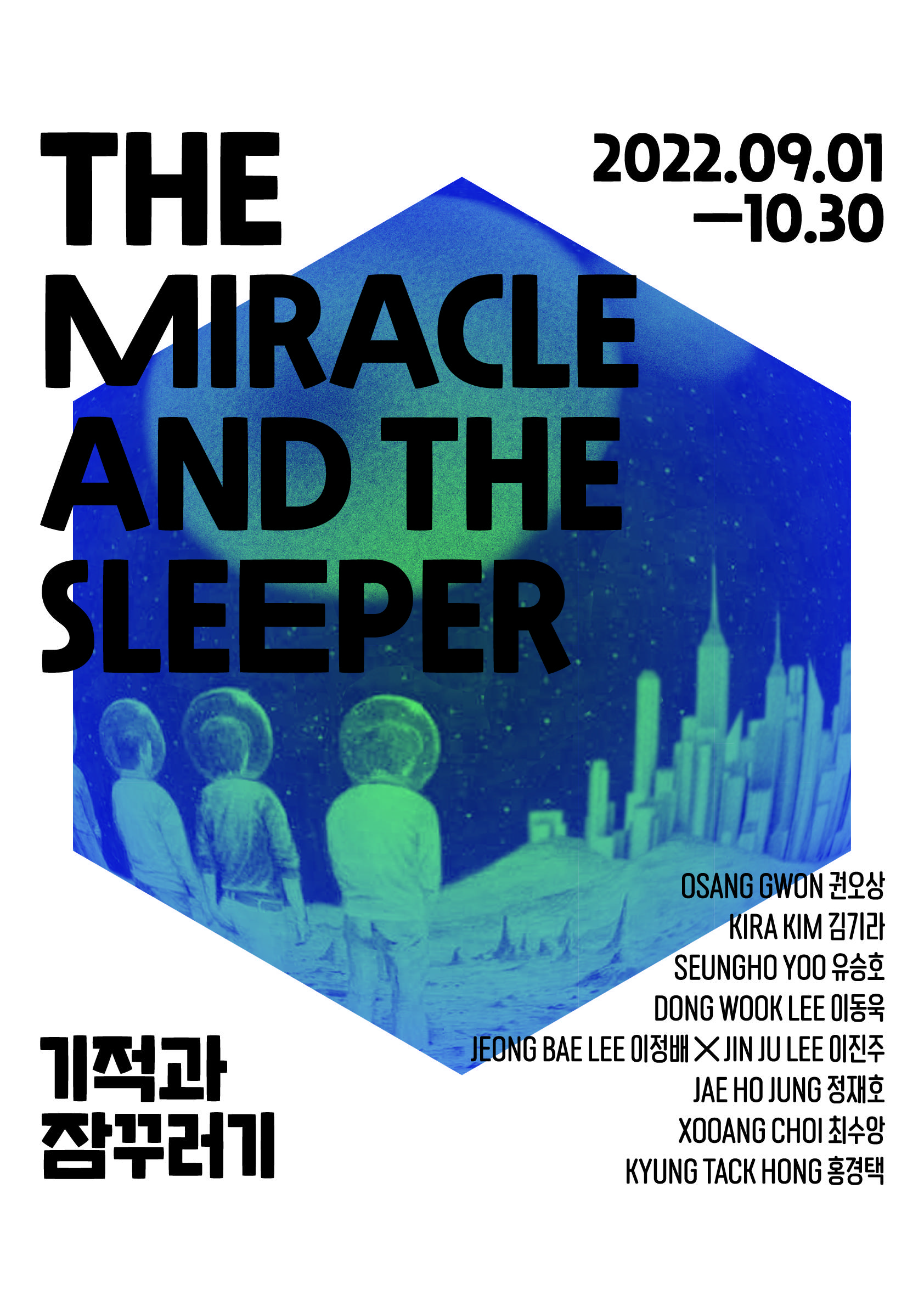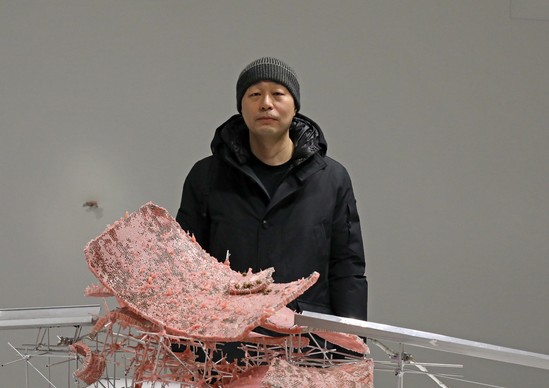

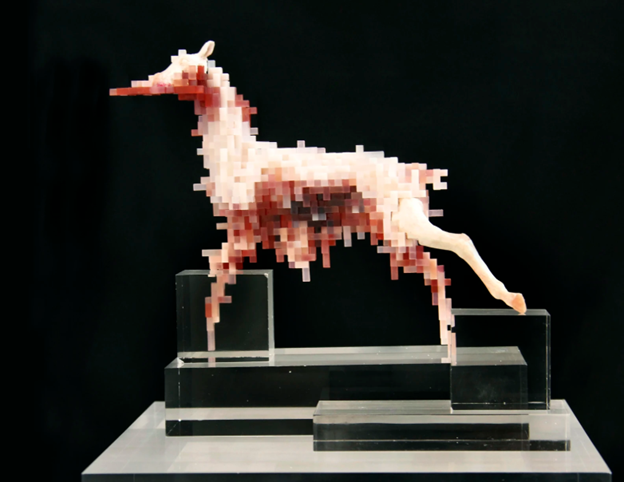
In the studio, the sound of birds chirping could be heard. These resilient creatures had endured over 20 days without their owner. The silent goldfish were also swimming leisurely. These are the small animals cherished by sculptor Lee Dongwook. After completing the schedule for his eighth solo exhibition at Charlotte Lund Gallery in Stockholm, Sweden, held from January 24 to March 7, Lee Dongwook returned home. This exhibition marked his second show in Northern Europe, following his 2008 exhibition at Avante Gallery in Zurich, Switzerland. In the meantime, he held solo exhibitions at Doosan Gallery in New York and Arario Gallery in Seoul, among other significant events. He also participated in notable exhibitions showcasing leading Korean artists, including 《Peppermint Candy》 Exhibition, a seven-country tour across South America including Buenos Aires, and 《Korean Eye》 at Saatchi Gallery in London. In Sweden, the country with the highest reading rate globally, his works, rich in deep insights into humanity, were met with great interest, making the exhibition a success.


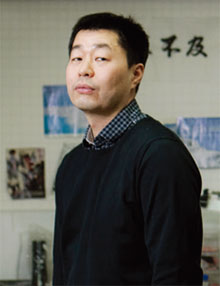
Lee Dongwook

Born in 1976 in Daejeon, South Korea, Lee Dongwook graduated from the Department of Painting at Hongik University and completed his master's degree at the same institution. Since his first solo exhibition in 2003, he has held eight solo shows, including exhibitions at Charlotte Lund Gallery in Sweden, Arario Gallery in Samcheong-dong, Doosan Gallery in New York, Avante Gallery in Zurich, and Total Museum of Contemporary Art in Seoul. He was selected as a representative Korean artist in exhibitions at renowned institutions such as the Museum of Arts and Design in New York, Uppsala Art Museum in Sweden, Frederiksberg Town Hall in Copenhagen, Saatchi Gallery in London, National Museum of Modern and Contemporary Art in Gwacheon, National Museum of Fine Arts in Buenos Aires, and the National Art Museum of China in Beijing. His works are part of prestigious collections worldwide, including the National Museum of Modern and Contemporary Art (MMCA) and Arario Collection in Korea, as well as the Würth Collection in Germany and the Rubell Family Collection in the United States.


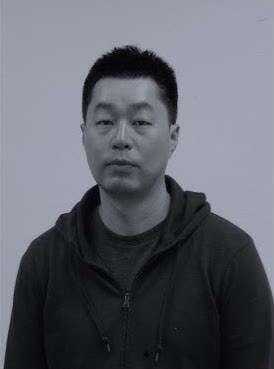
The Artist’s Profile © Lee Dongwook

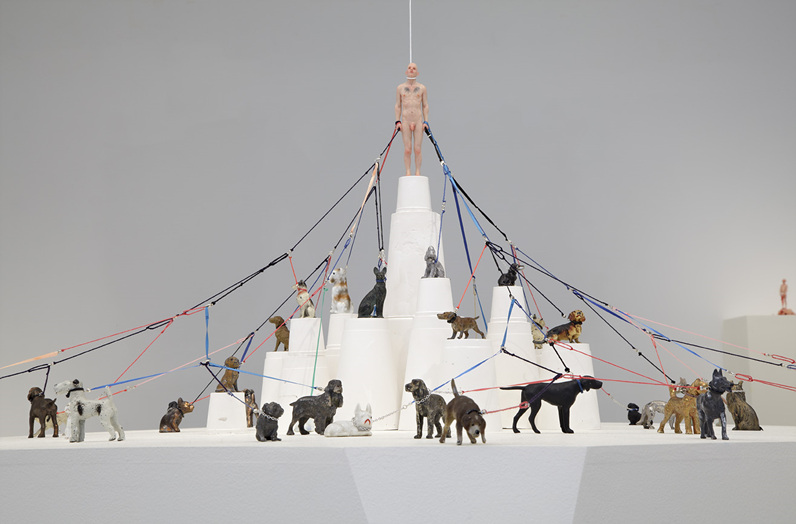
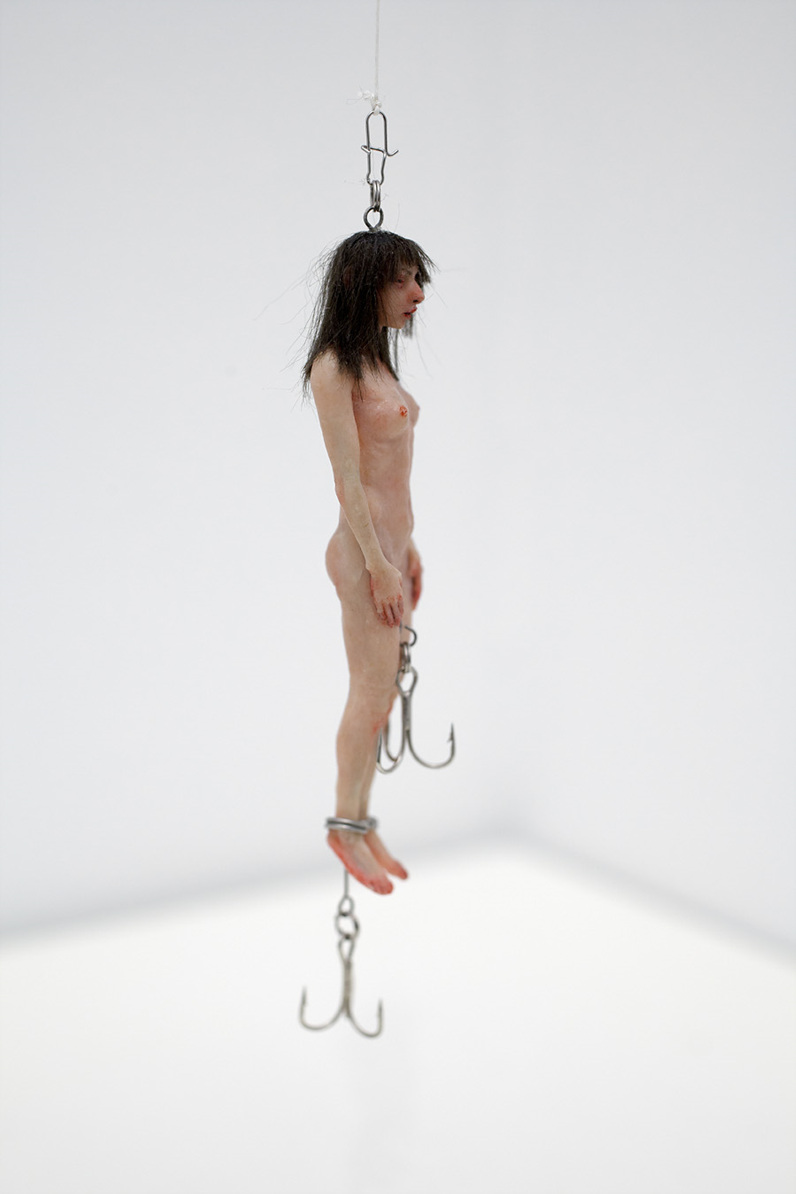
Except for works utilizing traditional birdcages or trophies, Lee Dongwook's basic sculptures are small, naked figurines about 15 to 20 cm tall. These small figures became a sensation in the art world from his very first exhibition in 2003. Just one year after his debut, he participated in a group exhibition at the National Museum of Modern and Contemporary Art and became an exclusive artist with the renowned Arario Gallery. Despite being an artist who studied solely in Korea, Lee has quietly expanded his reach to international audiences. Although his sculptures are small enough to require viewers to bend down and look closely, the meanings they convey are by no means small.

Since his debut, Lee Dongwook has consistently questioned one subject in his diverse works: ‘humanity’ itself. Through the portrayal of the naked, essential human body, Lee delves into the nature of human beings. The human body is a crucial theme in contemporary art, often interpreted not as a natural entity but as a product of social relations. In this era of well-being, where even the stability of the mind and soul is pursued through bodily harmony, Lee addresses the universal keyword of ‘body,’ which resonates globally.

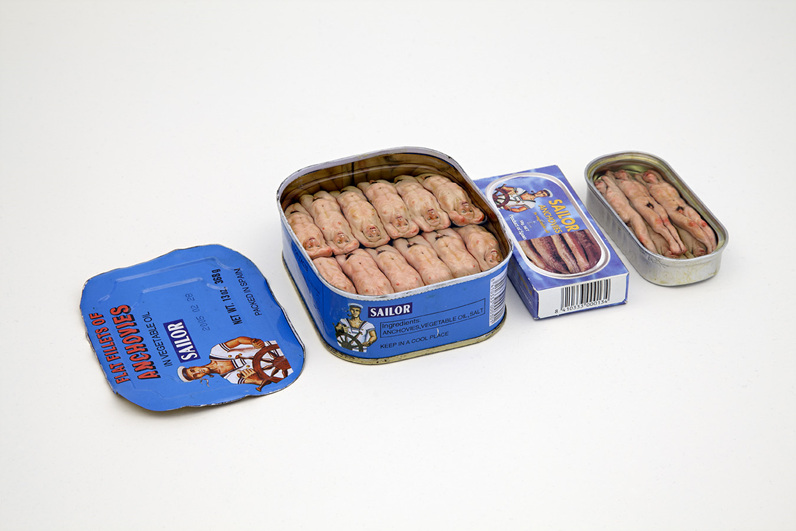
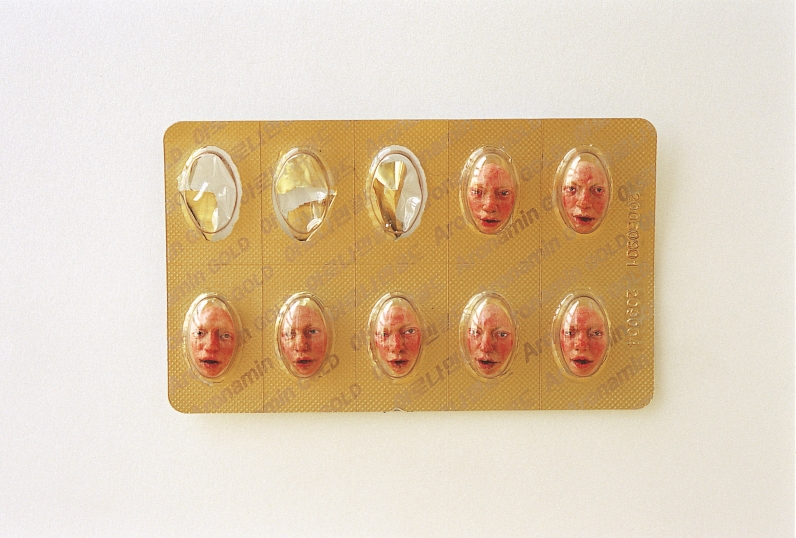
His figures are racially ambiguous, bearing a facial structure somewhere between East Asian and Western features, embodying a universal human archetype. Stripped bare and vulnerable, these figures reveal themselves within various scenarios. Sometimes their round heads become Chupa Chups lollipops, or they are packaged as vitamin tablets, or even enclosed in sausage casings or anchovy cans. They are bound within the very products and packaging created for human convenience. Beyond the initial shock of these images lies a deep sense of compassion for humanity.

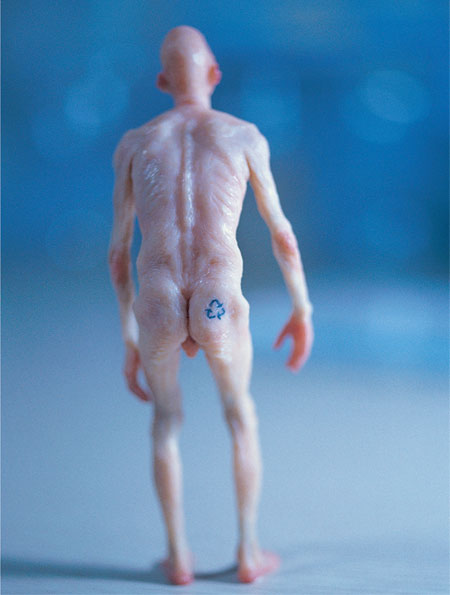
One small piece depicts an elderly man with a recycling symbol on his back, titled Resurrection. It raises the poignant notion that while objects of economic value can be repurposed for new lives, this is not an option for humans. When asked directly, “What is humanity?” Lee responded:

“I acknowledge human frailty. People, especially as individuals, are inherently weak. Even human wickedness stems from this vulnerability. We are all essentially the same.”


Lee Dongwook, Dress, 2012, Mixed media, Pedestal, 18×12.5×5.6cm, 120×40×40cm © Kim Sunah

Due to this perspective, his works universally exhibit expressions of slight pain or emptiness. These faces are not meant to shock or frighten but rather reflect his candid observation of the human condition. Lee refrains from passing judgment, complaining, or lamenting; instead, he observes with quiet neutrality. His sculptures subtly reveal that people are not as strong as they may seem.

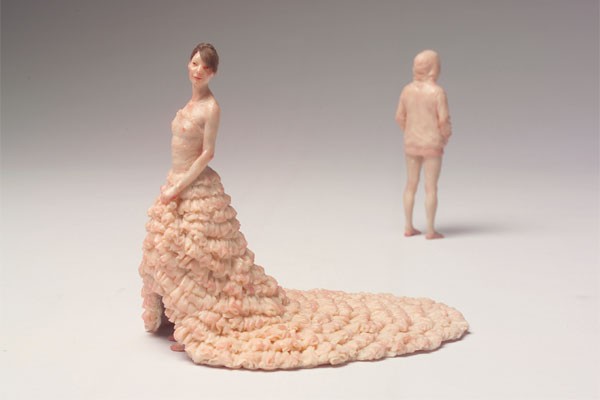
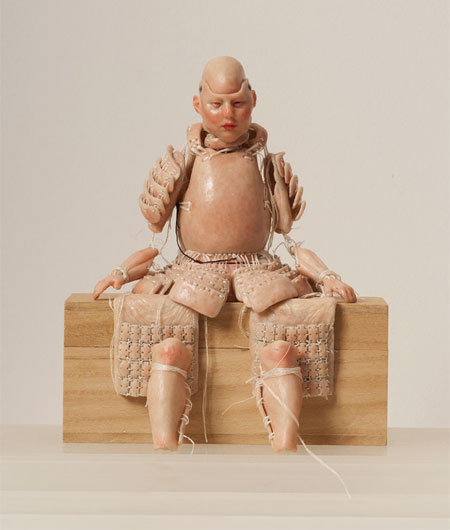
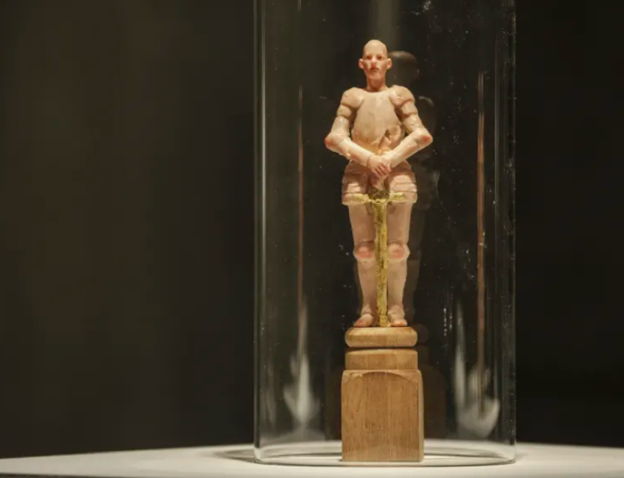
A samurai sits serenely, clad in armor, which upon closer inspection is made of his own skin. Likewise, a woman in an elegant dress is actually wearing her skin as clothing. Lee describes these pieces as depicting “people whose skin has turned into their attire.” Whether armor or dress, these garments offer no real defense or disguise. They depict fragile attempts at strength—powerful imagery capturing the weak facades people present.


Lee Dongwook, Bride, 2008, Mixed media, 20×19×16cm © Kim Sunah

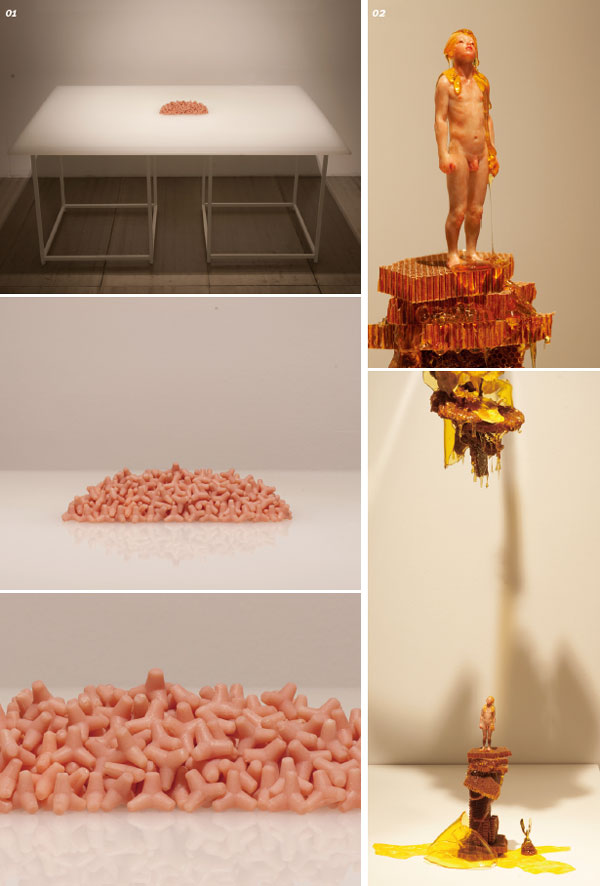
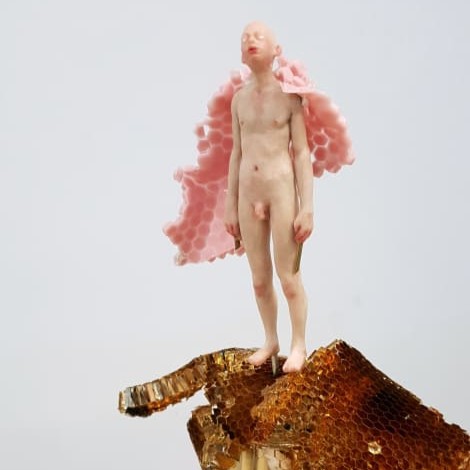
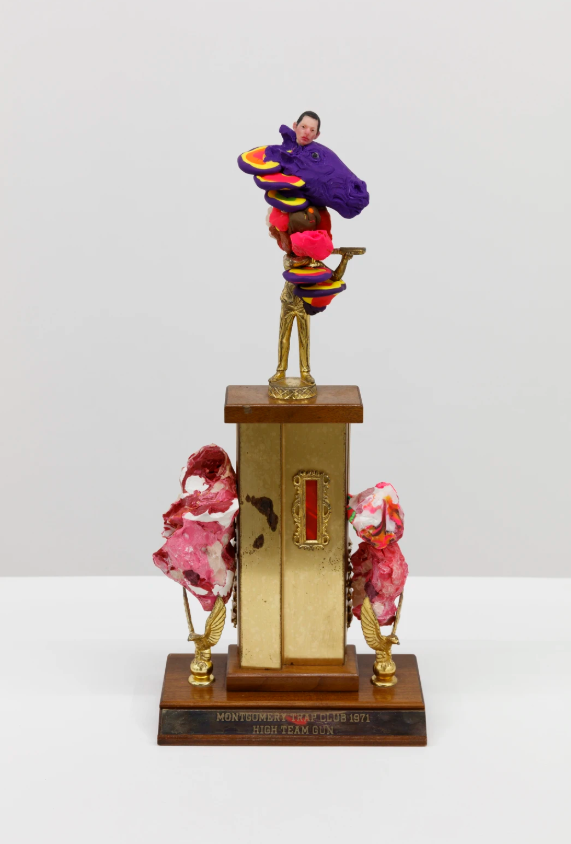
Lee’s works also contemplate human indulgence in pleasure and reward as a means to compensate for their inherent weakness. A boy stands drenched in honey flowing from a beehive, reminiscent of a parable from the Buddhist Agama Sutra, which Tolstoy famously retold in his 《Confession》. In the story, a man hangs by a tree root above a pit of snakes while mice gnaw at the root. In this perilous situation, he still licks the honey dripping from the root. This allegory reflects the irrational and foolish nature of human existence. Similarly, Lee’s work Commemoration places his sculpture atop a trophy, the victor’s face marked with scars. Lee observes, “Victory is like that. It always involves pain and regret.”


Lee Dongwook, Armor, 2008, Mixed media, 28.5×45.5×24.5cm © Kim Sunah

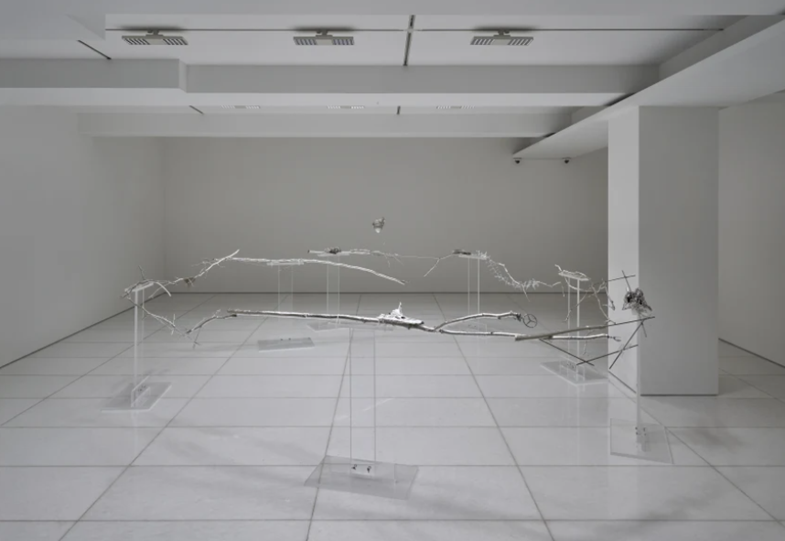
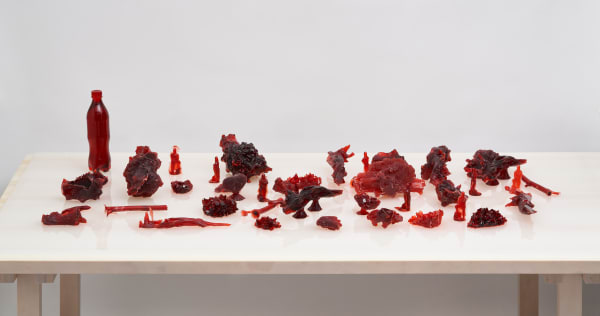
He creates a small world. Breakwaters that withstand fierce waves are piled up in miniature pink triangles. These tiny replicas transform their original significance, emphasizing their defensive role while also revealing their vulnerability. In reality, these are massive structures; yet, by shrinking them, Lee emphasizes their fragility and the importance of unity against formidable forces.

This approach challenges viewers to lower themselves and observe carefully. Sometimes, to truly understand the world, one must look humbly.


Lee Dongwook, Resurrection, 2004, Mixed media, 14×5×4cm © Kim Sunah

Ironically, the titles of his recent exhibitions, Love Me Tender and Love Me Sweet, are taken from Elvis Presley’s song lyrics. Returning to the Buddhist parable, without even a drop of honey, how could one endure life’s precariousness? Through his works, Lee portrays human frailty, foolishness, and the boundless compassion it evokes.

In his contemplation of humanity’s contradictions, Lee does not rush to provide answers or solutions. He may continue to expose more questions, knowing that true healing begins with facing reality head-on.


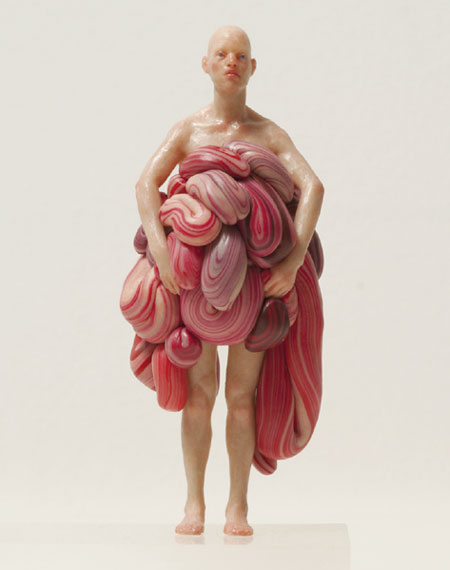
01. Lee Dongwook, Pinky, 2012, Mixed media © Kim Sunah
02. Lee Dongwook, Untitled, 2012, Mixed media, 70×30×95cm, 35.5×41×36cm © Kim Sunah

A peculiar artwork features a figure carrying an airplane on its shoulder. At first glance, one might interpret it as a modern reinterpretation of the crucifixion or a reference to the tragedy of 9/11. Curious about its meaning, I asked the artist, only to receive an unexpectedly different answer.

“That’s a tumor growing around the neck. It just happened to take the shape of a broken airplane. A tumor isn’t something imposed from the outside; it comes from within. You could cut it off, or you could let it grow to that size.”

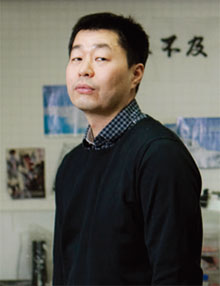
How could he speak so calmly about such a haunting image? I looked at his face once more, searching for a clue. Then, suddenly, I thought about the tumor on my own shoulder—perhaps a mass of pride, self-doubt, or some other complex growing within me. For whatever reason, I haven’t been able to cut it off, and today, too, I carry its weight as I move forward with heavy steps.

It is this delicate and piercing insight into humanity that drives him to be such an exceptional artist.
 

Photography by Kim Sunah

References