
The works in this exhibition, which fill two large exhibition halls, are in continuity with Lee Bul’s Mon Grand Récit series that began in the mid-2000s. Although the phrase "my grand narrative" includes a personal pronoun, the artist, having consistently achieved remarkable success both domestically and internationally for nearly two decades, undoubtedly possesses the qualifications to discuss grand narratives. Moreover, Lee Bul belongs to the generation that experienced the rise and fall of grand narratives firsthand, having come of age during the 1980s and 1990s.

However, the grand narrative that Lee Bul articulates through her work leans more towards its dissolution. This exhibition, in particular, targets the grand narratives entangled with modernity, employing luminous, lightweight materials that have been integral to modern architecture. Whether addressing grand narratives or their end, the way they are visually realized is truly spectacular. The large-scale works, characteristic of an artist well-versed in the international art scene, are not only grand in dimension but also imbued with meticulous detail and conceptual relevance.

Looking back on past exhibitions, Lee Bul has consistently demonstrated an ability to translate contemporary discourses into tangible formal language. Most artists tend to focus on either narrative or form, rarely achieving a balance between the two. This is especially true when dealing with grand discourses, which often result in work that falls into neither category effectively. However, Lee Bul’s practice successfully bridges these elements, offering both formal sophistication and a sharp engagement with theoretical discourse.

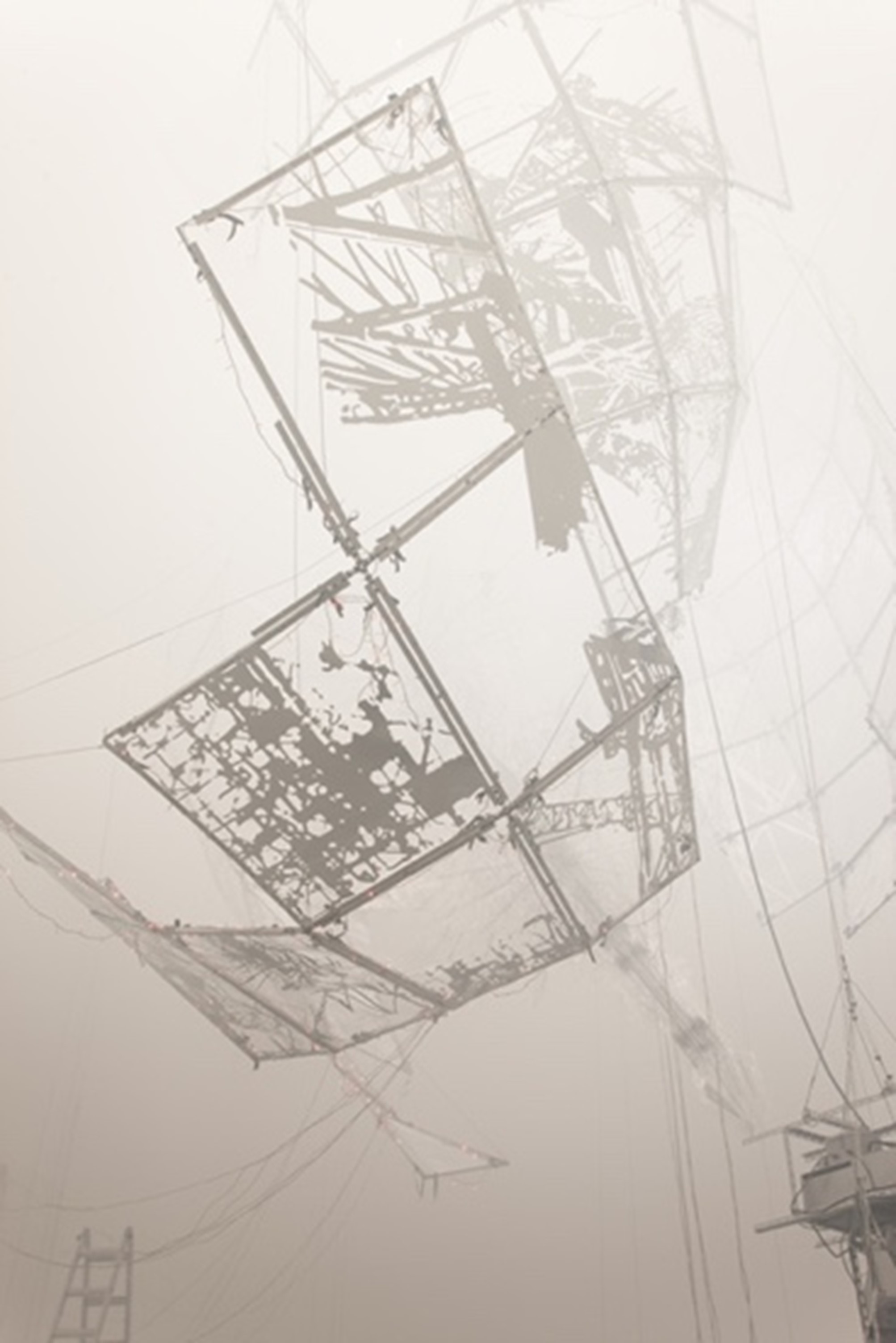
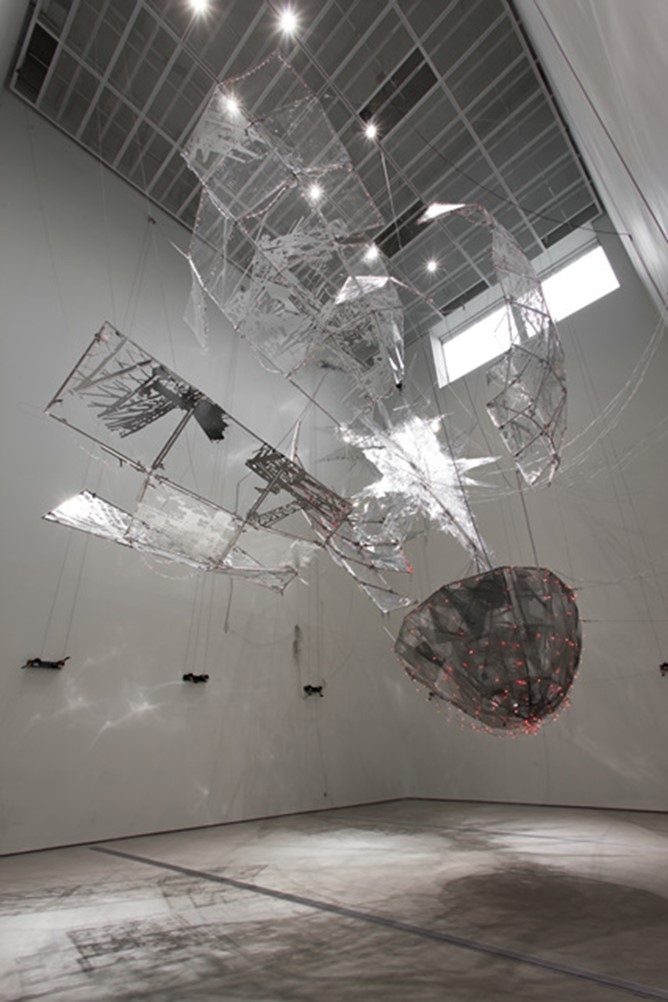
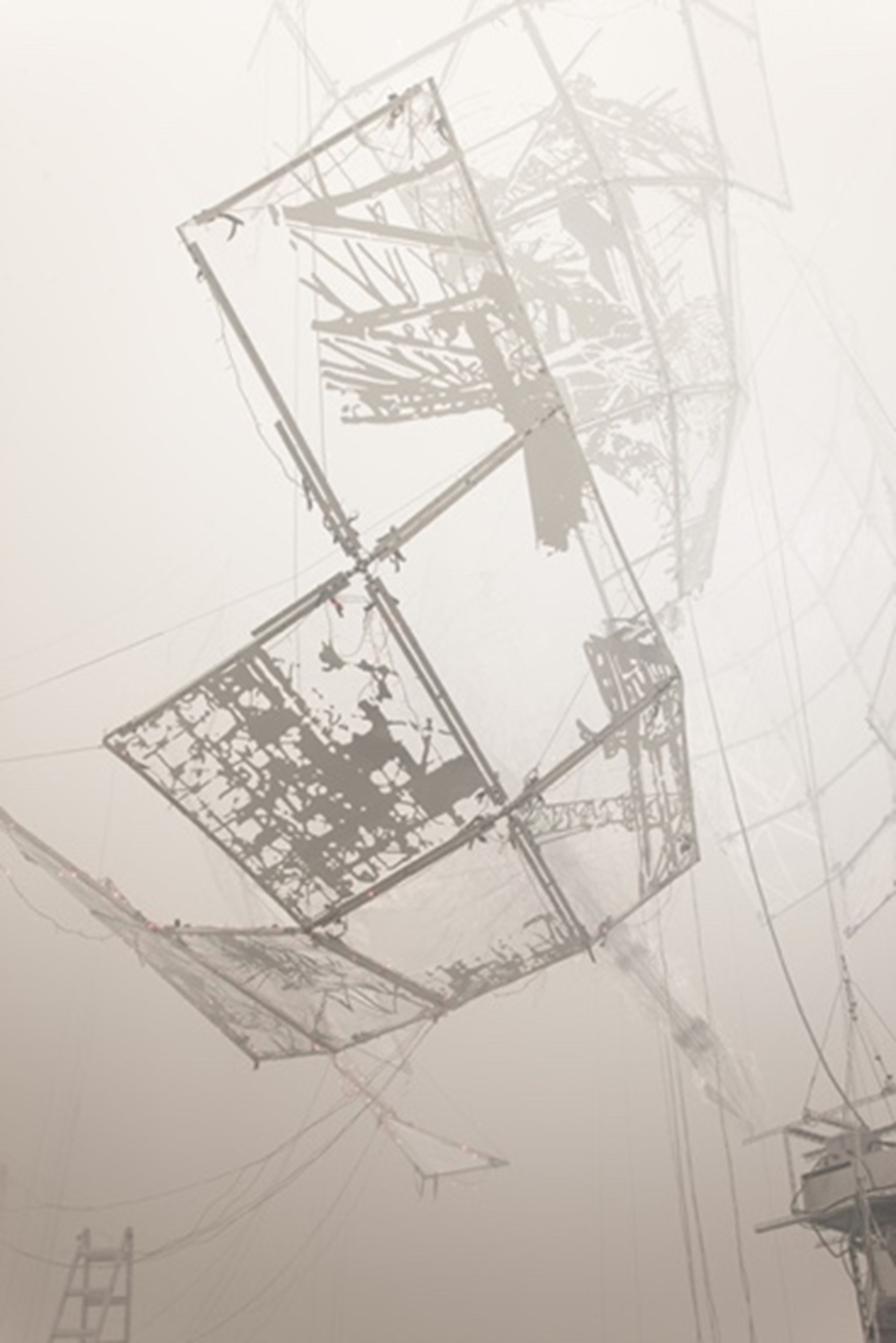
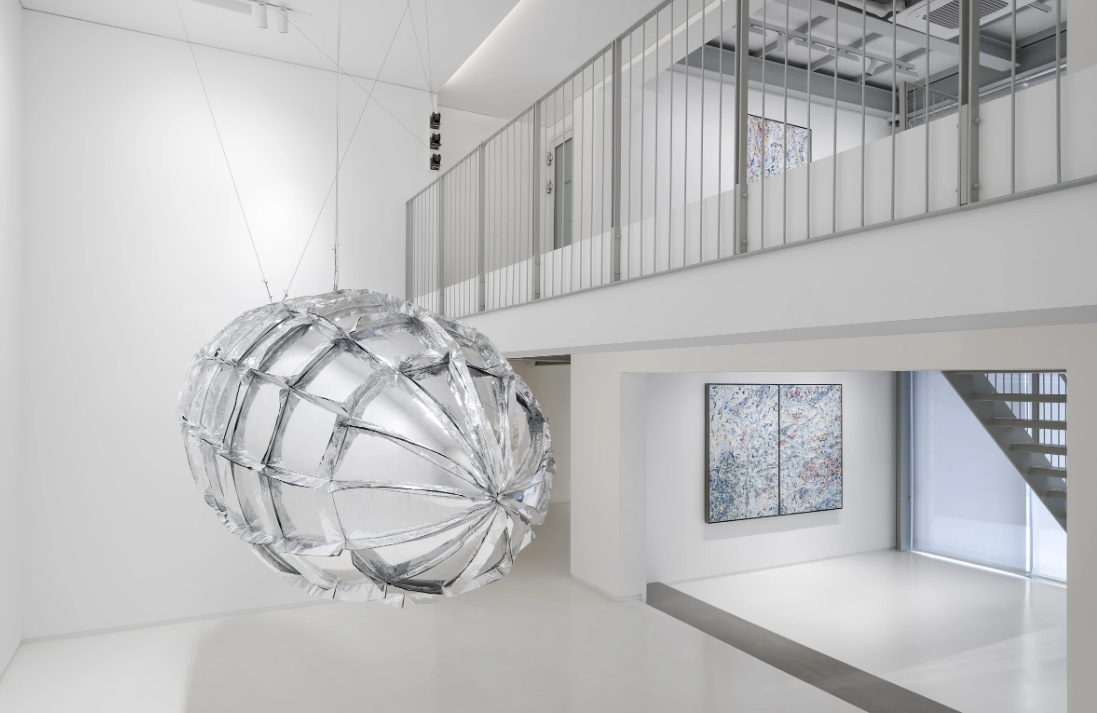
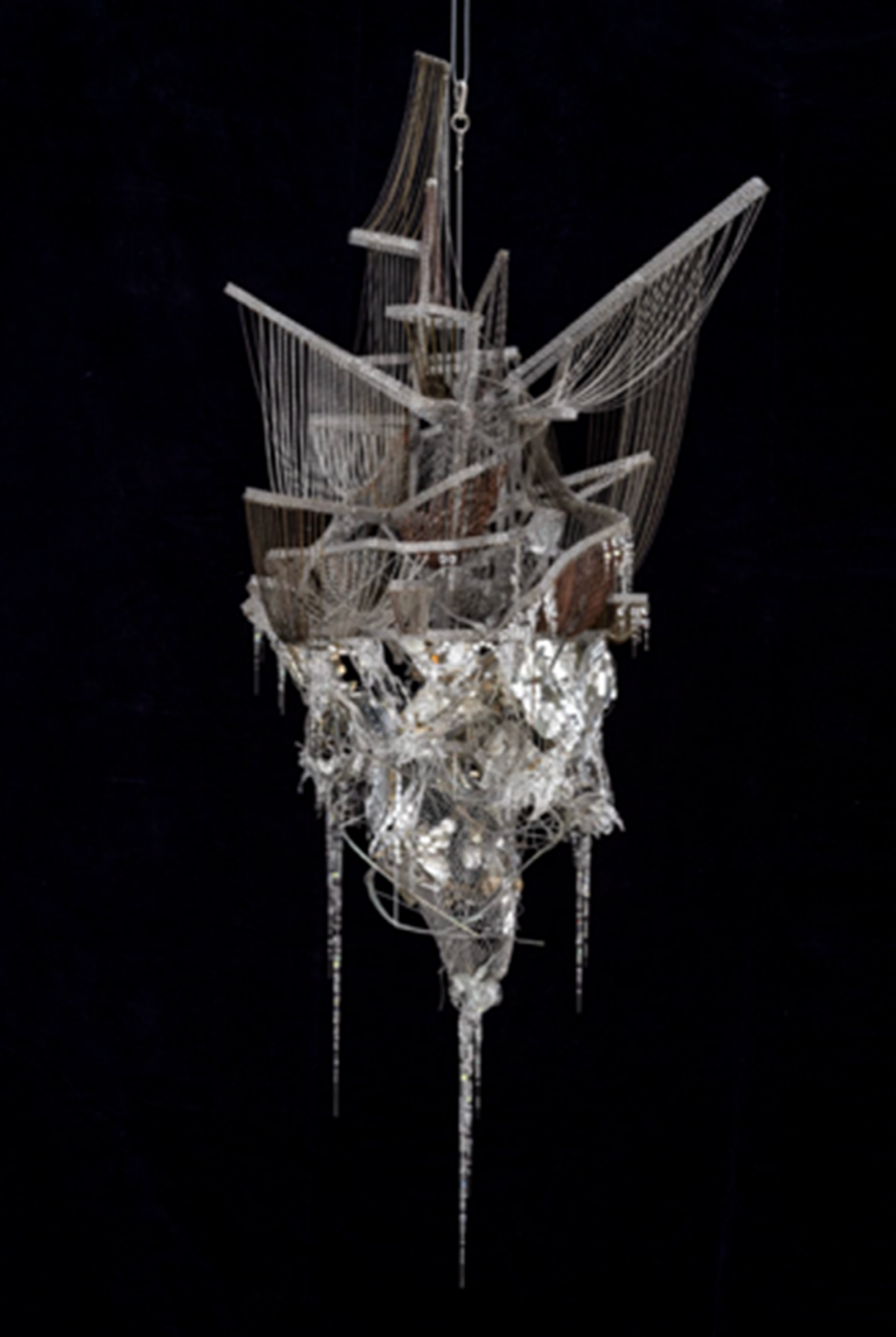
Lee Bul, Aubade III, 2014, aluminum, polycarbonate, metallized film, LED lighting, electrical wires, stainless steel, fog machine, variable installation ©MMCA

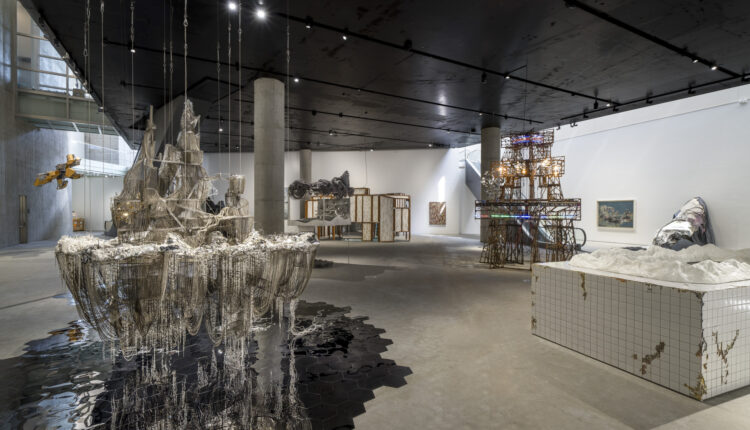
The two exhibition halls present a landscape where objects that should be standing tall or soaring through the air have instead collapsed. The force of gravity, pulling things downward from above, operates with great intensity. This effect is particularly pronounced in Civitas Solis, where visitors must keep their eyes on the ground to navigate safely. The installation works, which depict the wreckage of grounded aircraft or the ruins left in the wake of colossal collapse, satirize an era’s obsessive drive to ascend without limits. The prophetic pathos aimed at distant, unattainable heights comes crashing down.

Yet, the grand narrative of an era—the ideal of progress toward freedom and liberation—cannot be dismissed so easily or completely. In Lee Bul’s work, images of aerial explosions and structural collapse are visually breathtaking spectacles. The grand narrative had wings, after all—it was bound to fall precisely because it had once soared. The fragments, arranged amidst periodically dispersed fog and flickering lights, evoke a sublime and deeply aesthetic experience.
 
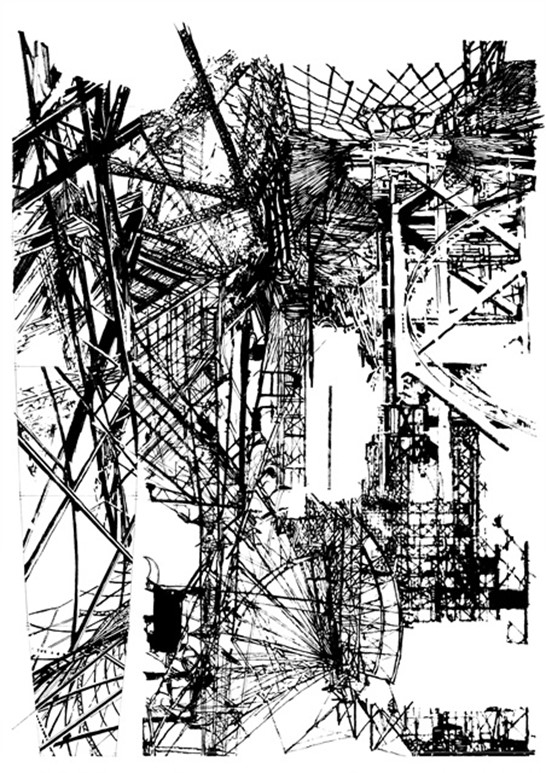
The work Aubade III is said to be inspired by German architect Bruno Taut’s Monument des Neuen Gesetzes (1919) and the early 20th-century Hindenburg airship. In the 15-meter-high exhibition space, scattered masses and planes appear to bear witness to the moment of explosion—silent screams and reverberating booms echoing through the void. The fragmented bodies, impossible to reconstruct into their original forms, reveal torn edges and jagged cuts. The sheathing that once encased mechanical components is now ripped apart, suspended in midair. Though the structure itself does not move, Aubade III brims with Baroque dynamism. Approached through the haze, its tangled metal plates resemble a loosely sewn patchwork rather than a meticulously assembled machine.

Despite the mechanical metaphor, the work does not feel precisely engineered but rather precariously stitched together. It is both an image of destruction and an anticipation of disintegration, like a time bomb already primed to dismantle itself. Time, as an agent of entropy, will inevitably expose the temporary nature of what once appeared to be a perfect spatial order. We have now come far enough to look back upon modernity from a distance—ironically, due to the very acceleration of time that modernity itself set into motion. The end of time is inherently apocalyptic. As the cyclically released fog gradually dissipates, the catastrophic nature of the scene becomes clear.
 
Even within the hazy mist, the flickering red LED lights overlay the image of mechanical breakdown with that of organic rupture. Amidst these exploding visuals, something sharp and piercing at the core introduces an almost erotic undertone. This moment of suspended motion, forever unable to reach its intended target, recalls the meaning of Aubade—a medieval love poem lamenting an unfulfilled romance. The piece expresses the moment of psychological, physical, and material rupture. Such a rupture is both disaster and ecstasy. The brief instant when energy, once compressed within matter, is released into the air dramatizes this duality. The utopian aspiration and its catastrophic outcome manifest on both the individual and systemic levels.

It also evokes the fate of those who dare to defy the ancient taboo against flying too close to the sun. As anthropology suggests, the violation of taboo simultaneously invokes both a curse and the sacred.

Lee Bul, Aubade III, 2014, aluminum, polycarbonate, metallized film, LED lighting, electrical wires, stainless steel, fog machine, variable installation ©MMCA

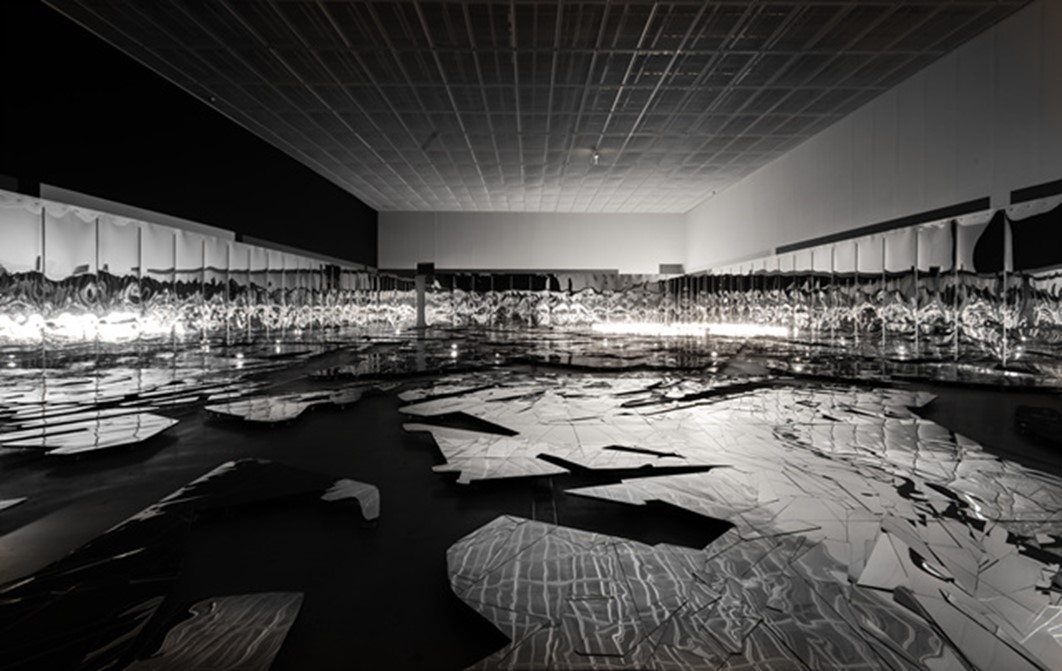
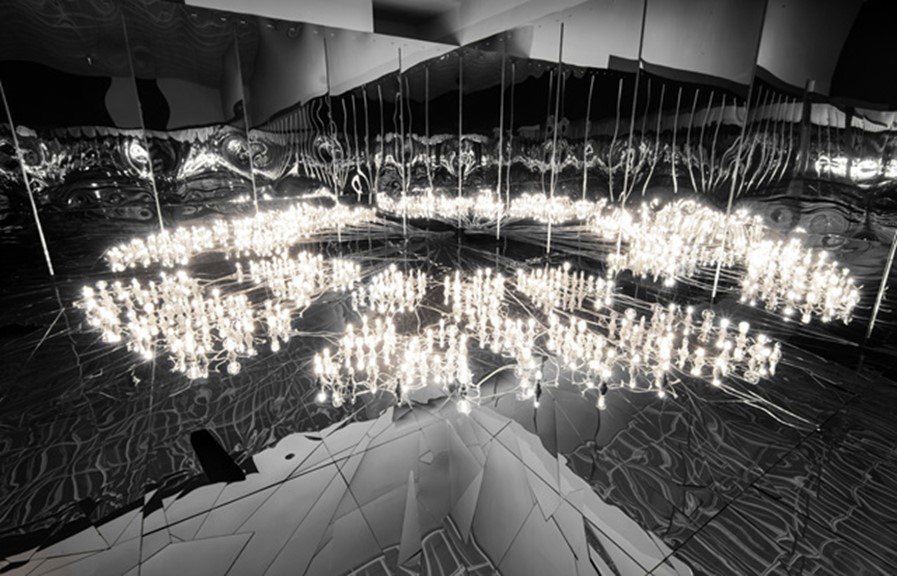
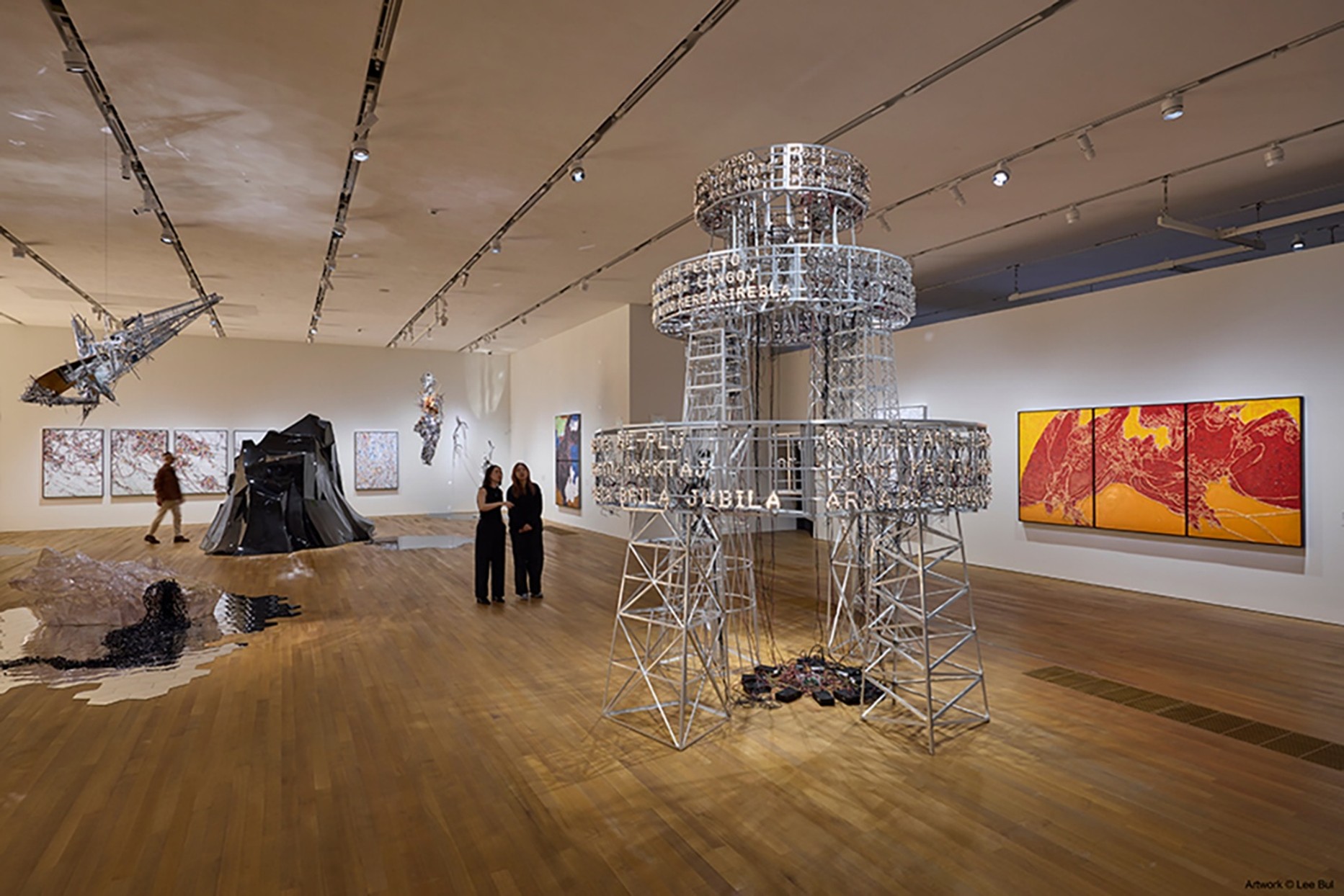
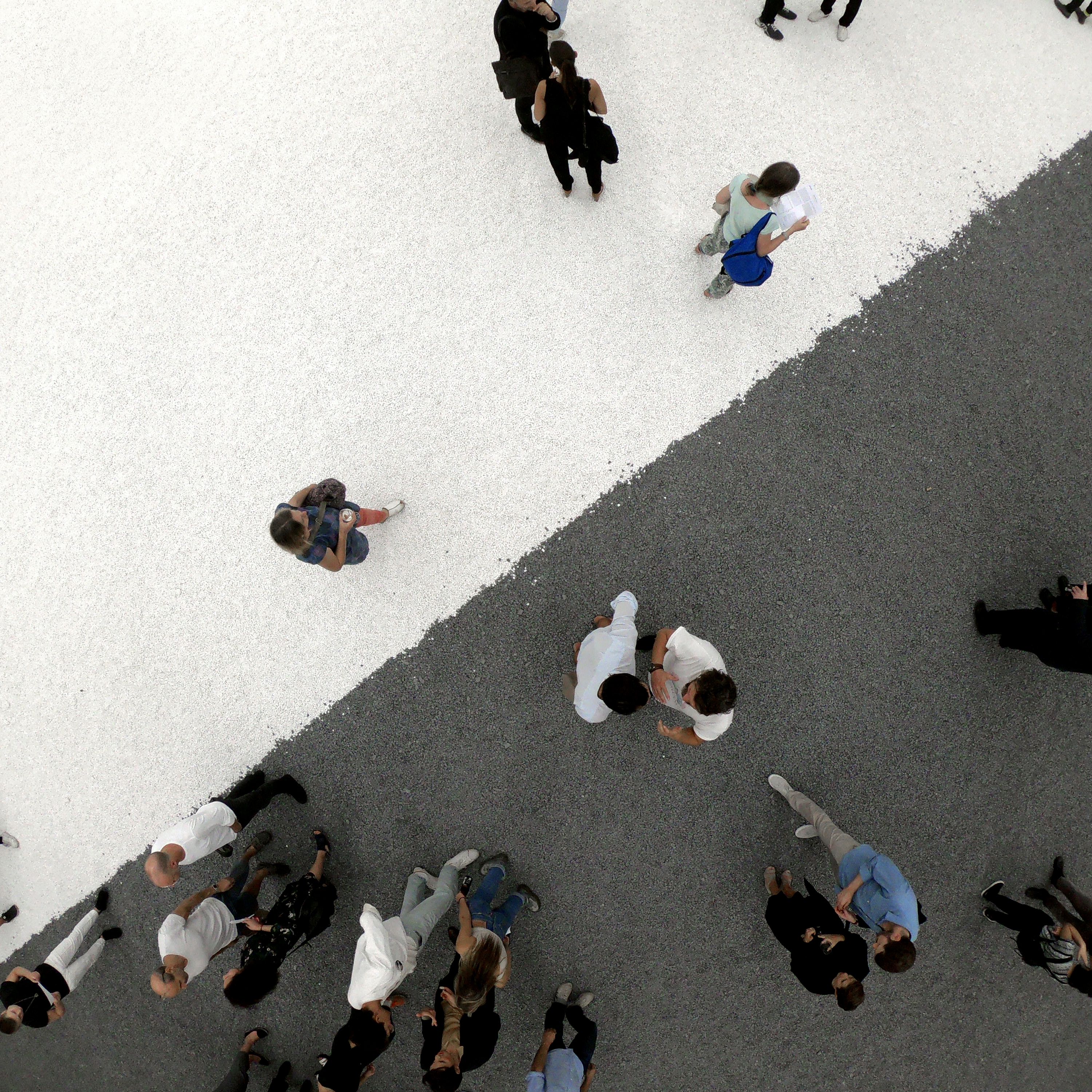
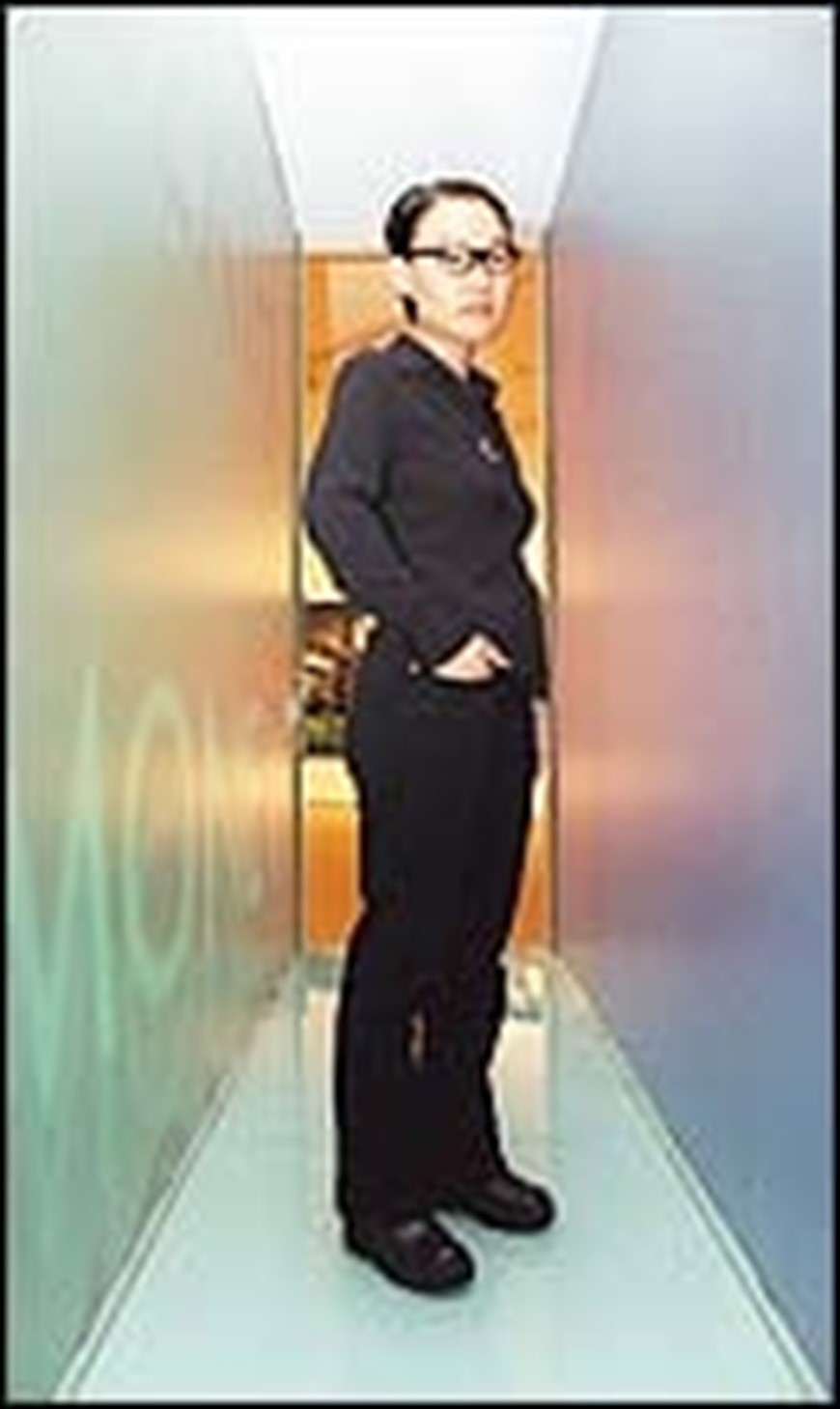
Civitas Solis II is a space enclosed by mirrored walls, with a fragmented pathway of scattered mirror shards forming a labyrinth. Within this vast, chaotic reflective space, the paths soon become a maze. Lee Bul upgrades the ancient mythological imagination of the labyrinth into a dazzling 21st-century version. This maze could also be likened to what Jacques Attali describes as a "network as a totality of interconnected knots." However, within this labyrinth, moving forward has nothing to do with progress or advancement. The overwhelming number of shards on the floor hints at the scale of collapse that has occurred. Entropy pushes toward its maximum, and the undulating reflective surfaces surrounding the viewer make any stable perspective impossible. Here, one can only wander. The scattered puzzle pieces, exposing their sharp, jagged edges, cannot be reassembled. The catastrophic event has already ended at some point, and the remnants scattered across the three-dimensional space convey a sense of fear transformed into mystery.

At the end of the path, flickering light bulbs are installed, their reflections in the mirrored surfaces revealing the words Civitas Solis (City of the Sun). The structure, readable only through illusion, suggests a reality inverted by fiction.
 
At the same time, illusion and reality combine complementarily to create a new reality. The merging of the real and the imagined forms an archetype onto which anthropological fantasies of perfection are projected. In the absence of a collapsed reality, the significance of illusion becomes more pronounced than ever. In a city that appears to have crumbled entirely, for whom does the sun shine? The title Civitas Solis is said to be inspired by Renaissance philosopher Tommaso Campanella’s utopian vision. Throughout history, utopian imagination has continuously emerged as a response to the struggles of humanity. However, with the advent of modernity and its technological advancements, utopia became more tangible than ever before. Lee Bul’s Civitas Solis applies classical ideas of the ideal city to modern utopian projects.

In the Enlightenment-driven architectural projects of modernity, the metaphor of the sun was clear. New materials—glass, steel, concrete—along with modular construction principles, were meant to harness more sunlight, banishing the darkness of previous eras. However, the Enlightenment itself has since been revealed as nothing more than another myth, whose inevitable consequences are now unfolding before us.
 
The disenchantment produced by the Enlightenment has now entered a phase of re-enchantment. The mirrored chamber of infinite reflections becomes a space where one sees oneself reflected in the fragments of dissolution and collapse, endlessly repeating the ecstasy and tragedy of Narcissus. It is a space where the subject expands until they ultimately lose themselves. In contrast, modernity was an era where the direction of human progress seemed clearer than ever—it was always toward a more advanced future. The modern historical consciousness placed increasing weight on the future, emphasizing what ought to be rather than what is, and prioritizing potentiality over the present. This outlook was largely shaped by the role of universal intellectuals, who positioned themselves as mediators of progress.

In Thinking About Modernity, Michel Maffesoli points out that modern elitism functions much like medieval monastic life, as a practice of prophetic interpretation. Just as monks deciphered religious texts, modern intellectuals read society in the same manner. These universal intellectuals often critique the past and present by invoking visions of the future. As modernity expanded the scope of its temporal concerns, its narratives grew increasingly grand. However, within this very process of magnification, the myths that modernity sought to overcome inevitably returned from the margins.


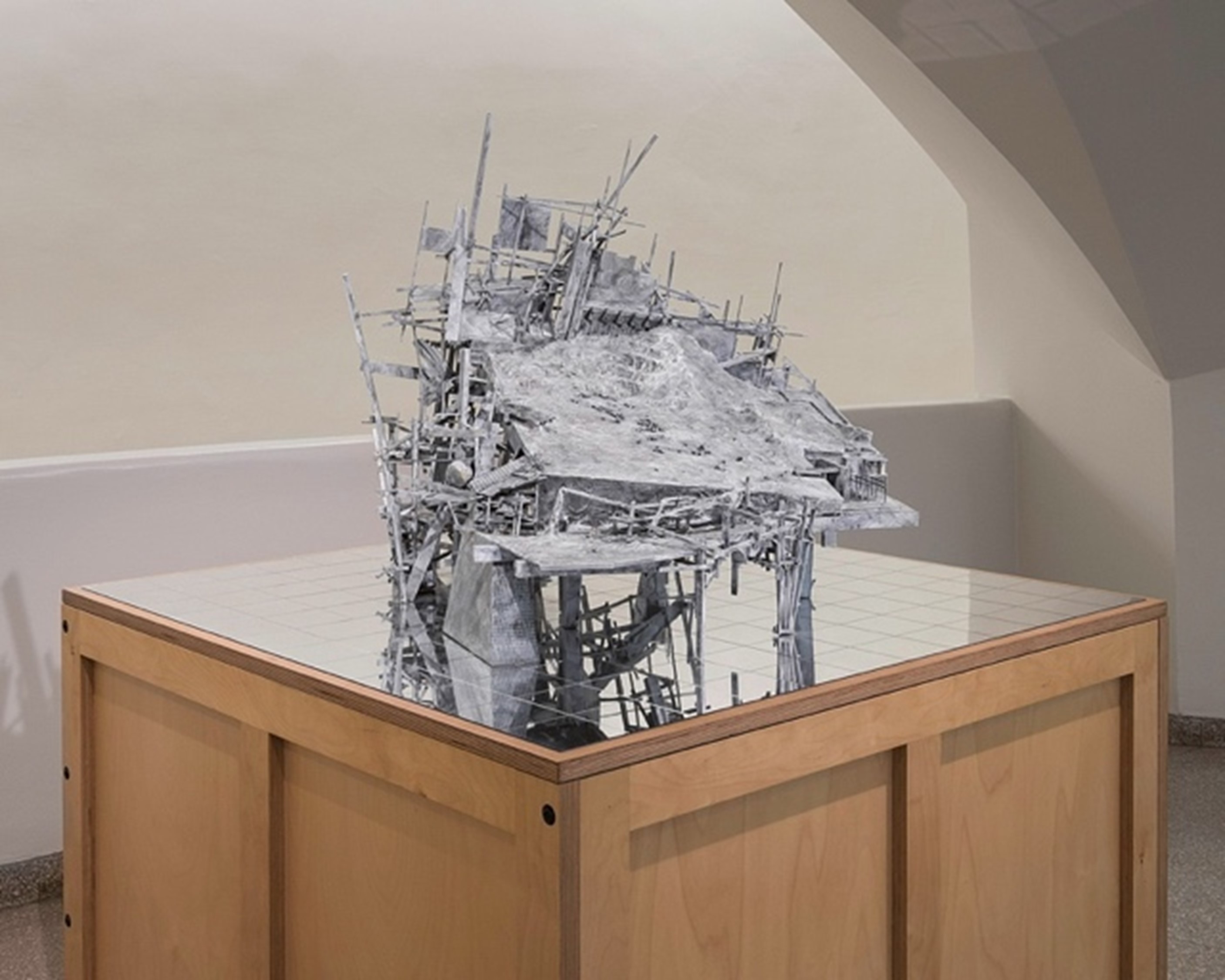
Lee Bul, Study for ‘Aubade III’, 2014, Paper, India ink, pigment ink, 59 x 49 cm ©MMCA

In Futures Past, Reinhart Koselleck states that as time was increasingly experienced as a transition into a "modern" era, the challenges posed by the future grew exponentially. The future’s share in human consciousness expanded disproportionately due to the conviction that the world to come would be qualitatively different from the present and past. Modernity, therefore, was also the era in which various utopian visions flourished. Artists played a crucial role in projects aimed at accelerating the arrival of utopia. It is significant that the word avant-garde was first used in a cultural context in 1825 by the utopian socialist Henri de Saint-Simon.

In The Shock of the New, Robert Hughes discusses how the belief that social innovation could be driven by cultural challenges—an "avant-garde" notion—was fervently pursued for nearly a century. According to Hughes, the artist was seen as a pioneer, and truly valuable works of art were those that could contribute to the construction of the future. Similarly, Ernst Bloch, in The Principle of Hope, argues that all works of art and philosophy possess a "window of utopia," through which they present a newly emergent vision of the world. Just as unarticulated thoughts surface from the depths of human consciousness, so too does artistic creation bring forth that which has not yet been realized in the world.
 
Both art and utopia share an intrinsic kinship, as they rely not only on the technological advancements of their time but also on the power of imagination. The visions of utopia are as diverse as artistic imagination itself, and they oscillate between optimism and pessimism. The enigmatic silence embedded in Lee Bul’s utopian works suggests that the once-loquacious discourse of future-oriented utopian projects has been exhausted. Yet, at the same time, her works preserve utopia under erasure. Even within the hazy smoke and labyrinthine paths, the flickering lights continue to point beyond reality. The spark of imagination that could rebuild or reach the future Civitas Solis has not been extinguished. However, utopia is no longer defined by rational, large-scale systems. Wandering within the labyrinth, we can no longer gain a totalizing perspective—only fragmented experiences are accessible. The present moment, once mortgaged to the future, resurfaces anew.

Positioned within the framework of Mon Grand Récit, Lee Bul’s imagined landscapes move beyond collective and universal declarations that fixate solely on the distant future. Instead, she speaks of smaller utopias rooted in the here and now, in the individual, and in particular lived experiences. Civitas Solis merges the sun, an infinite source of energy, with the city, a space where humanity has sought to overcome the chaos of nature. Heaven has often been imagined as a city, visualized through soaring Gothic cathedrals or towering skyscrapers. The utopian imagination projected onto the city emphasizes order rather than boundless freedom. The philosopher Tommaso Campanella, from whom Lee Bul draws inspiration, also envisioned a utopia founded on order.

Karl Mannheim, in Ideology and Utopia, contrasts Campanella’s Civitas Solis (1623) with Thomas More’s Utopia, positioning the former as a model of social order. Campanella equated order with social happiness. In Civitas Solis, it is not freedom but meticulously structured order that serves as the measure of universal well-being.

Lee Bul, Civitas Solis II, 2014, Polycarbonate, acrylic mirror, LED lights, electrical wires, 330 x 3325 x 1850 cm ©MMCA

In Civitas Solis, every aspect of life, including family and public affairs, urban organization and transportation, bathing and dining customs, and even proper sexual conduct, is regulated solely by the movement of the stars. In this utopia, citizens work only four hours a day, with no exploitation or profit-making, and all production is communally distributed. “In Civitas Solis, people will not remain slaves to material possessions; rather, possessions will serve them.” (Campanella)

According to Mannheim, in Campanella’s utopia, God is depicted as the Sun, or as a "metaphysical entity." His vision portrays a fully realized state that radiates divine brilliance. This is not a utopia of individual freedom but one where a transcendent, egalitarian order is embedded within a global state—exhibiting even communist characteristics. In Campanella’s world, necessity defeats chance, fate overcomes contingency, and harmony triumphs over fortune and destiny. Mannheim characterizes this worldview as one that resolutely opposes the medieval chaos and nothingness.
 
The vision embodied in Civitas Solis presupposes order as the foundation of freedom, distinguishing it from the disorderly relativism associated with postmodernism. It is a vision that aligns with the concerns of Lee Bul, an artist who has consistently balanced discipline with freedom. While her works in the 1990s were dominated by metaphors of fluid, organic bodies, her post-2000s works exhibit a stronger affinity with science fiction. Whether utopian or dystopian, her works engage in a dynamic interplay with structures.

Modernist architecture serves as a key model in Lee Bul’s recent works, where utopian visions are projected. In How Humans Have Imagined the Future, Cantó and Pallíou point out that Le Corbusier’s vision of the “vertical city infused with light and air” applied Charles Fourier’s communal principles to a monolithic, efficient, and modular urban space. Having emerged from the devastation of revolution and two world wars, modern architecture was imbued with utopian aspirations from its very foundations.

Lee Bul, Civitas Solis II, 2014, Polycarbonate, acrylic mirror, LED lights, electrical wires, 330 x 3325 x 1850 cm ©MMCA

The green and brown hues that once dominated previous eras, symbolizing the weight of nature and tradition, were to be replaced by light, transparent, and radiant materials. Bruno Taut, the architect who inspired Aubade, once proclaimed, “Down with solemnity! Long live transparency and clarity! Long live purity! Long live crystal! And long live what is flexible, elegant, angular, luminous, sparkling, buoyant—long live the architecture of eternity!” His declaration resonated with the spirit of the 1920s, envisioning a utopia that merged the boundless energy of nature with the structured order of civilization through architectural forms designed to harness the maximum sunlight.

In Aubade, the skeletal image of an airship emerges as a possible ultimate model of architecture striving to ascend closer to the sun. Similarly, in Civitas Solis, multiple reflective surfaces amplify even the smallest glimmers of light to match the intensity of the sun itself. The interplay of light and mist creates contrast, each element enhancing the other. Lee Bul’s exhibition, through the convergence of Enlightenment ideals—demanding ever more light—and the concept of ou-topos (a place that exists nowhere, utopia), reveals both the grandeur and the disquieting nature of imagination.

References