In the beginning was the Word. It was only afterwards that the Silence came.
The end itself has disappeared…
1. I grappled with how to approach Kim Sangjin’s work because polar opposite attitudes clashed throughout his work yet made a discordant coexistence. I spent quite a long time thinking about what it was that was out of joint, what I had almost understood but ultimately let slip between my fingers.
Was it because Kim Sangjin’s work is difficult? No. Kim Sangjin explicitly reveals comparatively conceptual materials (language, sign, conventional wisdom, standards, etc.) in a straightforward way for the work’s final form, leaving less room for contextual vagueness or obscure intentions. Rather than dodging the questions raised, he tends to confront them head-on.
Then the question lies not in the work itself but in the relation between the work and its intentions. The seemingly clear-cut and straightforward work, presented in the form of an object without further explanation, clashes with its intentions formulated out of a complex and lengthy thought process. I am thus left unsettled between taking the work at face value and focusing on its inherent thought process and relevant discourse.
Such an issue stems from the fact that all of Kim Sangjin’s works are, in part, conceptual art. They begin by questioning how the world and system ought to be along with the consequential absurdities born there. He has consistently approached the imperfection of our inconsistent perception and the errors in our manmade rules and systems through the domain of signs and senses.
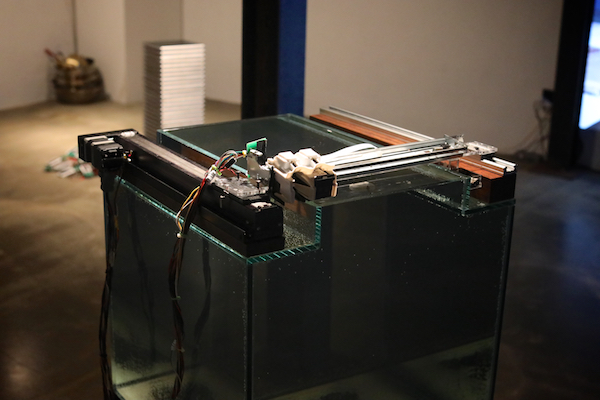
Extracting audio from a sound source, employing artificial vocal programs, and devising a printer that can print on water, the artist’s works, which heavily incorporate technological apparatuses, are often labeled media art. In theory, the interpretation of a work remains an open-ended question. Thus there is no need to reject such a categorization.
In fact, used as a medium of perception, the apparatus bears significance in Kim Sangjin’s work. However, his works focus not on the apparatus itself or its produced effects, but rather on such aspects as the existential conditions of a human being, the difference between reality and illusion in our technological environment, the deconstruction of our contemporaneous time and space, and the change in our perceptions.
This leads us to question: What am I looking at? What am I who am looking at the object? And what are the systems and structures that intervene in my vision and cognition? In this regard, my own perplexity may be substituted with the question generally raised in conceptual art: the dilemma between the concept of the work that reigns more important than its material substance or visual appearance and the non-linguistic medium and sensory attributes that undeniably deliver the very concept itself.
The bottom line is that I think that obscurity or complexity sets Kim Sangjin apart and fundamentally aligns with the artist’s repeated questions about our perception and reality. The tension between physical substance and conception can be said to parallel the gap between object and text, as with the conflict between the world in front of our eyes and the signs of its referents.
Furthermore, since the expanded interest in our contemporaneous digital environment in 2019, the artist has been dealing with more-extensive complexities of the absurdity. Reflected in the artist’s contradictory ambivalence, crisscrossing modern thinking and postmodern mindlessness, is the issue of contemporaneity intertwined with the premodern, modern, and contemporary. This essay attempts to sketch out how the works presented in Korea Artist Prize 2021 reveal the diverse manifestations of the absurdity without being too serious.
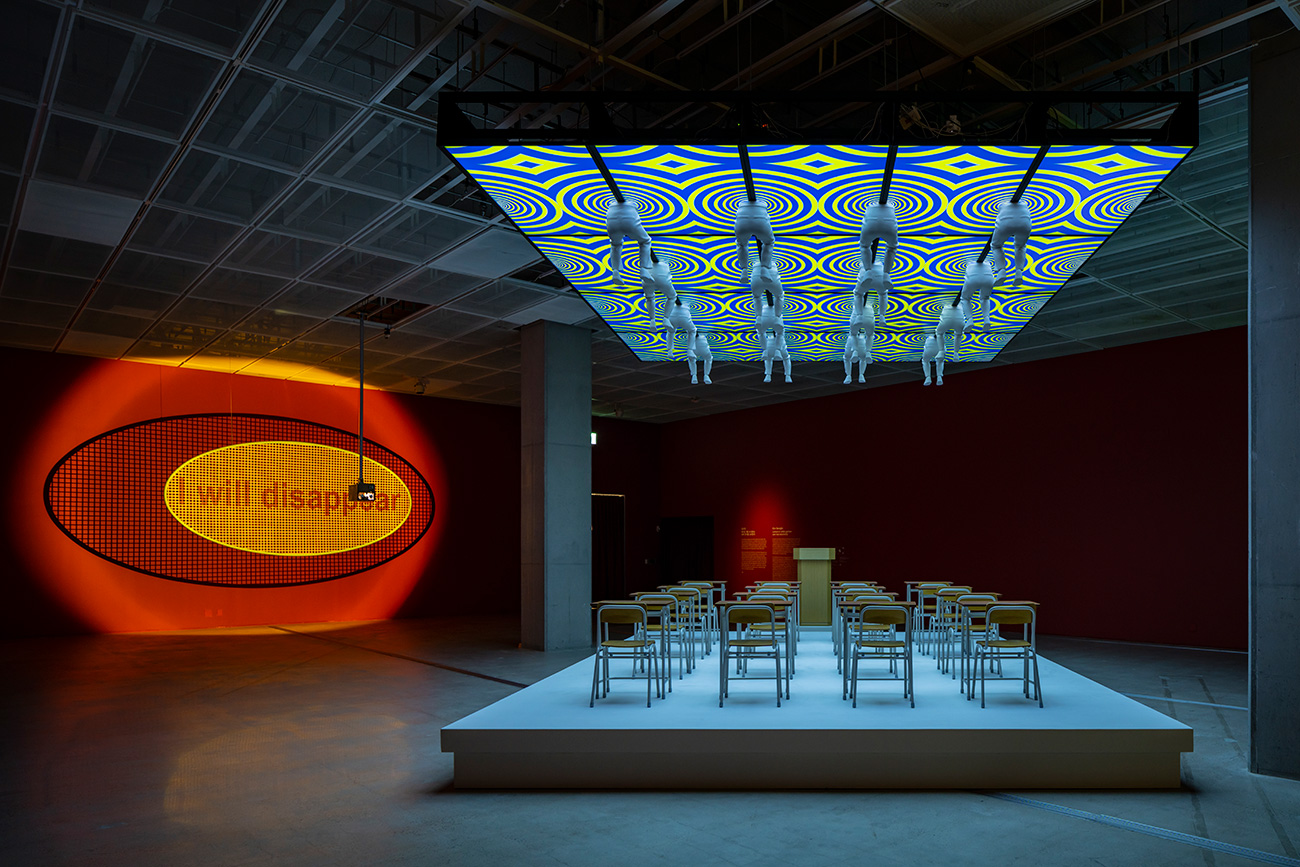
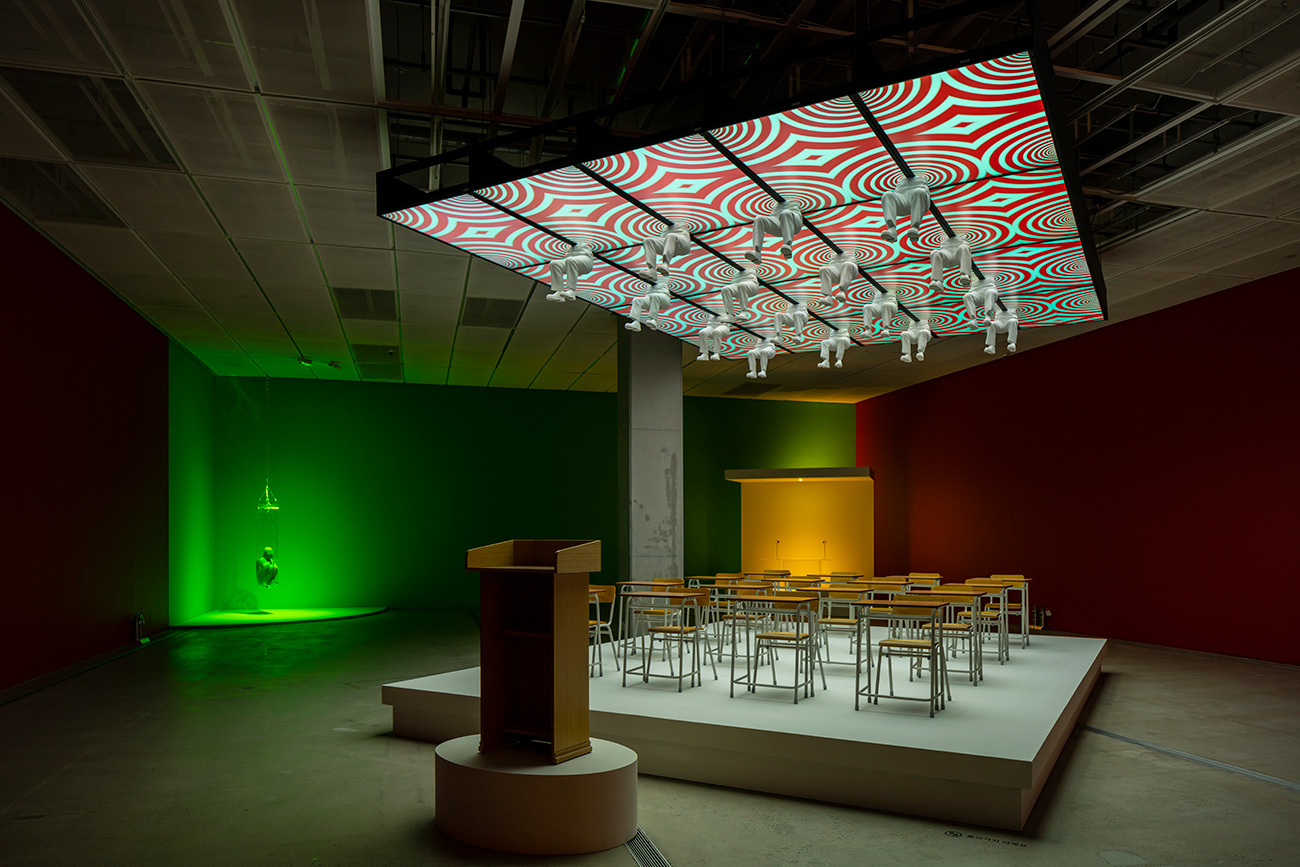
2. Lo-fi Manifesto_Cloud Flex (2021), stimulating our sight and hearing with a repetitive rhythm reminiscent of 1980s synth-pop, is both visually and conceptually the exhibition’s centerpiece. Against the slow but hypnotizing music continually playing in the background, the viewers are drawn to look at an immense screen, composed of 20 individual screens, showing colorful patterns in repeated motion.
The dazzling patterns stop our thinking and draw us to our senses. The delusion of our visual perception sucks us into the ever-repeating screen. Our minds sink into it while our bodies remain behind. Having soared over their desks to plunge into the screen, the students, or their lower bodies left dangling, become a portrait of and simile for today’s people drowning in the flux of images projected from the black screen.
While our flesh exists in meatspace, our minds are confined in the virtual space of the screen. Although most of our life takes place in YouTube videos, games, and social media, the physical limitations of our body existing in the form of a biological being nevertheless constantly pull us back to our physical body formed of “flesh.”
Such division, created by alternating back and forth between the virtual and the real, is the contemporary contradiction visualized in Lo-fi Manifesto_Cloud Flex. The artist states the theme of this work to be not the hi-fi virtual world pursued with great expectations by those of modernity but the lo-fi virtual world that has become our everyday reality.
Current changes indicate the end of materiality-based traditional humanism, yet also signify the arrival of a new kind of human being and world based on the novel experiences of virtuality. The artist’s lo-fi virtual world neither clearly differentiates the virtual from the real nor substitutes one for the other. Instead, it appears to be a place where both worlds absurdly coexist.
The future has arrived, but we are still in an unresolved state of uncertainty as to where we are moving toward. This is the root of contemporary anxiety and the point that brings about a sense of déjà vu. It is unnecessary to extend the scope to philosophy to find déjà vu to be the driving force behind Lo-fi Manifesto_Cloud Flex.
In keeping with the synth-pop aesthetic, Lo-fi Manifesto_Cloud Flex comes across as retro in concept and form. Primarily, symptoms of fragmentation directly relate to a postmodern delirium, which Jean Baudrillard and Fredric Jameson put forth. In a world absent of all referents and left rotating with nothing but simulacra, there remains uncanny schizophrenic happiness, devoid of any sense of depth or distance, leaving only an intensified present.
What Jameson describes as “suddenly engulf[ing] the subject with indescribable vividness, a materiality of perception properly overwhelming” can be applied to Lo-fi Manifesto_Cloud Flex without much difficulty. Considering not production, but post-production, which reassembles rather than creates, the technological format that defines our contemporary digital environment, the retro-ness of Lo-fi Manifesto_Cloud Flex in itself is contemporary.
However, repetition always yields difference. While Jameson described the intense excitement and hallucination of dismantling the signifying chain and liberating signifiers as the hysterical sublime, the glaring optical illusion visualized by Kim Sangjin comes closer to the exhaustion described by Franco “Bifo” Berardi.
The “semiocapitalist acceleration” and the “overexploitation of nervous energies” make threshold values unresponsive to any stimulus. Of importance here is the state of repeating rather than clarifying contents. The temporality of repetition, continually circulating and nullifying the linear flow of time, is the contemporary time of semiocapitalism, one separate from the noumenon.
Lo-fi Manifesto_Cloud Flex can be associated by form with op art. While this association is coincidental, especially considering that Kim Sangjin’s previous works were far from visual spectacles, the analogy is worth considering. Lo-fi Manifesto_Cloud Flex resonates with op art so that eye and body correspond. Despite its pure visual properties, its optical illusion patterns cause such physical effects as dizziness, headache, and vertigo.
The inherent duplicity of visual tactility was employed to criticize pure visuality from the standpoint of anti-art (Marcel Duchamp’s Rotorelief No. 6: Escargot, 1935) and made way for the art critic Rosalind E. Krauss to examine op art as an example of a “new perceptual abstraction” responding to the era of electronic media.
Intertwining eye and body, Lo-fi Manifesto_Cloud Flex points to our mediated senses, a property of contemporary synesthesia. At the same time, the work reveals the inevitable coexistence of reality and virtuality caused by the inability to separate mind from body. Virtual reality, touted as the most realistic tactile epiphany, is, in fact, a false sense of vision mediated by a headset as its apparatus.
The epiphany of tactility via sight is tangent to the body’s disappearing by being sucked into the delusional patterns. However, parts of the body not engulfed but left behind appear to expose the duality of contemporary there-being that crisscrosses the real and virtual worlds. And although the virtual world is given more weight as reality dwindles, the presence of physical existence exemplified by the fatigue of online lectures has, ironically, become even more underscored.
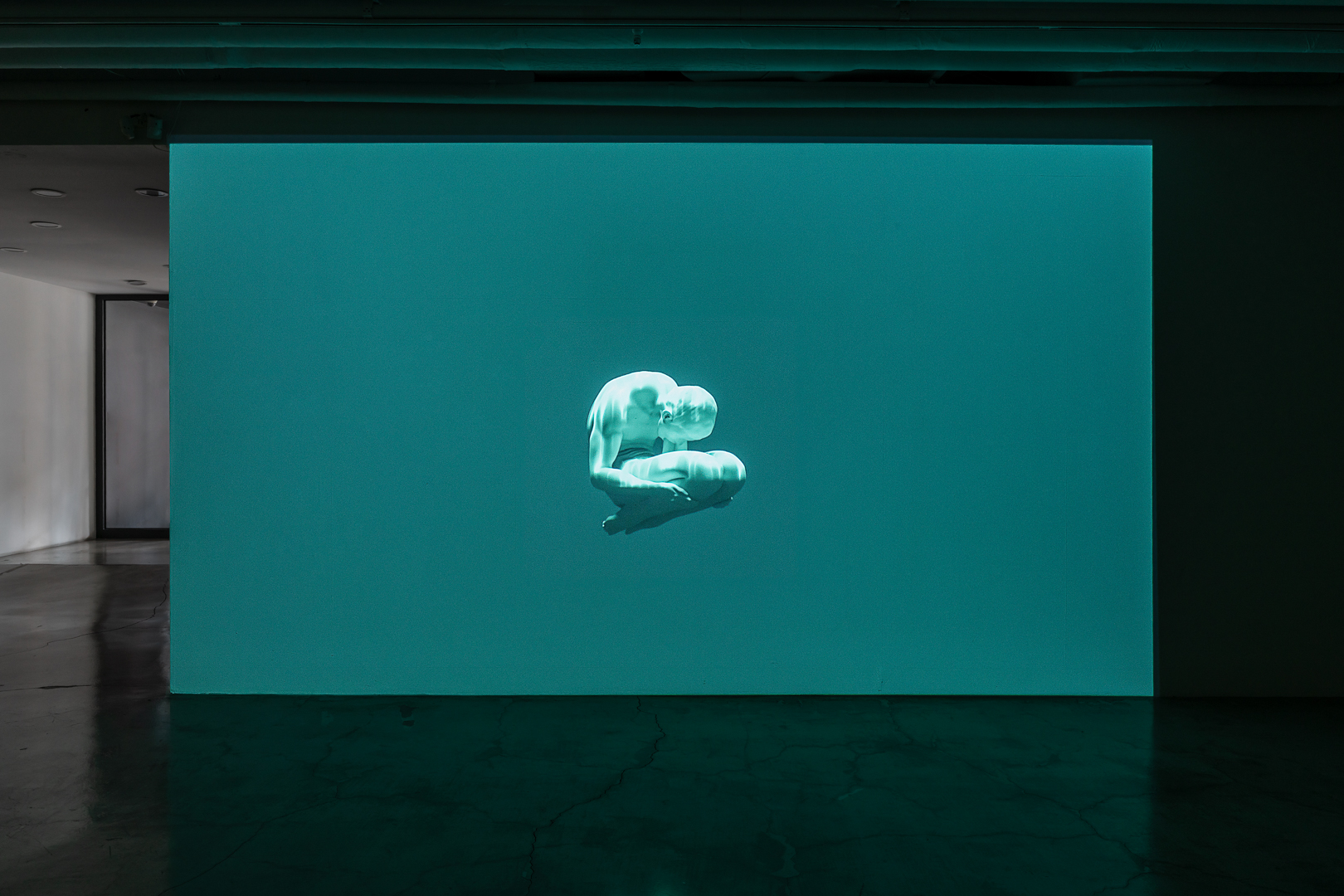
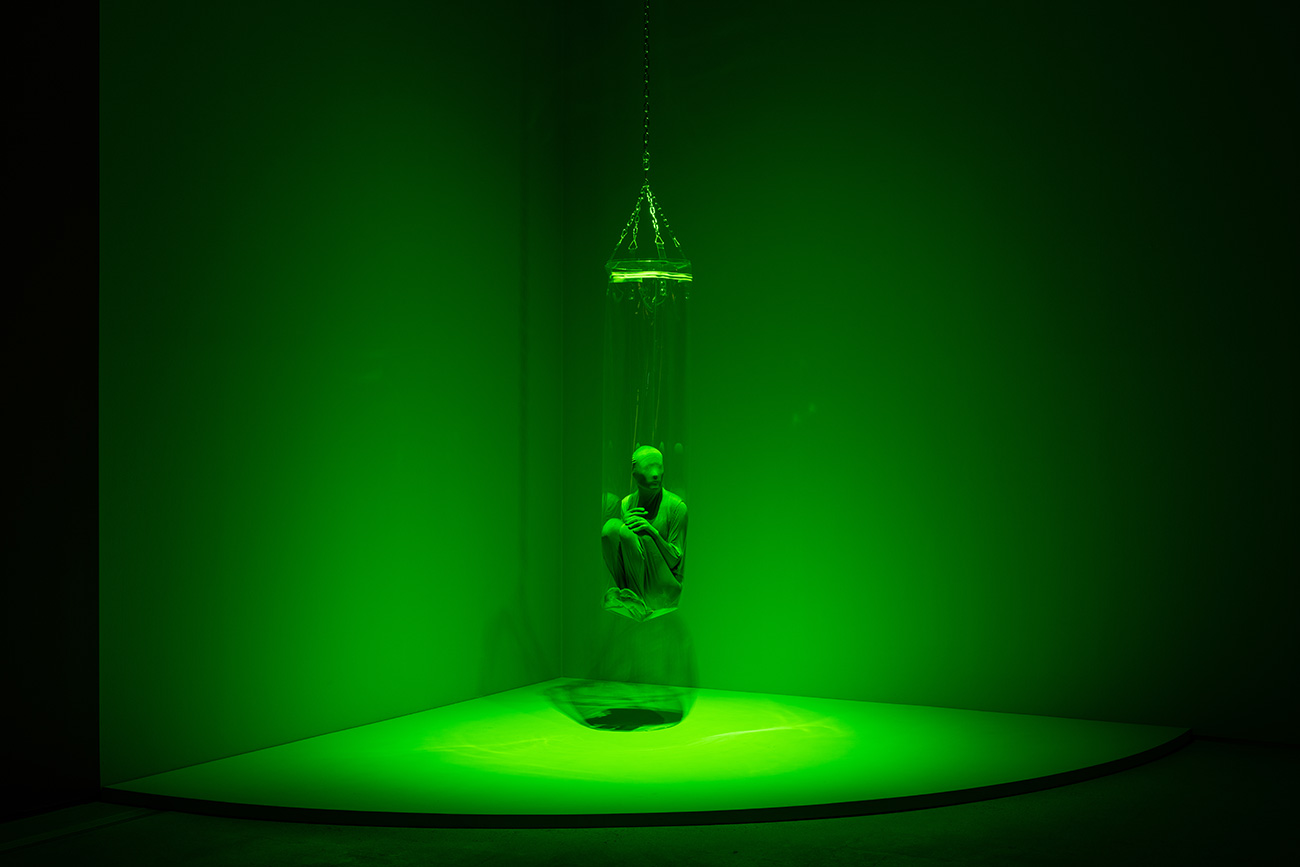
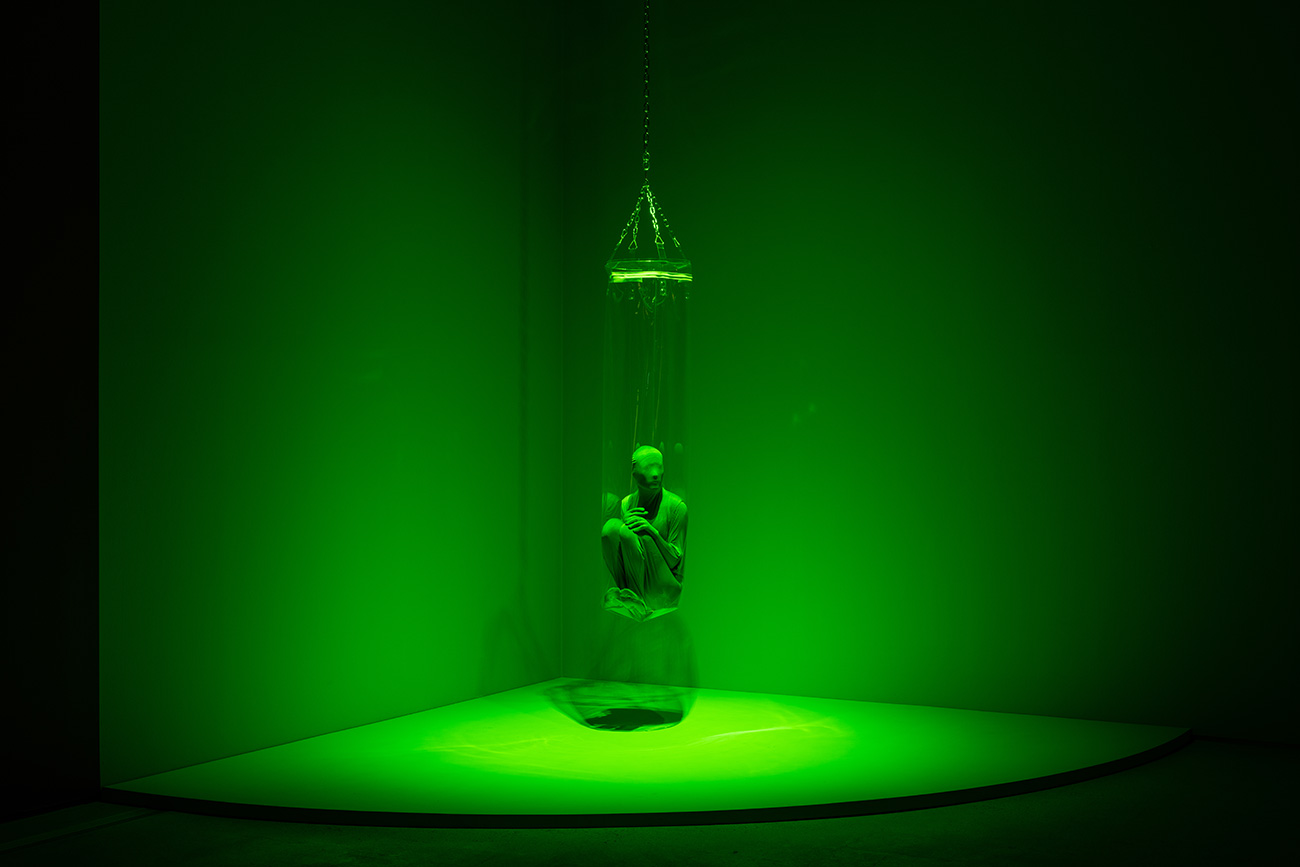
3. Chroma Key Green (2021) and This is fine (2021) explicitly portray the contemporary digital environment, where the artificial has become the new nature and the human condition that simultaneously exists and does not exist. Today’s data matrix, in which tools are “no longer tools but have become nature (quoted from the artist),” is most directly stated in Chroma Key Green.
Conventionally, the color green has symbolized intact nature as well as its intrinsic materiality. However, in our contemporary moving image production environment, where postproduction is essential, green is employed to erase such materiality. In this sense, the figure wearing a green chroma key bodysuit simultaneously embodies the real and unreal and serves as a metaphor for existence of contemporary human being.
One interesting paradox in connecting concept and form occurs here: finding the expression of an image world, where physical properties disappear, even more limited by such physical properties. To render realistically a human being crouching in a transparent urethane vinyl bag, the artist looked to traditional carving techniques of sculpting materials from the outside along with 3D-printing techniques of building a figure from within.
Since the massive sculpture had to hang from the ceiling, its physical properties inevitably became core to the overall working process, implying the relationship between the virtual world and the real world we cannot entirely escape, no matter how extensively numbers are substituted for the real world. In fact, Chroma Key Green combines two contradicting styles of previous works.
At one end are works using traditional sculpting methods exemplified by Human copyright information (2007), which presents a sculpture as a replica of the artist carrying a bag containing another simulacrum, and The street where I’m living (2010), which experiments with the minimum condition of recognizing the noumenon by installing in the streets a sculpture that replicates the artist.
And at the other are works realizing today’s electronic nature in which simulacra substitute for reality, such as I know this steak is not real (2020), depicting humans revolving in a world of crumbled hierarchical structures as drifting signifiers, and Electric Cave (2018) replacing the sound from an actual cave with an ASMR sound file to help us sleep.
Kim Sangjin once mentioned in a text a slippery, sticky, and slimy subversive possibility of viscosity exuding out of an obsessive matrix of a world of tools. He most likely meant to discuss the general possibility of violation that may contaminate a data society based on consistent forecasts. However, the inerasable organicness of our age-old flesh may also pose as an impediment that paralyzes “Signifiers–the carcass of dead meanings (quoted from the artist).”
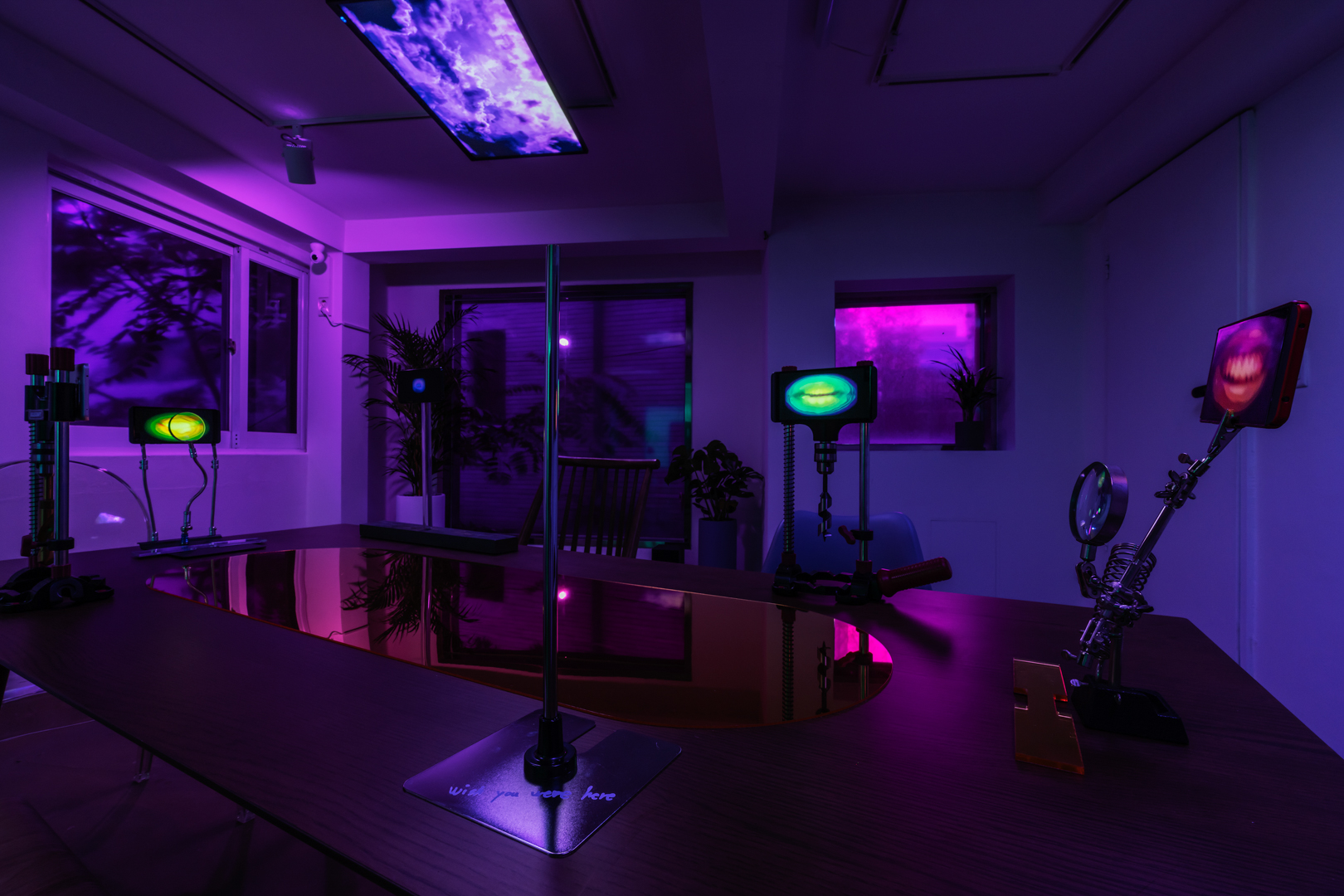
While Chroma Key Green deals with discordant symbiosis of the real, organic world and the abstract world of signifiers, This is fine focuses on the present landscape overpowered by simulacra. The eyes displayed on smartwatches, engaged in a staring contest, remind us of the predominance of virtual persona whose social media accounts replace physical beings in meatspace.
This is fine presents a slightly different attitude from Chroma Key Green. While the latter offers a relatively serious existential deliberation despite its self-mockery and sardonic humor, the tone of the former is much more cynical, negligent, and dry. This sentiment is shared by the meme after which the work was titled.
Sipping a cup of coffee in a burning house, a character uttering “This is fine” refers to the state in which we live disconnected from reality, immersed in a virtual world, or to the social atmosphere geared toward pursuing some insignificant but definite source of happiness detached from whatever going on in the rest of the world.
In a world that consists only of an endless chain of slippery signifiers that deny any guarantee of standards or orders, who cares whether the steak is real? And does that even matter? After all, there are smartphone-mouths, devoid of physical flesh, engaged in lively conversation at a dinner table (Fuck you and I will see you tomorrow, 2020).
In connection, Kim Sangjin’s attitude toward memes requires attention. He once stated that memes, images that many people online enjoy as satirical amusements, had inspired him in many ways with their treatment of the absurdities. They are hidden plays for only those who know of their context, profane in the way that they disrupt and challenge rank and hierarchy. They are difficult to predict, mixing frivolity and gravitas.
We can assume that all these characteristics grabbed the artist’s attention. Indeed, all Kim Sangjin’s works alternate between serious epistemic contemplation of the self and the world and half-joking nitpicking already aware of its uselessness. Besides his works, Kim Sangjin’s attitude harbors an absurd coexistence of modern thought and postmodern violation.
Oasis (2021), another work that began from a meme, is half laughable internet joke and half conceptual study of the operation of signs. A “Caution Wet Floor” sign underwater invites its viewers to laugh. Subverting an object’s purpose to render it meaningless, the strategy vaporizes the signified (content) by transposing the context without damaging the signifier (form). Within the framework of art history, the root of this strategy lies with Duchamp.
His infamous Fountain (1917) did not morph the object; merely changing its location from a bathroom to an exhibition space converted the object’s meaning. While Fountain redirects a physical location, Oasis devises a paradoxical situation to make the signifier meaningless. Duchamp’s play on the signification of signs often appears in Kim Sangjin’s other works as well.
Time_watch sound (2010) emphasizes time differences between sounds to reveal that the measurement of time, which assumes simultaneity, is arbitrary. It is a time-based antithesis of Duchamp’s 3 Standard Stoppages (1913–1914), which unveiled the arbitrariness of measurement through different types of curves formed by threads in the same length.
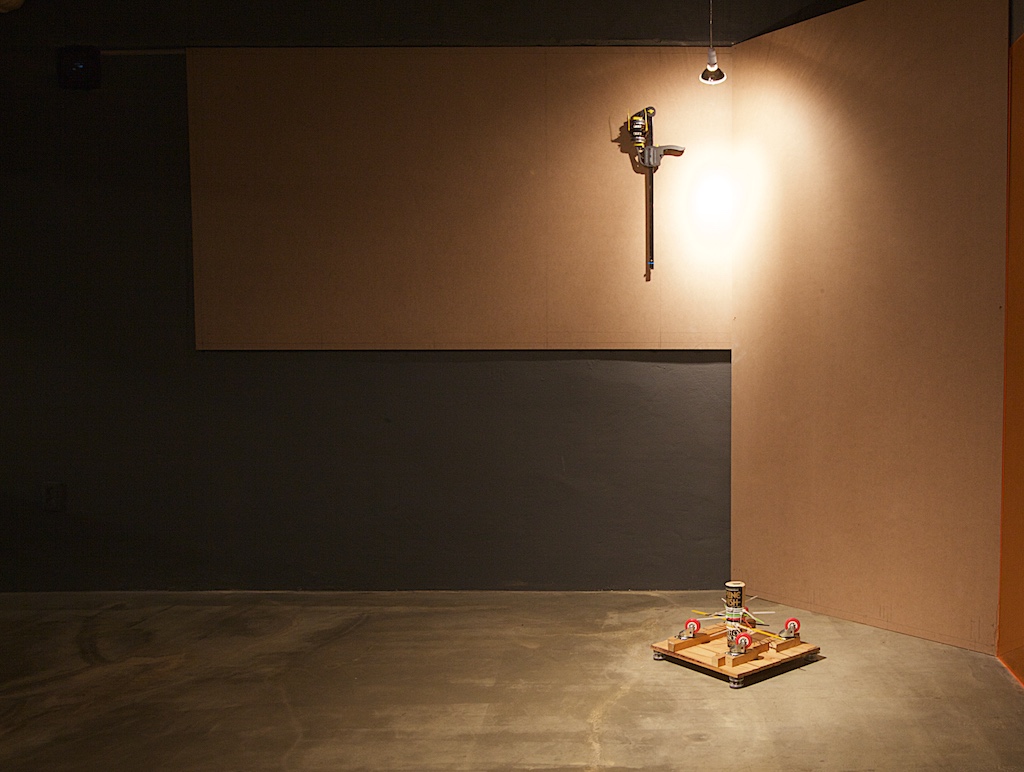
Time_watch sound_2 (2018), which deconstructs linear time by transposing functions, and Jack (2017), which moves the emphasis from the object of signs to the system of signification by uniting the measuring apparatus with the measured object, are both Duchampian interferences that disturb a signification often taken for granted. However, it is safe to ignore such theoretical implications and view Oasis as a funny meme. Is it not the purpose of this work to convey the absurdity of paralyzing slipperiness by filling up with excessive slipperiness?
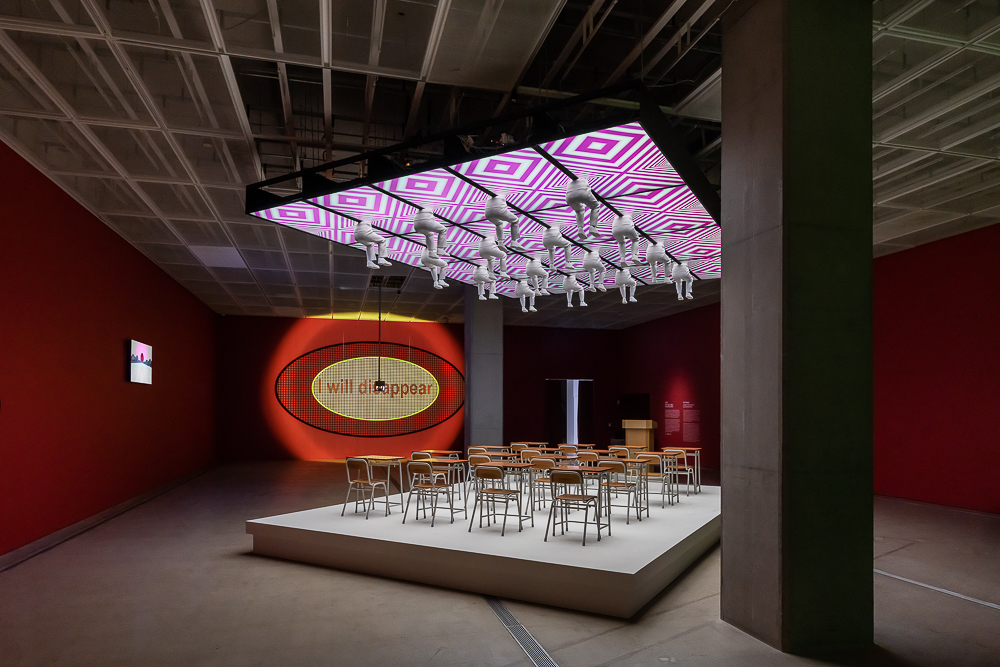
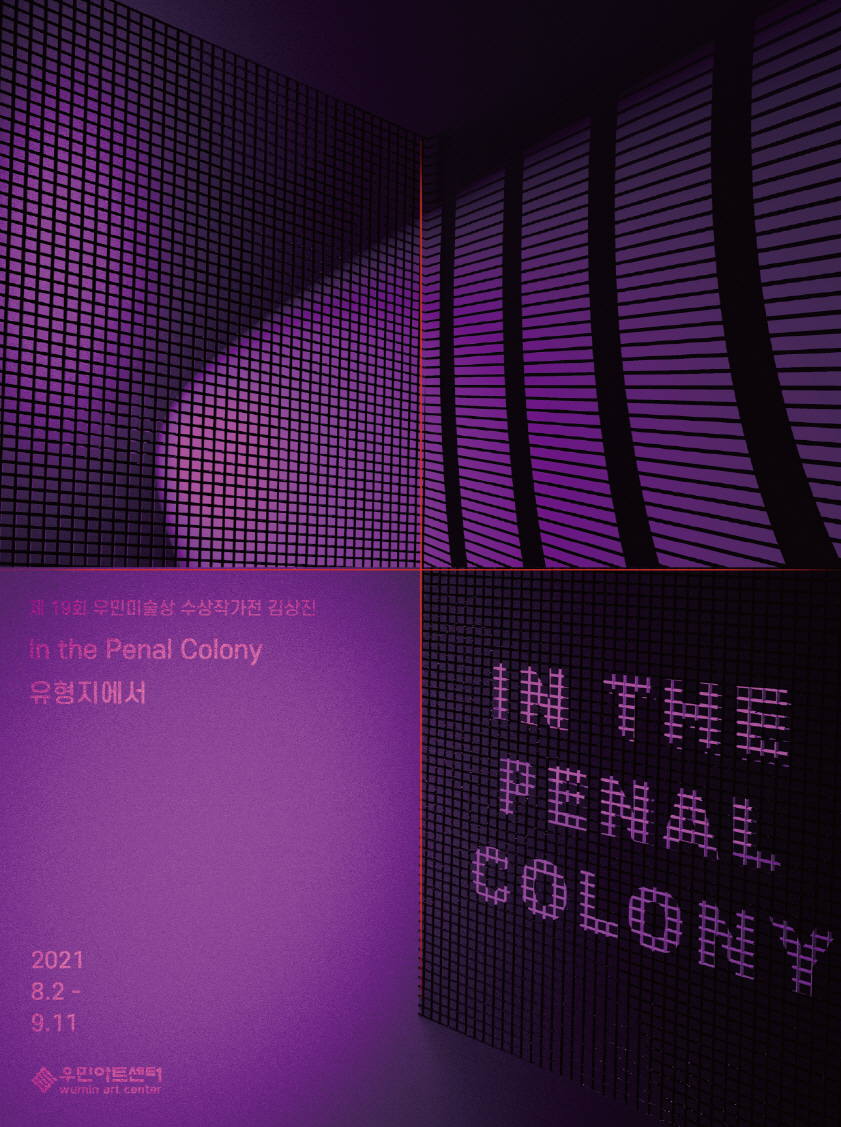
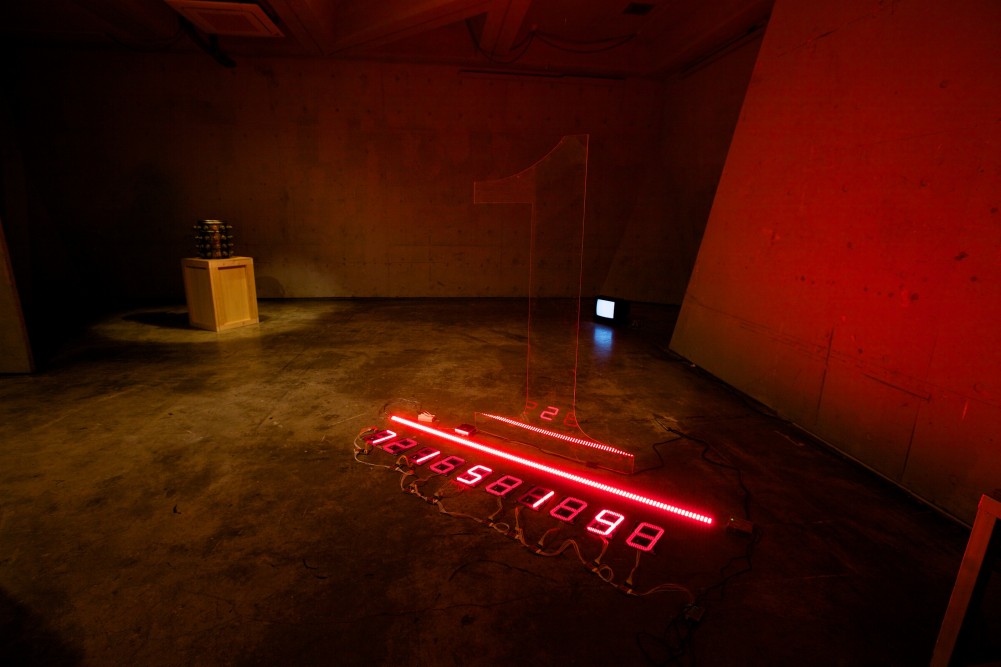
4. I will disappear (2021), a work in the exhibition with as much gravity as Lo-fi Manifesto_Cloud Flex, compresses the most critical themes in Kim Sangjin’s existing oeuvre. They all lie in its title: “I,” the “language” that denotes it, and their “disappearance.” This work too can be traced back to a meme, this one showing a Wilson brand tennis racket with the “W” logo absent in its shadow.
While it seems silly to exclaim, “Where did the W go?!”, that is how we usually are, forgetting time after time that what we see might not be what it seems. Although representation and reality are not equal, we understand, compose, and transform the world through images. In that sense, images can be said to exist prior to, rather than to derive from, reality, and to be involved in forming our consciousness and thinking.
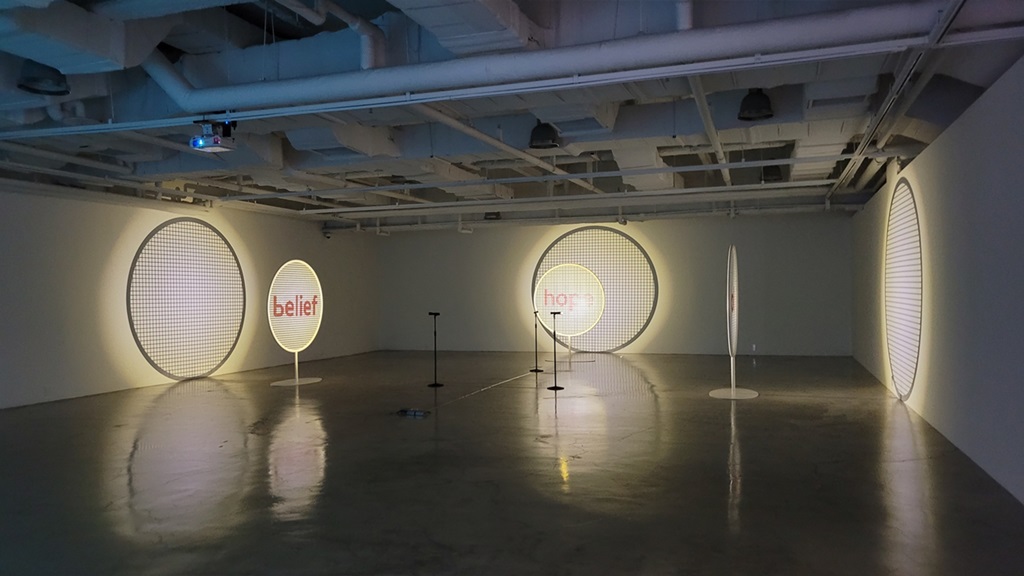
As viewers look at I will disappear, that phrase is generated by the difference in colors painted upon the grid. Since it is insubstantial, it is not reflected in the grid’s shadow. Language is thoroughly arbitrary among signs and can capture only parts of the world in simplification and abstraction. Nevertheless, as what structures our consciousness and unconsciousness, language is taken for granted.
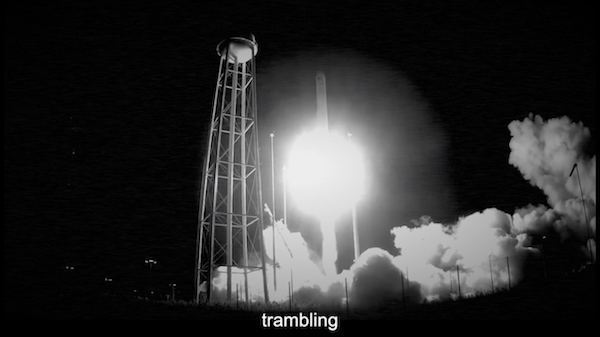
This transparency of language, so natural that we don’t notice it dominating our cognitive process, is exposed in We are not (2017), which shows video footage of a U.S. satellite exploding, severely shaken by an impact with a rocket. The subtitles imposed on the footage, however, remain steadfast. The text, separated from the image yet defining our comprehension, symbolizes the dogmatic status of language: it cannot precisely coincide with the world, but it still dominates our understanding.
The imperfection of language as a representation of the world is also revealed in works that experiment with the omission of signs. Language is a net too sparse to filter the world, annihilating countless senses and experiences that cannot be indicated within the process of becoming language. 95% of data is discarded when converting a WAV sound file into an mp3 format; such data was collected and played alongside the 5% retained by the mp3 file in the work Moonlight sonata (2010), casting the world as a prototype that is lost in its representation.
What about “oneself,” then? The epistemic dilemma—the inability to communicate without language despite its imperfections—can also be applied to the self. Because we cannot survive once we doubt our own integrity, we introduce an illusion called the self. Yet the existence we name “I” is a phenomenon that occurs by comparative differences through ever-changing interactions with the external world.
Ever divided between the mind and body, “the world” and “I,” the self and the other, the past and present, we are vulnerable therein, as has been discussed many times in Kim Sangjin’s works. Because we cannot exist without being represented, the “I” has been endlessly duplicated as an image, statue, name, registration number, and other signs. However, none of these representations can wholly contain the “I,” which continues to leak.
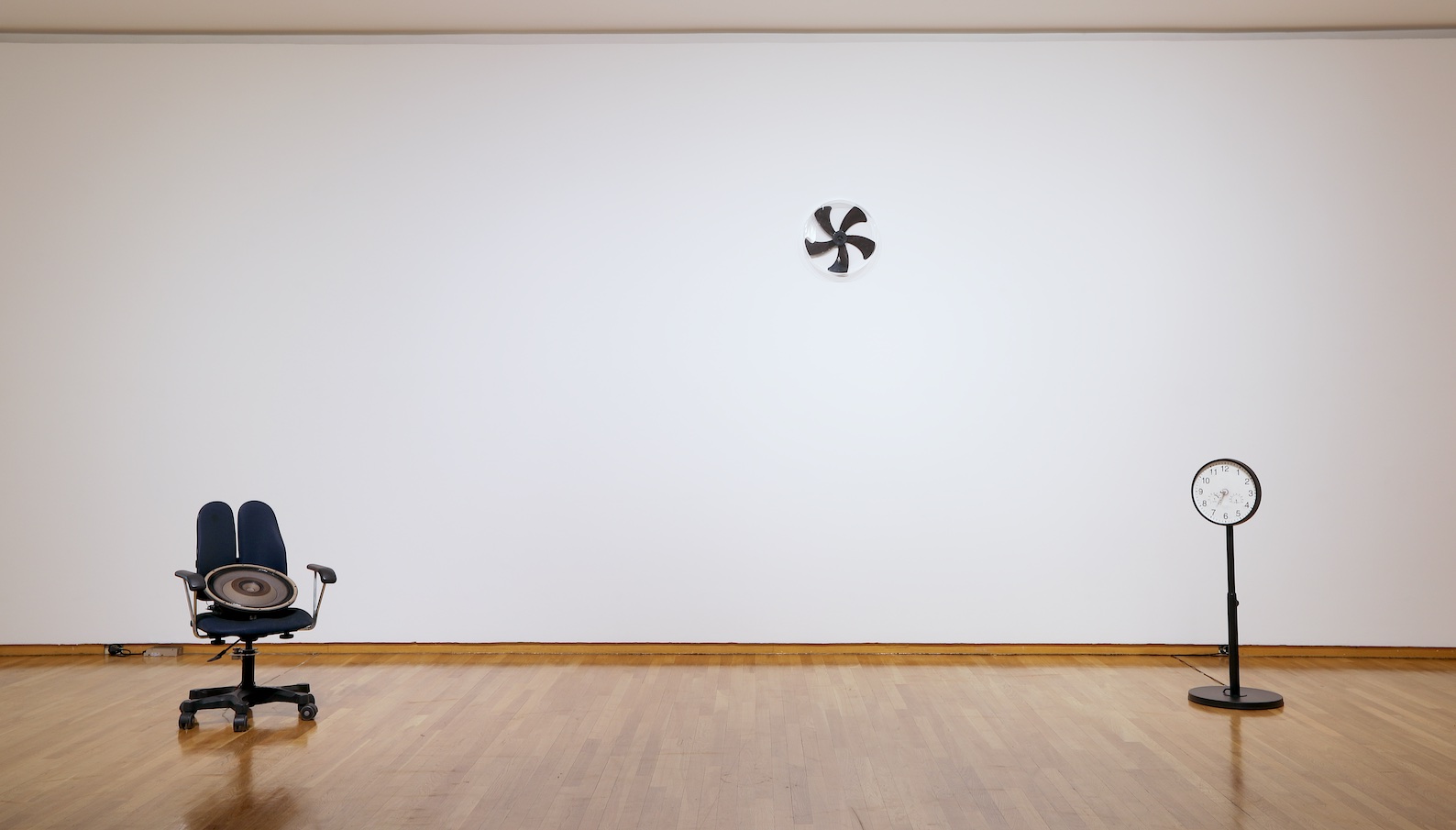
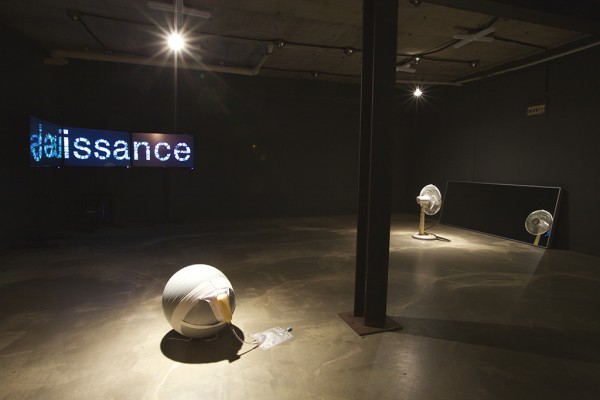
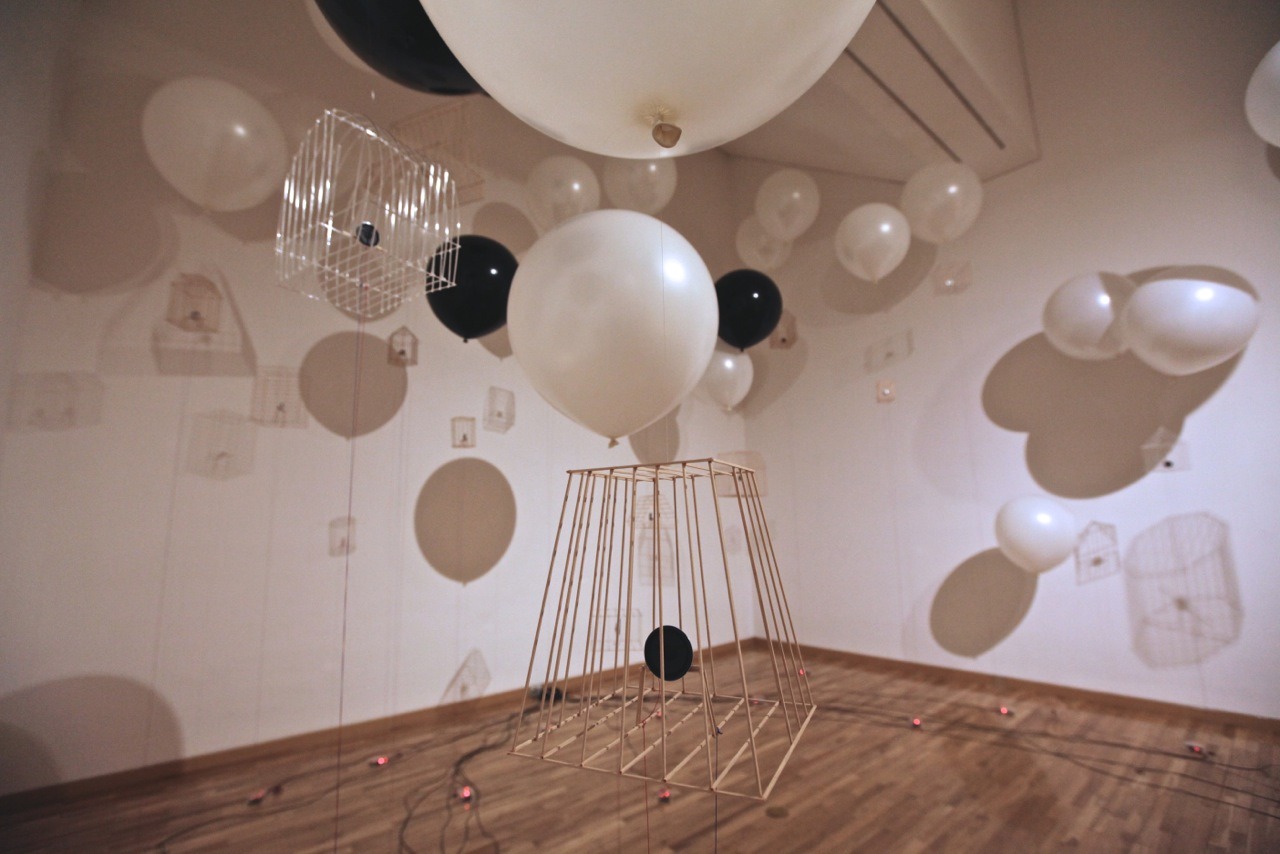
Human copyright information, a work presenting a replica carrying a replica, signifies the idea of a closed loop of loss. I’m not frantic yet (2016) displays an electric fan facing a mirror, its hard-working movements all but in vain. The work implies the existential nature of representations that strive with limited capability to capture the world. The same goes for the self, which has no choice but to convey itself through a proxy.
In that sense, the phrase “I will disappear” printed on the grid gains significance in many ways. The “I” can be seen here as both the subject self and the language sign system. The future tense, which belongs to neither past nor present, attests to a willingness to disappear. Should “I” be a physical entity, “I will disappear” points to the weakening of its physical reality and a gradual transferral to the world of codes.
Separately, if the “I” is seen as a language system, “I will disappear” can be understood as a paradigm shift, in which the analog system of representation is replaced by a digital sign system based on numbers. In any case, the disappearance is neither complete nor truthful. No matter how thoroughly machines replace humans, as long as its receptors remain human, an organic body’s physical properties will continue to limit the scope of data.
Only signals within humans’ visible and audible ranges are extracted and given significance; this phenomenon indicates that our physical existence limits the potential of data. Humans have been fragmented into a data set that provides information to the matrix, yet the “I” continues to return. In addition, even if the organic language has been pushed behind mathematical numbers, the bureaucratic and patriarchal power of symbols does not disappear.
In the sea of data, stirred even more rapidly as time goes by, intense, immediate images and affective economies emerge, rather than slow, static text. Behind them, however, lies the rule of an algorithm that perpetuates prejudice and discrimination, betraying its self-evident and transparent appearance. Thus, the phrase “I will disappear” becomes a paradox, being at once true and false. It is a ghost-like illusion that seems to disappear until you look back and see it appear again.
5. As a sentence in the future tense, “I will disappear” heads toward a future marked by a more intensive semiocapitalism than at present. Perhaps it is closely related to what Baudrillard described as the “great disappearance,” the “division of the subject to infinity, of a serial pulverization of consciousness into all the interstices of reality” made possible by the accelerated labor, time, and fragmentation of the self.
In this disappearance, a person “is nothing but the residue … of the process of valorization,” and the only thing that exists is an “infinite brain sprawl, an ever-changing mosaic of fractal cells of available nervous energy.” Like a canary, Kim Sangjin is the first to detect the signs of value systems being overthrown.
The augmentation of tools called reason and rationality unintentionally discards the human epic that began with the Word of God, and its gaping void is filled by the language of such tools. As space-time, consciousness, and the subject disappear, so does the apocalypse. What exists is only an infinite present, with disappearance omnipresent.
What stance, then, does the artist take toward this numbing landscape of emptiness? Kim Sangjin begins by doubting the naturalization given to the smooth plane of the simulacrum. What is important is to betray the anticipation of what one regards to be natural and disrupt the system of predictions. Messiah (2021) is a small expectation, or sought-out way, of escaping a closed world of reduction from which the self has disappeared.
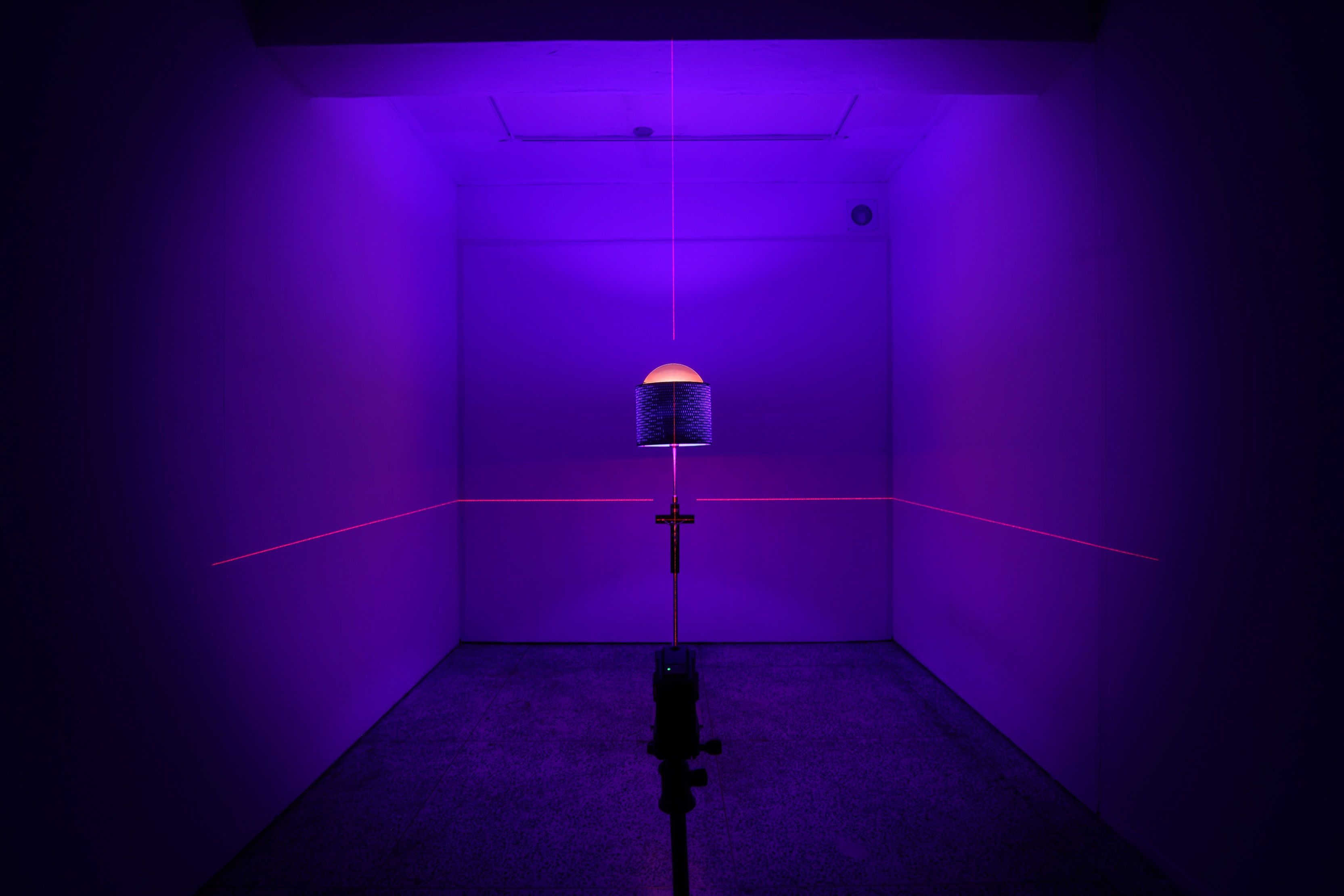
Upon an endless gridded plane, there far away is the Messiah so small that he looks like a dot. He is walking but not getting any closer. Nevertheless, he keeps on walking. The Messiah here does not seem to be a savior in the conventional sense. He seems closer to some kind of possibility that creates an interstice out of a smooth, tightly constructed matrix.
To Kim Sangjin, this is the absurdity. His methodology of the absurdity, described as “placing midway a twist in the road, pretending to be calm, just simply ending things, asking for trouble, etc. (quoted from the artist),” is a continued raising of issues, joking, and interrupting while recognizing its own uselessness. This futile nitpicking might be a version of Berardian resistance.
Berardi sees expressions of passivity, such as uselessness, idleness, dullness, and withdrawal, as forms of radical resistance in a totally capitalist world emphasizing speed, efficiency, and productivity. Exhaustion could put the brakes on this restless climate of productivity. Compared with Berardi’s, Kim Sangjin’s strategy of revealing absurdities through doubting naturalization seems both more old-fashioned and more proactive.
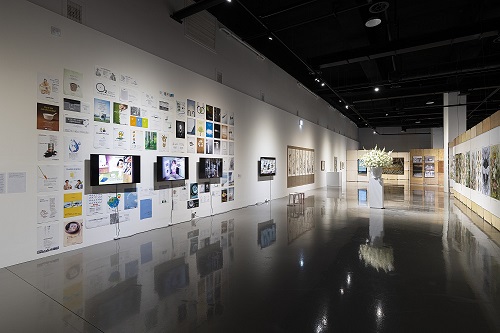
This is because Kim Sangjin’s strategy can be characterized by a Cartesian subject that begins with doubt and eagerness to unfold the practice of thinking. The exhibition’s title, “Lamps in video games use real electricity,” is another truth hidden as a joke. The lamp’s light rendered in the video game is virtual, but also real in the sense that the graphics are manifested using electricity.
Setting up such an absurd situation, where simulation and reality coexist, the artist states in all seriousness, complemented by a meme-like attitude, the reality of our current day. Absurdity is discussed not only in his work, but fundamentally in the identity of the artist himself. Is he the descendant of Descartes, sure of his existence as a thinker, or one of today’s bots, clicking away without a thought?
Surely we know the answer: he is both. To this extent, Kim Sangjin shares Hito Steyerl’s stance toward intensifying the paradoxical instead of solving it. Objects in the mirror are closer than they appear, but that could be just the way they are. There is no need to be perplexed with such duality. Baudrillard already guaranteed that people live in a state of dependency or counter-dependency, to their model, permanently challenging it.
He went so far as to state that it is normal to lead a dual life and abnormal not to. Indeed, it might be far-fetched to distinguish the normal from the abnormal. Even without me or the artist pointing it out, is it not a known fact that human beings are themselves contradictory and live alongside the absurdity?