I
There is a white penis against the blue sky. It is the sight of a spacecraft carrying Amazon founder Jeff Bezos ascending toward the atmosphere. The image, which seems like an homage to the phallic spaceship featured in the film Austin Powers: The Spy Who Shagged Me (1999), seems perfectly suited to becoming one of the defining memes of the year. It captures, with a peculiar sense of unease, the space race among the super-rich to escape Earth, unfolding at a time when the pandemic continues to drag on and climate disasters are striking rich and poor countries alike.
Twenty years ago, the image of a phallus departing Earth provoked bursts of absurd laughter on the movie screen. Now that it has appeared in reality, however, it brings an uncanny silence.
This is because it is real. Just as the torrents of water and walls of fire that once surged toward the screen in disaster films have now become a “reality” frequently posted on social media, so too is the sight of billionaires proclaiming their ambitions for space travel and rehearsing their departure from a polluted Earth at a time when the vast majority of humanity is forced to restrict its movements behind masks (or is dying where it sits, unable even to wear one).
The phallic form receding into the distant sky is, quite literally, departing while leaving the overwhelming majority of humanity behind amid catastrophe. And so, although we eagerly circulate memes of the “penis rocket” and “Dr. Evil” on social media, we cannot bring ourselves to laugh. Instead, we merely contort our faces into peculiar expressions, overcome by a strange emotion that is neither self-deprecation, cynicism, nor anger.
Yet what is even more bewildering is that our own predicament, as those left behind on Earth to live alongside the virus and be swept away by floods and flames, somehow fails to become truly tragic. We are still sitting comfortably in the plush seats of multiplex cinemas, watching “reality” with indifference.
Even when disasters burst through the screen and sweep away the people sitting right beside us, we continue to watch, eating popcorn and drinking cola as though nothing has changed. Although we know that our turn may come at any moment, we cannot quite bring ourselves to take the situation seriously. All that remains available to us is a little melancholy and a little irritation.
II
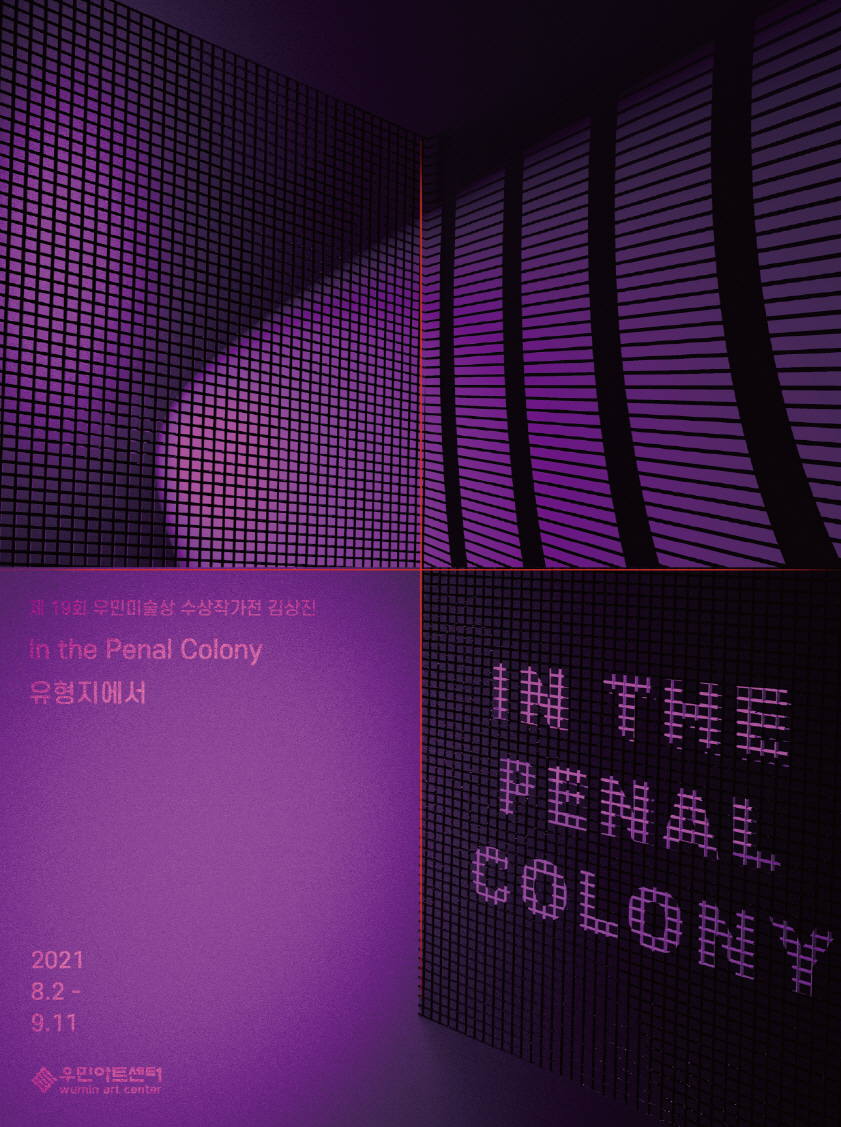
Sangjin Kim’s exhibition 《In the Penal Colony》 reflects a perspective that seeks to examine, on multiple levels, a reality in which the real and the virtual, tragedy and comedy, laughter and silence, danger and safety, exposure and confinement have become unpredictably intertwined. What this perspective attempts to capture are unfamiliar arrangements and strange configurations that fleetingly emerge amid extreme confusion.
To do so, however, it is necessary to dissect the points at which existing arrangements and configurations cease to function. As he has consistently done throughout his practice, the artist once again takes a scalpel to the weak links in established conventions, ideologies, desires, and beliefs.
Most of the works presented in this exhibition were produced around 2020, when the COVID-19 pandemic began. The exhibition itself, titled 《In the Penal Colony》, seems to suggest a critical response to the pandemic. Yet the questions that disasters raise about humanity and the world are hardly unfamiliar to the artist.
His work has consistently questioned the coherence of the world constructed by human beings. In this sense, the arrival of the pandemic represents not so much an entirely new situation for him as the realization and full-scale manifestation of the inconsistencies within the human world that he had already perceived as symptoms.
What is particularly intriguing is that the artist approaches these circumstances from a semiotic perspective. No matter how many lives an event claims or how immense its economic consequences may be, it is not perceived as a “disaster” unless it significantly affects the arrangements and configurations of signs embedded within the human world. Conversely, even an event that attracts little attention may be regarded as a disaster in the fullest sense if it brings about a decisive transformation in the arrangements and configurations of signs.
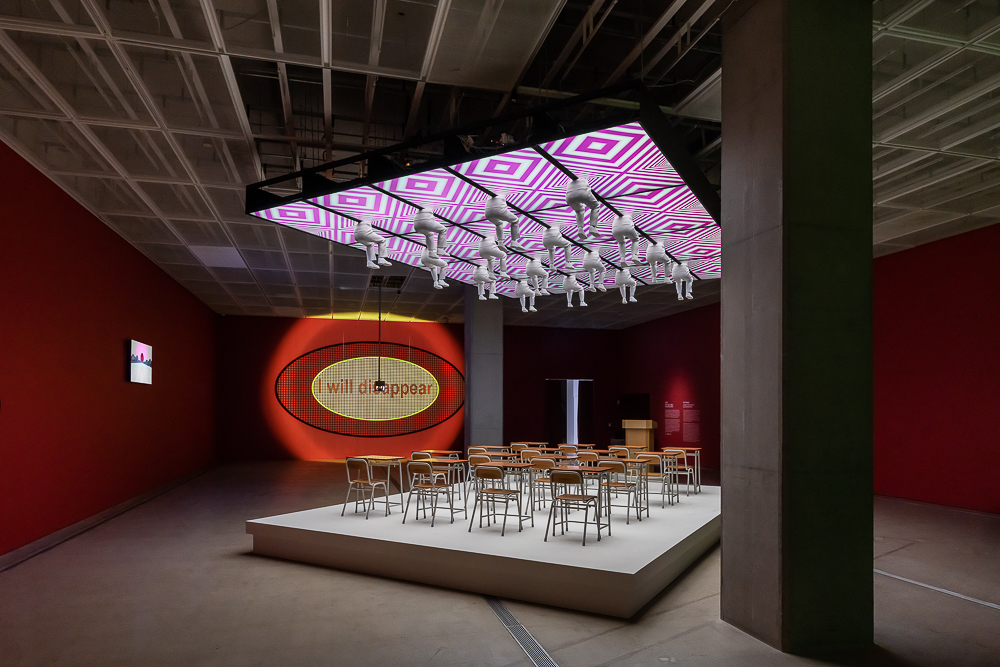
In interpreting the present situation, the artist likewise focuses less on its immediate damage or losses than on the ruptures and malfunctions it produces within systems of signs. Accordingly, the process of signification becomes a more central concern in this exhibition than ever before. Indeed, the most visually prominent element in the exhibition is written language. The first thing visitors encounter upon entering the exhibition space is an array of letters and characters emerging from the darkness and occupying an expansive area.
III
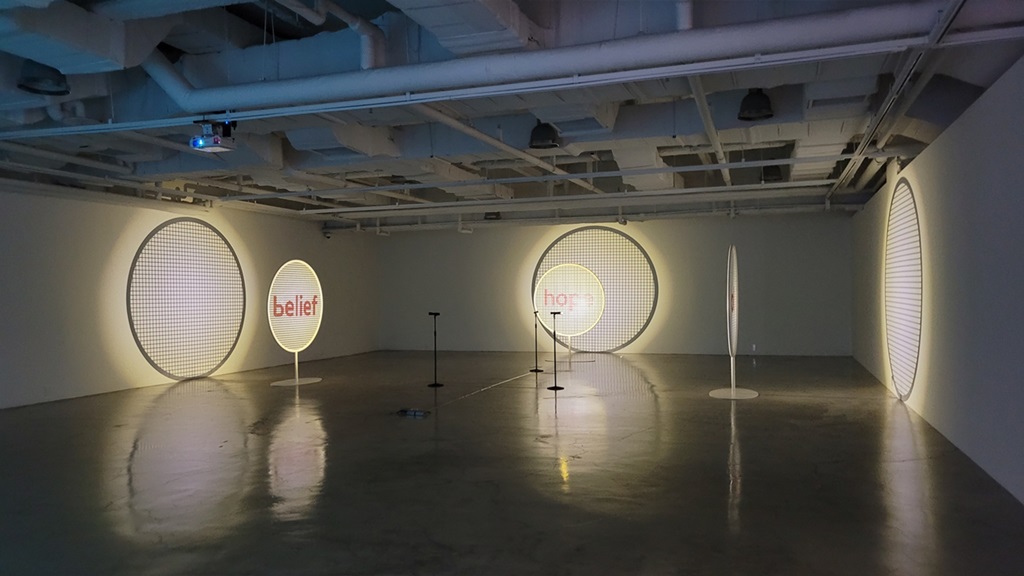
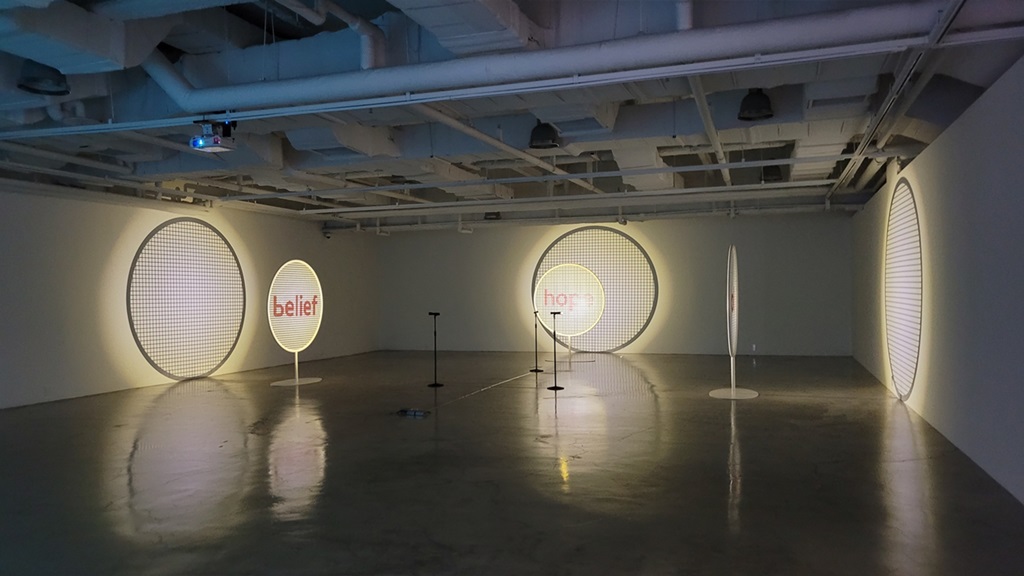
The exhibition begins with the words “belief,” “hope,” and “love,” faintly emerging from the darkness. “Faith, hope, and love—these three will remain, and the greatest of them is love.” (1 Corinthians 13) This is a familiar passage even to those who are not Christians. Yet these words, which have maintained a sense of universality throughout much of human history, now evoke a feeling of melancholy. Their universality has been irreparably fractured.
The notion of the “human,” grounded in such cherished ideals, has been undergoing rapid disintegration for some time, while a different kind of being, characterized by unfamiliar configurations, is beginning to emerge. As a result, we now find ourselves directly experiencing situations in which emotions, thoughts, and behaviors that defy our established standards of judgment abruptly surface in everyday life.
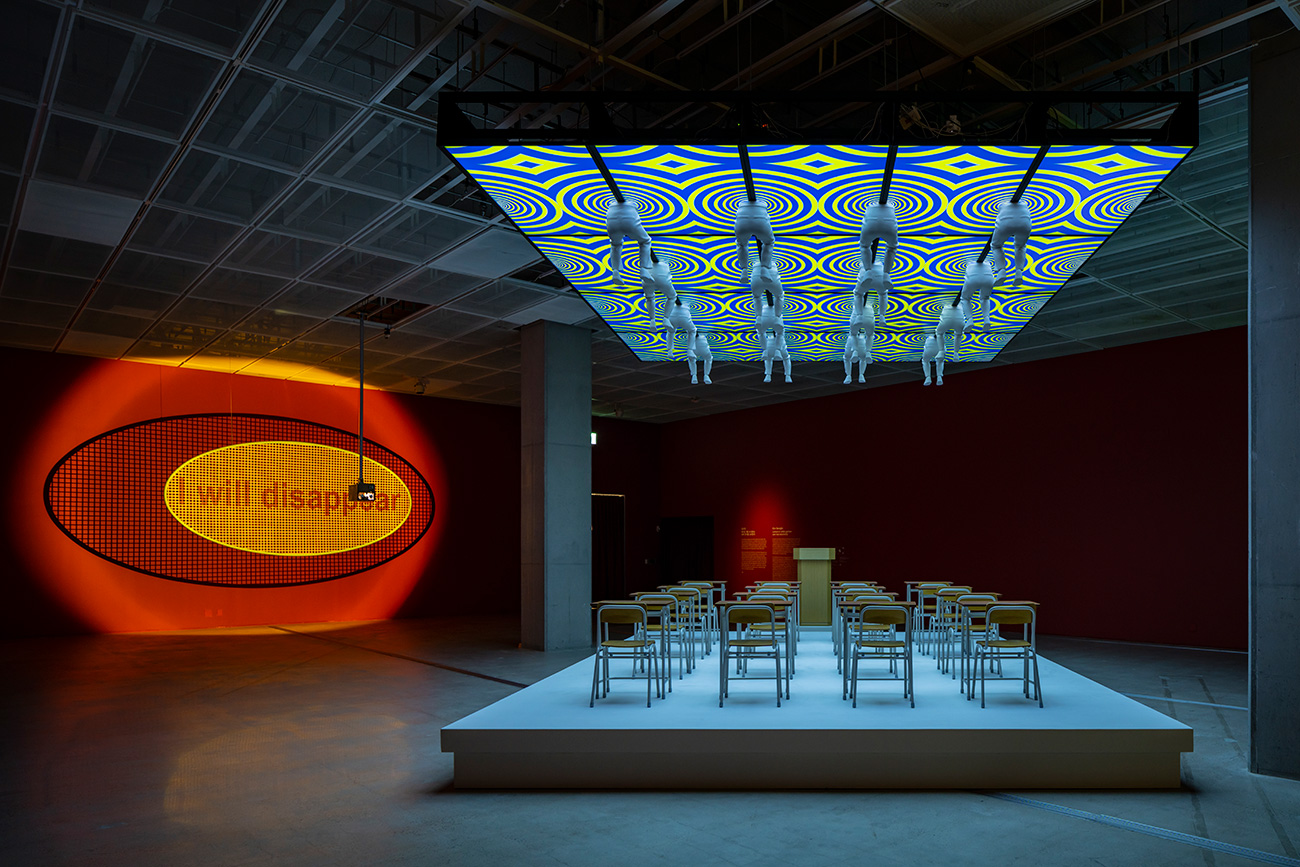
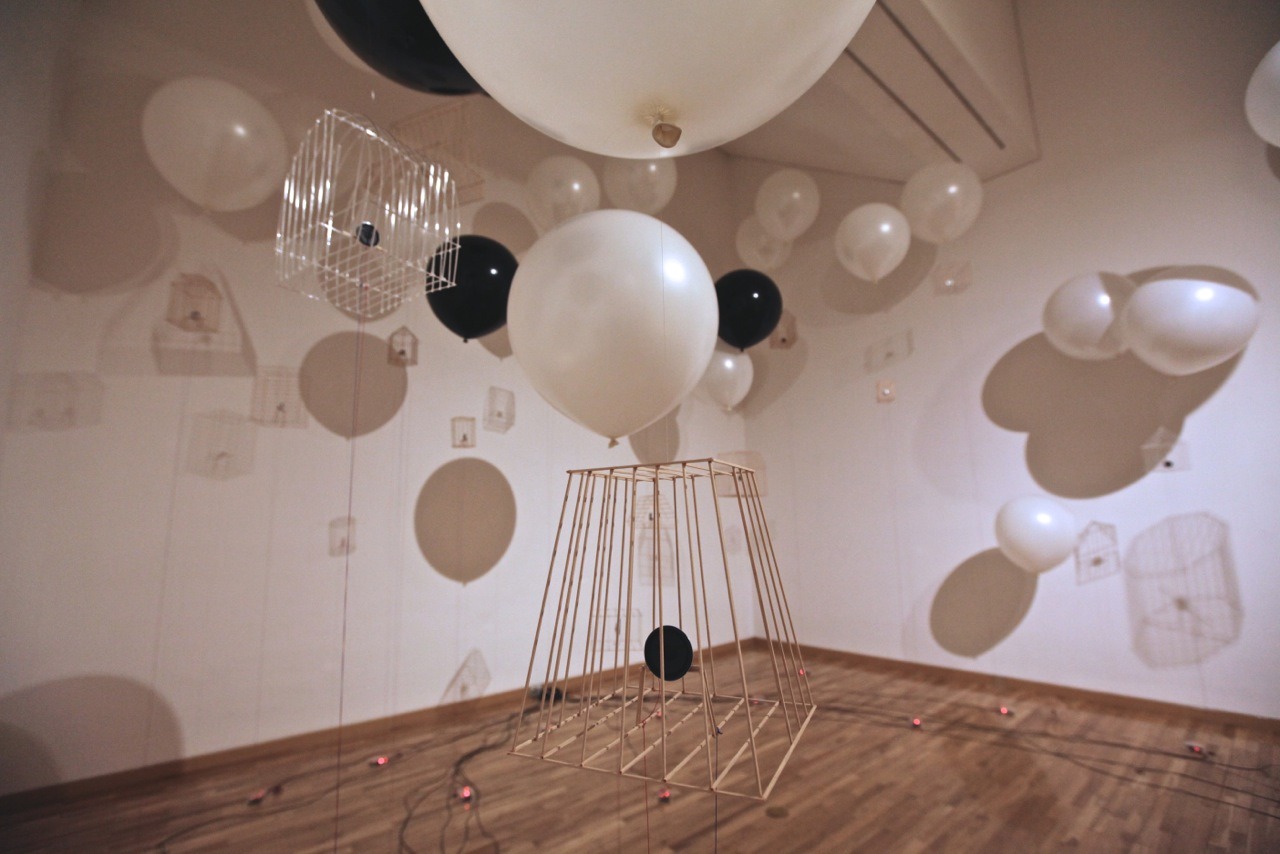
In this exhibition, the artist presents the familiar ideals of everyday life—“belief,” “hope,” and “love”—as written words at the first point visitors encounter upon entering the space. The red letters inscribed on a white grid with a rounded frame are clearly legible, yet appear so faint that they might vanish at any moment.
Under intense illumination, an enormous shadow of the grid is projected behind the letters. Yet within this shadow, which stands in stark, heavy contrast to the physical object, the letters are absent. The words “belief,” “hope,” and “love” inscribed on the grid cast no shadows, like ghosts.
This blasphemous spectacle even evokes a slight sense of fear, as though declaring, “Faith, hope, and love have never existed.” However, as one spends more time contemplating the work, the empty shadow of the grid may also begin to resemble a blank space upon which new signifiers could be inscribed.
IV
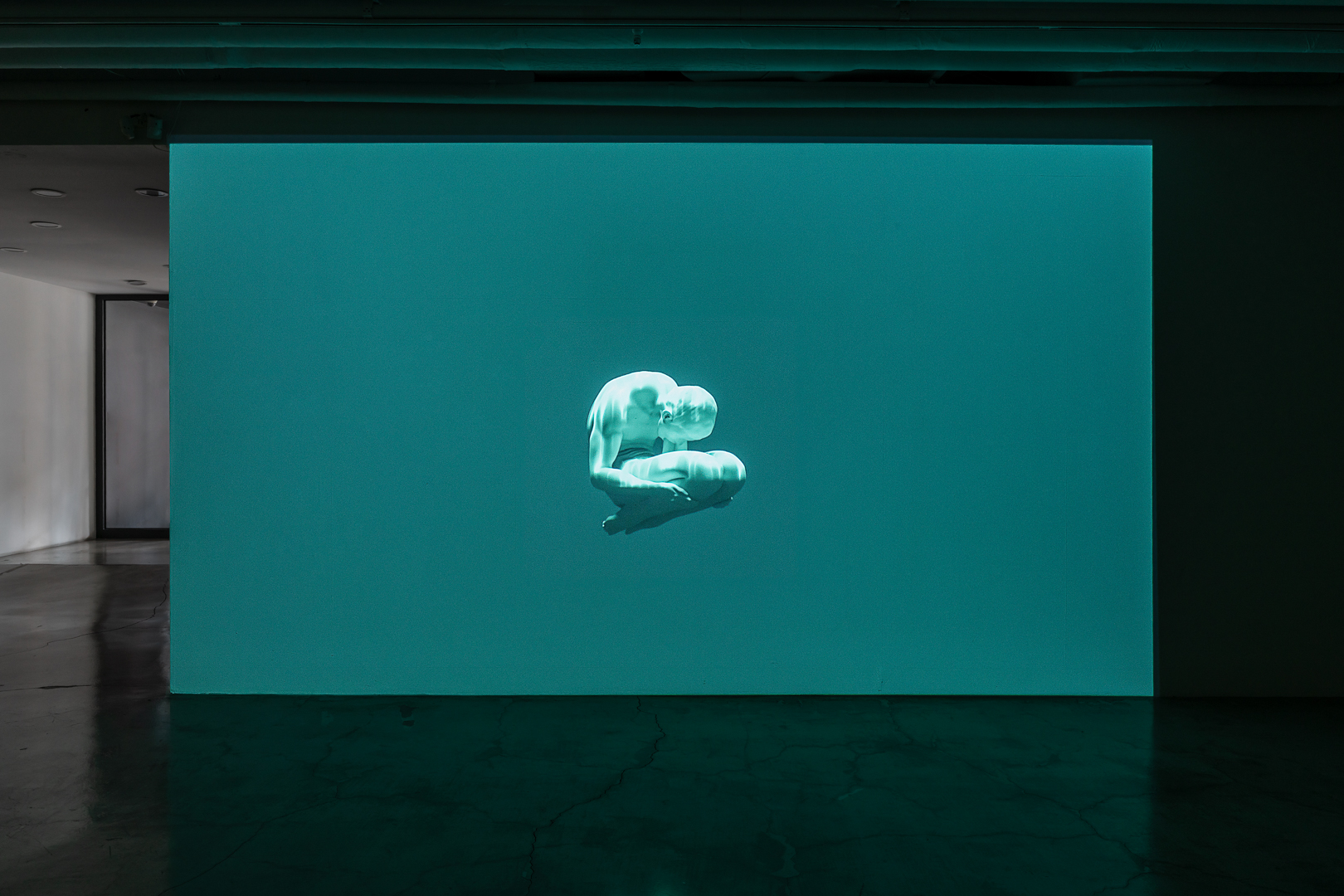
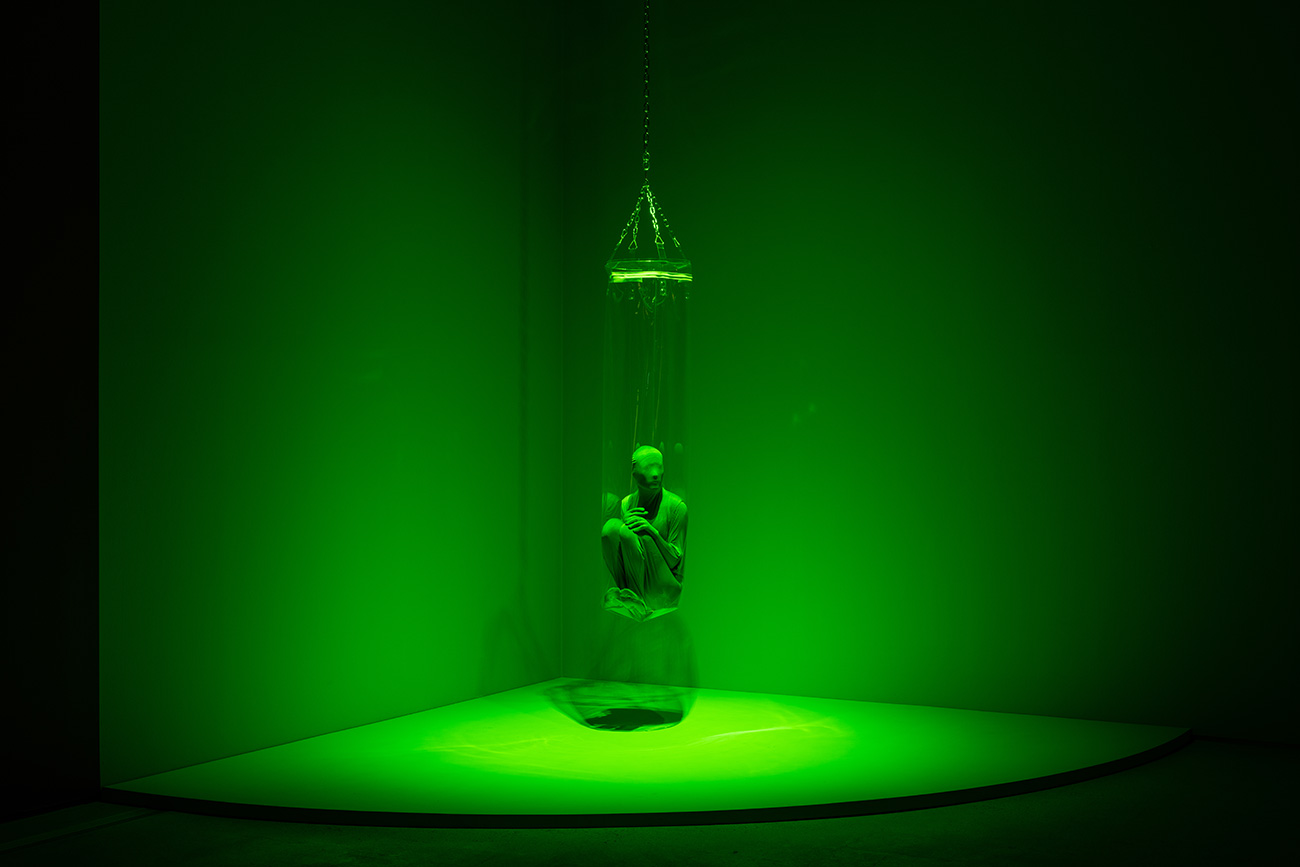
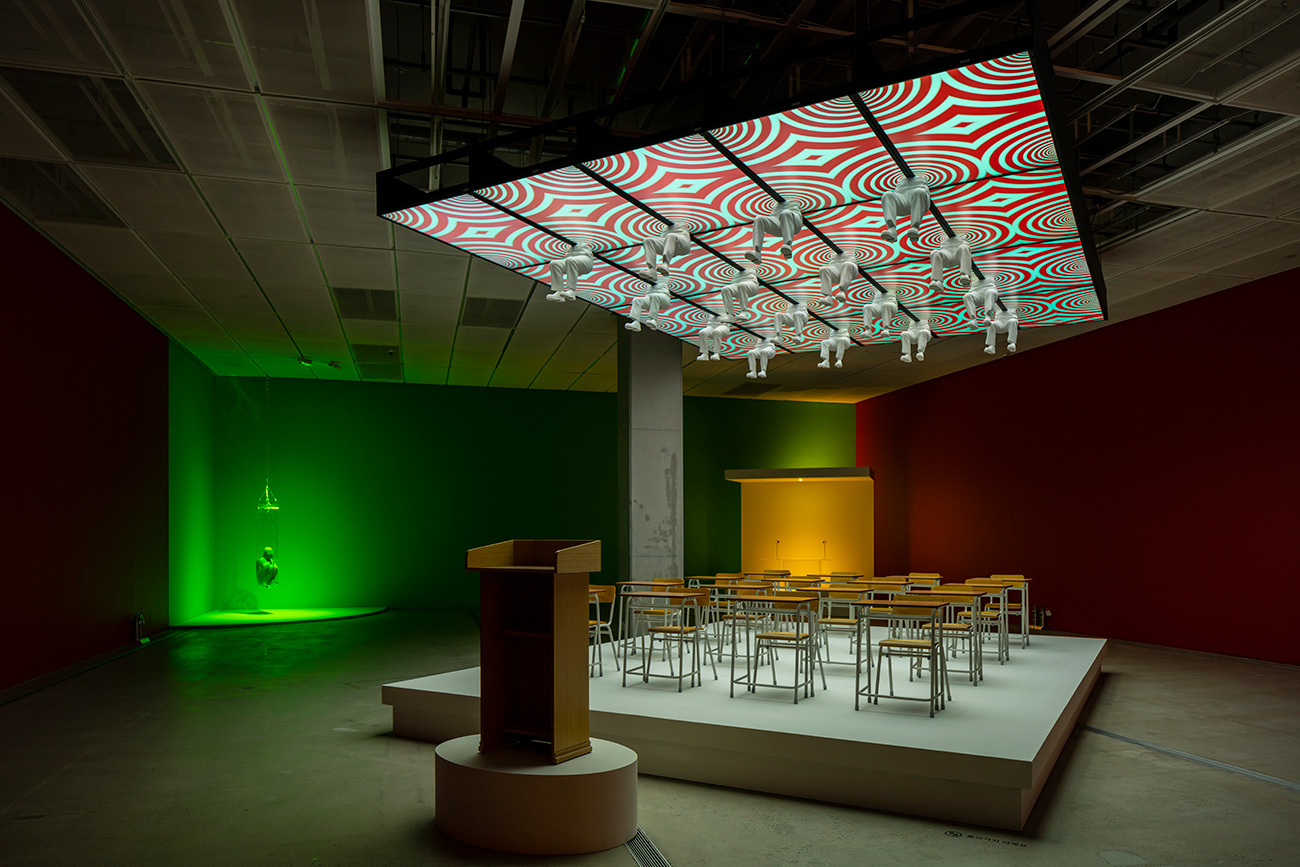
A figure, knees tucked and torso curled like a diver, rotates serenely underwater. The posture seems familiar yet slightly awkward. The head is drawn so far toward the abdomen that it raises questions. Although the rotation makes it difficult to discern at first glance, it soon becomes apparent that the figure is holding his own penis in his mouth. It is a man absorbed in autofellatio.
Perhaps because the figure is a computer-generated animation rather than a real person, the image does not feel obscene. Instead, it seems more like a symbol or an allegory. The work is titled I Know This Steak Is Not Real. The title presumably represents the inner monologue of a man enclosed within his own pleasure. Yet because his digitally rendered body is itself an obvious simulation, the work evokes a peculiar sense of double negation.
This raises the fleeting suspicion that the man in the video may be concealing a “real penis” under the guise of autofellatio. Indeed, the point at which his penis remains invisible (because it is in his mouth) occupies not only the center of his rotating white body but also the center of the entire underwater scene. It therefore creates the impression that something solid and substantial is firmly embedded at that point.
Moreover, on the wall opposite the projection, the shadows of the grids devoid of “belief,” “hope,” and “love” intensify the sense of absence. Consequently, the man’s penis, initially presented as “not real,” comes to function as the focal point with the strongest sense of material presence in the entire space.
The man’s penis, concealed within a virtual underwater environment, thus forms an intriguing contrast with Bezos’s “penis,” which was exposed against the actual sky. While the super-rich billionaire’s penis is perceived as an obscene simulation despite being given solemn and beautiful names such as “Blue Origin” and “New Shepard,” the man’s penis is regarded as a concealed reality, even though it appears as an instrument of the self-enclosed act of autofellatio.
As mentioned earlier, the artist positions this video opposite belief, hope, love, establishing a reciprocal relationship between the two works. In this context, the invisible penis seems to be presented as a signifier suitable for inscription onto the empty grids.
V
The title of this exhibition, 《In the Penal Colony》, is also the title of a short story (In der Strafkolonie) published by Franz Kafka in 1919. In Kafka’s story, the “penal colony” is a place where a grotesque execution apparatus is installed. The machine uses automated needles to inscribe the nature of a prisoner’s offense onto his body while he is strapped to a bed.
As time passes, the needles penetrate deeper into the prisoner’s flesh, eventually causing his death. The apparatus is operated by an anonymous figure known as the “officer,” who not only carries out the execution but also single-handedly determines the verdict and the offense to be inscribed on the prisoner’s body. (The prisoner himself dies without ever knowing what offense is being inscribed upon him.)
The officer forms a symbolic unity with the execution apparatus, but following the replacement of his immediate superior, the “commandant,” he begins to feel profound anxiety about the machine’s future and his own position.
When various circumstances lead him to conclude that the apparatus can no longer be maintained, the officer enters the words “Sei gerecht!” (Be Just!) into the machine and steps into it himself. Before the words can be inscribed, however, the apparatus repeatedly malfunctions and begins to disintegrate. In the process, the officer is pierced by the needles and dies.
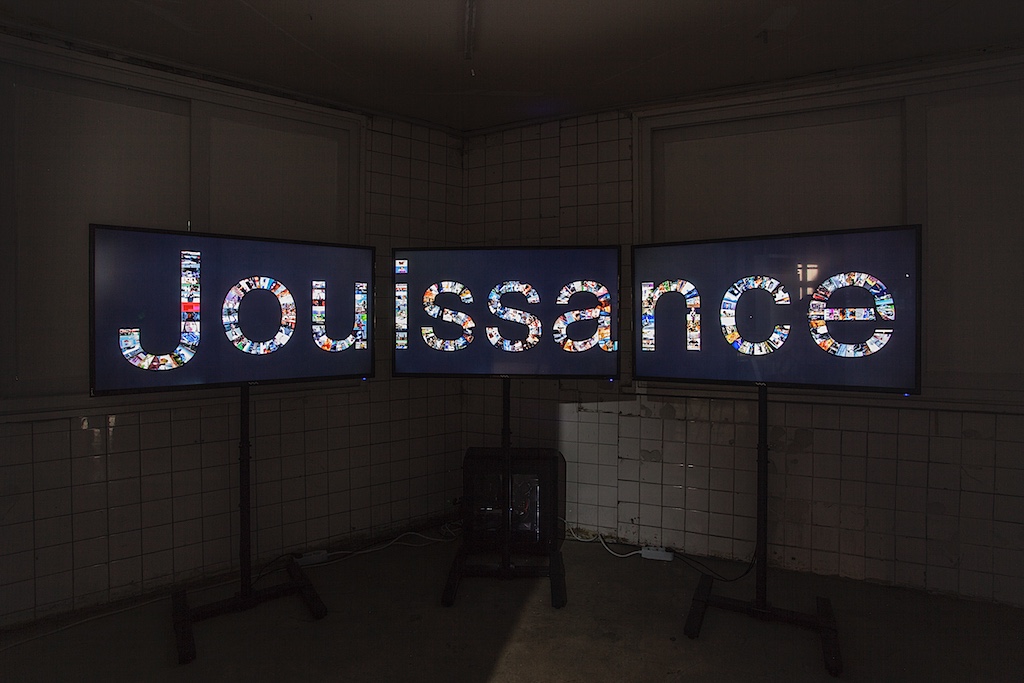
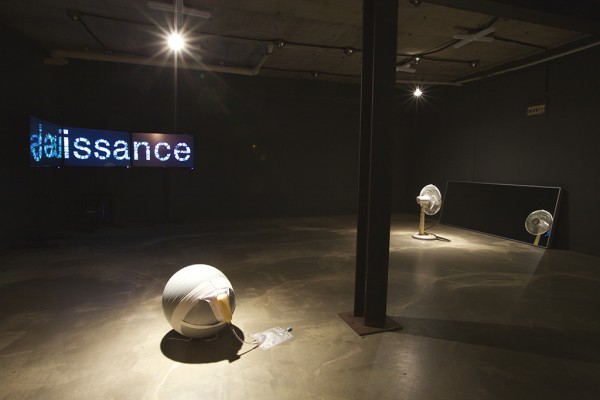
If the oracle inscribed upon Kafka’s penal colony reads “Sei gerecht!” (Be Just!), the oracle inscribed upon Sangjin Kim’s penal colony reads “Jouissance.” And whereas Kafka’s oracle is realized through an execution apparatus that inscribes the names of offenses upon bodies and kills their bearers, the artist’s oracle is realized through images from commercial videos stripped of their corporate logos.
One enacts justice, the other jouissance; one inscribes names, while the other erases them. Yet they form a pair, like two sides of the same coin. Indeed, the “justice” of the officer in Kafka’s penal colony, who enters the execution apparatus naked and dies pierced by its needles, corresponds to the “jouissance” of Saint Teresa, who experiences divine ecstasy as she is pierced by an angel’s arrow.
What, then, is the jouissance produced by the accumulation of video images from which corporate logos have been removed in this penal colony? Perhaps it is the ultimate intensification of the ritualistic pleasure the officer experienced as he threw the bodies of executed prisoners, one after another, into a common pit.
To erase is also to kill. Erasing/killing corporate logos and filling the channels of the signifier “Jouissance” with purified video images may constitute the “jouissance” of the penal colony, much like the experience the officer recalls with nostalgia in Kafka’s story. Upon attaining such “jouissance,” could the artist’s penal colony become a place resembling an altar, where the passing world may be mourned and a new world approached?
VI
On the wall to the left of Jouissance, a video is projected. The projection is relatively small, requiring viewers to approach it closely to watch. It shows footage of an unmanned rocket exploding shortly after launch, filmed from a nearby location. Coincidentally, the video contains the very things we referred to as the “real” at the beginning of this essay: a rocket ascending into the sky and flames surging toward the screen.
Yet the “real” presented in this video loses its power to affect us the moment it appears. The rocket explodes before it can reach the open sky, while the flames that engulf the screen violently shake only the world within it, leaving the space we occupy entirely untouched. At the bottom of the video, a subtitle appears: “Camera is trembling after explosion but we are not.”
Who is the “we” in this subtitle? At first glance, it seems to refer to us, the viewers watching the video in the exhibition space. But is that really the case? If so, this work would be out of place in this penal colony, which serves as an analogy for the world of the pandemic. This is not a place where the screen prevents the intrusion of the real.
The real of the pandemic era, manifested in mutating viruses and sudden natural disasters, emerges both inside and outside the screen, leaving us unsafe wherever we may be. In other words, in this place, we are not the “we.”
Then who is this “we”? We might first consider the entity that inscribed the subtitle onto the video. In practical terms, of course, that entity is the artist who created the work. Yet he is not the subject of the statement inscribed in the subtitle, but merely someone acting on behalf of that subject. Who, then, is the subject capable of declaring “but we are not,” even in a pandemic-stricken world where the real intrudes everywhere?
VII
In Kafka’s story, the person who issued the command “Sei gerecht!” (Be Just!) is the former commandant. He is the one who designed the entire penal colony. Although he is already dead, his command remains alive. The execution apparatus that translates his command into “written language” continues to operate despite his absence.
The officer in the story is a man who has constructed his identity around the command issued by the former commandant. To the officer, the former commandant is a divine figure, and the command he left behind is as absolute as an oracle. The order imposed upon the penal colony by the former commandant is equivalent to divine law, and is therefore, in principle, eternal and inviolable.
The dilemma faced by the officer in Kafka’s story lies in the fact that the absolute order already imposed upon the penal colony can be replaced by another absolute order. The most threatening figure to the officer is the new commandant. Like his predecessor, he possesses the authority to issue divine commands. Although the officer despises him intensely, he does not deny the legislative power the new commandant holds.
Thus, before the new commandant can issue a new order, the officer destroys himself in accordance with the command of the former commandant. Yet as the officer erases himself, the execution apparatus designed by the former commandant also disintegrates, creating a void in the order of the penal colony in which jouissance may emerge.
In Sangjin Kim’s penal colony, too, an entity that imposes order can only be counteracted or replaced by another entity capable of imposing order. Mutating viruses and sudden natural disasters cannot directly affect the entity that imposes order.
Instead, such eruptions of physical reality undermine the functioning of the existing order and weaken the sovereignty of the entity that imposes it, much like the frequent malfunctions of the execution apparatus in Kafka’s story. Nevertheless, physical reality cannot itself become the agent that nullifies the existing order or establishes a new one.
VIII
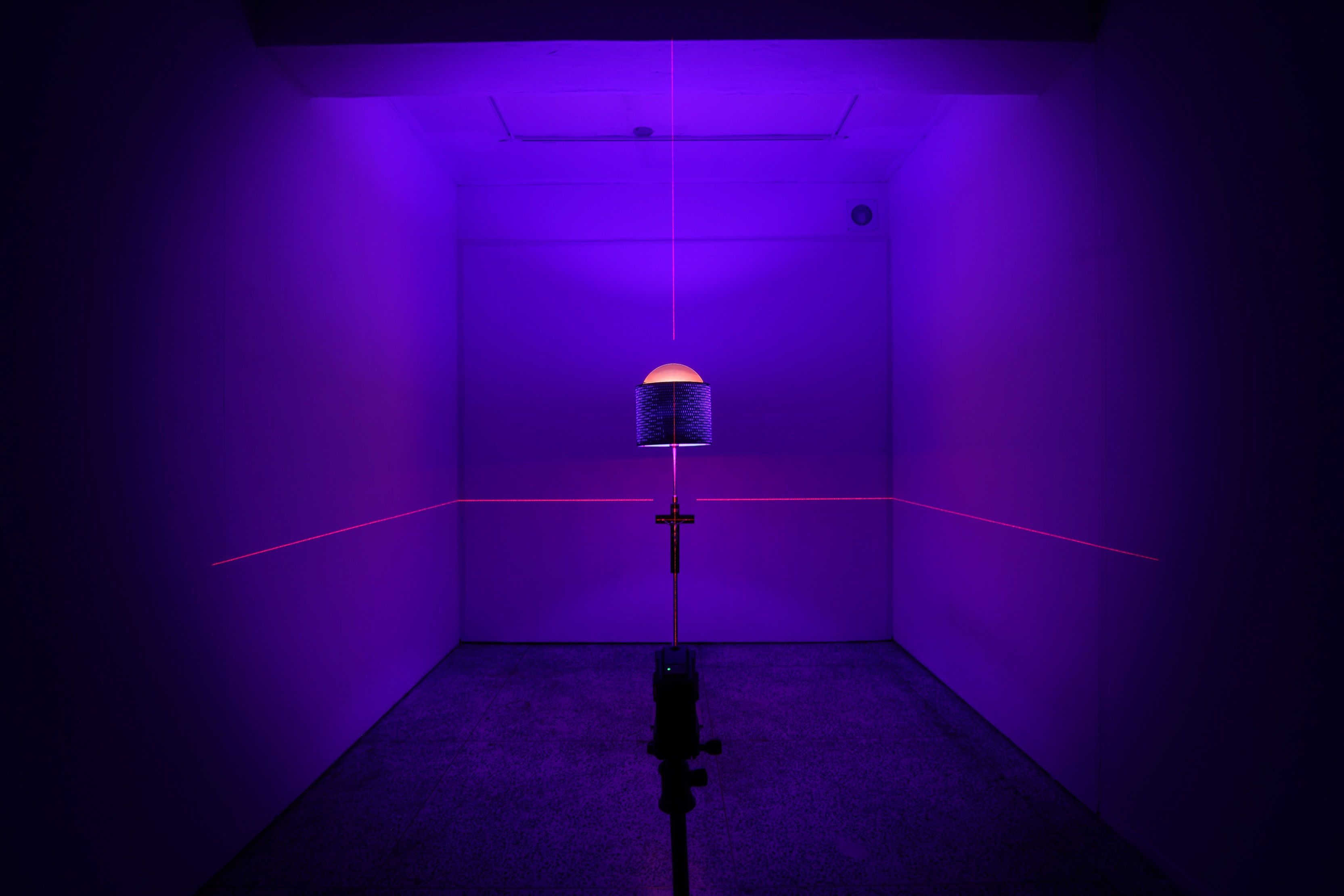
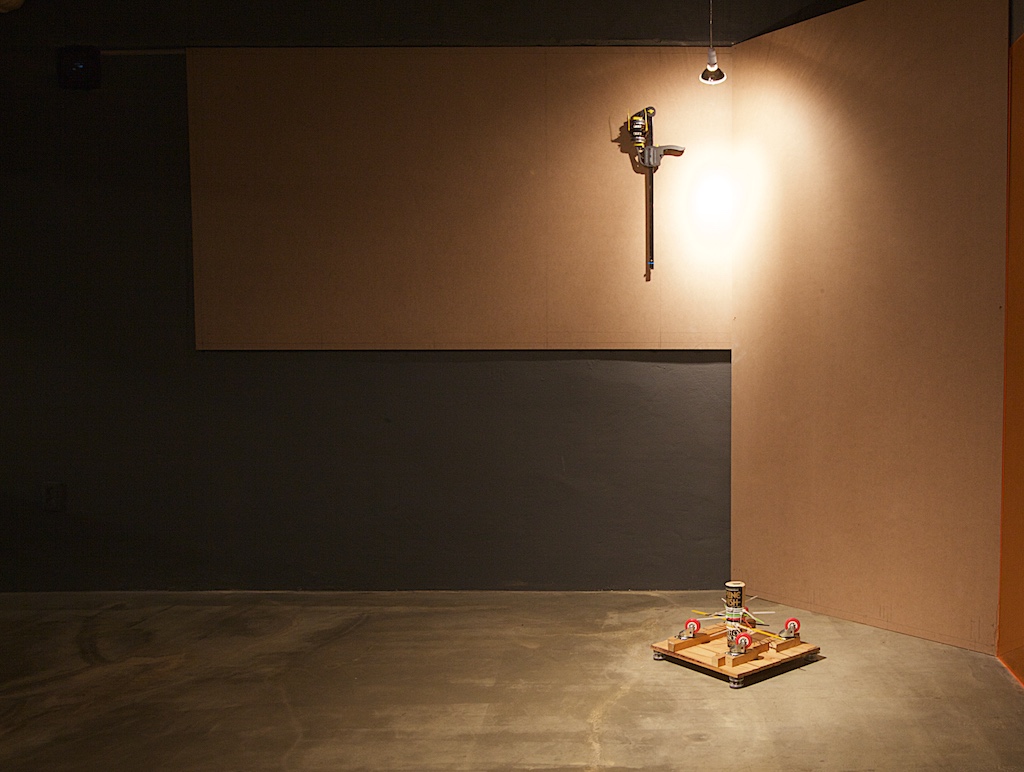
Between the spaces housing Jouissance and We Are Not, there is an entrance leading into a small room. Upon entering, visitors encounter two overlapping crosses. One is a crucifix representing the Christian system of signs, while the other is the crosshair of an electronic level, representing the system of signs associated with scientific measurement.
The work is titled Crosscheck, suggesting that two “crosses,” each symbolizing a different order, intersect and cross-examine one another. Since the finitude of one order can only be recognized through another, the equal superimposition of two distinct orders, each examining the other, ultimately exposes the contingency and arbitrariness of both. The artist further emphasizes the sense of a final chapter implicit in this scene by incorporating panoramic footage of a sunset.
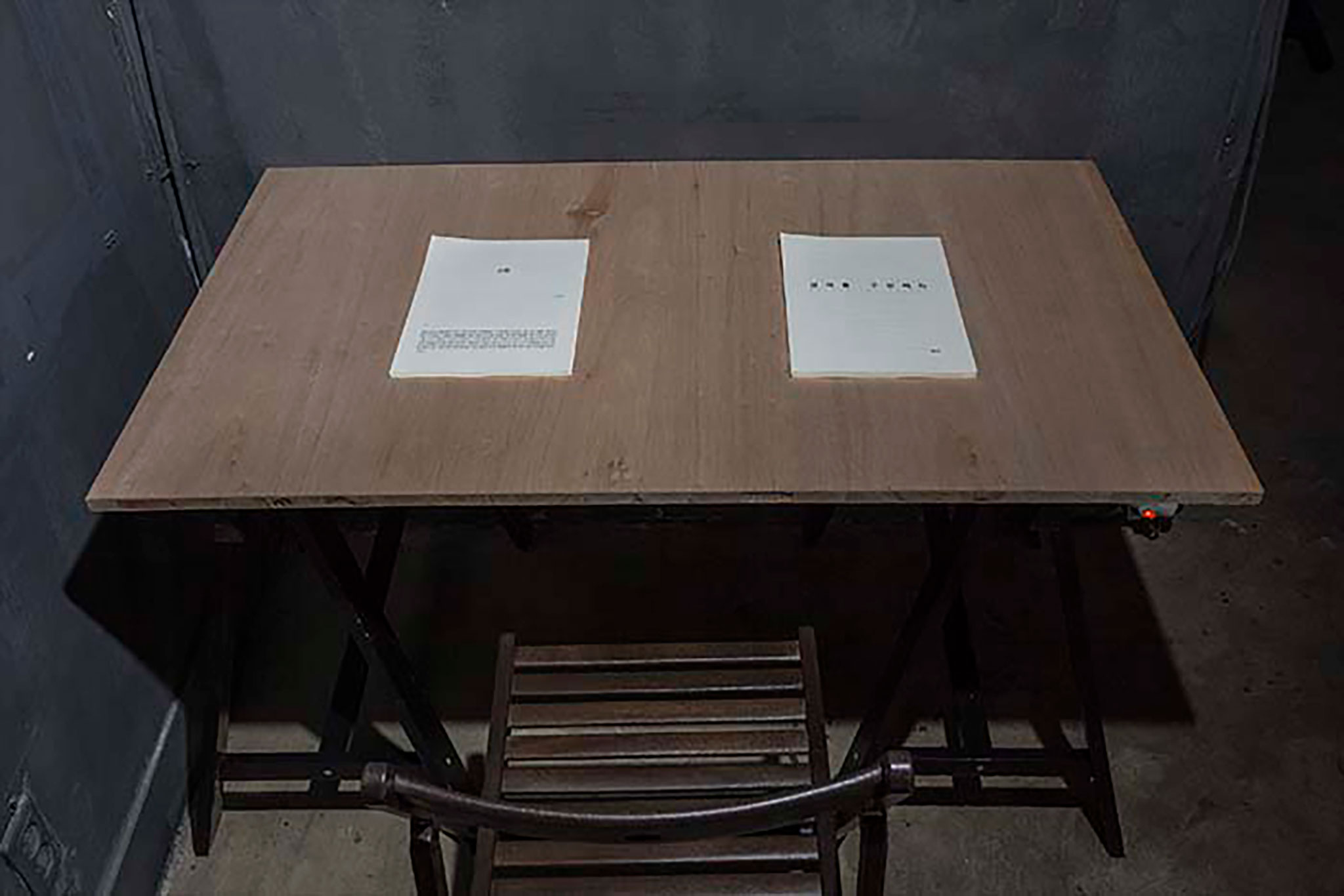
To the right of Jouissance, there is another entrance leading into a separate space, as in Crosscheck, along with a table illuminated by a green light. The table is the first thing visitors encounter. Upon it lies a text, coincidentally titled Crosscheck. Written in an aphoristic style reminiscent of Friedrich Nietzsche, the text contains distinctly apocalyptic themes. Foretelling the end of “humanity,” it defines the “human” as “the trembling boundary itself” and concludes with the question, “Can you feel this trembling?”
In Sangjin Kim’s penal colony, where law-giving inscriptions hold sway, such questions concerning “boundaries” and “trembling” are undoubtedly blasphemous. Yet because what this place ultimately seeks to reveal is the erasure and absence of these law-giving inscriptions, such questions, while seemingly alien, do not appear out of place.
IX
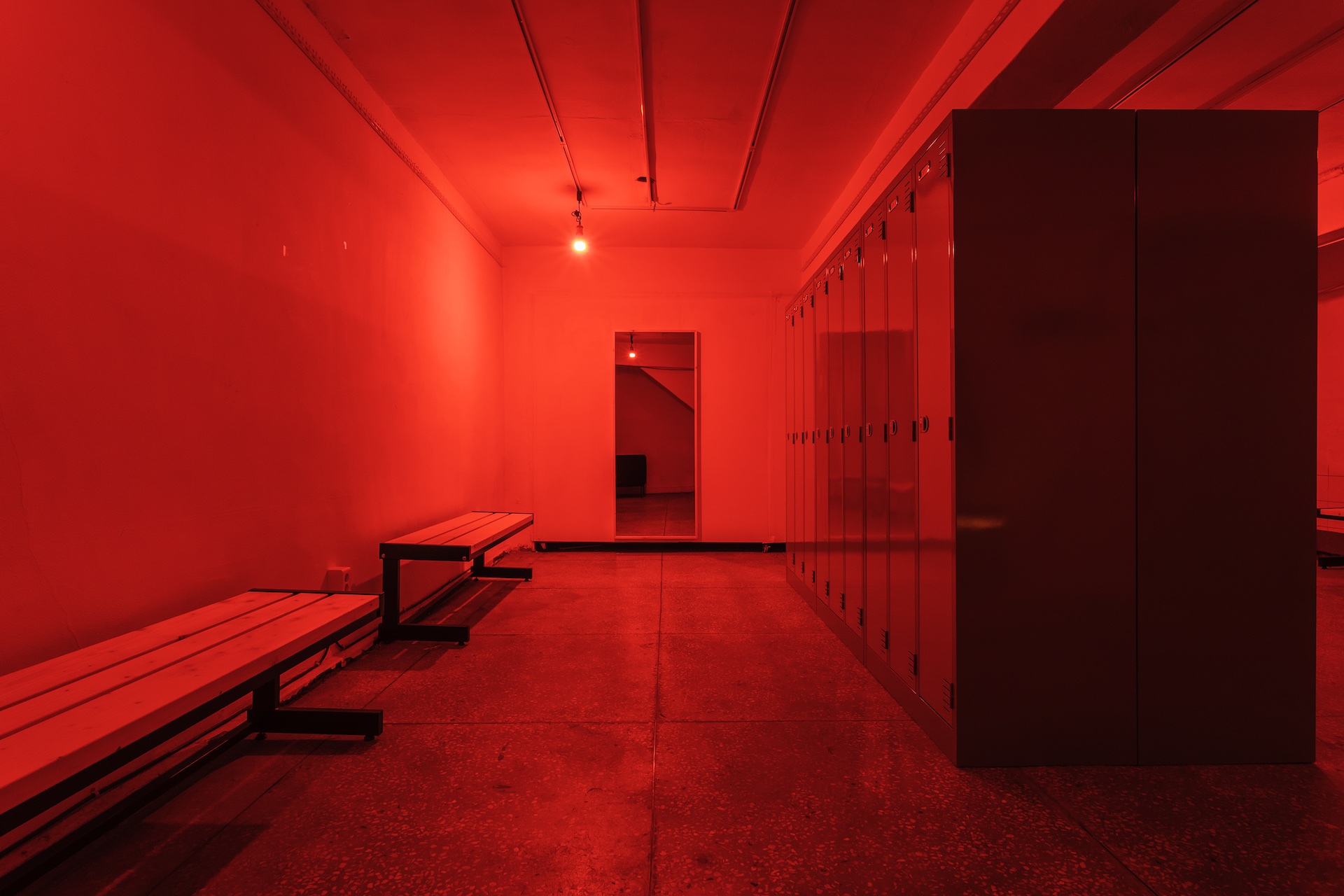
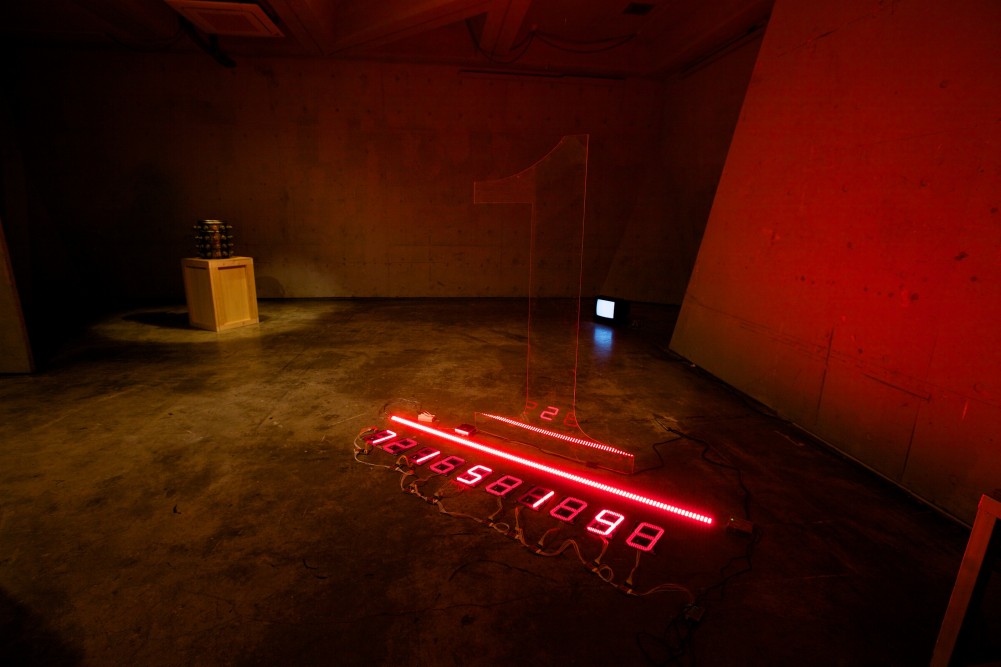
The final space visitors encounter in this penal colony is titled Evil Residence. Upon entering, they find themselves in a locker room bathed in red light. The arrangement of lockers, benches, and mirrors is ordinary and familiar. What stands out as unusual is the numbering of the lockers. For some reason, the sequence begins at 661, and as one counts through the numbers—661, 662, 663, and so on—it becomes apparent that one number is missing: 666.
There is no indication of what this omission signifies. Only the title “Evil Residence” and the red lighting offer vague clues for interpretation. (Of course, those familiar with Christian culture will readily recognize the number as the symbol of the Antichrist described in the Book of Revelation.)
Yet, much like the penis in I Know This Steak Is Not Real, the number 666 in Evil Residence exerts a subversive influence over the entire system of signs surrounding it precisely because it is concealed. Moreover, “Evil Residence” is none other than “God Residence,” that is, “the place where God resides.” In a place where the “devil” and “God” coexist, a situation of “crosscheck” arises, much like the overlapping of two crosses.
Indeed, in one corner of the space housing Evil Residence, the text of Crosscheck is being read aloud. Approaching the source of the voice, visitors discover a small television resting on a tangled mass of black electrical cables. A low, murmuring monologue emanates from beneath the cables, while the television, though switched on, displays nothing but static.
The television screen, having lost its signal and become incapable of representing anything, once again presents the void of the signifier that has appeared repeatedly throughout the exhibition. Unlike the previous instances, however, this void is accompanied by a trembling. Composed of flickering gray particles, it offers no object upon which to fix one's gaze, yet gazes back at the person standing before it.
Nothing is more terrifying than a disembodied gaze. Combined with the voice emanating from beneath the tangled cables, this gaze produces a peculiar sense of sanctity (or blasphemy). When the voice of God (or the voice of the devil) resounds, the listener becomes aware of being exposed as its target. Whatever that voice says, it constitutes an imperative and a command. This remains true even when it takes the form of a suggestion or a question.
The true terror experienced by someone exposed before this void lies in the inability to determine whether the entity issuing commands is God or the devil. Without knowing to whom the penis concealed behind that opaque static belongs, the person must make a choice. What is truly unfortunate is that, in this chaotic age gradually being drawn into a vortex of disasters, God and the devil coexist, constantly exchanging faces.
Thus, whether one obeys or defies the command, punishment is inescapable, and no matter how wisely one chooses, one can never settle in “God Residence,” that is, a state of “permanent order.” This is because, in our time, the very place where God resides is itself flickering in and out of existence in bewildering succession.
Under such circumstances, the only possibility left is to perish in the jouissance of trembling “beyond good and evil,” like the officer in In the Penal Colony. Thus, what we ultimately encounter here is not a vision of a new order (or God) yet to come, but a command emanating from a void filled with static.