Jeff Wall’s Picture for Women (1979) is one of his representative photographs exploring the relationship between the gaze and power. Within a space constructed according to precise linear perspective, a woman looks directly at the camera, while the artist looks at her, and the camera itself occupies the vanishing point.
The entire scene is an image reflected in a mirror. Wall’s photograph is often discussed in relation to two paintings from art history that also feature mirrors. The first is Diego Velázquez’s Las Meninas (1656), in which all the figures, including the painter, are arranged in relation to the gaze of the king and queen reflected in a small mirror at the center of the composition, suggesting the absolute authority of the monarchy at the time.
A more direct reference is Édouard Manet’s A Bar at the Folies-Bergères (1881–1882). Depicting a woman standing with her back to a large mirror behind the bar and looking straight ahead, the painting has been the subject of controversy because it also shows, to one side, the woman’s reflection apparently conversing with a man, thereby presenting two different perspectives of the same woman through the painter’s gaze.
In Wall’s Picture for Women, meanwhile, the gaze of the woman looking at the camera in the mirror intersects with that of the artist looking at the woman reflected in the mirror. Beyond these two gazes, there is also the gaze of the camera, which encompasses both figures, the entire space, and even the camera itself. Unlike Las Meninas, which is structured around the gaze of the sovereign, or A Bar at the Folies-Bergères, which is shaped by the painter’s selective gaze, Wall seeks to articulate the absolute power of the camera positioned at the center of all these gazes.
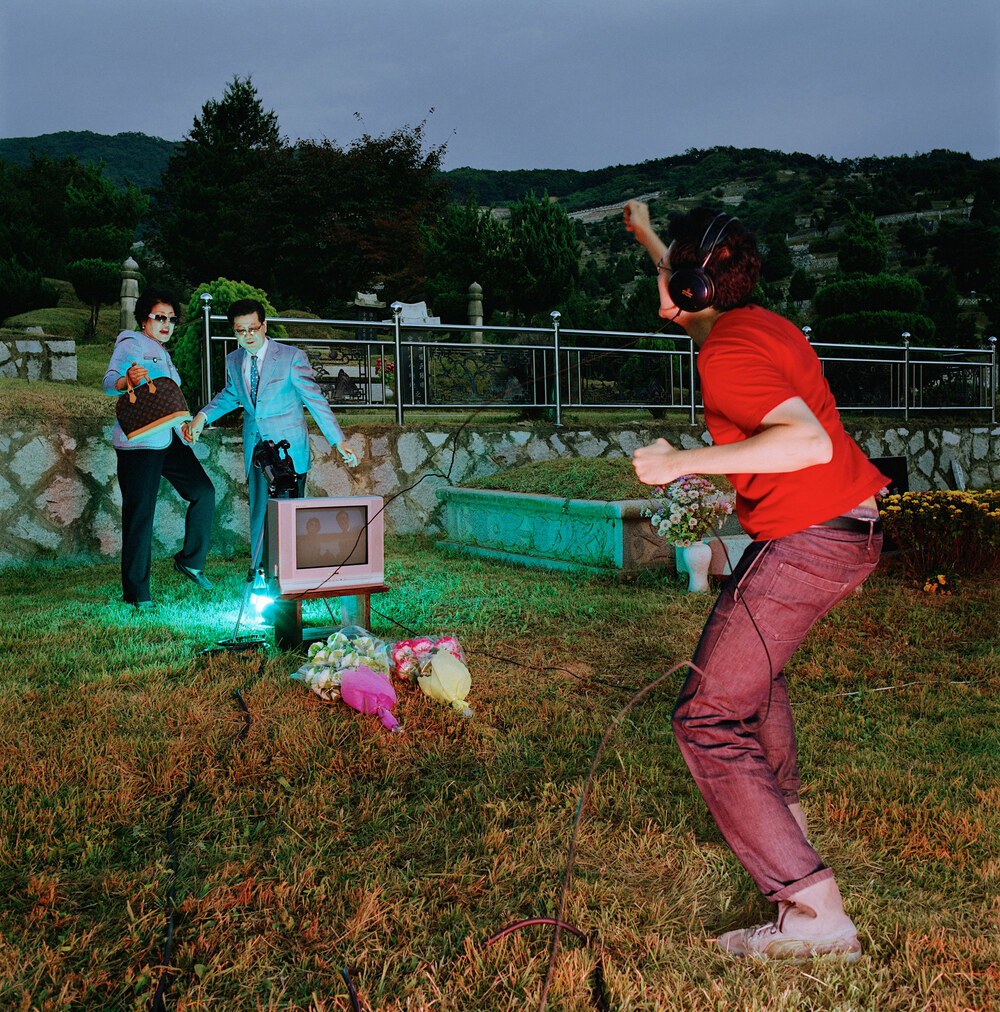
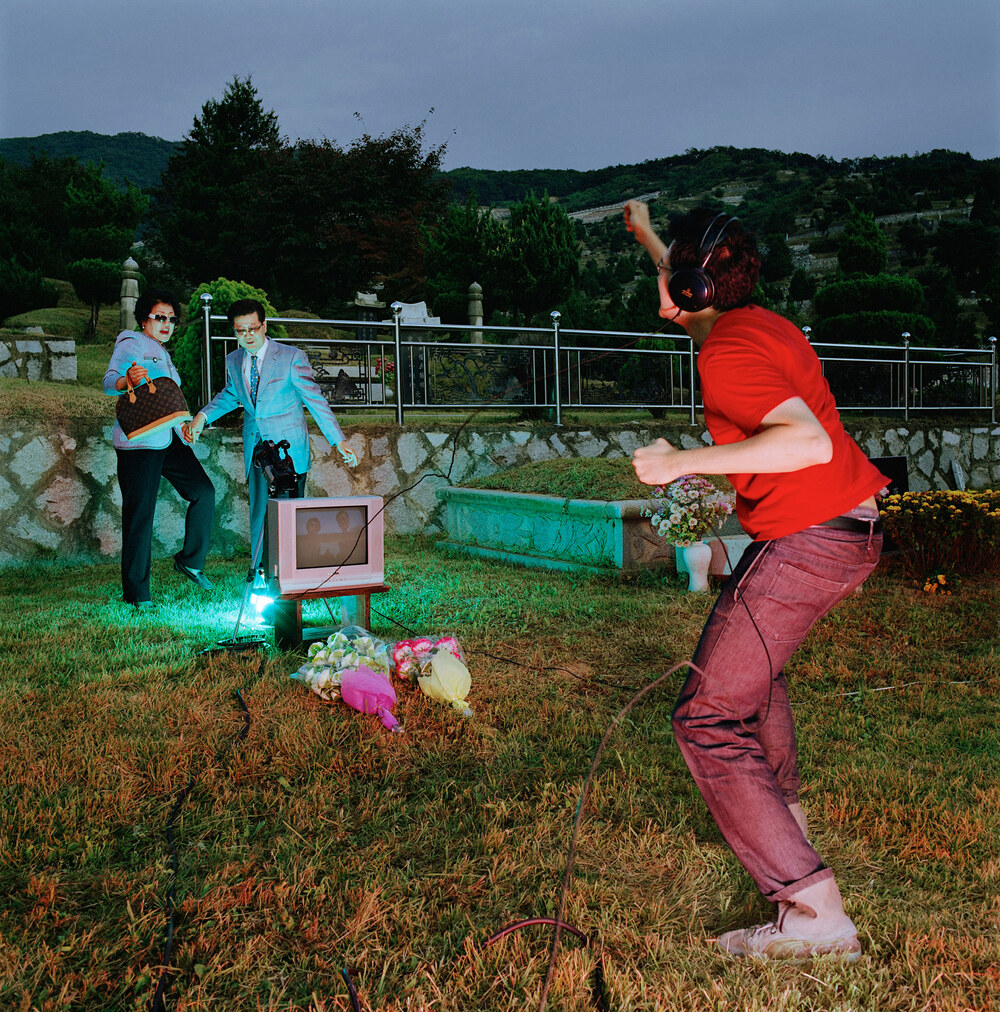
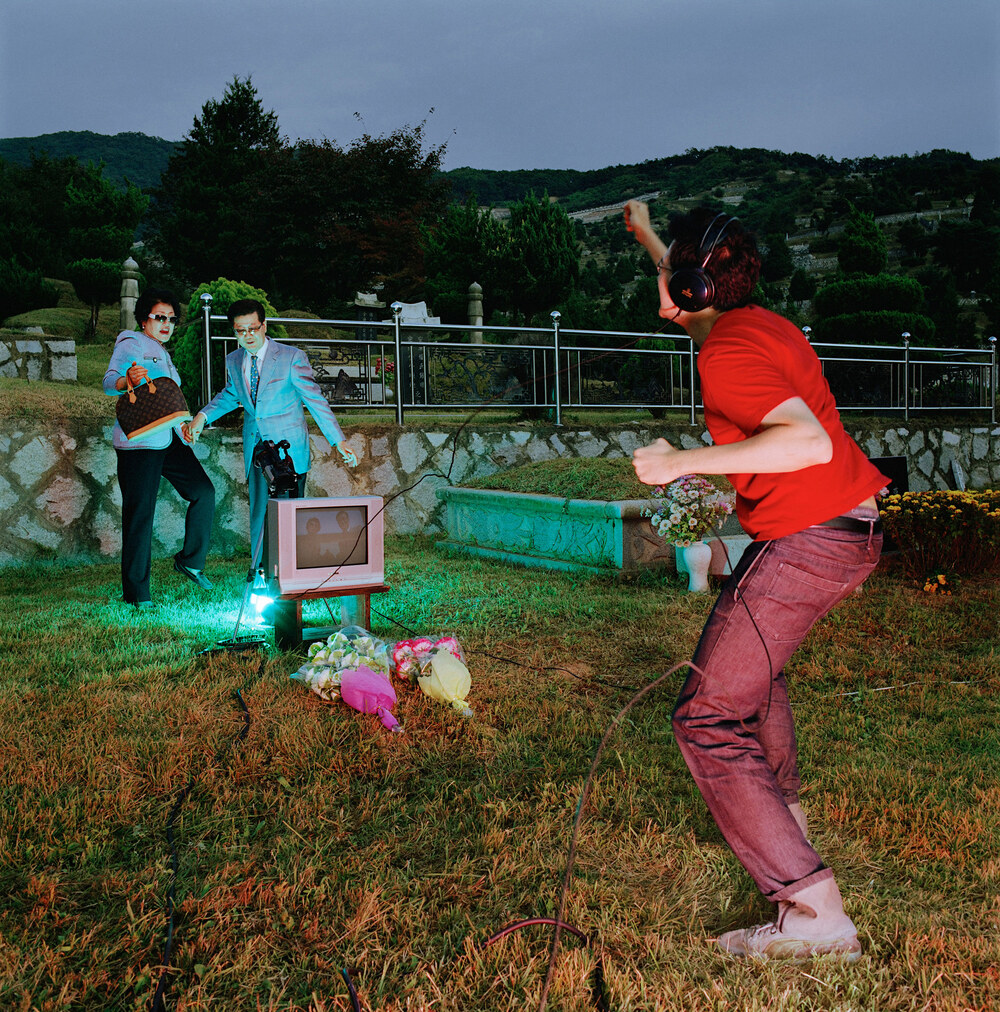
Jinkyun Ahn is a photographer who interprets this relationship between the gaze and power through the circumstances of his own life. His photographic practice begins at the burial plots reserved for his still-living parents. Standing at the place where they will eventually be buried, his parents pose cheerfully for a video camera, while the artist watches them on a monitor and dances exuberantly, holding a camera shutter release in his hand.
This somewhat irreverent photographic triptych, in which the movements vary slightly from one image to another, is titled Dance Dance Dance (2006) (the Korean titles of the works mentioned in this essay have been provisionally translated by the author based on their original English titles). Although none of the figures in the photographs looks directly at the camera, the artist leaves visible all the equipment that reveals the structure and process of photographic production, including the lighting, video camera, monitor, shutter release, and even the cables connecting the devices, thereby emphasizing the absolute gaze of the camera.
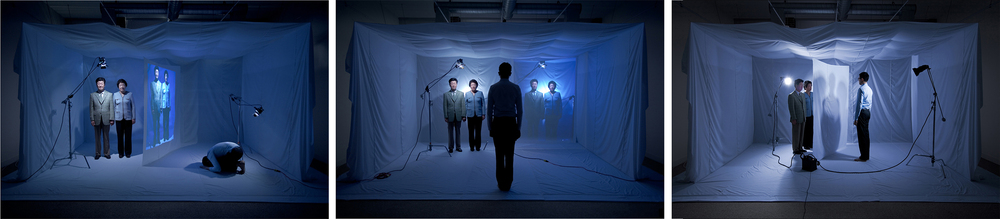
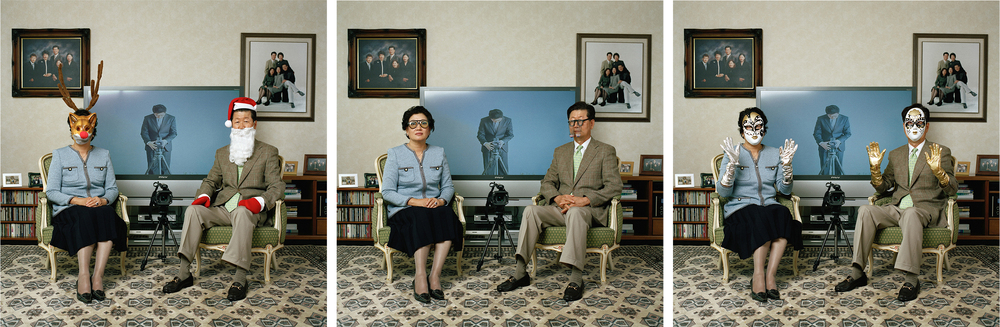
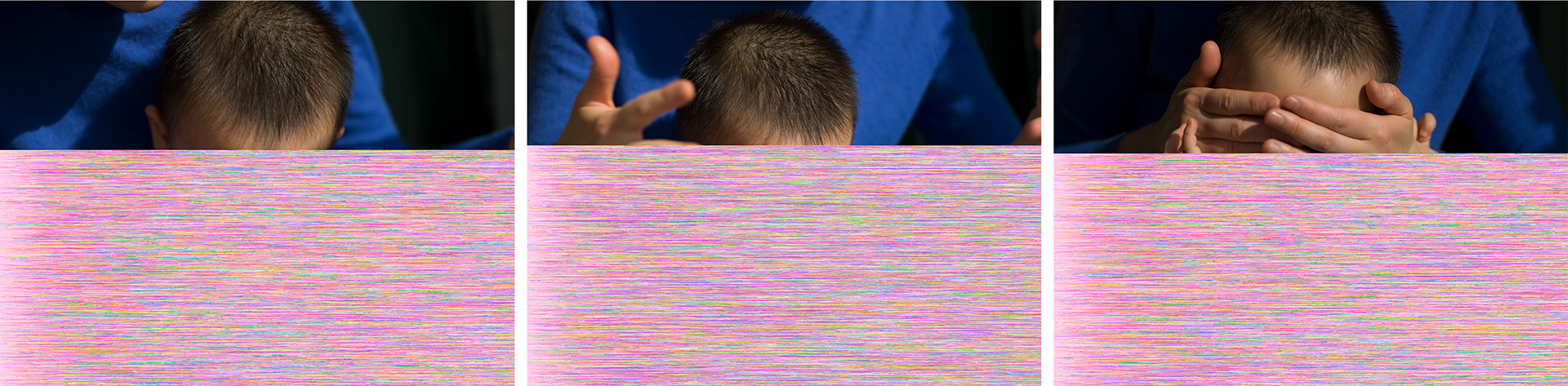
The ten-part series ‘Masquerade’ (2006), produced around the same time in his parents’ living room, likewise features the artist and his parents. This time, his parents’ eyes are concealed behind comical masks, while the artist, visible on a television monitor, lowers his head toward the camera, effectively excluding his own gaze. Yet, as in Wall’s photograph discussed earlier, a camera occupies the very center of the composition.
It is a video camera recording the photographic camera and the artist outside the frame as they capture the entire scene. In this sense, the two cameras reflect each other like mirrors, but ultimately it is a single photographic camera that brings the entire structure together into one final image. In this way, Ahn has consistently placed both himself and his parents on a stage as photographic subjects, directing their gazes away from the camera while revealing the camera’s presence either directly or indirectly, thus granting absolute authority to its gaze.
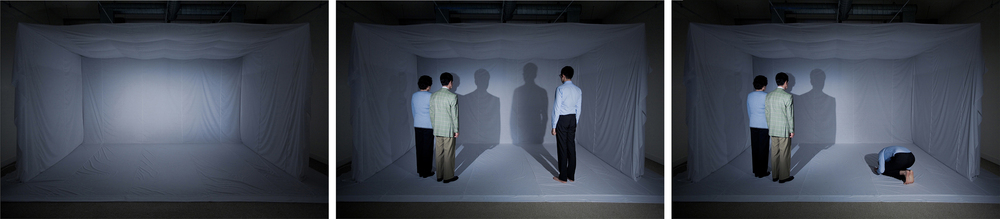
This approach appears to stem from his desire to observe more objectively his relationship with his parents, who occupy a significant place in his life. ‘Encave’ (2010) offers a particularly striking example. For this series, Ahn constructs a stage using white fabric, evoking Plato’s cave, and places himself and his parents within it.
By depicting himself bowing toward the shadows of his parents, he seeks to demonstrate that neither his parents nor he himself can escape the imaginary cave of Confucian order. Moving beyond the direct caricature of his parents found in earlier works, he attempts to neutralize the authority of their relationship by turning both himself and his parents, within the context of Confucian culture, into objects before the camera.
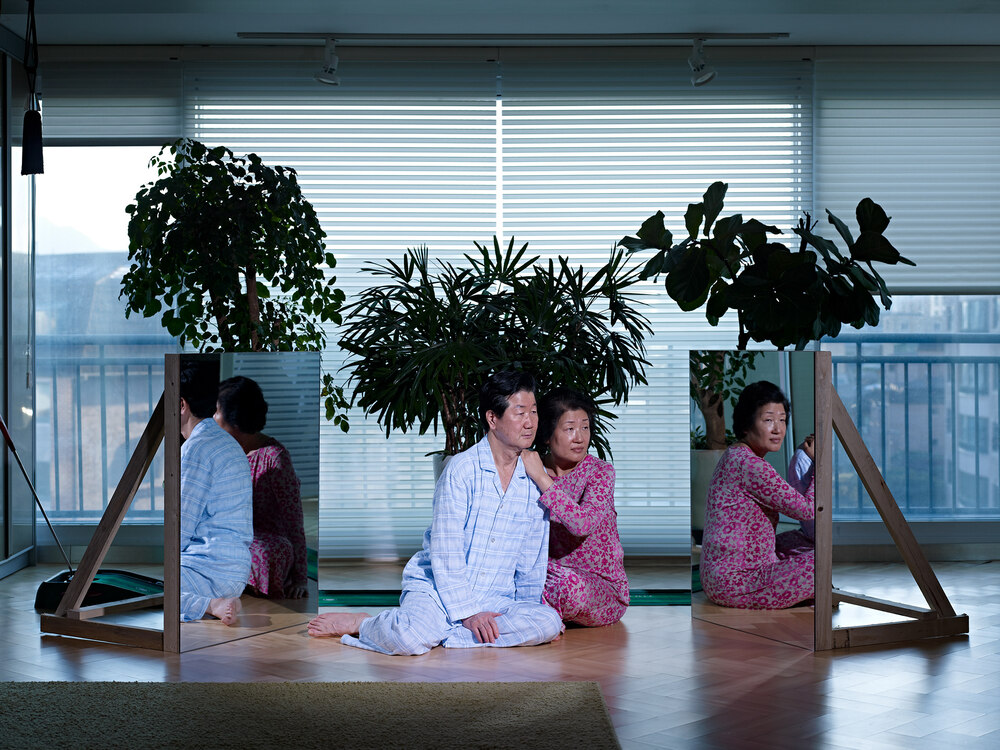
Meanwhile, in the series ‘Villa of the Mysteries’ (2012), Ahn continues to explore similar themes, relocating the setting to his parents’ living room. The Villa of the Mysteries is one of the most significant archaeological sites in Pompeii, the ancient city buried under volcanic ash, where many people perished but numerous artifacts were consequently preserved.
Particularly remarkable are the frescoes inside the villa depicting Dionysus and ritual scenes involving various figures. These paintings remain vivid and splendid, as though untouched by the catastrophe of death brought about by the volcanic eruption. Taking the Villa of the Mysteries as his motif, Ahn seeks to examine the point at which life and death intersect.
Whereas his earlier series directly addressed the future deaths of his parents, ‘Villa of the Mysteries’ shifts the setting to the place where they currently live, suggesting that life and death exist along a single continuum. Unlike the previous series in which he appeared alongside his parents, Ahn now conceals himself behind the camera, transforming his parents entirely into photographic subjects and minimizing his personal involvement in order to establish a greater degree of objectivity.
He pursues this objectification more actively by asking his parents to assume various symbolically charged poses, as seen in Gazing, Covering, Hiding, and One Step Forward; by cutting photographs across the bodies of the subjects and reassembling them symmetrically, as in Decalcomanie; and by introducing structures in place of human figures.
Ahn’s attempt to dissolve the boundary between life and death and confine his parents within the rectangular frame of the photograph, transforming them entirely into images, can be understood not only as resistance to Confucian order but also as a form of psychological defense against the fear of their eventual deaths.
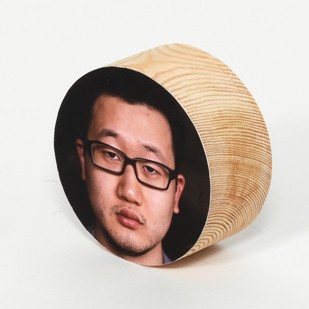
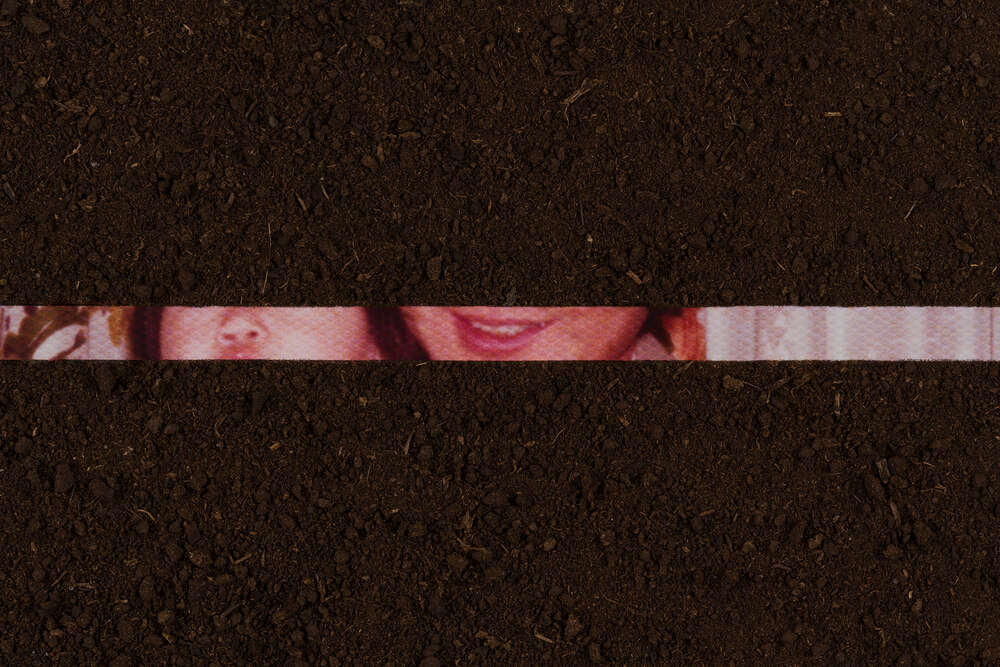
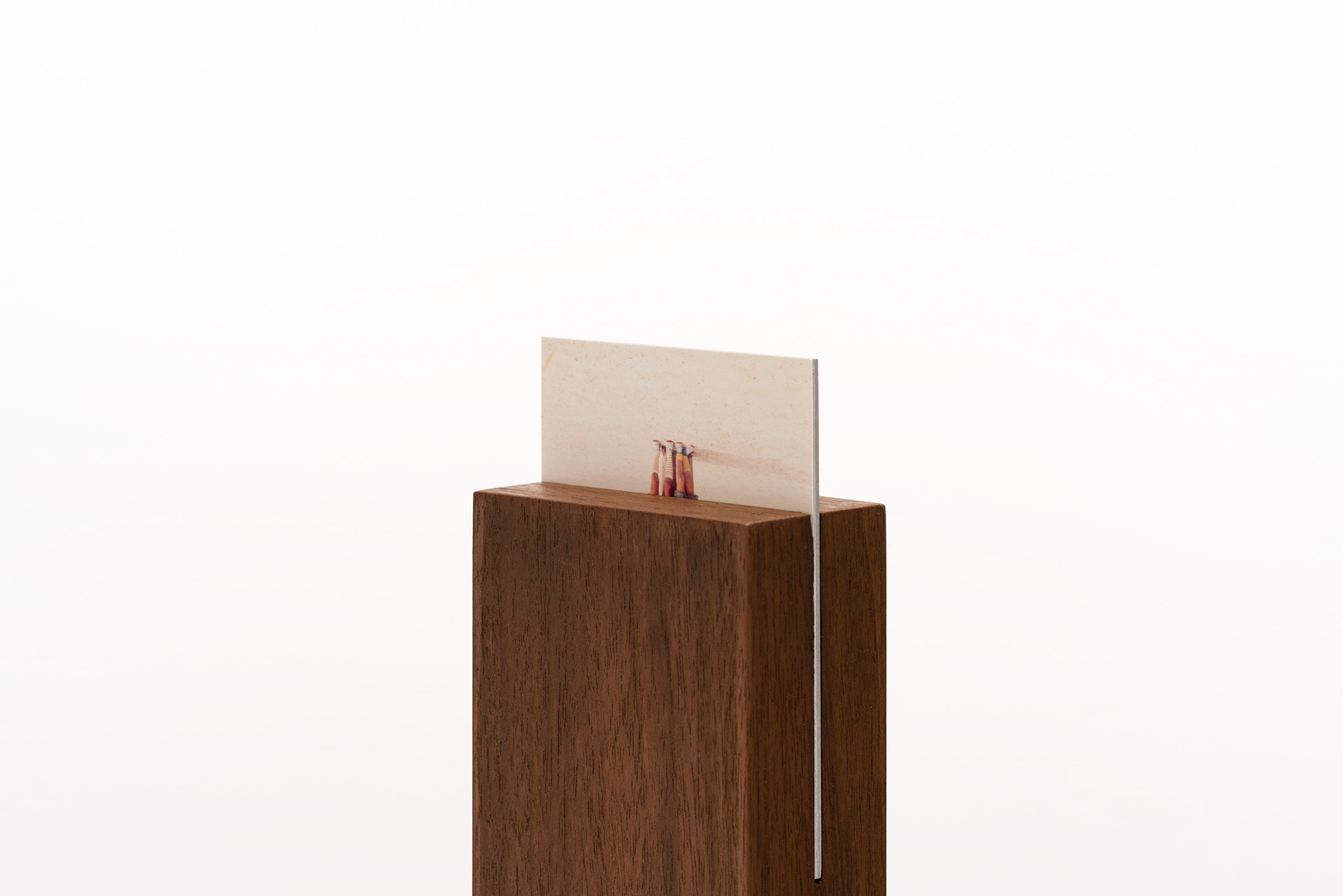
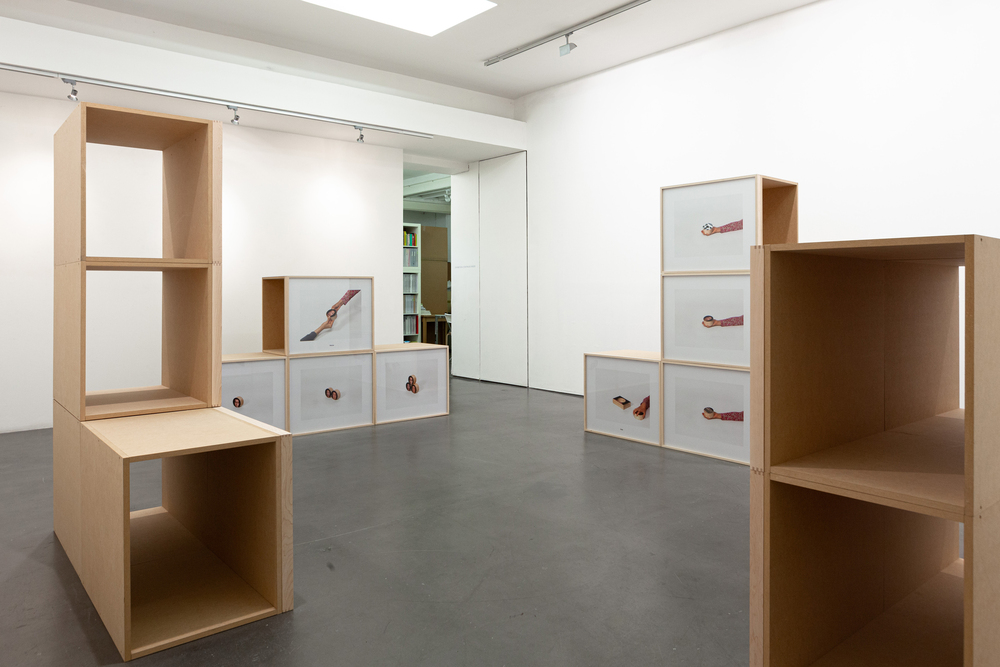
These recurring concerns reach a provisional conclusion in ‘Three Faces Two Places One Device’ (2014). The series symbolically brings together three faces—those of his father, mother, and himself—two places representing death (the burial plots) and life (the living room), and one device, the camera, that observes them all.
Ahn attaches photographs of the respective faces and places to small rectangular wooden objects, then photographs specific actions involving these objects: carving circular holes into them (Hole), exchanging the carved-out pieces (Button), holding hands through the openings (Cord), or suddenly extending a hand through a hole (Nose). Through these photographic sequences, each consisting of four images, he offers playful metaphors for the relationships between parents and children, and between life and death.
Ahn’s sustained engagement with these consistent themes appears, in fact, to originate in the circumstances of his own upbringing. One can reasonably imagine the conflicts he experienced as the only son among three children, with two sisters, growing up under a self-made, patriarchal father while pursuing an education in art.
Yet Ahn does not remain confined to these personal motivations. Instead, he expands his concerns to encompass family relationships and Confucian culture more broadly, while investigating the distinctive nature of photography as a medium through the relationship between the gaze and power. There are further reasons to understand Ahn’s photographs not simply as photographs in the traditional sense of recording reality, but as contemporary artistic practices employing photography as a particular medium.
First is his preference for sequences of images that unfold like scenes in a film, establishing relationships among individual still photographs and connecting them into a larger whole. The video cameras and monitors that appear in most of his early works provide an important clue to this characteristic, which also relates to his background in studying moving images before photography.
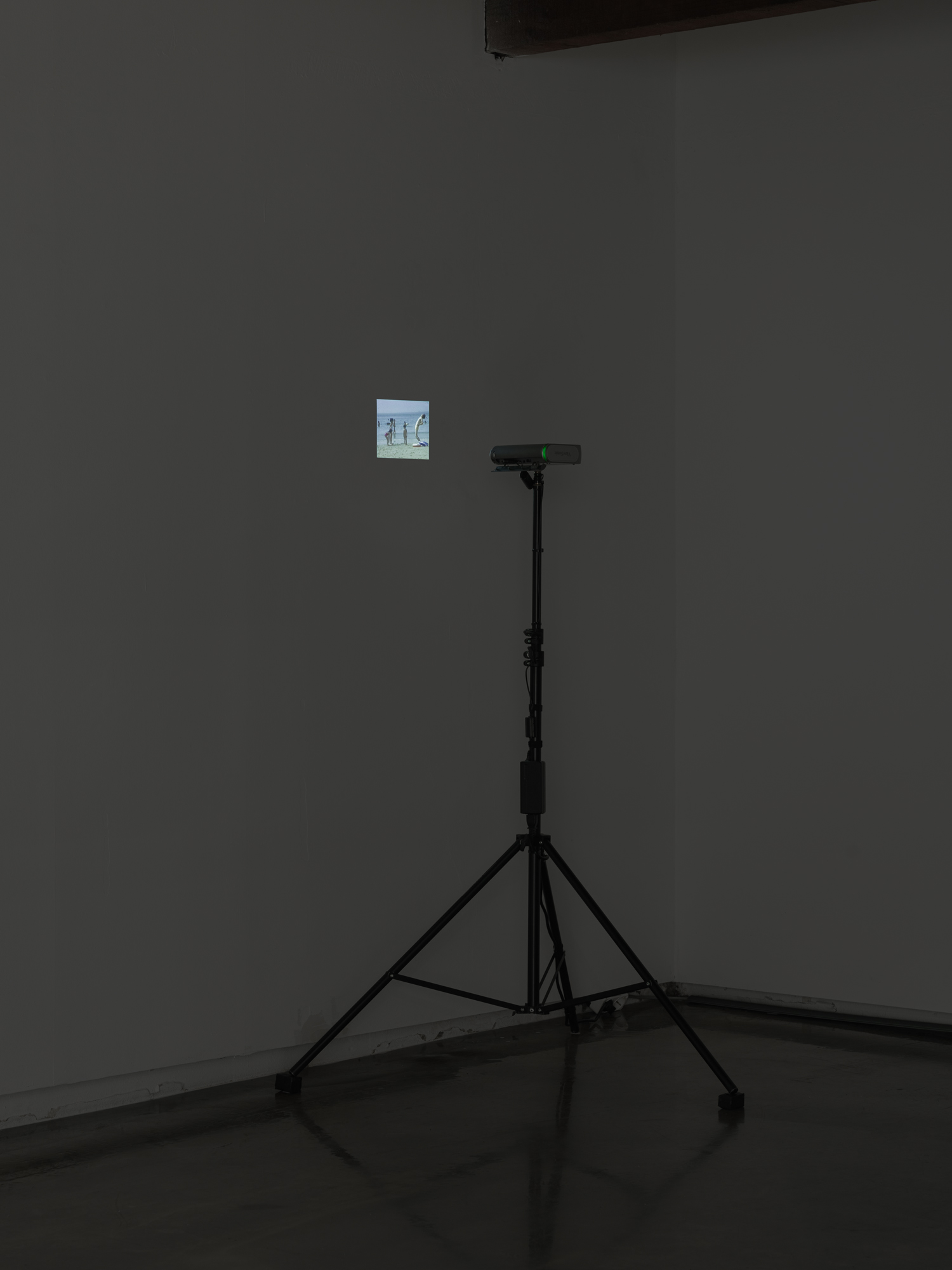
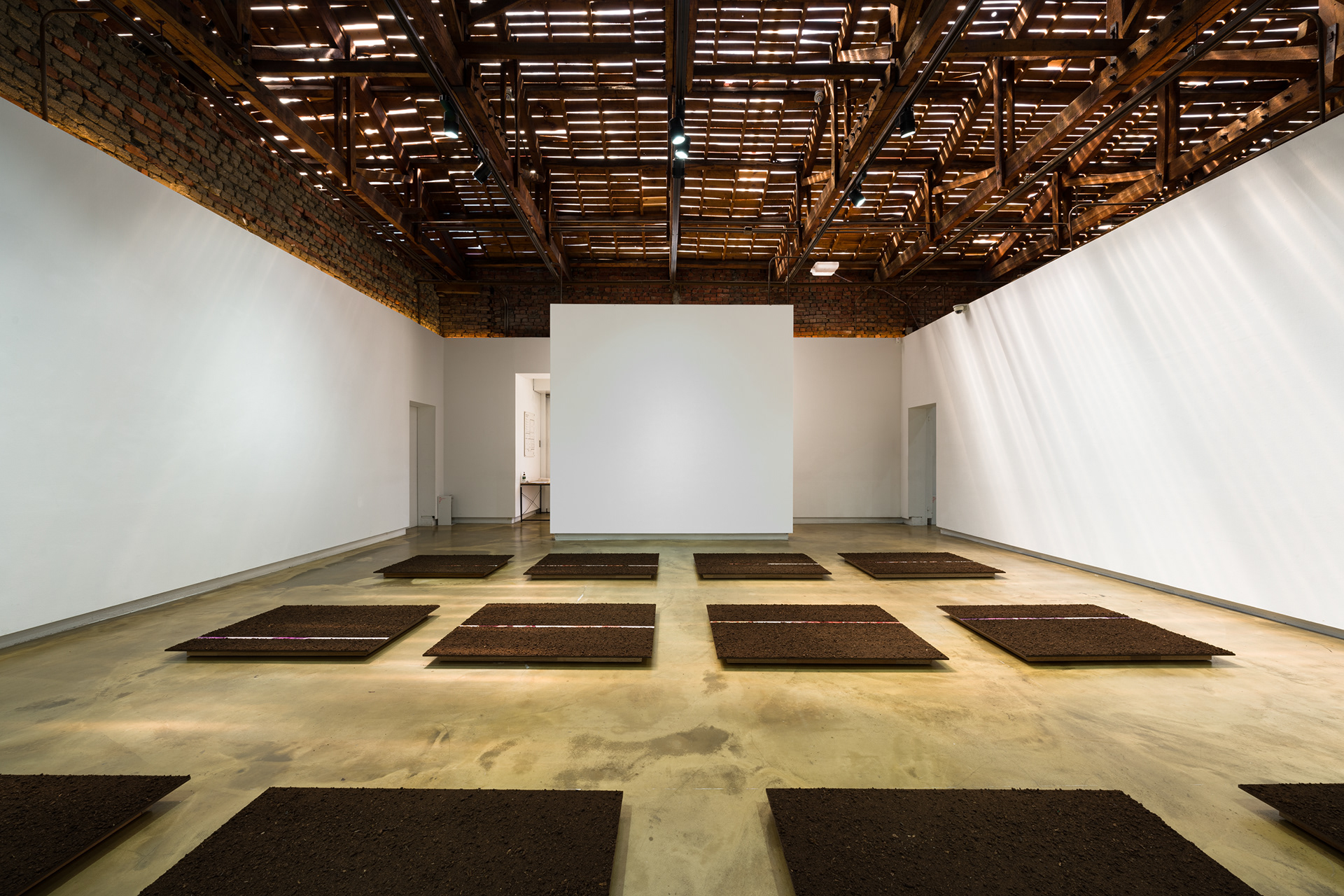
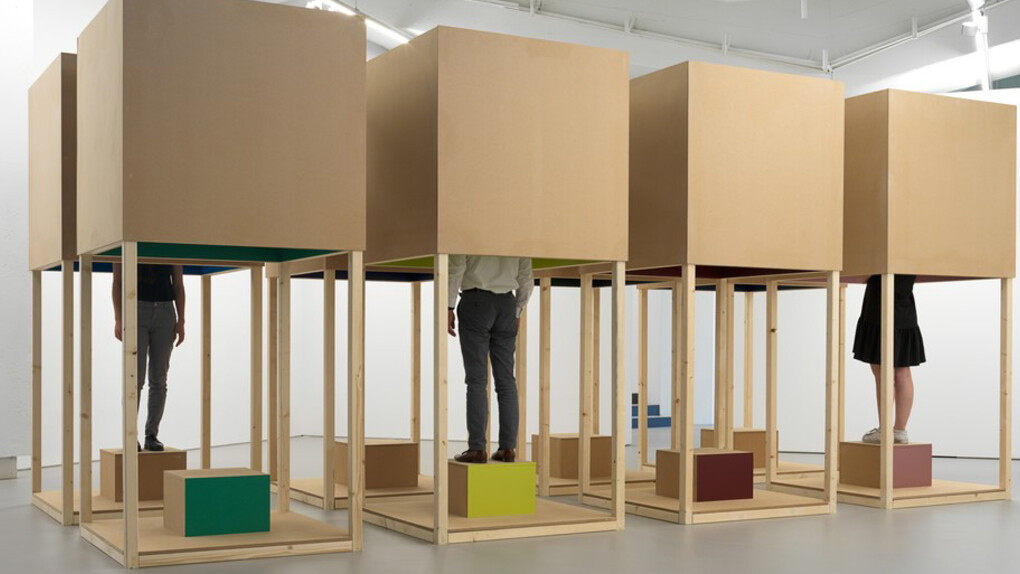
Another significant aspect is that his practice does not end with the photographic image itself but extends to questions of installation—where and how photographs are positioned in space. In addition to producing specific objects and structures on which to display his photographs, Ahn, whose work has consistently addressed the question of the gaze, understands the gaze within the artwork and that of the viewer as interconnected, and therefore pays careful attention to the spatial arrangement of his photographs.
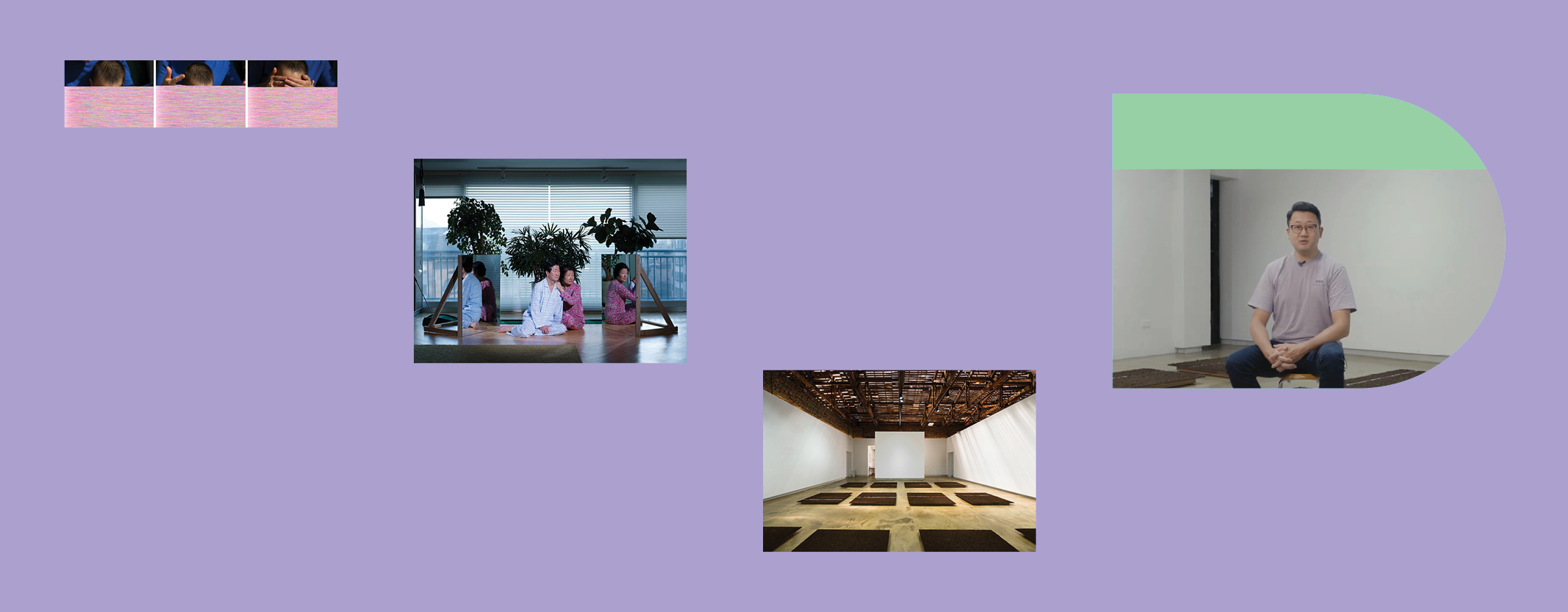
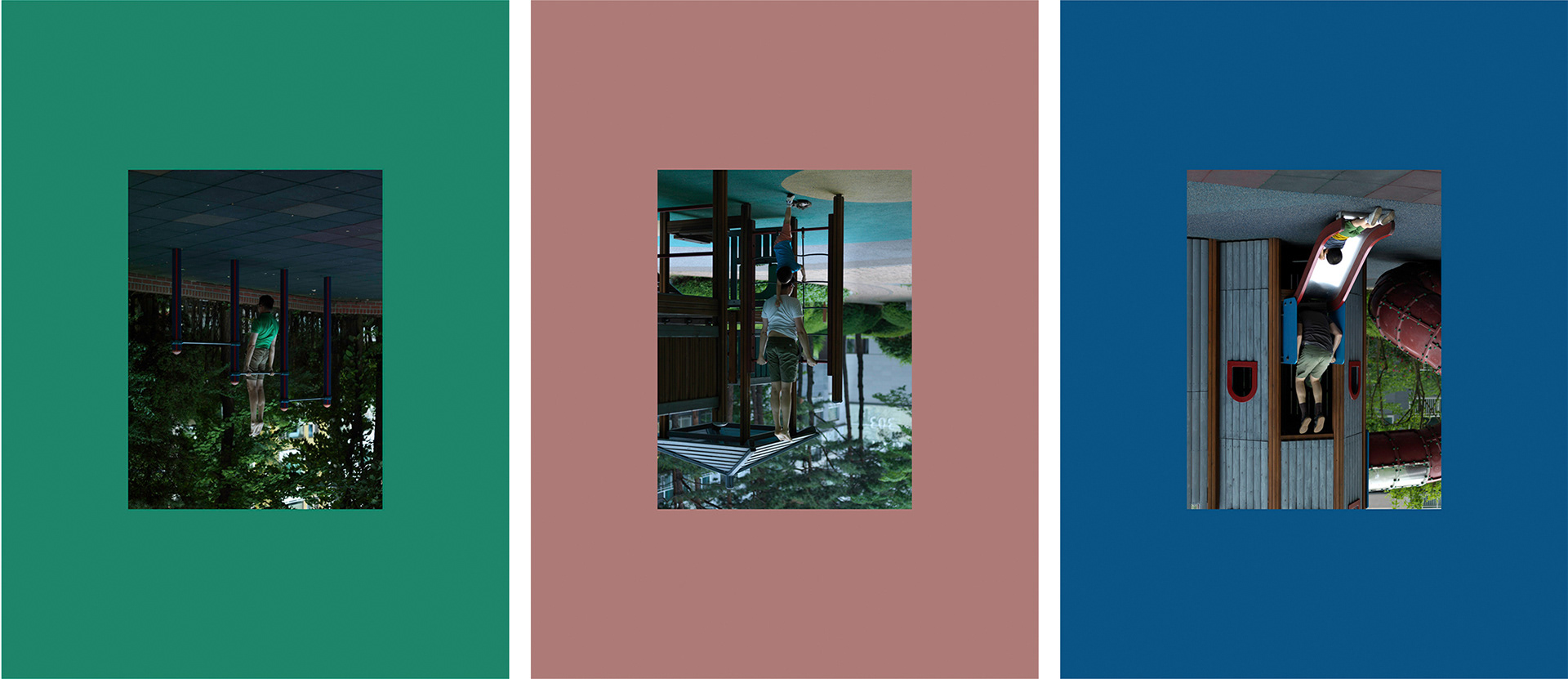
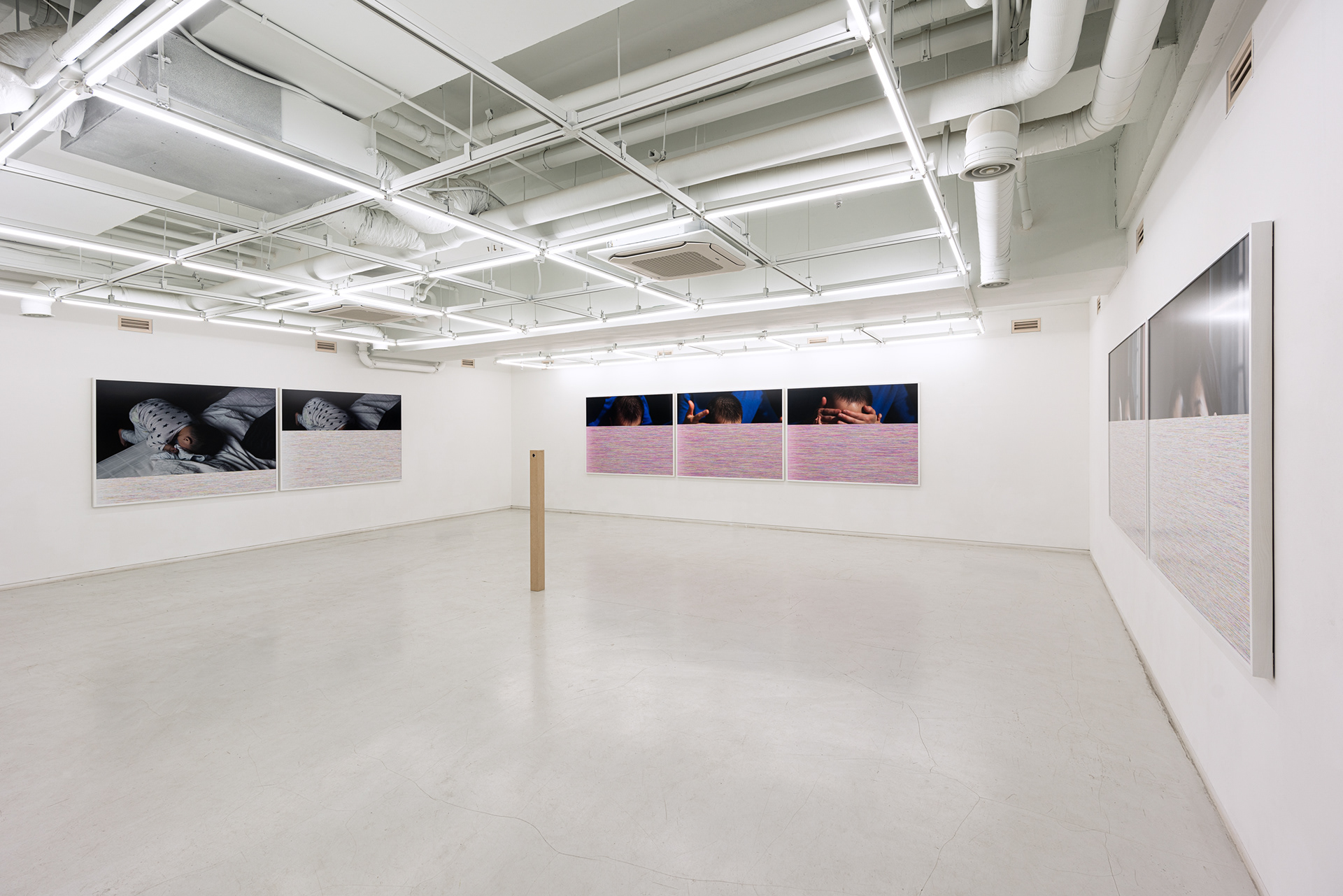
His more recent works maintain these general characteristics while suggesting a certain shift in both content and form. His parents disappear, and a baby enters the frame. As Ahn moves into a new position in which he must establish a relationship with his newborn child, just as he once related to his own parents, he becomes acutely aware of the cyclical relationship between life and death and appears to seek an expansion of his practice toward more universal subjects.
Central to this development is an attempt to draw parallels between the relationships of parents and children, life and death, and photography’s inherent qualities of reflection and resemblance. If one desirable direction for art is to transform the specific circumstances of an individual life into universal narratives with which others and society can empathize, then Ahn is steadily moving in precisely that direction, camera in hand.