Is an object that juxtaposes a clever concept with beautiful imagery enough to qualify as a great work of art? This is a question that has lingered in my mind for a long time while viewing contemporary art. Films or design products can be even more beautiful, and if I want to encounter intelligent or profound ideas, I can simply read a book or search Google. Yet some artworks make me feel as though I have come all the way to a museum only to be lectured with platitudes.
Even the works of well-known artists are no exception. Although I recognize that the subjects they address are intellectually engaging and worthy of agreement, they do not necessarily move me. It is said that Asian audiences tend to expect art objects to be refined and beautiful. Perhaps I, too, wanted to see evidence of delicate craftsmanship alongside an intelligent concept.
A recent exhibition by Hito Steyerl seemed to exemplify this dilemma. One of her works presented an intricate argument about capitalism for more than an hour, while the project Mission Accomplished: Belanciege, apparently conceived as a response to the contradictions of capitalism, included a plan of action to undermine luxury brands.
The project was so complicated that even after reading the wall text several times, I could not fully understand it. I could only infer that its general direction was to critique the contradictions of capitalism. I even found myself wondering why such complex and obscure ideas had to be expressed at such length, and in words, rather than simply being written into a book. Some of the works were not particularly beautiful, either.
Yet beauty merely means that an artist's craftsmanship and technical abilities have reached a certain level, allowing the images to reflect the history of aesthetics and what I presume to be contemporary tastes. It would therefore be unfair to dismiss Steyerl's images as crude simply because they neither pursue nor achieve conventional beauty.
Taking these considerations into account, do her works satisfy the conditions of great art? The meaning and value of an artwork are created by those who view and interpret it, and there are many flaws in the broad question I have raised here. Still, are my expectations excessive?
The reason I insisted on reviewing Woojin Kim's work was precisely my curiosity about whether it offered something beyond the combination of seemingly intelligent concepts and beautiful images. I suspected that there might be something more that I simply had not yet discovered, and that meeting the artist might help me recognize it.
Above all, I had high hopes that asking her directly about the logic behind her visual compositions would provide some answers. When I finally met Woojin Kim, I began our conversation by asking what she thought of Hito Steyerl's exhibition. Kim seemed to agree with me to some extent but remained reserved, while I struggled to formulate the right questions, and time simply passed.
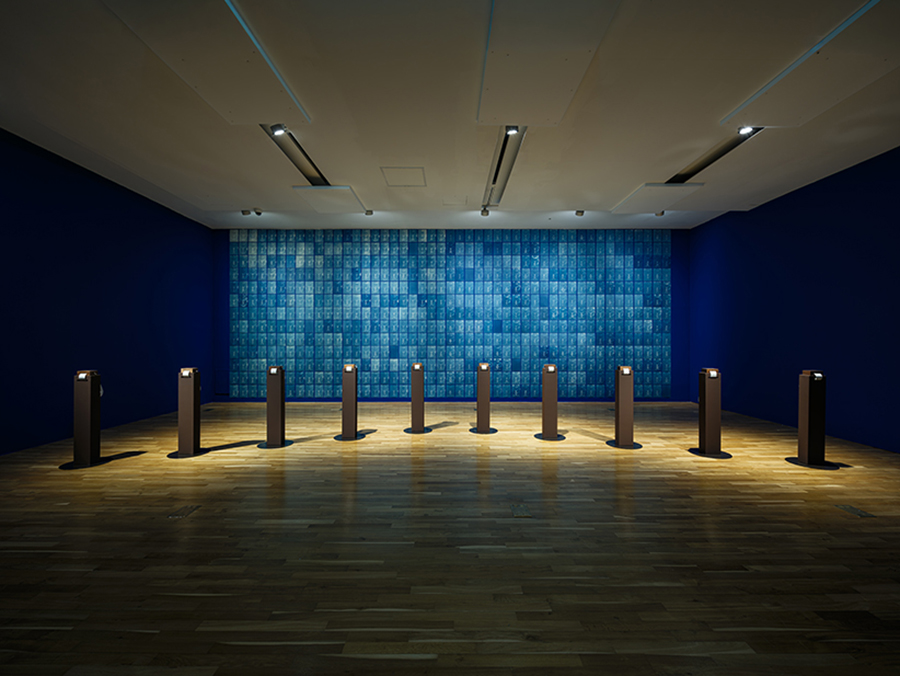
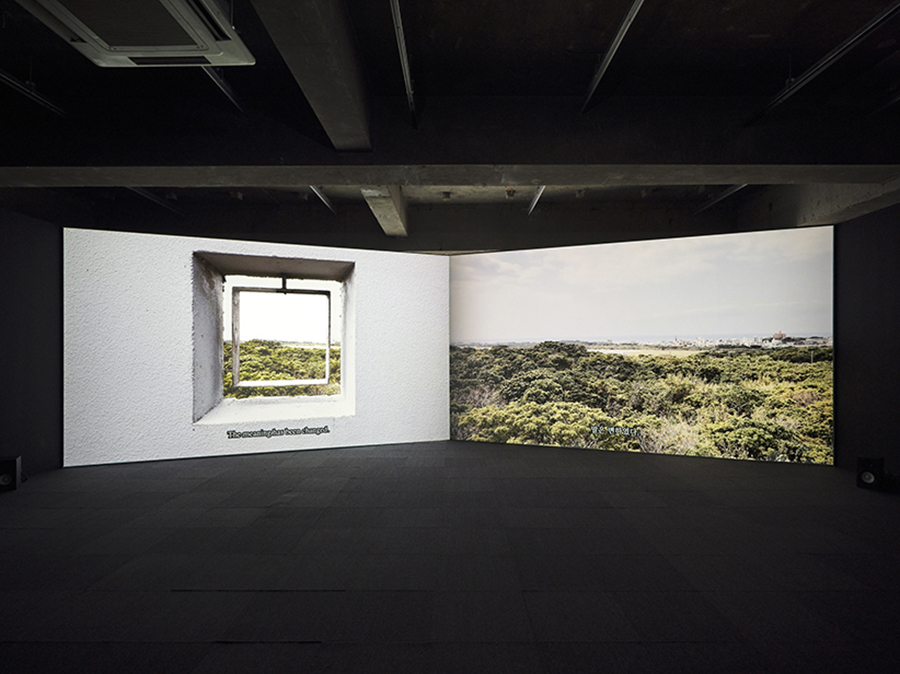
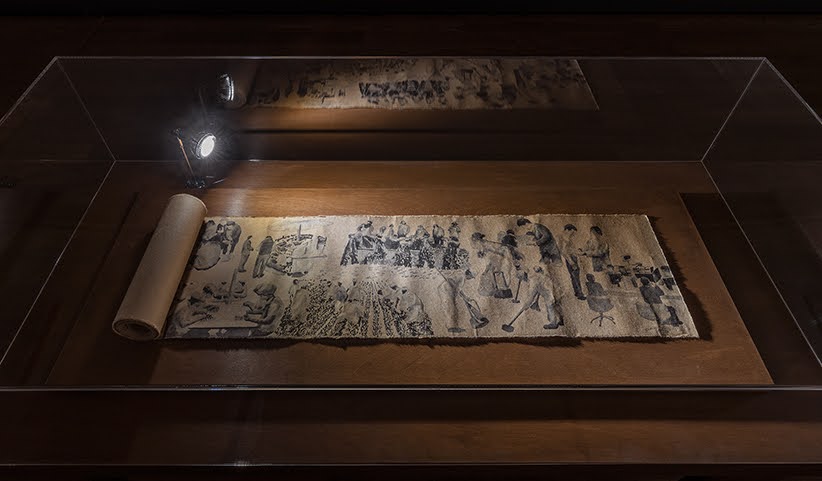
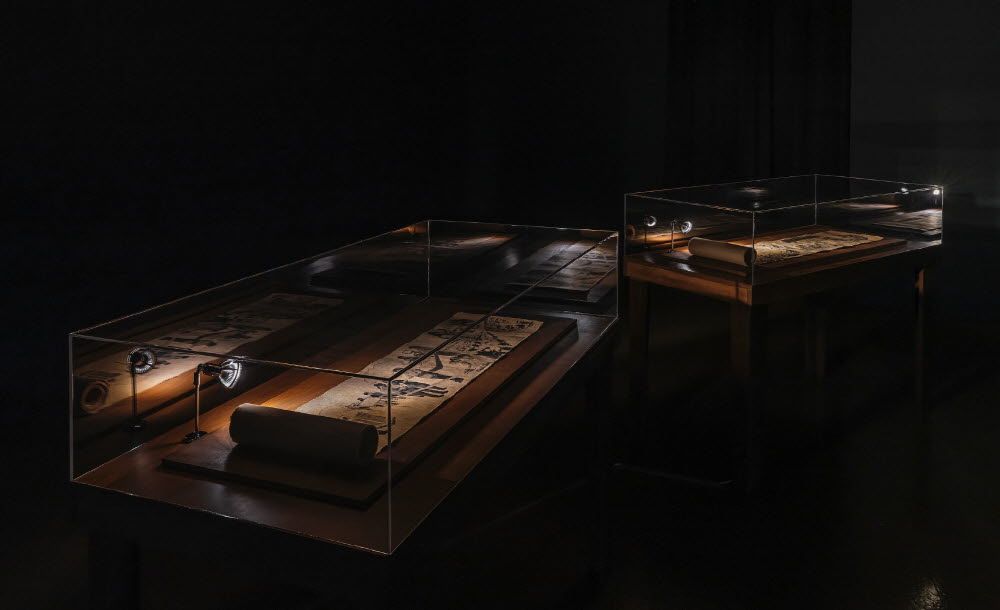
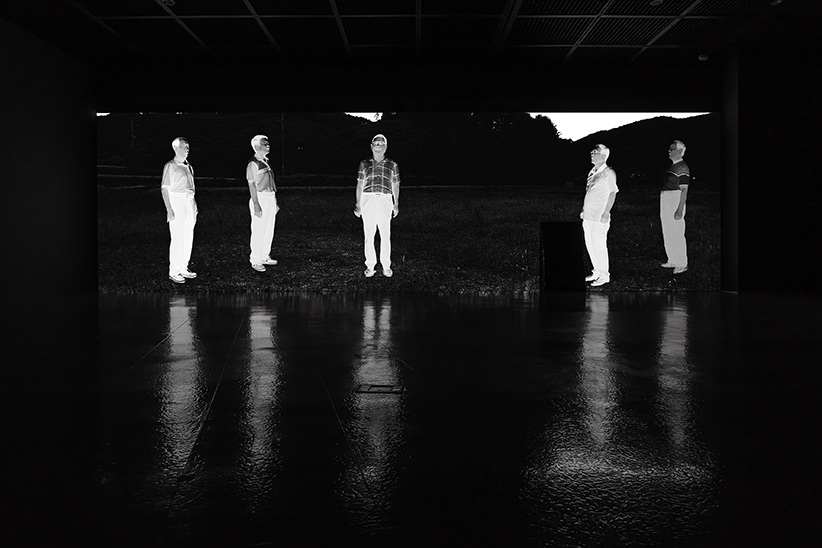
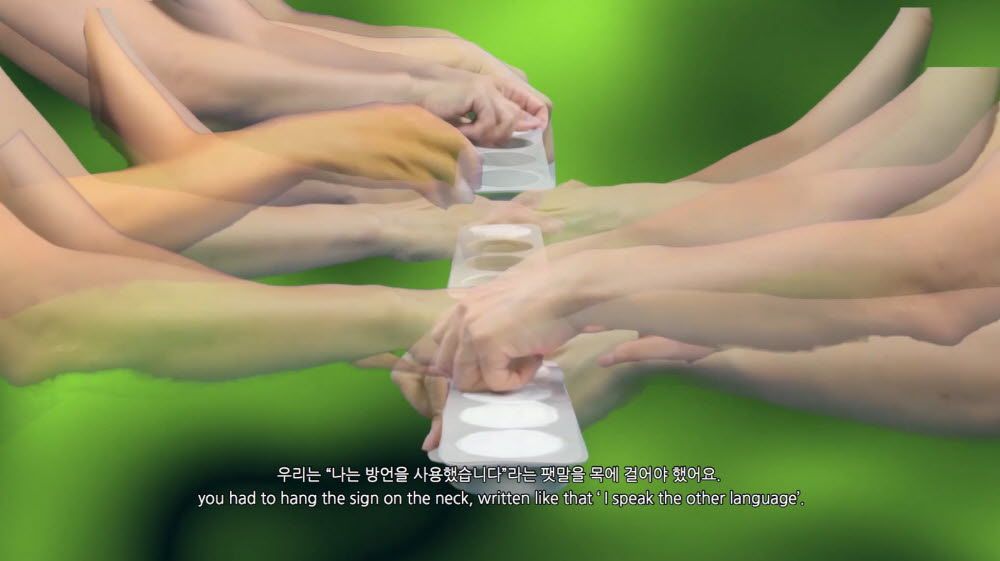
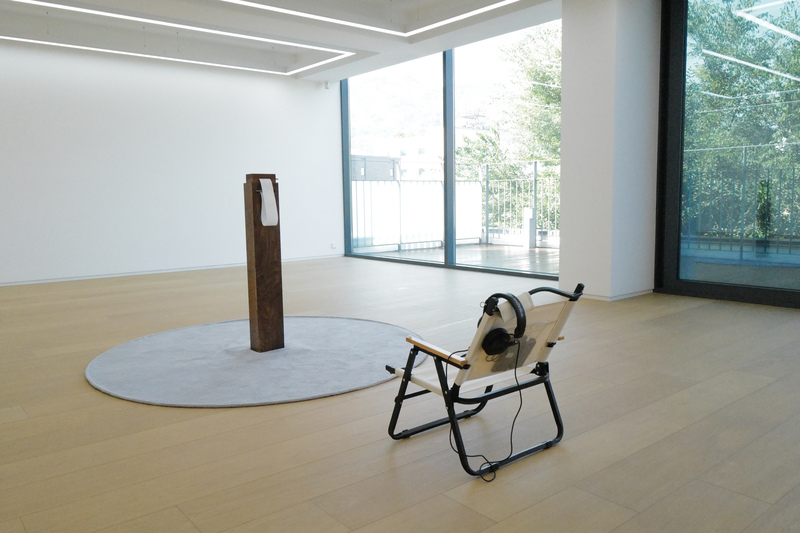
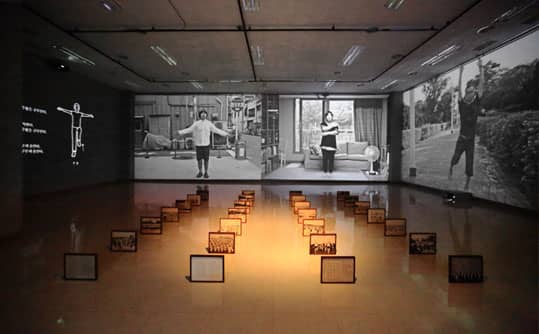
That day, the artist showed me several of her earlier video works. Perhaps because she had studied painting, her production methods and visual compositions seemed closer to painting, without emphasizing narratives structured around a clear beginning, development, and conclusion. In the works presented in the exhibition 《The Language Between》, as well as in her earlier works, at least until 2020, I noticed a recurring pattern of juxtaposing two tracks: repetitive moving images and conceptual text-based messages.
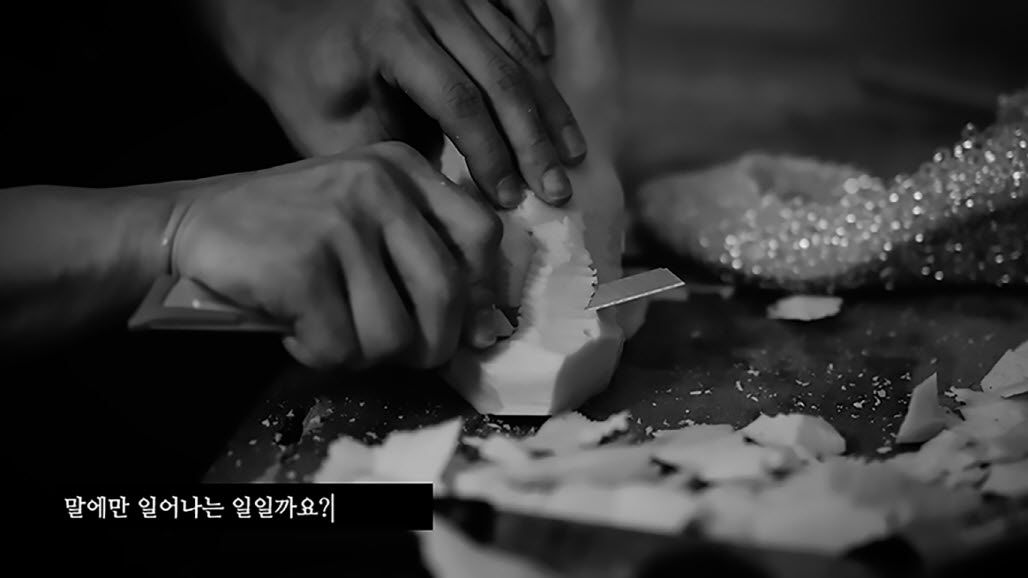
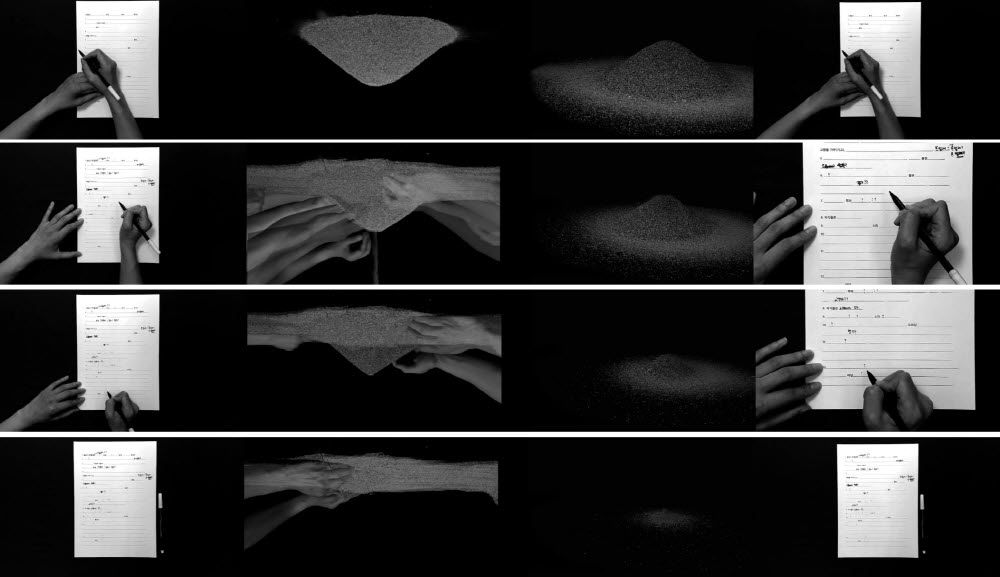
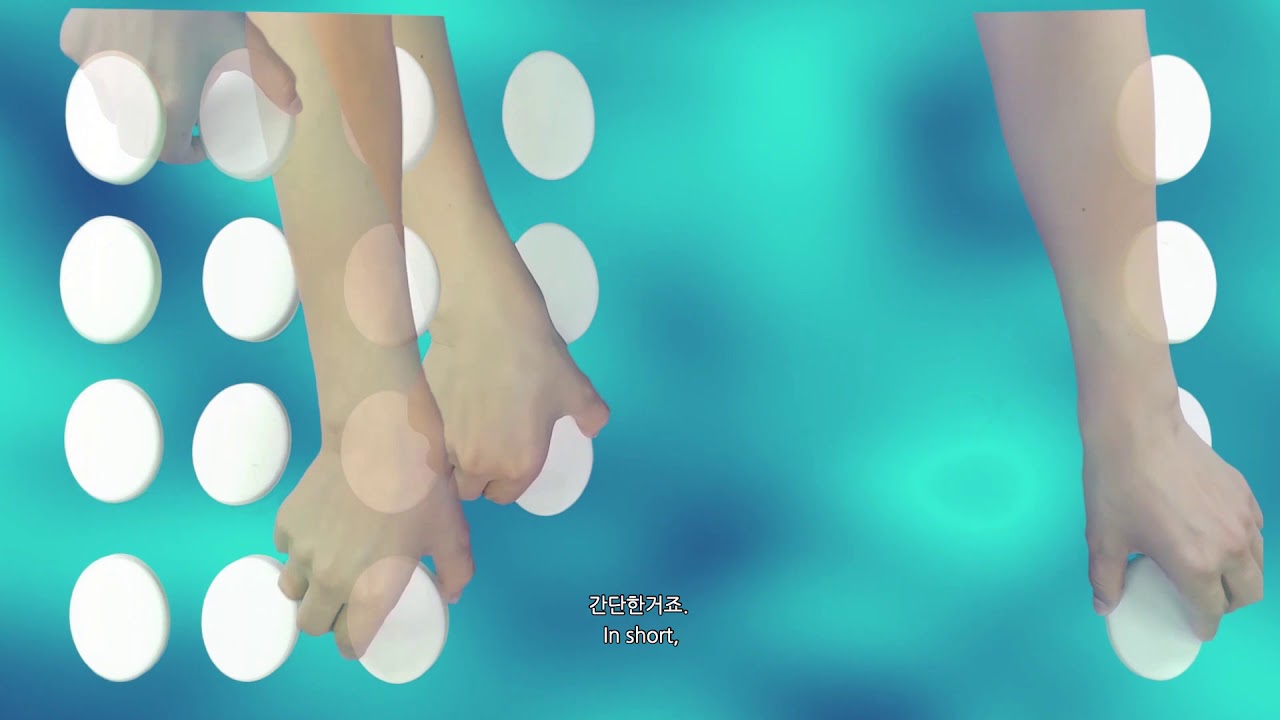
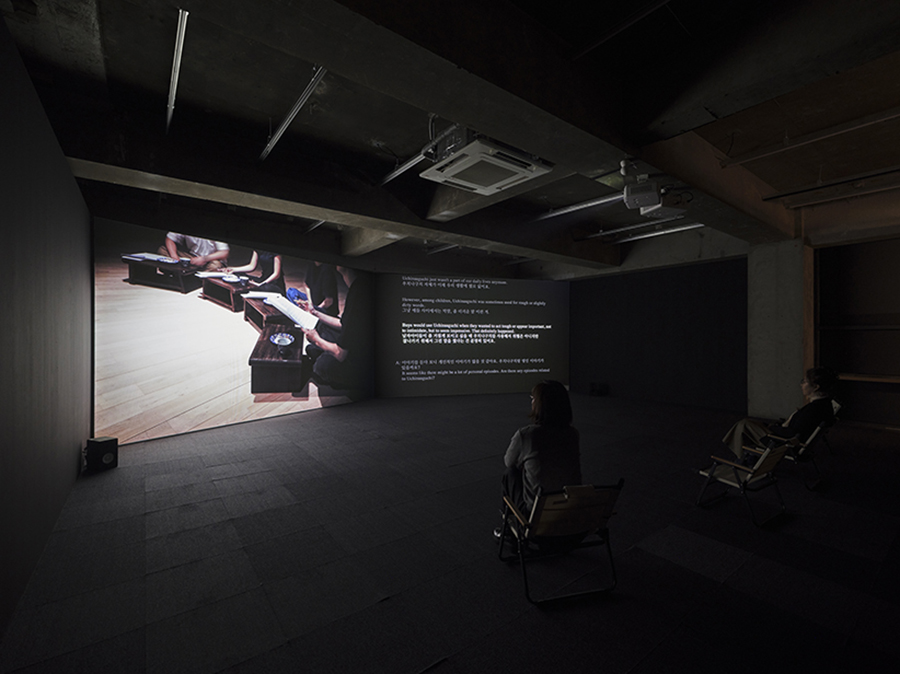
For example, in The Prelude of the Perfect Ending H_18_01 (2019), a video showing paper clay being pressed into molds to produce uniform, coin-shaped lumps was overlaid with an interview discussing how Cantonese, once the language of Hong Kong, was being forgotten as it became excluded from schools and official settings.
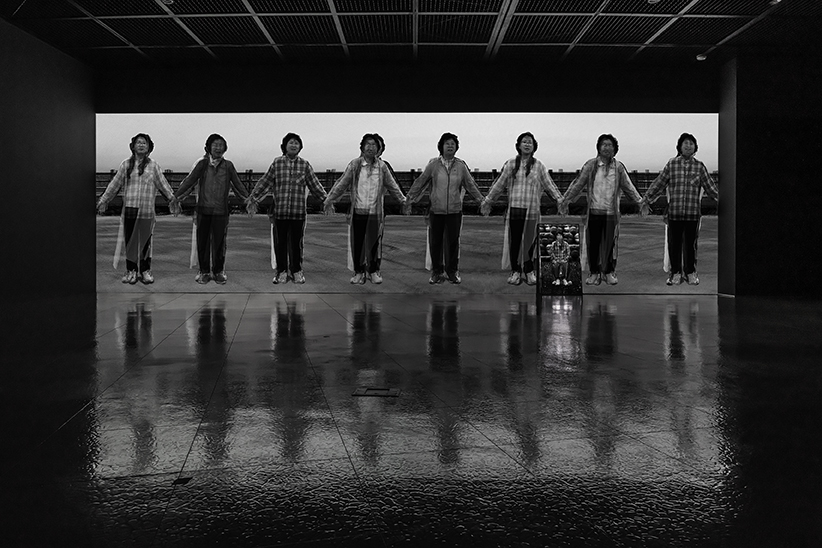
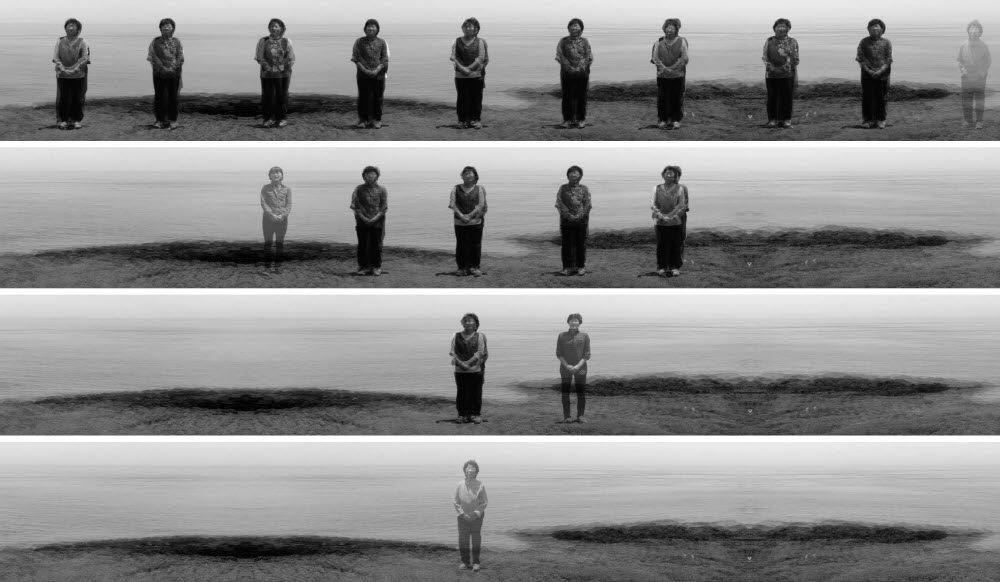
Similarly, in Between Sunshine and Night, a video showing eight haenyeo (female divers) standing in a row and disappearing one by one was accompanied by a monologue recounting the life of a haenyeo engaged in diving work. In both works, the two juxtaposed tracks of text and simple moving images establish a relationship in which they complement and describe one another.
Having witnessed Pop Art and Conceptual Art, Arthur Danto declared that contemporary art had begun to engage in philosophy. He arrived at this conclusion because artworks and ordinary objects had become indistinguishable from one another. His declaration effectively signaled that artists no longer communicated messages by depicting or imitating particular circumstances; instead, what mattered was whether the messages they conveyed possessed sufficient complexity and depth to be considered philosophy.
Philosophy is the result of an individual's insight into the world, yet it cannot transcend the realm of concepts. Philosophical insight must synthesize and penetrate fragments of experience accumulated at different moments; in other words, it must eliminate details. Both Steyerl's conceptual art and Kim's early works depicted ideas. Yet they failed to move beyond the conceptual because they could not explain why the language of the haenyeo needed to be remembered in the first place.
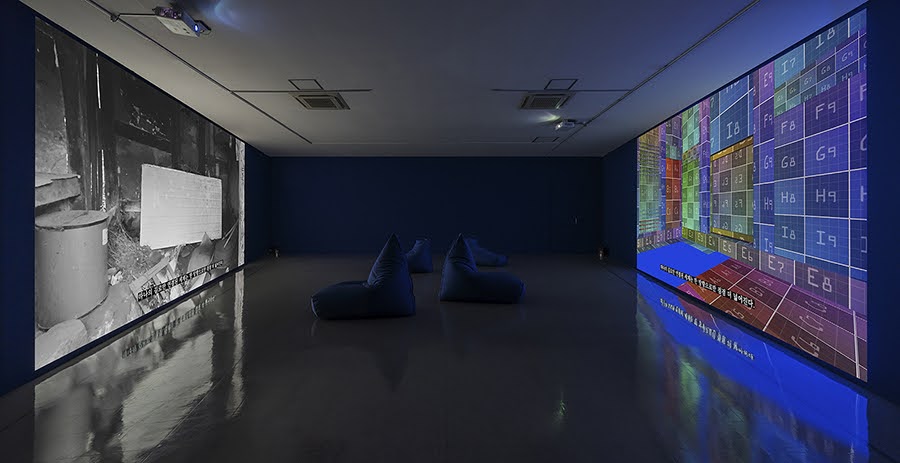
If art constitutes an independent system, how should it differ from philosophy? I found an answer in the expressive approach Kim attempted in her recent work. In a 2022 exhibition, she presented the video work The Ghost, Sea, and Möbius Loop. She filmed the traces of life scattered throughout the abandoned house where her parents had lived, a house destined to be sold. Was it out of fear of intruders, or perhaps a desire to preserve the possibility of returning someday? The house, now deserted by its occupants, contained a conspicuous number of locks.
There was an awkwardly positioned shelf, installed at a height that must have suited the owner's reach but departed from the basic structure of the traditional Korean house, or hanok, and a roughly cut piece of wood used to hold a door in place. These improvised traces were sufficient as visual devices to evoke a sense of the time the homeowner had lived through and the feelings that accompanied it.
Rather than inviting rational analysis, these scenes possessed an affective quality, or valence, capable of generating emotions in the viewer. Kim succeeded in transforming traces of the homeowner's bodily resistance against an era and the passage of time governed by the law of entropy into affective valence.
In her artist's statement, she expressed her intention to convey through the 'Memories Project' series that "the processes through which languages disappear and the memories of individuals are meaningfully interconnected, even when they occur in different societies." Perhaps what I had wanted to see was precisely what concepts are inherently unable to encompass: these "points of meaningful connection," or the particular sensations experienced by an individual being in the course of living a life.
When Kim drew attention to the disappearance of the Jeju language and Cantonese, I had wondered, "Why must these languages not disappear?" Yet when I encountered the passage, "Intoxicated by splendor, I had not yet even become a spectator," I sensed that although the words might have belonged to someone else, the feelings behind them were hers. I could feel Woojin Kim's own breathing rather than a mere assemblage of concepts.
From that moment, I could resonate with the loss of language presented through footage tracing the remnants of a life, recognizing it as a source of solitude, and with the artist's sorrow over what could never be revisited. Such resonance is something that art must accomplish beyond what an artwork communicates through philosophical logic or signs. Perhaps it is a methodology unique to art, one that can only be realized through close observation at the level of affective valence.
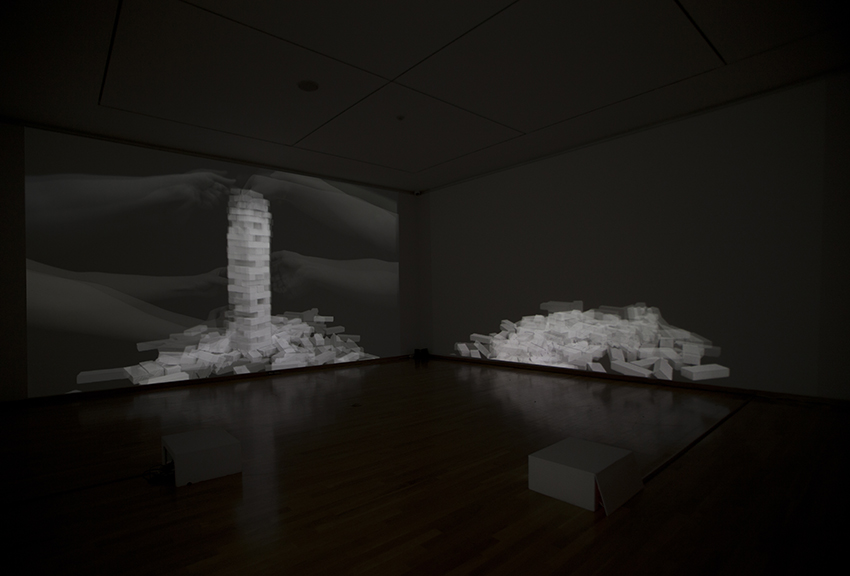
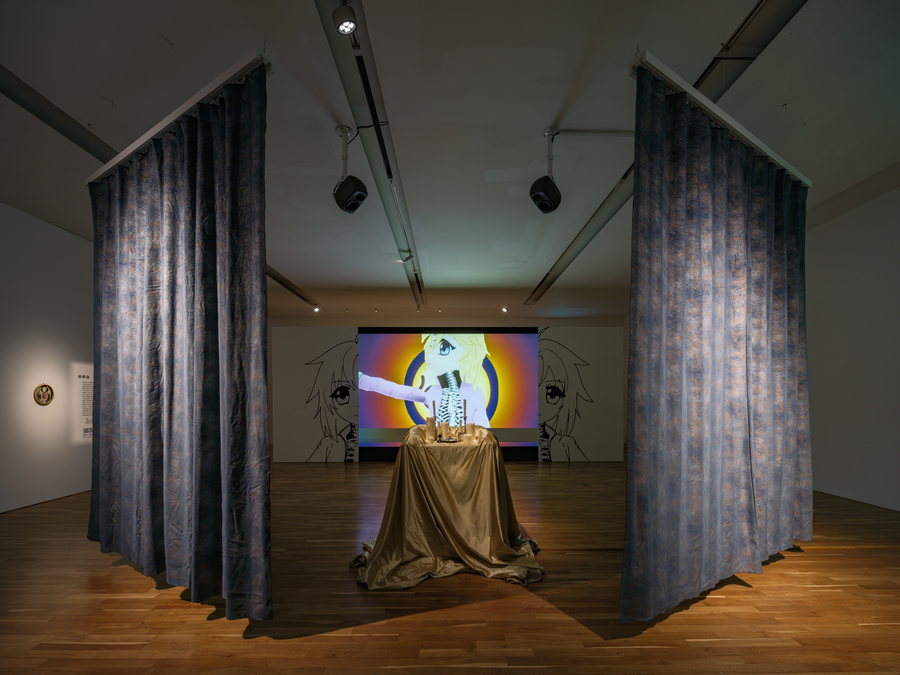
At the same time, Kim's characteristic visual grammar of juxtaposing concepts and images remained evident. Images of human traces left in the ruins were overlaid with a narrator's monologue describing how the path leading to the abandoned house was gradually becoming obscured by weeds. This grammar of juxtaposing two tracks became even more complex with the addition of another screen.
In other words, Kim juxtaposed footage depicting the disappearance of someone's language or voice with another narrative that provided an explanatory context for that disappearance. On the opposite projection screen, she further overlaid a computer-generated virtual rendering in which the abandoned house was transformed into a grid and rectangular fields of abstract color.
The realm of ideas can be translated into English as "the virtual," then extended to the virtual world and, ultimately, to cyberspace. The virtualization, or conceptualization, of reality began with Descartes' invention of coordinates, in which numerical values along the x- and y-axes serve as representations of reality, and has culminated in technological developments that allow everything to be converted into vectors.
For the artist, this condition seems to be conceived as one in which "meanwhile, the boat is slowly drawn beneath the surface by the waves," and there is no longer any way to perceive "a person whose mother tongue is a language in which they can speak to no one." Norbert Wiener regarded living activity as a form of space-time governed by negative entropy.
Yet if the law of entropy entails the intensification of individuality to the point where reduction becomes impossible, it remains highly debatable whether virtualization, which performs a process of reduction, constitutes negative entropy or moves toward maximum entropy. Once again, this demonstrates the limitations of criticism as a form of conceptualization. Nevertheless, the affective valence of sorrow and solitude emanating from Kim's work in the exhibition space remains valid as art.