Kyungwoo Han’s departures from the familiar conventions of media art in the contemporary art scene are consistently grounded in simple strategies. Whereas video art often demands prolonged viewing through lengthy running times that can lead to viewer fatigue, Han’s works are typically condensed into three to six minutes.
Although he employs a fixed camera, the dramatic reversals that unfold within the frame sustain the viewer’s attention and sense of anticipation. Moreover, while video art frequently becomes preoccupied with its medium-specific qualities as a time-based art form, often gravitating toward elaborate storytelling, Han’s video works are closer to the tradition of two-dimensional painting that conceals a visual riddle.
In a sense, his practice follows the long tradition of trompe-l’œil painting, translating its techniques of visual deception into new media. Yet despite their shared reliance on illusion, traditional trompe-l’œil and Han’s work proceed in precisely opposite directions. While conventional trompe-l’œil painting depends on the painter’s dexterous ability to reproduce objects so convincingly that they appear to exist within the canvas, Han’s illusions rely on meticulous calculations of perspective.
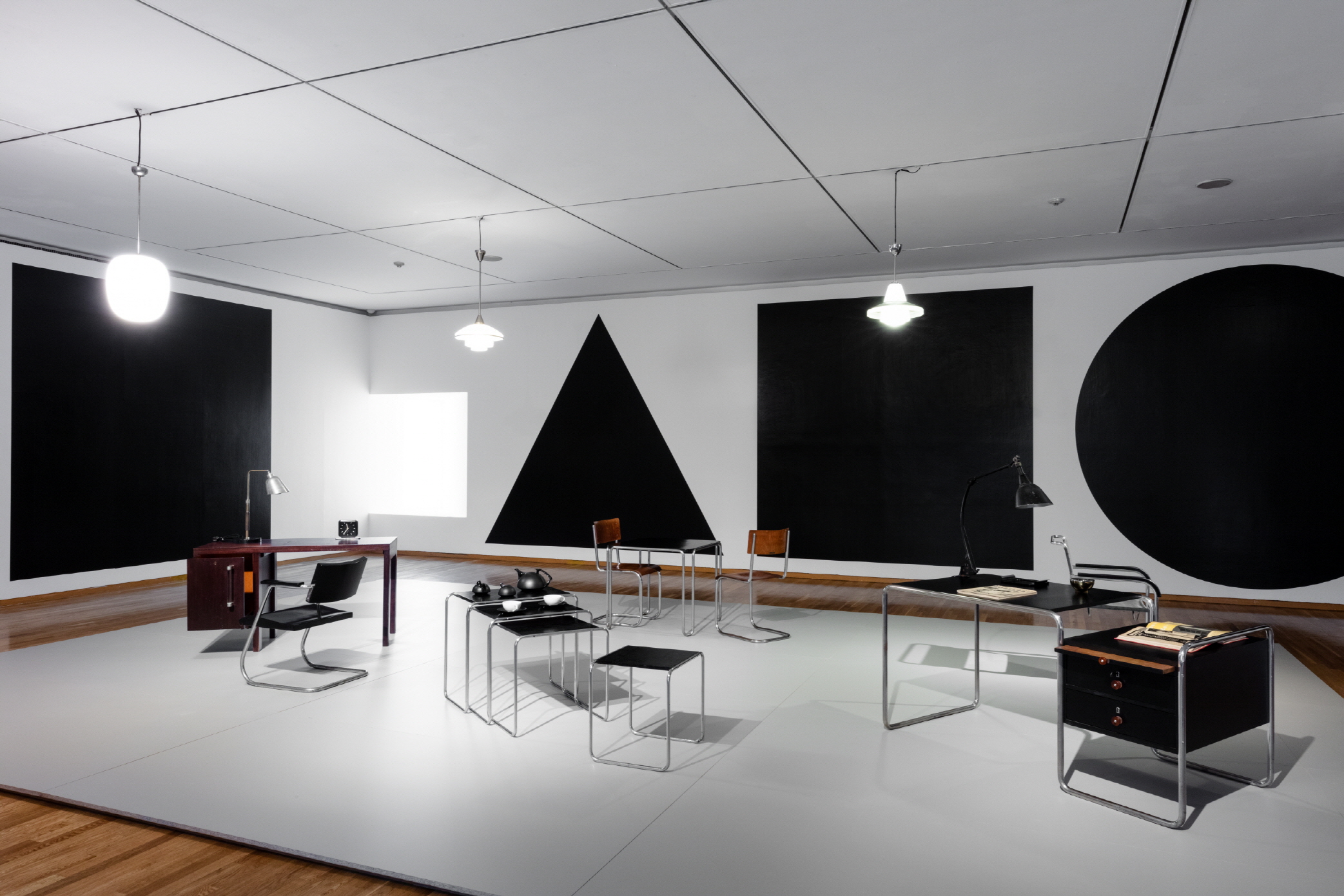
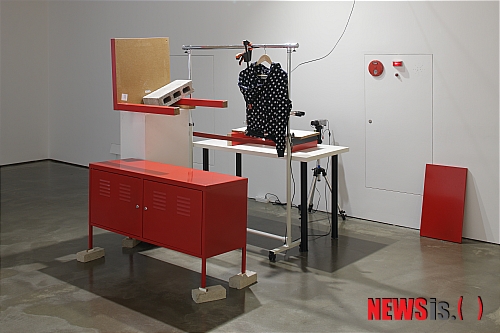
What initially appears to be art within a monitor ultimately reveals itself to be nothing more than an arrangement of actual objects resembling art. Almost without exception, the artist films combinations of everyday furnishings arranged in perspectivally distorted configurations, leading viewers to mistake them for flat images.
Just as he sustains viewers’ attention through brief running times in a medium where concentration can easily waver, another strategy Han persistently employs is to place readily recognizable icons at the entrance to his works. These familiar icons also prove effective in establishing aesthetic double meanings.
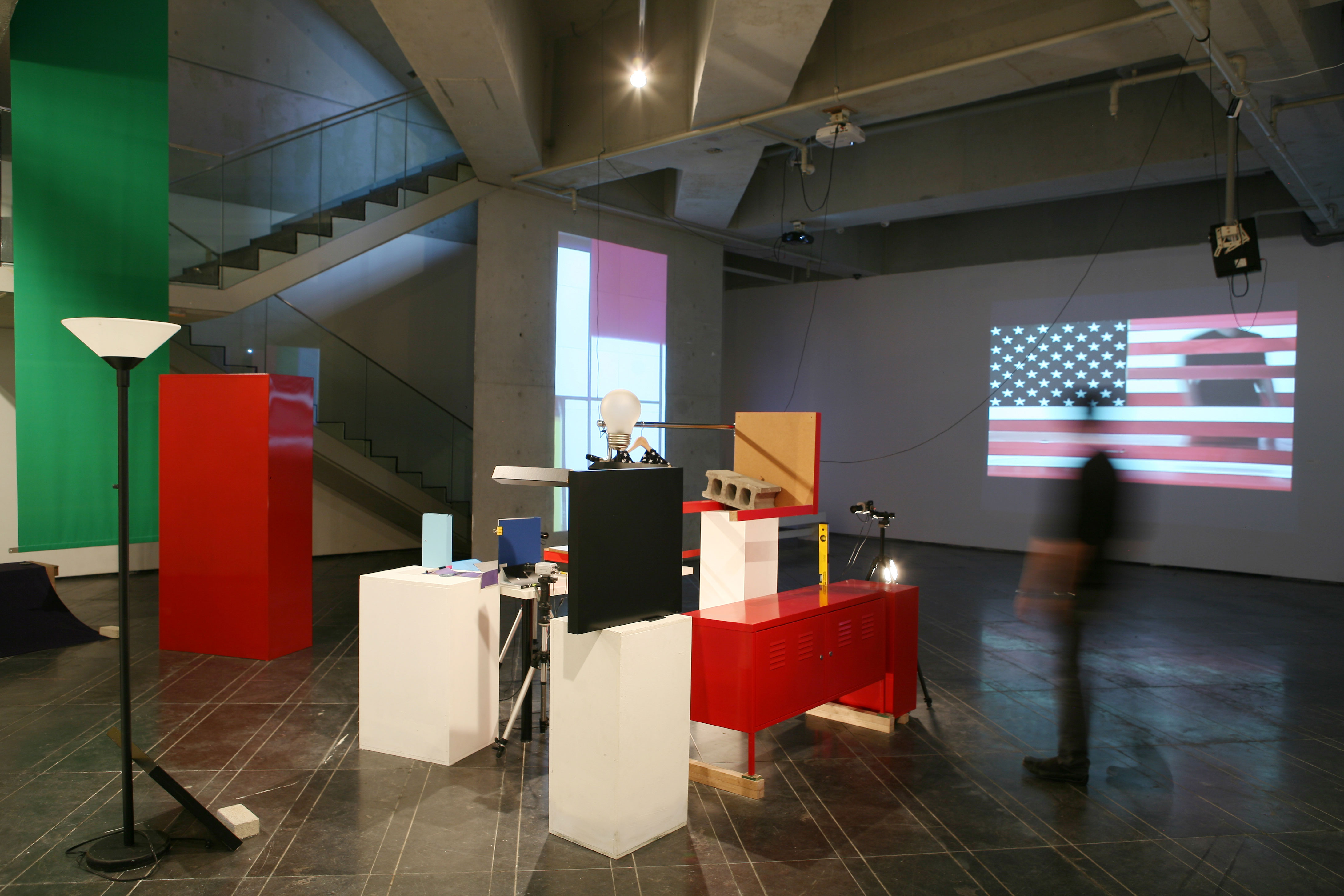
His early work Red Cabinet (2005) employs the television test pattern once commonly displayed during broadcast interruptions; Tableau with Objects (2008) draws on Mondrian’s geometric abstraction; and Star Pattern Shirt (2011) appropriates the American flag. All are familiar visual motifs. The hill depicted in Sky Hill (2011) is presumably borrowed from the desktop wallpaper of an outdated version of the Windows operating system. Television test patterns and Windows desktop backgrounds have become unavoidable images in an era when visual experience increasingly converges on the monitor.
Likewise, Mondrian’s compositions and the American flag are virtually inescapable images for those engaged in the visual arts, particularly considering that Jasper Johns repeatedly employed the American flag as an iconic motif through which to address the relationship between painting and objects in terms of flatness. If Mondrian and Jasper Johns belong to an earlier generation of artists who, in different ways, contributed to the doctrine of flatness, Han makes the generational divide apparent by disrupting the planar aesthetics of his predecessors.
While his short running times and appropriation of familiar icons from the media age make video art more accessible than ever, the visual composition Han most frequently employs is bilateral symmetry, or a form of new-media decalcomania. The four-part CCTV screen in Merge (2006), the vertical symmetry in Green House (2009), which creates the illusion of furnishings reflected on the surface of water, and Ten 46 inch monitor soccer field (2012) all conceal techniques of optical illusion within symmetrical compositions.
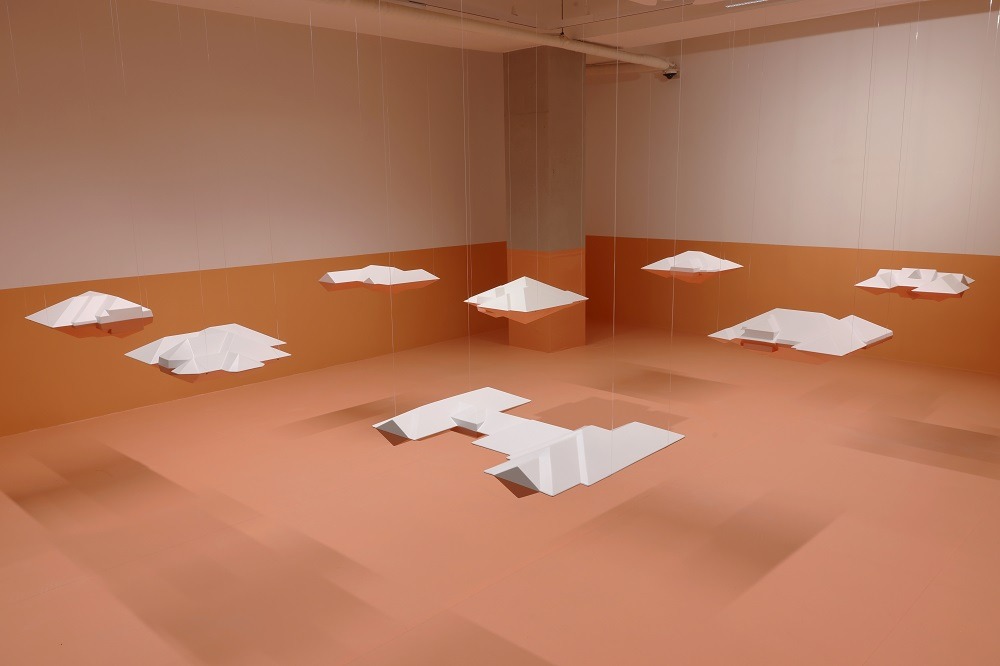
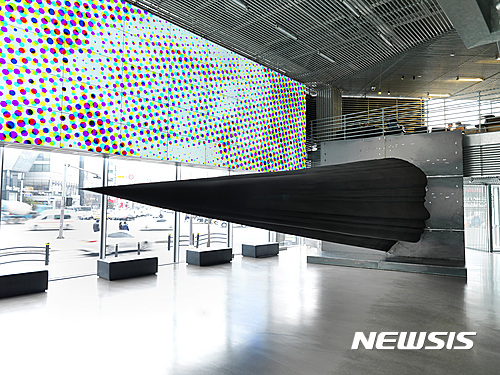
If the definition of bilateral symmetry is applied more loosely, Black Chair & White Objects (2007) and Construction barrier (2007) may also be included among the works that employ symmetrical compositions to generate visual illusions. In the artist’s current solo exhibition at SongEun Art Space, this unwritten rule of symmetry is continued in Plastic Rorschach (2014).
The Rorschach test is a psychological assessment that examines subjects’ mental states by analyzing the meanings they perceive in accidentally generated, bilaterally symmetrical images. Whereas the inkblots used in the Rorschach test consist of symmetrical images formed by chance, Plastic Rorschach presents symmetrical forms deliberately constructed by the artist.
By appropriating an image that has long enjoyed authority within its respective field and arbitrarily transforming its meaning, Han extends his earlier practice of freely modifying the aesthetics of Mondrian and the American flag—or, more precisely, Jasper Johns’s interpretation of it.
The Rorschach test enjoyed a long period of prominence in the field of psychological analysis. Nevertheless, it has consistently faced criticism because the accuracy and reliability of its results are difficult to verify, leaving room for subjects to fabricate responses or examiners to impose subjective interpretations.
Skepticism toward the test remains persistent, with some dismissing it as pseudoscience because its validity has not been empirically demonstrated. Yet despite such criticism, the Rorschach test has survived within psychological practice. Its enduring but unverifiable authority, the collective tolerance of ambiguous interpretations, and its prolonged dominance within the field bear striking similarities to the history of abstract art in the art world.
In the Rorschach test, the only grounds for the subject’s responses and the examiner’s interpretations are their respective subjectivities. Indeed, the accidental forms appearing on actual Rorschach inkblots can seem both abstract and figurative, and a considerable number of them undeniably evoke the shapes of genitalia.
It is unclear whether this tendency has any connection to the fact that Hermann Rorschach, who devised the test, belonged to the Swiss Freudian school. Nevertheless, the Rorschach inkblots, with their apparent sexual metaphors, can even give the impression of steering subjects toward particular responses.
Regardless of the skepticism surrounding the Rorschach test within psychology, the overwhelming majority of the symmetrical plastic forms Han creates by deliberately crumpling black and colored plastic bags resemble genitalia. Presumably, the artist has intentionally shaped them to evoke sexual associations. Through this visual joke, he appears to deliberately exaggerate a vulnerability of a testing method that, despite its long-standing dominance in psychology, has continually faced challenges to its authority.
Whether working with photography, sculpture, or video, Han arrives almost invariably at an anarchic conclusion, following a narrative in which represented art makes a dramatic return to everyday reality. At times, these conclusions are marked by the artist’s entrance into or exit from the frame.
The image of the American flag transforms into a star-patterned jacket worn by Han as he walks out of view, while the television test pattern is reduced to an ordinary object, a red cabinet, through the rearrangement of furnishings. These dramatic reversals, in which art is transformed into objects, are invariably the result of precise calculations of perspective and the proportions of objects.
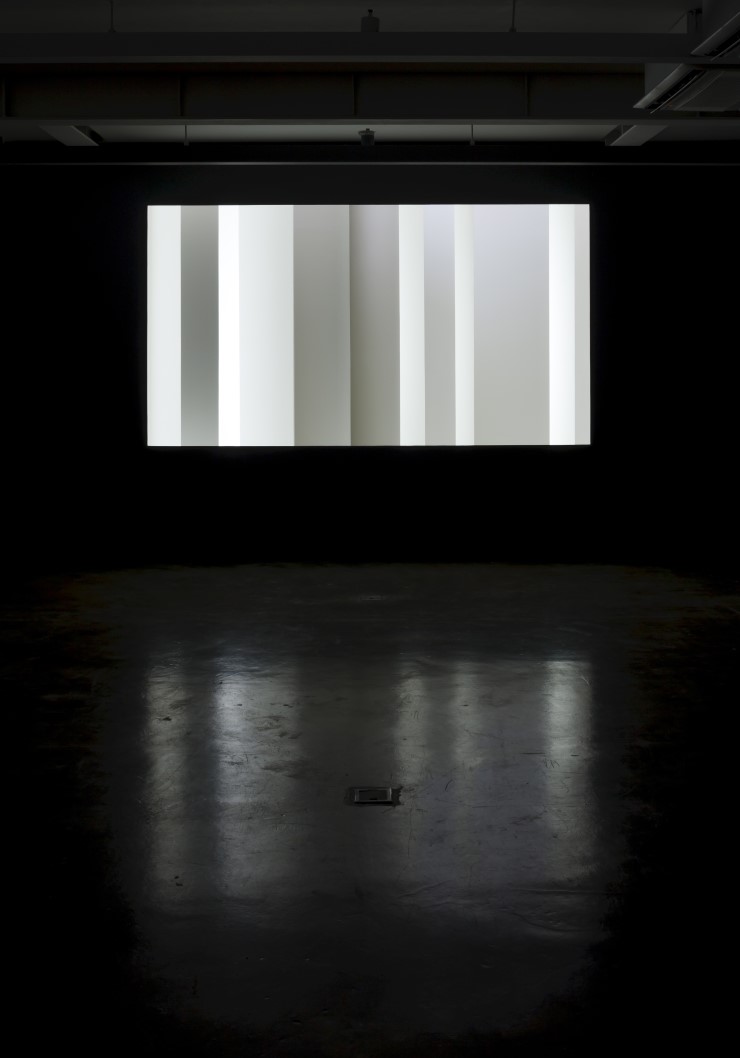
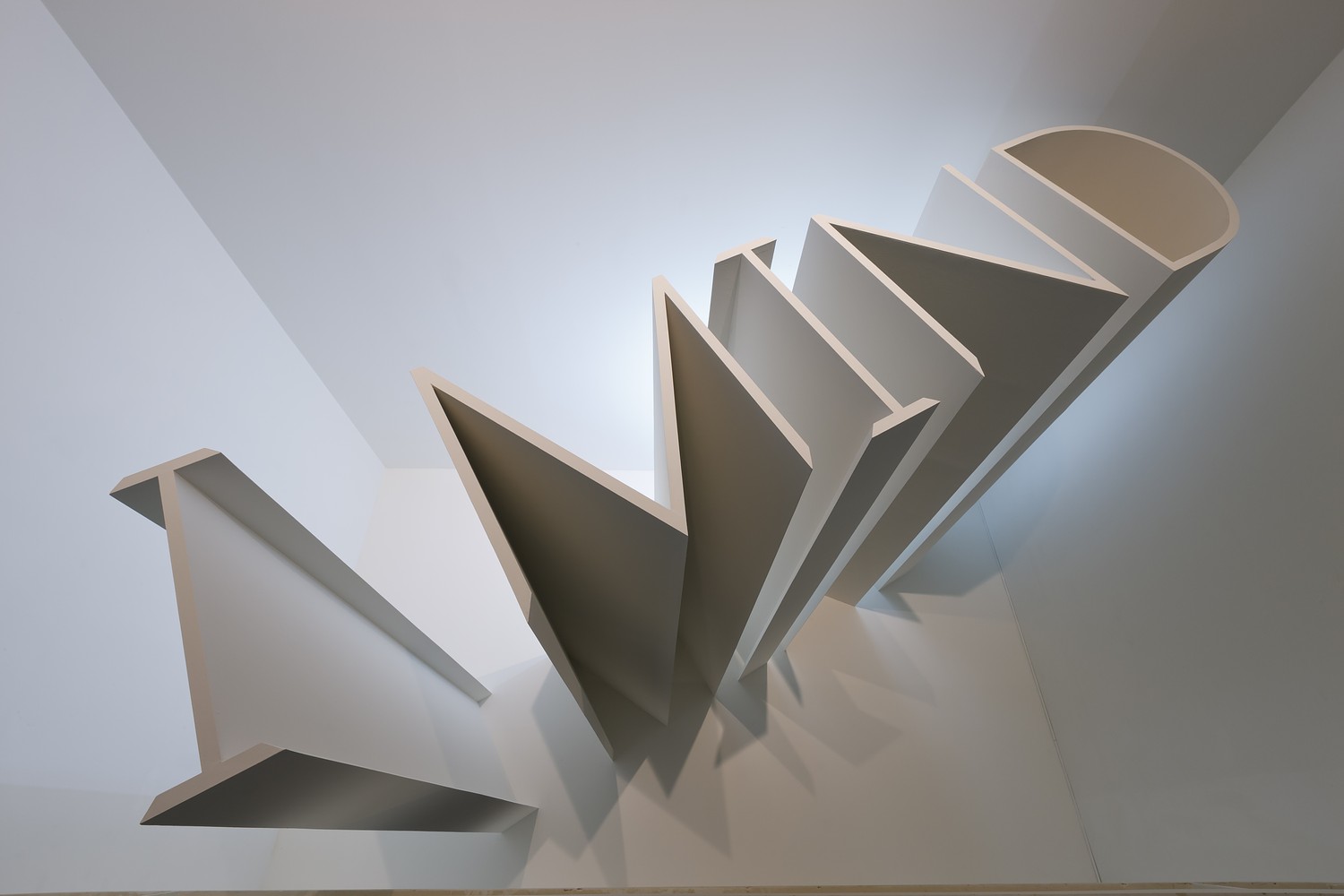
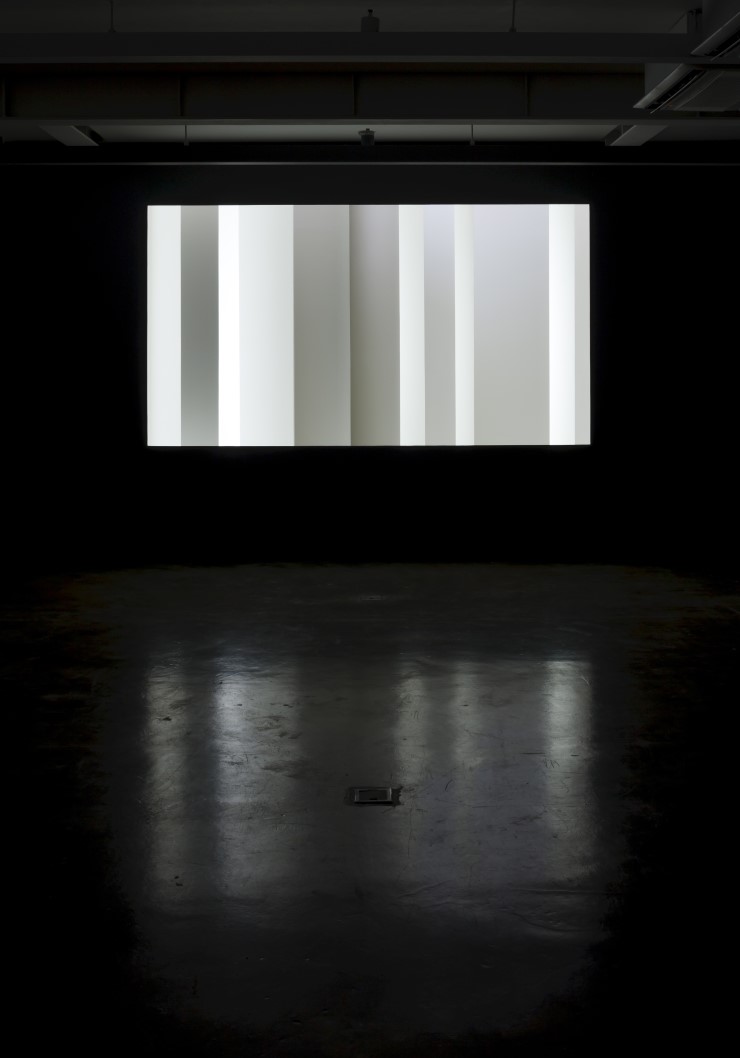
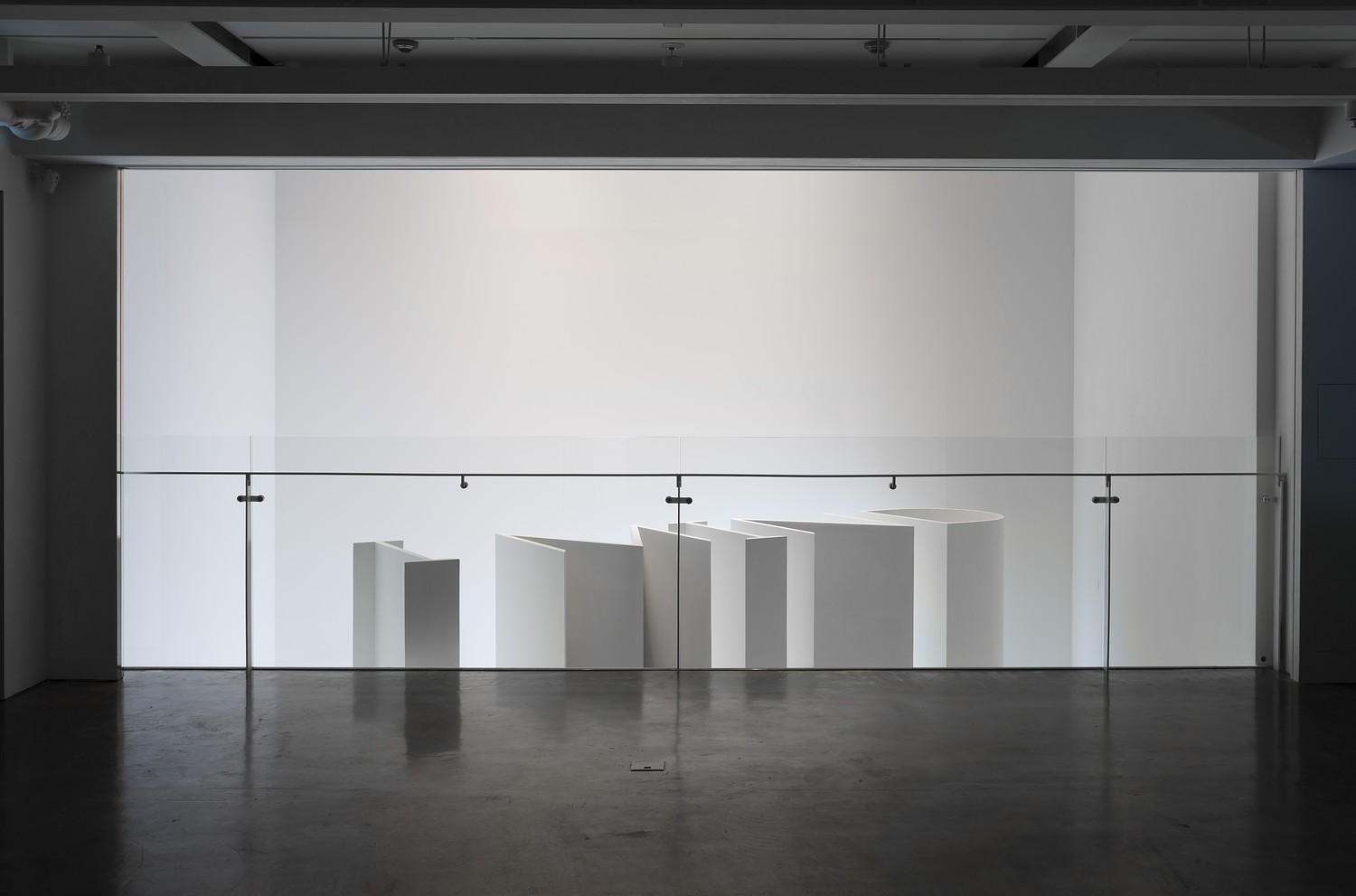
Meanwhile, the conclusions and underlying essences of his works consistently converge on restrained forms of expression. This is evident not only in the endings of numerous works where dazzling artistic images are reduced to everyday furnishings, but also in the fact that the underlying structure of I MIND is nothing more than a white construction, and that the early work Black Chair & White Objects (2007) concludes with two channels distinguished simply by black and white. Such restraint seems to affirm the artist’s response to an era characterized by an excess of visual stimulation.
P.S. Among the artists invited to 《Photography and Media: 4 AM》, an exhibition that concluded last month at the Seoul Museum of Art, at least three—Moonho Lee, Won Seo-yeoung, and Han Sungpil—demonstrated an astute understanding of optical illusion.
In this respect, their practices share considerable common ground with Han’s. It is worth examining why a group of prominent contemporary artists has become so focused on variations of optical illusion. Their work might be understood as a playful response from professional visual artists to an era of new media in which illusionism continues to intensify.