There
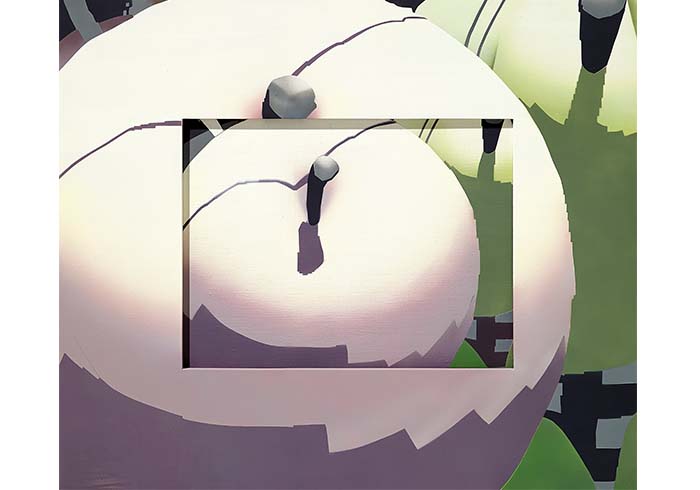
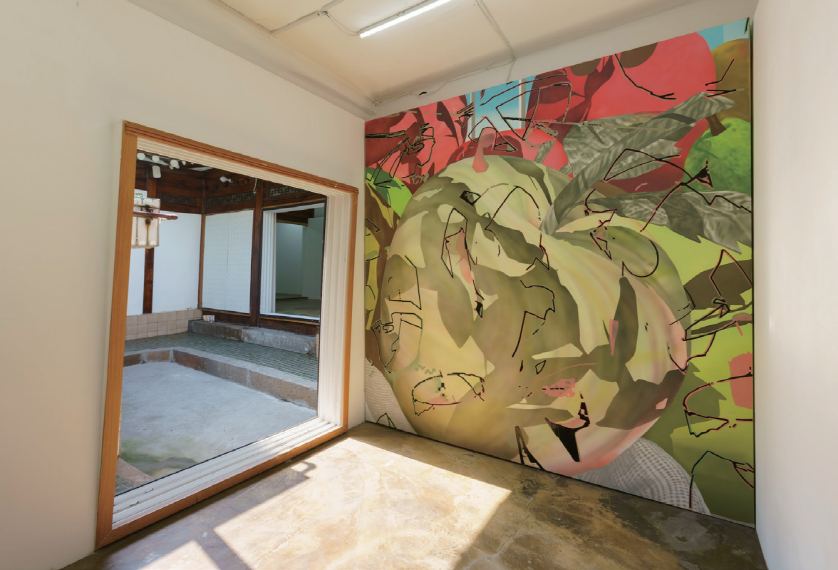
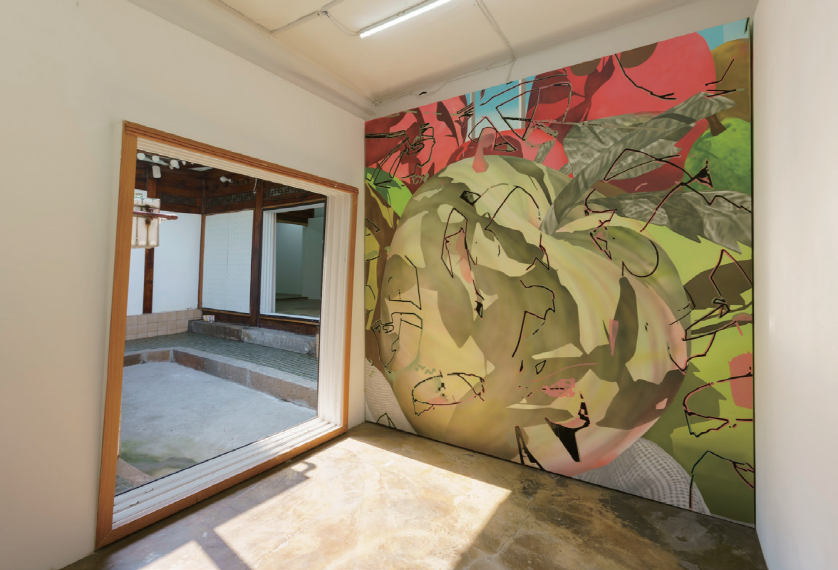
Might be Two Suns (2019) is a composite testimony to this exploration.
. The painting covers three layers: the digital screen, the surface of the
canvas, and the object of reality. It was like a commentary that succinctly
revealed the painter’s concerns, which have been fragmentary and more about
ulterior motive than about the greater cause. First, the painting speaks about
the digital world of the digital screen. The front of the painting depicts
apples that exist as images on a digital screen. On the surface of the apples,
the shadows of a seedling object pass by, which casts sporadic shadows on the
apples, their tops, and leaves, but does not reveal its shape. Notably, the
sharpness and tone of the shadows remain constant regardless of orientation,
whether near or far, left or right, etc. This evokes the characteristic of a
digital environment where light illuminates everywhere on the screen, where
there might be multiple suns, unlike in real life.
After the drawn apple is recognized, we see that the surface of the canvas is
where the apple is painted. A virtual apple that lives in the digital world, or
in other words, an apple that mimics the shape of a real apple, has been placed
on a real object, the canvas. The problem here is that the apple has long been
a fundamental object of exploration for painters who have honed their skills in
the art of painting. Painted on the front of the painting, the apple as a
“primary subject,” the artist approaches her painting as an allegory to the
history of painters who have used the sphere as one of their basic shapes and
as a tool to cultivate their skills. The apples brightened by the light and the
appropriately contrasting shadows that are only shaded. Depictions that follow
the curved shape of the apple, protruding from the depths and gradually
spreading downward with backlit and half-lit areas. The color of the apple,
painted in a fine range of light green and purple. There’s an exploration of
the fundamental processes of painting that one might expect to find at the
beginner level. And this exploration reveals the painting to be a study in
still life itself, as it is usually the subject of painters who create still
life paintings.
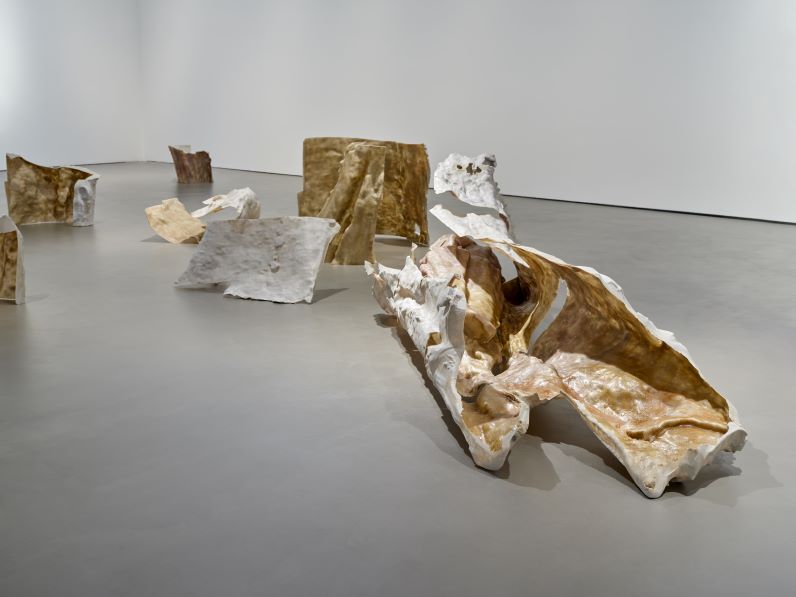
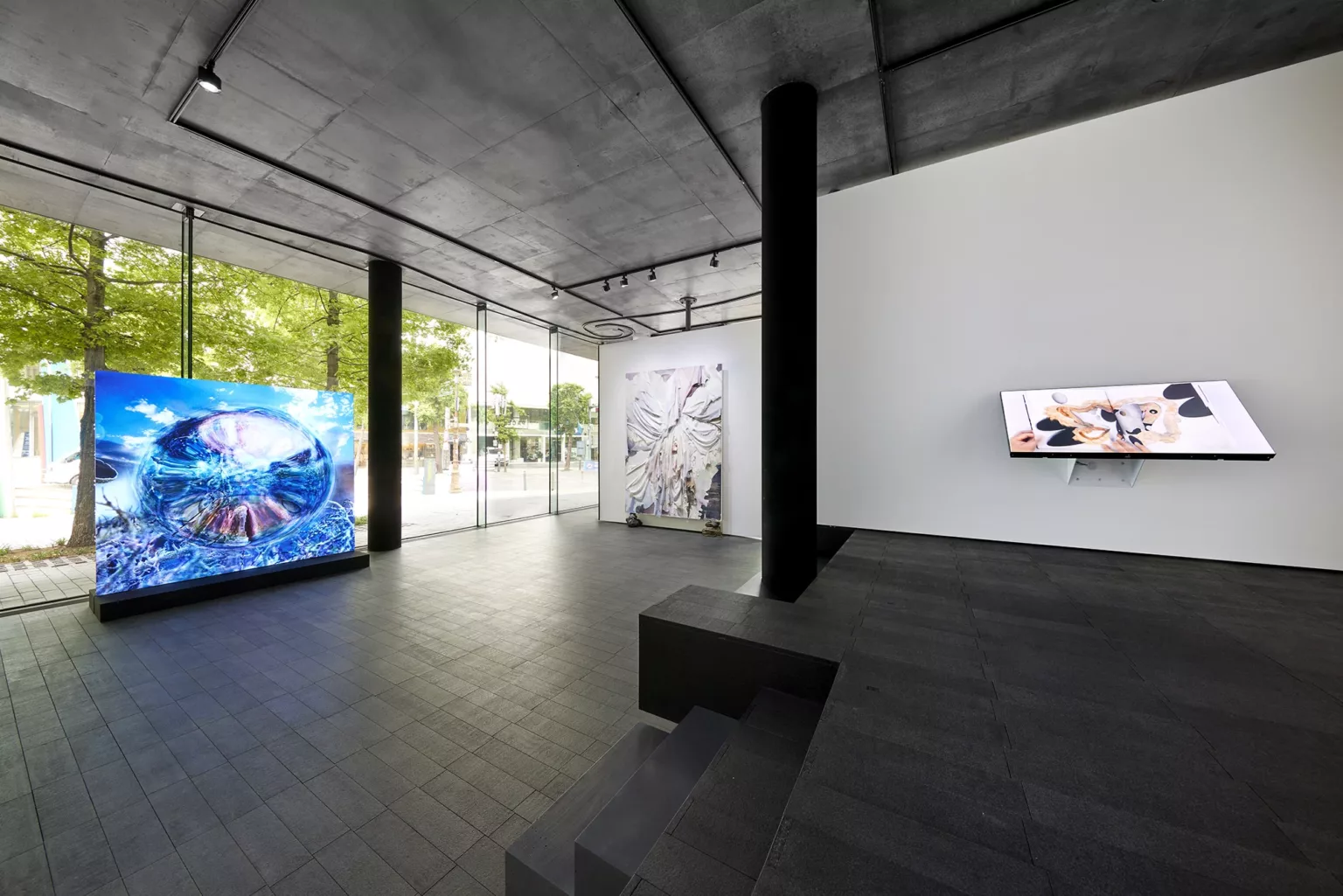
The final layer of the painting is the fact that it has become an object in
itself. As the exhibition preface explains, “I would like to place today’s
still life paintings as “suspended objects” in an exhibition space like a
halved watermelon,” 3 the painting filled one wall, right
next to the entrance to the small room of audiovisualpavilion, like a newly
painted wall. It cuts through the space of reality, as if slicing through a
cross-section. At this time, the light of the sun from the entrance
illuminated the painting: the space where the apple she initially brought as
the subject of the painting was originally located was a digital world in which
multiple suns coexisted, but in the final stage, it had entered the space of
the here and now, where only one sun exists. This gives the painting an
identity as an object placed in real space, beyond the possibility of
reproduction or a laboratory for technological exploration, and takes on a
third layer beyond the double layer of digital screen and canvas surface.
The methodology of imitation
By the time Heemin Chung released her apple painting to the world, in 2018, a
year earlier to be precise, her interest had expanded to the thickness of the
paint layer. For her, thickness actually refers to the thickening of a
material, particularly the concept of thickness as it is understood within the
genre of painting and what is realized through paint. The source of her
interest in thickness is in acrylic, a material she chose to overcome the
technical constraints of oil paint, and the reason for her interest in acrylic
is that it employs a methodology of imitation to assist oil paint. During this
period of transition in her practice, she devised a method called
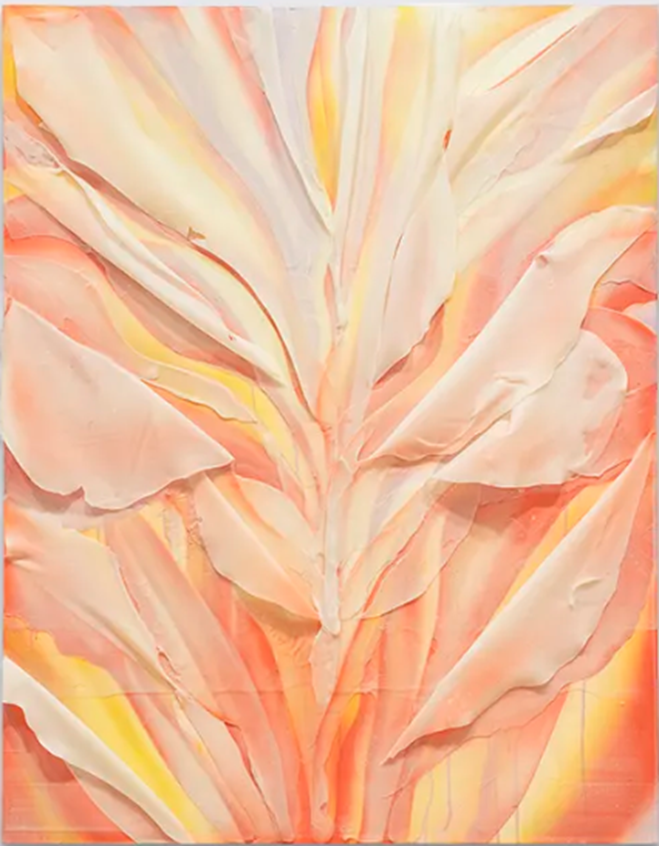
“modeling.” In her hand was Gel Medium, a supplement that maximizes the
effectiveness of acrylics. As a painter, her concerns in the apple painting
extended to painting with thick layers of water-based paints, and gradually,
she captured the chain reaction between the three substances in her paintings:
acrylic as a device to imitate oil painting, and gel medium as a device to
support acrylic.
Acrylic
is a material intended to improve the art of painting in terms of efficiency
beyond the limits of oil. In most of its effects, such as color, gloss,
and texture, acrylic mimics oil painting. This means that acrylic is not a new
material that has never been used before, but rather a material that has been
developed from the history and role of oil, a material which acknowledges oil
as its parent, and therefore, with some exaggeration, has the properties of a
substitute. As always, oil, the most traditional medium for painting, is an
oil-soaked material that requires a great deal of time and effort to build up a
physically solid layer. To overcome this slow drying and thinness, acrylics
were developed, which are paints based on water rather than oil.4 Because
water-based acrylics do not contain slow-drying oils, they can be airbrushed to
create thin, clean layers, or thickened to create chunky layers quickly.5
Gel
medium, meantime, is a supplement that comes in gel form, as the name implies.
When the pigments that give acrylics their color are removed, all remains is
the binder, the substance that binds the pigments together and makes the paint
stick to the canvas. The clear, sticky binder is made into different types of
mediums with varying degrees of gloss, viscosity, and unique additives (such as
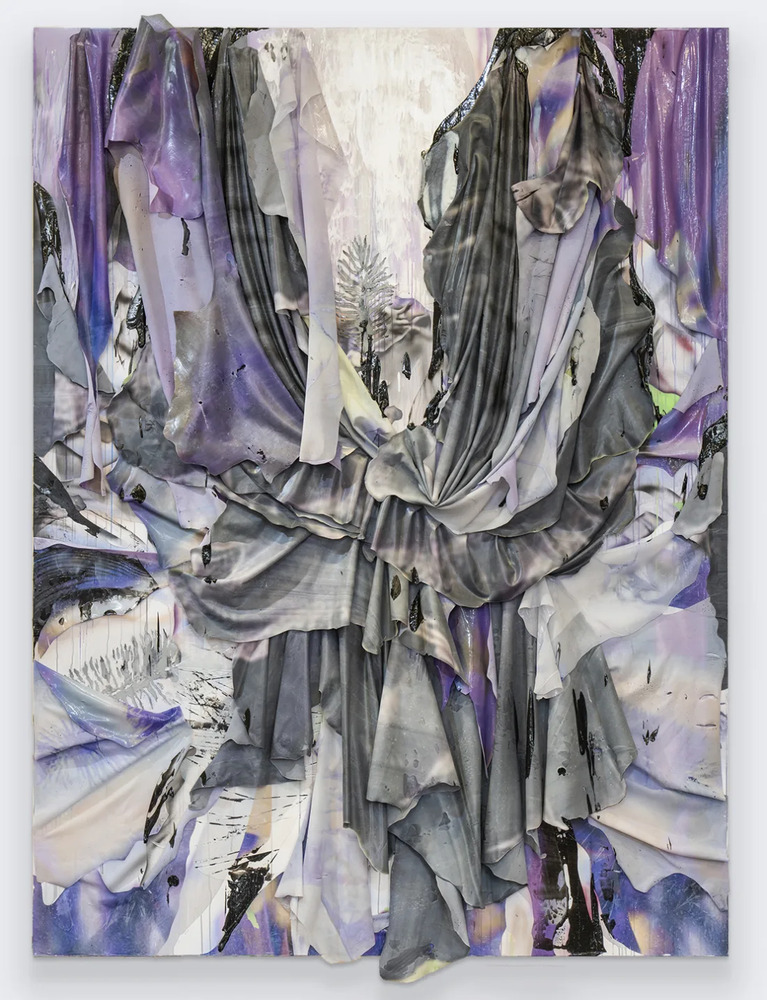
glass, sand, etc.). Gel medium is not just paint that can be spread, but can be
“sculpted” into three-dimensional shapes by adjusting their thickness with a
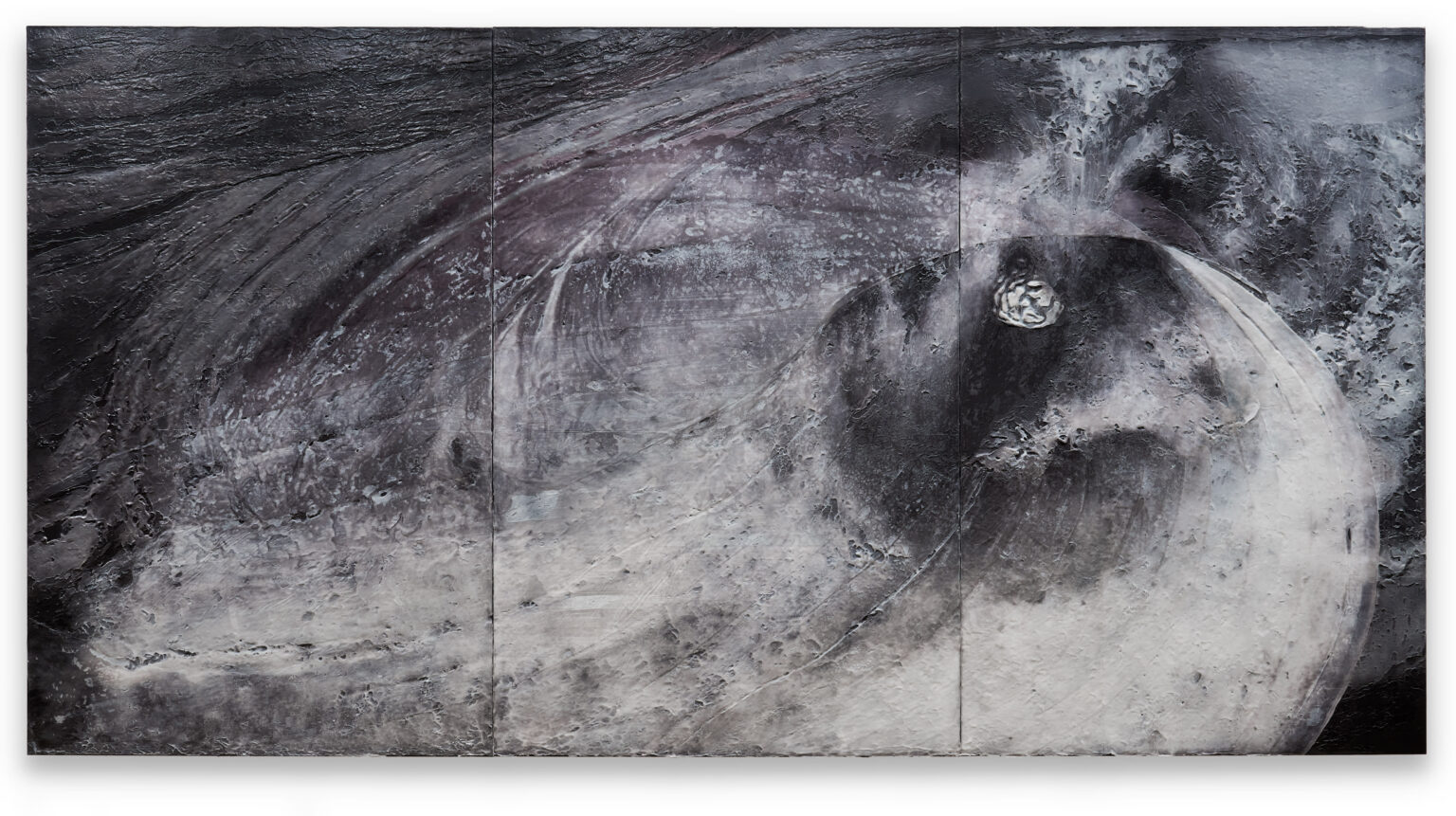
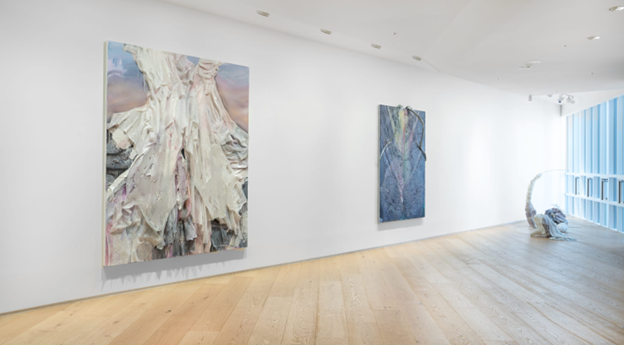
brush, knife, or hand. These materials turn the paintings that have been
characterized by the projection
of the third dimension onto the second dimension into objects that actually
belong to the third dimension. Of course, in the process, if a painting is
always based on a canvas, it does not become a sculpture. It just exceeds the
sculpture’s task of dealing with the three-dimensional world.