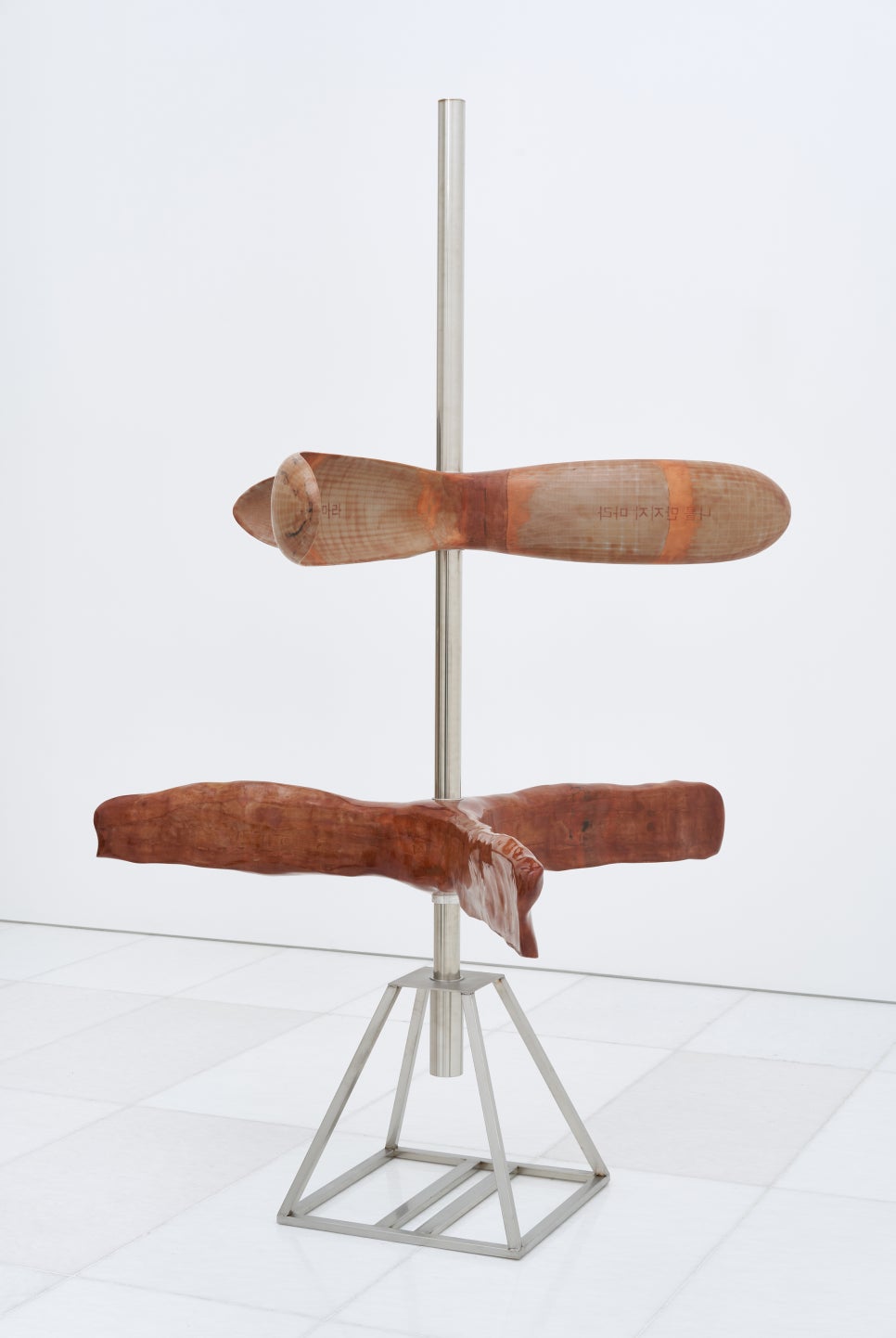
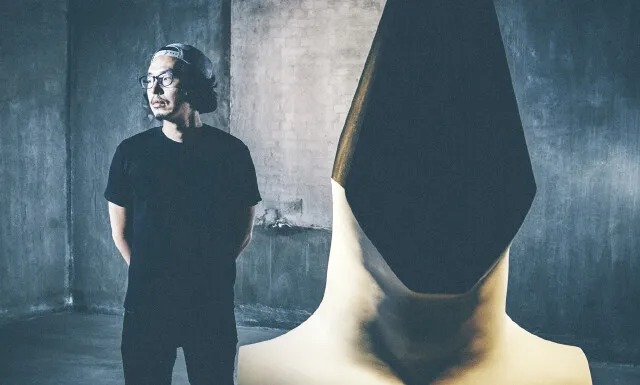
Inbai Kim’s exhibition 《Eliminate Points, Lines and Planes》 at ARARIO GALLERY SEOUL may be described as a rebellion of the body against the ocularcentrism of modern culture. This is because the exhibition stages a reversal in which, rather than the eye looking at the body, the body looks at the eye. Points, lines, and planes exist only within human visual concepts; they do not exist in nature.

Maurice Merleau-Ponty, who rejects the notion of time as a succession of discrete events, states in The Visible and the Invisible that real space-time contains neither points nor lines. Within this mode of thought, the primordial rational truth that a = a—the principle of identity—disappears, and all perception is understood as movement. For Kim as well, the line is a medium, while the point is merely a center of forces.
Yet vision, the most conceptual and abstract of the five human senses, tends to establish geometric elements such as points, lines, and planes as coordinate axes. These coordinate axes form the basis of speculative philosophy. Speculative philosophy is “the endeavor to frame a coherent, logical, necessary system of general ideas in terms of which every element of our experience can be interpreted” (Alfred North Whitehead). Incapable of accommodating change, speculative philosophy rejects plural realities and adheres to “a necessity that is only one possibility” (Merleau-Ponty).


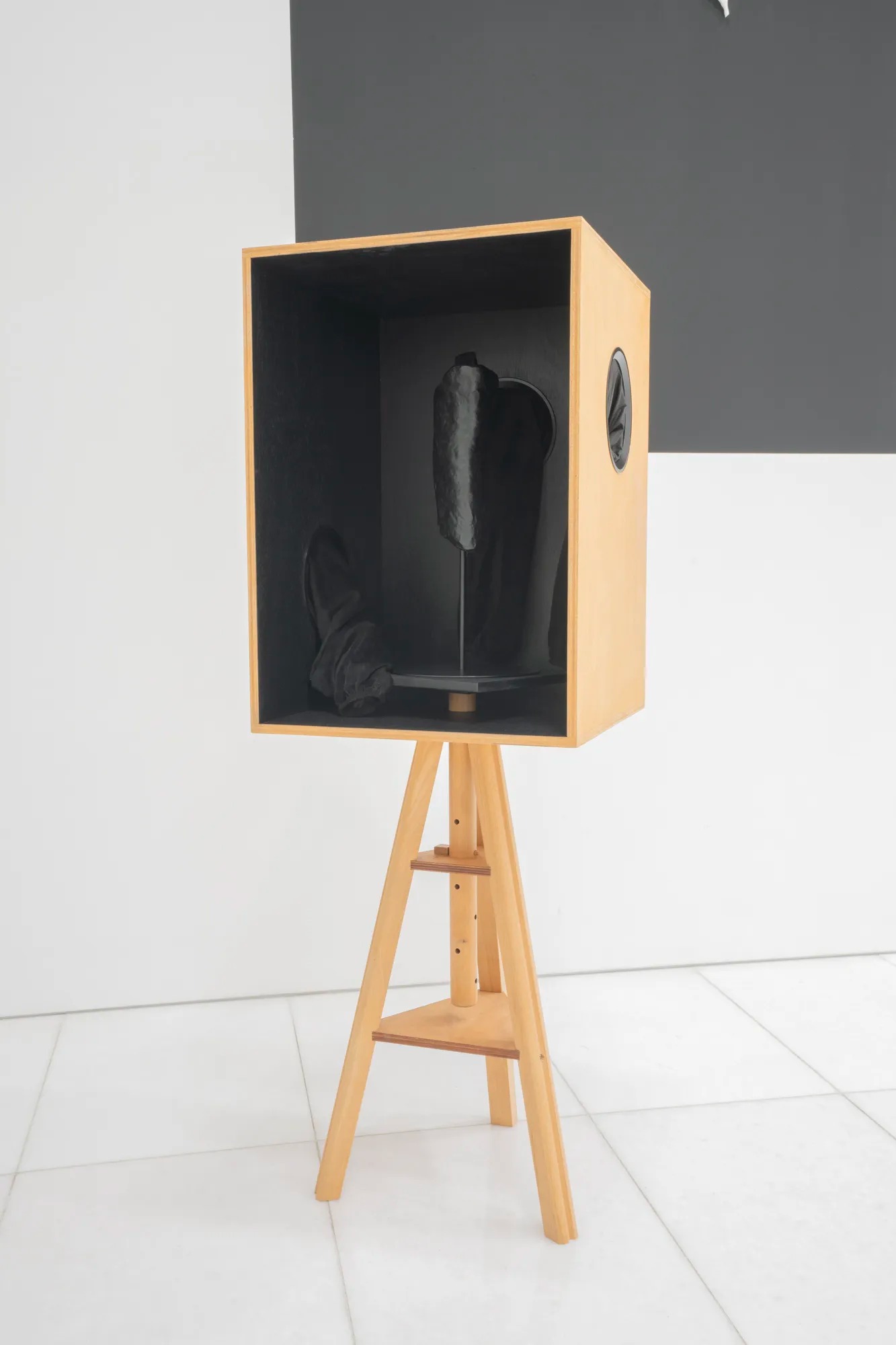
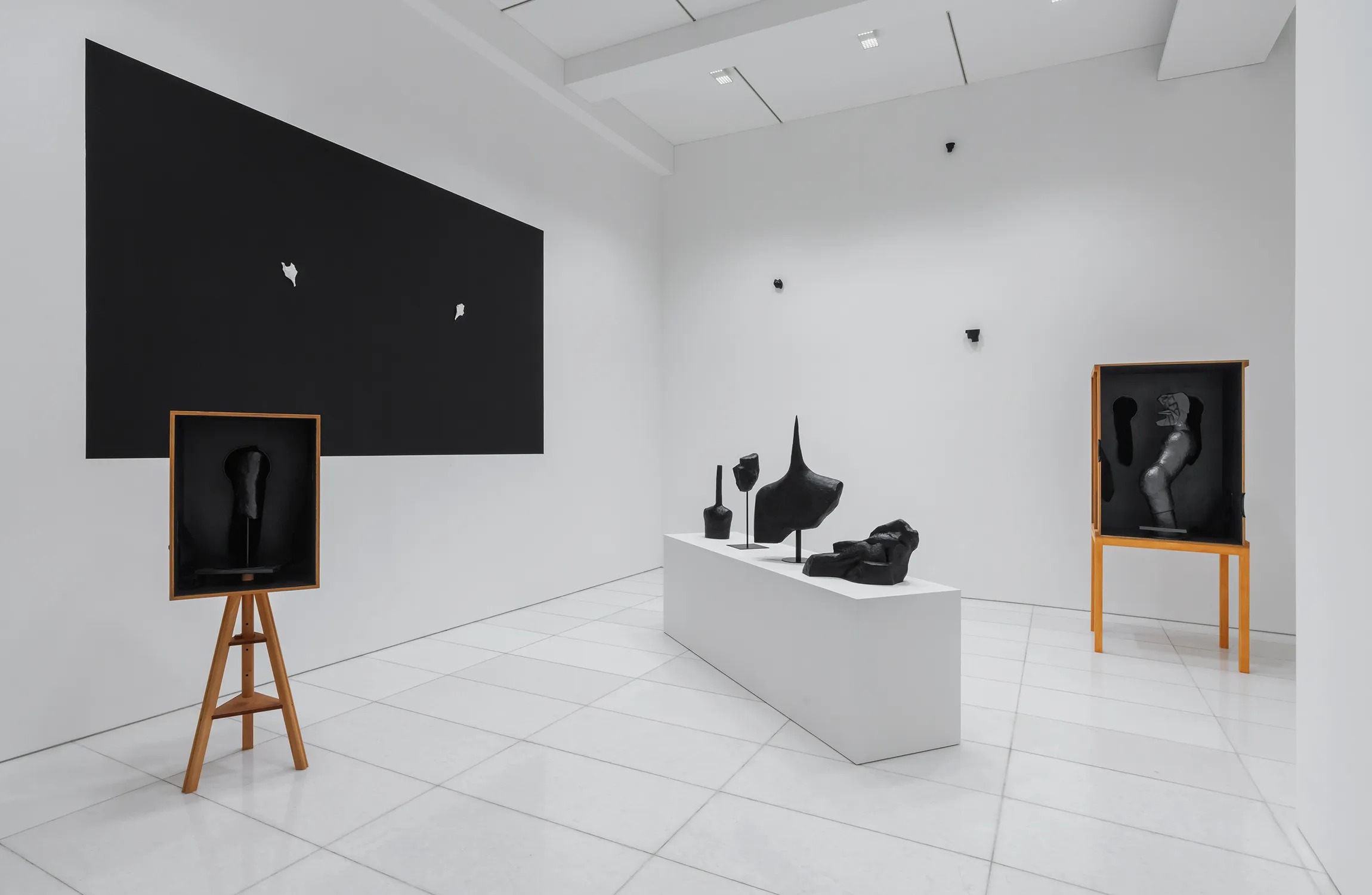
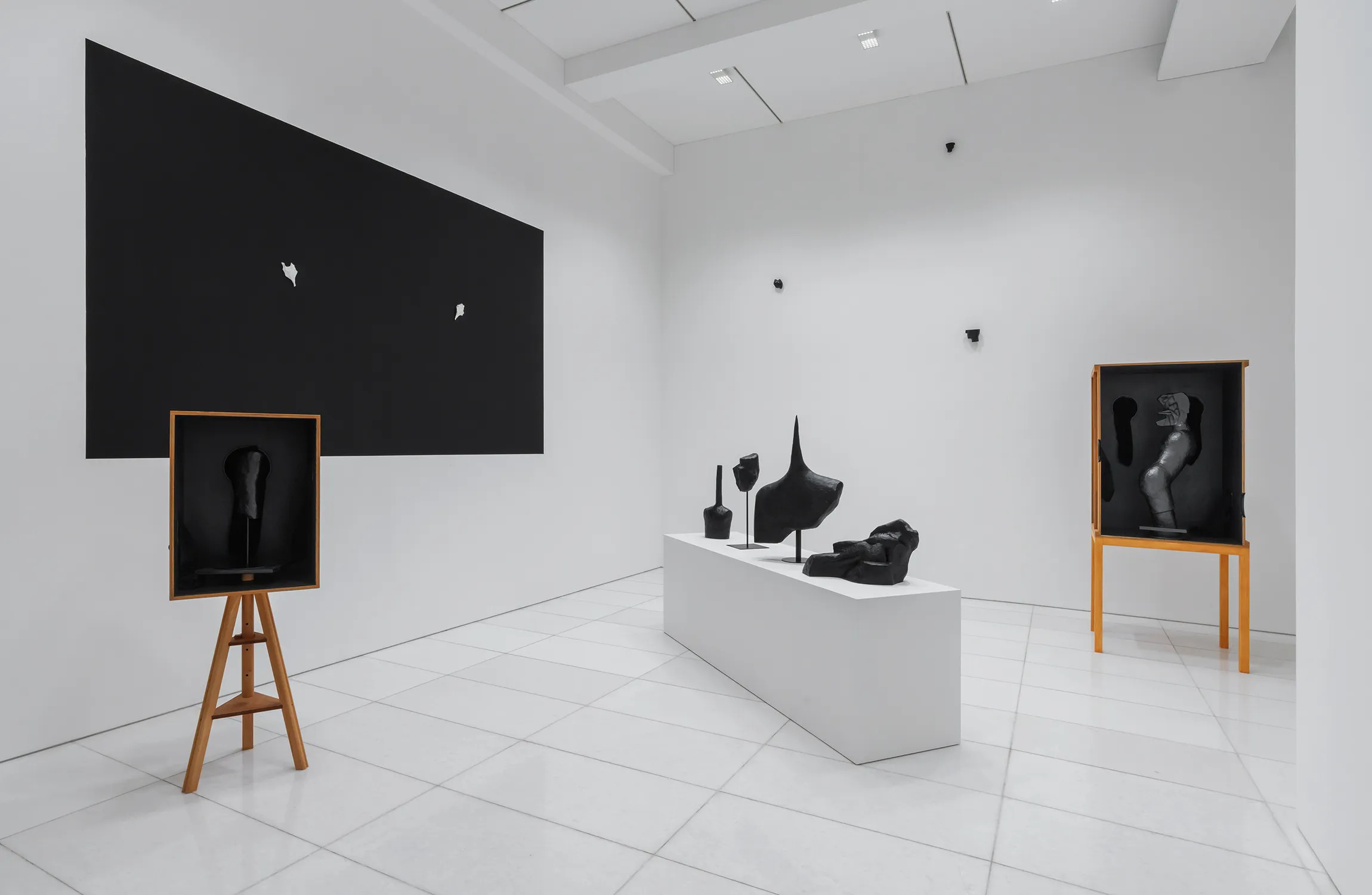
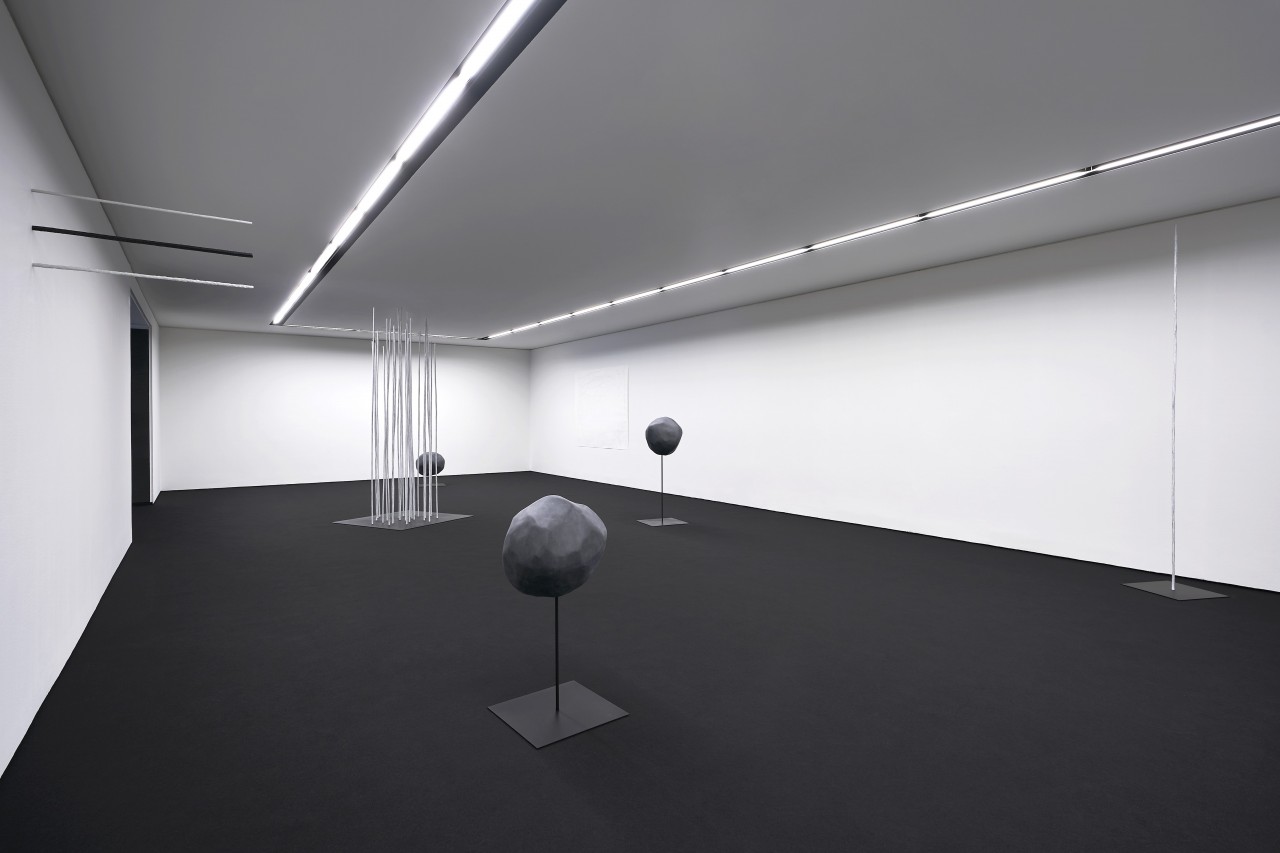
Installation view of 《Eliminate Points, Lines and Planes》 © ARARIO GALLERY

In Inbai Kim’s work, the body—which disrupts and relativizes vision fixed by concepts—is invoked as a representative of nature that cannot be codified. In his work, the body is not a microcosm that echoes the order of the macrocosm, but rather skin or flesh that shifts fluidly like a Möbius strip.

As seen in Not Afraid of the Big Bad Wolf (2001–2011), which depicts a half-human, half-animal being, and Alarm (2009–2011), which presents a phallic female figure, beings whose species and gender become uncertain through slight transformations frequently appear in Kim’s work. The body is not fixed according to some innate essence, but is merely a series in which different forces are realized and different rules determine its arrangement each time.

He states, “Classification, understanding, and logic are conspiracies designed to bring things to a standstill” (artist’s note, 2011). In his work, the face, positioned at the pinnacle of the human figure, is not treated as an inviolable and sacred order but as an extension of the body, subject to constant transformation.

Nature, represented through the body, does not remain still but is filled with indeterminate elements carried along by the flow of time. Yet although the body is positioned in opposition to concepts and vision, it remains far removed from an anarchic feast of flesh and bodily fluids crossing boundaries, or from rampant objectification and fragmentation.

Although Kim’s work dismantles conceptual vision represented by points, lines, and planes, it is so rigorous and static that it evokes a ritual space. The figures arranged like idols on an altar in the dim exhibition space gaze at the viewer without revealing their own faces—their identities. Eyeless faces watching the viewer from multiple directions inspire fear and awe like an omnipresent deity.

Figures stretched by some powerful force and abruptly severed are arranged like pieces on a chessboard. The works assume strategic configurations through which various narratives and imaginings become possible depending on their combinations. Although his works remain within the most fundamental sculptural framework of the human body, movement lies latent within stillness, and discordant orders within alignment.
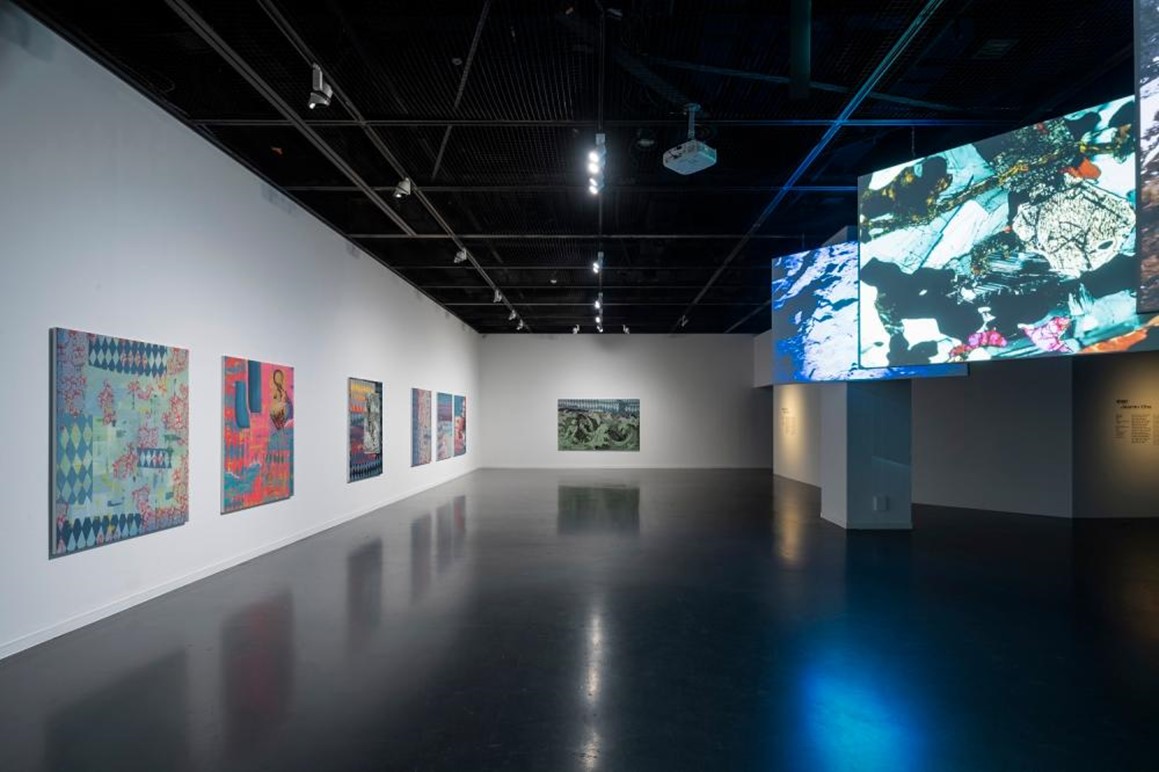
In both his first solo exhibition, 《Stand on the Edge of Dimensions》 in 2006, and 《Move in Earnest》 in 2007, there was an active interchangeability between drawing and sculpture, and much changed within the dimensional interval when a drawing was translated into sculpture.

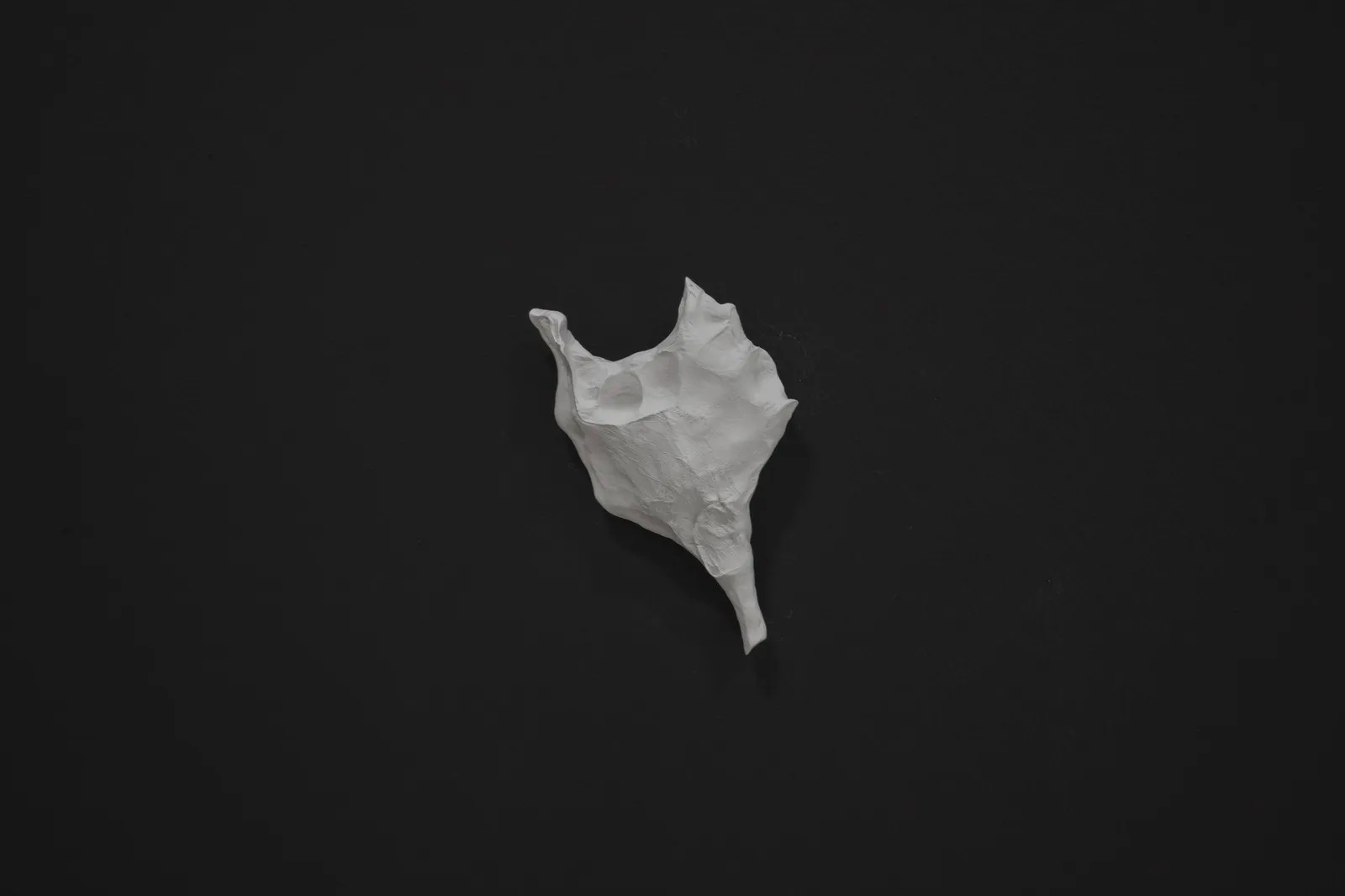
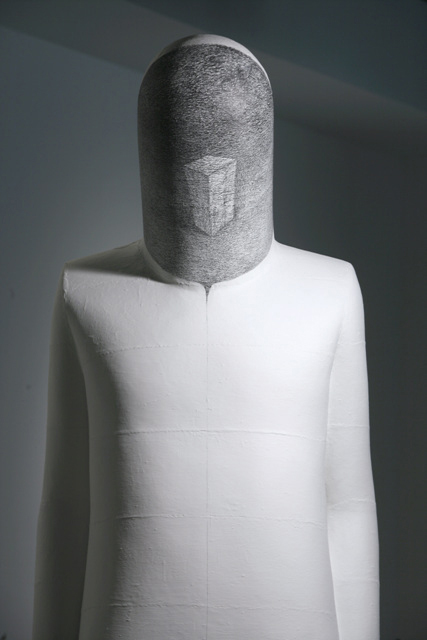
Like Turbulent O’Clock, presented in New York in 2010 and Cheonan in 2011, the wire figures depicting bodies in successive stages of movement amount to drawing in space. The white figures in the present exhibition, made by directly spraying expanded resin without an intermediate sculptural process, are likewise painterly.

Although the exhibition calls for the elimination of points, lines, and planes, these elements are not absent from Kim’s works. Just as anti-religion remains an extension of religion, and the transgression of taboo constitutes another aspect of the sacred, an escape from geometric axioms is merely replaced by another set of rules.

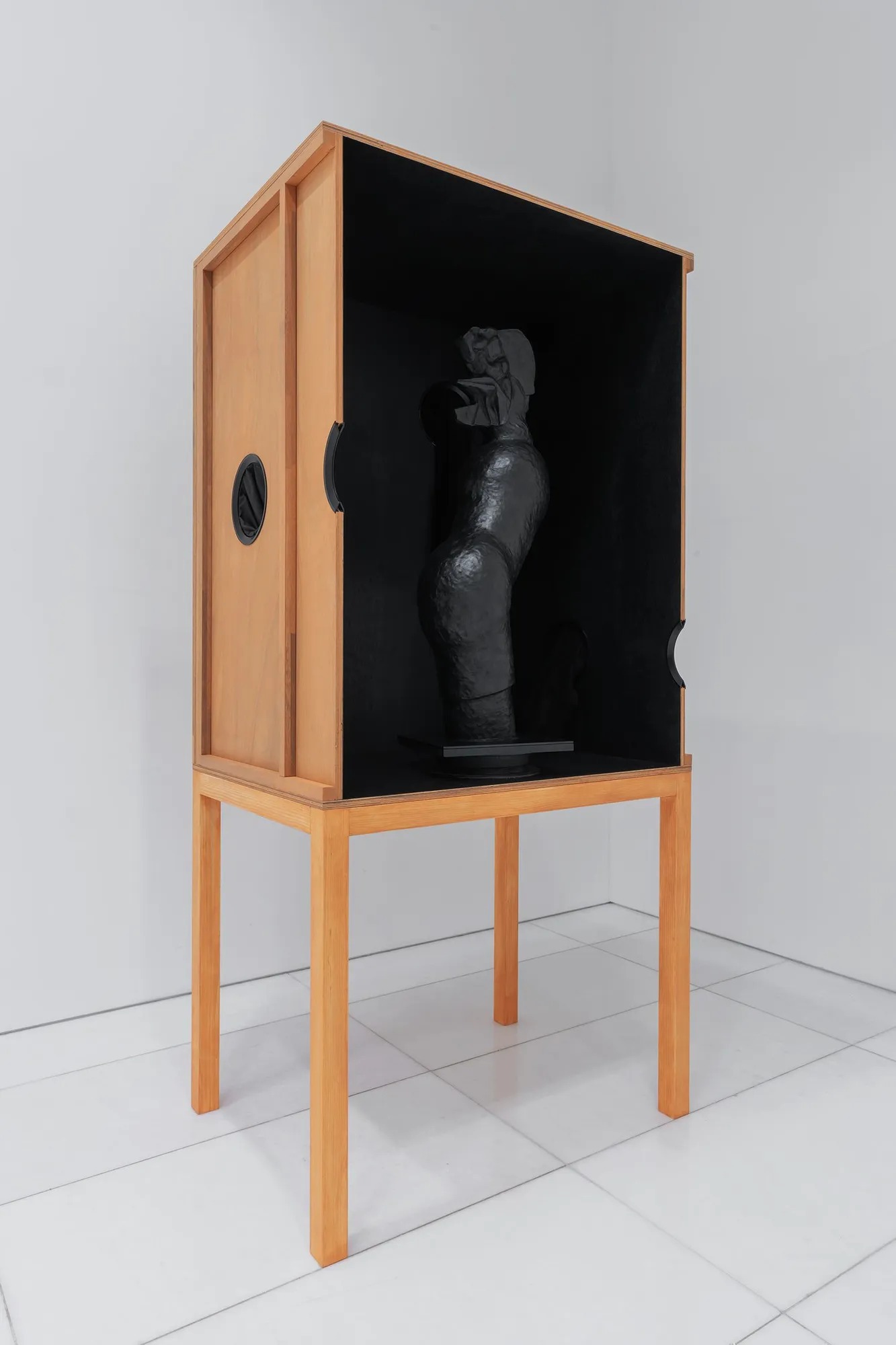
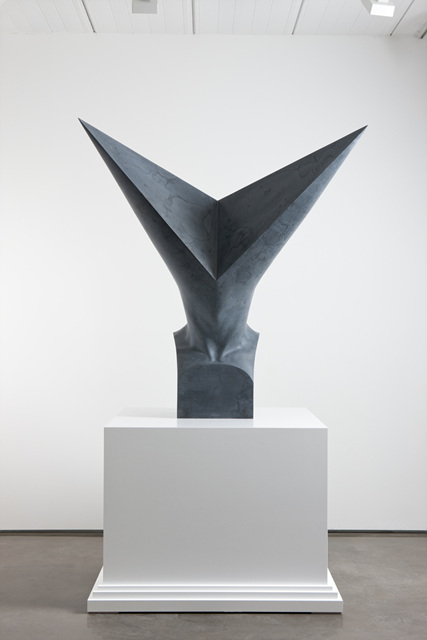
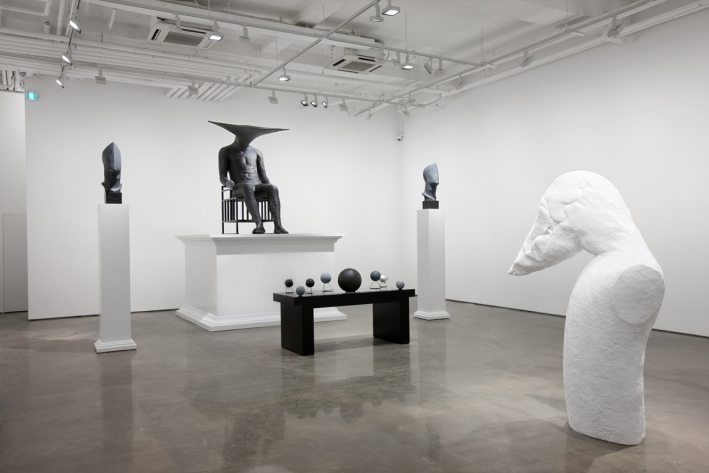
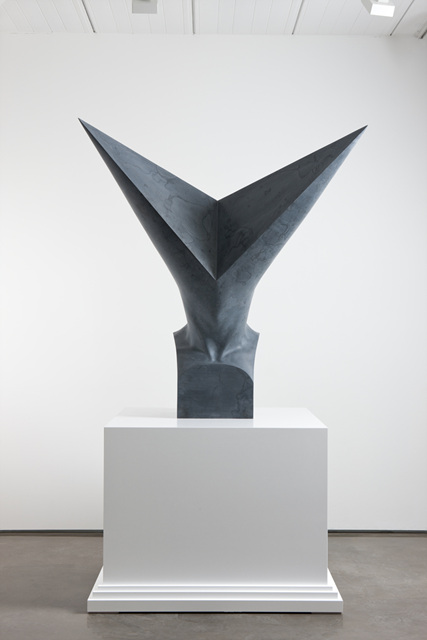
In the basement gallery, sharp figures with their faces sliced away flank a monumental seated figure dominating the center, while at the very front stands a figure with an edge running down the middle of its face. The only discernible element in this sharply divided “face” is an unfamiliar angle. The transformation imposed upon the most familiar part of the human body is startling.

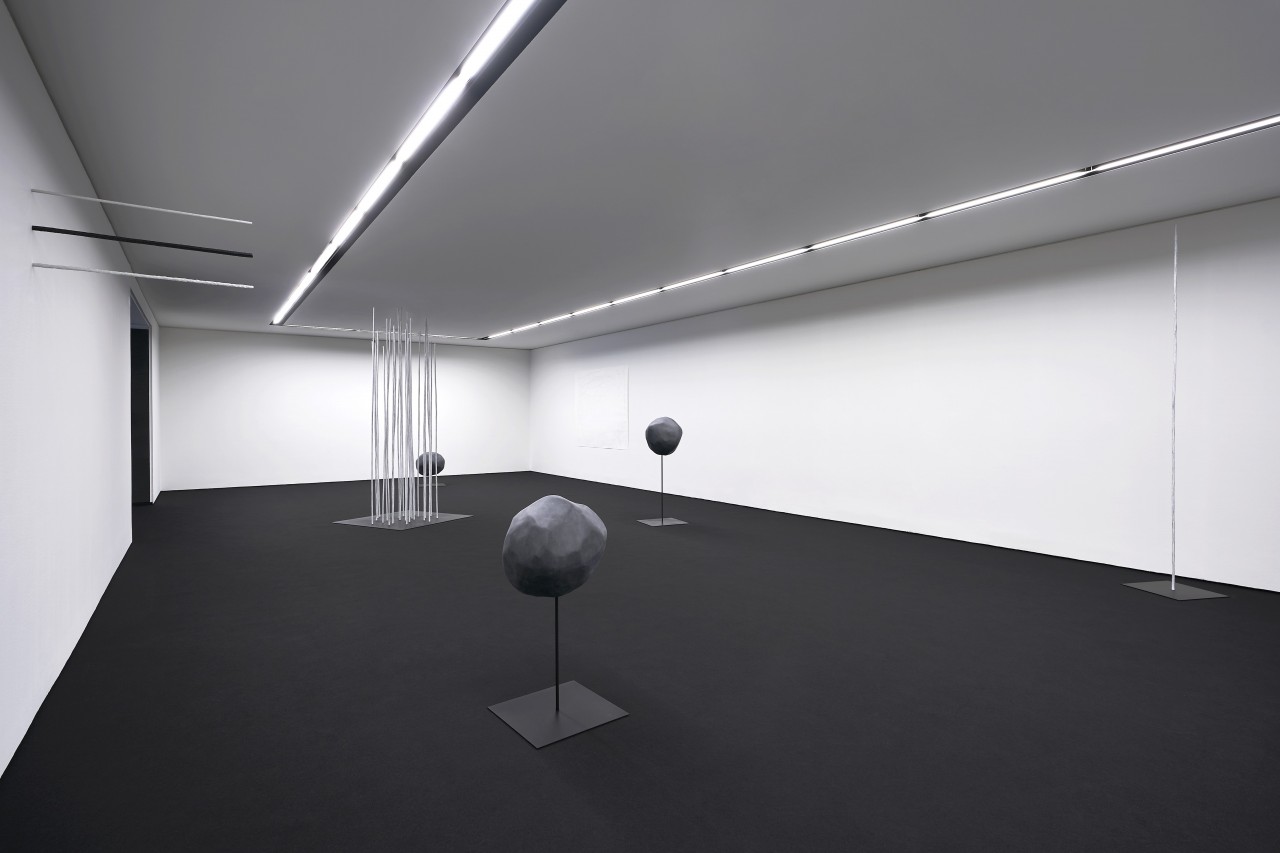
Here, one seems even to hear sounds inaudible within the dimensions of everyday life. In this exhibition, where sharply transformed heads are particularly prominent, the largest work is a figure whose face has been compressed horizontally like an enormous pair of pincers. Both wrists are severed and replaced by round spheres. Considering that the achromatic spheres placed in one corner of the exhibition space symbolize clocks, the spheres at the hands appear less as signs of mutilation than as markers of an omnipotent being who governs time.


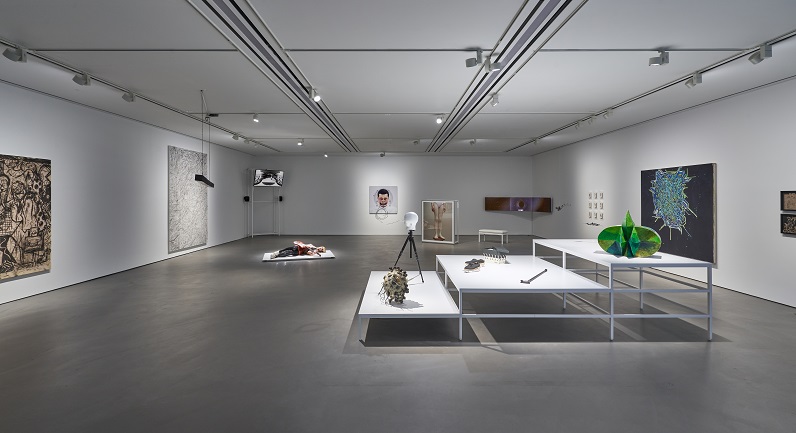
Installation view of 《Eliminate Points, Lines and Planes》 © ARARIO GALLERY

Even within a death-like state of stillness, a distinct temporality led the artist to introduce an image—the sphere—that retains the potential for movement. Video and music, which the artist is said to favor, inherently partake of temporality. Temporality, a major element in the transition from classical to contemporary sculpture, came fully to the fore in the exhibition 《Turbulent O’Clock》, held at ARARIO GALLERY CHEONAN in 2011.
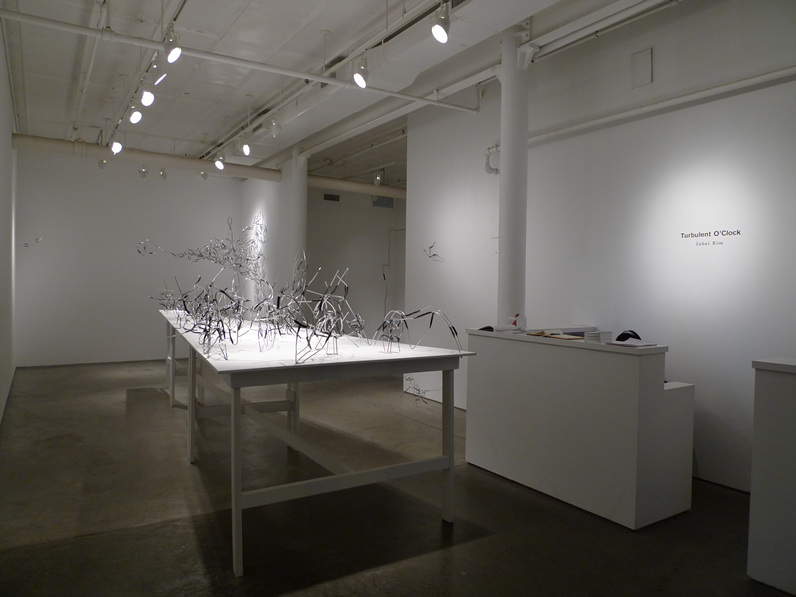
In this exhibition, Rising Fastball compressed the successive motions of a pitcher into a single pose, while Clock arranged male torsos like luminous bodies whose genital areas gradually turned red. What unfolds along the axis of time is nothing other than transformation. In the present exhibition, the face and hands—the two most human, and therefore most divine, parts of the body—are transformed into forms beyond imagination.

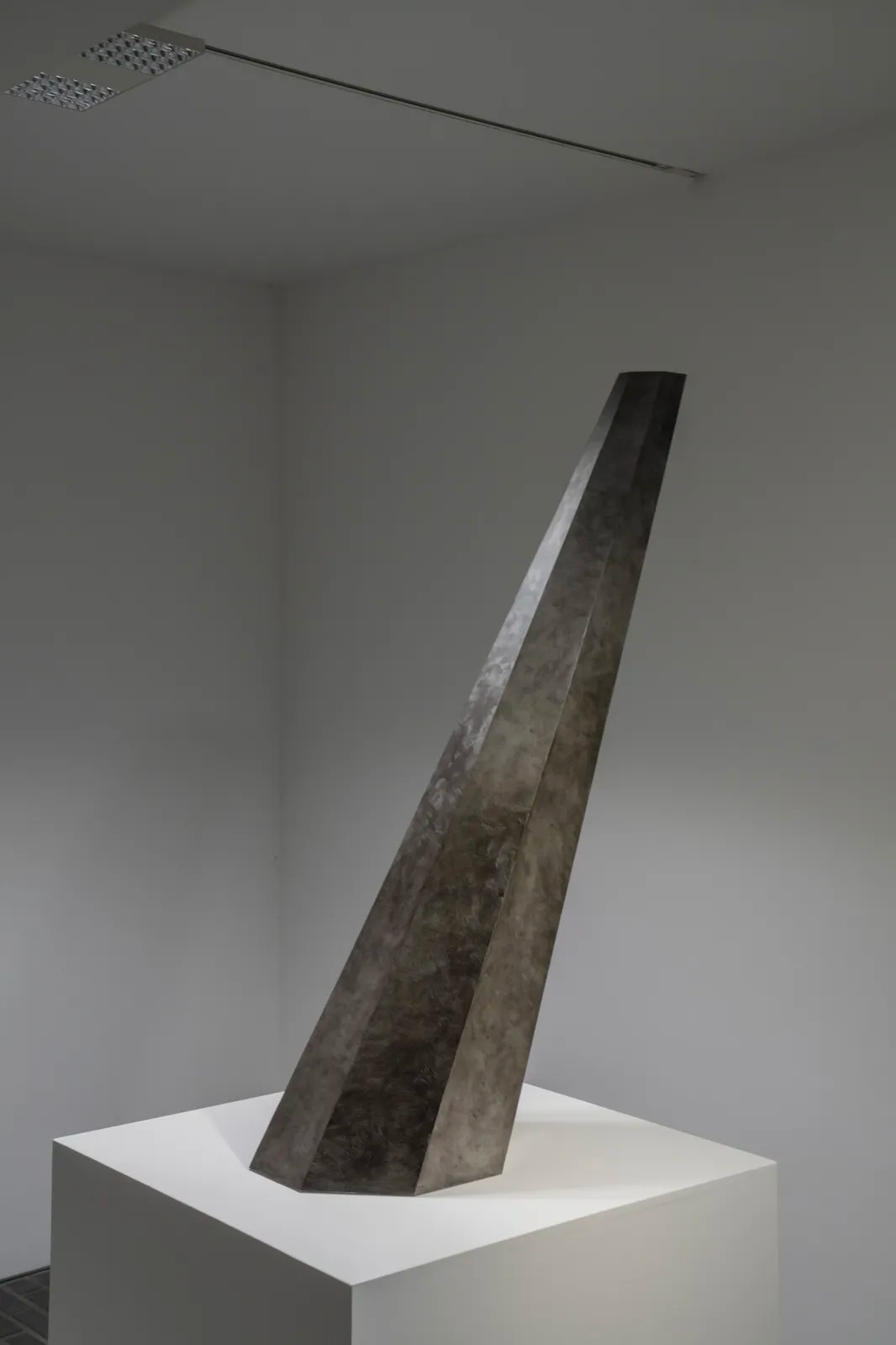
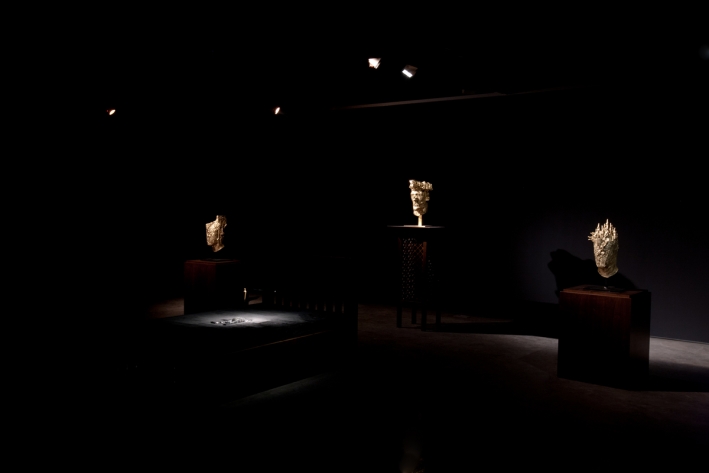
The roughly rendered, massive bodies violently evoke the most sensitive boundaries of the human body. A small pair of brass human figures placed among menacing statues with blade-like edges establishes a contrast between light and darkness. The black figures in the darkened space resemble a landscape of the unconscious. Within this profoundly dark space, the glow of brass holds only the fragile presence of a small, flickering candle. In the realm of the unconscious, human reason is radically relativized.

Although Kim’s works are static, abrupt differences in scale and brightness generate a latent sense of movement. Examples include the small brass-colored human figures surrounded by dark statues, and a human figure that seems to dissolve into a black dot beneath the piercing gazes of brass-colored heads. In the latter work, the headless and armless body makes the bed appear enormous because of its own diminutive scale.

The brass-colored heads positioned opposite the bed form a trinity. Centered on a crown-like head, the figures on either side appear to bear jagged, fantastical rock formations upon them; despite their sacred colors, numbers, and arrangement, they are monsters in which certain organs are absent while others proliferate excessively. The brass-colored figures, which also manifest light itself, are crushed beneath the excessive weight upon their heads and resemble chaotic ruins.

Yet this luminous trio of monsters also possesses an aspect of sacred order, like the linguistic symbols that govern human society. The true nature of the tiny human being trapped within the black cosmos remains shrouded in mystery, as the threatening cascade of light causes fear and sacredness to coexist. Those eyeless figures can only be seen; they themselves do not see. This blind gaze, reminiscent of spiteful reason, seeks to reduce the human being—alienated within the world to which it belongs—to a small stain in the darkness, or to an “absolute prime” (Whitehead): that is, a point.


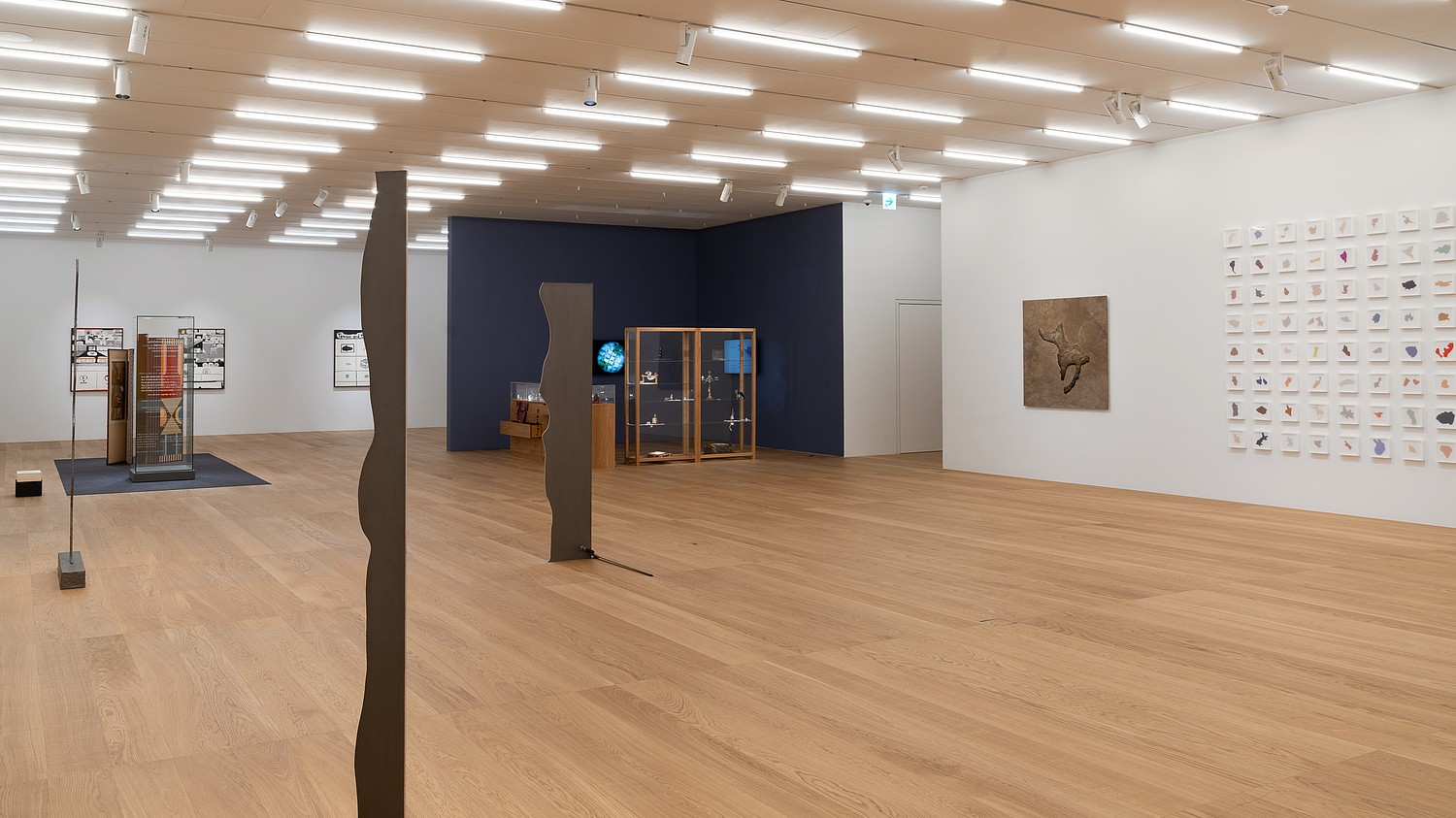
Installation view of 《Eliminate Points, Lines and Planes》 © ARARIO GALLERY

Like the sun, the screen of signs that exists prior to the human subject determines the human point of view in advance, much like points, lines, and planes. Can human beings escape the network of meaning determined by these external structures? The encounter between the brass figures and the black human figure expresses the split between the gaze and the eye. In the arrangement devised by the artist, the object cannot be seen clearly within the beams of light that induce the gaze.

In The Split between the Eye and the Gaze, Jacques Lacan argues that the gaze precedes the eye. According to Lacan, the gaze symbolizes what we discover within the field of vision and constitutes an experience encountered suddenly, in the form of a mysterious contingency. At the moment when the world triggers the gaze, a sense of unfamiliarity also begins. I look in only one direction, yet I am seen from every direction.

Through the split between the eye and the gaze, drive emerges within the visual field. The points of an ultimate gaze, which are nothing more than fantasies, generate endless desire. Within the overall static composition of intersecting vertical and horizontal axes, another brass-colored human figure is sufficiently evocative of the iconography of a particular religion.

Its head is shaped like a cube; the wrists of its outstretched arms have been severed and replaced with the tiny hands of a Barbie doll, while the male genitalia are drawn back behind the legs. The absence of eyes, severed wrists, and concealment of the phallus all evoke castration.

Although the human figures in this exhibition appear in a wide range of variations, the incomplete—indeed, fatally damaged—human (= male) fundamentally calls patriarchy, reason, and vision into question. Axiomatic systems represented by points, lines, and planes are not so much laws of nature as human rules. Precisely because they are rules, they can and must be transformed.

A formal system, which constitutes only a provisional truth, claims absolute self-sufficiency, yet remains uncertain insofar as it cannot be demonstrated on its own terms. In order to render uncertainty certain, human vision tends to separate subject from object. Within this abstract separation, the fluctuations of embodied sight and the operation of diverse visualities are suppressed.

A visual epistemology detached from and transcending the body extends from Renaissance perspective to the viewpoint of the camera, culminating in the present, when the perspective of the mechanical eye has become generalized. In Modernizing Vision, Jonathan Crary points out that such vision organizes the world according to systematic and immutable constants, expelling any discrepancy or irregularity from those codes.

Through distinctive representations of the human body that emphasize both explicit and latent movement, Inbai Kim’s works see without eyes—or see through the body. The opaque layer of the body transforms the virtual transparency inherent in visuality. The art-historical significance of these works lies in their alignment with a trajectory in contemporary sculpture that seeks “to corporealize the visual against disembodied visuality” (Rosalind Krauss).

References