Chu Mirim has consistently observed urban landscapes and
translated them into geometric two-dimensional works and installations. Her
works incorporate pixel-art-like units, either individually or in combination,
to depict everyday life in the city. For an artist who was born and raised in
an urban environment, it is natural for her experiences of city life to form
the foundation of her work. Likewise, as someone from a generation familiar
with the internet and computer interfaces, it seems only natural that her
visual thought process is influenced by digital media.
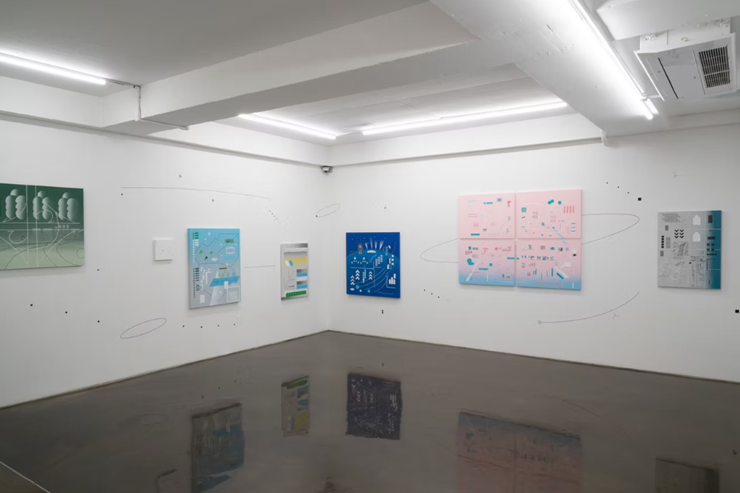
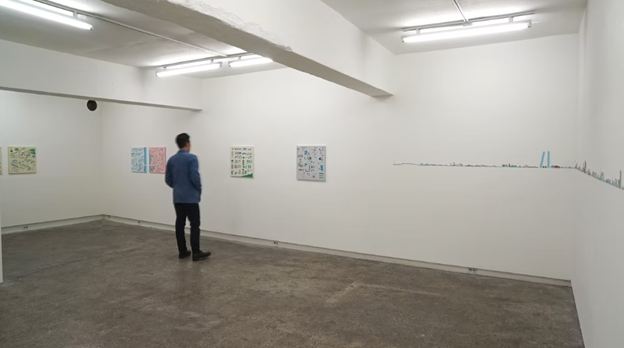
Her solo exhibition 《Satellites》, held at Gallery Lux, showcased
works depicting everyday life and landscapes in Seoul and its surrounding urban
areas, including apartment complexes, dense clusters of buildings, and the
roads that connect cities. This exhibition was particularly significant as it
reflected the artist’s personal experience of moving through Seoul’s satellite
cities since childhood. Chu happened upon a copy of her Resident
Registration Abstract, where she saw a record of all her previous addresses.
This document was not just a personal record of movement but also a testament
to her family's life, which had been inevitably influenced by three decades of
Seoul’s urban expansion, real estate policies, and the development of new
satellite cities.
Yet, the exhibition does not dwell solely on individual memories;
rather, it evokes the shared experiences, aspirations, and disappointments of
many who have lived amidst high-rise apartments and skyscrapers. Beyond the
pursuit of a comfortable life, the exhibition reminds us of the disillusionment
and struggle of chasing the myth of real estate investment. While the works and
the exhibition itself are imbued with nostalgia for the artist’s childhood and
a warm, understated humor about urban life, they do not erase the harsh
realities surrounding real estate and urban development.
Pixels and Windows
Chu Mirim describes herself as someone who exists in both the
physical city (offline) and the internet (online). She emphasizes that the
online environment, connected through computers and the internet, is just as
integral to her life as the tangible urban environment. Having first worked as
a graphic designer before transitioning into an artistic career, she is deeply
familiar with computers and the internet—not merely as tools, but as mechanisms
that shape computational thinking. For Chu, the desktop
screen of her computer serves as a kind of sketchbook. Her working process
begins with all necessary windows open on her desktop, making it both the
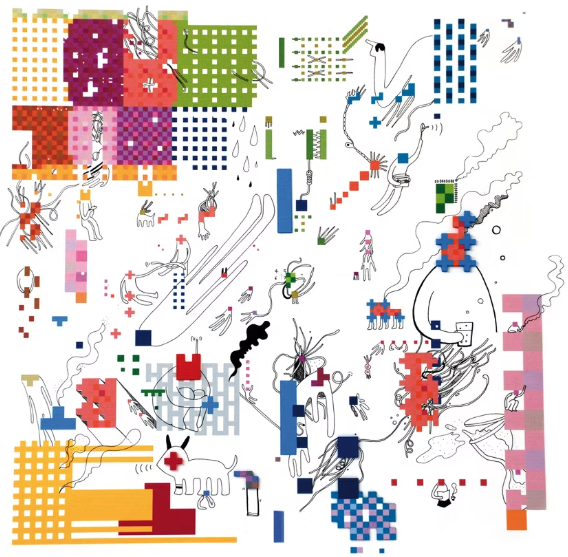
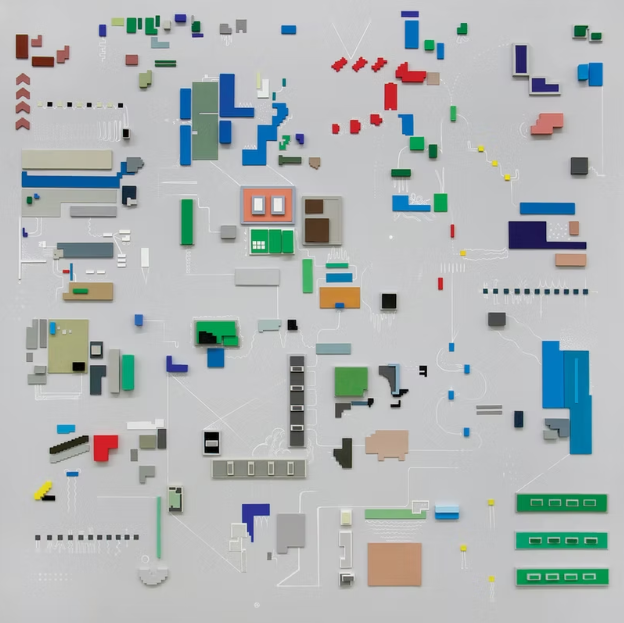
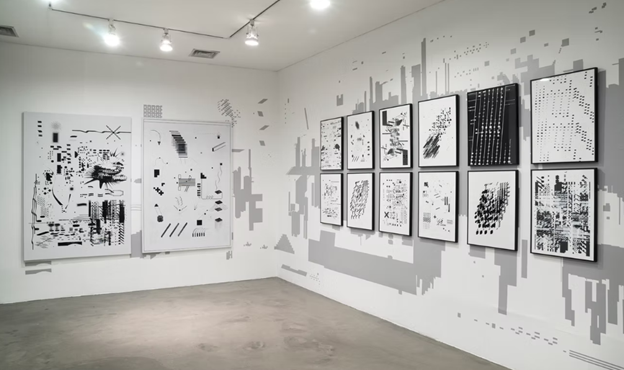
source and the starting point of her creations. In her work Interface(2020),
she constructs a composition reminiscent of multiple windows, graphic units,
and grid lines, suggesting that the screen itself is her personal workspace.
Had she used a horizontally elongated canvas similar to a monitor’s aspect
ratio, the connection to a computer screen would have been even more direct.
However, she deliberately used a vertical canvas, approximately the size of a
typical room window, making it resemble an architectural window rather than a
digital display. As a result, the composition appears as if it is framed by a
window through which one views the city’s divisions and structures—yet, since
it originates from Chu’s digital workspace, this transition feels natural.
In fact, architectural windows serve as a significant framing
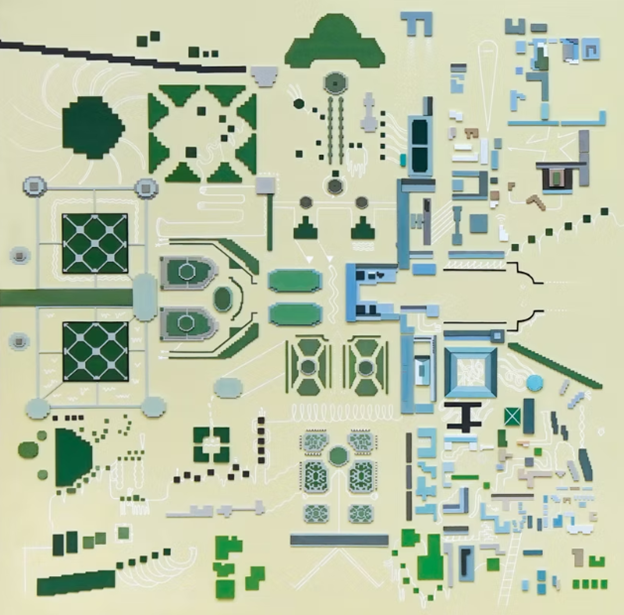
device in her work. The geometric forms derived from building exteriors and
window grids become both formal elements and narrative structures. In Castle(2020),
Chu presents a series of works resembling apartment elevations,
referencing large-scale branded residential complexes. The title hints at the
class consciousness embedded in real estate, but the content reflects both
reality and the artist’s romantic imagination. Using bright acrylic sheets cut
into geometric shapes—squares, rectangles, parallelograms, and triangles—she
constructs a colorful façade that resembles cityscapes filled with
high-rise apartments. Within these geometric frames, she illustrates scenes and
moments that could be observed inside or outside such buildings. Some images
even resemble emojis, evoking the familiar icons of smartphone chat
applications. These pictograms and symbols collectively depict the multifaceted
nature of life in both online and offline spaces.
A similar approach is evident in the video work Windows(2020),
where Chu creates multiple animated scenes within frames shaped like squares,
rectangles, and stair-like structures. These visual fragments include views
of apartment complexes, satellite navigation maps, comet trajectories, and
emojis—all elements associated with urban structures and digital screens. At
one point, the artist zooms into a satellite map until individual pixels become
visible, emphasizing the digital construction of urban imagery. Her works are
often mistaken for digital prints due to their clean lines and smooth
color fields. While her paintings are frequently introduced as pixel-based
paintings, it is important to clarify that they are not derived from
pre-existing digital blueprints but are hand-drawn works on paper.
When discussing pixels, many assume that “pixel = square”,
but pixels are merely the smallest units of a digital image—they are not
inherently square. However, because bitmap images often display grid-like
patterns when resolution decreases, many associate pixels with small
squares. Chu extends this concept, connecting pixels to urban windows,
metaphorically framing everyday city life through these digital-architectural
correspondences.
The Drifting Ones
In this exhibition, Chu reflects on her experience of constantly
relocating as Seoul’s satellite cities expanded. Satellite cities are
secondary urban centers designed to absorb population overflow from major
metropolitan hubs, and in South Korea, many suburban cities function
as dependent satellite cities rather than self-sufficient urban
entities. Since the 1990s, South Korea has rapidly developed new planned
communities, such as Bundang and Ilsan, which were followed by numerous
other New Towns. Having grown up in these rapidly constructed cities, Chu
frequently moved due to her father’s job relocations and real estate
investments, leading to a childhood of constant adaptation. She recalls how
these new cities, built under rigid urban planning, felt artificial
and impersonal, leaving her emotionally unanchored.
Her work Sweet Section(2020)
represents Seoul, the ultimate destination in South Korea’s real estate
aspirations. Unlike the actual complexity of Seoul, her depiction is more
relaxed, softened by a pink-toned background, making it seem like an idyllic,
comfortable city. Flanking this work, Icy Moon(2020)
and The Rabbit Hole(2020) reflect her thoughts on
satellite cities. The uniform cityscapes reminded her of Saturn’s icy
moon, Enceladus, evoking a cold and distant feeling. Meanwhile, the hidden
pedestrian paths connecting different cities—known only to local
residents—often became sites of territorial disputes. In Flyer.002(2020),
she highlights the interchangeability of real estate marketing slogans,
demonstrating how identical promotional phrases could be applied to various
cities like Wirye or Misa without seeming out of place.
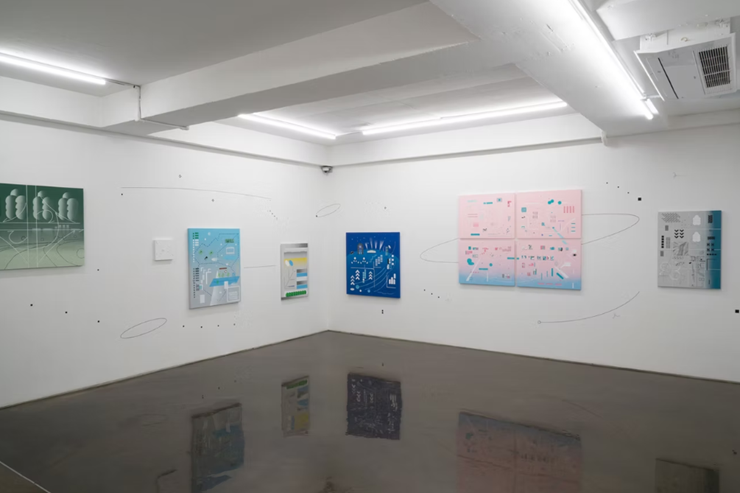
The exhibition visually conceptualizes Seoul’s relationship
with its satellite cities by likening them to the dynamic orbits of
planets and satellites. Works on the gallery walls were connected
by curved lines and dots, visually echoing planetary trajectories. This
arrangement made each piece appear like a celestial body floating in
space, reinforcing the theme of movement and displacement. The strongest sense
of weightlessness emerges in Interchange(2020), which
depicts a highway interchange—a transitional space between cities. The
circularly arranged trees and overlaid arrows resemble Andy Warhol’s Dance
Diagram(1962), evoking a sense of choreographed motion. The
circular movement suggests a light, buoyant dance, a fitting metaphor for
those drifting between Seoul and its satellite cities.
Finally, the artist presents Bubble Walking(2020),
a self-reflective work depicting a figure walking inside a bubble. Unlike
the real estate bubble, this floating sphere allows Chu to drift
freely between Seoul and its satellite cities. If there is no stable ground to
stand on, why not imagine defying gravity altogether?
In a time when housing insecurity has led to terms
like “jeonse refugees” and “hotel
squatters,” perhaps floating above the city is the ultimate form
of freedom.