Every Saturday was a day to hang
out with friends at Rodeo Street. The meeting time was 1 PM, the location
was Fountain Square. What did we do? Browse stickers at a stationery
store, eat instant tteokbokki and fried rice, go to a karaoke room, have a
parfait at Canmore, take sticker photos, and stop by McDonald's. It was pretty
much the same as Seoul. As a child, I believed that new towns in Gyeonggi
Province had everything Seoul had—just in a more convenient way. It was a
time of uncontainable excitement.
Starting with Apgujeong
Rodeo Street, countless Rodeo Streets have been replicated across the
country. Our society has accepted the ambiguous term "Rodeo" as a
generic noun for a bustling commercial area, to the extent that some districts
have even incorporated it into their official names. Apgujeong Rodeo Street
began as a luxury shopping district, but outside Seoul, most Rodeo
Streets simply signify a city’s central commercial hub. In Gyeonggi
Province, for example, places like Seohyeon Station Rodeo Street and Suwon
Station Rodeo Street refer to commercial areas around subway stations.
These places are typically anchored by a landmark shopping mall,
surrounded by franchise restaurants, cafés, karaoke rooms, PC rooms, billiard
halls, opticians, clinics, beauty salons—essentially, a mix of everything
necessary for daily life.
The city of
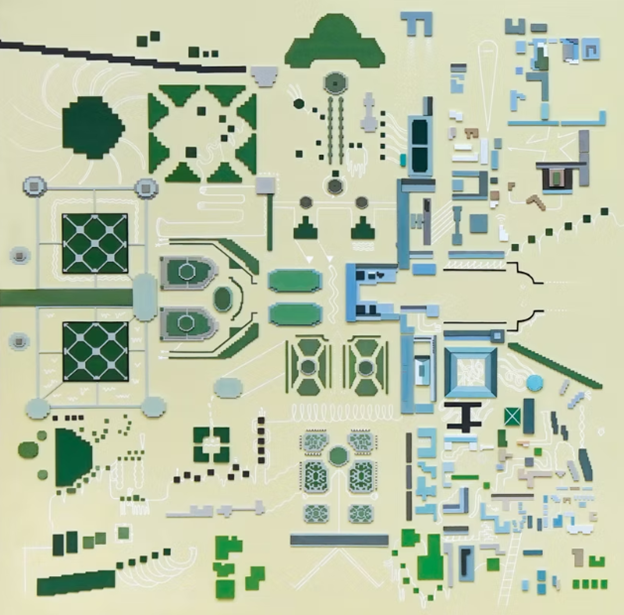
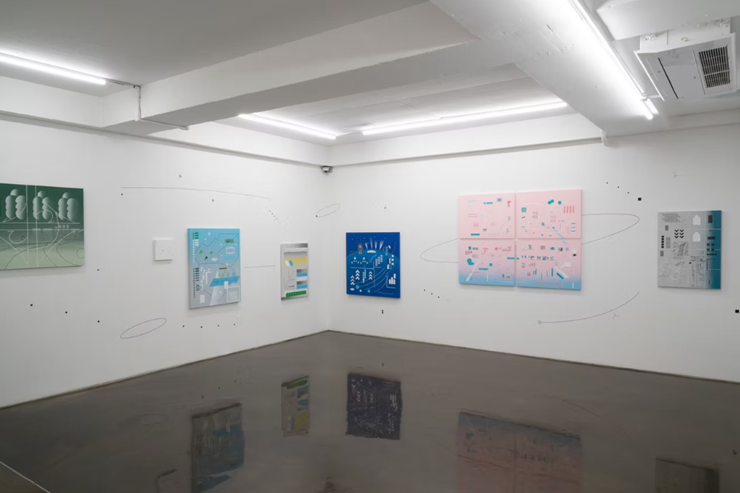
satellites depicted in Chu Mirim’s 《SATELLITES》 is one that
mimics Seoul but always feels slightly incomplete and awkward. A city
that inevitably orbits the central planet—Seoul.
The Urban Universe of Seoul and
Its Satellites
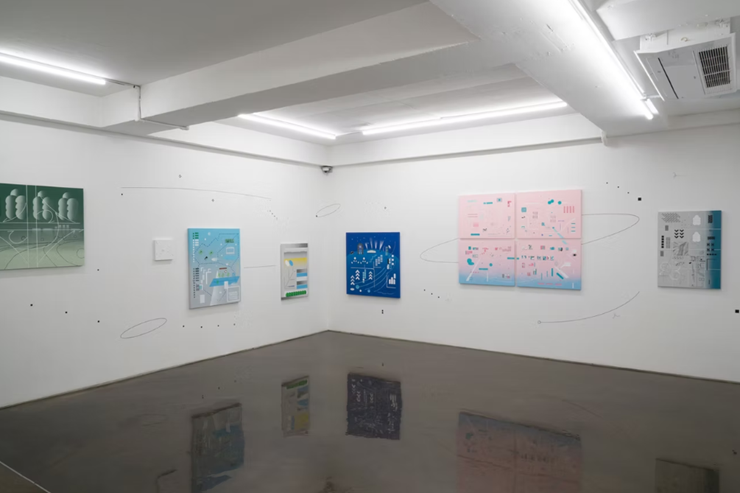
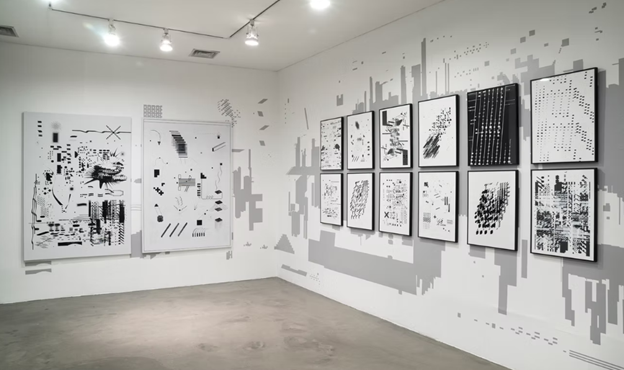
At the heart of the exhibition
space, Seoul is displayed in bright pink—the city that everyone
dreams of going to. Surrounding Seoul, satellite cities unfold: cities that are
busy with mothers and children during the day but grow even livelier
at night; cities with precisely gridded roads and tightly packed apartment
complexes; cities that can only be reached by passing through massive
interchanges. Chu’s graphics extend beyond the canvas, spilling onto
the gallery walls, transforming the entire space into a universe—a
cosmos where Seoul and its satellites coexist.
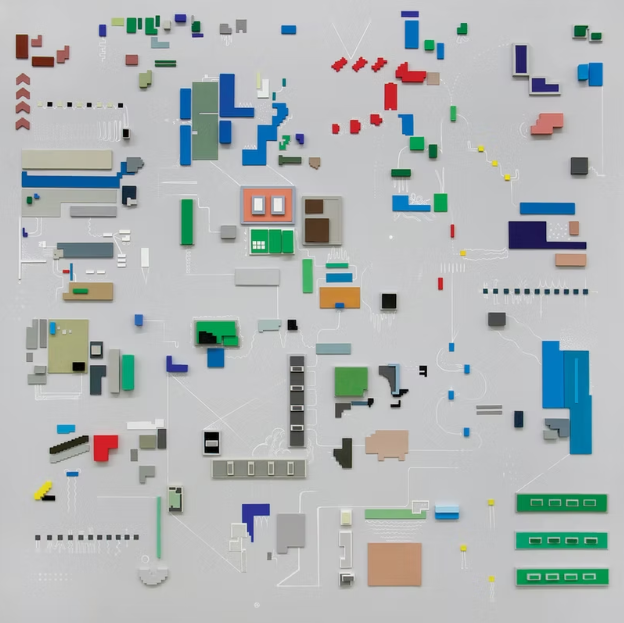
Chu abstracts urban landscapes
into graphic imagery. Apartment complexes become arrays of
rectangles, highway interchanges are curving intersections, and city
landscaping is reduced to circular shapes. The meticulously
planned new townscapes are rendered in crisp, clean-cut
graphics, almost as if computer-printed. However, despite their
refined formal structure, these images contain an inherent stickiness
of emotions. Chu distills deeply personal memories and layered experiences
into restrained visual forms. Her gaze upon these landscapes is not
detached but filled with affection.
In Swimming Pool
After School, she portrays an apartment complex with a swimming
pool, not just as a depiction of a particular urban scene, but as a place
embedded with memories—a location where she spent her time after school.
Likewise, in 《SATELLITES》, a shopping mall is not just a commercial structure
but a meeting place where friends once gathered.
An interchange is not merely a highway structure but a familiar
sight from the bus window on a weary commute home, evoking relief and comfort.
In Chu’s work, a city is never just a physical entity—it is
a repository of lived experiences. Her abstracted graphics are
not mere visual reductions but emotive expressions of her personal
encounters with the urban landscape. The cityscape is not simply illustrated;
it emerges through the very experience of life itself.
A City as a Place of Experience
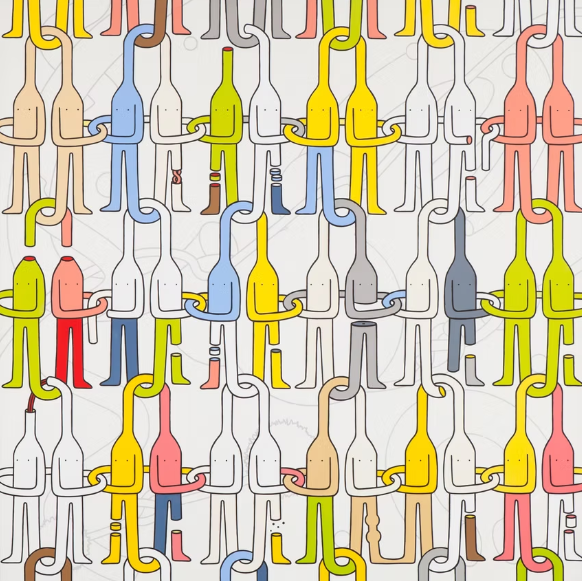
Chu's Castle series
intensifies this reinterpretation of the city as an experiential space.
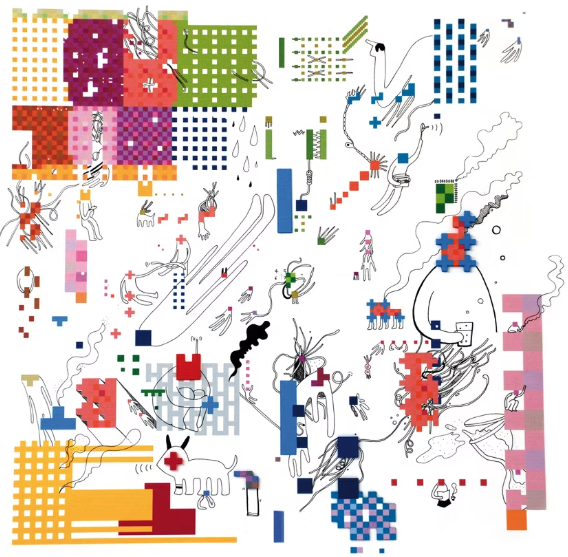
The acrylic panels, resembling apartment façades, contain small
compartments, each holding a fragment of a story. The urban scenery
is iconized into abstract graphics—with playful, hand-drawn pen and
marker illustrations reminiscent of doodles in a childhood diary.
Through both content and visual style, Chu evokes a particular era,
summoning the past through nostalgia and memory.
For Chu, a city is not a
mere geographical location but a sensory and emotional construct. It
is shaped through digital hearts on Instagram, the pencils clutched
tightly in her hand, and the sardine-packed buses she commuted on. Her
urban landscapes are not about documenting the physical
cityscape; rather, they are conveyed through lived experiences. The
experiences themselves become the city.
A Moving Cityscape
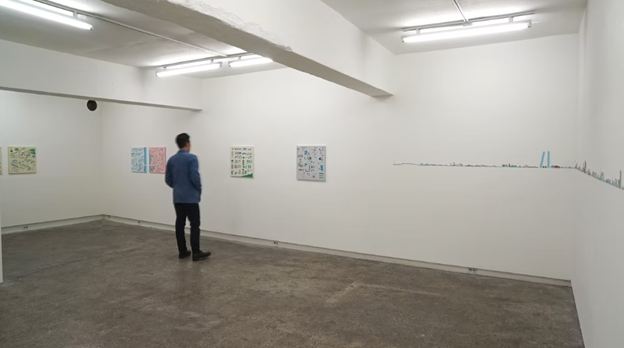
In Windows,
the urban landscape transforms into moving images. The acrylic
panels, abstracted into graphic forms, leave empty spaces, through
which cityscapes flow. As the exhibition title suggests, the cityscape
moves past like a view through a window.
These animated sequences do
not flow seamlessly—instead, they move with a slight roughness,
reminiscent of old Flash animations. This imperfect
motion recalls past moments and memories, leaving gaps for viewers to
fill with their own narratives. Just as Chu’s abstract graphics leave room
for personal interpretation, the disjointed, hesitating
animation invites viewers to insert their own recollections into the
voids.
Walking Through the Past and
Future
The passage of time, embedded
in one’s origins, defines the present self. 《SATELLITES》 traces this temporal
journey, allowing Chu to revisit her own beginnings. While tinged
with melancholy, her approach is ultimately bright and buoyant,
stepping forward with an upbeat stride.
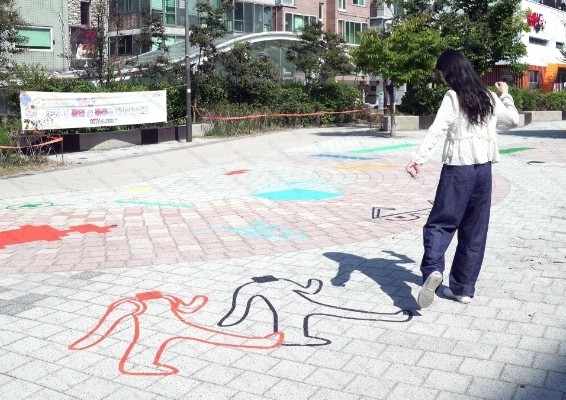
The exhibition's iconic
work, Bubble Walking, portrays the artist walking
inside a transparent, blue-tinged bubble. This represents her younger
self, cheerfully commuting for three hours between Seoul and Gyeonggi
Province, as well as her present self, moving forward through life without
knowing what the future holds. In doing so, she traverses both her origins
and her present reality, embracing them with warmth and optimism.
Throughout 《SATELLITES》, small moments of affection
and playfulness appear everywhere—whether in the cheerful girl
walking in 〈Bubble Walking〉, the soft paw prints of a beloved cat, or the endless
stream of floating hearts. These are the true protagonists of the
exhibition. This vibrant, lively energy permeates the entire show, waiting
for us to discover it.
A City That is Both Familiar and
Distant
It has been over ten
years since I left the new town where I spent my adolescence.
Living in Seoul, I finally realized that the city I grew up in was
merely a copy of Seoul—an inferior replica of the capital. Now,
having become too accustomed to life in Seoul, I no longer wish to return
to that diluted version of the city.
Yet, whenever I revisit that
place, it has transformed into an “ancestral new town,” marked
by the passage of time. The street trees have grown thick, and old
buildings have undergone haphazard renovations. Despite these changes,
the bustling, chaotic energy of Rodeo Street remains unchanged.
A place that witnessed the
turbulence of adolescence cannot be easily reduced to indifference.
The cityscape, no matter how clumsy and artificial, still holds
the youthful energy and liveliness of its past inhabitants.
No matter how flawed, it
remains a part of me.