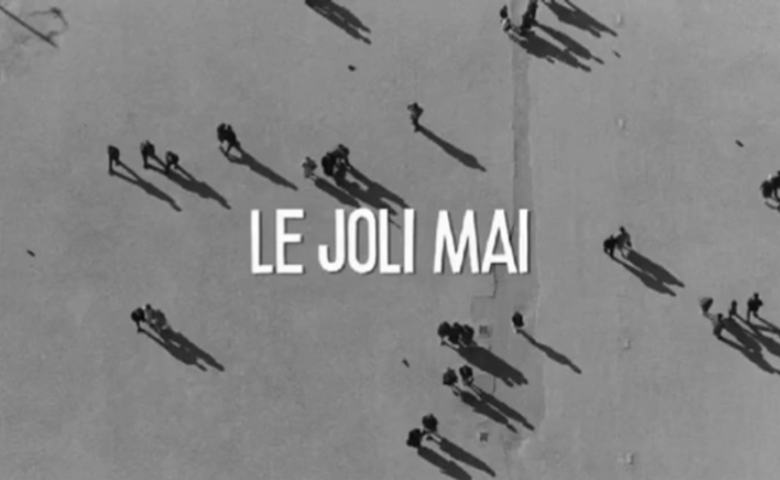
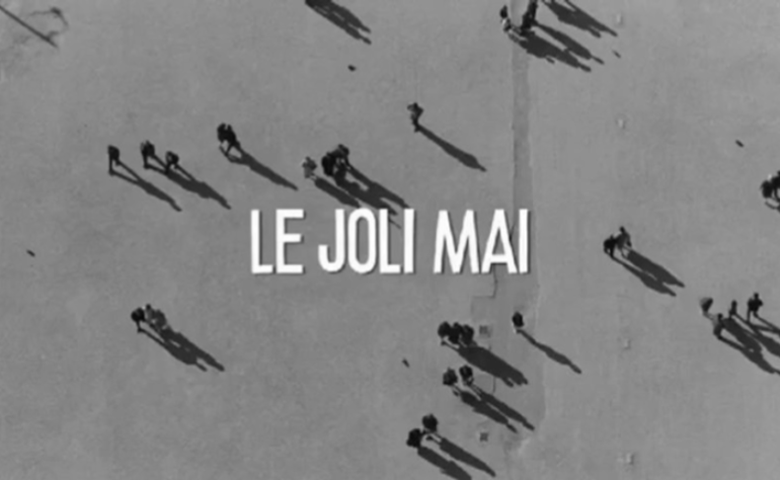
Chris Marker and his colleague Pierre L’Homme made the documentary Le Joli Mai and released it to the public in May 1963. Running for well over two hours, the film captures various aspects of Paris in May 1962 alongside interviews with Parisian citizens. It was during this very “beautiful May” that Marker made La Jetée. In Le Joli Mai, he refers to this period with the phrase “the first spring of peace (le premier printemps de la paix).”
The resistance of colonial Algeria against France, which had ignited immediately after the end of the Second World War, developed into the Algerian War, and the Évian Accords that brought the war to an end were signed in March 1962. As France was already experiencing steep economic growth, the period seemed to invite even more hopeful prospects.
Yet Marker was cautious rather than simply optimistic. Although the title was “Beautiful May,” the voices and landscapes contained in the documentary quietly revealed that the war was not truly over, that another form of war—one not entirely beautiful—was continuing. Marker sensitively traced the problems concealed beneath the rhetoric of peace and prosperity, and it is highly symbolic that La Jetée, made in a Paris more “beautiful” than ever, was set in a Paris completely destroyed by the Third World War.
After the end of the Second World War, Marker had continued working around the world—in Finland (Olympia 52, 1952), China (Sunday in Peking, 1956), the Soviet Union (Letter from Siberia, 1958), Israel (Description of a Struggle, 1960), and Cuba (Cuba Si!, 1961)—while reflecting on ideology and political systems. To him, the Parisian spring of 1962 appeared suspicious.
Born in 1921, Chris Marker was someone who experienced firsthand the national violence of war and the contradictions of institutions. After Paris fell to the German army in 1940, Marker continued both resistance activities and artistic work in various ways. In 1943, he joined the resistance organization Combat in the Lyon region before moving to Switzerland, where he was soon arrested by Swiss police and interned in a refugee camp in Cossonay.
Lists of internees from the time remain in the Geneva archives, and Marker can be found registered under his real name, Christian François Bouche-Villeneuve. (He began using the pseudonym “Chris Marker” in 1945.) On the page immediately following Bouche-Villeneuve’s record appears the record of an internee named Davos Bou-Hanich. He became Marker’s friend in the camp—later changing his name to Davos Hanich—and more than twenty years later would play the protagonist in La Jetée.
The collaboration between Marker and Hanich, whose relationship began in the refugee camp, did not begin with La Jetée. In January 1944, after his release from Cossonay, Marker resumed Resistance activity in the mountainous Haute-Savoie region. As conditions worsened, however, he soon crossed secretly back into Switzerland. With the help of a doctor named Chris Mayor, the twenty-three-year-old Marker barely managed to find shelter.
In order to earn operating funds, he devised a plan to fabricate a story and sell it to the press. Enlisting Mayor’s son, who was around his age, as well as his former camp companion Hanich, Marker staged and photographed nine images, using them to create a story titled “The Execution of a Maquis” (“maquis” being the term used for Resistance fighters operating in mountainous regions).
In this audacious prototype of a photo-roman, composed of photographs and a small amount of text and reminiscent of La Jetée, Davos Hanich played a prisoner executed by Chris Marker, who appeared as a Resistance leader.
The recurring fate of death in La Jetée, and the scene of that “impossible memory,” does not simply belong to events taking place “a few years before the Third World War,” but reaches further back to a period when the Second World War itself was still underway. “Many died. Some believed themselves to be victors. Others were taken prisoner.”
This narration from La Jetée describes scenes Marker had personally witnessed during wartime and also quietly warns against the careless certainty of victors. On October 17, 1961, only a few months before La Jetée was shot, demonstrators demanding Algerian independence and an end to discrimination gathered in central Paris, and hundreds were killed in a violent police crackdown.
Those who retained memories of the Resistance sympathized with the struggle of the National Liberation Front and were appalled by the violence of the French police. Le Joli Mai includes footage of the funeral of workers killed by police during another demonstration on February 8, 1962, organized under the banners of “against fascism” and “peace in Algeria.”
In order to resist the fascism and violence that continued to persist in changing forms, Marker had to expose the unbeautiful “present” within that “beautiful May,” while at the same time making La Jetée, set against a destroyed Paris, and “send emissaries through time.”
(Published on Literature and Intellect’s Naver Post, May 8, 2019)