What does it mean to be a video artist in the 2000s? Now that video art is no longer regarded as either cutting-edge art or the exclusive domain of intellectual artists, and at a time when even ordinary art students are equipped with digital editing systems and professional broadcasting equipment such as the PD-150, how can a video artist survive as an artist with a distinctive name and identity?
As Dongjin Seo has suggested, does video cease to be art because of the performative nature of the medium itself? Will it become merely a means of recording everyday life, or, through the increasing accessibility of shooting, editing, and screening, something equivalent to the democratization of artistic creation—or more precisely, the universalization of visual production—that art has long envisioned?
Junebum Park is one of the artists who, in response to such questions, affirms that artistic creation still involves exceptional modes of production and demands a particular kind of effort derived not from dependence on a medium itself, but from more complex techniques of thought. In his work, Park employs an original formalism that exceeds the generic characteristics of video. For example, he uses roughly three narrative devices in constructing his works: theatrical distanciation, anamorphosis, and time-lapse photography.
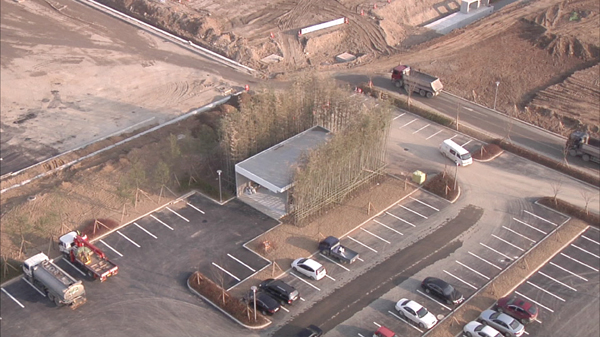
In Junebum Park’s work, theatrical distanciation is fundamentally produced through the positioning of the body and the camera. By placing the camera at a right angle to the subject, he emphasizes frontality and flatness. Subjects, usually tightly framed through a wide-angle lens, acquire a flattened appearance through the deep focus of a front-facing camera.
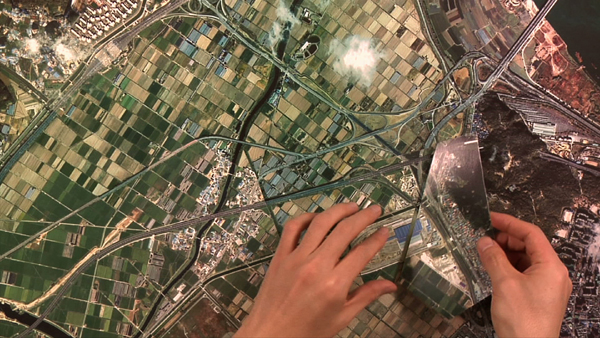
Beginning with video works produced around 2000, Park achieved striking visual effects by staging mime-like gestures in which his hands appear to move objects across a flattened background. In Parking, filmed from the rooftop of an apartment building so that the artist’s hands appear to move cars and pedestrians in the parking lot below, mime performance, pictorial flatness, and the body as a theatrical device—reminiscent of the Japanese puppet theater bunraku—are connected within a single narrative context.
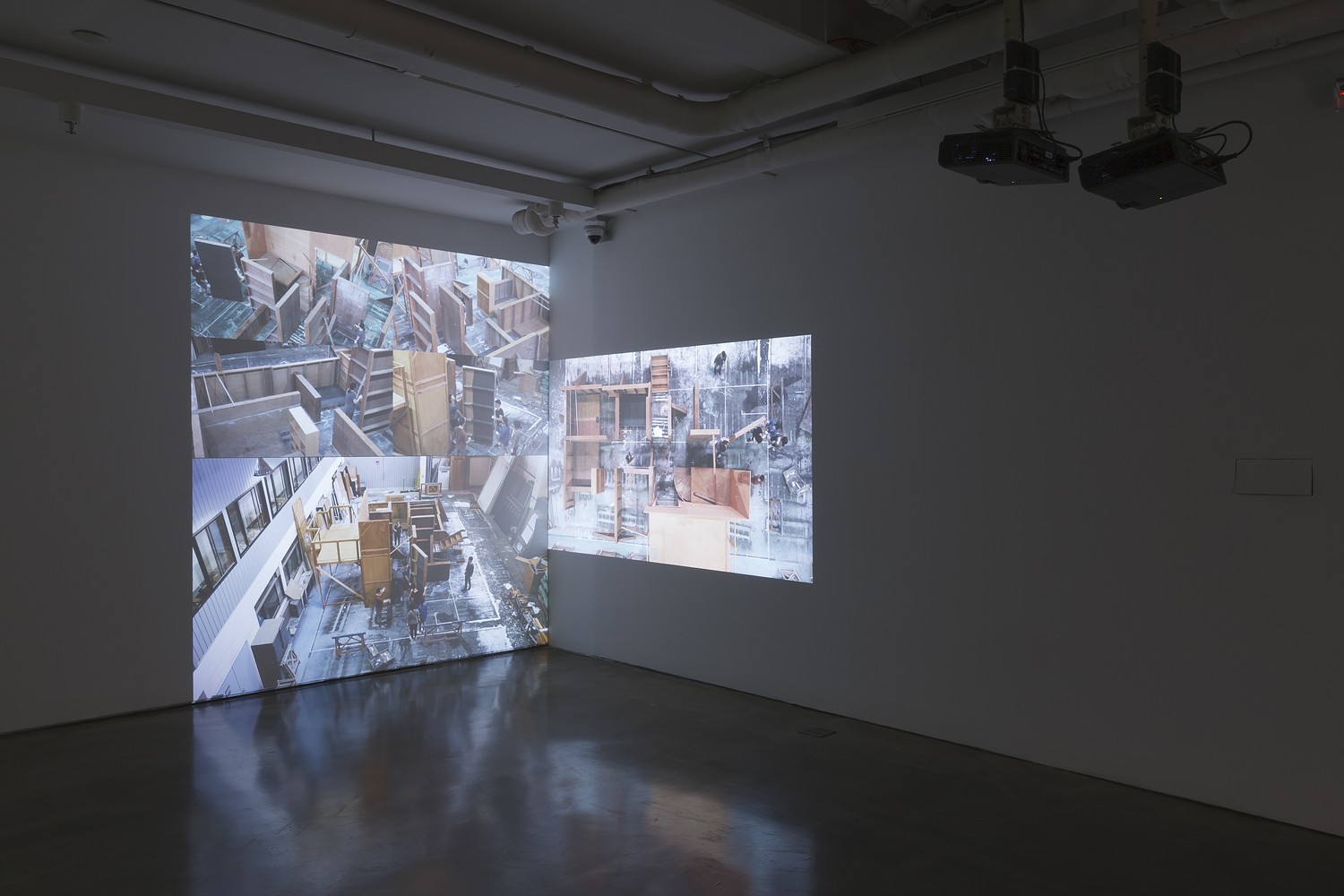
This intellectual mode of staging also appears throughout series such as 'Crossing', 'excavators', and 'Escalator', linking his works not only to contemporary forms of artistic production but also to more classical problems long discussed within the tradition of optical vision, including semantic perspective, the camera obscura, and trompe-l’œil. In the 'Warp Gate' series, Park stages highly humorous scenes.
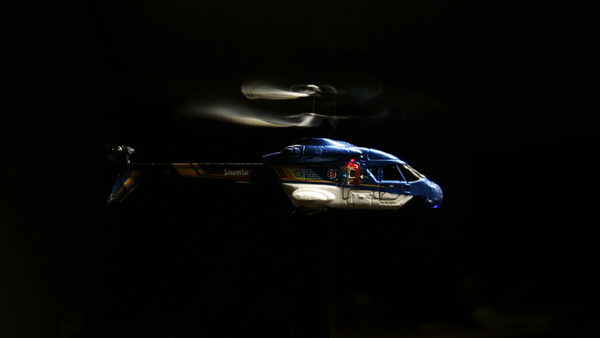
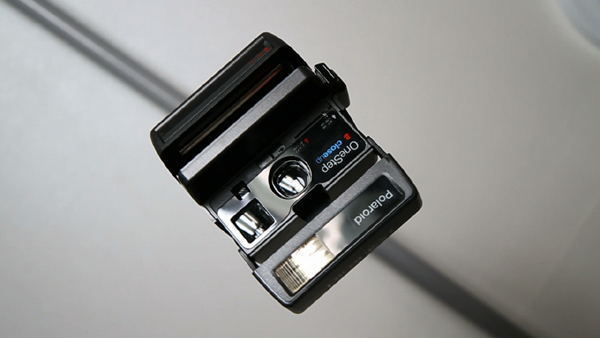
Urban landscapes filmed with the camera turned sideways become somewhat clichéd science-fiction settings—the equivalent of planets or space stations unaffected by gravity—while various mobile phones and remote controls held directly in the artist’s hand repeatedly and slowly lift off like spacecraft or space shuttles.
The hands, which in his earlier works implied a somewhat omniscient viewpoint, are here clearly revealed as theatrical devices. This method, which seems to invoke Japanese bunraku—often regarded as a precursor to Brechtian stage space and well known for its puppeteers dressed in black and remaining visibly present behind the puppets, while convention dictates that the audience regard them as invisible—constitutes one of the most radical examples of distanciation.
It strongly suggests that the narrative of video can generate more variations through the virtuality of the “gray matter,” to borrow Duchamp’s expression, than through electronic or visual virtuality.
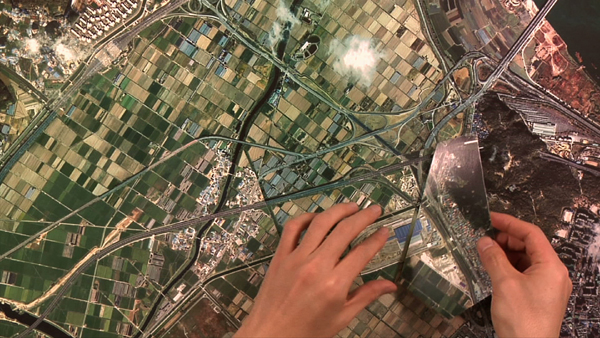
Anamorphosis is a technique for addressing the invisible reality latent within visible reality—in other words, a kind of virtual reality. Originating in the fifteenth century and primarily employed in painting and sculpture, this technique requires no electronic effects beyond an optical arrangement. Park deliberately regards video not as an electronic apparatus but as an optical configuration.
To this end, his process demands highly precise camera angles as well as repetitive and skillful bodily performances. He has stated that the considerable physical difficulty involved in this live-action process is worth enduring because it remains consistent with his original intention to reveal the potential of invisible reality. From a fixed viewpoint, the perspectival arrangement of objects produces a displacement of distance together with a flattening of contours.
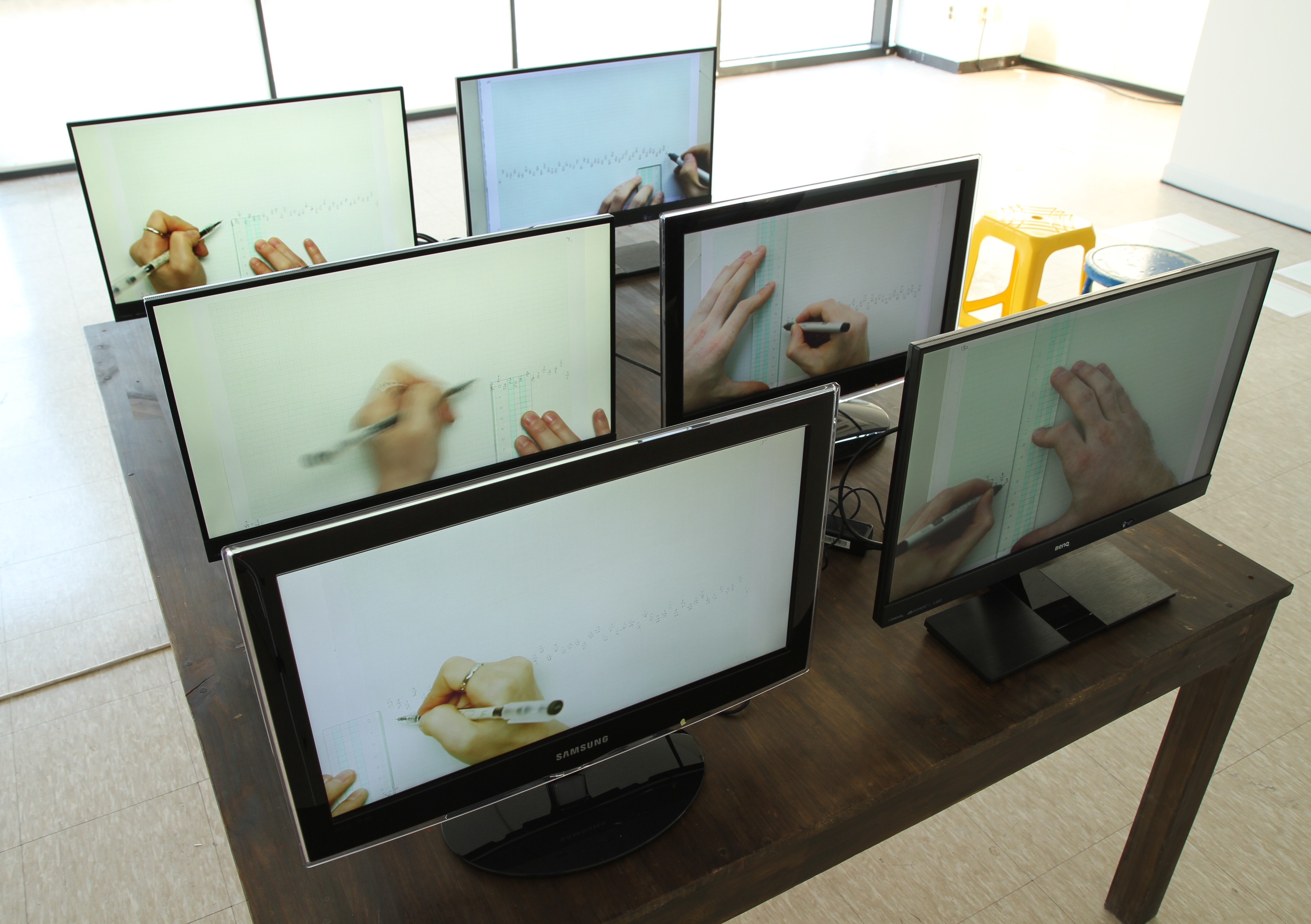
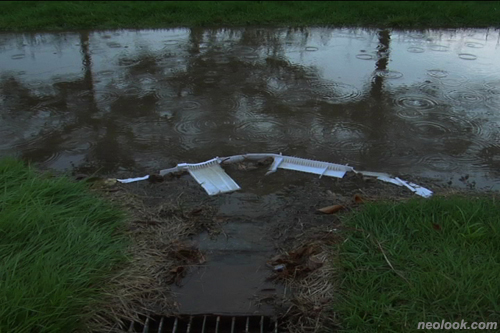
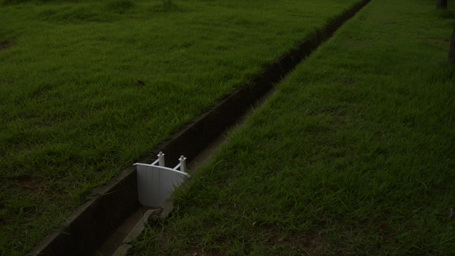
If anamorphosis is a technique for revealing invisible reality spatially, time-lapse photography is its temporal equivalent. A reality that cannot be perceived within ordinary time begins to transform into an entirely different dimension through slight acceleration or deceleration. Conversely, such acceleration and deceleration are excellent means of emphasizing that what we regard as “normal speed” may in fact be only one highly exceptional case among countless possible realities.
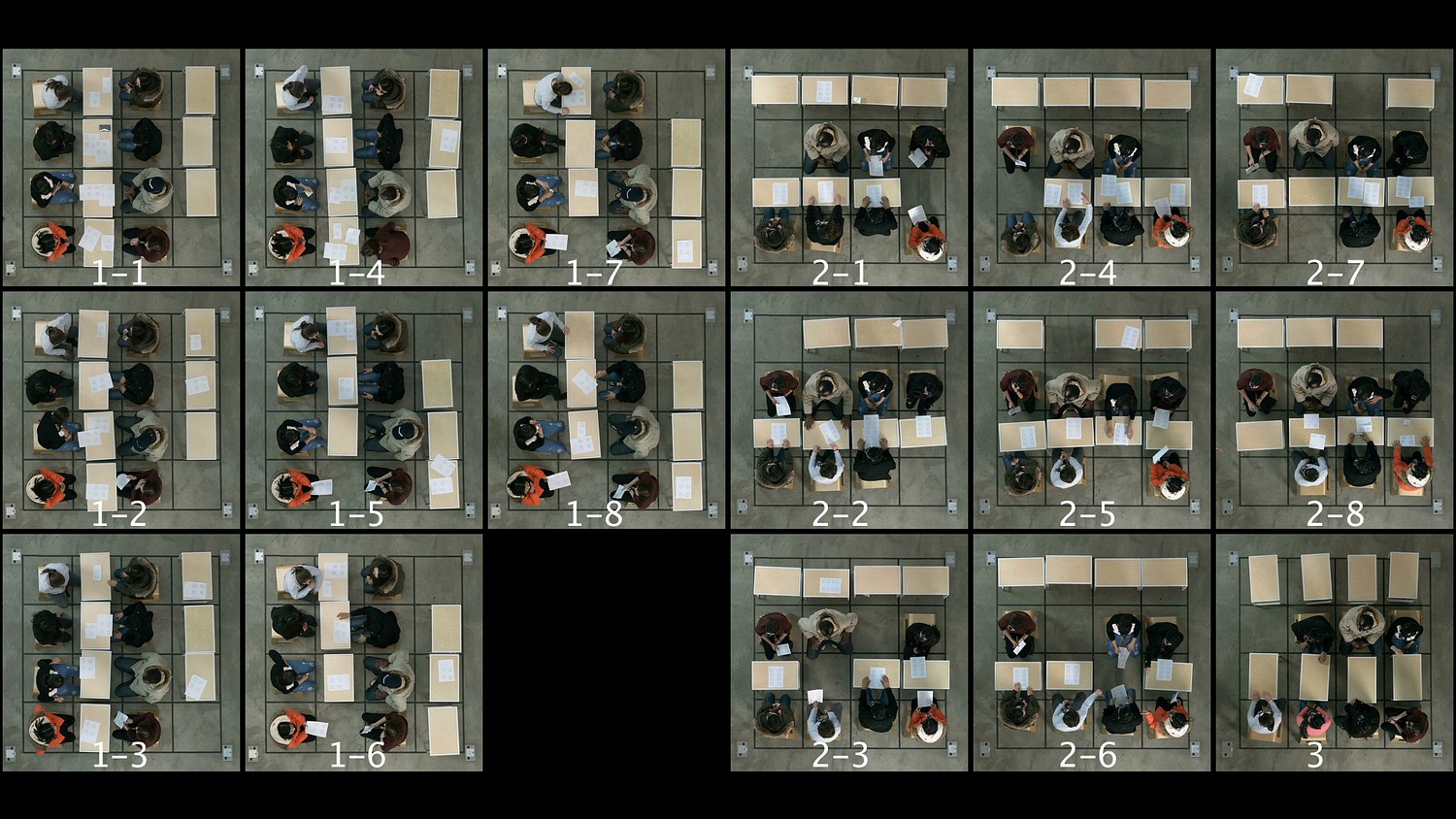
Park’s performances, recorded over considerably long periods, are condensed into sequences of three or four minutes, producing semantic transformations. The crucial element that activates the work is not the symbolism of the performance, but the relationships among the elements contained within its formal arrangement. Anchorage refers both to the capital of Alaska and to the act of anchoring.
In this work, which captures two boats moored on a dark seashore repeatedly colliding with one another, Park simply accelerates time, transforming the movement of the boats into a reduced scale while simultaneously converting the sounds of friction they produce into a kind of Morse code. Here, with the theatrical elements represented by the hand omitted, only two factors—the camera angle and acceleration—transform the subject into an image traversed by lines of altered relations.
In the more recent work Acrophobia, Park draws upon his own experiences with sports. Here, “acrophobia” metaphorically refers to the stress caused by his fear of “high-flying balls,” stemming from a childhood memory of being hit by a baseball. Through a performance in which he throws dozens of basketballs into an empty basketball court late at night, he appears to seek a form of vicarious resolution to this conflict.
In this work, performance organized around an autobiographical narrative seems to take precedence over the visual effects and formal elements repeatedly found in his previous video works. Yet even here, the camera angle and the trajectories of the balls produce subtle distortions of perspectival space.
The movement and rebound of the balls, which travel outward beyond the frame in the direction of the camera, repeatedly create distances that appear unreal within a space dramatically flattened by lighting. The sound of the bouncing balls marks the boundary between opposing relational terms such as flatness and extreme vanishing, movement and the contraction of space. Here Park once again demonstrates that the “formalist predominance” he emphasizes is not limited to visual repetition, but concerns the relationships among formal elements and the ways in which they operate.
Among contemporary artists working with video, Junebum Park is one of the rare figures whose practice is grounded in physical labor while ensuring that such labor is closely connected not to the presentation of action itself, but to the representational structure of the work. In his works, the body intervening in perspectival scale is clearly inscribed within the semantic circulation of the image, even when it is not visibly present.
This is one of art’s longstanding questions, yet one that is posed differently each time: how, and at what level, should form be addressed? Park has made an exceptionally strong beginning in answering this question—one that is particularly significant in contemporary video art.