I hope the place where meaning is generated
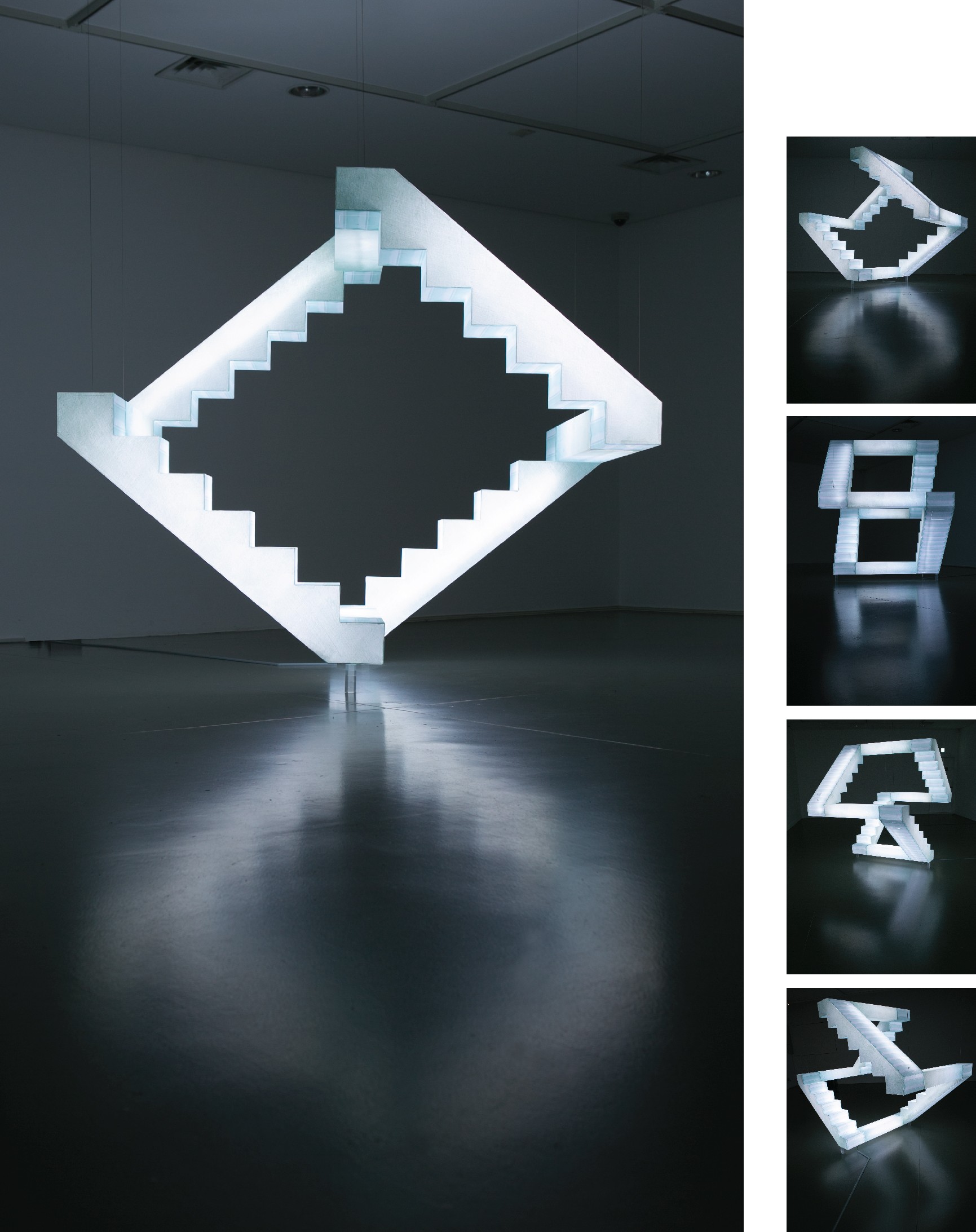
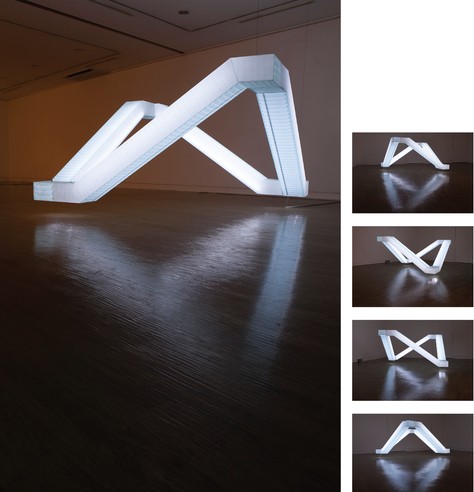
The main motif of Min Jin Young’s work is the house. Min’s work represents her memories of spaces such as attics and stairs. As a result, her work takes on architectural from, but what she’d like to express is not architectural space but psychological space. Her staircase that is in an endless loop with no beginning or end like the Mobius strip is a combination of stairs descending underground and stairs ascending to a rooftop.
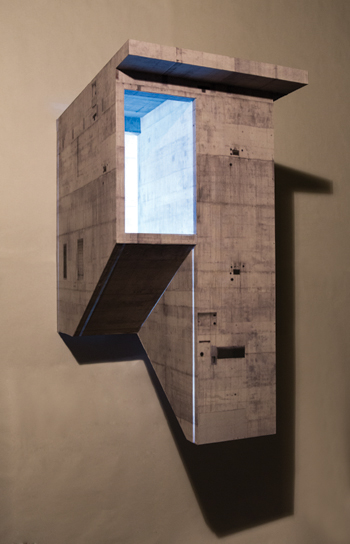
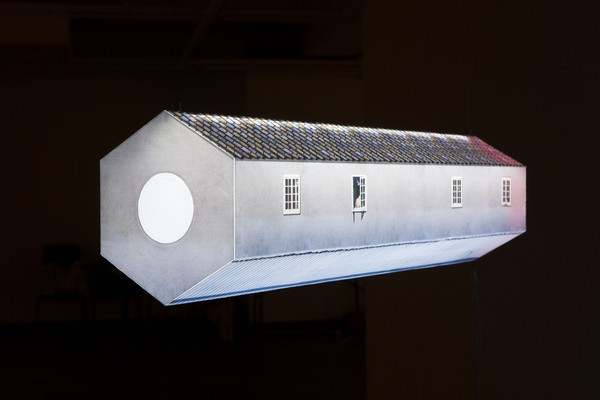
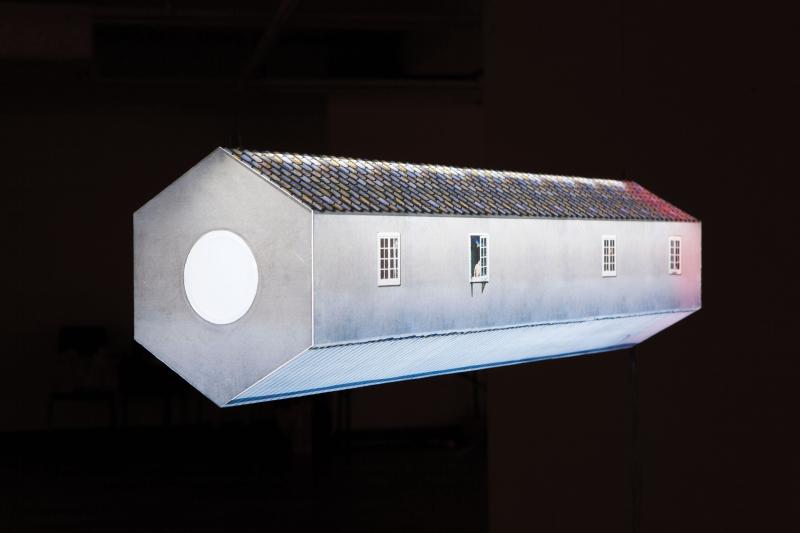
This work is a representation of psychological fluctuation: one would like to ascend for the bright light when staying in an underground space; and one would like to descend to the ground when staying on the rooftop. Such ambivalence is also sensed in The Space between Roof and Roof in which two roofs share the same space.
This house whose roof is formed with the roof represents her memories of a house and an intricate psychological state pertaining to it, rather than being merely a habitable house. This house is therefore suspended in the air, not standing on the earth. Min said the motive for this work was based on her own memories of ones we commonly have about a house.
That is, she made one integrated form with two roofs through her childhood memories. This form is perhaps derived from her experience of living together with other families in the same house as a child. The artist also explains she created this work marrying two houses into one considering others who might pay attention to the wounds she had.
This aspect indicates her work is not any architectural representation but a manifestation of her heart. Its flickering lighting can be said to be a metaphor for such psychology.
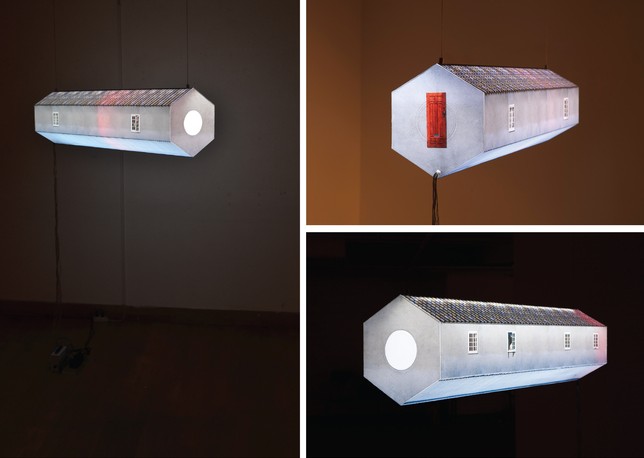
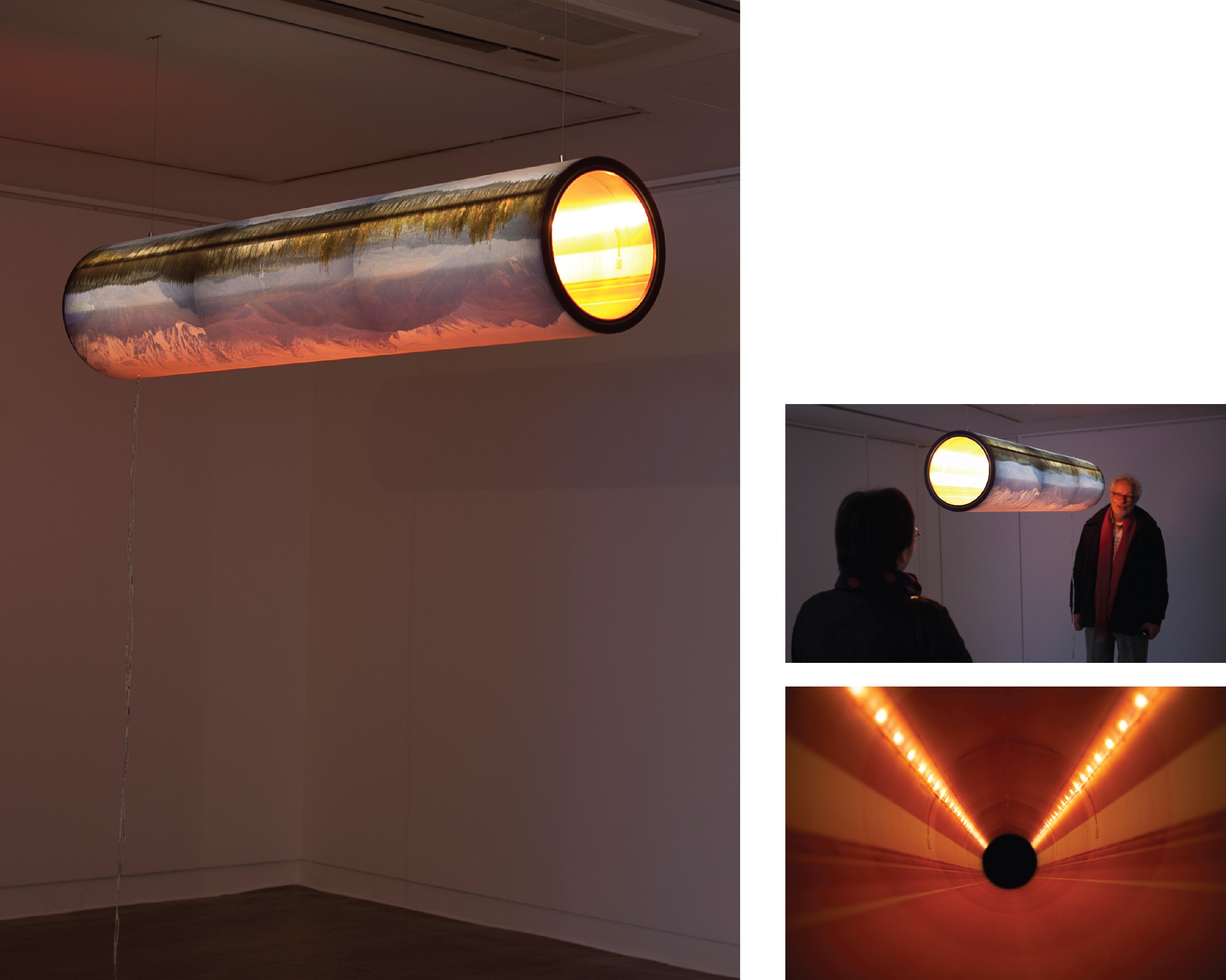
The Space between Roof and Roof that looks like a long hexagonal tunnel is an extension of He has no child Min produced in 2009. The basic form of this work – emotional and with a narrative – is also the house. However, this house is not made of solid material but is a temporary construction. Different video images are projected from the two ends of this temporary space in the form of a long tunnel.
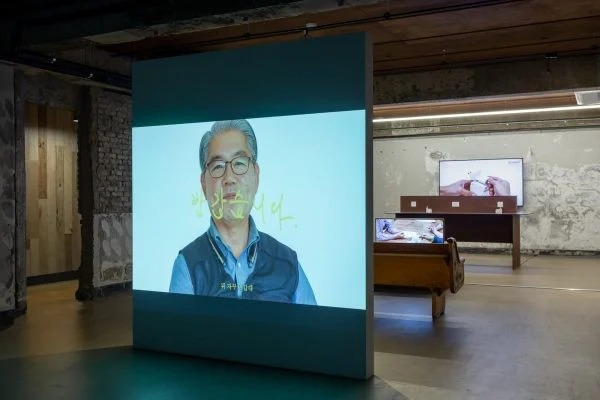
29 signs are repeatedly projected from slides at one side at three-second intervals, and the video showing the inside of the tunnel is projected on the opposite side. She takes the motifs of these signs for which she arbitrarily modified pictograms familiar to the public, such as construction signs, warning signs of wildlife, and signs of child protection, within events that occurred between the artist and her father.
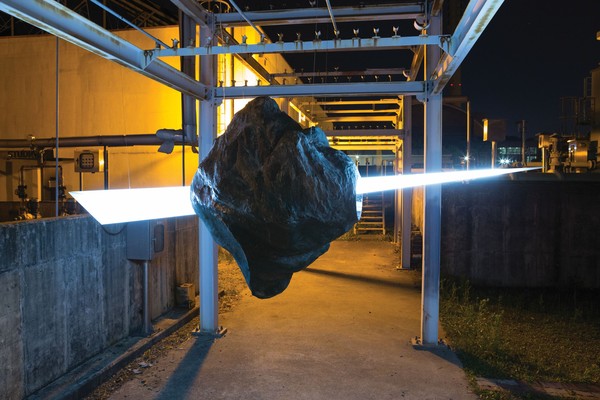
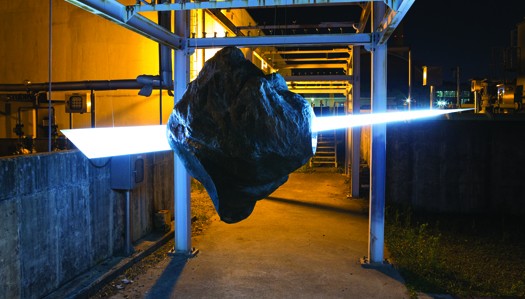
The artist was born in Samcheok, Gangwon province and moved to Seongnam, Gyeonggi province as a child. As the new town Bundang was under construction at the time, she naturally became familiar with the scenes of construction sites. In Unusual Object II, mountains and hills fashioned with cement are set in a metal container we often call a “drum” and whose surroundings are encircled with a scaffold and safety net.
This is also a reproduction of a scene she witnessed at a new town construction site. It was a quotidian scene we could see when the construction industry was booming and a scene she always met in her surroundings as a child. The pictograms of a shovel and crane at a construction site, a freight train, and a bus projected on a wall in He has no child reflect her childhood memories of construction sites she often met in everyday life.
As her work titles suggest, the pictograms slightly modified by her intent to convey her message to unspecified majority are symbols and signs of her individual experience.
These pictograms sliding by at three-second intervals are a representation of her ambivalent feelings, such as her expectation of a new civilization created by development and construction and a longing for disappearing nature, and the product of her metaphors for inconvenience between the artist and her father. The tunnel image projected onto the opposite side of the space is also an entrance to an abyss of the unconscious: a labyrinth we cannot escape.
The mechanical sound arising from the slide projector is louder than car noise and can be said to be a riddle the artist conceived or device to conceal her self-confession. An individual affair secretly seeps into the space between the temporary residential space symbolized with a tent and the pictograms, and the tunnel image repetitively projected is an entrance to the labyrinth of individual affairs.
But, it is not easy to grasp its content as the artist suggests lots of elements before entering the world. This work demonstrates her fluctuating mental state between her desire to unveil her private affair and shyness she feels when something she wants to conceal is revealed. Her work is thus an architectural structure and simultaneously a psychological architecture created by her mental state.
Light is an essential, crucial element in Min’s work. She has often adopted artificial lighting to represent her sensibility, emotional and psychological state. Her memory of light harkens back to her childhood experience. At 5 she experienced wandering about a mountain with her father who was drunk and couldn’t keep his balance.
Although she was a young child, she could barely arrive at her house depending on the low light of the mountainous area. Fear she felt then, a sense of relief offered by the light, the light to which she was glad and grateful like beams of a lighthouse are a means to expose her mind and a guide for ushering individuals to their history.
Her special interest in the house reflects her thoughts on her relationship with her family. As singles increase, much more single room and bachelor apartments tend to be built, but a house is mostly for one family. A house is a space where my body exhausted by labor can take a rest, and it is a small community, a haven, an extension of my body and skin.
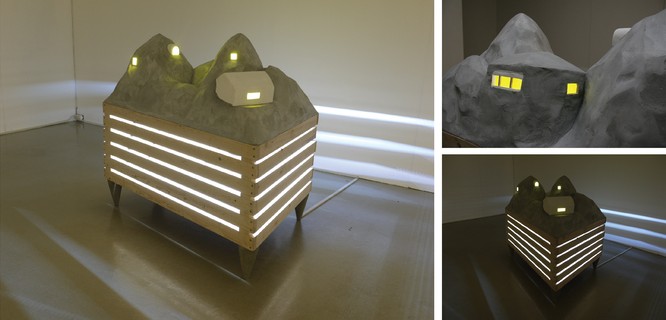
Individuality in Mountain in which mountain peaks are made with tents and lighting move to each peak, flickering at a regular interval, demonstrates a violation of the equation, house=family=haven, questioning such an idea. The artist gained the motifs of this work from Japanese film Nobody Knows directed by Hirokazu Koreeda based on a true story.
Nobody Knows tells the story of four siblings – each with a different father – and their mother, who move into a small shabby apartment. They could barely move in the apartment, by telling a big lie that the mother lives with her one son, and her husband works overseas, because she could not rent a house and raise four children without a father.
But, the mother ran away and got married, irresponsibly abandoning the children, and they were forced to survive on their own. The youngest child suffering from hunger died from an accident. The film ends with the three remaining children going to an airport with a suitcase containing the body of the dead child.
We can guess that the artist produced this work through her serious consideration and introspection of the meaning of family in that this work took its motif from the film that makes us ponder affection, trust, respect, and protection among family members.
If each peak we see one house or home in this work, its extension as society. However, family members are in a close relationship, which at time causes awkwardness, regret, inconvenience, disappointment, and anger. The light shining over the peaks, however, seems to be a signal for communication, overcoming the crisis of family dissolution caused by the severance of relations.
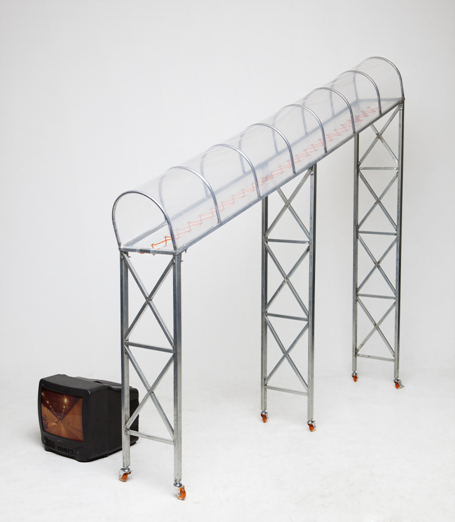
In Reads the House III a circular vinyl greenhouse structure in which light moves stands in for her troubled mentality toward her family, rather than referring to an abode. The structure, underpinned by a few support fixtures, is more like a cave than a house. This house-as-cave is not a residential space but a pavilion suspended in midair, or maybe a tunnel designed to return to a starting point.
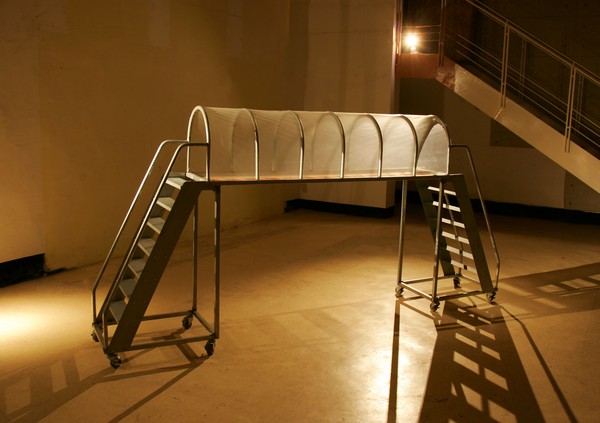
The structure – transparent yet redolent of a cave – is a representation of fear of the house with a vague, uncomfortable psychology vis-à-vis the world. In Reads the House I a tunnel or arcade bridged with two wheeled stairs is also a metaphor for fluid family relationships, rather than any settlement.
A sense of crisis – that a narrowly sustained balance is likely to be upset when pressured on any side; and the tunnel-like structure placed on top is likely to fall – disclose the source of her discomfort, there in the relationships with her family, not in the house. The transparent vinyl used for this work stands for her psychology, her clandestine feelings, and the residence she desires to conceal but cannot conceal in actually.
While commenting on ambivalent feelings causing a stir in her heart, what Min really wants to express is a haven for herself. Such a haven is a sphere where her body and heart can rest, be it made of vinyl, or be it a tent. In this respect, the space needed for her is a space where she can heal her psychological wounds.
In The Eighth Day of the Week, Marek Hlasko’s novel, set against the backdrop of 1956 Warsaw, Poland, which became a socialist country after World War II, the female protagonist Agnesika keeps saying “How I wish there was just a wall. Is it alright when there is a room walled with only three sides? Can it be a room, walled only with three sides? Can people live in such a room? Where isn’t such a room?”
Whereas this novel represents the frustration and vanity lovers feel under the surveillance and suppression of communism, what’s necessary for Min is a haven for her heart, not a room as physical space. The house she portrays is thus generating space for her heart.
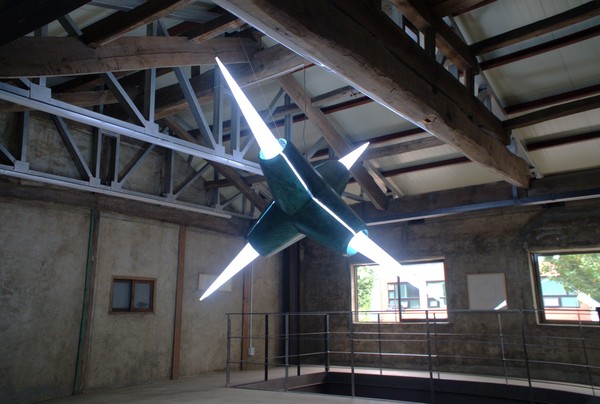
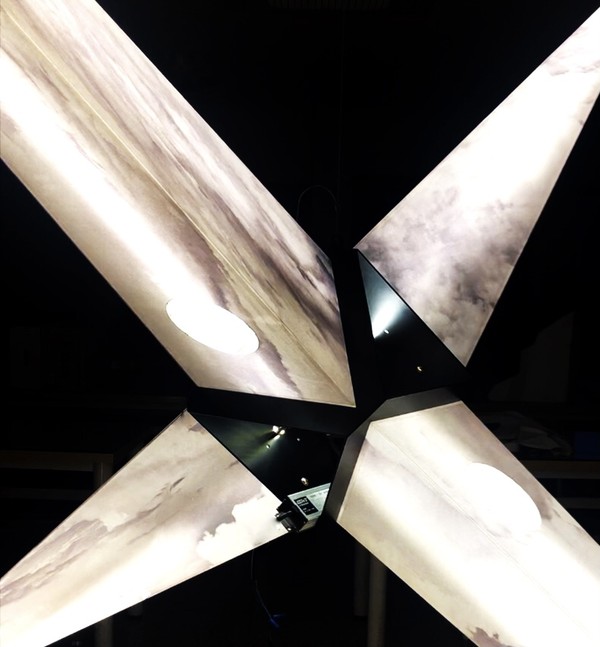
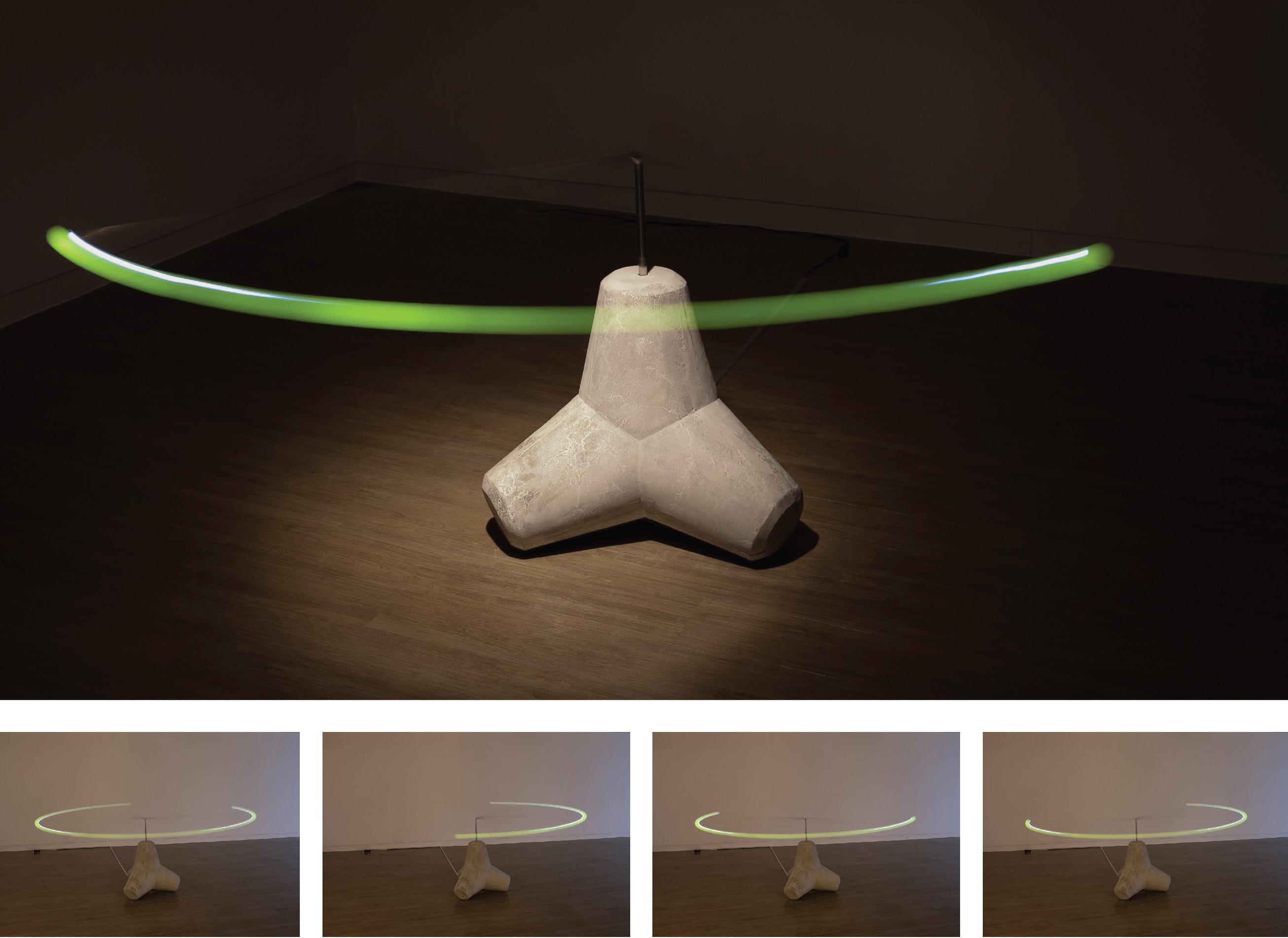
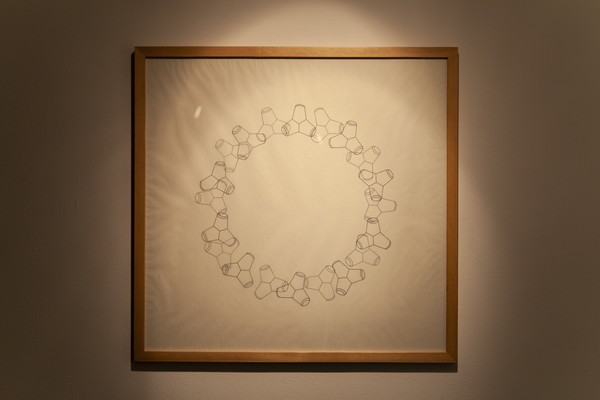
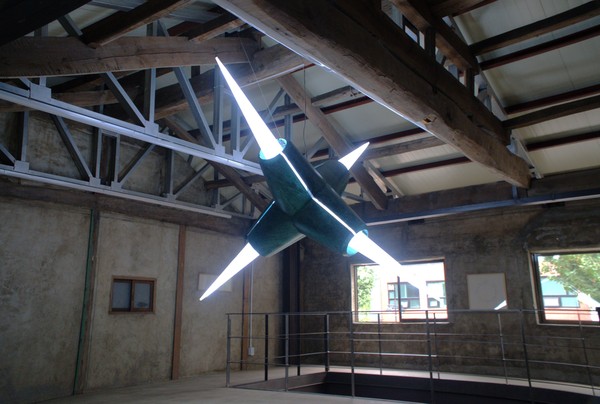
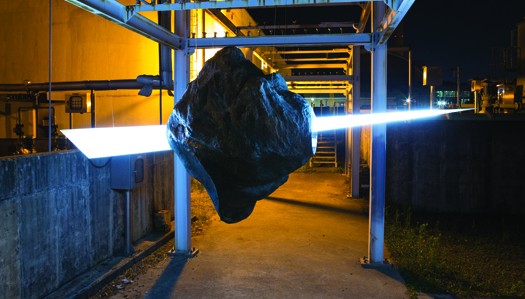
Chora, conflating a tetrapod, a four-legged concrete structure used as armor unit on breakwaters with a path of light circulating like a halo, presents a thread to elucidate such space as generation. As Plato described in Timaeus as the offspring Universe is created when the mother Chora embraces the father Form, chora refers to means a base as departure, beginning, and cause, not a specific place. Julia Kristeva presented “chora semiotic”, a feminist concept of the generation of meaning, and saw chora as a key to grasp the unconscious.
In her study into Antonin Artaud who sought the theater of cruelty and madness, Kristeva referred to chora as a variable lieu. In this respect, chora stands for the most elemental process of generation, departing from all symbolic structures in social order. Julia Kristeva defines the two characters of chora as follows: the venue as the land before primordial matter, which cannot be gauged with a metaphysical matrix, is formed and is the land where chaos conducts its generative movement; and also “non-expressive whole”, severed from desire in terms of language.
Based on this perspective chora is the womb available for pregnancy and childbirth in a narrow sense and a sphere where energy with which ineffable unconsciousness can act is engendered. A tetrapod is reminiscent of a woman who spreads her legs but looks like a space or place fission and fusion repeats as energy integrated into the inside rather than being radiated outside.
The artist defines this structure as “a device to suck up moisture from the sea”. It is perhaps the result of representing chaosmos as the continuance of movement marrying chaos and order. A place where we desire to escape but have to return may be an abode or an arena where our floating mind stays for a while. A house is the scope of my heart where meaning is formed rather than a physical place to protect my body. I therefore wish to have a house as a place where undulating energy in my mind is reborn with new meaning.