1. The First Perspective: “Presence and Absence”
Since the twentieth century, presence and absence have been regarded as major concerns across all genres of art. They became particularly pronounced in the urgent circumstances of the fin de siècle and the postwar era, when questions of “existence” acquired unprecedented depth.
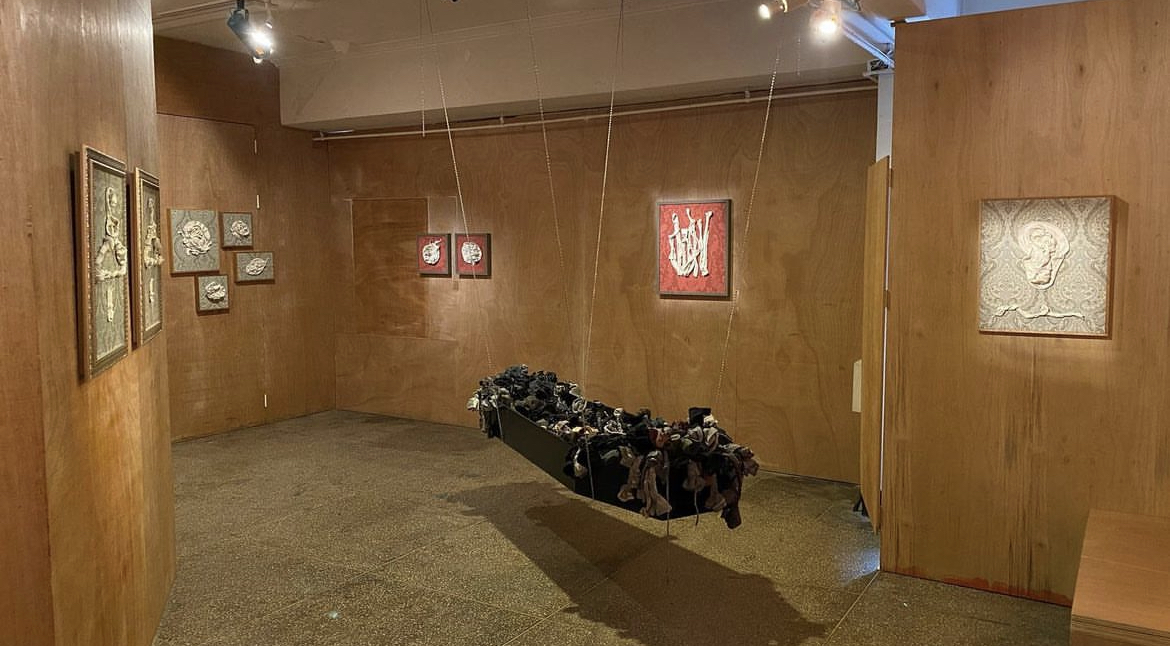
For example, Yoonah Kim’s sorry, composed of five small canvases joined together, and Franz Kafka’s The Metamorphosis both ask how human existence affects the environment and relationships surrounding it, and whether those relationships can remain valid when that existence loses its function.
Like José Saramago’s All the Names, the work contains profound philosophical questions concerning life and death, as well as the “existent” and “existence,” through the figure of a woman.
Couldn’t be there#2, one of Yoonah Kim’s works covered in green pus, and Jang Yong-hak’s The Legend of the Circle, which unfolds a primal exploration of human existence and tragedy through a series of events from a third-person omniscient point of view, share a certain affinity in that, despite resisting easy reading, both compel those living in reality to confront meaningful questions about themselves.
Waiting, which depicts a frail-looking elderly man seated beside a Chanel bag, allows the signification of human presence and absence to be read from a contemporary perspective, while Gift can kill you quietly reveals situations of interpersonal communication, the manifestation of our inner selves, and the unconscious loneliness and emptiness concealed within us.
Insofar as these works portray a human being who desires what is absent and wanders all the more when the object of desire proves impossible to possess, they are reminiscent of the play A Streetcar Named Desire.
Among Kim’s recent works, Never the less, with its striking image of a man and woman kissing, is particularly compelling. Viewed only in terms of the physical union between a man and a woman, the painting appears suffused with surface-level sweetness and seems to promise hope. Yet the story changes when one notices the wind blowing in a single direction and the bleak landscape.
It is difficult to deny the presence of an encroaching anxiety, like the uneasy moment before a storm. In some respects, the work seems to connect Oskar Kokoschka’s The Tempest and Gustav Klimt’s The Kiss within a single field, revealing a cyclical link between ecstasy and anguish that is passing, or has already passed.
If this is translated into the broader concept of anxiety inherent in human existence, the painting can be read as a question mark placed upon humanity itself: on a stage where different times and spaces have come to a halt, the contrasting development of the man and woman evokes solitude, loneliness, and the artist’s emotions before and after the depicted moment.
In this sense, it would be difficult to call an interpretation of her work adequate if it fails to locate traces of humanity itself, solitary existence, lost memories, and inner absence. Likewise, even if what ultimately remains at the end without an alternative is only the unchanging present of “today,” a kind of emptiness, any analysis that fails to glimpse the unconscious world repressed beneath consciousness cannot be considered precise.
Her paintings, however, do not offer easy comprehension. Their signs and symbolic codes generate imagination and narrative, yet resist immediate perception.
Still, if we begin from the premise that works such as with red tree, depicting a figure wearing sunglasses and red clothing, extend into the context of Surrealism and awaken a descent into the unconscious, and if we consider several recurring rules—signs, colors, forms, and so forth—it becomes clear that her paintings move beyond simple ecological description to sustain questions concerning essence.
At the same time, Yoonah Kim’s visual language is imbued with spatiality and temporality. The key to decoding it lies in signs. First, “space” penetrates and reconstructs the tangible and intangible memories embedded in place, while describing the characteristics of space itself—the prevalence of outdoor settings is evidence of this. The time-space developed from the painterly point of view is reconstructed through photography.
The artist’s reassembly of space fundamentally takes place through rearrangement and reinterpretation; past and present spaces are placed together within a single pictorial field, upon whose surface signifiers are layered. Figures, landscapes, and urban imagery are overlaid as painterly collage, with messages placed on top.
This mode of construction develops into a configuration in which worlds of different dimensions form an integrated whole, offering viewers something familiar while simultaneously introducing another layer of sensibility.
The figures in her paintings are both others distinct from the self and the self itself, while architectural structures, trees in parks, and scenes from city towns function as starting points for an expansion of subject matter and as triggers that activate circuits of memory unique to the artist. Naturally, they also serve as driving forces for inward exploration.
Semantically, these elements constitute tangible links between two dimensions: consciousness and unconsciousness, reality and that which lies beyond reality. They are also evidence of “difference” produced through the arrangement of time and space. Put differently, they resemble a personal grid that overlays the present and the past.
What is particularly interesting is her use of signs, for her paintings are filled with latent signs subtle enough to escape immediate notice. More specifically, these signs constitute an escape from conventional ideas about reality and a diary of desire, while at the same time functioning as icons of self-questioning concerning existence. This can be observed both in the recognizable scenes of her paintings and in works such as NO ENTRY, Suicide society, and Gift.
At first glance, Yoonah Kim’s work may appear to speak solely of her own story. Yet within it lie conceptual and physical dimensions suspended from the axis of time centered on the self, into which are inscribed the difference between presence and absence, meaning and meaninglessness.
Through works using photography, the overlapping of natural and urban environments, the division and depiction of pictorial fields on different levels, the flow and suspension of time, and various symbolic signs carrying forms of directionality, one can understand that what she seeks to address are “proofs of presence” and “proofs of absence” floating across a certain interval. And these are, in the end, another name for life.
2. The Second Perspective: “Life and Gaze”
A second perspective. This time, let us look at her works from a different angle. If one were to identify one of the most enduring discourses in art history, it would be the aesthetic contemplation of consciousness and the unconscious.
This philosophical mode of thought, which is necessarily incomplete, is not only defined as indeterminate, fluid, and psychological, but can also be understood in our terms as a notion of suspension (留保), conceptually implying a postponement of addition and subtraction. For this reason, it has long been embraced by artists from the modern era to the present day.
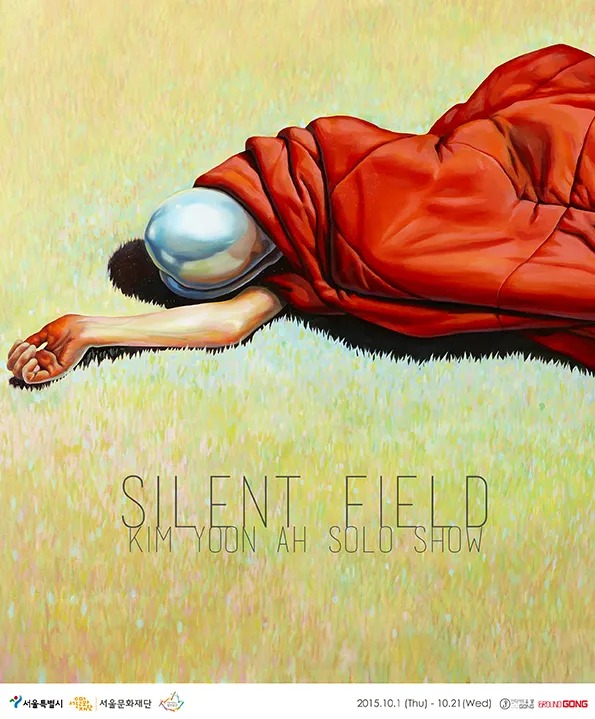
In this respect, Yoonah Kim’s works follow a similar trajectory. Her paintings primarily take as their basis subjects closely connected to her own life, or place the self directly on the stage as though she were the protagonist. Allegorical works such as the aforementioned 2011 piece sorry, as well as the figurative tendencies that constitute many of her more recent realist works, may appear universal, yet at the same time serve as a mechanism through which she produces a distinctive style of her own.
Among them, the figurative works are formally highly artificial and surrealistic. Yet within them, consciousness and the unconscious acquire universality under the representation of unity, ultimately articulating relationships between reality and that which lies beyond reality, and between the self and others.
Life—for some, an unbearably harsh one. Within the short yet long journey of living, each event a person encounters, together with fragments of convenience and inner desire, exists in her paintings almost like instructional diagrams cast into molds of form. Although the works generally take the self as their central subject, this does not mean that they cannot also be interpreted as landscapes embedded within contemporary life.
If one looks closely at her paintings from the standpoint of viewing, they seem saturated with countless things that unexpectedly surface and make it impossible to close one’s eyes, despite neither searching for nor intending to see them.
Loneliness, solitude, heartbreak, anguish, happiness, joy, sorrow, the self, contemplation, and every other imaginable state are dissolved into the works like traces of long years piled layer upon layer in an attic, ultimately converging, by today’s standards, into a message of longing for hope.
Let us also consider them from a psychological perspective. Her paintings do not reveal the exact identities of the minute elements within them, fine as grains of sand, yet these may be desires, or indications of the condition of the artist’s past life—or her present one. They may also constitute communication between thought and idea.
Viewed from a greater distance, they encompass living, carrying on with life, being alive, and even circumstances in which one is simply made to live, whether or not the artist consciously intended this. Yet in this regard, perhaps two or three lines written by the artist herself are more effective than a hundred descriptions by others: “Even in the absence of someone we love, even after someone confesses to profound depression and takes their own life, even as illusions created by circulating words brazenly roam the streets, our lives continue to flow so quietly.
The dazzling streets were at times unbearably unfamiliar and cruel to me; at times I was overwhelmed by the desire to assimilate into them; and at other times I wished I could simply become a landscape that anyone might glance at indifferently and pass by.” It would not be wrong to say that everything discussed above is reflected in this passage.
Today, the artist reflects on life through art, allows art to stand in for the everyday, and thinks through it. She does not stop there, but absorbs into small and large canvases, like air, “things that are unbearably cruel and always quiet,” only to exhale them again.
In negotiating the problem of the “inside” and the “outside,” she attempts to make everything contained within herself stand in for the existence of the “inside,” naturally expressing sensibility through feeling, thought, and judgment. Put simply, this can be described as breathing an inexpressibly sorrowful, rough, yet subdued “breath.”
Ultimately, Yoonah Kim continues to construct her own history as though she wishes to scatter the rough breath of change and transformation toward something yet to come. But are all of these things—stories, trajectories, and experiences—merely narratives confined to the life of a particular individual? No. It is precisely for this reason that her paintings naturally move beyond the subjective boundaries of the artist, enabling viewers to empathize and inviting emotional resonance.
Finally, insofar as her paintings are not subordinated to speculative interpretations of this kind, it seems clear that they move beyond the search for new relationships between space and time and arrive at a point where the identity and subjectivity of human existence are narrated through the dimension of life itself.
One can also discern an attempt to follow the lingering traces left by those who once existed but have departed, and by the gap between the time-space of yesterday and that of today. In this sense, the works inevitably lead us to think of Roland Barthes’s “there-then” and “here-now.”
Paradoxically, they also call to mind Kahlil Gibran’s proposition that all things that exist remain forever, or that the mere fact of an existence being present is itself what proves that existence. This, too, may be regarded as one of the defining characteristics of Yoonah Kim’s paintings.