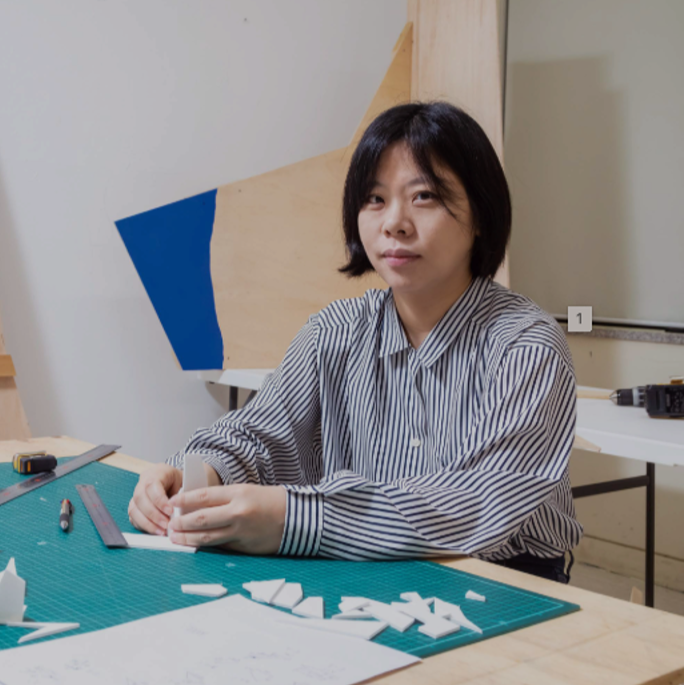
Ye-eun Min attended elementary, middle, and high school in the 1990s, when the hybrid organization of culture accelerated after the end of the Cold War was beginning to take shape. She then moved to France in the early 2000s, where she completed her undergraduate and graduate studies.
Her personal experience of spending her adolescence in Korea amid a global atmosphere where cultural globalization and localization coexisted, and then beginning to build her own world in France from the age of 19, explains why concepts such as “migration,” “cultural intersection,” “Creole,” “hybridity,” and “hybridization” lie at the foundation of Min’s work.
These concepts led Min to focus, in her practice, on the “house” as a space/place where the many dimensions of globalization—capital, information, people, commodities, and more—are closely intertwined, while also containing the diverse times and memories of individuals.
The “house,” and the furniture inside it, curtains or blinds, lampshades, clocks, tiles, calendars, and even wallpaper, must have become effective motifs for the artist, insofar as they are indicators of the identity of those who lived in a certain time and space, and boundary membranes that collide with the territories of the self and the other.
Centers in Parallel, Peripheries in Assembly
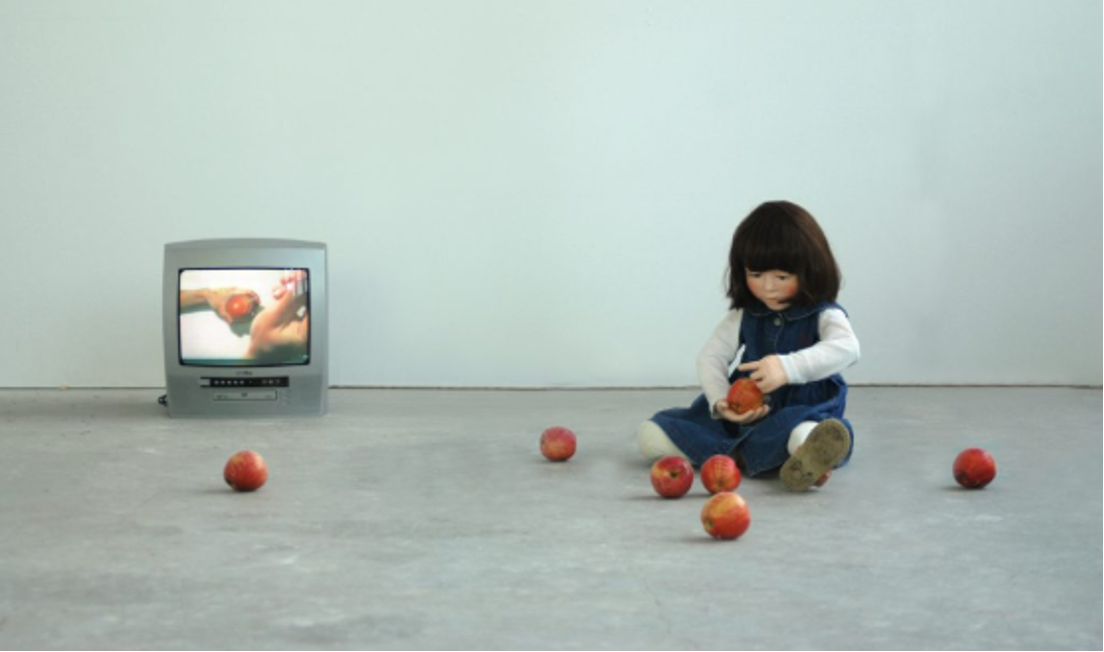
The artist’s full-scale “house” works began with Furniture House(2013–, Brittany), followed by Caravan(2015, New York), Lavihamahamahyunchuchuhappyj33atomausepponssugizetteblackbyungddoungkkeong…(2019, Seoul), Cannot Be Conveyed in Words(2021, Incheon), Peillacasanstmartinsurousthanampipriacivrysurseinesene…(2022, Incheon), and When Memories Assume Particular Forms(2024, Jeju).
These works can be divided into forms that fully possess the shape of a house, forms that are minimized, fragmented, or structured through the proliferation and reconstruction of fragments.
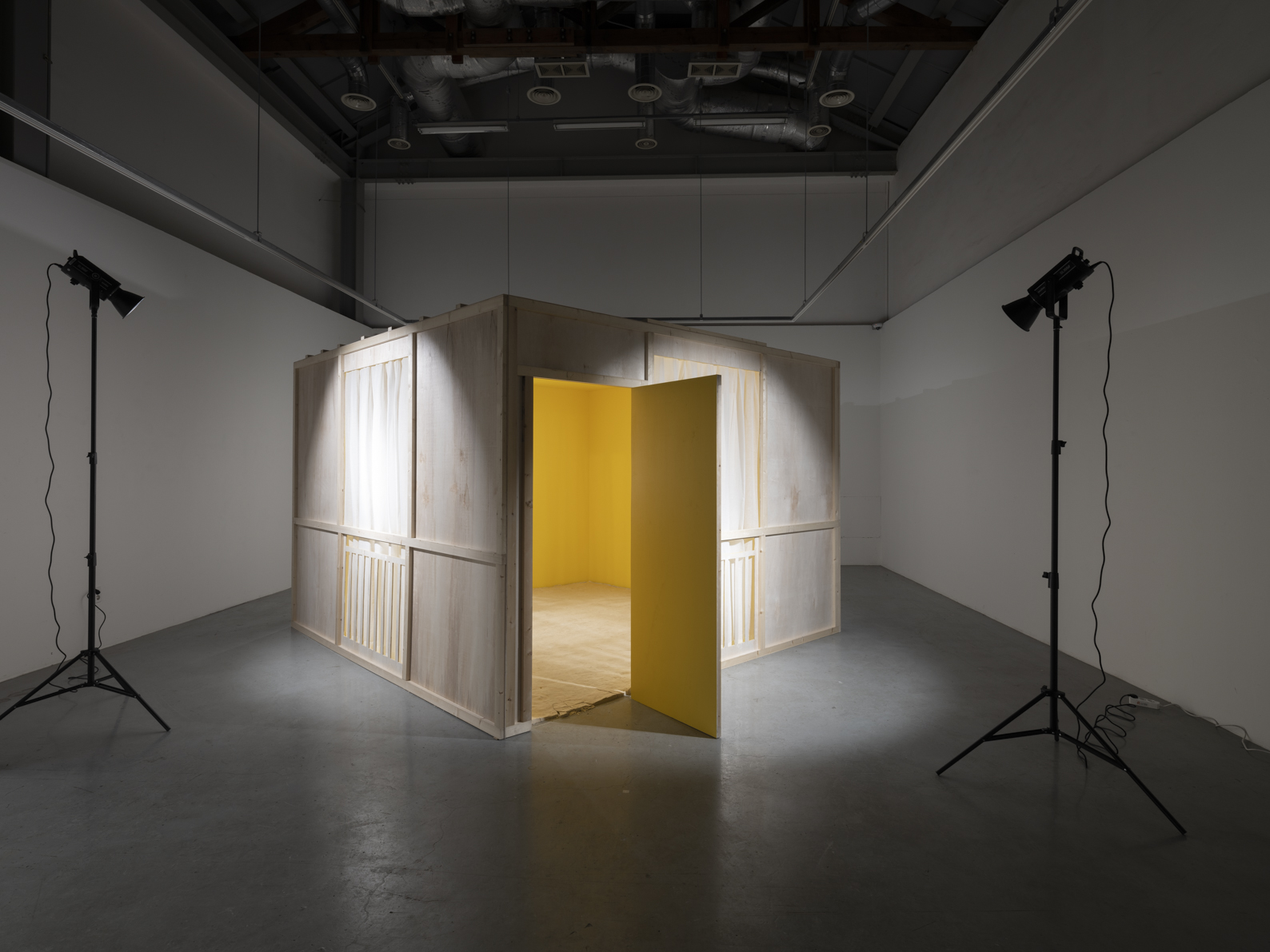
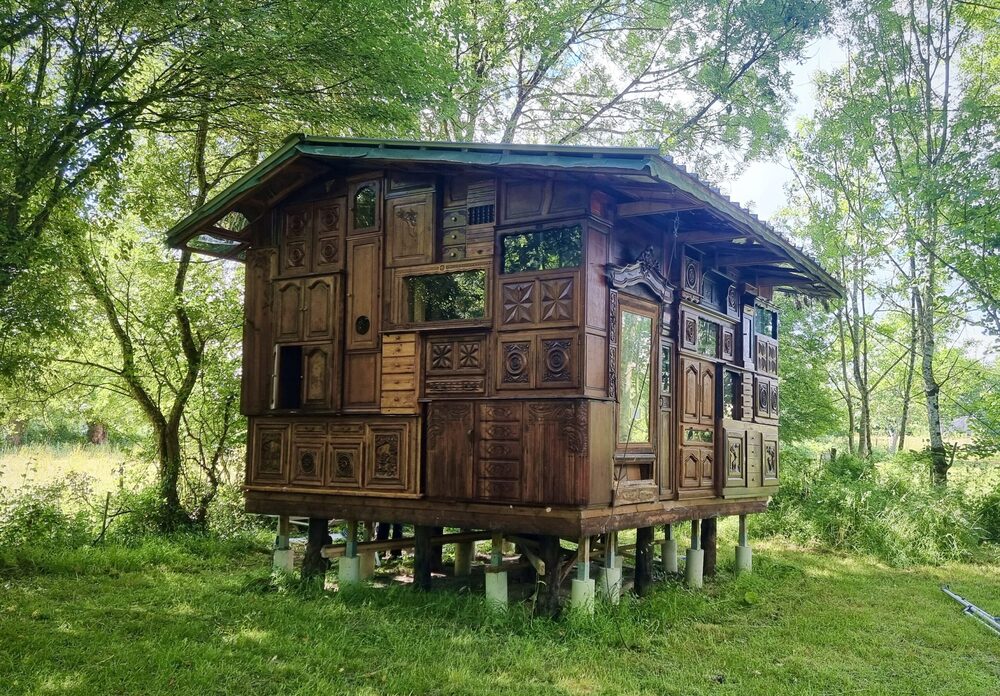
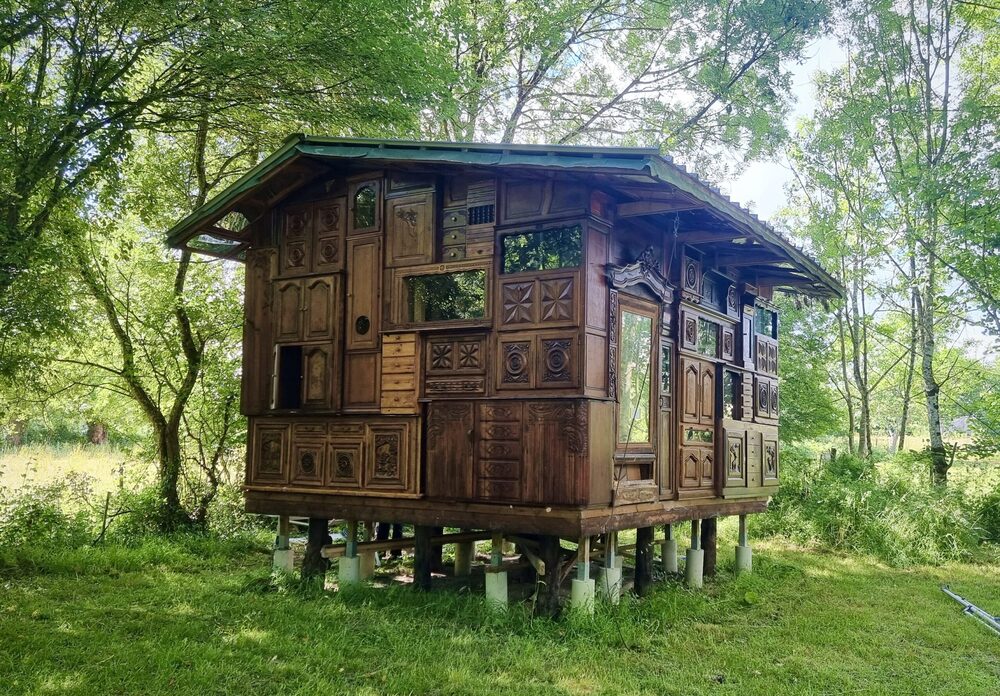
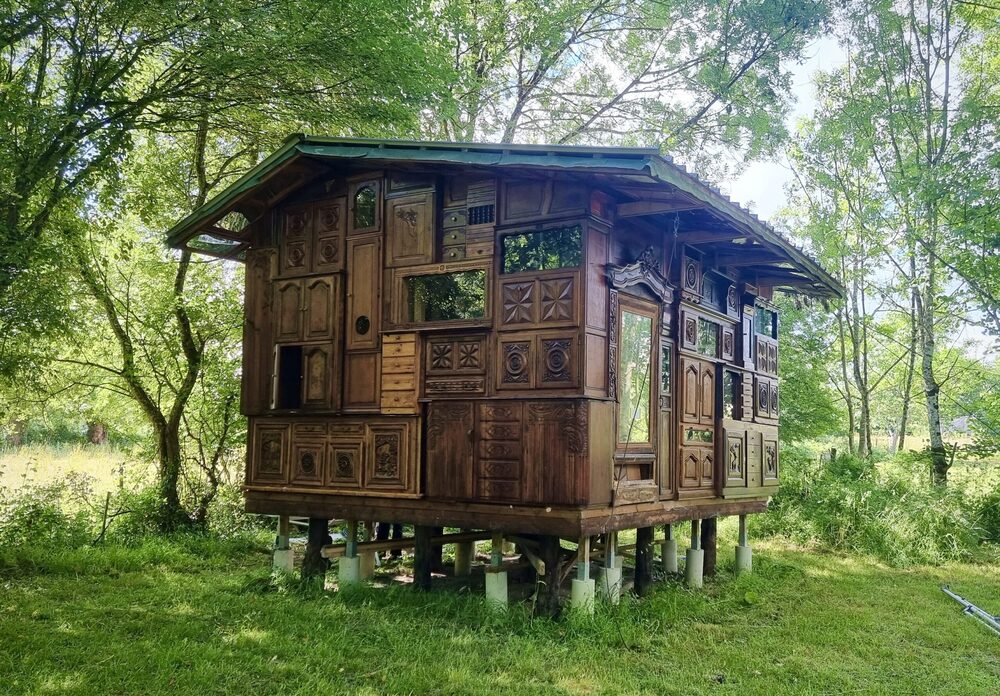
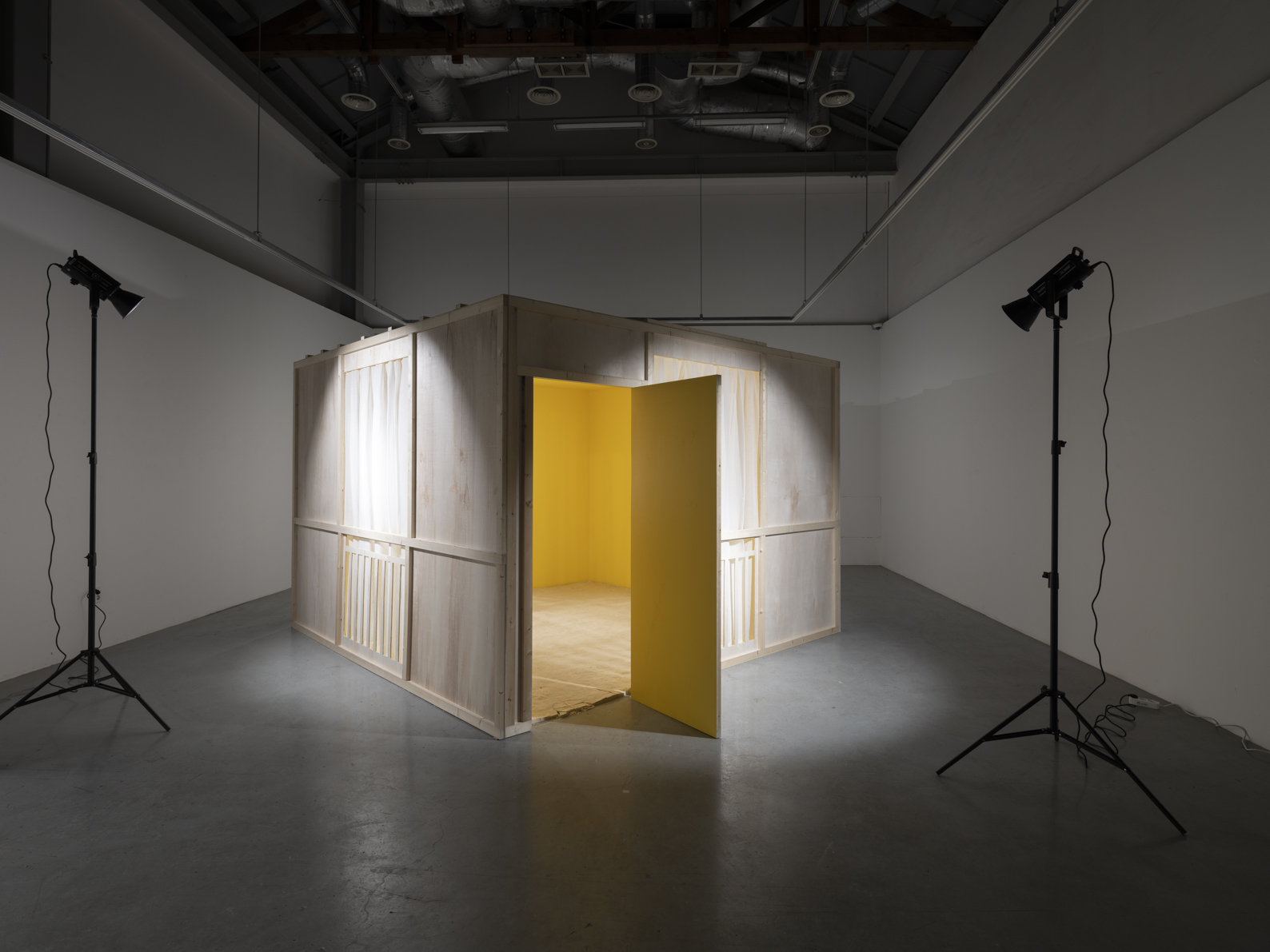
Furniture House, which fully takes the form of a house, is close to an ongoing project that Min began producing in the summer of 2013 in Brittany, at the northwestern edge of France facing the Atlantic Ocean, and has continued to the present. Built in collaboration with local architects, engineers, and construction specialists, Furniture House is a structure measuring 400×500×380cm that can be inhabited.
Taking into account the river that frequently overflows in winter due to the region’s heavy rains, the structure was raised one meter above the ground. As the title Furniture House suggests, the house is composed of around 70 pieces of “secondhand furniture” donated by local residents or purchased at flea markets.
Interestingly, its exterior walls are made from the whole or partial forms of mirrors, doors, wardrobes, and other objects once used inside someone’s home. The interior exposed outward, the reversal of inside and outside, the gathered narratives and memories/languages of individuals, and the traces of interlocked times seem to question the conceptual and existential hierarchy—and the indeterminacy of that hierarchy—between “Creole,” “hybridity,” and “hybridization,” and imagined “myths” or notions of pure-blooded “tradition.”
At the same time, through centers placed in parallel and peripheries gathered together, the work emphasizes that the reversal, inversion, and subversion of center and periphery can possess endlessly shifting force.
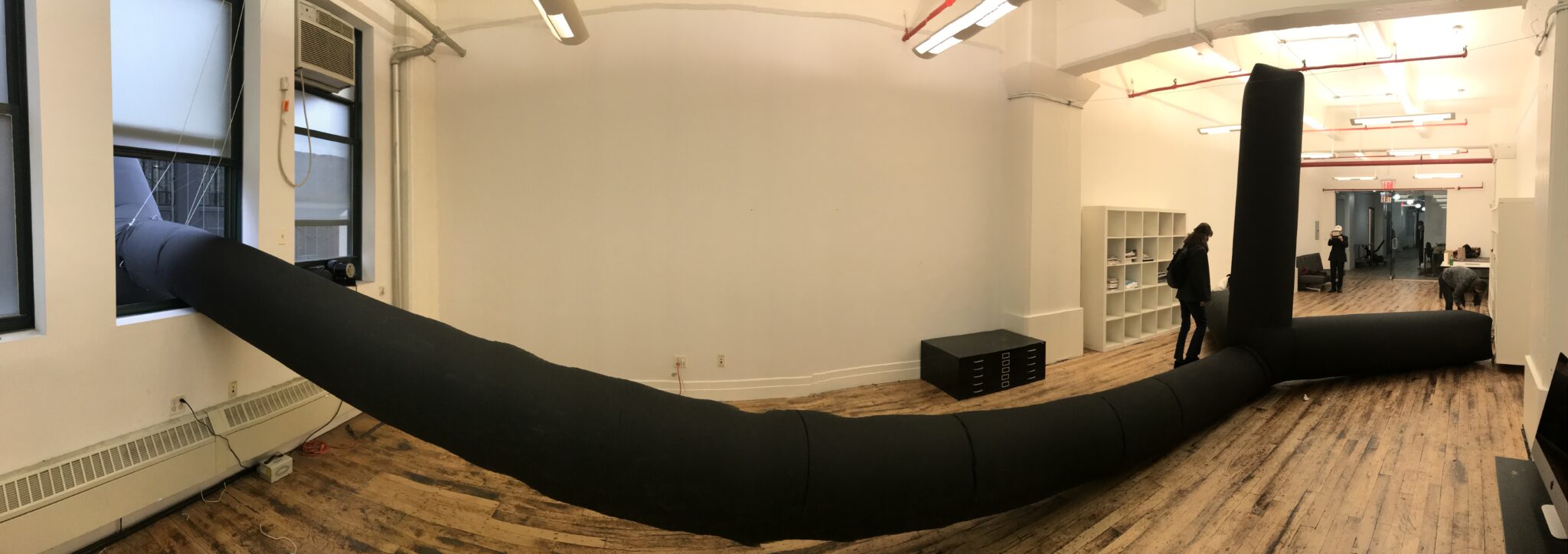
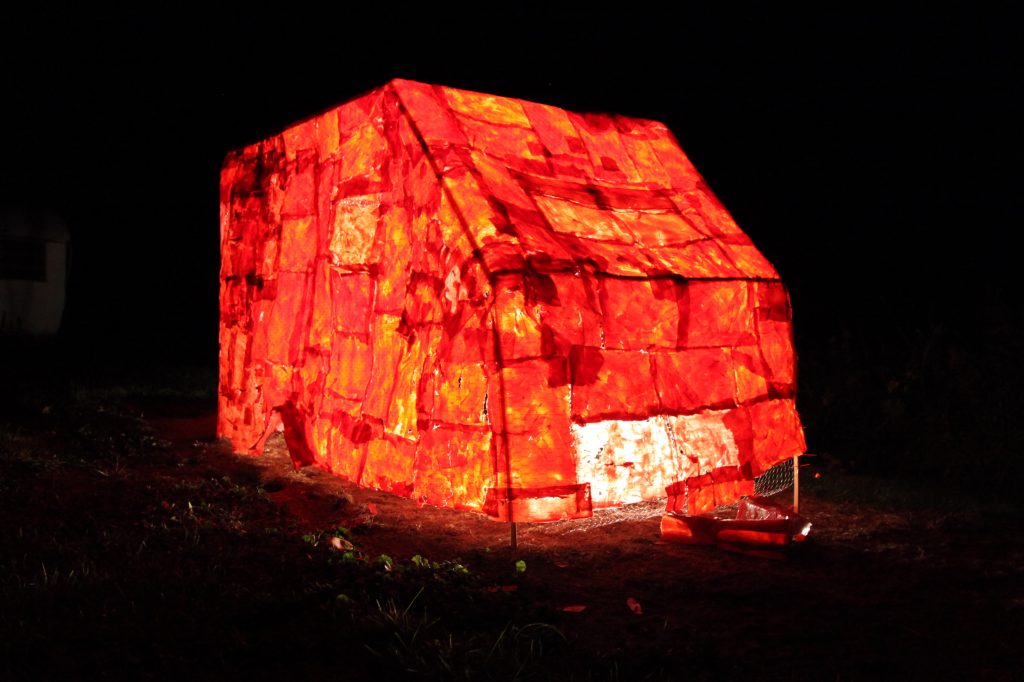
Caravan(2015) is a “house” whose form has been minimized. Originally referring to groups of merchants who crossed deserts or wastelands and engaged in commercial exchange between countries, peoples, and regions, the caravan today is known as a typical form of mobile home. At the Triangle Artists Workshop in New York, the artist simplified the actual “caravan” that had served as her accommodation and produced it as Caravan.
Installed in the same place, following the traces of where the actual caravan had been, Caravan was composed of several thin panels made by applying and hardening wax, a material sensitive to conditions such as time and temperature. The temperature difference between hot days and cold nights gradually transformed the form of the wax-built Caravan.
Melting in sunlight, hardening in the dark night, then melting and hardening again, Caravan clearly reveals the nature of identity as something that wavers and is reconstructed over the passage of time. In this sense, Min’s Caravan, as a “house” made of thin melting wax panels, unsettles conventional ideas of the fixed and solid “house.”
The Parallel Worlds Visualized by the Cut House
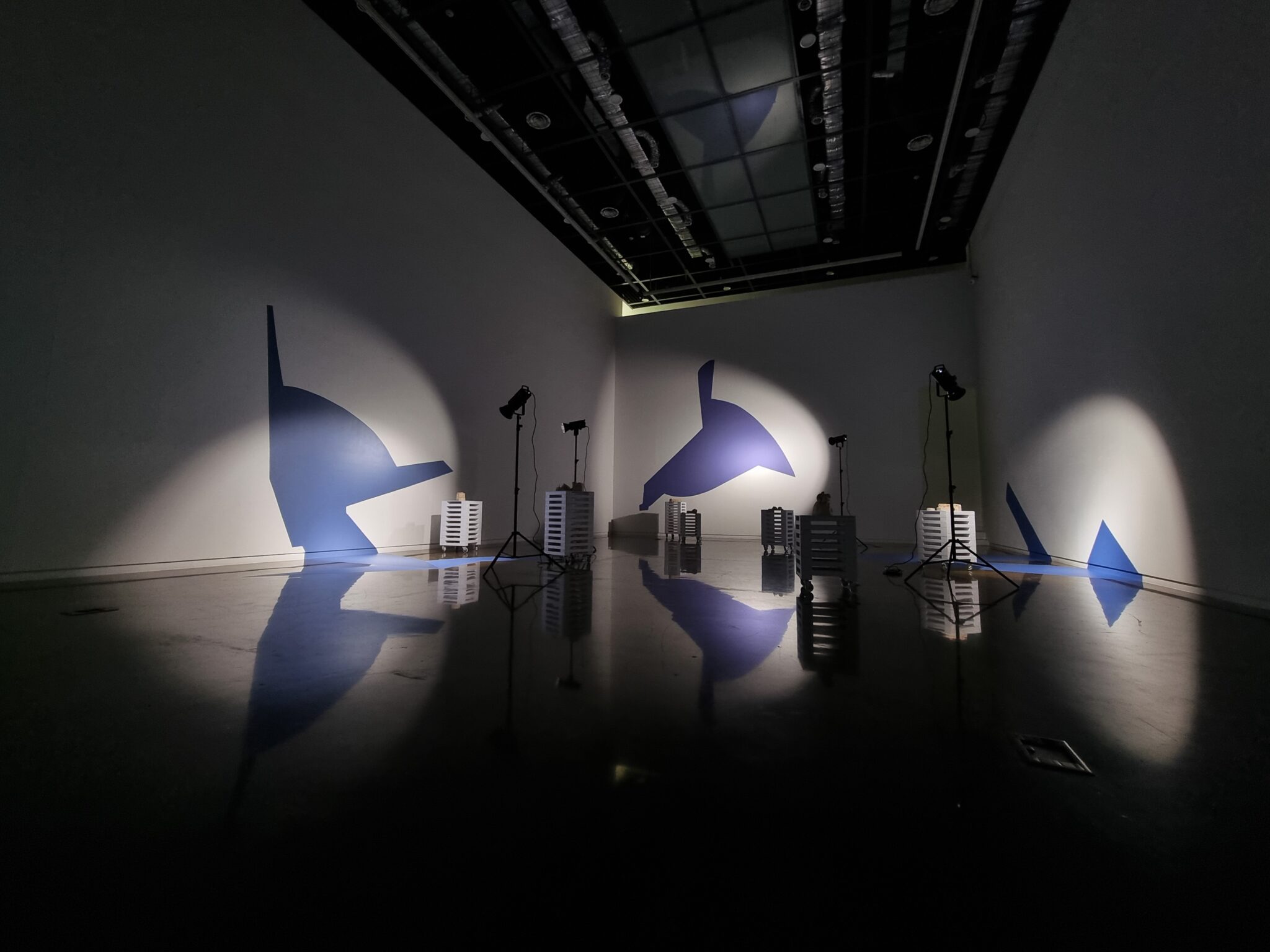
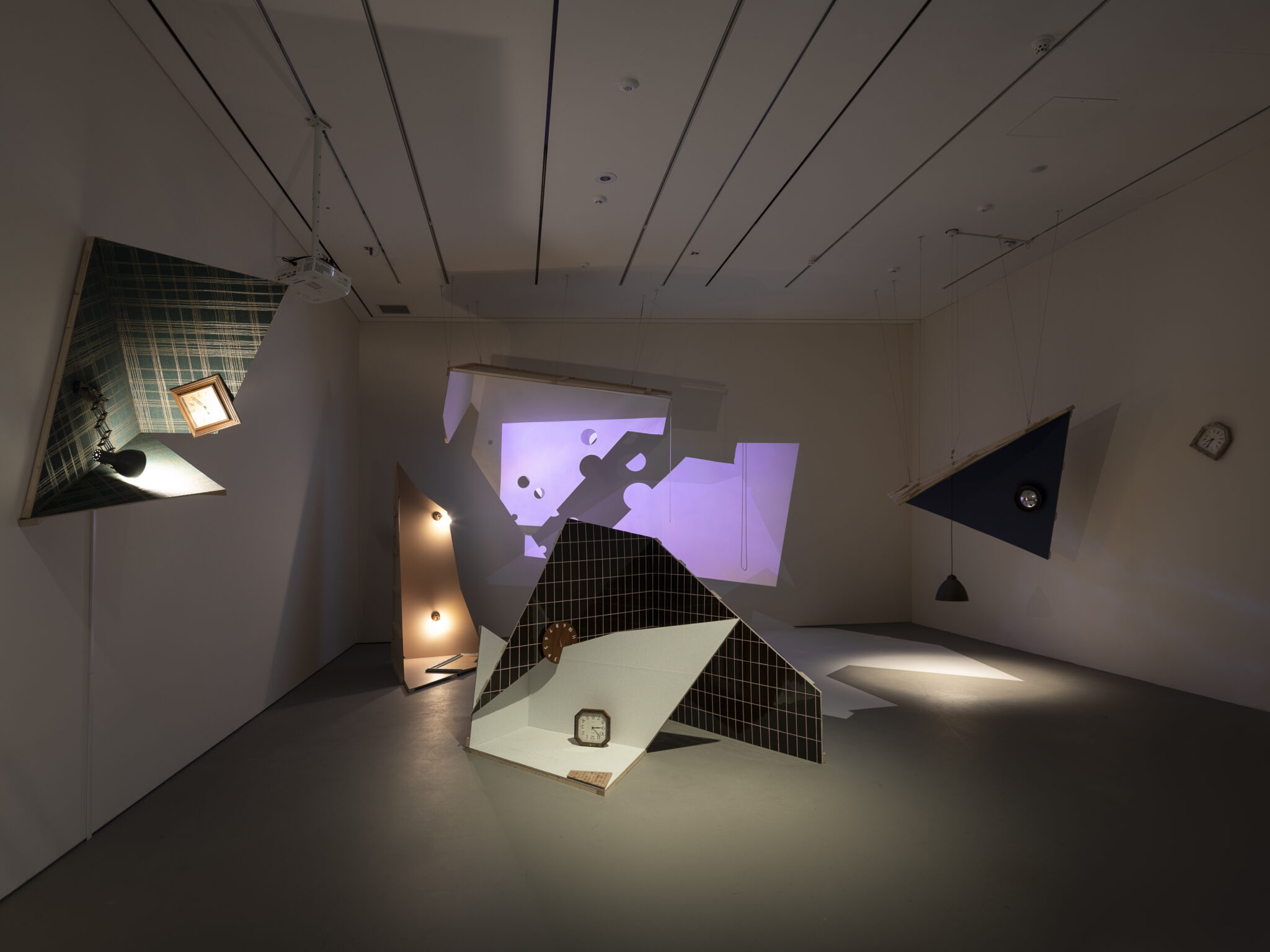
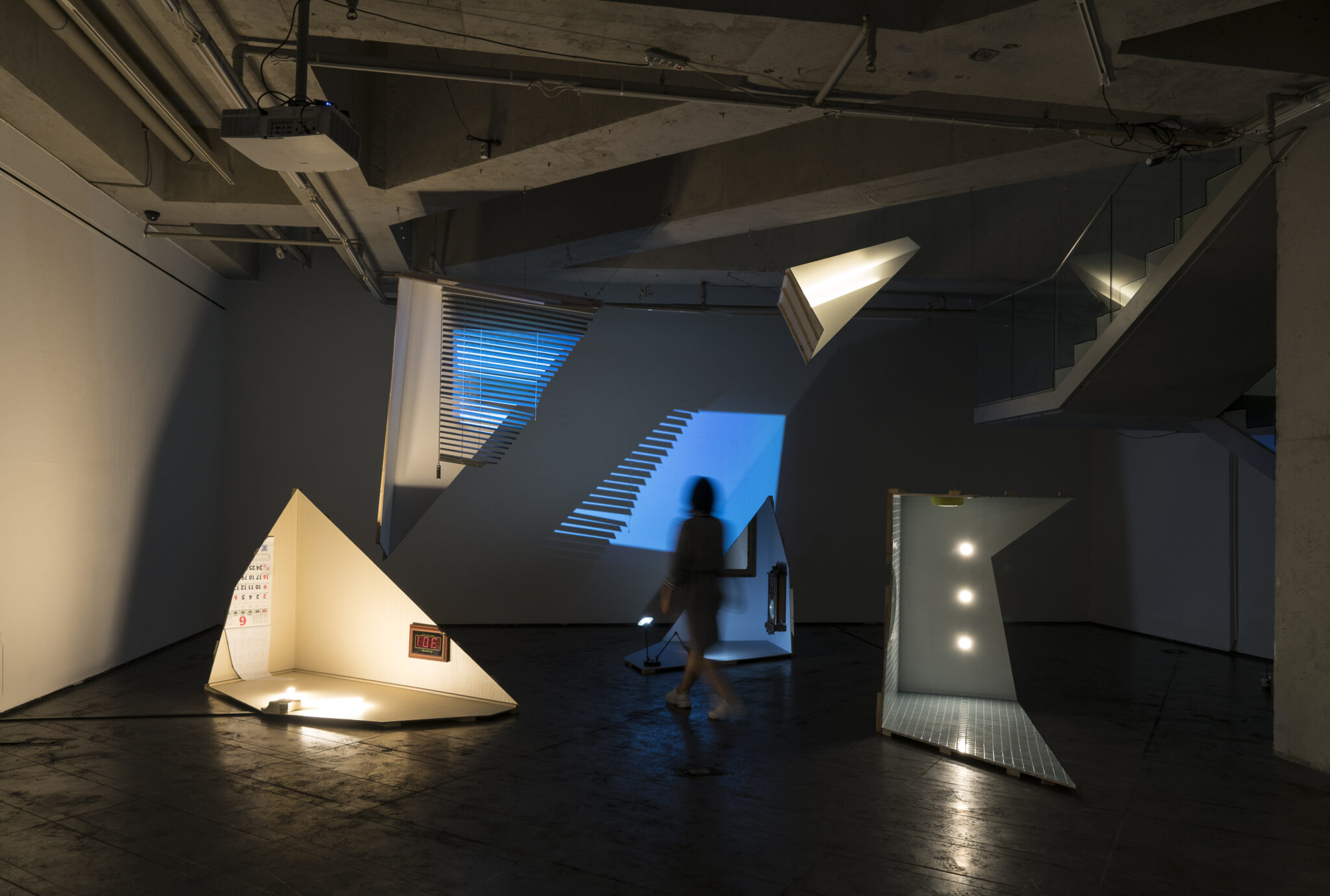
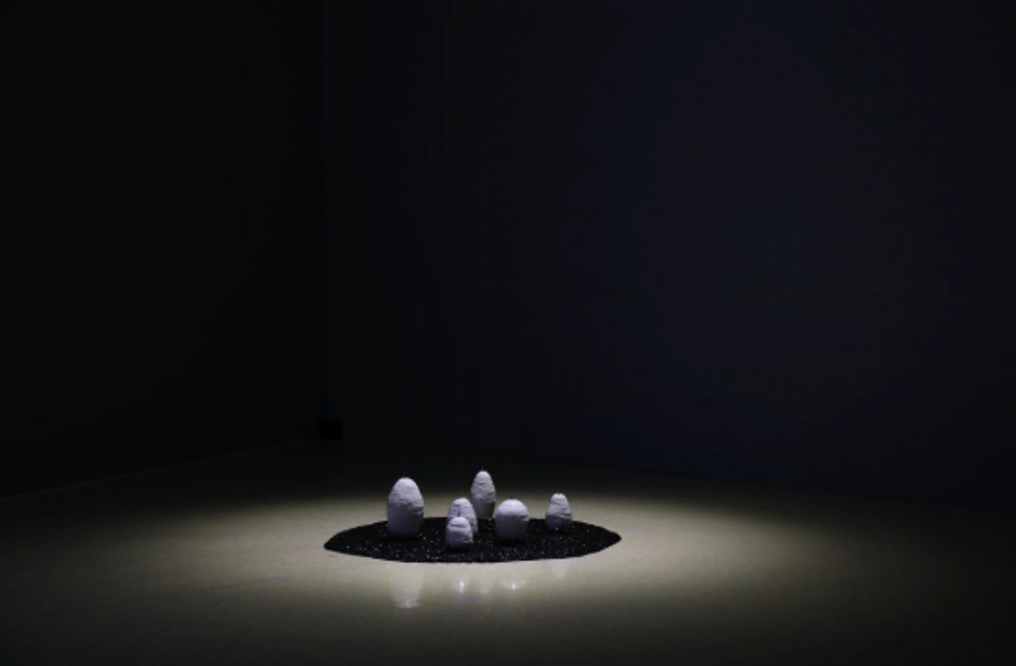
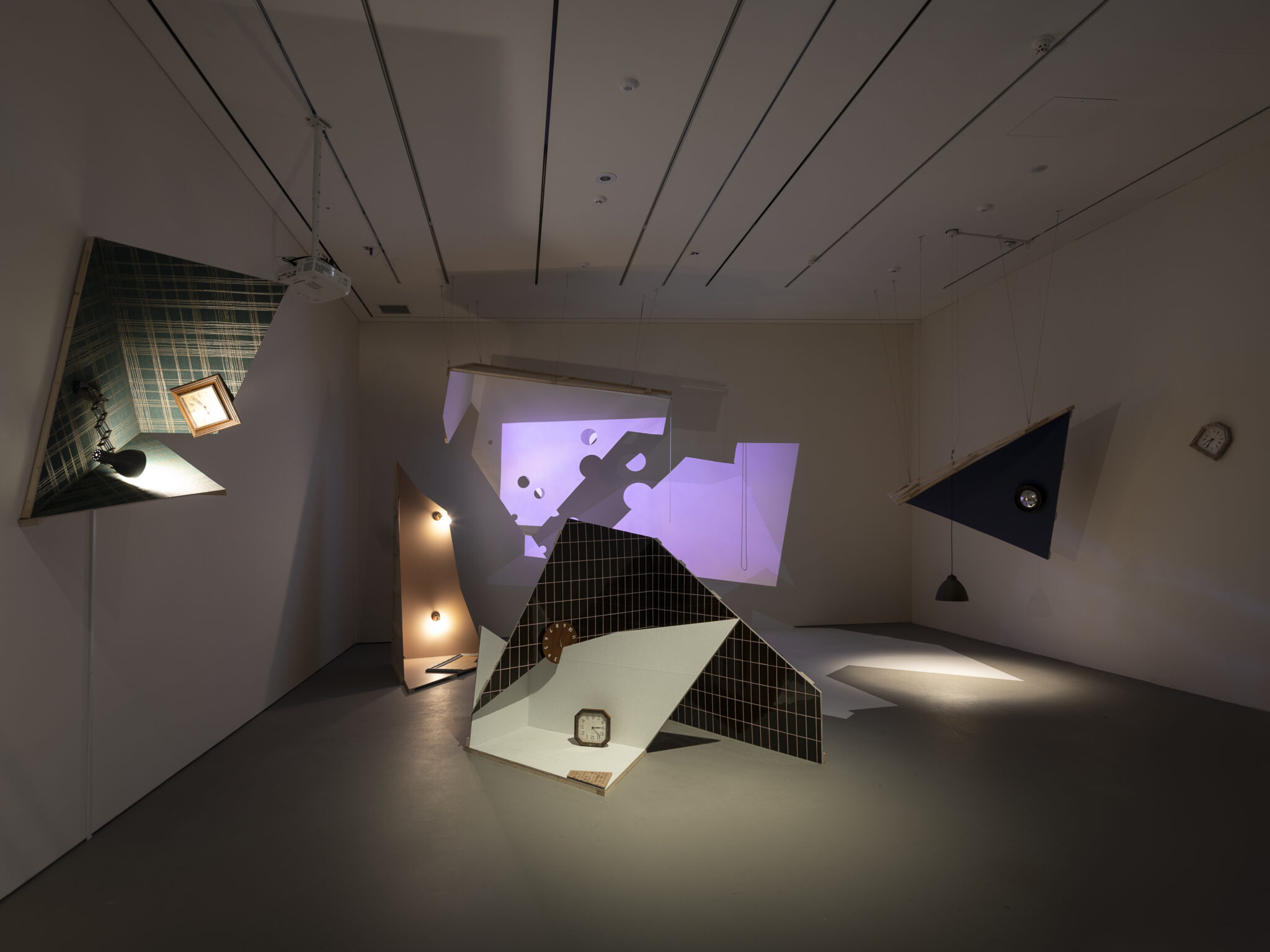
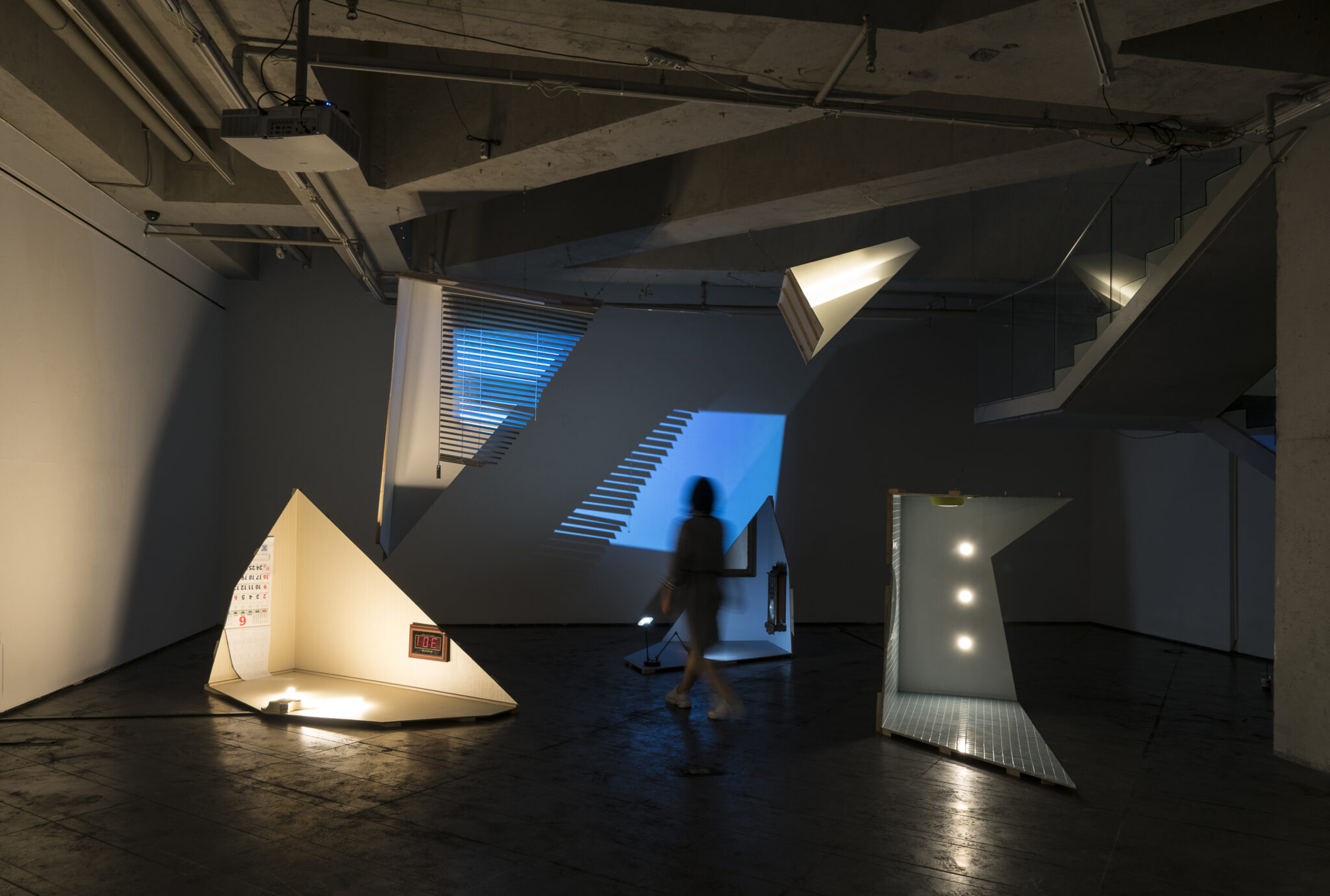
Since around 2019, Min has continued to create a new form of “house”—more precisely, a “house” that she has cut, fragments/pieces of a house, and its interior. For example, Lavihamahamahyunchuchuhappyj33atomausepponssugizetteblackbyungddoungkkeong… is a work in which a rectangular solid measuring 150×240×150cm was cut into six uneven pieces and installed in space.
The six fragmented pieces are placed in the space as if drifting, without specific coordinates. Attached to the inside of the fragments are several objects that allow viewers to infer that they were once part of someone’s “house” or interior. These objects, collected by the artist through various routes, include bathroom tiles, a wall clock, a digital clock, a mirror, a window frame, and a tear-off daily calendar.
Objects with different years of production and trends stimulate nostalgia and aspiration, recollection and archaeological knowledge, depending on the age of the viewer.
Lavihamahamahyunchuchuhappyj33atomausepponssugizetteblackbyungddoungkkeong… was made by collecting secondhand goods that had circulated through a kind of region-based hyperlocal platform, either through transactions or sharing.
Today, hyperlocal services have become active as social network services (SNS) combine with business models such as secondhand trading and local information exchange, but at the time this work was produced, the artist collected objects purchased or given away for free through online communities formed around specific regions and neighborhoods.
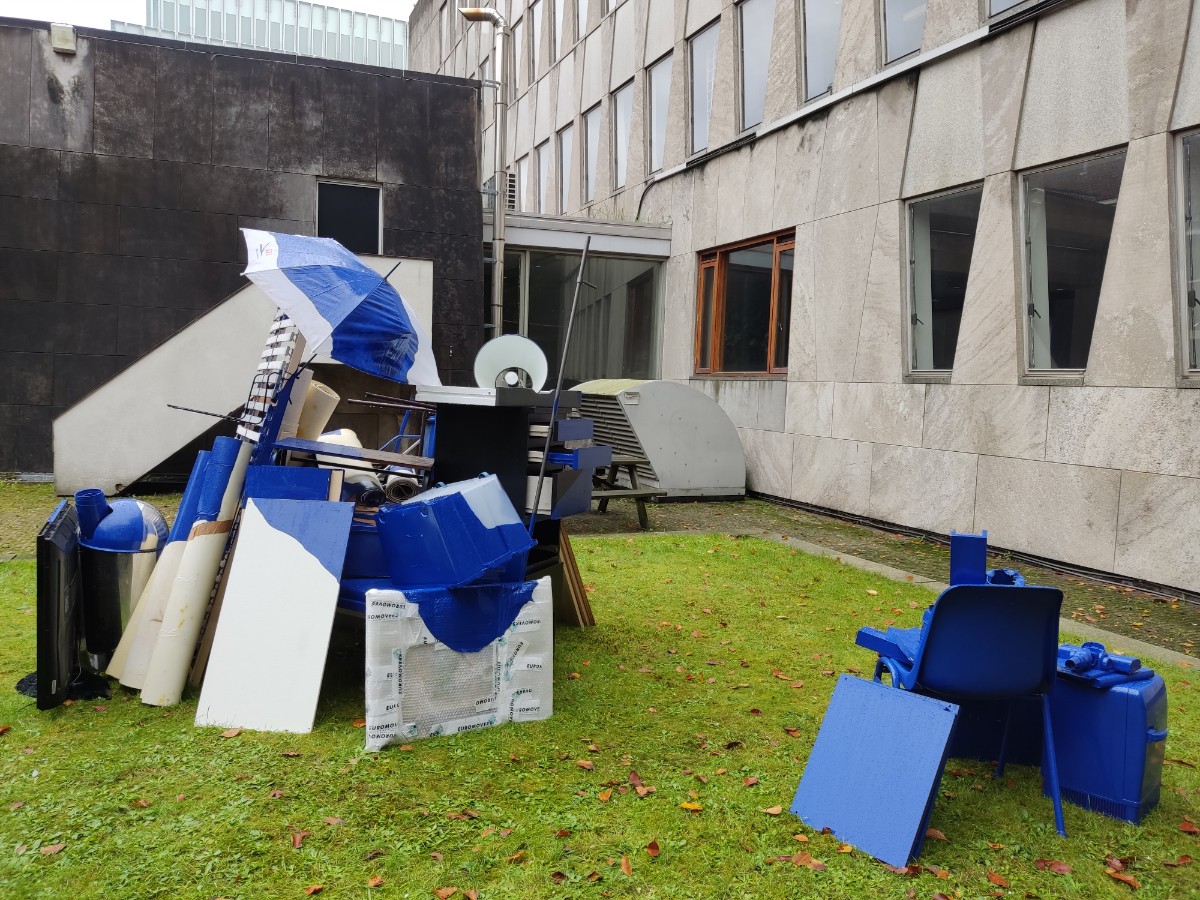
These objects were things that had lost their use and function for someone, their value damaged, or had been discarded because they had lost their trendiness or period character. Since the Industrial Revolution, the overflow of objects has worked in tandem with the logic of capital, rapidly hierarchizing the usefulness and disposability of many things in everyday life.
Here, Min’s Lavihamahamahyunchuchuhappyj33atomausepponssugizetteblackbyungddoungkkeong… proposes to put a brake on the hierarchization of value and to dismantle and overturn such violent hierarchies. Critic Jung Hyun’s expression, “this long and endless title that cannot be deciphered,” can also be viewed along the same lines.
This title is a random combination of the user IDs of hyperlocal platform users, and it “perhaps reveals the essence of the work better than the assemblage of broken spaces where the boundary between inside and outside is ambiguous.” Min’s consistent reversal of the boundaries between the inside and outside of the “house” can be understood in the same context.
The act of collecting and reconstructing discarded objects is no different from an attempt to restore damaged meanings and values, and to recover discarded time. Through such reconstruction, parallel worlds, approached each time as different scenes, can open through the newly widened spaces. The hearts of viewers who walk or stand among these nonhierarchical, parallel, fragmented sculptural “houses” will tremble, either warmly or coldly.
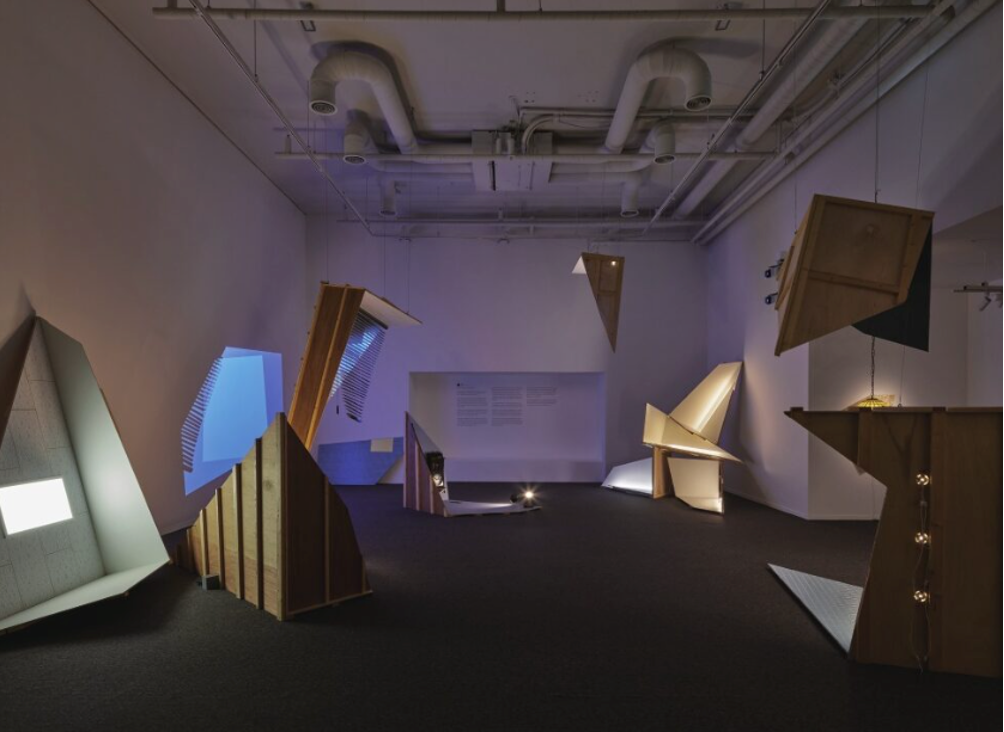
Peillacasanstmartinsurousthanampipriacivrysurseinesene… is also similar in its compositional method and structure to Lavihamahamahyunchuchuhappyj33atomausepponssugizetteblackbyungddoungkkeong…, in that it dismantles and fragments a rectangular solid assumed to be a “house,” and through this reverses the boundary between inside and outside.
The two works above underwent continuous processes of proliferation, combination, and reconstruction and were installed as When Memories Assume Particular Forms(2024). Here, the processes of proliferation, combination, and reconstruction converge into the world that Min strategically seeks to visualize and unfold.
Ultimately, this world arises from attaching within a single space objects that were produced, distributed, and used at different times, and from the relations formed among things that are disparate and improper. The world reconstructed by the artist is a landscape where instability and transcendent aesthetic beauty stand in contrast. This is perhaps due to the shadows produced from various angles and distances.
The surreal landscape staged by multiple shadows cast simultaneously within one space causes existence to question not only itself, but also the world as a whole, including time and space. In this space, where a single light and a specific coordinate have disappeared, we turn our gaze toward shadows of unknown origin.
This is like reading a long and endless title that does not seem like a title, or a series of propositions that do not seem like propositions. Like a shadow that we have assumed to be singular, a title that we have believed should be one stretches out into more than one, carrying the possibility of proliferating infinitely into five, ten, twenty, thirty, and beyond. This tells us that, in the public square, declarations are not the only form of history; small murmurings can also be history.
What is interesting about Peillacasanstmartinsurousthanampipriacivrysurseinesene… is that the title is a combination of the actual “places,” or regional names, where the artist collected the objects. These places are everyday spaces familiar to the artist through experience and memory, but for many viewers who have no experience of those places, they are spaces without place, and cannot be the same as cyberspace or virtual reality.
“Peillac-Brittany / Asan-Chungcheongnam-do / Saint-Martin-sur-Oust-Brittany / Hanam-Gyeonggi-do / Pipriac-Brittany / Ivry-sur-Seine-near Paris / Séné-Brittany…”
Read aloud the paired names of towns and cities as spaces without place. Their irregular rhythm is like a surrealist poem that awakens a new sensation. Just like Min’s spaces.
“Because of the influence of my parents, who studied in France in the 1980s, I was exposed to both Korean and French cultures from an early age. But only when I went to France to study at the age of 19 did I realize that many of the words I had used in everyday life were French. Words like télécommande(remote control), chariot(cart), and panneau(road sign). Spending more than ten years in France, I realized that I did not fully belong to the culture of one nation. I called this ambiguous position, this situation of being in-between, ‘mixed-blood thinking,’ and unfolded it in my work.” – Artist’s Note
House and Identity
The deep and implicit connection between art and identity has existed throughout art history. Fundamental questions about human identity—how the world sees you, how you see yourself, and how you see others—have influenced artists, ideas, emotions, and creative expression from ancient Greece to the present. The subject matter, formal characteristics, and materials of an artwork reveal qualities of identity to both the artist and the viewer, on both personal and broader cultural levels.1
In her 1990 book Mixed Blessings: New Art in a Multicultural America, critic Lucy Lippard paid attention to the vitality of contemporary artists who represent themselves as members of communities, stating that an individual “identity” produced without relation to someone or something is nearly useless, and actively supported artists’ desire to connect with their own cultures.
Lippard supports the position that identity is relational, defined by similarities to and differences from others. She also argues for the acceptance of the concept of a collective self, and describes identity as something expressed by being represented in the name of visual and verbal shared identity.2 Lippard’s definitive claim about identity is connected to the collective identities that countless exhibitions of the 1980s and early 1990s focused on, particularly identities defined in terms of race, ethnicity, gender, and sexuality.
Ye-eun Min, who has worked by focusing on the “house” or parts related to the “house,” also encountered “migration,” “cultural intersection,” “Creole,” “hybridity,” and “hybridization” through the influence of her parents in childhood, studying in France, and participating in residency programs in various cities such as New York. Through these experiences, she can be said to have maintained her own artistic position on “identity.”
Nevertheless, Min’s case differs fundamentally from Lippard’s collective self or shared identity. Through the works discussed above, the artist attempts to recognize and reposition the unreal collective hybridity and hybridization that previous generations had othered and romanticized as real identity.
At the same time, she rejects the singular conceptual fiction imposed upon hybrid collective selves within linear hierarchies. The conceptual fiction we know has committed the error of assuming only clarity to be valuable. It is true that hybrid identities, relatively ambiguous and indistinct in definition, have been othered, disparaged, abandoned, and discarded.
Min, who is able to speak both Korean and French, says that we must recognize that a single term or concept explained by each language does not coincide exactly. The shared area between two languages around one concept, and even the ambiguous landscapes revealed by the areas outside that shared zone, are also the identities that each of us possesses.
Meanwhile, while paying attention to the form of the “house,” Min has dealt with five keywords—“time,” “space,” “language,” “material,” and “relation”—weaving them together in various ways. These five keywords function in Min’s work as a nonhierarchical network with multiple entrances and exits, moving between generations, places and spaces, memory and the future, familiarity and fear.
Without beginning or end, without a fixed path, they resist rigid composition and dominant concepts, allowing heterogeneous elements to become connected. Depending on which keyword one focuses on, the intense identity that Min’s work seeks to see will reappear through new perspectives and viewpoints between the world and me, me and myself, you and you all.
*This essay was written as a special contribution supported by the 2024 Korean Art Criticism Support Program of the Korea Arts Management Service.
1.See Jean Robertson and Craig McDaniel, translated by Moon Hyejin, Themes of Contemporary Art, Doosung Books, 2012(2nd printing), pp.74–75.
2.Ibid., p.72.