Following the Scent of Earth

Since 2019, I have been searching for mushrooms as a hobby. When September arrives, after a typhoon has passed and the intense heat begins to subside, I spend time in forests and fields, following the earthy scent carried on the wind. Many wild mushrooms are easy to overlook because they are small, inconspicuously colored, hidden among grass and fallen leaves, or shaped like pebbles.

Yet their distinctive odors can alert us to their presence. Some evoke smells already familiar to me, such as flour dough, boiled radish, seafood, or the odor released as a dead organism decomposes.

Although I do not know the composition of these countless volatile compounds, once I began to detect their scents, I would invariably find mushrooms and could sometimes even identify their forms or ecological types. The mental map of mushrooms that I have constructed in this way is entirely subjective.

There are several things I have deliberately avoided doing since I began searching for mushrooms. First, I do not look up their names or classifications. Second, I do not investigate whether they are edible or poisonous, nor do I consume them. Third, I do not collect them for commercial gain. In my artistic practice, which regularly engages with living organisms, I am not free from the centuries-old perspectives of economic biology and taxonomy established by humans.

For this reason, when I first became interested in mushrooms three years ago, I decided that, with this group of organisms at least, I would follow sensations that reached my body before studying knowledge discovered by others. I wanted to awaken and refine my senses toward unknown forms of life. Until then, I had encountered almost no mushrooms other than edible varieties. Some of this limited knowledge proved helpful in searching for mushrooms, while other assumptions were completely overturned.
When many people hear the word “mushroom,” they imagine a rounded cap resting on top of a stalk. Apart from a few edible varieties, they may recall the red cap dotted with white spots that appeared as a roof in the childhood cartoon The Smurfs or as part of the landscape in Alice’s Adventures in Wonderland, and divide mushrooms into those that can be eaten and those that will kill you if consumed. Many people also believe that mushrooms belong to the plant kingdom.


Mycelium–Symbiosis–Spores–Decomposition

In modern science, mushrooms are classified alongside molds and yeasts within the kingdom Fungi. They are eukaryotic organisms with distinctive biological characteristics that differentiate them from animals, plants, and bacteria.

Approximately two thousand species of forest mushrooms have been reported in South Korea to date, although this number will continue to change as taxonomic classifications are reviewed and existing records supplemented. More than sixty thousand mushroom species are said to have been documented worldwide, and many mushrooms in Korea have likely yet to be seen or named by anyone.

After I began searching for mushrooms, I encountered organisms with forms and ecological characteristics unlike anything I had ever imagined. In the beginning, I quickly realized how diverse they were, as I seemed to encounter a different mushroom every time I went out.

Accurate and beautifully photographed images of Korea’s forest mushrooms are readily available in numerous field guides and online sources, so I have not included them with this text. Instead, I introduce several scenes from the mushroom life cycle that I witnessed firsthand.


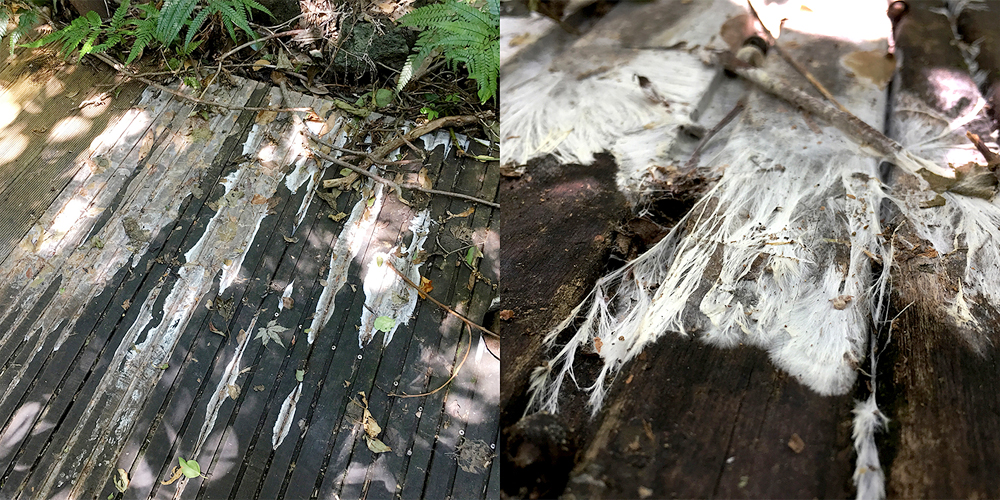
Mycelium © Lee Soyo

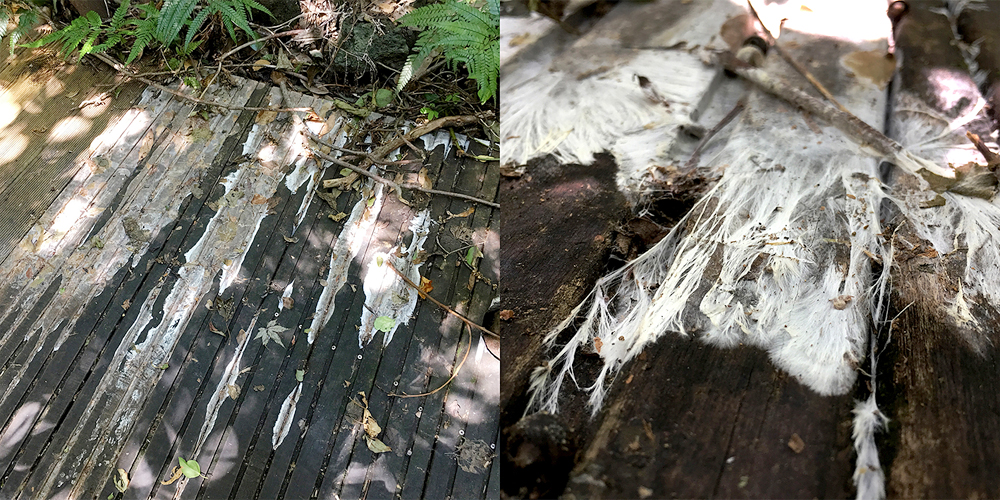
Mycelium depicts a large fungal colony spreading across the wooden decking laid in a park. The familiar rounded cap and stalk constitute the fruiting body of a mushroom. Much like a plant sending up a flowering stem and blooming in order to disperse its seeds, this is the reproductive organ that a fungus produces to generate spores. Most of a fungus’s life, however, takes place beneath the soil.

A fungus consists of threadlike cells known as mycelium. As seen in the photograph, these cells merge and branch in regular patterns, spreading outward radially. Because fungi obtain nutrients by decomposing the bodies of other organisms, they serve as decomposers within ecosystems, returning dead matter to the soil.

When a mycelial colony that has spread through the soil in search of nutrients seeks to leave its site, relocate, or extend into another area, it produces fruiting bodies and forms spores. When a spore germinates, new mycelium emerges. Spores may fall directly beneath the fruiting body, but they can also travel on the wind or attach themselves to other organisms, moving over long distances before establishing a new colony elsewhere.


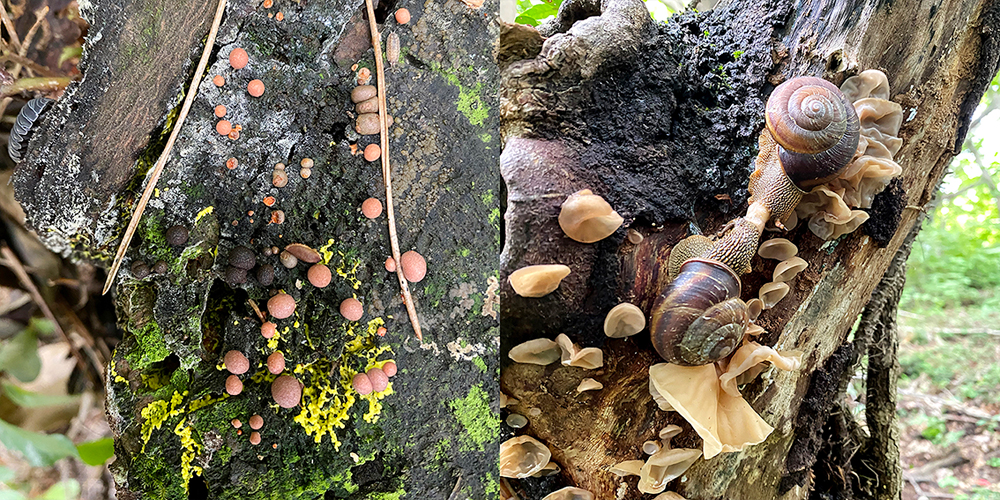
Symbiosis © Lee Soyo

Symbiosis presents a scene in which mushrooms can be seen living not alone, but alongside other organisms in their surroundings. Trees, snails, woodlice, slime molds, mosses, molds, and countless organisms invisible to the naked eye all live in relationships with fungi. They provide one another with food and shelter or perform cleaning functions; at times, they even share genetic material, and eventually return to the soil together.

Fungi obtain nutrients by attaching themselves to living or dead hosts. Some, such as matsutake mushrooms (Tricholoma matsutake), grow only among the roots of living plants of the genus Pinus, while others, including many species of the genus Pleurotus, grow exclusively on dead wood.

Understanding such characteristics has enabled humans to cultivate certain edible mushrooms, but most fungi cannot survive when forcibly separated from the ecosystems to which they belong.


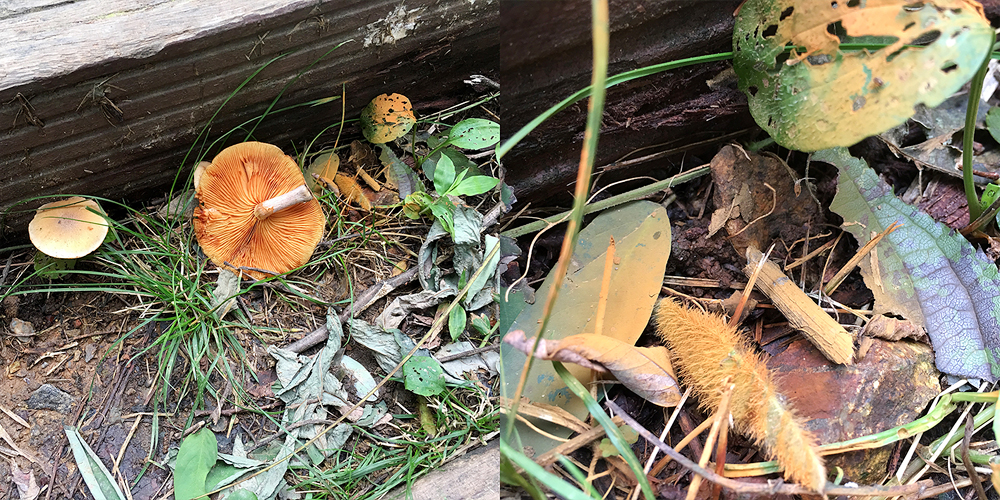
Spores © Lee Soyo

Spores shows mushroom spores covering various objects lying on the ground. The common button mushroom has a white cap, but when turned over, its gills appear dark because its spores are black. Similarly, the mushroom in the photograph has a yellow fruiting body and orange spores. Because there was no wind when the spores were released, they fell vertically and settled delicately on the objects surrounding the cap.

The hairs of a plant pod, the veins of leaves and stems, and the particles of stones and soil are clearly visible. Some of these spores will find suitable hosts, produce mycelium, and begin new colonies.
Mushrooms with gills on the underside of their caps may be the most familiar, but many other forms exist: some have no gills and instead contain sponge-like pores; some have an opening at the center of the upper cap through which spores are released; and others produce spores mixed with mucus, allowing them to attach to insects or animals and travel elsewhere.


Decomposition © Lee Soyo

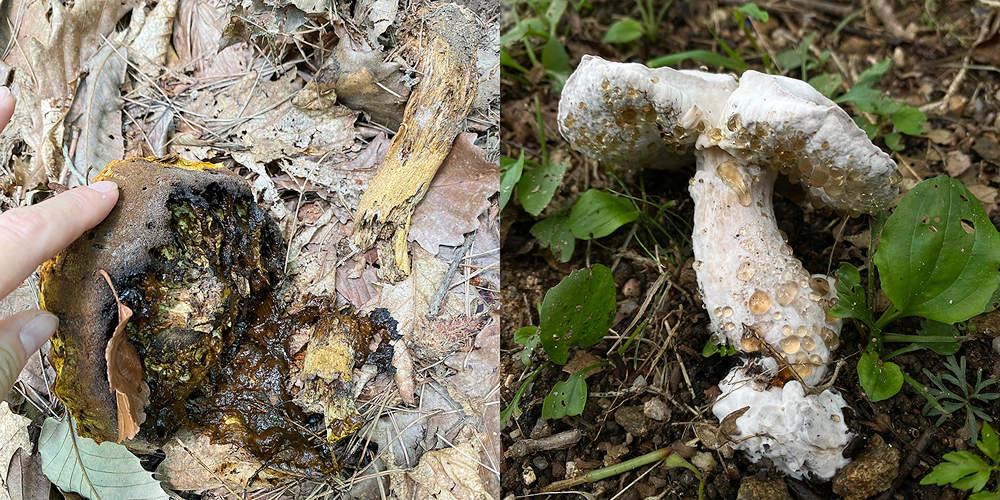
Decomposition depicts a mushroom’s fruiting body returning to the earth after completing its role. As noted above, fungi decompose other organisms, but their own bodies also become food for countless insects and microorganisms.

After displaying an array of colors, sizes, and forms—or quietly remaining hidden between stones and beneath fallen leaves—the fruiting bodies that have fulfilled their function dissolve into a viscous mass and return to the soil.

Some fruiting bodies melt into a pitch-black liquid resembling ink and drip downward, while others decompose in strange ways, forming droplets of vivid red fluid like blood. It is also common to see other molds or fungal mycelia blooming on them, or swarms of flying and crawling insects gathering to feed.


Attending to Diverse Forms of Life

Searching for mushrooms has opened up for me a world of organisms whose diverse forms surpass imagination, while cultivating my ability to sense the places and weather conditions most conducive to encountering them. It has also taught me how to approach other beings according to their circumstances rather than human schedules and convenience.

Before asking whether another organism benefits or harms me, or what it might offer me, this practice awakens and trains my body, mind, and senses, helping me attend to these beings’ lives on their own terms. It teaches me how to approach quietly without taking possession, and to love the ways they hide or transform unpredictably in an instant.

It also allows me to discover for myself what kinds of lives exist without first searching for their names. Now that I have spent three autumns with mushrooms, I find myself able to relate more deeply to the experiences and knowledge recorded by others in books.
I do not know how many more autumns I will witness in the years remaining to me, but I consider it a great stroke of fortune that I encountered mushrooms before it was too late. As the mushroom season draws to a close in late October, I conclude this text by recalling, one by one, the many forms of life I glimpsed this year.
References