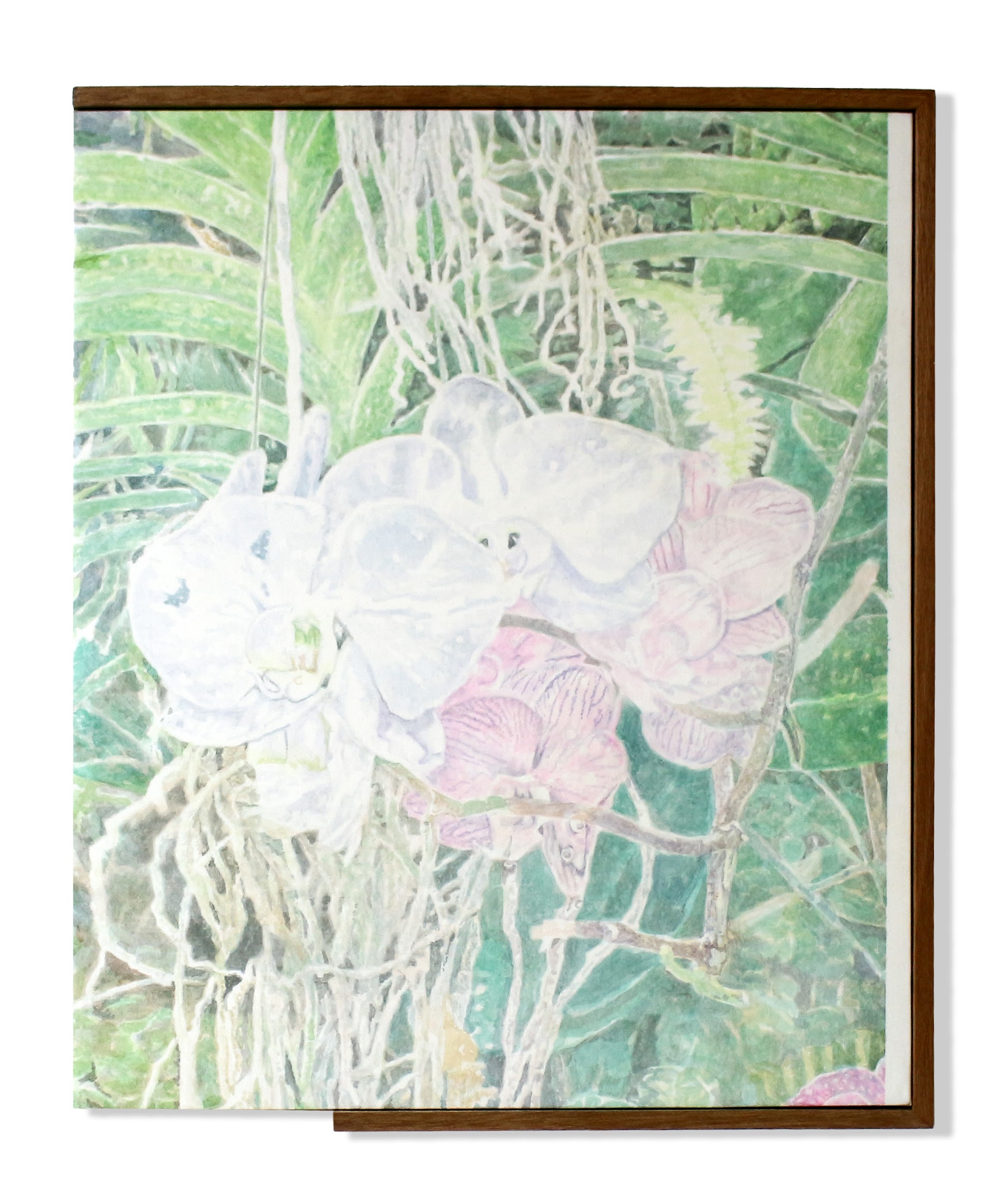
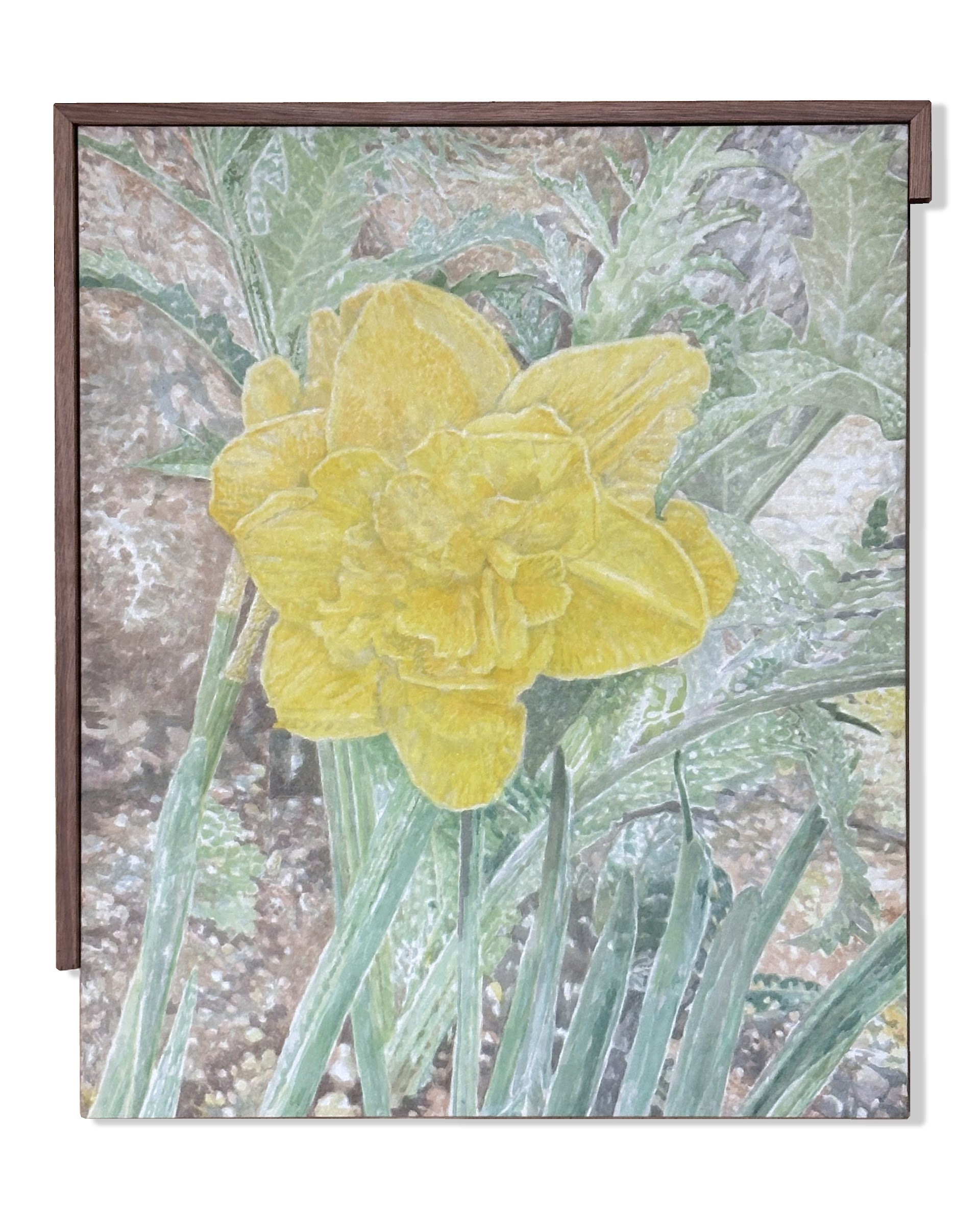
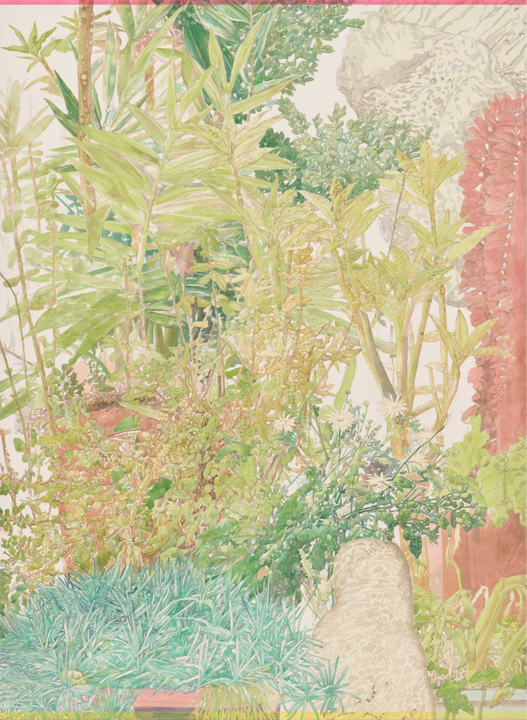
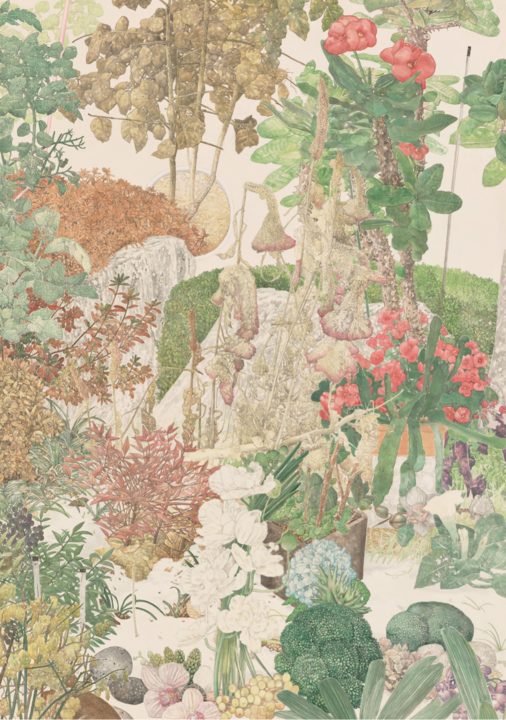
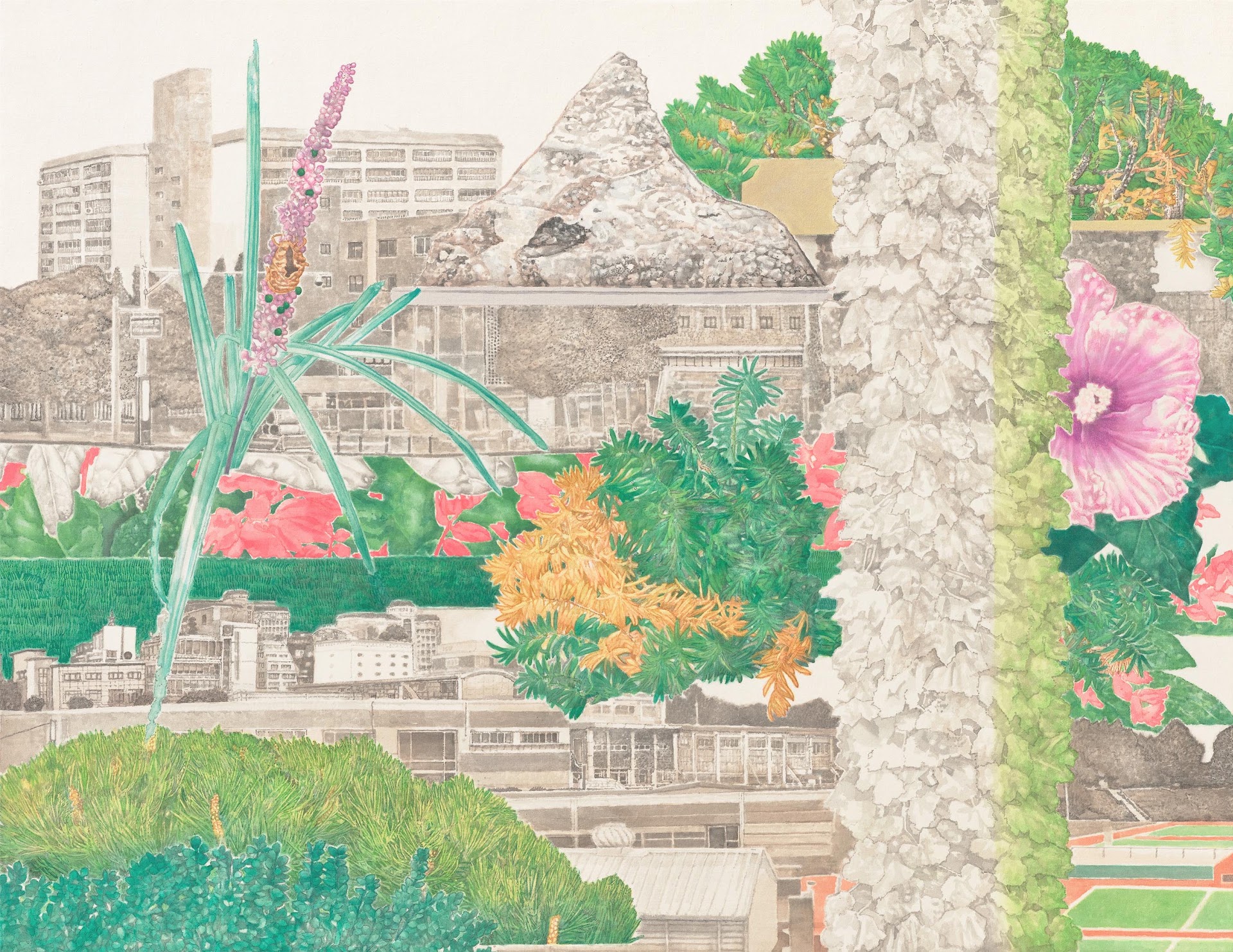
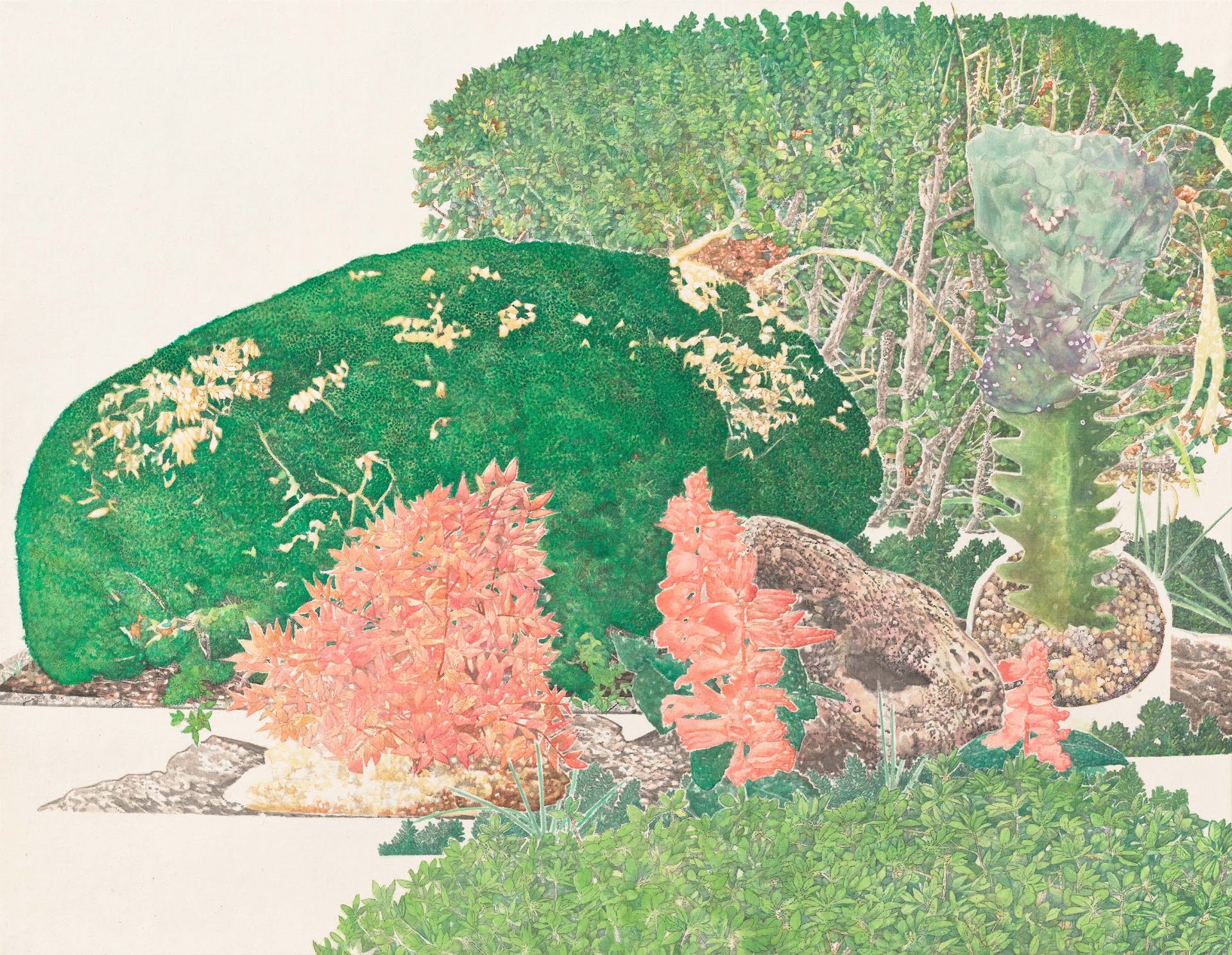
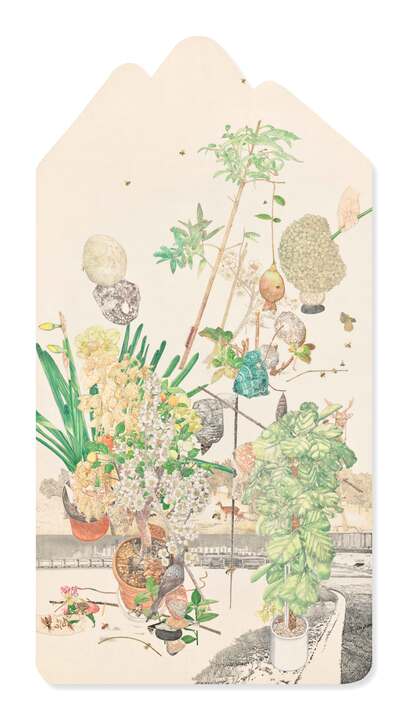
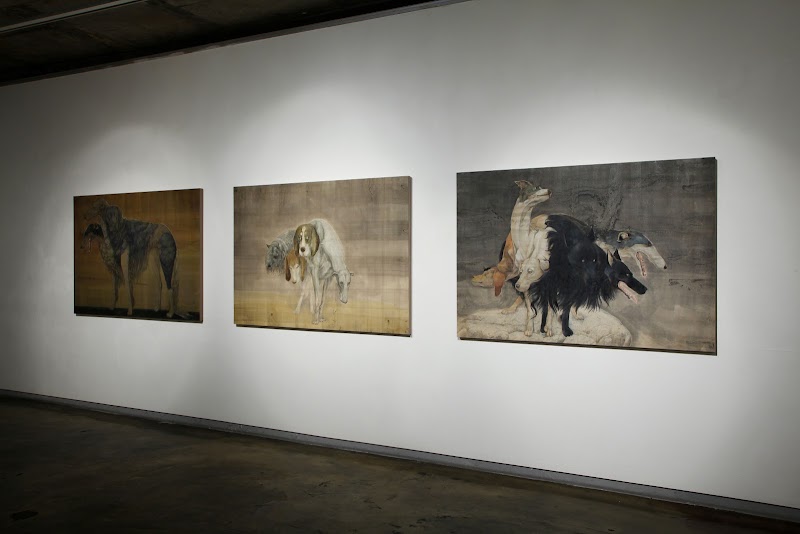
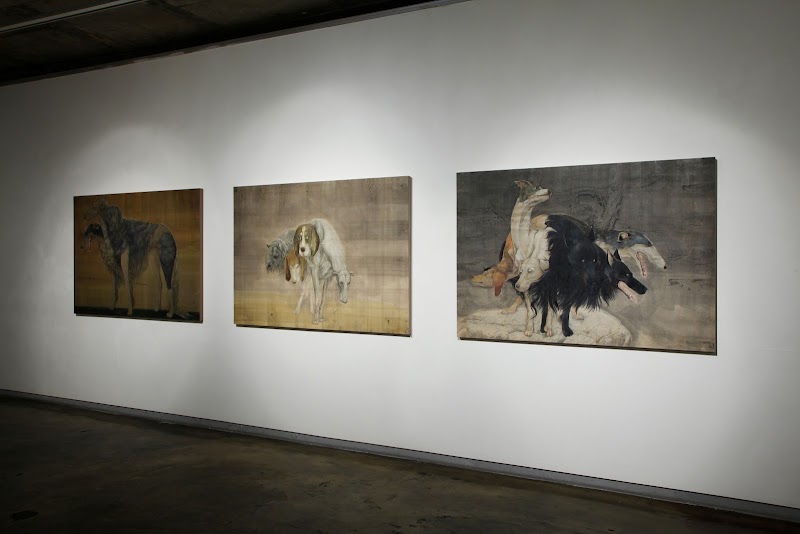
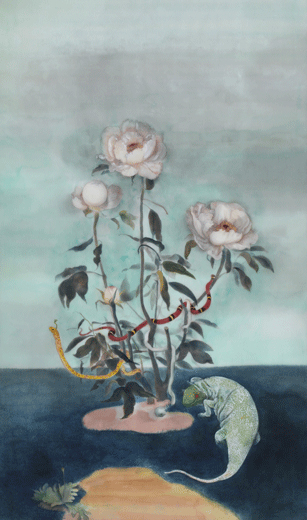
It is a “grotesque” landscape in which dogs and snakes are entangled with various living creatures. The work is a color painting meticulously rendered on silk using the reverse-coloring technique.
Although realistic, it also appears strangely fantastical and surreal. The most fundamental element constituting fantasy lies in the viewer’s anxiety or hesitation—in other words, a reluctance to determine whether the event or situation represented in the work is natural or supernatural.
This painting presents concrete subjects in an extremely unfamiliar and disconcerting situation. Multiple different heads are attached to a single body, interlocking and becoming entangled with one another. The figures are deformed and distorted. Sparse grasses and flowers bloom between them. The scene recalls a specific moment within the natural world or an ecosystem, yet at the same time it is profoundly alien and strange.
It is an uncanny image in which familiar, recognizable subjects suddenly appear unfamiliar and bizarre. On the one hand, the word “uncanny” is related to meanings such as “homely, familiar, affectionate, cheerful, comfortable, and intimate,” while on the other, it signifies “unfamiliar, uncomfortable, strange, and alien.” The sense of uncanniness is formed precisely through the overlap and collision of these two semantic layers.
According to Freud, “the uncanny is not something entirely new or alien within reality, but something long familiar and established in the mind that has become estranged from it through the process of repression. It is nothing other than a projection of the unconscious.”
JIN Minwook’s paintings also contain elements of the bizarre, the grotesque, and abjection. These imply an attack on totalizing and homogeneous concepts such as identity, institutions, and order. They are said to possess a subversive force above all because they do not respect boundaries, positions, or rules, instead foregrounding the intermediate, the ambiguous, and the hybrid.
In fact, art is fantasy from the outset insofar as it deals with situations that might exist and with possibility itself. It is also an irreverent desire. Fantasy is a deviation from mimesis and, furthermore, a deviation from realism. In retrospect, art ultimately possesses playful and escapist functions, as well as the capacity to destroy or criticize established order.
Although it may appear absurd at first glance, it continually critiques given reality, widens its gaps and intervals, and inflicts wounds upon it. Through this process, what already exists begins to fracture, and alternative possibilities appropriate to the given conditions emerge. Art may be considered the product of two impulses: mimesis, the desire to imitate and to depict events, people, situations, and objects; and fantasy, the desire to alter what is given and transform reality.
Fantasy originates when the actual object is absent. It is situated in the hallucinatory fulfillment of desire. The most fundamental fantasy therefore suddenly appears when one attempts to recover hallucinatorily the object associated with the earliest experience of satisfying and resolving desire. The realm of fantasy is thus not a mental world entirely separate from the real, but a domain that is both real and unreal, actual and imaginary.
It is a world that cannot be grasped within the binary structure of presence and absence. From a psychoanalytic perspective, therefore, the essence of fantasy should be located not in reality-transcending reverie or delusion but somewhere between reality and imagination. Fantasy art is ultimately an art of desire that seeks to compensate for the lack produced by artistic repression.
Perhaps the imaginary world of fantasy art may be described as an indeterminately positioned “interstitial space” between “the real” and “the unreal,” or as a liminal territory or in-between space situated between “subject/anti-subject,” “internal/external,” and “past/present/future.” It is neither “the real” nor “the unreal,” but occupies a position somewhere between them.
Like a ghost that is neither dead nor alive, fantasy art takes hold of reality while simultaneously breaking it apart. It relies on realist conventions to tell a plausible story, only to negate those realistic premises through the unreal.
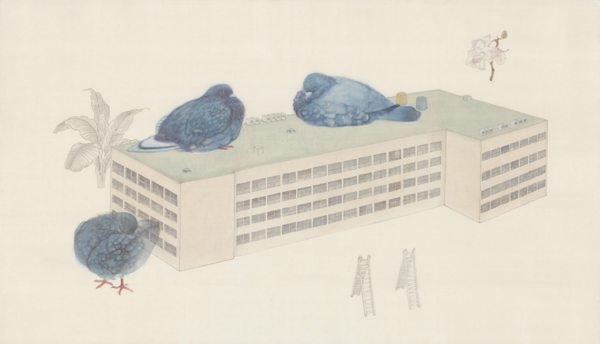
JIN Minwook’s paintings likewise intermingle scenes of unreal imagination and fantasy as though they were real. For the artist, the dogs, snakes, lizards, insects, and leafless rugosa roses that compose these fantastical pictorial spaces function as a kind of symbol. In East Asian art, borrowing natural forms as surrogates through which to represent and project one’s inner world has long been a tradition.
Art, in fact, continually draws the natural world surrounding human beings into one’s consciousness and body, dreaming of a state of unity with it, or reflecting anew on the origins of one’s existence through the emotions arising from such encounters.
JIN Minwook states that through strange combinations and arrangements of animals and nature, she seeks to heal herself through “inner reflection aimed at overcoming experiences of isolation, inferiority, and a fragmented sense of self.” Dogs and snakes, in particular, emerge here as beings with which she identifies. At the same time, they suggest the everyday relationships through which she is implicated with others.
Life is a succession of events. The self is formed through ceaseless interaction with that which is not the self. The “I,” or ego, is therefore ultimately a concept generated through contact and encounters with others. If that which is not oneself is called the other, then the relationship of mutual influence with others may be described as “other-related,” while what is formed within the self through such relationships may be called “otherness.”
In the end, all existing beings can sustain their existence only through the relationship between selfhood and otherness. Ultimately, the self does not exist. The ego is absent, and in its place lie the continuous relationships and conflicts between self and other. For JIN Minwook, the multi-headed snakes and dogs suggest such plural and intermingled images of the self.
When one thinks about it, a dog stands on four legs, constantly glancing around, tongue extended, unable to conceal the anxiety and vigilance in its gaze. The multi-headed dog created by the artist further heightens this condition of anxiety and alertness by bearing several heads upon a single body. According to the artist, these multi-headed dogs and snakes also express “a loss of direction and the lethargy that follows the loss of purpose in life.”
At the same time, both animals are meaningful symbolic figures that appear frequently in mythology. The artist understands them in particular as symbols standing at the boundary between good and evil, death and life, time and space, and reality and fantasy. Since ancient times, these creatures have been represented countless times within networks of such symbolic language.
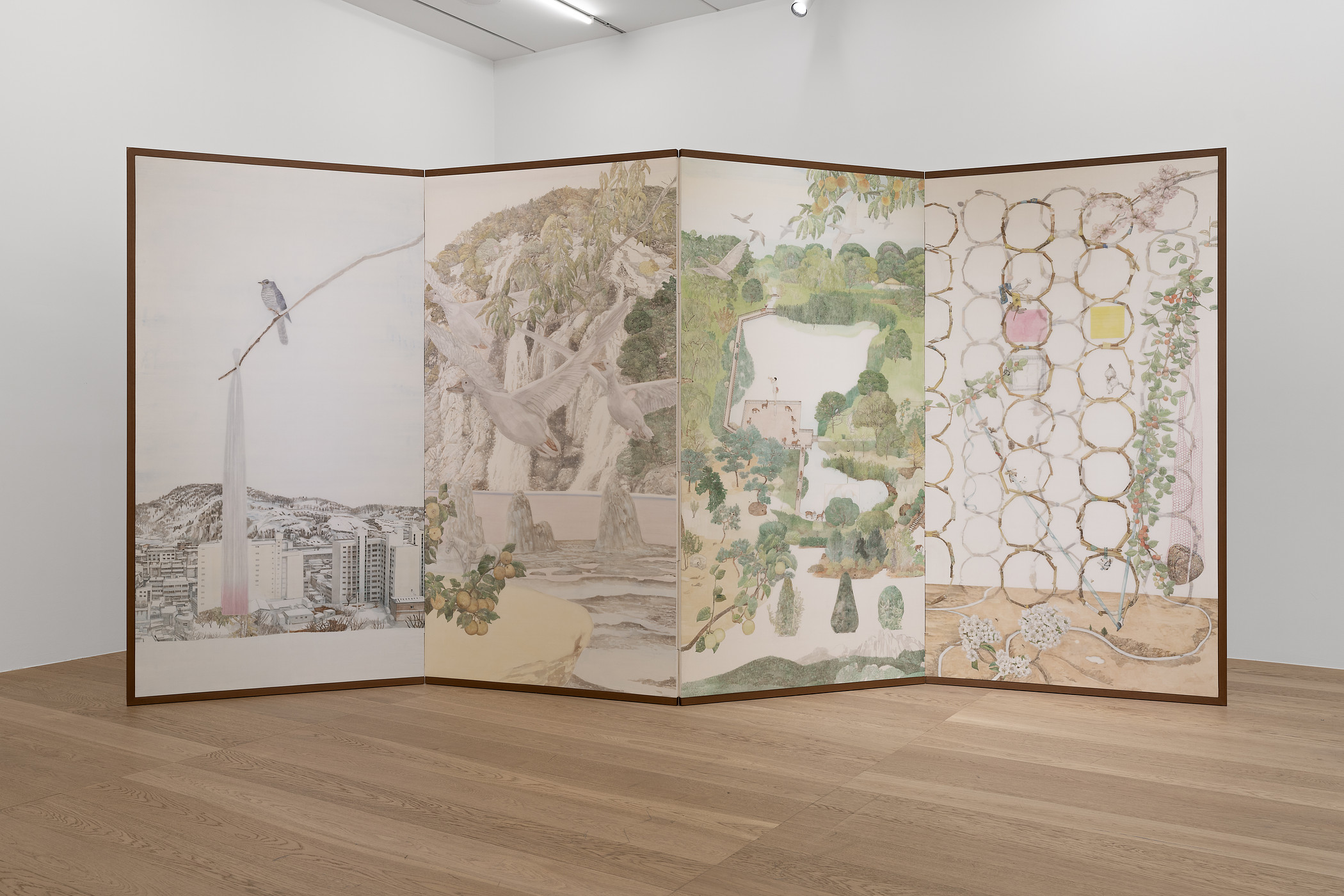
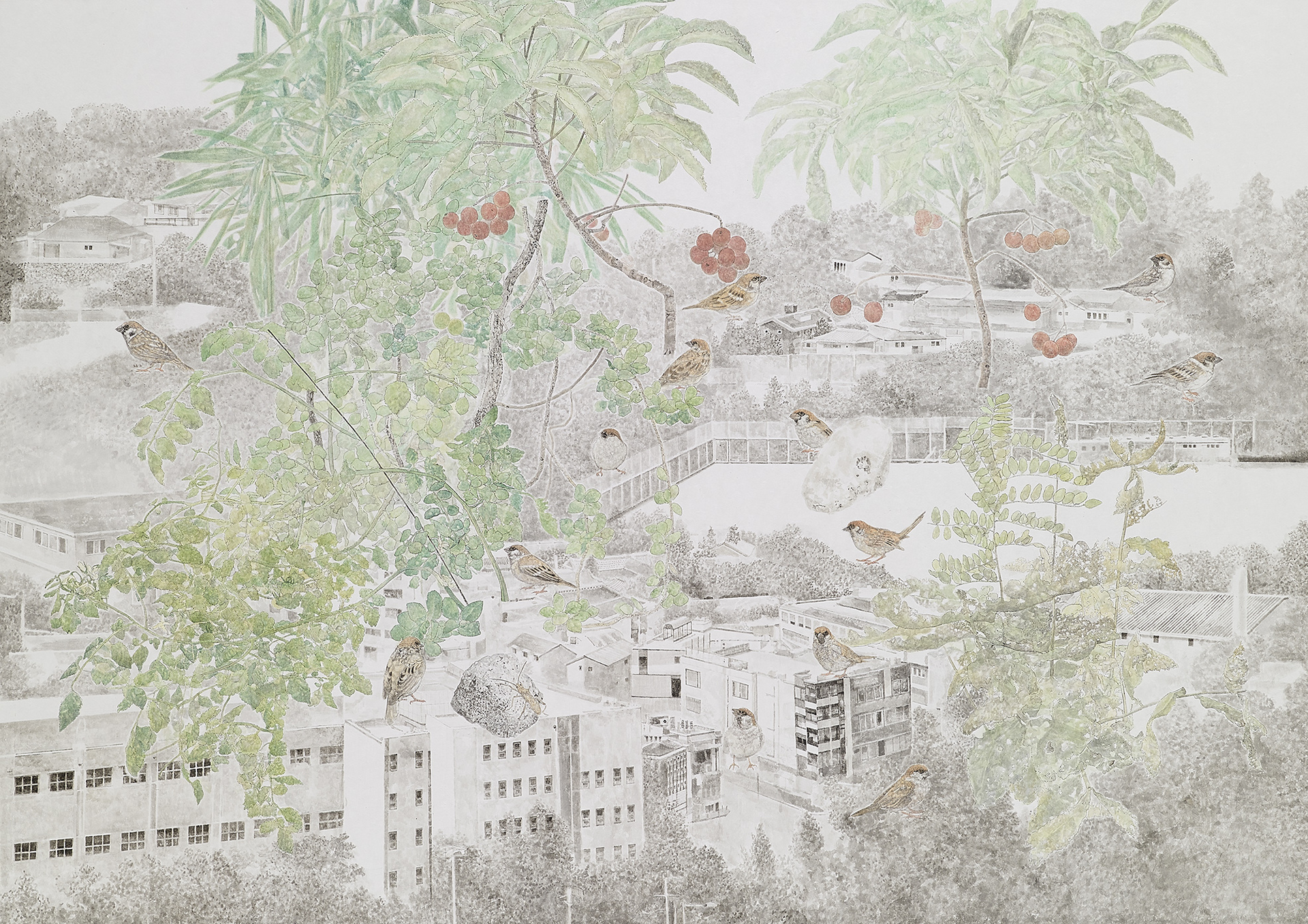
Drawing on traditional iconography, the artist re-represents and rearranges them in order to articulate emotions arising from her contemporary everyday life. Her use of color likewise follows the understanding that, in ancient East Asian painting, color—like symbolic imagery—does not remain a simple reproduction of what the eye perceives but possesses symbolic meaning. The artist therefore employs color in an effort to visualize as fully as possible the inspiration she derives from everyday life. The pale, soft, and subtle colors evoke an unreal atmosphere.
Perhaps the artist’s own life and consciousness drift between the rigid framework of reality prescribed by this world and an unreal realm—utopia or dystopia—from which she seeks to depart freely. The landscape and situation constructed by the artist may therefore also be understood as an inner landscape of the self positioned at the boundary between these two worlds.