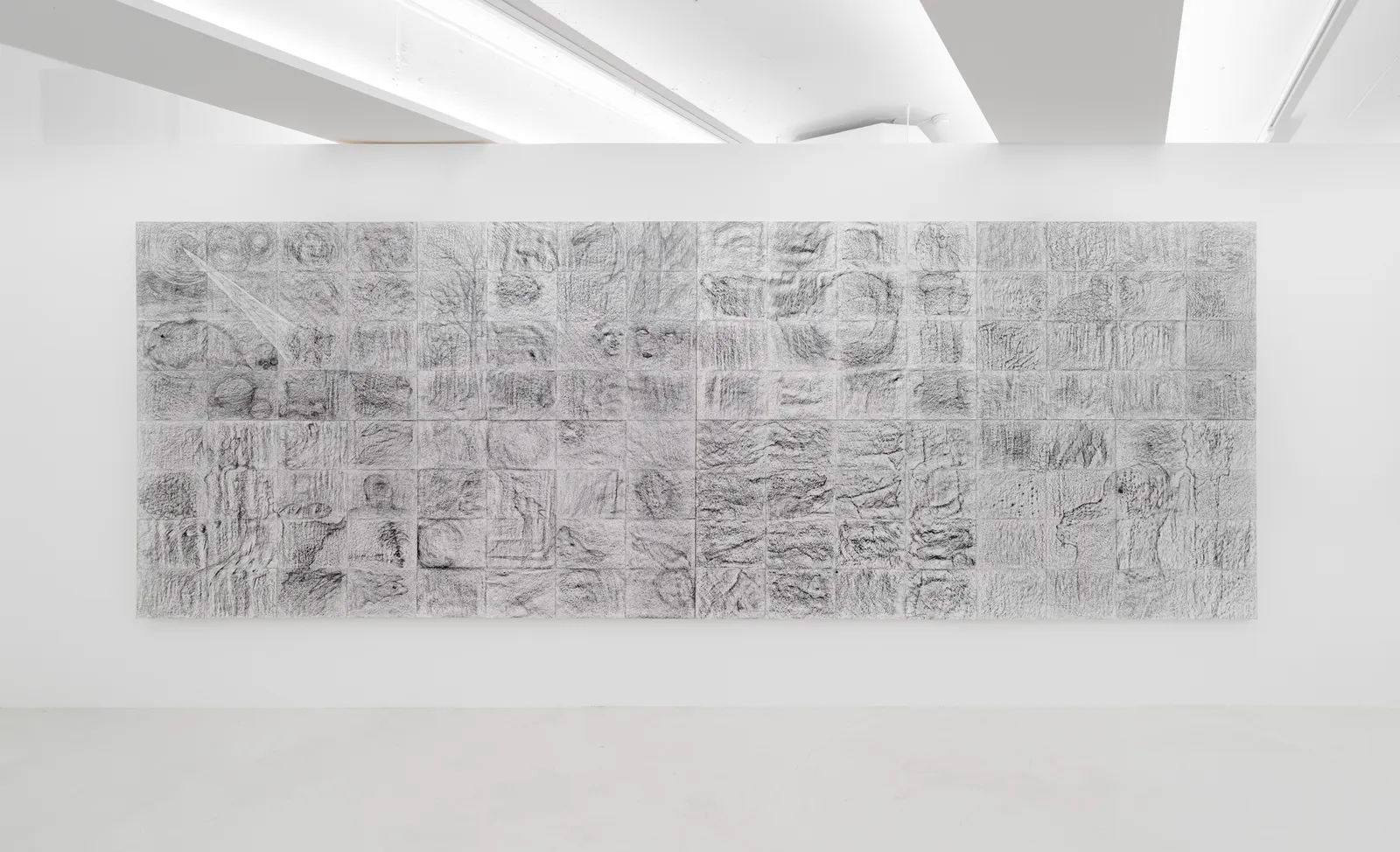
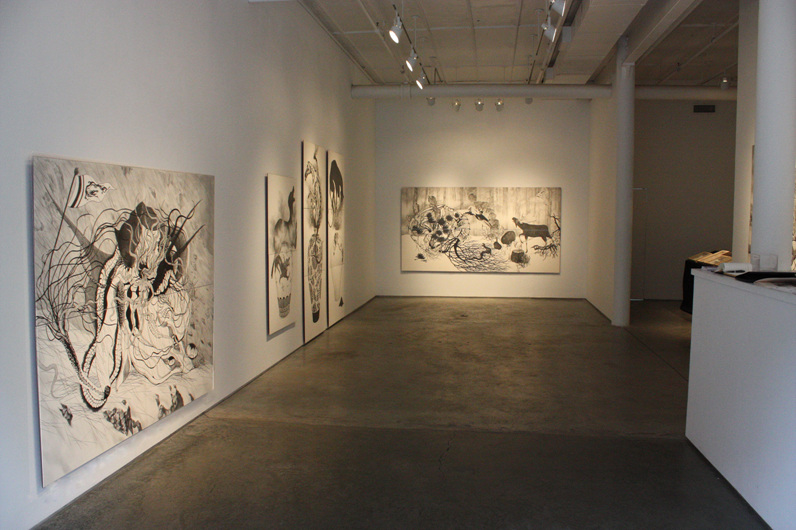
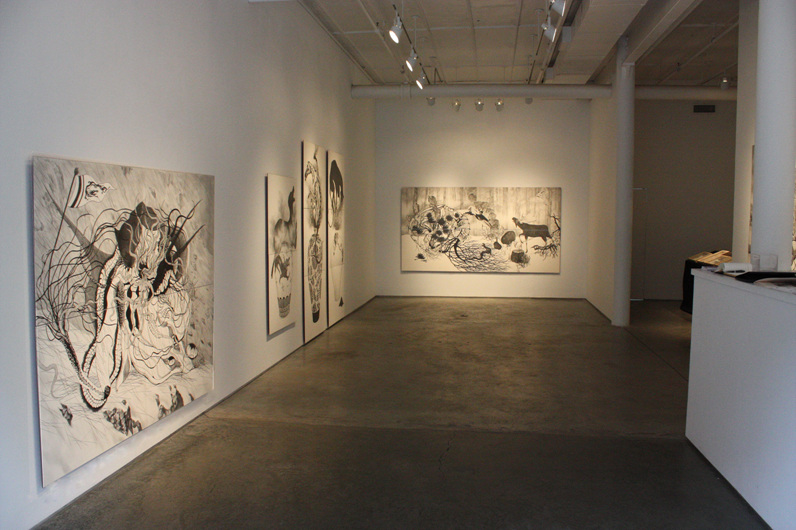
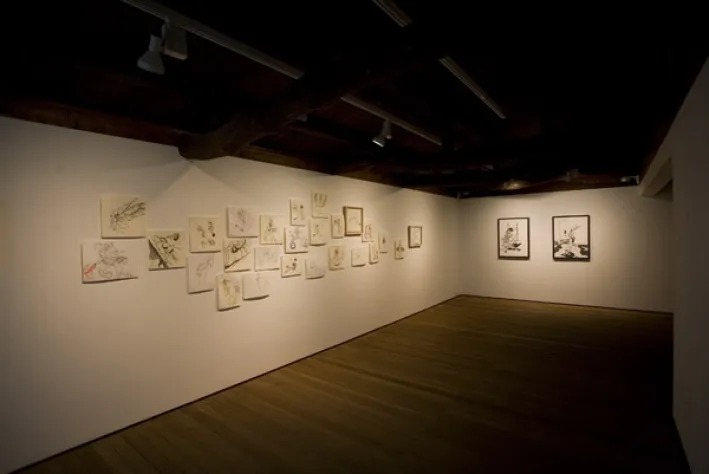
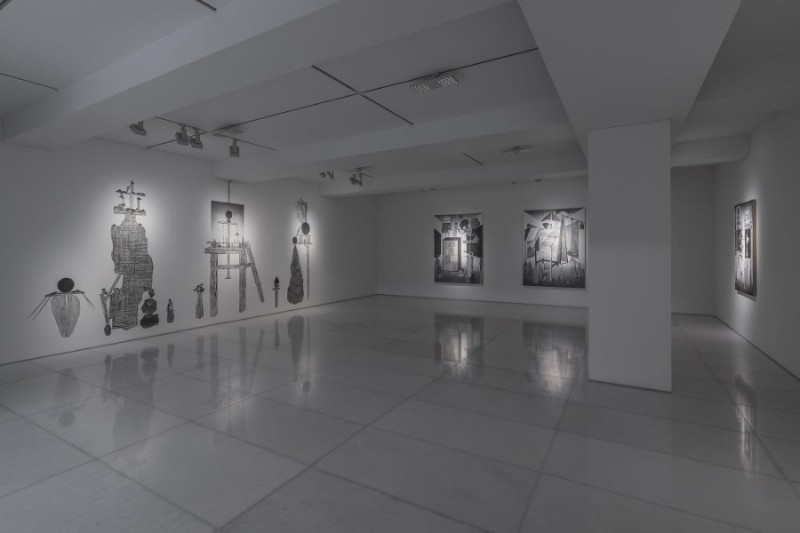
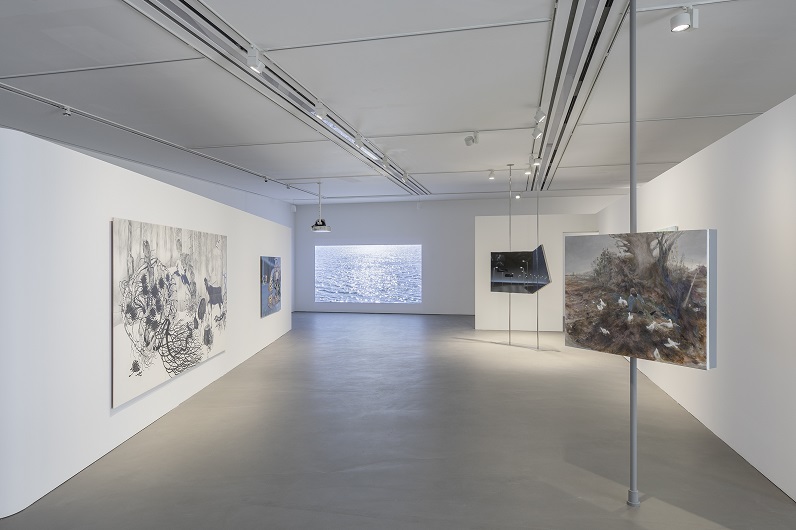
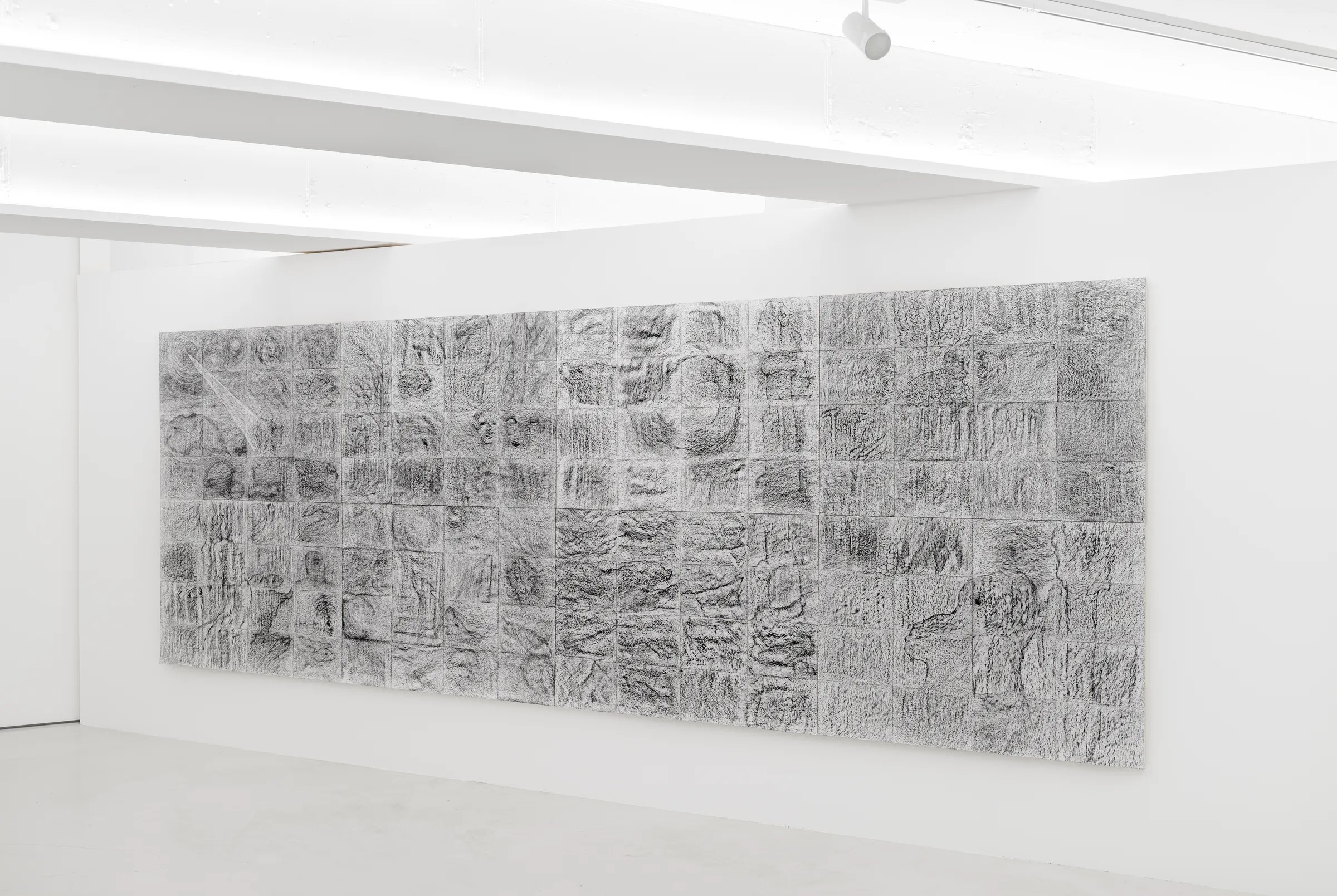
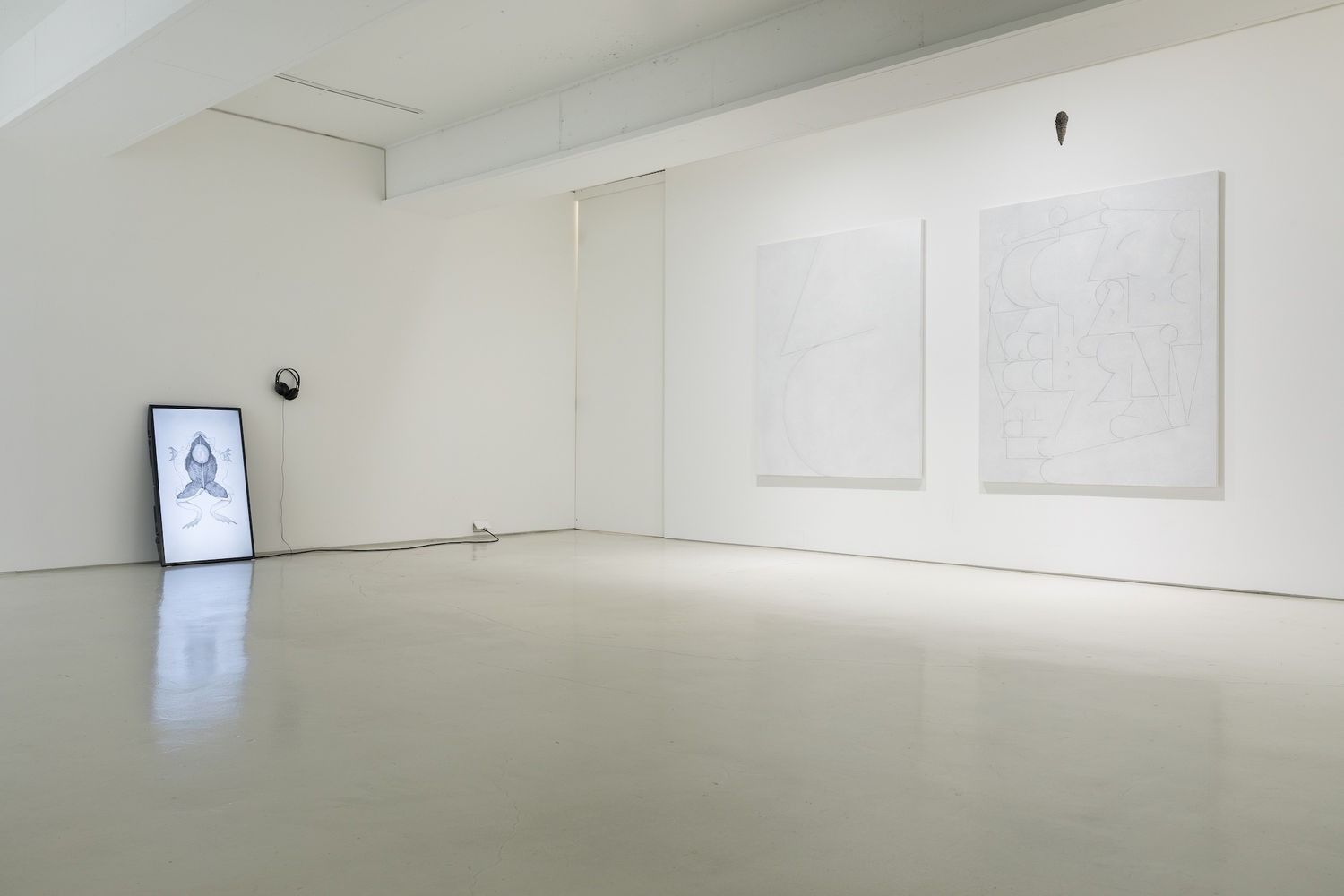
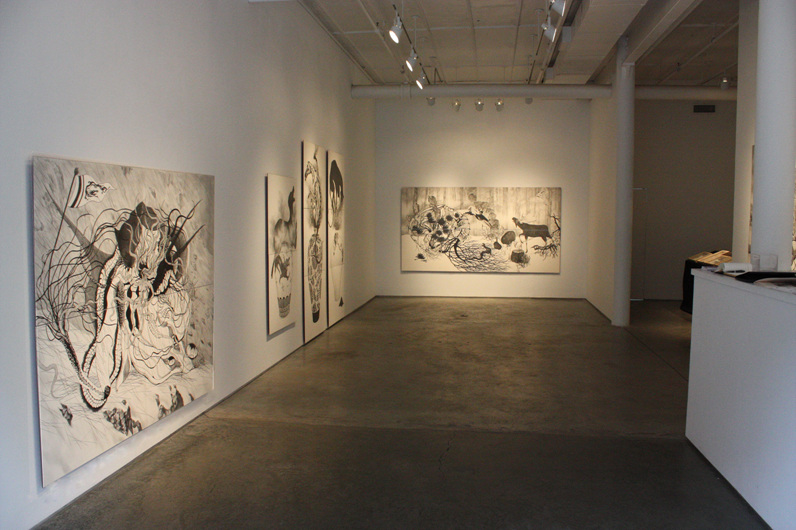
Seung Ae Lee’s exhibition, held for one month from mid-February at DOOSAN Gallery in Chelsea, New York, presents another version of the monster series she has shown in solo and group exhibitions in Korea over the past several years. Strange creatures of indeterminate species continue to appear, but this body of work differs in its occasional inclusion of backgrounds reminiscent of East Asian landscape painting and the presence of ceramics.
Perhaps because I visited her studio on an extremely cold day of heavy snowfall, the monsters attached to the walls with magnets seemed like wild, anomalous species inhabiting a snow-covered highland. Unlike worldly beings who shrink into themselves as the cold intensifies, they appear to gather even greater life force and radiate energy in the thin, frigid air.
The most striking aspect of Seung Ae Lee’s work is her consummate draftsmanship, which renders fantastical beings as though they truly existed. Executed solely in pencil, the drawings evoke illustrations from biological encyclopedias once copied with scientific precision in taxonomy or anatomy classes.
The meticulous rendering of every vibrating tendril of the monsters also recalls Joseon-period portraits in which not a single strand of hair was omitted. Combining naturalistic precision with fantasy to remarkable effect, her drawings retain an ambiguity that makes them neither wholly fictional nor entirely real. As implied by the exhibition’s subtitle and by monstrum, the Latin root of “monster,” these unknown beings suddenly emerge and make themselves visible.
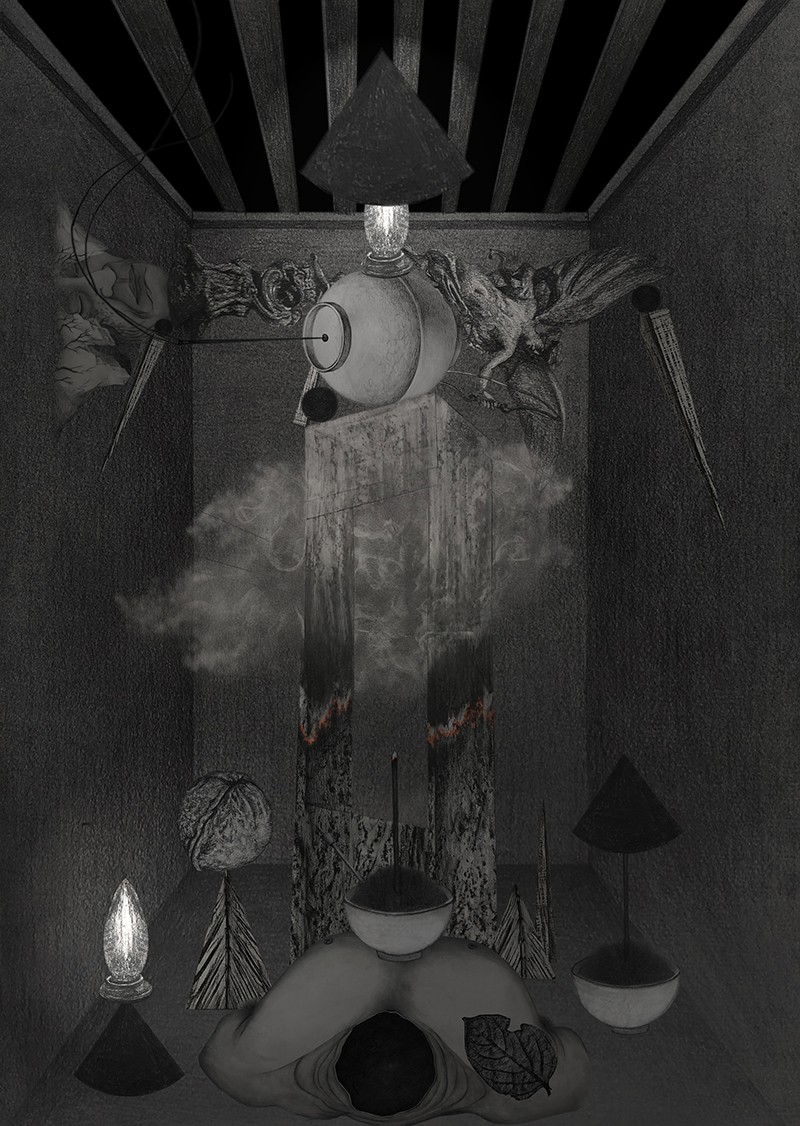
These fierce and threatening beings go beyond playful grotesquerie to become, for some, dependable allies and a cheering force of protection. The wild anomalies rampaging across the paper possess a sense of reality more intense than that of beings grounded in fiction. The ‘Mummy’ series, contained within small boxes, seems to testify that its figures were once alive, like archaeological or biological specimens.
This originates in the artist’s childhood experiences and habits of observing natural forms more varied and strange than anything found in art or popular culture. Having studied numerous illustrated encyclopedias of plants and animals long before she began drawing, Lee explains that these images became so deeply imprinted and familiar in her mind that she can now draw them freely without looking at references.
Her practice consists of transforming naturalistic motifs embedded in the unconscious so that they correspond to the roles assigned to them by the artist. Yet in Seung Ae Lee’s work, the unconscious is not merely rediscovered; it is constructed. It is not simply remembered, but encountered. Good Luck depicts what appears to be a predator hunting a long-horned herbivore.
A flag extending from one of the tangled tentacles whose point of origin cannot be determined heightens the atmosphere of desperate struggle. Images resembling bones or organ cells, along with bodily fluids dripping from the sacrificial victim, intensify the violence of the scene. A ruthless exercise of force is underway.
Diagonal lines drawn in the same direction as the background, which resembles the slope of a snow-covered rocky mountain forest, emphasize dramatic currents of force. Absolute Courage combines a tiger’s face stained around the mouth with the blood of its prey, a torso bearing the tattoo of a Japanese warrior, and a dragon-like body with trailing tentacles.
With owls capable of seeing clearly at night also arranged across the composition, the scene gathers together powerful beings as though to unleash an ultimate force. The pine tree upon which the monster is perched and the landscape-like background below it make the creature’s East Asian origins unmistakable. Monsters appear in both Eastern and Western mythology, but the works in this exhibition display a pronounced orientation toward the East.
The artist has cultivated her imagination through texts such as the traditional Chinese geographical and mythological compendium Classic of Mountains and Seas. Rather than identifying with Western monsters, which have often been cast as villains within a dualistic division between good and evil, she sympathizes with embodiments of justice, auspiciousness, empowering force, and good fortune.
Although the strange imagery in her works may evoke comics or animation, the artist says that she neither readily immerses herself in nor identifies with the codes of popular or subcultural imagery. In an age flooded with images that can be produced with ease, Seung Ae Lee’s paintings, painstakingly created with pencil rather than brush, even possess an old-fashioned atmosphere. Her studio is filled with erasers and collections of pencil stubs left over from the work.
After more than a decade of experimentation with the medium of pencil, which she has persistently used since her undergraduate years, Lee has developed a freely controlled range of tones and textures achievable with pencil alone. Owing to their East Asian atmosphere, the works can appear from a distance as though they were painted in ink.
Because of the habitual intimacy of writing, pencil or pen is a more immediate medium than the brush, allowing the body and mind to be transcribed without embellishment. Lee adjusts tone with an eraser, cotton swab, or the direct touch of her fingers.
Because pencil marks are not irrevocably fixed and can be easily revised, the medium is well suited to the unfolding of fluid imagery. Paper, its counterpart, can also be continuously joined and extended. For her, paper and pencil are at once the most fundamental and the most mutable of materials.
Like letters written on paper, the sharply defined black-and-white handwriting of pencil shifts into an ink-like range of tones and a variable scale. At the tense occasion of an exhibition, where an artist who has endured a long and difficult period of creation must reveal herself in full, the monsters appear as her alter egos.
In 1979, titled after the artist’s birth year, her own name can be seen carved in Chinese characters into a rock. A dense forest resembling primordial nature untouched by human presence, birds flying among the trees, birds of prey flashing fierce eyes, and a reindeer all appear in relatively intact form. The monsters in this work are arranged without conflict, as though they were companions.
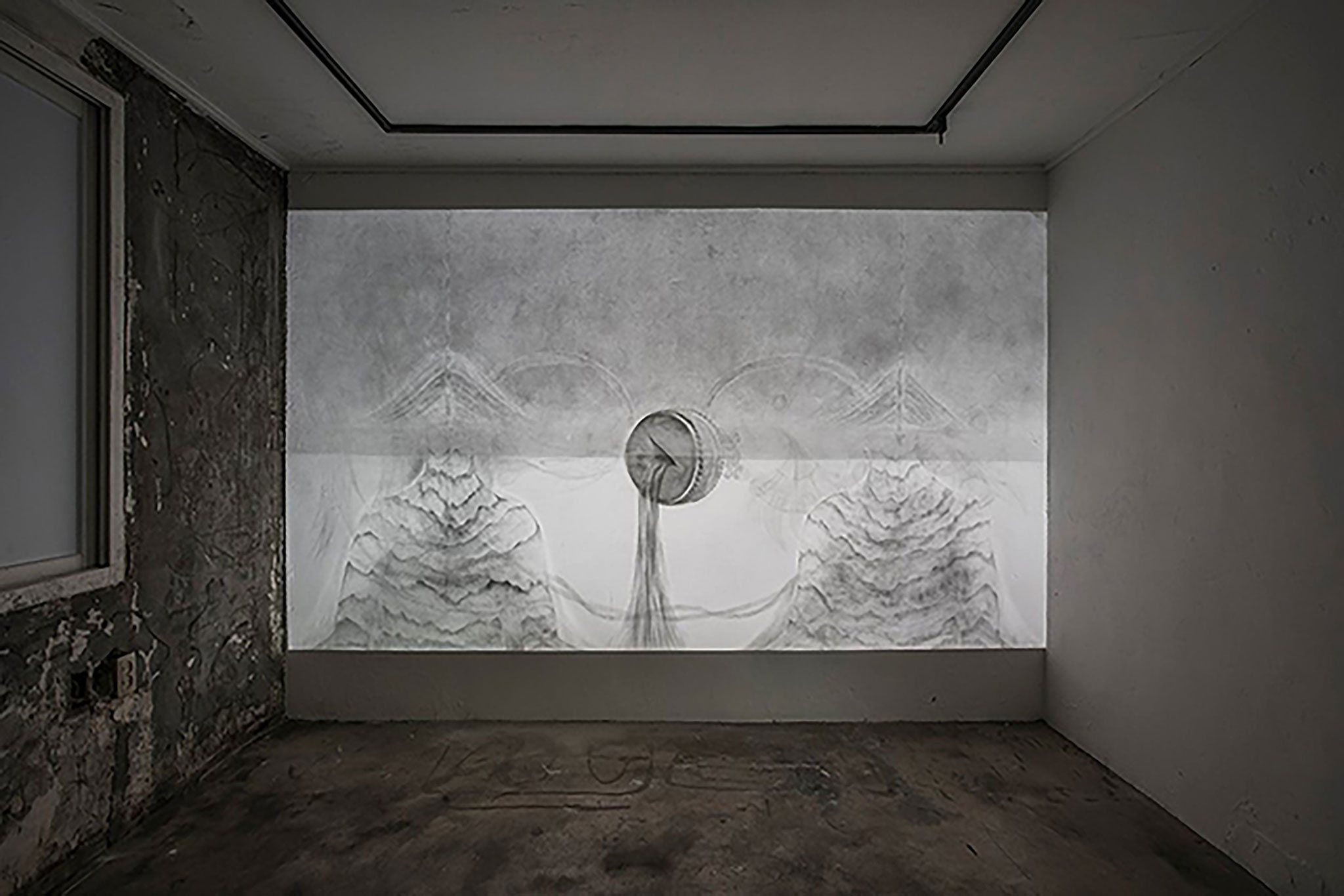
At the tips of branches resembling snakes’ tongues, lizard tails extend outward, while dense, volcanic ash-like smoke rises heavily from the center of the composition, and a fantastical bird that might appear in mythology gazes at the name carved into the rock. In the ‘Phantom Pain’ series, monsters are positioned atop ceramics, while nationally treasured vessels are rendered without alteration, lending the works a sense of realism.
The ceramics suggest the frameworks that each person possesses. People strive to preserve these frameworks. Such efforts may give a person identity and dignity, but they may also constrain the self. Countless frameworks are broken before a single masterpiece can emerge.
The monsters that appear to have just emerged from the surfaces of the ceramics and now coil above their openings function as guardian deities protecting those frameworks. The dimly spread mist and smoke make the creatures appear to rise directly from the mouths of the vessels. The monsters correspond to the patterns painted on the ceramic surfaces.
In Phantom Pain 2, for example, the monster atop a vessel decorated with dragons faces the same direction and roars like a dragon. In Phantom Pain 3, which features a vessel with a grape motif, the two monsters, appearing almost like a pair, assume a warm and harmonious posture. In this exhibition, the artist sought to give her fantastical creations a solid physical presence like that of ceramics.
At the same time, the series contrasts representation—the ceramics—with becoming—the monsters—thereby illustrating her artistic direction more clearly.
For Seung Ae Lee, the monster does not remain merely an unconscious force or dream to be disciplined by the ego or superego. It has already become her alter ego, encountering others in place of her vulnerable self. It is qualified to do so because it is not created solely through a discerning eye and manual skill, but is the product of the artist pouring into it the energy of her entire body and soul.
As though she had given birth to and raised it herself—the alliance between woman and monster is intrinsic here—everything of herself is inscribed into the work, enabling it to exert a shamanic power upon its creator. She says that while fully absorbed in the act of making, she becomes so united with the work that she can no longer tell whether she is drawing it or it is drawing her.
As a being on the boundary that resists clear classification, the monster has carried meanings of being either below or beyond the norm. As a deviant and anomalous presence, it oscillates between the poles of abjection and wonder. In this exhibition, Seung Ae Lee’s monsters appear as more affirmative beings. A monster that has lost organic unity can escape the role of villain when its deconstructive energy is understood as a positive force.
Its capacity for transformation becomes a symbol of strength for new forms of adaptation and challenge. Violating the limits of taxonomies that depend on lineage and structure, the monster itself becomes an embodiment of becoming. Seung Ae Lee’s monsters move beyond abnormality and ambiguity to reveal diversity and singularity.
Beings inhabiting their own distinct plateaus gather upon the level plane prepared by the artist. Like the “singularities” conceptualized by Deleuze and Guattari in A Thousand Plateaus, they are not models, unique prototypes, realized ideals of perfection, privileged terms within a series, or foundations for absolutely harmonious correspondences. A singularity is neither an individual nor a species; it merely carries affects.
Seung Ae Lee’s strongly linear monsters seek transformation at edges and thresholds. The mutable flow of lines produces becoming by ceaselessly modulating dimensions. The abundant animal imagery gives rise to a highly specific “becoming-animal” that traverses and includes the human, transforming not only animals but humans as well.
The becoming-animal conceptualized in A Thousand Plateaus is always connected to packs, bands, populations, and modes of habitation. Becoming-animal is a matter of sorcery, and humans enter or become within it through contagion. The reason it assumes the form of seduction and takes monstrous shapes in the imagination is that becoming-animal departs from predetermined trajectories.
It is an example of becoming—that is, of dramatic generation. Becoming exceeds mere resemblance, imitation, or identification. To become is neither to progress nor regress along a series. Becoming does not occur in the imagination. Becoming-animal is neither dream nor fantasy. Becoming is entirely real. This becoming produces nothing other than itself.
Becoming is not evolution, at least not evolution through descent or genealogy. Becoming always belongs to an order different from lineage. It concerns alliances. In Seung Ae Lee’s drawings, communication and events take place between heterogeneous populations. The rhizomatic emergence of one population from the edge of another does not attempt to balance the proportions of formal relations.
Here, becoming is a process of desire. In the tangled lines surrounding each population and in the particles released like smoke, dynamic relations emerge between movement and rest, speed and slowness. Becoming moves toward becoming-minoritarian rather than becoming-majoritarian. According to A Thousand Plateaus, majority does not signify a relatively greater quantity, but a state or standard—for example, male-adult-white-human.
What drives the viewer toward becoming in her work are details that are varied through unexpected forms and scales. The lines depart from the task of representation and instead propel mutation. Becoming replaces the imitation of an originary model with the very first mimesis without a model. In Seung Ae Lee’s monsters, as the binary structure established between model and imitation collapses, the boundary set between reality and fiction likewise disappears.
This is also true of phantom pain itself, which gives one of the works its title, Phantom Pain. These mutant-like beings have neither evolved through adaptation to a new situation nor regressed. Rather, they are instances of involution. A Thousand Plateaus defines involution as a form of evolution that appears between heterogeneous things. Becoming is involutive, and this involution is creative.
To regress is to move toward something less differentiated. But to involute is to form a block that unfolds by establishing relations among given terms along its own proper line. Creative involution, as opposed to regression, bears witness to inhumanity directly experienced within the body and constitutes an unnatural coupling that takes place outside the programmed body.
The issue is to make a body together with animals, that is, to make a body without organs defined by zones of intensity. The monsters in Seung Ae Lee’s works sometimes gather together like packs, and the pack is both the reality of the animal and the reality of human becoming-animal.
Contagion is both the mode of habitation of animals and the propagation of humanity’s animal habitat. In Seung Ae Lee’s work, this human animal habitat ultimately culminates in the image of the warrior. The warrior exists outside family and state and overturns lineage and classification. The warrior animates the battlefield through beast-humans endowed with every kind of becoming, including multiplicity, speed, ubiquity, metamorphosis and betrayal, and the capacity for transformation.
According to Deleuze and Guattari, the East possesses more individuations based on haecceity than on individuation grounded in subjectivity or substantiality. Haecceity refers to the entire assembled arrangement of individuated things. It is precisely the animal itself, or the human, that ceases to be a subject and becomes an event within assemblages inseparable from a given hour, season, atmosphere, air, or life.
Haecceity has neither beginning nor end, neither origin nor goal. It is always in the middle. It is made not of points, but of lines. It is a rhizome. Those made through proliferating lines like a rhizome wander across a surface without beginning or end, fleeing from the forms and subjects implied by deep roots. The continual coming together and dispersal of the various patterns that make up the monsters exemplify this flow of flight.
This multilinear system, which departs from a system of points dependent upon vertical and horizontal coordinates, races across a terrain like a battlefield. Lines that possess unpredictable speeds and directions are distinct from originary points. The line of becoming has neither beginning nor end, neither origin nor destination. The line of becoming has only a middle. The middle is not an average.
It is accelerated motion, the absolute speed of movement. Becoming is always in the middle. Seung Ae Lee’s monsters, too, are beings generated only in the middle. Through lines that derive from the middle and gather acceleration, content and form seek unity by becoming middle beings.