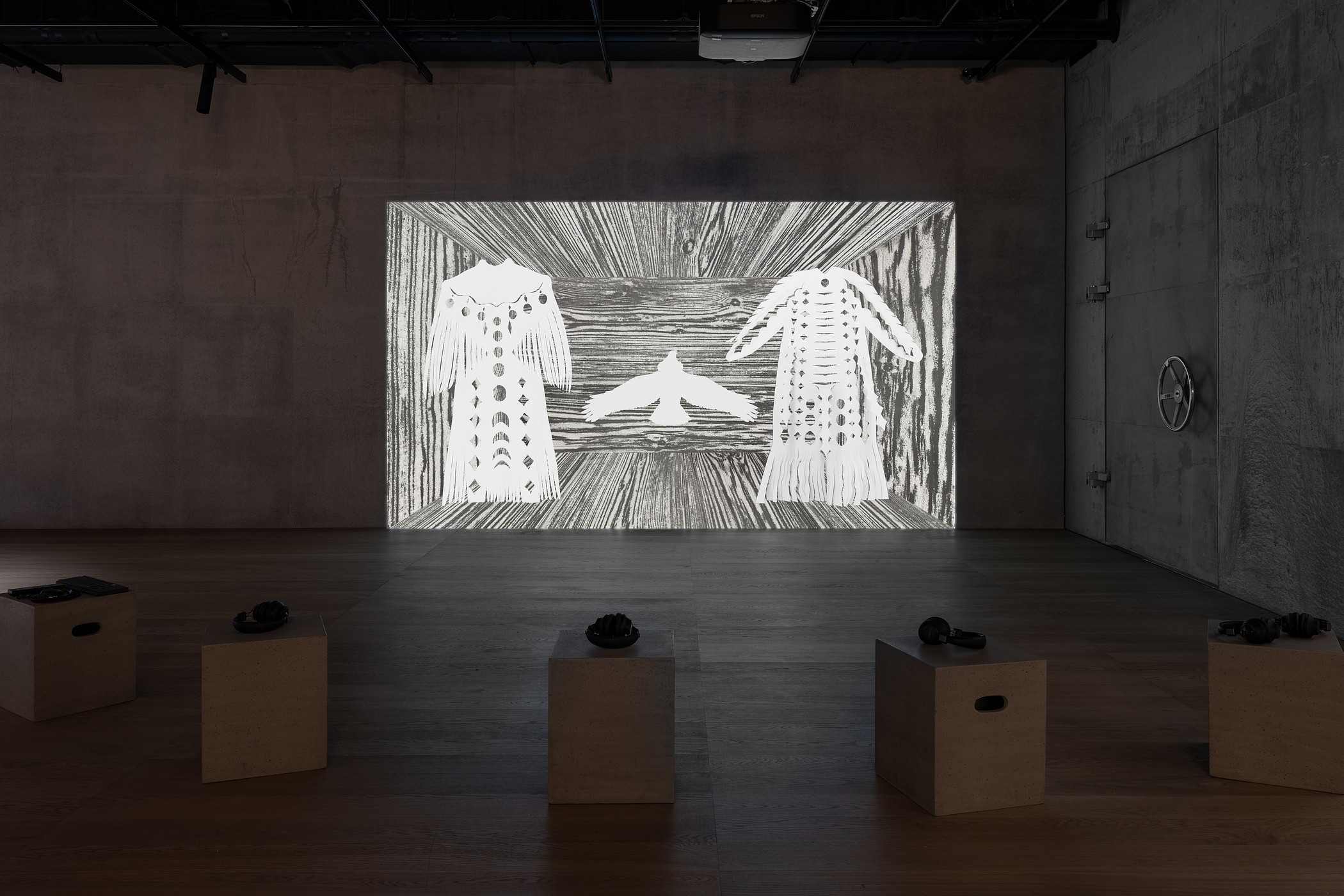
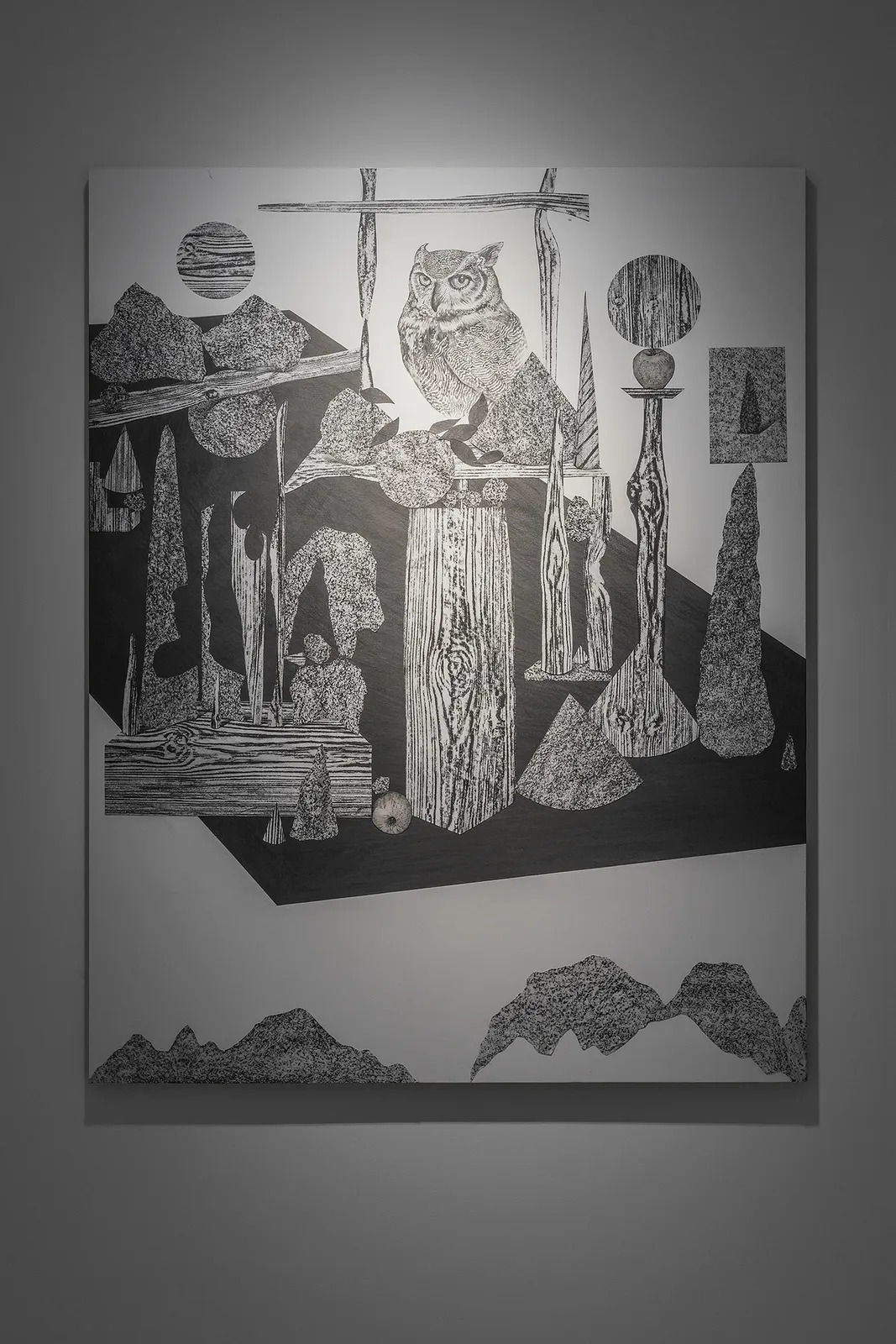
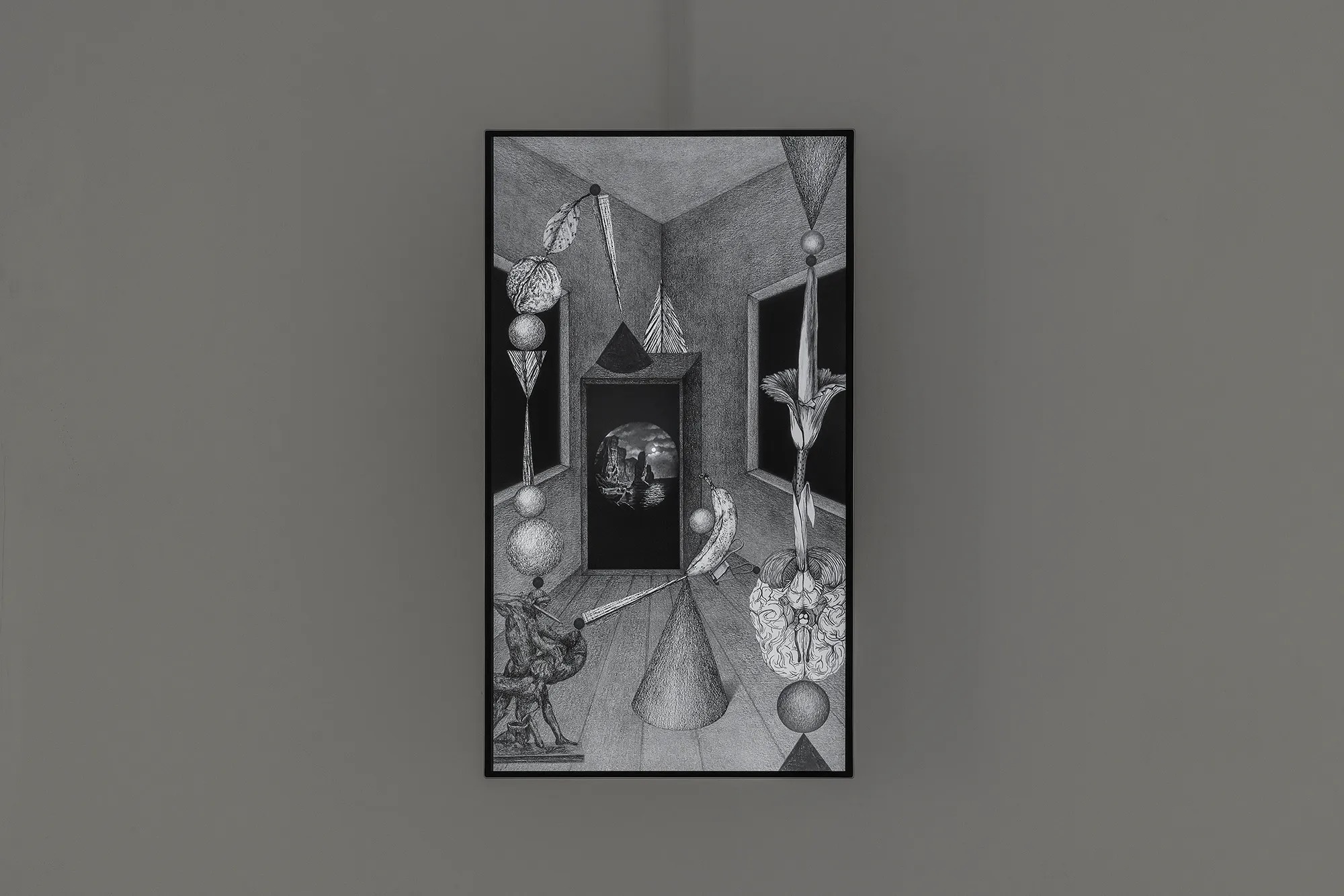
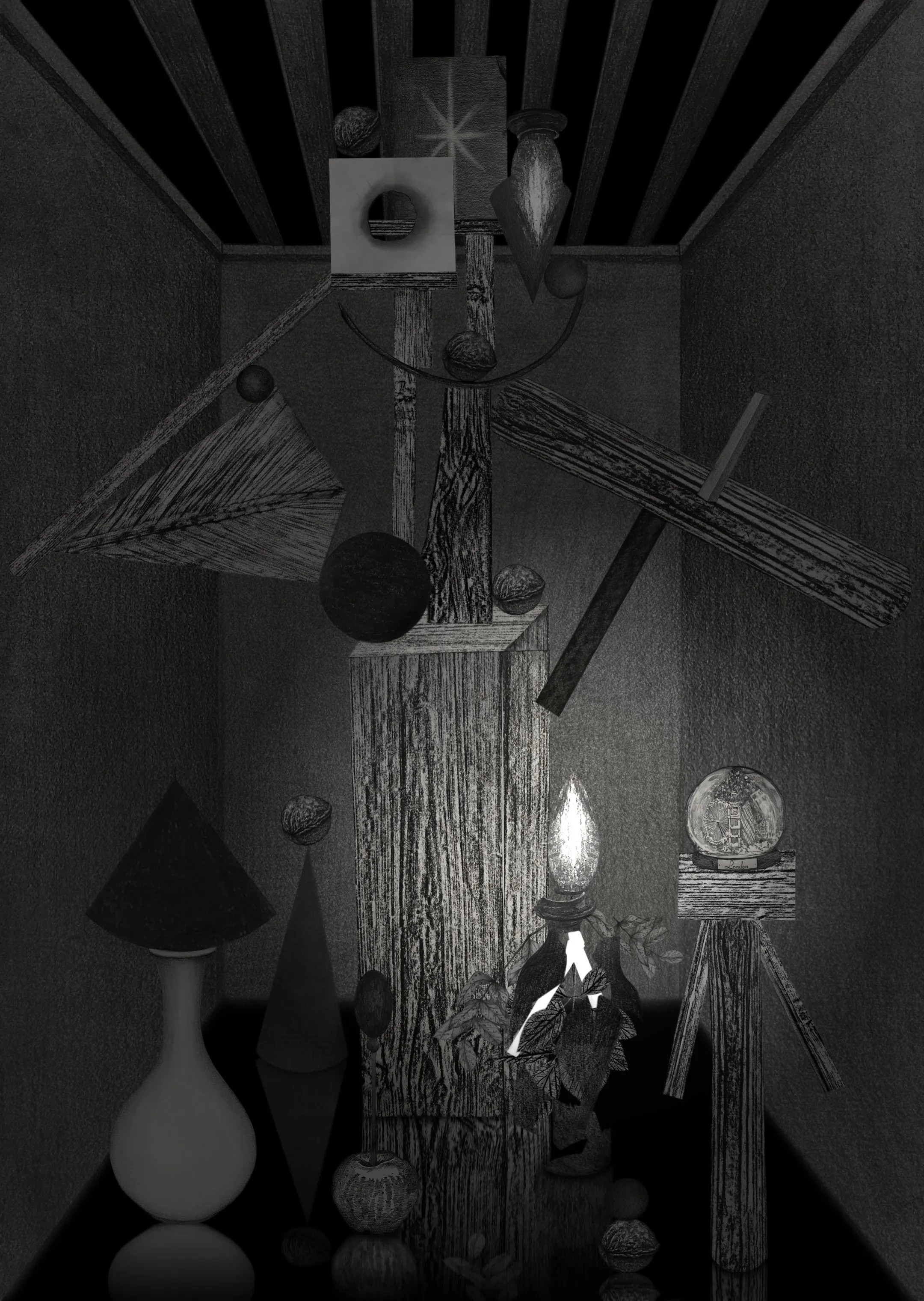
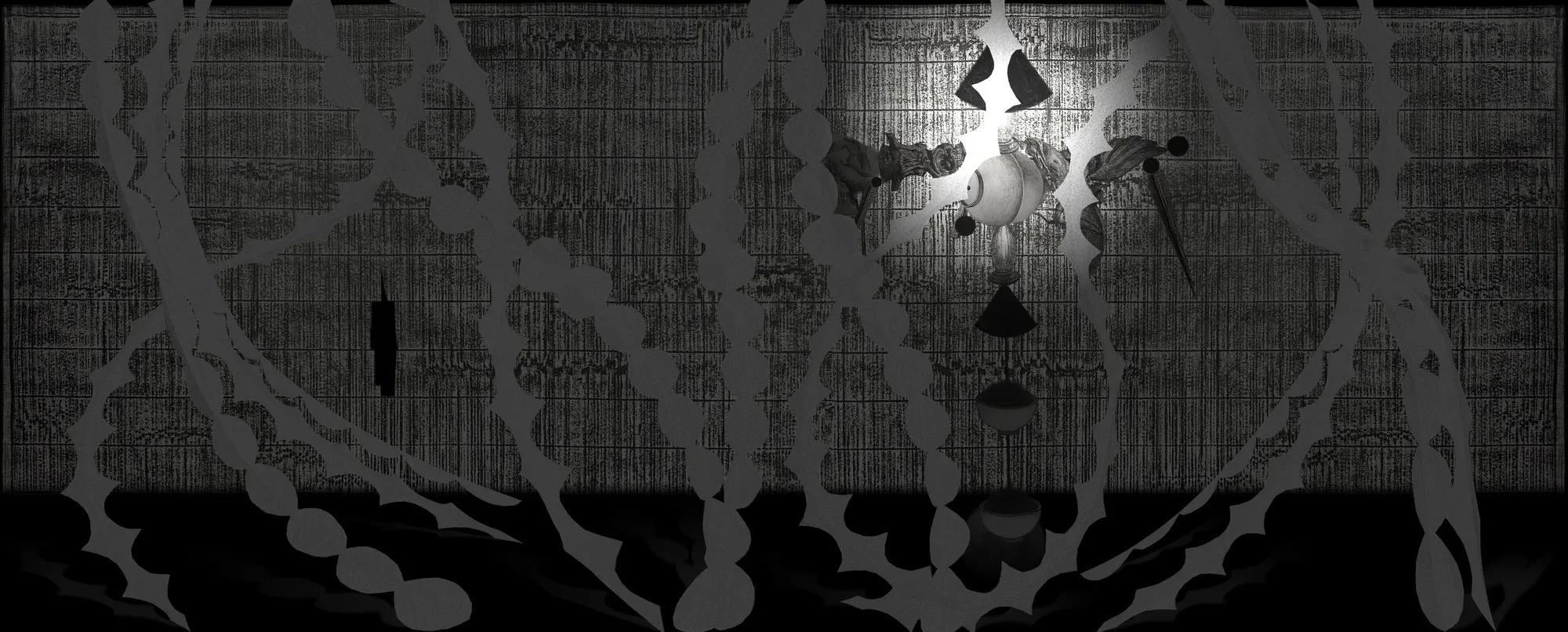
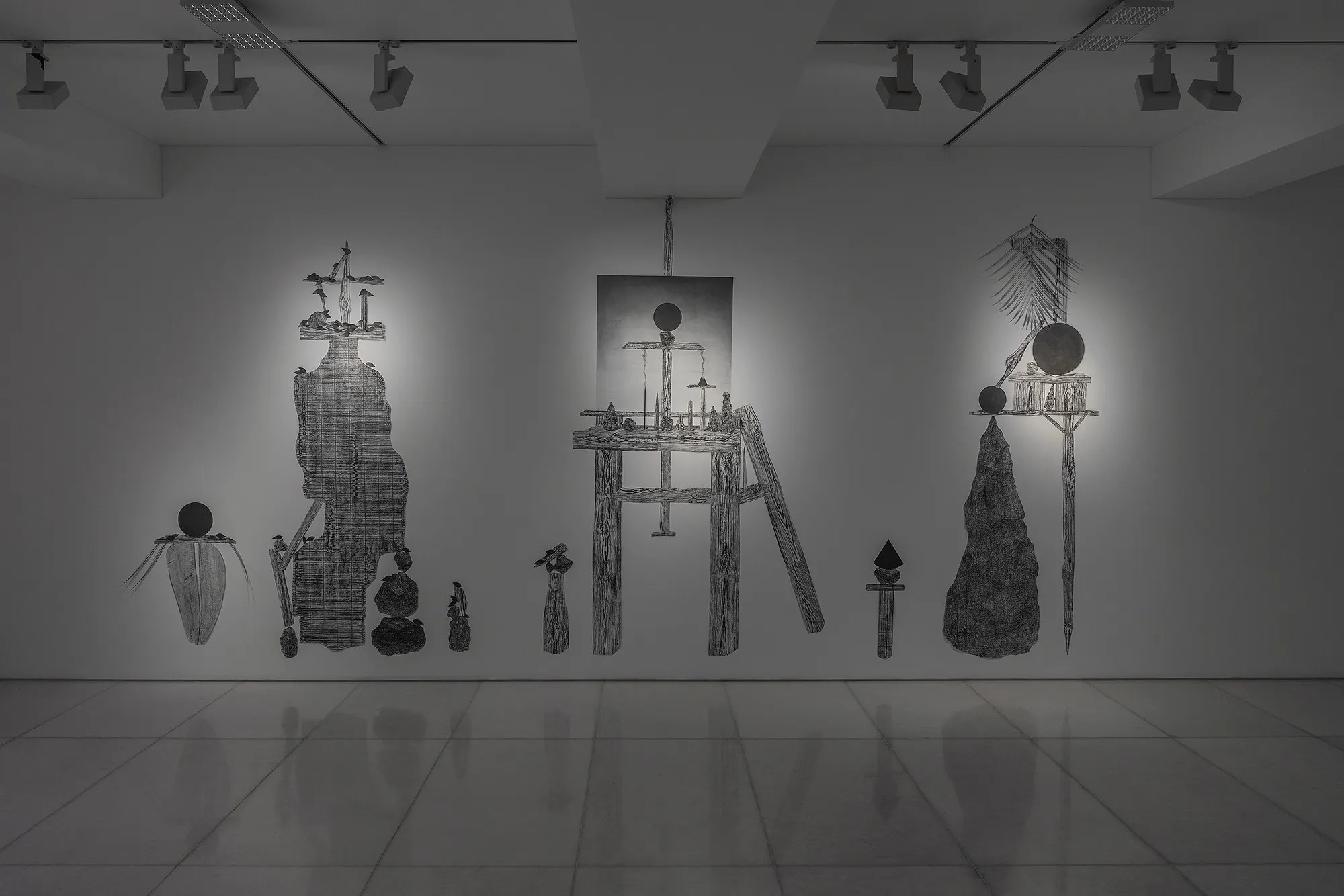
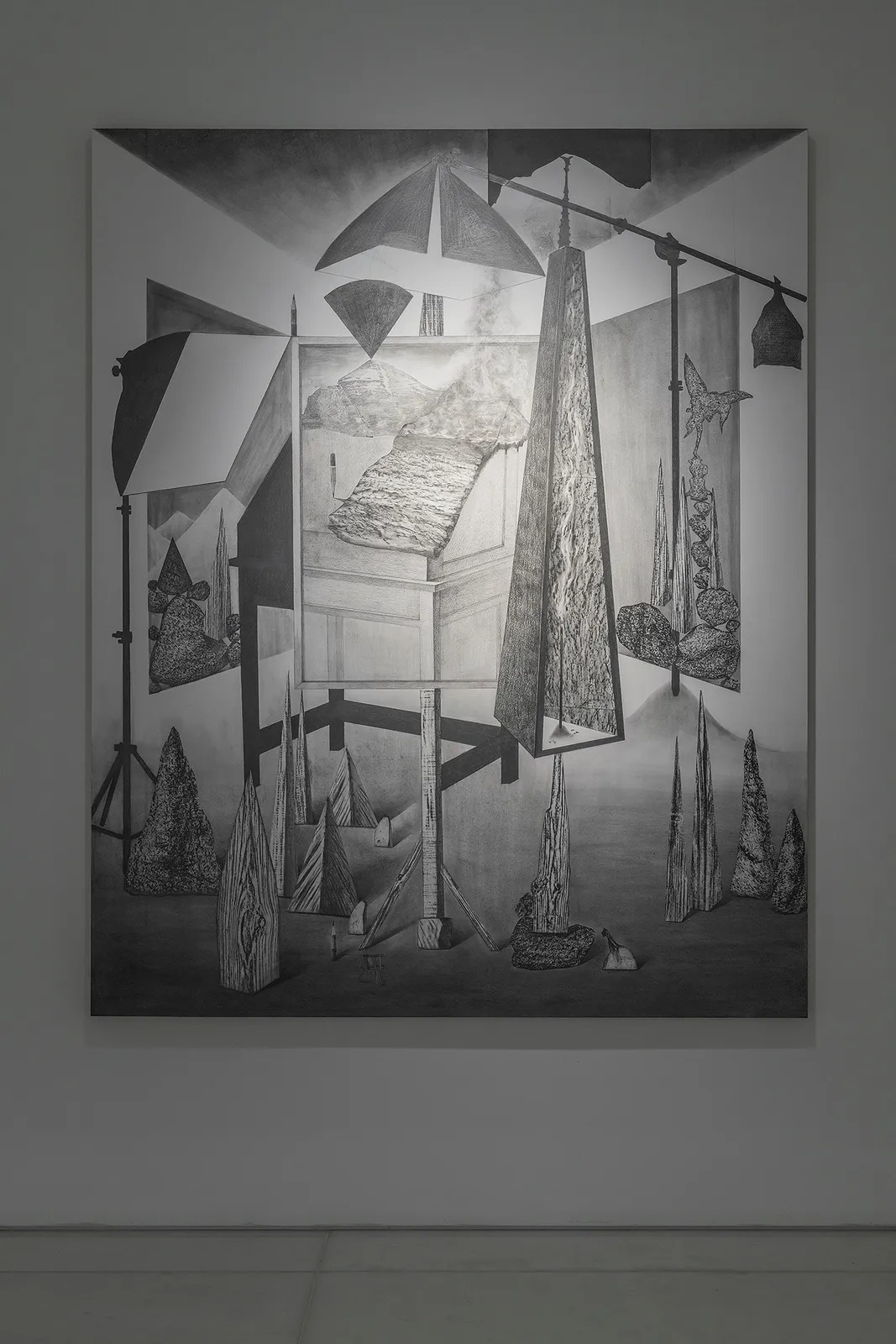
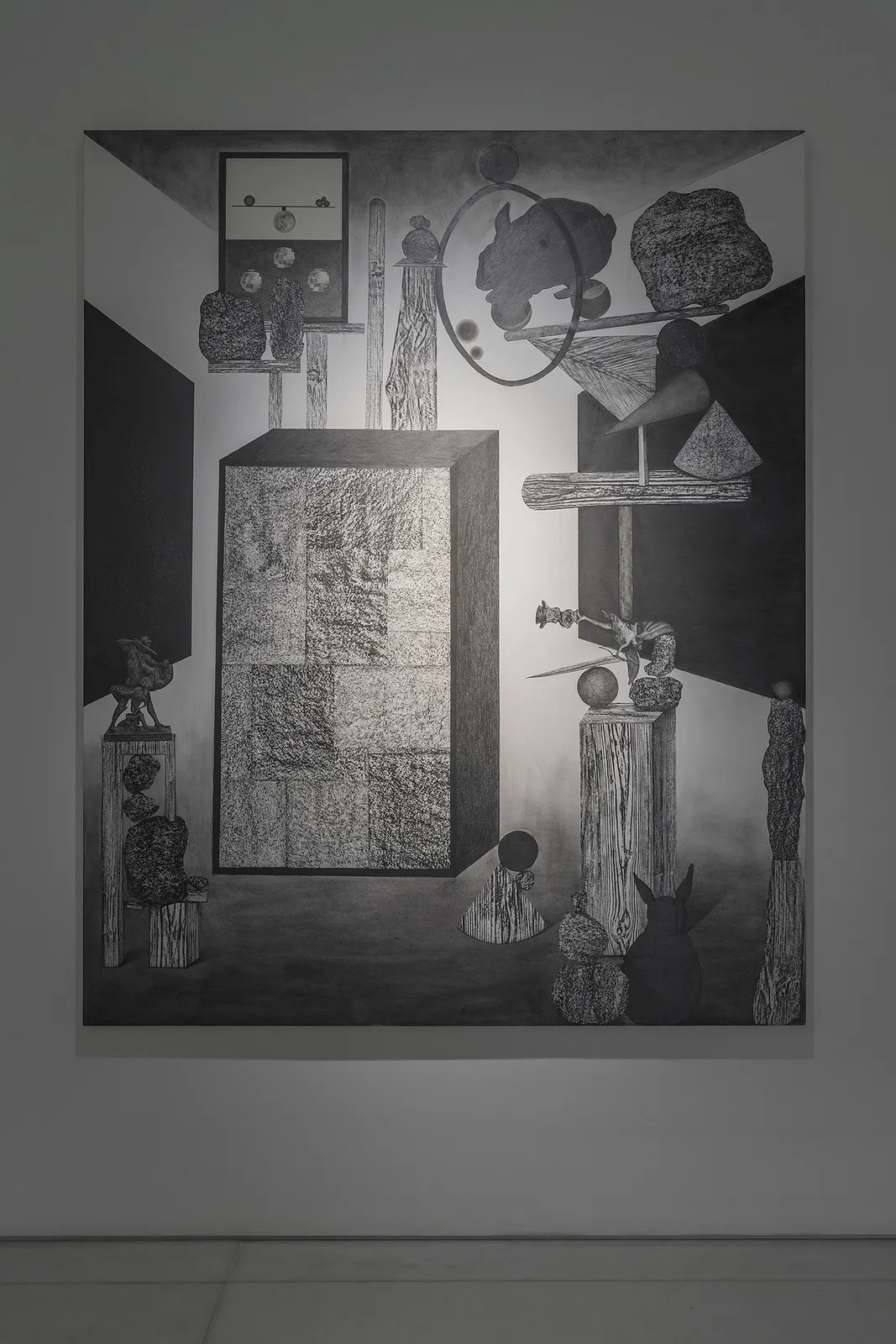
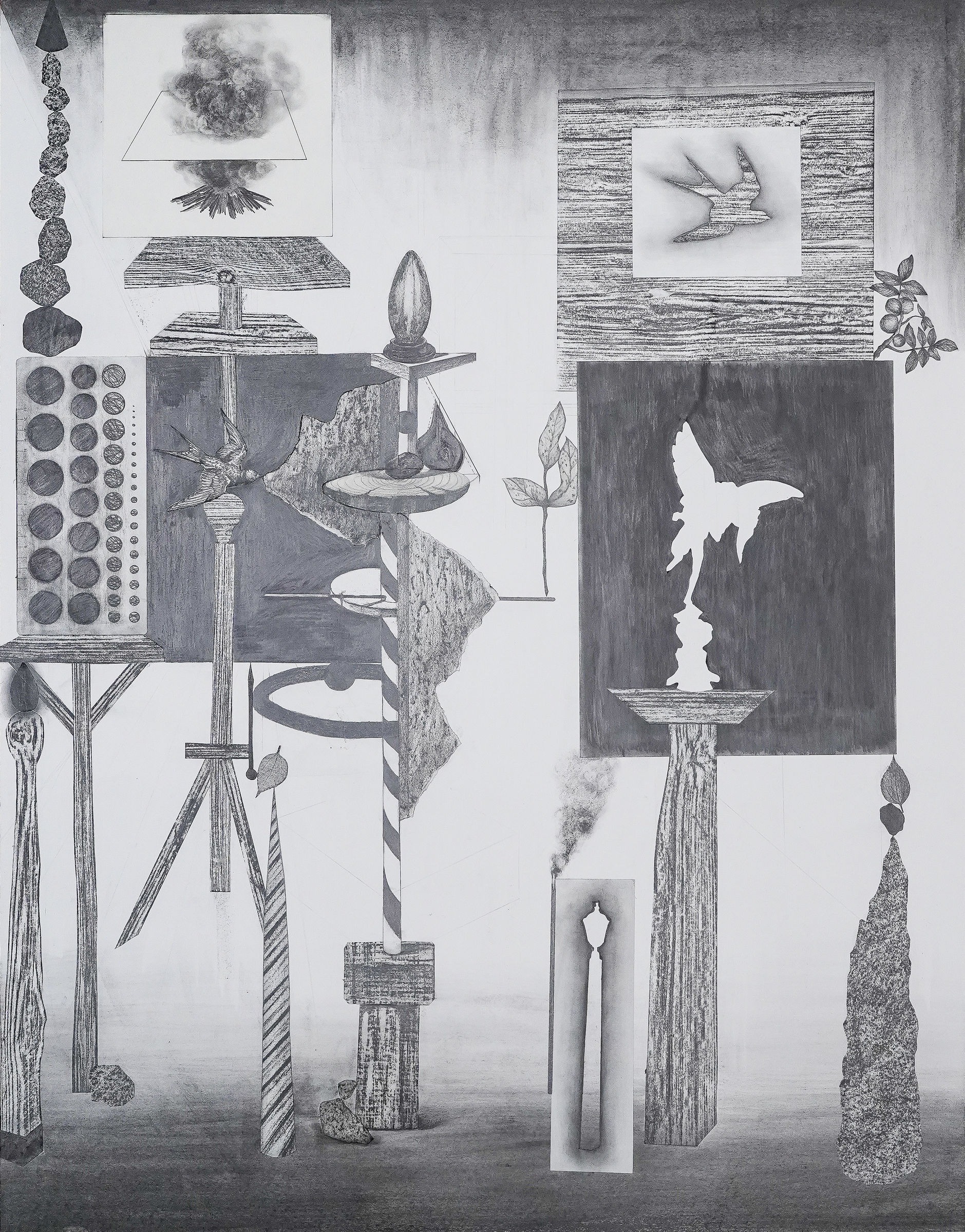
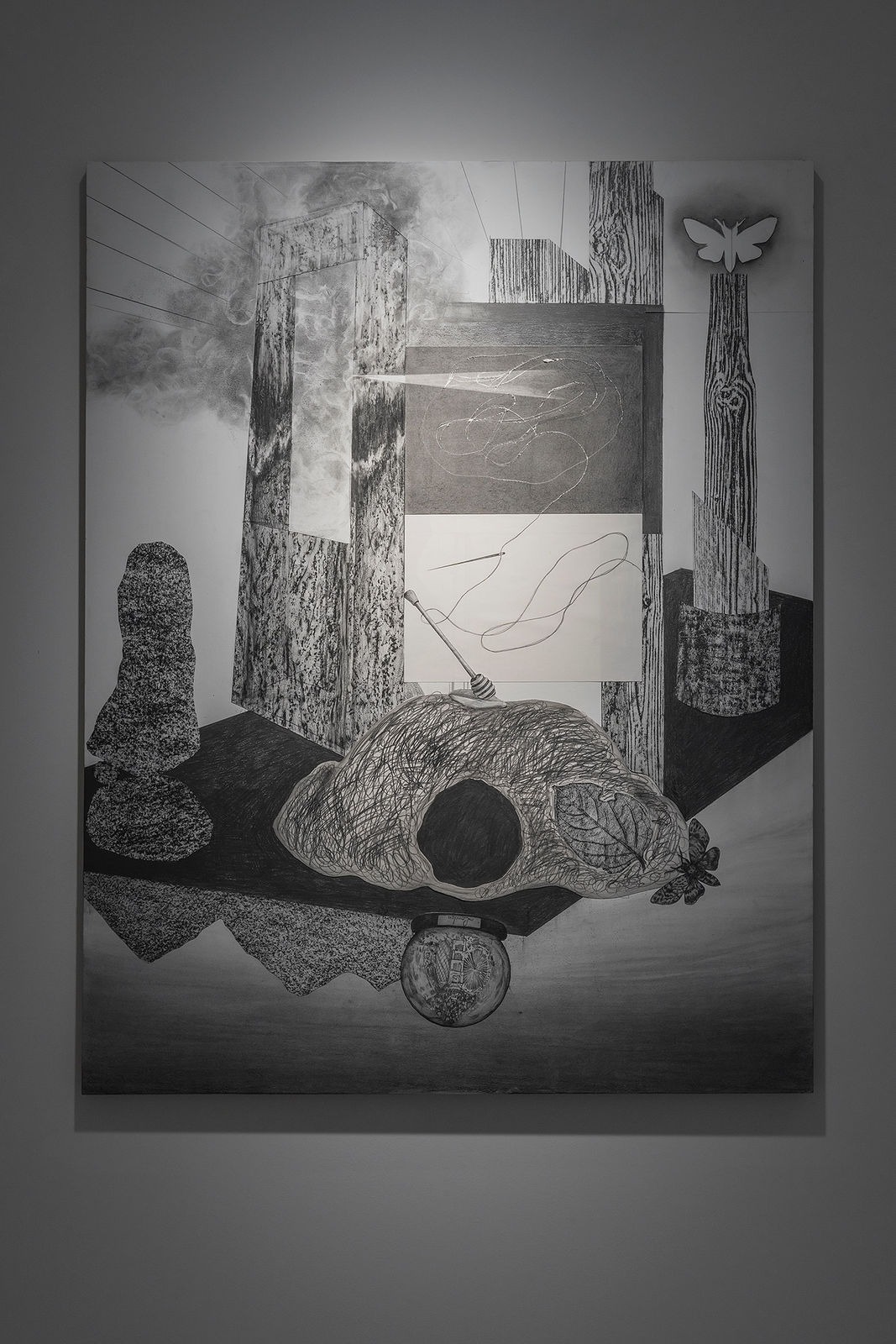
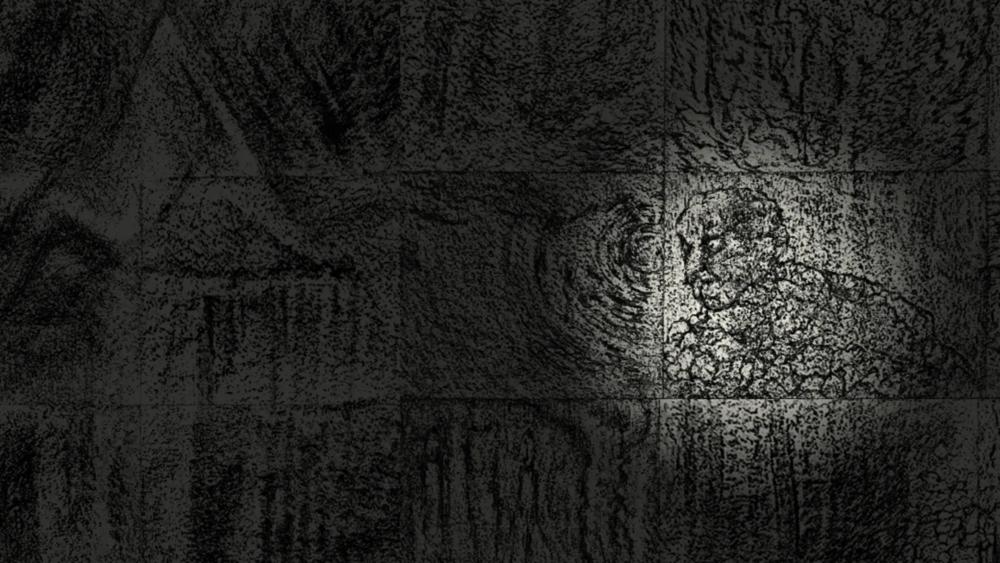
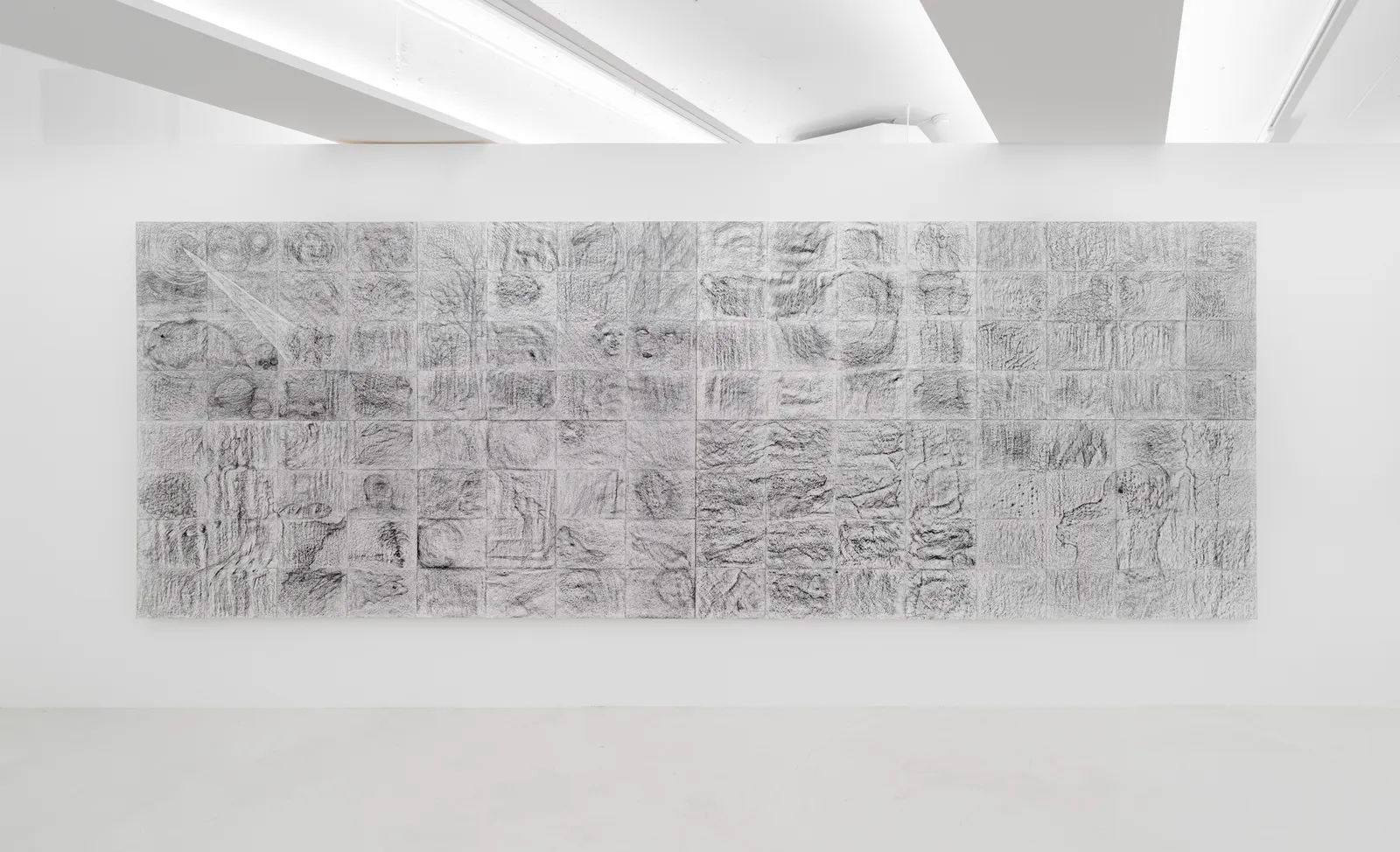
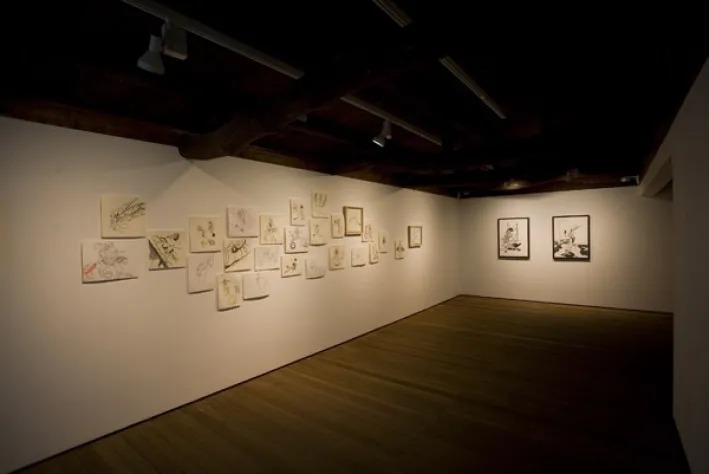
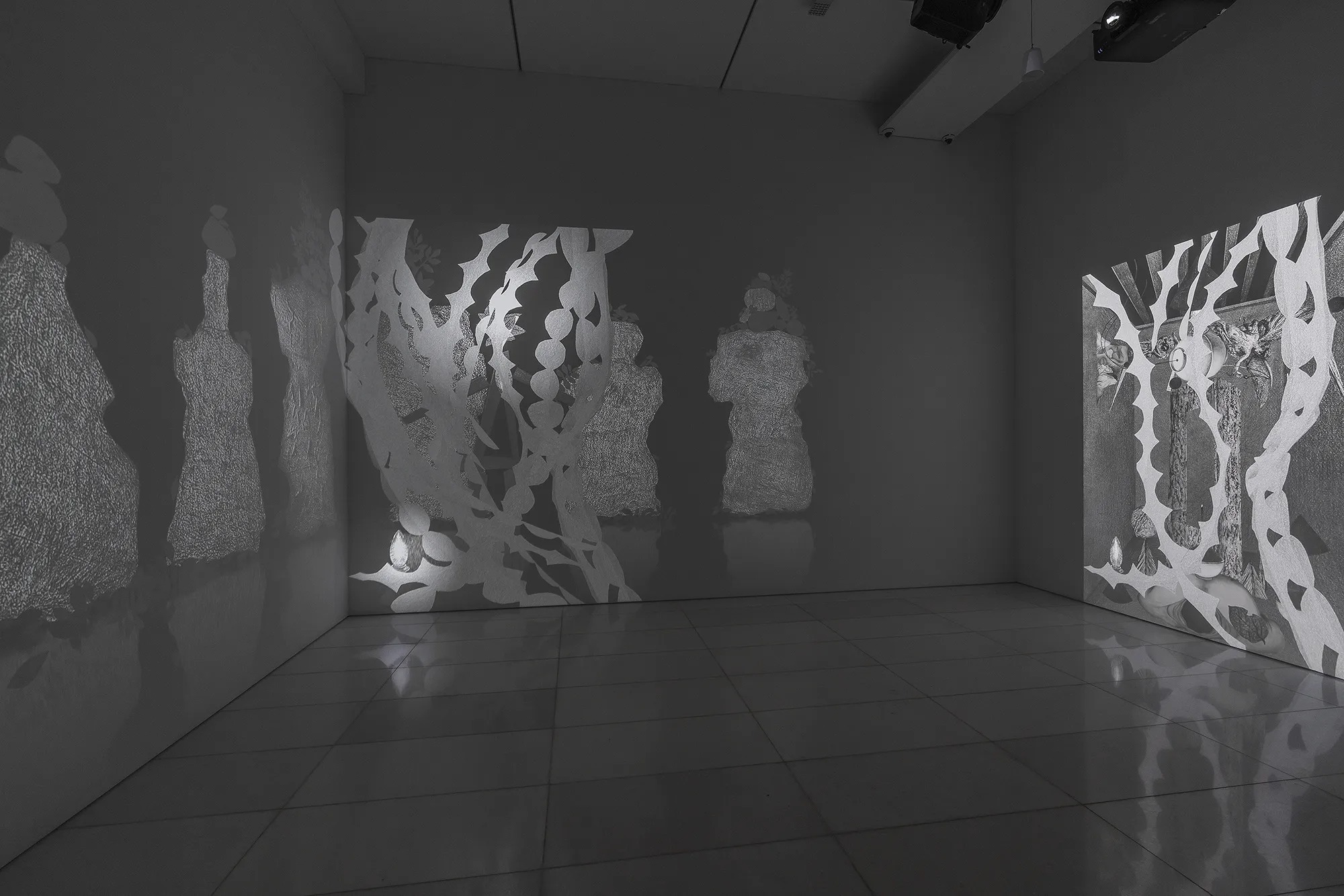
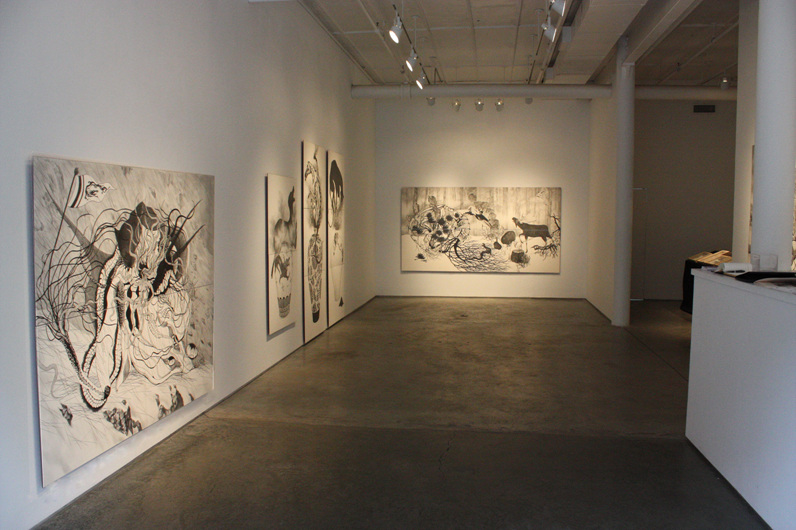
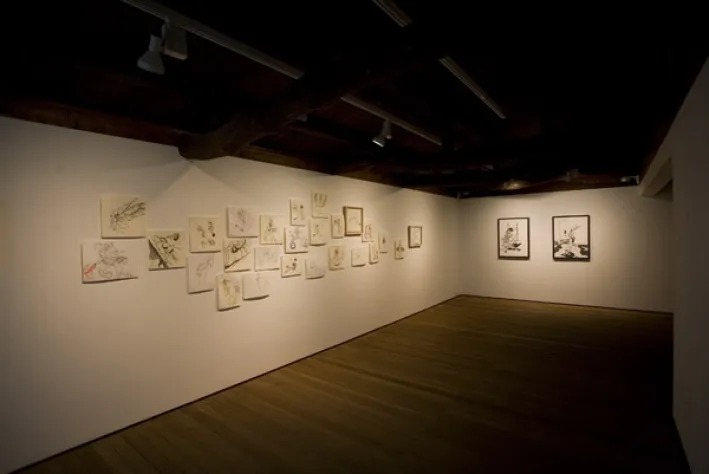
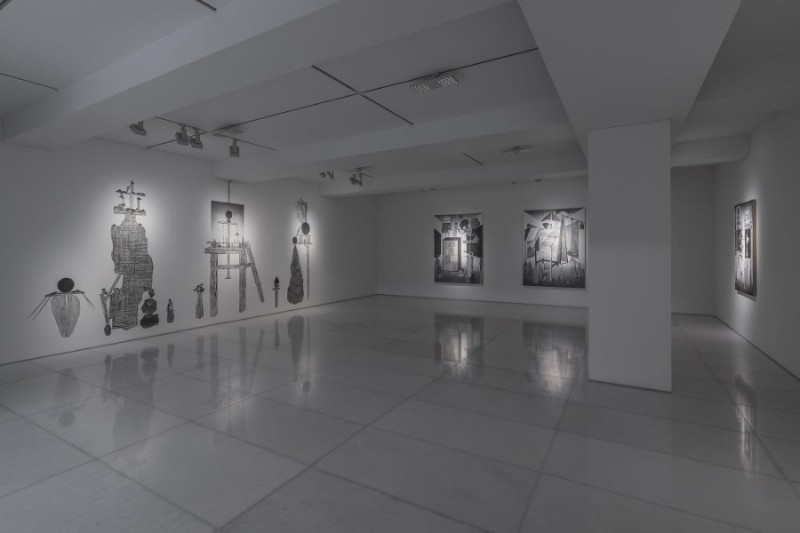
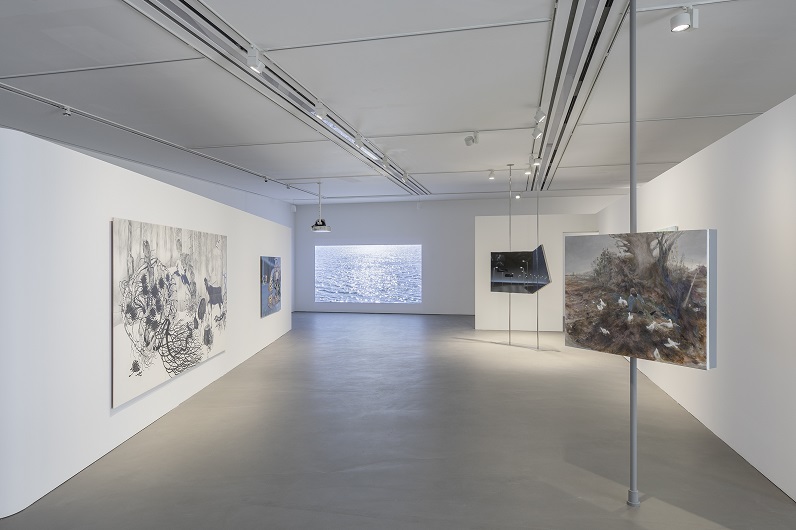
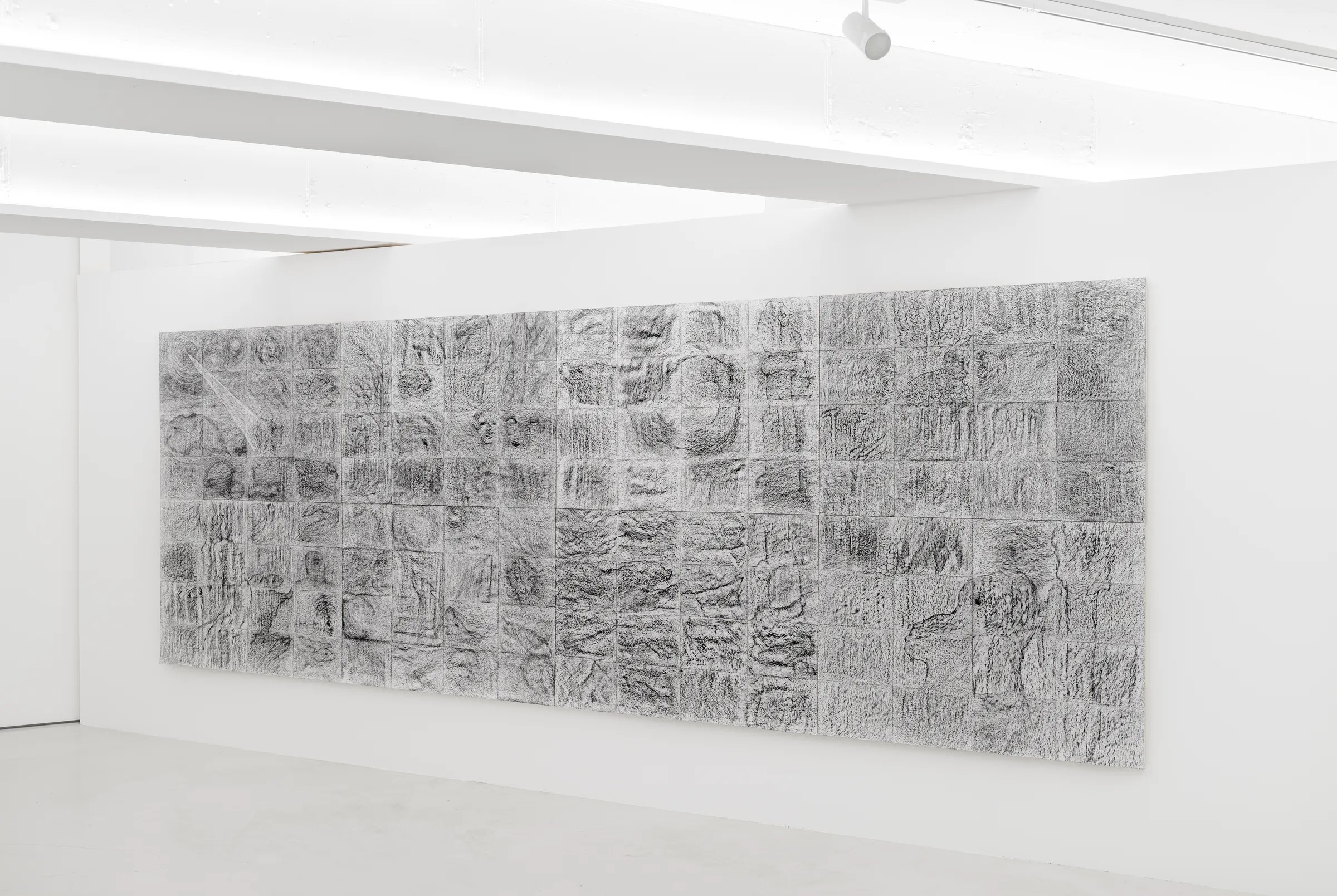
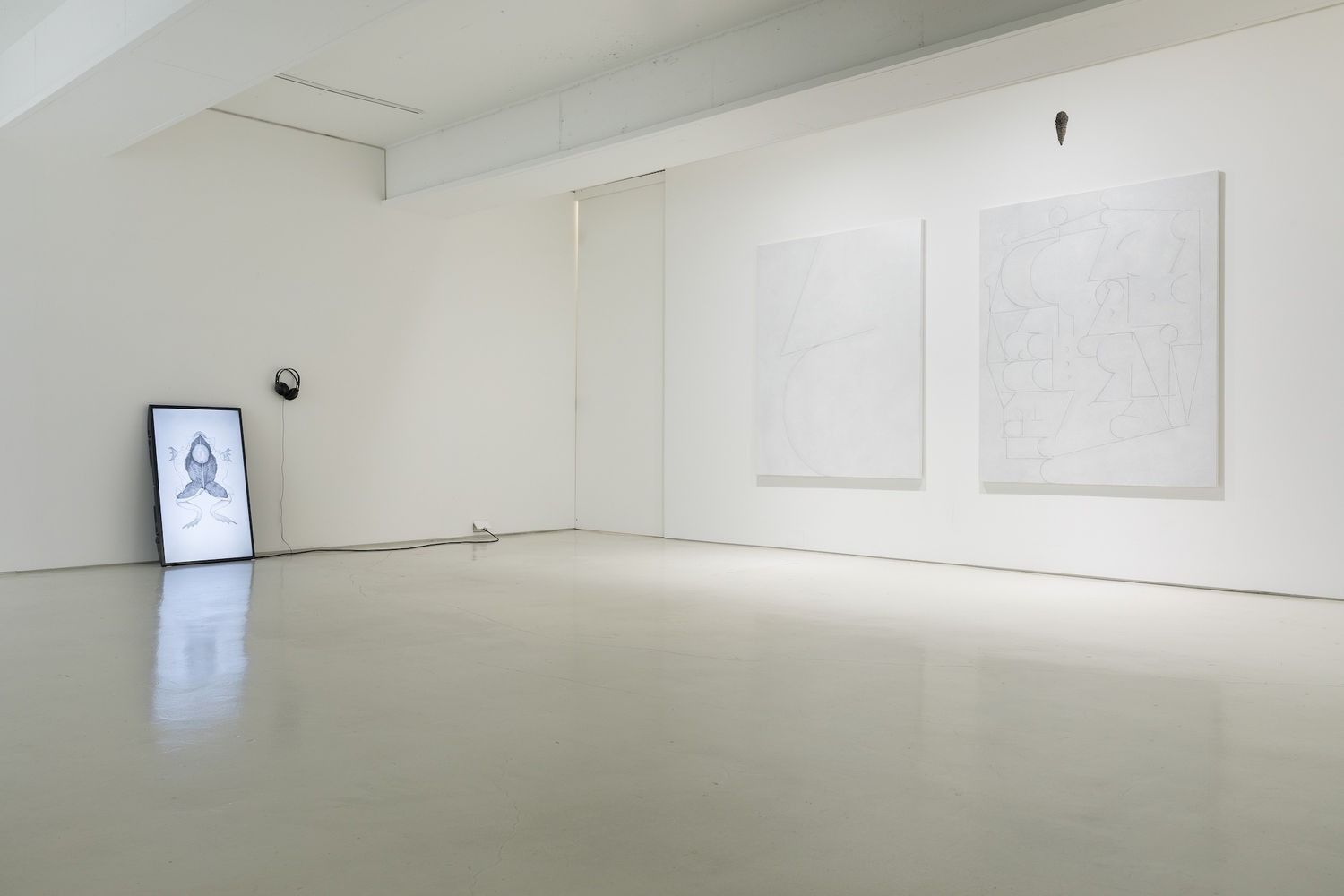
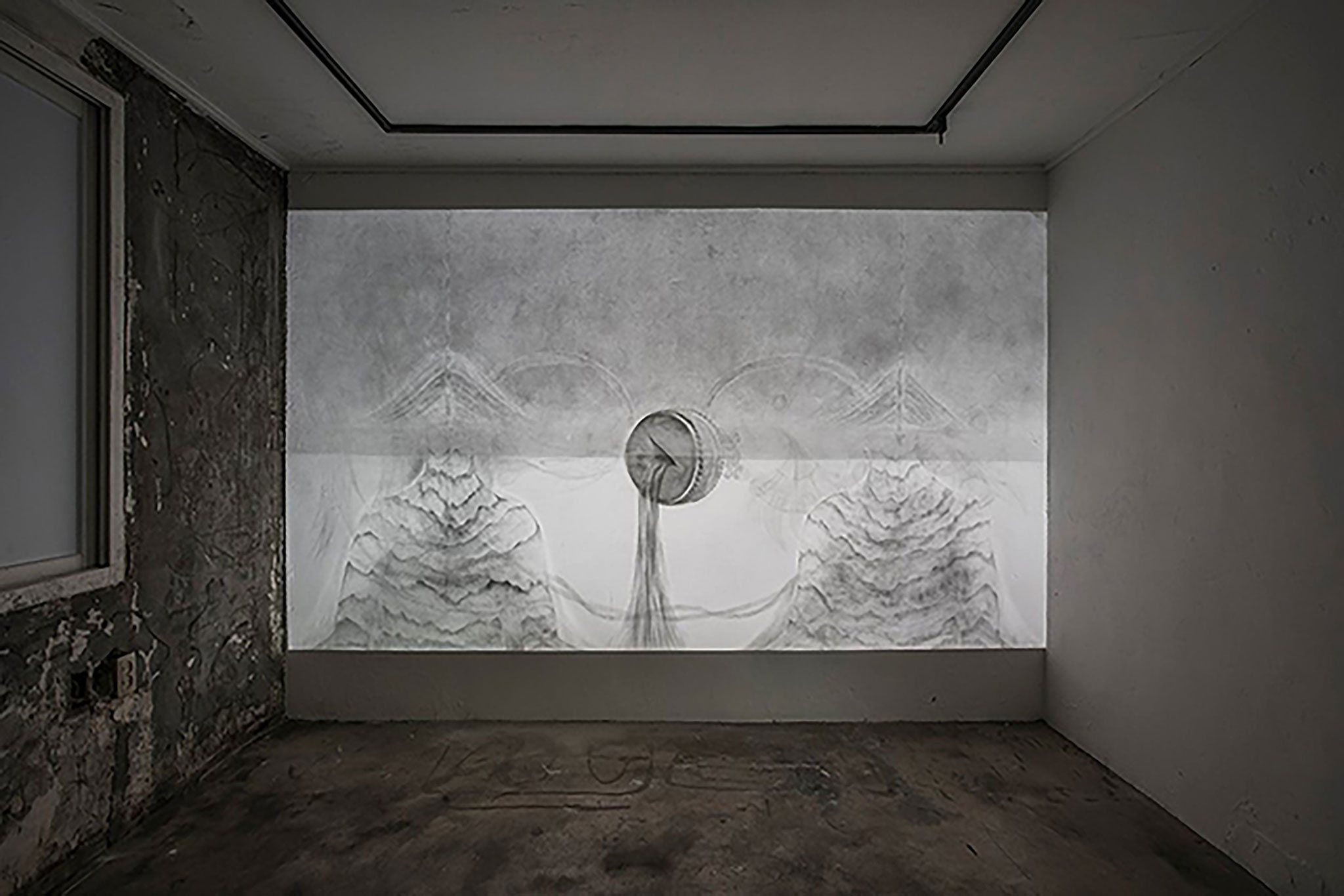
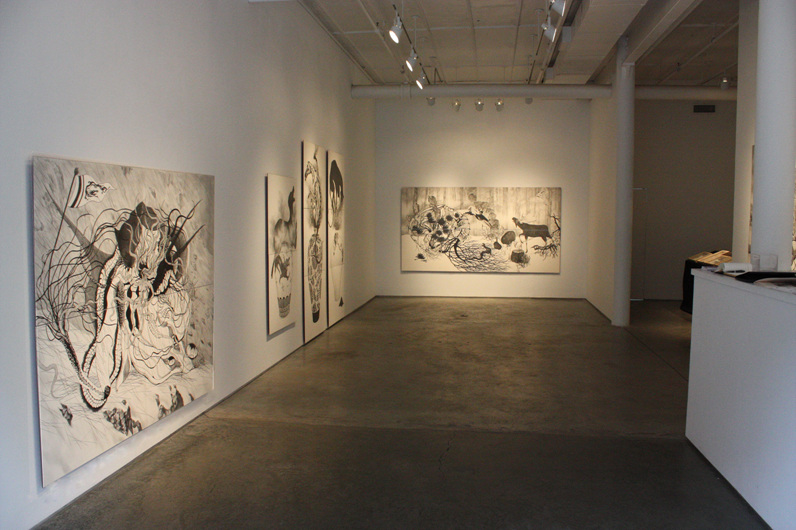
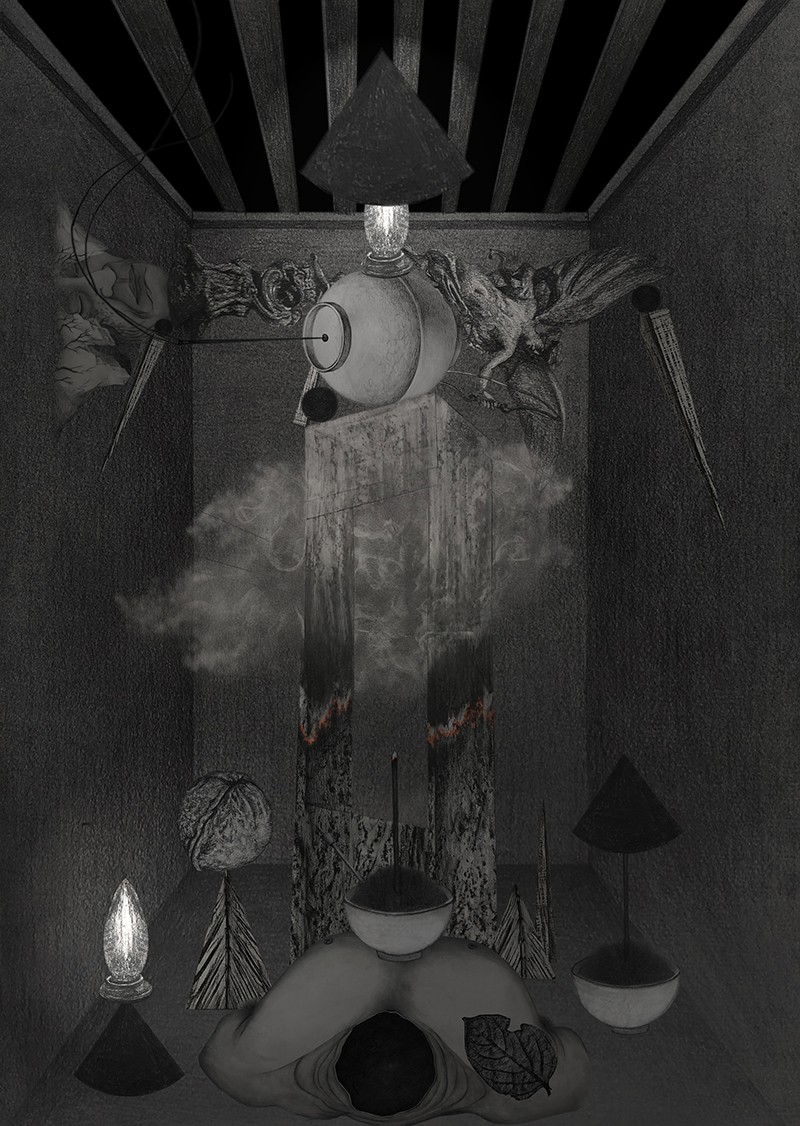
Fantastical monsters, meticulously rendered in pencil on paper as though observed firsthand, embody the full range of human emotions. The lines rise as fine as threads, shifting unpredictably like smoke in Brownian motion, and render visible the obscure Other coiled deep within the human psyche.
Just as the forms of the monsters are composed through arbitrary combinations, their titles consist of indecipherable arrangements of symbols, numbers, and letters. The titles of works featuring various kinds of monsters are organized according to a system of classificatory codes. Unlike the monsters’ arbitrary forms, these codes are assigned according to strict criteria.
Although they are not objective like scientific laws, they follow their own internal logic. Each title compresses information about habitat, mission, derivative order, birth, lifespan, constitution, and other attributes. The monsters’ missions, for instance, include defense, production, healing, transformation, and communication.
Although Seung Ae Lee’s monsters assume grotesque forms, the duties entrusted to them appear highly affirmative, almost like those of guardian angels. This reveals the contradictory meanings inherent in the monster.
According to Richard Kearney’s 『Strangers, Gods and Monsters』, the Latin root monstrare carries the dual meaning of “to show” and “to warn.” The monster embodies the paradox of being not only an impure force, but also the emergence of something wholly other and mysterious.
This duality of fear and mystery is also characteristic of religion, which resides deep within the human psyche. Scholars of religion have noted that kratophany, meaning “the manifestation of power,” and hierophany are often used synonymously. In the same context, gods and demons, as well as the sacred and objects of taboo, share the same origin.
In The Scapegoat, René Girard observes that everything that has come into contact with hierophany—that is, sacred violence—thereafter belongs to the divine and therefore also becomes the object of absolute taboo. Here, the adjective hieros, meaning “sacred,” may be translated as strong, intense, or excited, and is applied to the instruments of violence and war.
The Greek word hieros combines what is most harmful with what is most beneficial. Transcendence, when it descends to the human realm, always appears either as the immanence of the divine or in the form of impure temptation. The monster’s form is likewise composite.
Although its disorderly appearance may seem pathological, illness is “nothing more than the complex movement of life, an expanded form of life, or an anomalous variation inferred within life” (Michel Foucault). Disorder symbolizes both danger and exceptional power, and at this point the monster becomes entangled with art, which has pursued experimentation and provocation.
Seung Ae Lee’s monsters sometimes appear in hybrid human-animal forms, but her major works combine various animals with different stages of biological development. Rather than embodying an appropriate balance or restraint, the monsters unfold through multiple stages between the two extremes of undifferentiation and excessive differentiation. They move back and forth between the poles of inferiority and transcendence.
The monster lies outside the category of the normal. This should be understood as a characteristic of the monster’s primordial chaos. In psychoanalysis, primordial chaos is associated with the maternal principle or the unconscious. The monster is often subdued by a masculine hero and incorporated into an ordered symbolic universe.
Green Eyes, one of the works in the ‘Revenge’ series, depicts a leopard-like figure tearing something apart with its teeth. The gaze of its four multiplied eyes embodies images of hatred and revenge. The gaping jaw, an essential feature of the dragon- or serpent-like forms that constitute the monster’s basic type, is “a variation of the vagina dentata” (Lucie-Smith).
In contrast to Green Eyes, Brothers of Moon gives concrete form not to the predator but to the prey. The image of sheep being devoured by a monster belongs to the ‘Fear’ series. In Seung Ae Lee’s work, monsters express hatred and fear through scenes of eating and being eaten. If human society is understood as an extension of this ecosystem, such predator-prey relations reveal an emotional spectrum ranging from the fullness of life to deprivation.
At the same time, they become the driving forces of both wounding and healing. Nice Dream, one of the ‘Victory’ series, is among the most vigorous forms in Lee’s bestiary. According to the artist, “when the damage to a person’s mind exceeds a certain threshold as a result of psychological shock, black thorns are formed in the brain cells.
These thorns become firmly embedded in the person’s soul, and from that moment, the battle against them begins.” Nice Dream depicts a monster exulting after overcoming those black thorns. The monster may be the source of a fatal wound, but it is also the being that overcomes it. The relationship between wounding and healing becomes even clearer when the monster is associated with maternity.
Mother portrays the tender maternal love of a grotesque monster. Borrowing scales, horns, whiskers, and other features from multiple animals, Mother has the appearance of a typical monster in which even the distinction between inside and outside the body is ambiguous. The mother appears both to cradle her young and to serve as their nourishment, suggesting that maternity itself is the Other harbored within the self.
The artist identifies the deep, dark sea as the monster’s habitat. As the realm of primordial chaos from which all things emerge, the sea shares the monster’s essential characteristics. Within this realm—or time—of primordial chaos, differences intermingle and strange couplings occur. What the monster symbolizes is the power of transformation.
Seung Ae Lee’s monsters cause the range of human emotions, normally contained within appropriate limits, to oscillate violently. They soar to the edge of the heavens and descend beneath hell, moving between the sublime and the abject. This movement across boundaries is a quality shared by both the monster and the hero who subdues it. It also demonstrates that the monster is a violent battleground between the Same and the Other.
The monster appears as the subject’s counterpart, a being that crosses the boundaries of the socially defined, proper subject. Myth, religion, and philosophy have long served as stages upon which the Other, in the form of the monster, confronts the Same of the subject.
Richard Kearney divides approaches to the Other into two broad categories according to whether the Other is regarded as an alterity wholly distinct from the Same or as an extension of the self. Opposing the tendency to subordinate the Same to the Other is the tendency to subordinate the Other to the Same. While the former places the Other in the realm of absolute exteriority, the latter situates it within immanence.
The absolute Other is “an absolute surprise that is impossible, unimaginable, unpredictable, and incredible” (Caputo), and “the irreducible Other—the divinely infinite Other” (Levinas). Although it is problematic to regard the Other as merely an extension of the self, it is equally extreme to reject the very point of contact between self and Other.
Immediacy may give rise to leaps and mystery, but it can also become fixed in itself. Such is the case with alterity and the sublime in postmodernism, the culturally dominant species of contemporary capitalist society.
In order to cross a boundary, the distinction of that boundary must first be established; when this does not happen, transgression and deconstruction become fixed and blind. Growing Time exemplifies the fate of a being that crosses boundaries. In this work, the artist depicts a being that has crossed over into a warmer world from a place that “shone entirely white like heaven, yet was too cold.”
This violator of boundaries and taboos comes too late to realize “how many things absent in the country of snow could become fatal poisons” to itself. It is left ravaged by endemic disease and epidemic contagion. Transformation is essential to boundary-crossing, which entails the risk of the dissolution of the self—or death.
In his study of Kafka, Deleuze describes the state in which the writer ceases to be human and becomes animal, becomes nonhuman, as a line of flight: “Becoming-animal dismantles all form, signification, sign, and signified, making way for the waves of the unformed, of deterritorialization, and for signs of non-sense.
It is where content sheds its form, and expression throws off the signifier that made expression possible. Becoming-animal is absolute deterritorialization. Kafka becomes an insect in order to find an escape route that his father could not find.”
Enemy at the Gate portrays monsters that have entered a castle. According to the artist, this castle is an ominous place that gives “the feeling of somewhere confined in darkness for twenty years,” and thus symbolizes a prison. As in Kafka’s work, the castle appears as a vast bureaucratic machine, and its labyrinthine network of doors is seen as “perhaps a prison, or a machine room that manages reason, or else a secret passage leading out of here” (artist).
The thought of a monstrous being feeling the system as oppression and dreaming of escape is likewise connected to compassion for those expelled beyond the boundary. The same is true of Seung Ae Lee’s ‘Mummy’ series. Unlike the monsters whose force extends beyond the picture plane and onto the wall, the mummies are displayed like specimens in natural history.
Speaking of the monsters’ survival strategies, the artist explains: “In places where the temperature is warm, the soil fertile, the sunlight abundant, and food plentiful, the most extravagant and energy-consuming behaviors unfold.
But in bleak places that are cold and clouded, monsters are forced to adopt unique survival strategies because of scarce resources.” The mummies, with their desiccated dragonfly-like or bat-like wings, have chosen camouflage as their only means of defense.
If the energetic monsters are composed of sharply defined black-and-white lines, the mummies with human faces are rendered in shades of gray. If the former display a bizarre beauty through radical alterity, the latter evoke human compassion. Inspired by actual homeless people, the ‘Mummy’ series raises the question of an ethics of the Other, because it bears a more concretely human face.
They are scapegoats driven to the margins of society. Because the mummies are fixed like specimens, they appear all the more miserable. Their ambiguous mode of being is associated not with flight, but with سقوط—falling rather than ascent. They are not beings beyond the human, but beings below the human.
Through these two somewhat distinct styles of monsters, Seung Ae Lee reveals both the alterity and the familiarity of the Other. Empathy occurs in both kinds of monsters, but there is a difference. Perceiving the differences that exist among Others is necessary not only for aesthetics, but also for ethics. Richard Kearney argues that we must locate a point of contact with the Other that neither collapses into sameness nor becomes an immediate and inaccessible alterity.
The ethics of the Other, in other words, is not a matter of black and white, but of gray. Seung Ae Lee’s monsters, while immersed in the alterity of the Other—its irreducible difference and separation—constantly recall the lives of the self and fellow human beings, and in this sense attempt communication between the self (logos) and the Other (anti-logos).