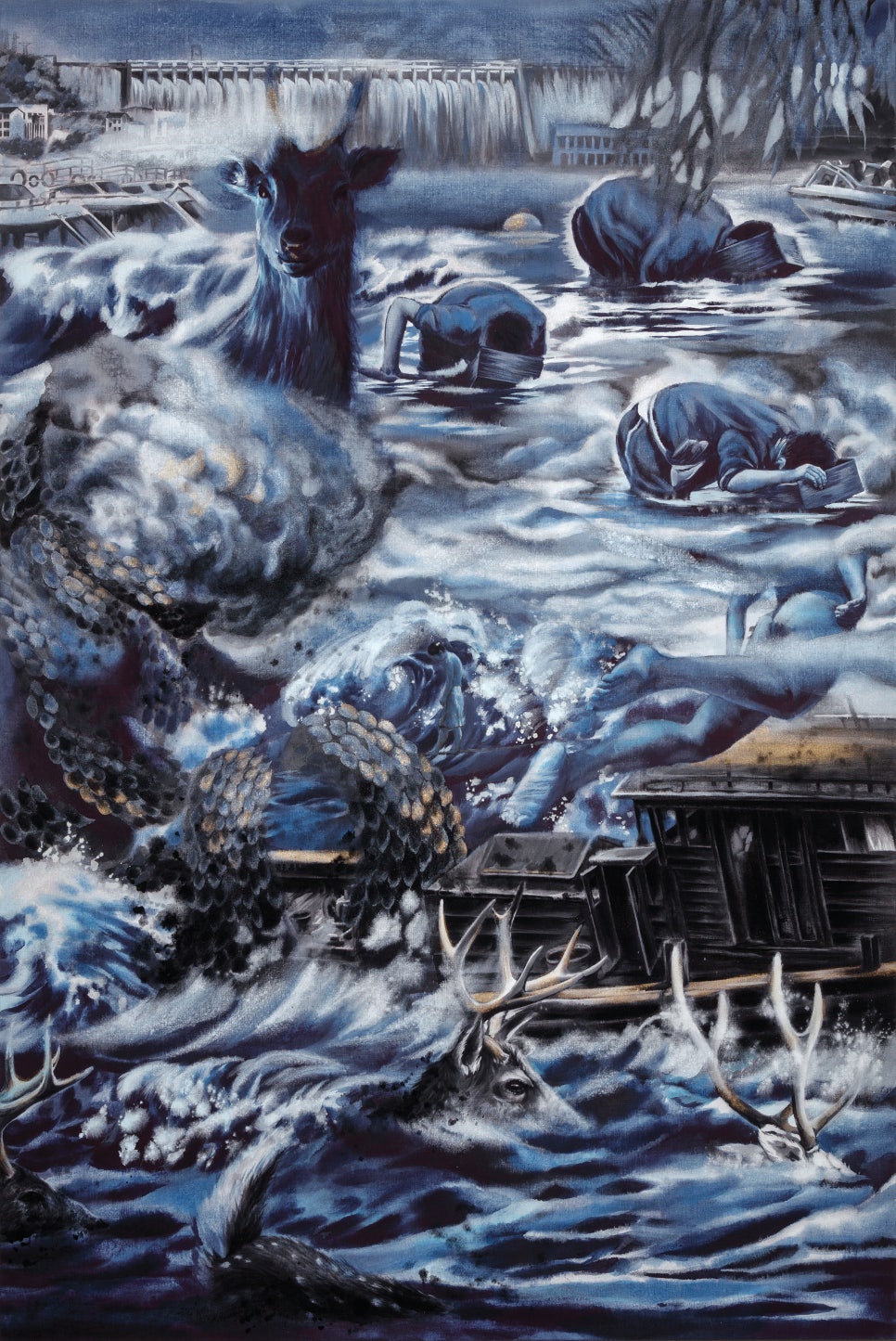
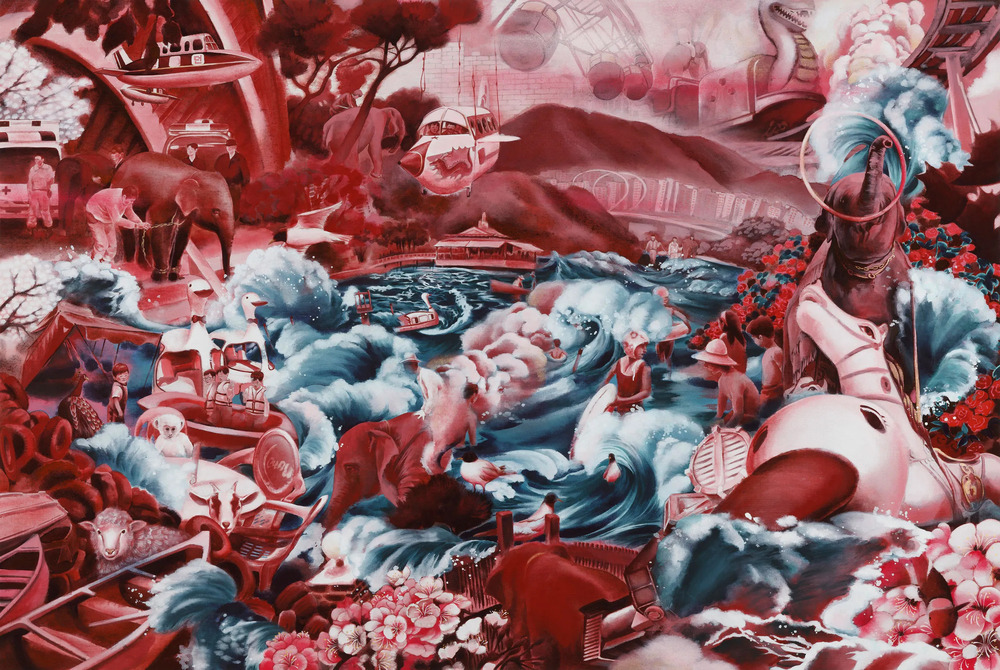
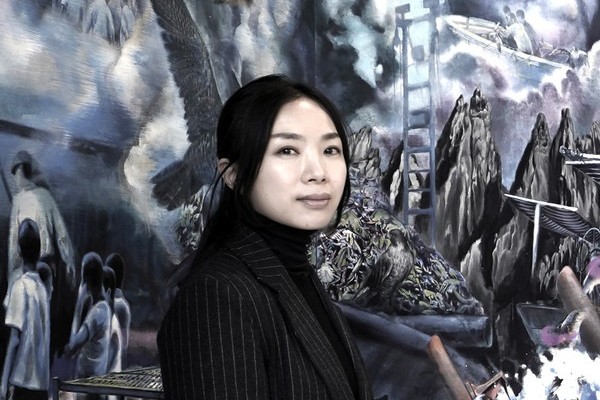
Naomi majored in painting, participated in stage and historical cinema production, and once dreamt of becoming a conservator-restorer while working at the Research Institute of Cultural Heritage. This background has effectively influenced her vision and understanding for her own work.
Even before she made a full commitment to become the artist we know today, Naomi had experiences with some artistic practices of recreating lost time and space through transforming a current physical space into something of the past. As an artist, she has consistently shown interest in the things that are old and perish over time.
Her work, which does not dismiss the past but expresses a unique spatial imagination by transforming it into a present virtual space, can be seen as a result of the combination of her professional experiences with visualizations of the past as well as her artistic interest.
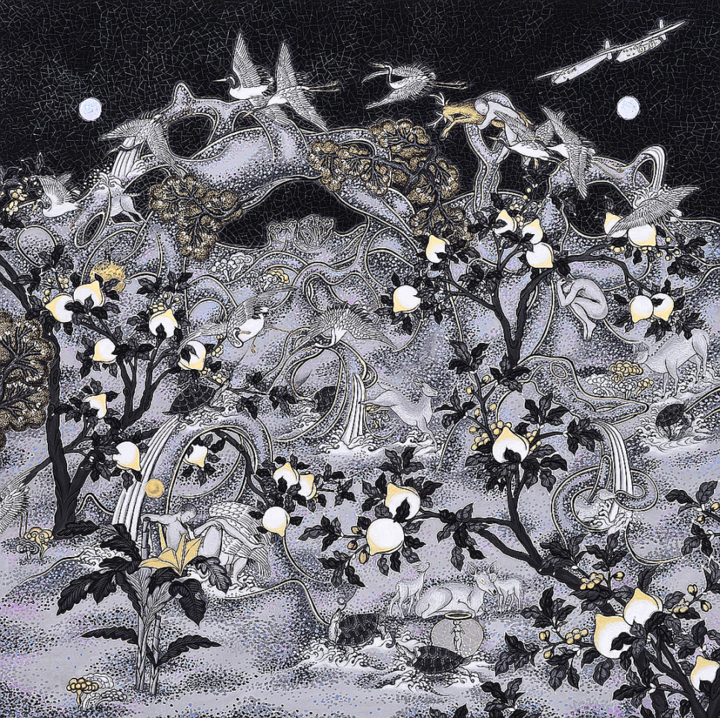
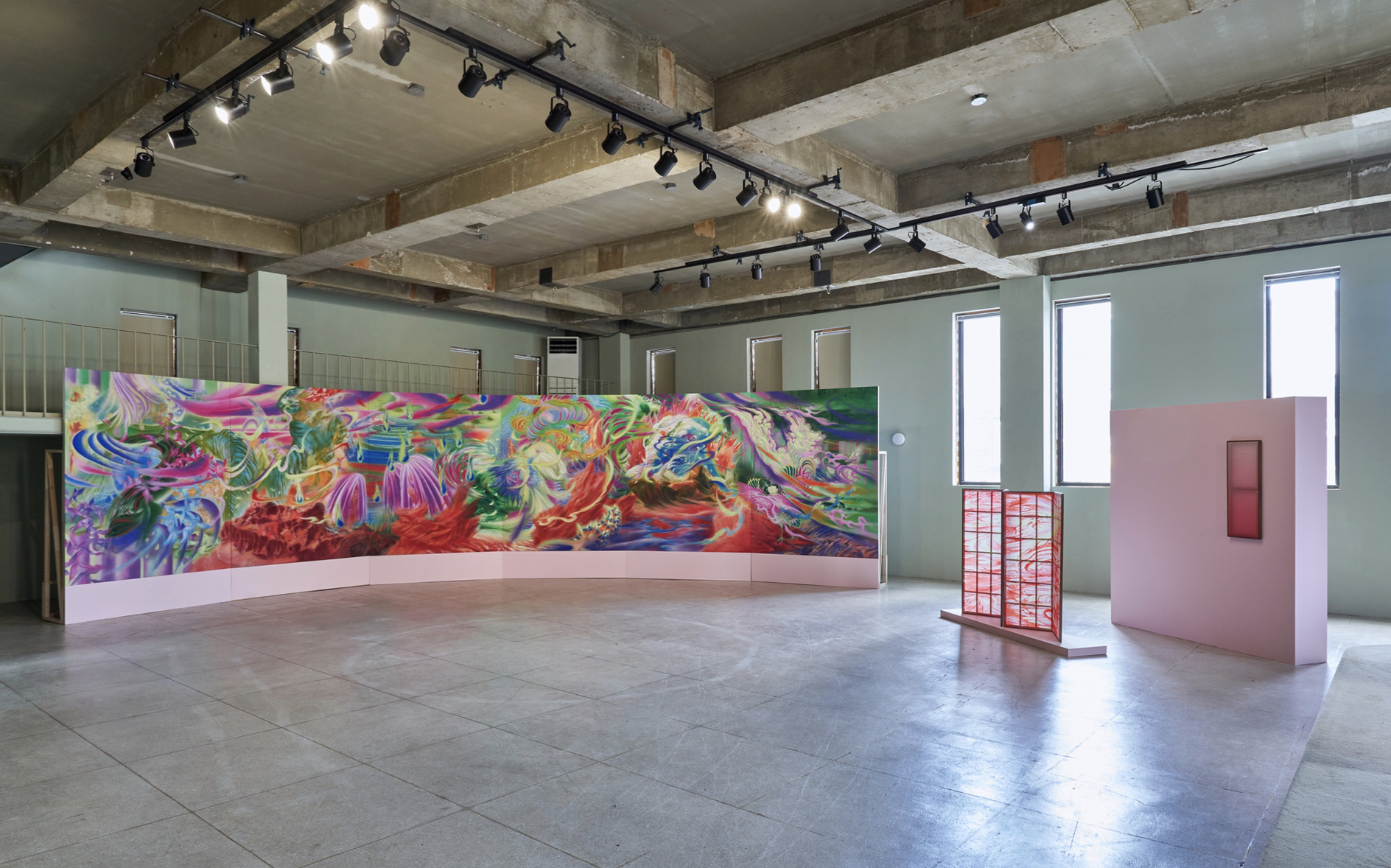
Naomi’s work, which converts disappearing things into objects of the present, manifests itself as dense paintings or complex space installations. Each project comes with strong characteristics and includes complex situations. Prior to engaging in her work, she makes sure to conduct in-depth preliminary research on the given subject.
The extensive historical or cultural materials she collects play an important role in rediscovering and expressing the narrative structure and images of a certain place from the past. An exclusive space, built by the artist’s various practices, attempts to expand its meaning by building connections with a new time-space based on their similarities.
In Naomi’s work, tradition and modernity, virtuality and reality, the East and the West are all encountered, while simultaneously paying homage to the empty space that is left behind.
Naomi’s Paintings Make Their Own Stage
The term Theater State has its origins in 1980, when American anthropologist Clifford Geertz referred to Negara, the capital of Bali, in the nineteenth century. Over the years, however, the term was used more commonly to refer to the nationalistic aspect of active propaganda during the Cold War.
It is particularly well known to the public as the title of a book by Hunik Kwon and Byung-Ho Chung describing North Korea, where the use of propaganda by the government is often seen. But the definition of the terminology cannot be seen as a concept that refers only to regional states with specific ideological ties, as it was recently also used to refer to the Korean Empire—the last Korean monarchy prior to the Japanese colonial period.
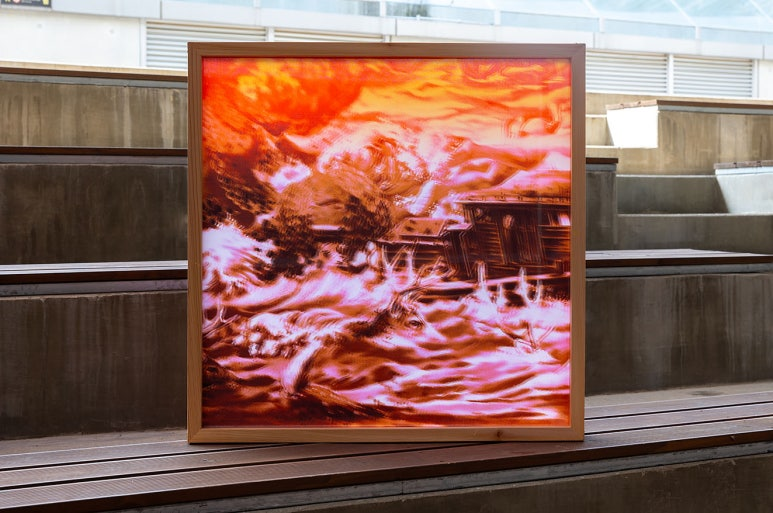
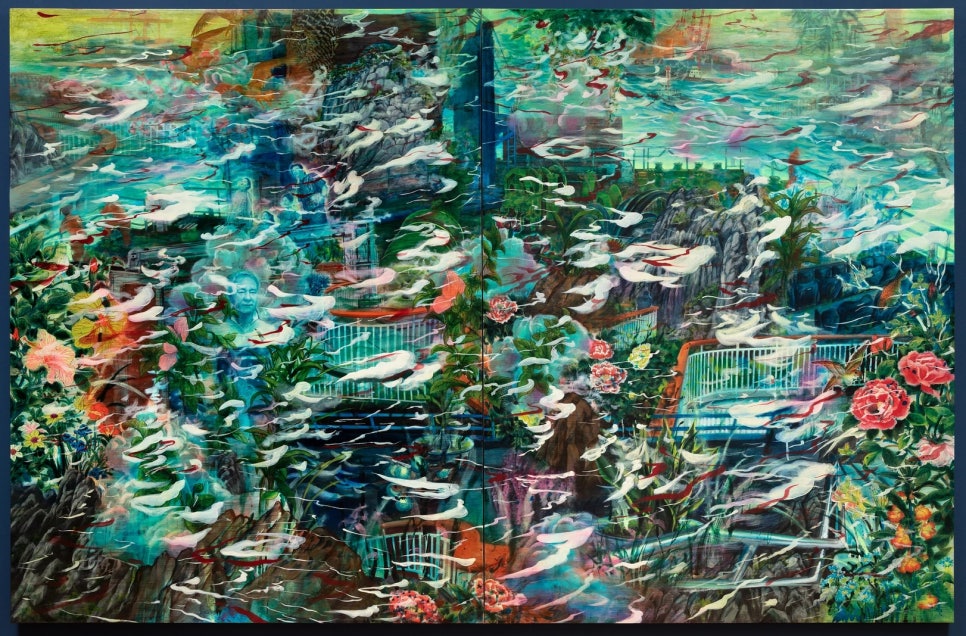
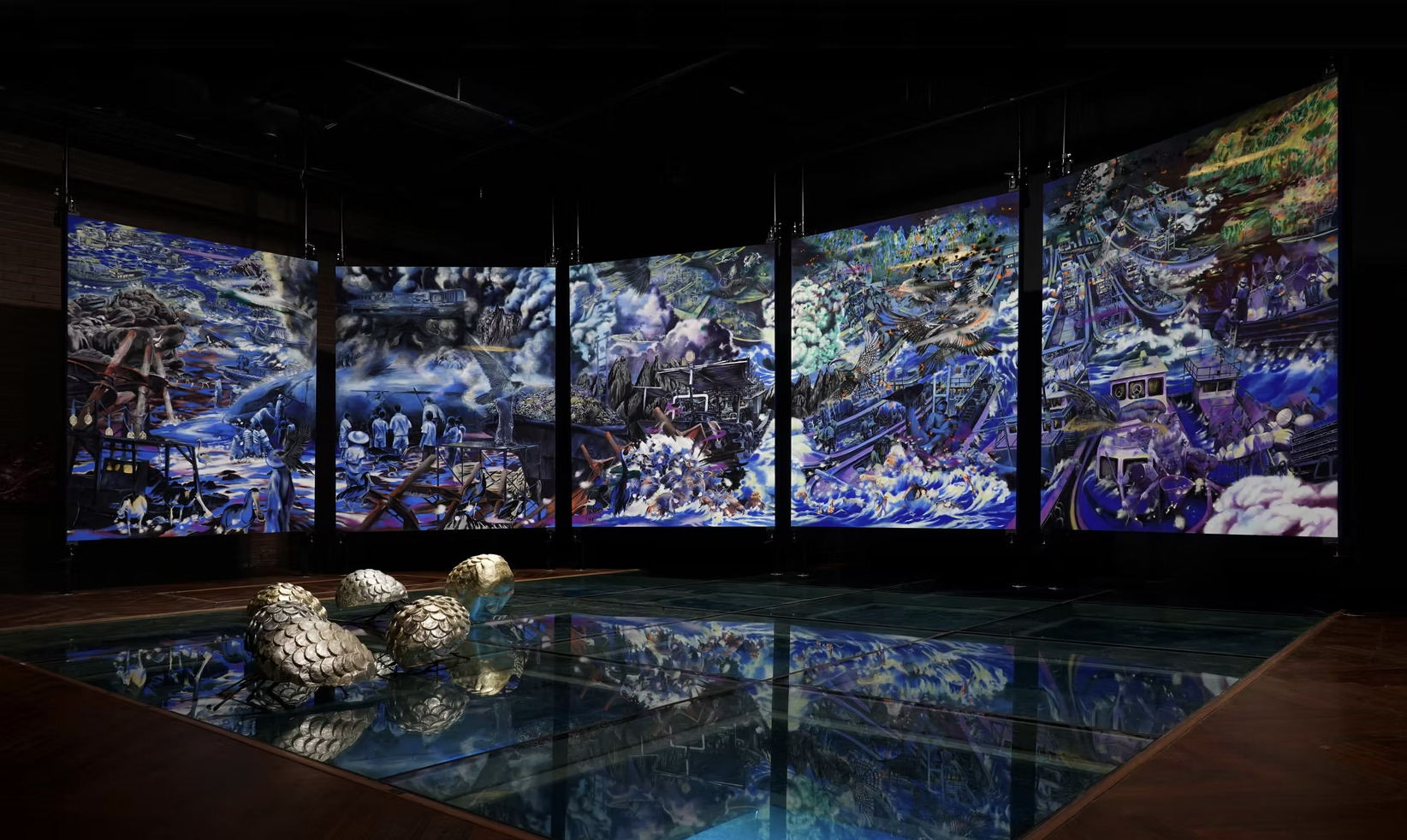
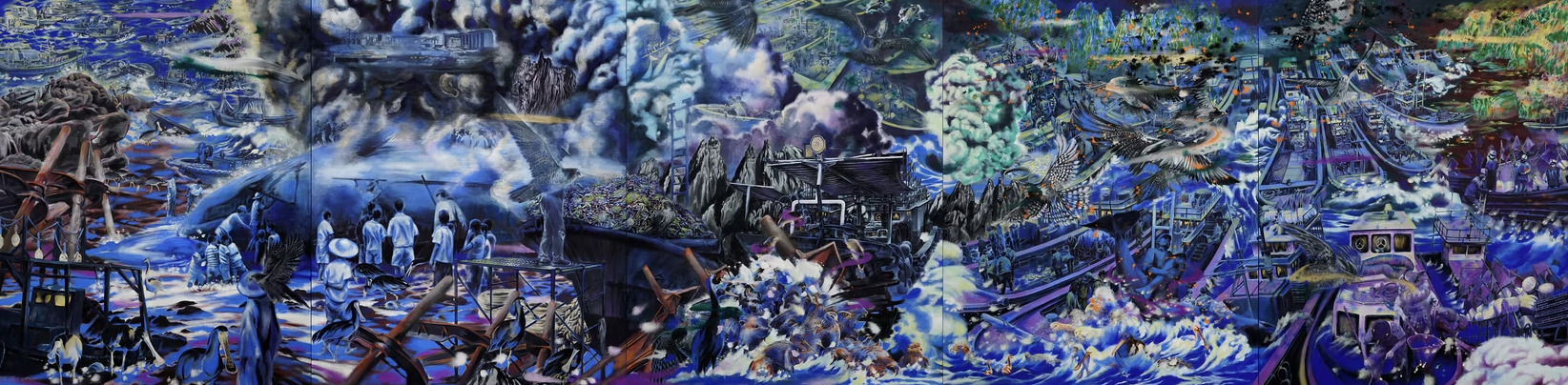
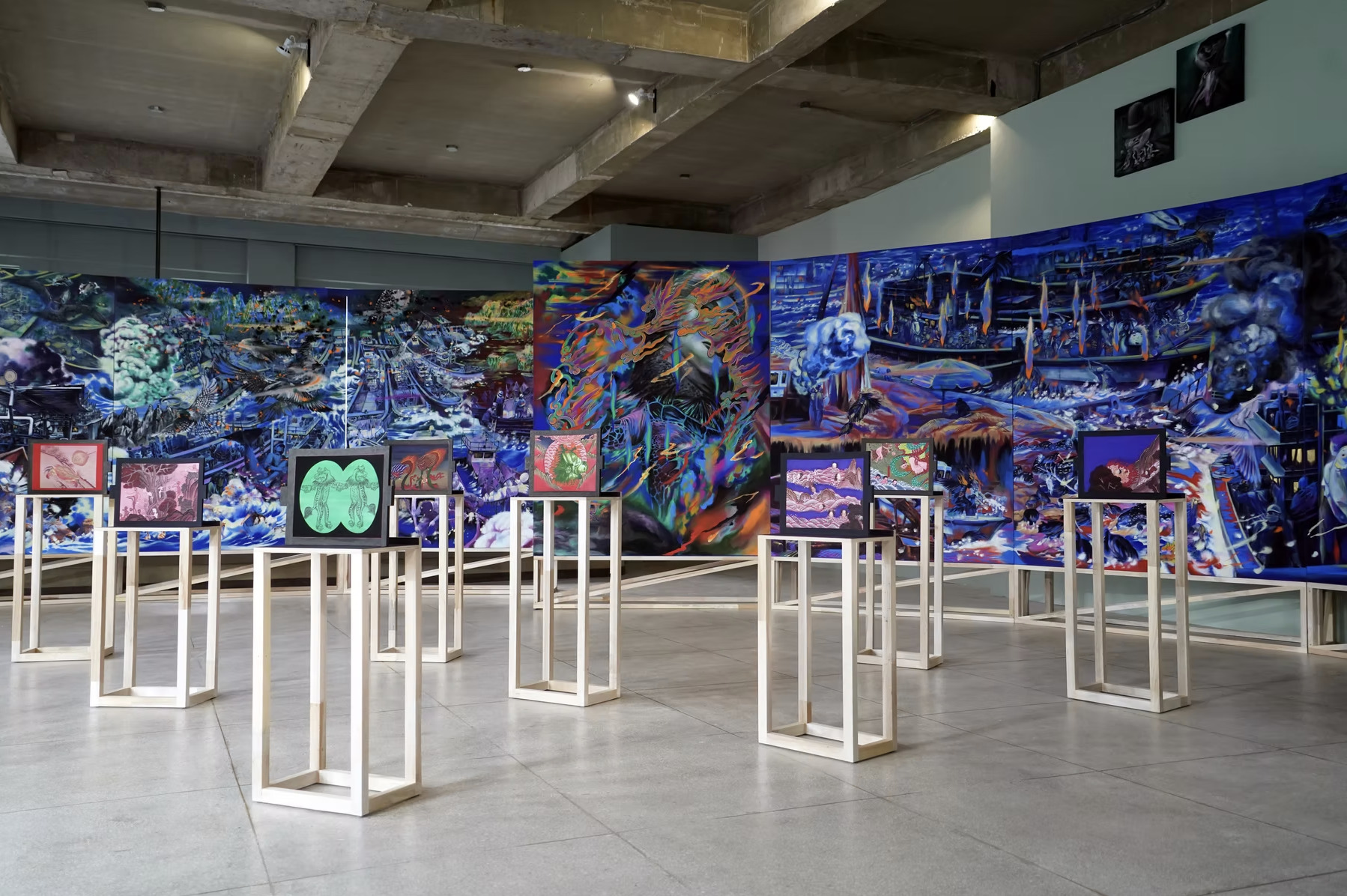
Naomi’s two-piece painting, Theater State, used various images as references: a postcard produced to showcase the modernization of the Korean Peninsula during the Japanese colonial period in the first decade of the nineteenth century, a photograph of the Yalu River viewed from Dandong (the Chinese city closest to North Korea), a postcard image attracting Chinese tourists, and a marketing photograph made to promote the construction of high-rise apartments in North Korea.
In this painting, with intense primary colors and a dynamic composition, the elements of East and West as well as images of capitalism and socialism are mixed together. This can be seen in the steeply rising rocky peaks of Mount Geumgangsan, the fragments of Western classical sculptures, the depicted broken bridge over the Yalu River, the uncanny exterior of a North Korean-style high-rise apartment, the classical pillars of Western architecture, and the steps leading to the seashore.
In the term “Theater State,” theater can be under- stood as a concept for the nationalistic cultural strategy that emphasizes the choreographed propaganda. The strategy, used by the government to reaffirm its power through spectacular national events, dates back to the imperialist era, and to some extent, continues to be seen to this day.
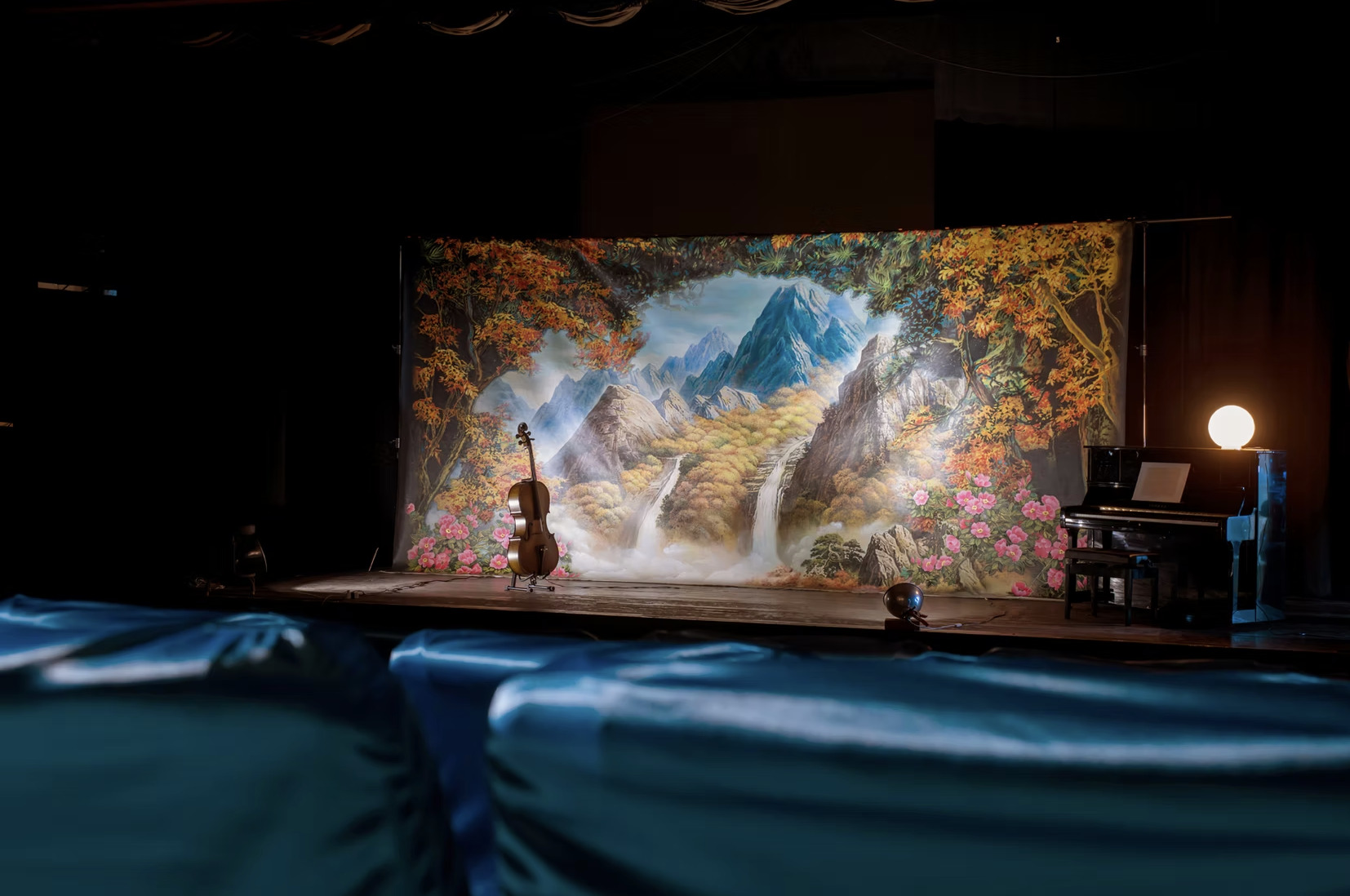
What makes Theater State intriguing is that the artist expressed the conceptual nature of the theater state by actually using elements of the theater. It is worth recalling that she used to frequently paint the stage backdrops in theaters. Her works not only recall the memories of outdated nationalism, but also acquire a vivid realism.
This is maybe because in reality shadows of nationalism still prevail, even despite the abundance of visual media underlying our daily lives. Contemporary nationalism exemplified by Donald Trump as US president and Britain’s Brexit proliferated to other countries, exacerbated by the state-level epidemic prevention systems caused by COVID-19.
National governments remain the most influential unit in the media, and they exert the biggest impact on our daily lives. The function of the “theater” remains vital and changes in accordance with the need of the state, used sometimes as a tool for cultural fantasy and at other times for direct propaganda.
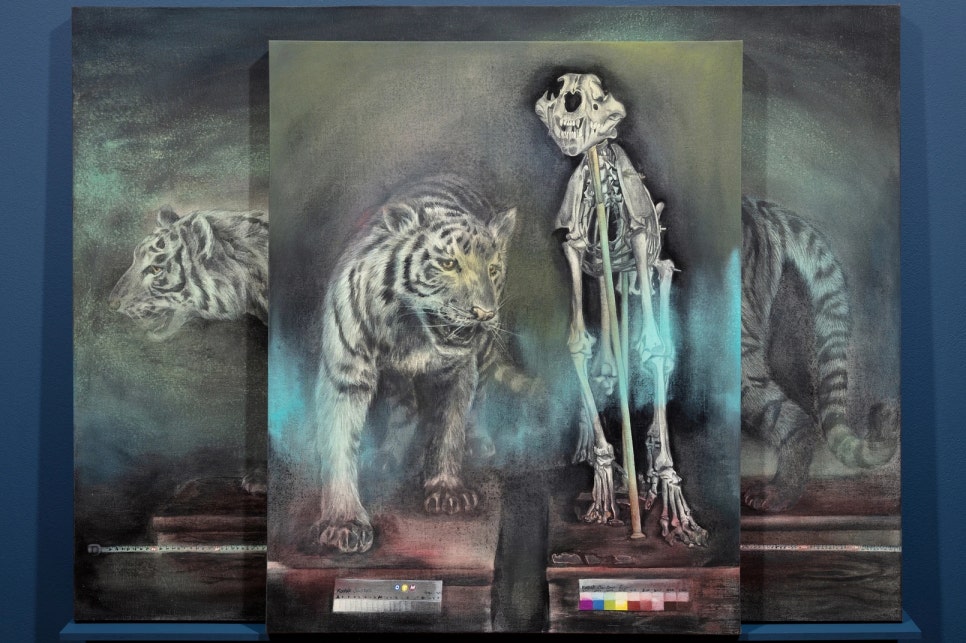
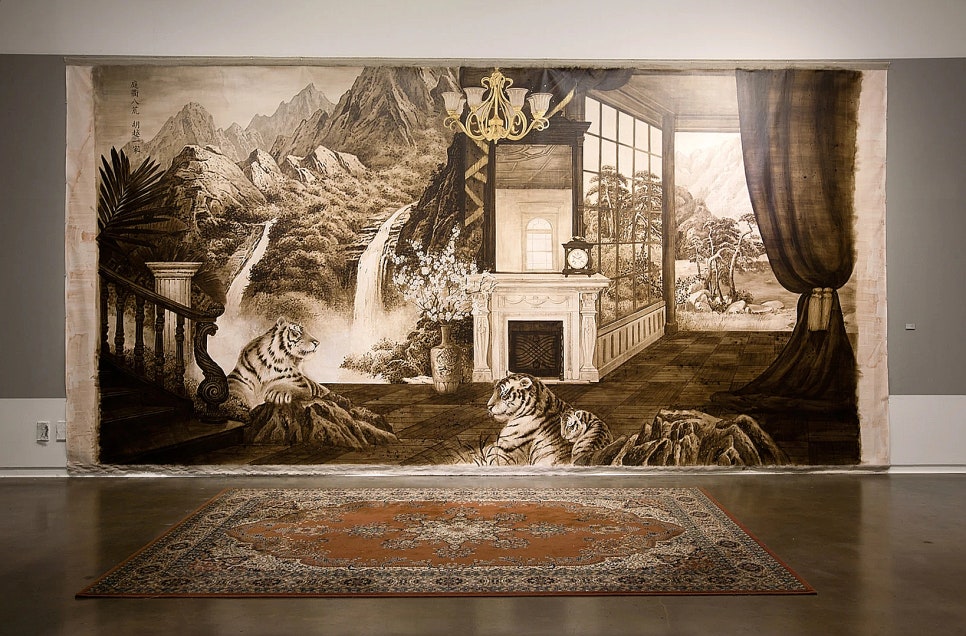
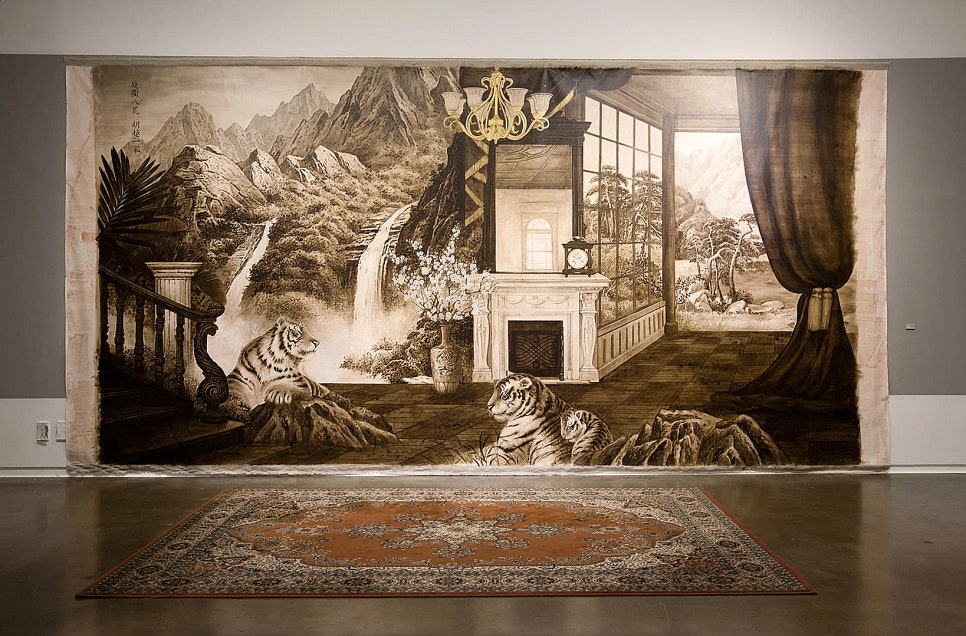
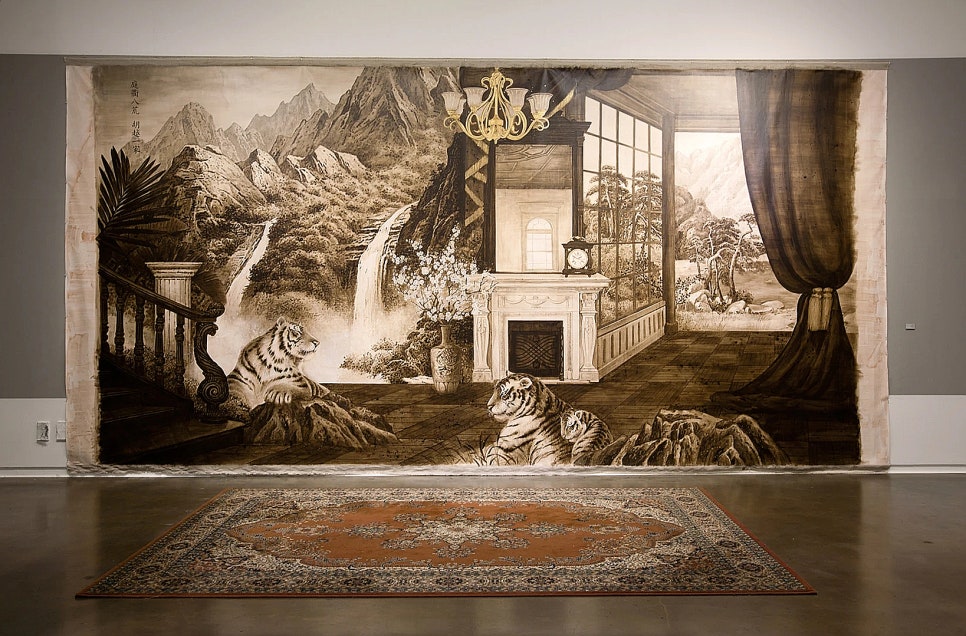
Meanwhile, Tigers of the Diamond Mountains (pp. 208–09) was the name of a North Korean restaurant near the artist’s studio in Incheon, which was run by sisters who escaped from North Korea. Incheon, which is close to Seoul, was the first open-port city of the modern Korean Peninsula, a metropolis with modern buildings in the old city center and with fancy skyscrapers in the Incheon Free Economic Zone.
It is also a place that has increasingly accepted North Korean refugees in recent years, in addition to the existing influx of a large number of immigrants. As she was talking with the North Korean refugees who were running the restaurant near her studio at the time, Naomi recalled that it had been ten years since tourism to Mount Geumgangsan was suspended mainly due to the strained inter-Korean relations.
Geumgangsan was a magnificent place where many classic tales have their origins, as it has traditionally been regarded as a utopia in the Korean Peninsula. Since the division of North and South, the mountain was no longer a place to be visited by South Koreans, which led to it being designated as an unexplored region beyond the armistice line.
The Geumgangsan Tour project began when relations dramatically improved after the inter-Korean summits in the first decade of the twenty-first century. It then received the spotlight and was regarded as a symbol of the restoration of the cooperation between the two Koreas. With relations becoming fragile again, however, the project was suspended in 2008.
Naomi said that she created this work by recalling dreams of times past. After the division of the peninsula, Geumgangsan was placed in the territory of socialism, and classic tales about the mountain were intentionally revised. If such classic tales are erased from the memory of Geumgangsan, would it still be able to maintain its nature as before?
Naomi was confused by how distorted its identity became in recent decades despite preserving its status for thousands of years. Thus, she collected images, including stage sketches of Mount Geumgangsan, tourist postcards, ink paintings, and images of tigers, who once lived in the mountain, and completed the work based on these images.
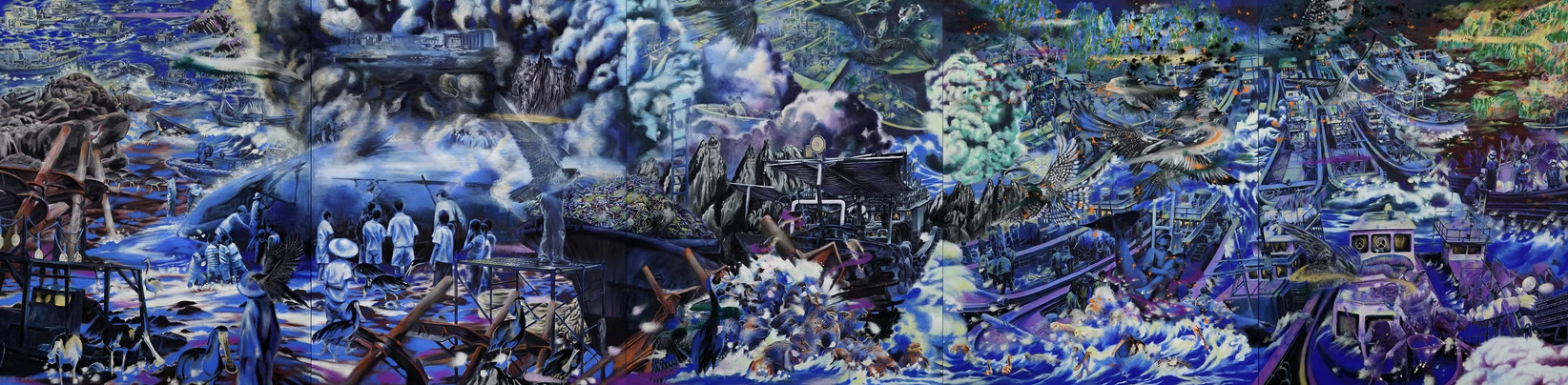
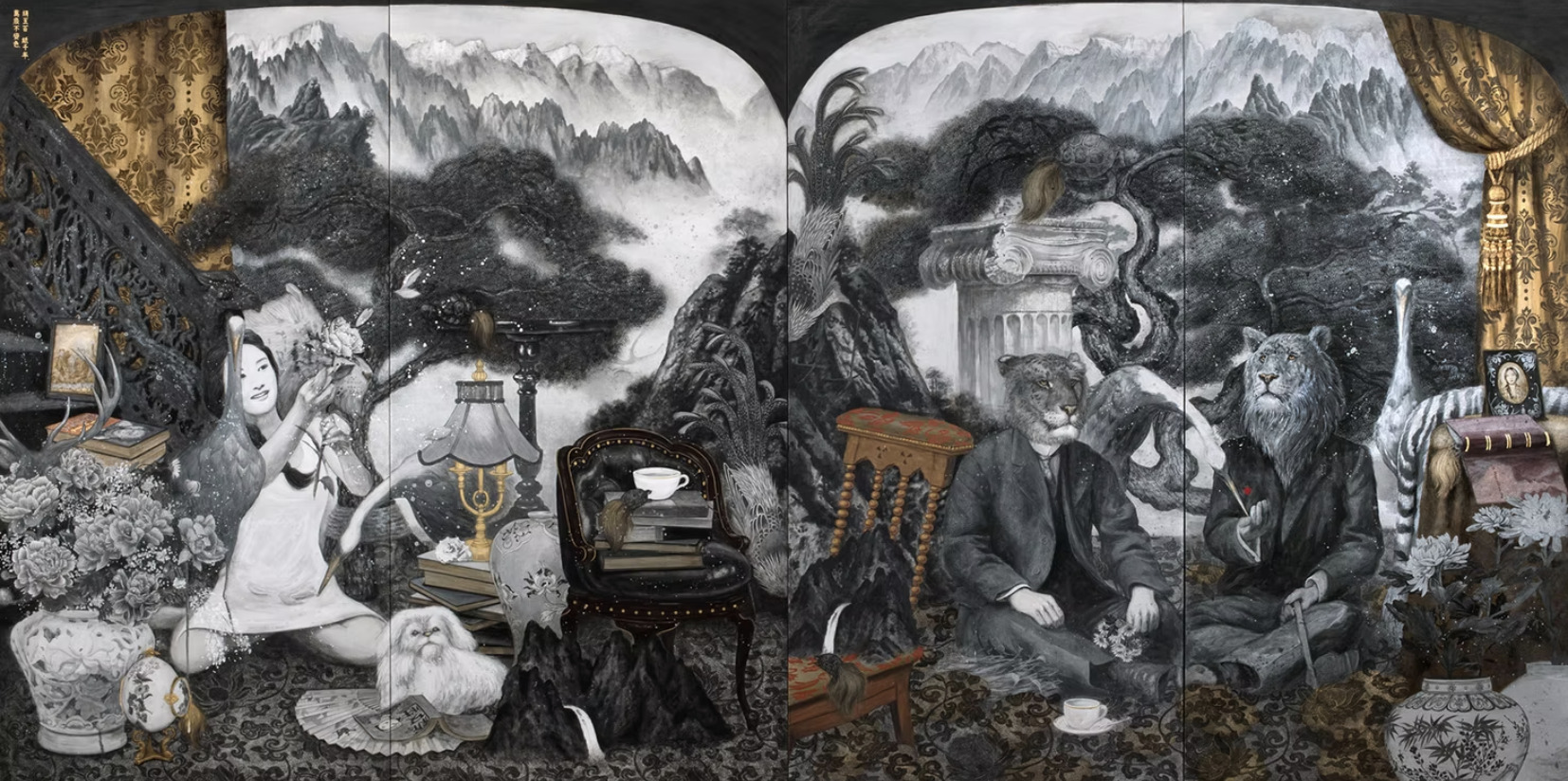
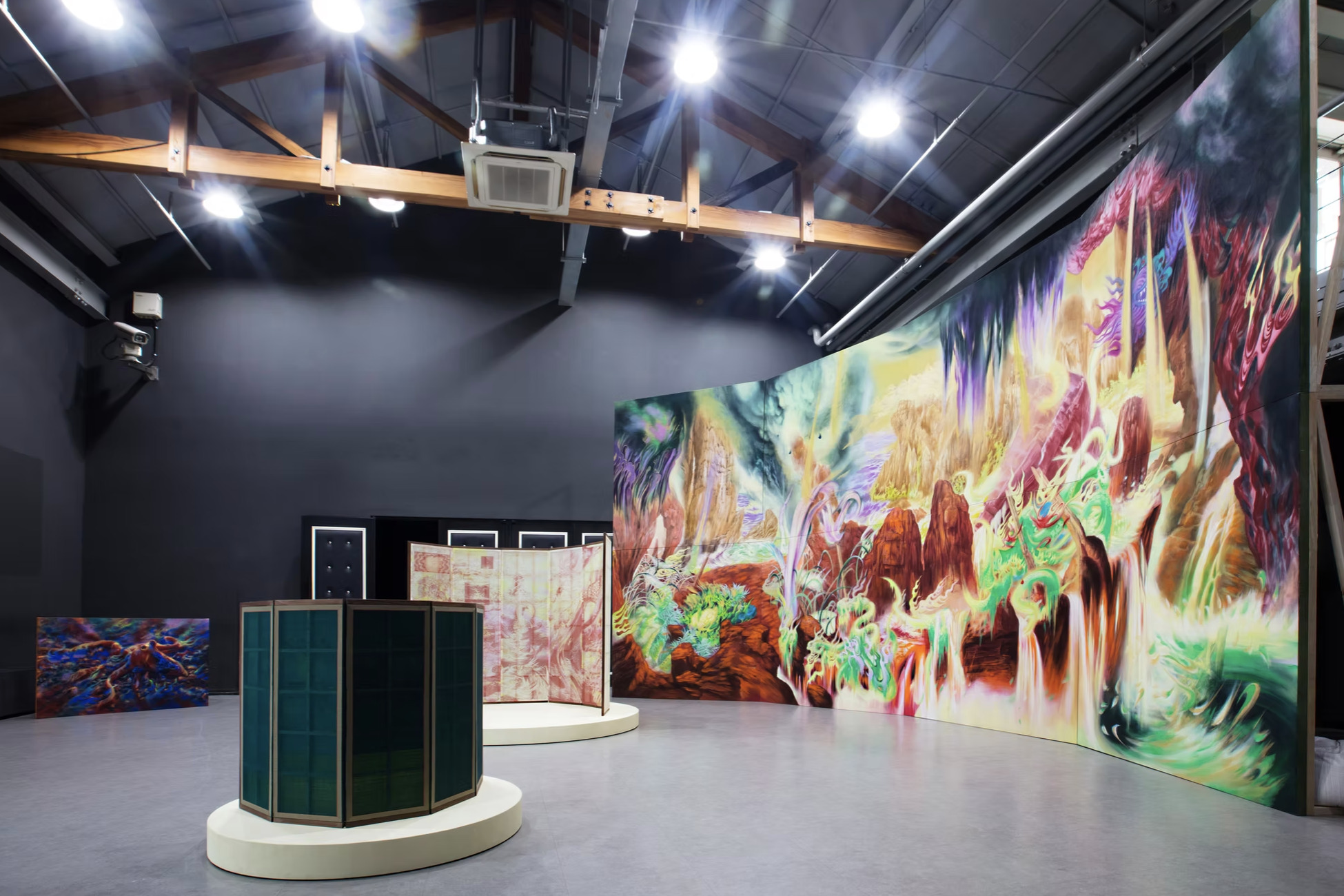
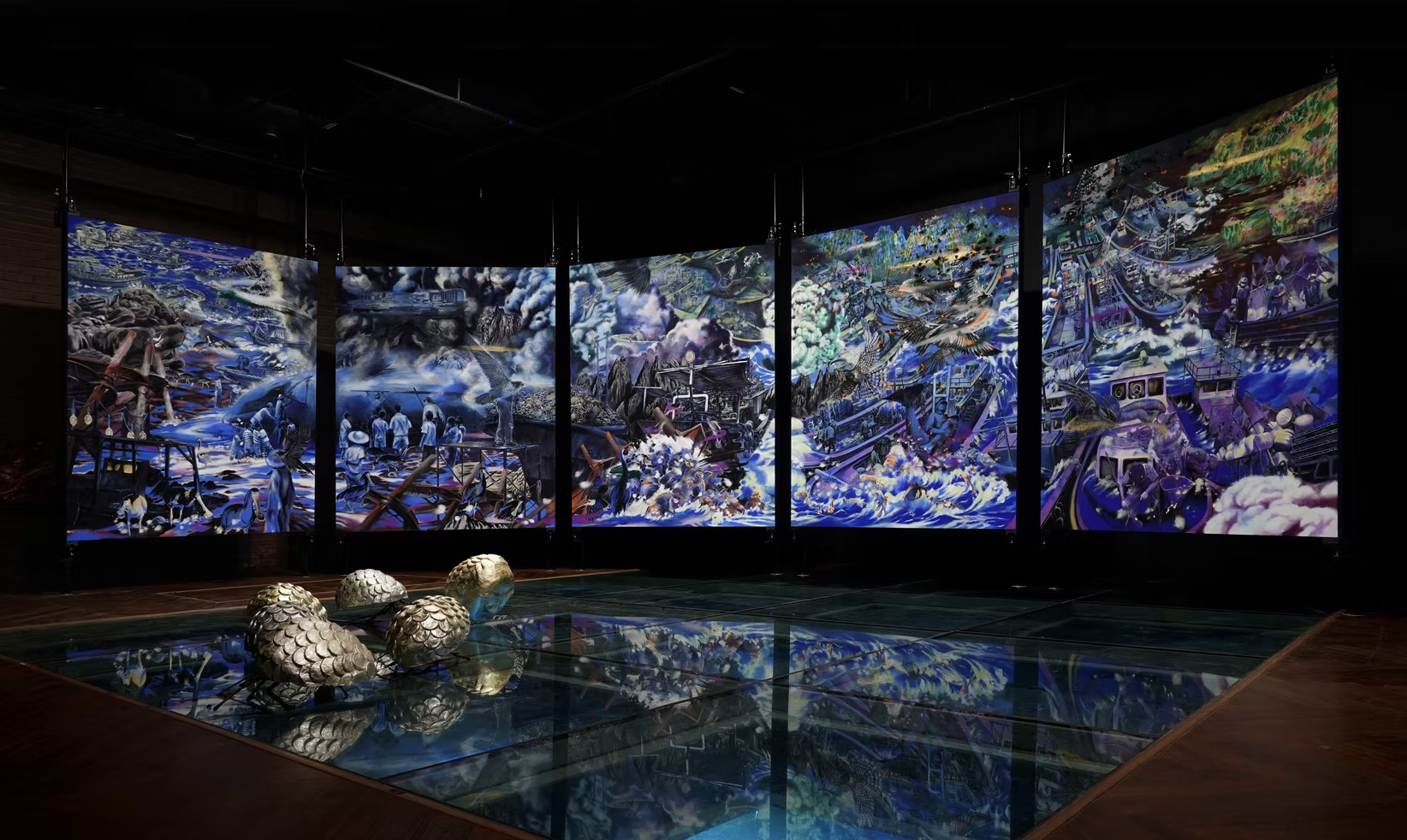
In this work, the images of steep peaks, waterfalls, pine forests, and tigers of Geumgangsan are mixed with images of fireplaces, staircase handles, vases, light fixtures, and clocks of modern Western homes. The artist creates quite the theatrical atmosphere by install- ing this large, five-meter-long painting as a backdrop for the stage of an imagined theater, with a carpet laid in front of it.
The color of this painting is restricted to monochrome shades, such as the color of a faded black-and-white photograph. Naomi also conducted a performance called A Studio of 100 Years Ago by taking pictures of this installation with an old camera. These black-and-white photographs, containing the back- ground image of utopia, look as if they were taken in a photographic studio of the past.
The stage is a place of fantasy where complex time and space coexist. Summoned to the stage, Geumgangsan regains its unexplored aura through Naomi’s artistic practice of reconnecting traditions severed by modern times. Naomi’s work creates another reality where the hustle and bustle of the present meets the past and is replaced by a virtual space.